 Скачать презентацию CBER 510 k Issues Sheryl A Kochman MT ASCP Chief
728a2610db490c3f4a00b35bca2f92ee.ppt
- Количество слайдов: 51



CBER 510(k) Issues Sheryl A. Kochman, MT(ASCP) Chief, Devices Review Branch DBA/OBRR/CBER IVD Roundtable – OIVD Workshop April 23, 2003 C B E R
Why does CBER review devices? l Jurisdiction for medical device review is governed by the FDA Intercenter Agreement between the Center for Biologics Evaluation and Research (CBER) and the Center for Devices and Radiological Health (CDRH) (October 31, 1991) Available at: http: //www. fda. gov/cber/dap/devpubs. htm C B E R
Intercenter Agreement Between CBER and CDRH (October 31, 1991) l CBER will have the lead responsibility for regulating medical devices used or indicated for the collection, processing, testing, storage, or administration of biological products (including blood products, blood components, or analogous products), and will use authorities under the Public Health Service Act (PHS Act) and the FD&C Act, as well as any other authorities delegated to it, as appropriate. C B E R
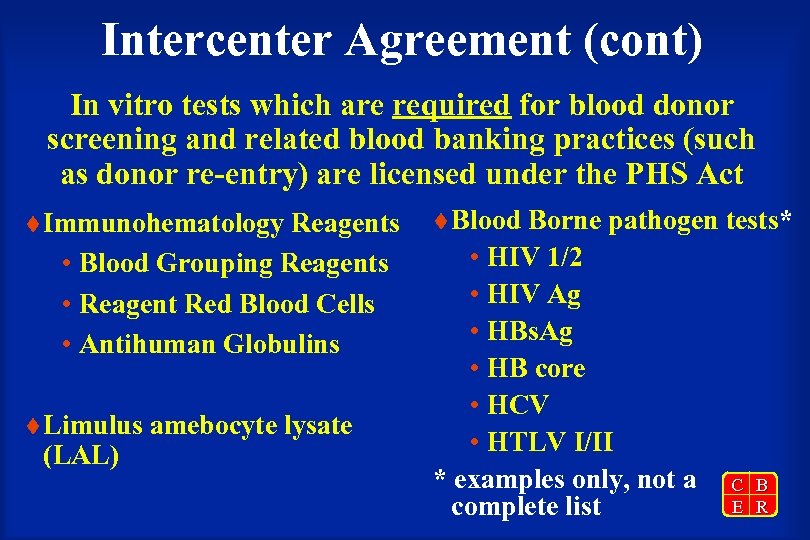
Intercenter Agreement (cont) In vitro tests which are required for blood donor screening and related blood banking practices (such as donor re-entry) are licensed under the PHS Act t Immunohematology Reagents • Blood Grouping Reagents • Reagent Red Blood Cells • Antihuman Globulins t Limulus (LAL) amebocyte lysate t Blood Borne pathogen tests* • HIV 1/2 • HIV Ag • HBs. Ag • HB core • HCV • HTLV I/II * examples only, not a C B E R complete list
Intercenter Agreement (cont) l CBER also has the responsibility for regulating all in vitro diagnostic tests and any other medical devices intended for use for human immunodeficiency virus, type 1 (HIV 1) and type 2 (HIV 2) and other retroviruses. l These devices, including but not limited to collection devices, specimen containers, test kit components or support materials and those used or indicated for the inactivation of these viruses, will be regulated by CBER under the Medical C E Device Authorities (MDA). B R
What devices does CBER review ? * l Medical devices that are dedicated systems intended for use in collection, processing, or administration of a licensed biological or analogous product t Includes • Apheresis machines Blood Warmers Plasma Thawers • Filters Stem Cell Concentrator • Refrigerators t Excludes • Administration sets • Therapeutic devices s. Dialysis machines C s. Intraoperative blood salvage devices E * As stated in the Intercenter Agreement B R
Devices Reviewed at CBER (cont)* Certain In Vitro Reagents l Those intended for use in the processing of licensed biologicals and analogous products t Lectins t Protectins t Bovine albumin potentiating media l Leukocyte typing sera or other medical devices intended for use in the determination of tissue type l Quality assurance reagents intended for use in conjunction with a licensed biological reagents or C B in vitro tests E R
Devices Reviewed at CBER (cont)* l Medical devices other than reagents intended for use in the preparation of, in conjunction with, or for the quality assurance of a blood bank related licensed biological product or practice. t. Clinical laboratory devices with separate blood bank claims t. Software programs for data management in a blood establishment t. Dosimeters and thermal indicators t. Microwave ovens used for thawing blood C E products B R
Devices Reviewed at CBER (cont) l See also t 21 CFR 864. 9050 through 864. 9875 t. List of Devices Regulated by CBER • http: //www. fda. gov/cber/dap/devlst. htm • KSS/Blood Banking supplies consists of a wide variety of devices, some of which are: • Blood temperature indicator • Tube stripper • Isotonic saline labeled for BB use • Blood irradiation label • Blood component separator C B E R
Devices Reviewed at CBER (cont) • ZZZ/Unclassified was used for devices for which a firm could identify a predicate, and therefore could submit a 510(k) but which had not been formally classified. This group also contains a wide variety of devices, such as: • HLA reagents • CMV test kits • Instrument software • Syphilis tests • Platelet antigen/antibody tests • Leukocyte removal filters C B E R
What kinds of premarket device submissions does CBER review ? l. Everything that CDRH does t. But fewer of them l. INDs and BLAs C B E R
Special Situations for IVDs* l For diagnostic use only (except HIV and retroviruses), CDRH regulates under MDA t. HIV and other retrovirus diagnostics regulated by CBER under MDA l For blood donor screening, CBER regulates under MDA, i. e. , 510(k) t. CMV * As stated in the Intercenter Agreement C B E R
Special Situations for IVDs (cont)* l For diagnostic use AND blood donor screening, CDRH is lead Center with each center reviewing their respective data sets under MDA t. CMV l Required for use in blood donor testing, CBER regulates under the PHS Act t. Blood borne pathogen tests (IND/BLA) • Syphilis is an exception (reviewed under 510(k)) t. Immunohematology reagents (BLA) C B E R
What are some of the public health issues that are unique to CBER ? Ensuring safety and efficacy of biological therapeutic products l Management of those products t Recalls l Management of donors t Temporary deferral and subsequent re-entry t Permanent deferral t Counseling l Rapid response to emerging infectious agents t TSEs t West Nile Virus C B E R t SARS l
What are some of the outside groups CBER deals with ? l Significant outside interactions with: t Blood Products Advisory Committee t Advisory Committee on Blood Safety and Availability t PHS Blood • FDA, CDC, NIH, DOD t Congress t Public perception of blood safety t Patient advocacy groups C B E R
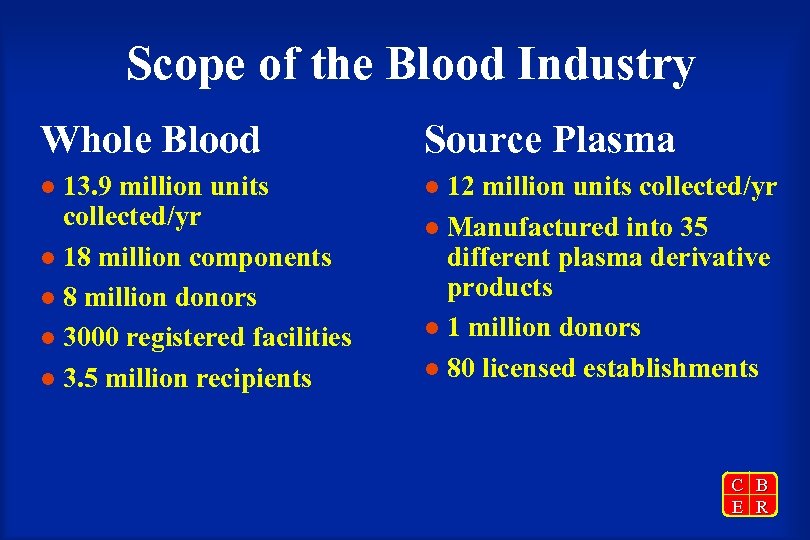
Scope of the Blood Industry Whole Blood Source Plasma 13. 9 million units collected/yr l 18 million components l 8 million donors l 3000 registered facilities l 3. 5 million recipients l l 12 million units collected/yr l Manufactured into 35 different plasma derivative products l 1 million donors l 80 licensed establishments C B E R
What are some of the review issues that are important to CBER ? Detection and identification of disease in a population of “normal, healthy adults” Versus Diagnosis of disease in a patient showing signs and symptoms of disease Requires higher numbers of clinical trial samples to assure statistical significance C B E R
What are some of the review issues that are important to CBER ? l l Many of our products are Combination Products because they are linked by their labeling, i. e. , a system t Licensed reagent(s) (biologicals) t Accessory reagents (devices) t Accessory instruments (devices) t Accessory software (devices) t Ancillary goods (devices) • Pipettes • Tubes • Micro-well plates Others are combination products because of their packaging C t Therapeutic biological in a syringe E B R
What are some of the procedural issues that are different at CBER ? l l We currently do not respond by e-mail to incoming e-mails that contain proprietary or confidential information but are working on a secure e-mail system to allow us to do so. We have different submission binding and filing formats. t Please see SOPPs 8007 and 8110 at: t http: //www. fda. gov/cber/regsopp. htm We have a different address: FDA/CBER Document Control Center, HFM-99, Suite 200 N 1401 Rockville Pike Rockville, MD 20852 -1448 We usually need more than one copy; please send at least two or call ahead and ask. C B E R
Recent CBER Process Changes (To Enhance the Review Process) l New priority courier service for regulatory documents l New bar-coded tracking of regulatory documents l Close collaboration with CDRH l Least Burdensome training l Active problem solving during first cycle, not just problem finding l Down delegation to Division Directors C B E R
Recent CBER Process Changes (cont) l Where possible, use CDRH policies l Set internal goals in parallel with CDRH tex. 60 day response for 510(k) IVD submissions l Increased pre-submission meetings l Device subcommittee of RMCC C B E R
Is everything unique or different at CBER ? ABSOLUTELY NOT ! l We are subject to the same Congressional mandates as CDRH t FDAMA t MDUFMA l We support the use of pre-submittal (Pre-IDE) meetings t CBER SOPP 8101. 1 http: //www. fda. gov/cber/regsopp/81011. htm l We utilize: t Standards & guidances t Scientific workshops C E t Advisory committee recommendations l B R
How Do I Find a Predicate ? l Go to CBER’s web site for list of cleared devices 1 st t 510(k) Blood Establishment Computer Software http: //www. fda. gov/cber/products/510 ksoft. htm t Substantially Equivalent 510(k) Device Information http: //www. fda. gov/cber/efoi/510 k. htm t 510(k) Device Applications (Cleared Since 1996) http: //www. fda. gov/cber/dap/510 kman. htm l If you can’t find one on ours, try CDRH’s website C B E R
What about guidance documents ? Most general CDRH guidances are applicable l Federal Register - FDA Modernization Act of 1997; List of Documents Issued by the FDA That Apply to Medical Devices Regulated by CBER - 4/26/1999 Several CBER-specific guidances exist. The following are available at: http: //www. fda. gov/cber/dap/devpubs. htm l Federal Register - Medical Devices; Hematology and Pathology Devices; Reclassification of Automated Blood Cell Separator Device Operating by Filtration Principle C from Class III to Class II; Final rule - 2/28/2003 B E R
![CBER-specific guidances l Draft Guidance for Industry: Premarket Notifications [510(k)s] for In Vitro HIV](https://present5.com/presentation/728a2610db490c3f4a00b35bca2f92ee/image-25.jpg "CBER-specific guidances l Draft Guidance for Industry: Premarket Notifications [510(k)s] for In Vitro HIV")
CBER-specific guidances l Draft Guidance for Industry: Premarket Notifications [510(k)s] for In Vitro HIV Drug Resistance Genotype Assays: Special Controls - 8/28/2001 l Draft Guidance for FDA Reviewers: Premarket Notification Submissions for Automated Testing Instruments Used in Blood Establishments - 8/3/2001 l Guidance for FDA Reviewers: Premarket Notification Submissions for Blood and Plasma Warmers - 7/19/2001 l Guidance for FDA Reviewers: Premarket Notification Submissions for Transfer Sets (Excluding Sterile C Connecting Devices) - 7/19/2001 E B R
CBER-specific guidances (cont) l Guidance for FDA Reviewers: Premarket Notification Submissions for Empty Containers for the Collection and Processing of Blood and Blood Components 7/19/2001 l Draft Guidance for Industry: Clinical Development Programs for Drugs, Devices, and Biological Products Intended for the Treatment of Osteoarthritis (OA) – 7/15/1999 l Guidance for Industry: Clinical Development Programs for Drugs, Devices, and Biological Products for the C Treatment of Rheumatoid Arthritis – 2/17/1999 E B R
CBER-specific guidances (cont) These CBER-specific guidances are available at: http: //www. fda. gov/cber/blood/bldguid. htm l Guidance for Industry: In the Manufacture and Clinical Evaluation of In Vitro Tests to Detect Nucleic Acid Sequences of Human Immunodeficiency Viruses Types 1 and 2 12/14/1999 l Draft Guidance for Industry: Application of Current Statutory Authority to Nucleic Acid Testing of Pooled Plasma - 11/26/1999 C B E R
CBER-specific guidances (cont) l Draft Guidance for Industry: In the Manufacture and Clinical Evaluation of In Vitro Tests to Detect Nucleic Acid Sequences of Human Immunodeficiency Virus Type 1 7/10/1998 l Guidance for Industry - The Sourcing and Processing of Gelatin to Reduce the Potential Risk Posed by Bovine Spongiform Encephalopathy (BSE) in FDA-Regulated Products for Human Use - 10/07/1997 l Reviewer Guidance for a Premarket Notification Submission for Blood Establishment Computer Software 1/13/1997 C B E R
CBER-specific guidances (cont) l Draft Guideline for the Validation of Blood Establishment Computer Systems - 9/28/1993 l Draft Points to Consider in the Manufacture and Clinical Evaluation of In Vitro Tests to Detect Antibodies to the Human Immunodeficiency Virus Type 1 - 8/8/1989 C B E R
Contacting CBER About Submissions l l For pre-submission help: t Contact the person identified in the slides that follow based on the device you wish to discuss t If you cannot decide who to contact, contact the Center Ombudsman, Dr. Sheryl L. Lard-Whiteford For post-submission help: t Contact your RPM first (see acknowledgement letter) • The RPM can set up conference call or meeting with the review team t Contact Division management t Contact Office management (Dr. Mary Beth Jacobs for OBRR) C B t Contact the Center Ombudsman E R
How to Contact CBER for Information Contact the Office of Communication, Training & Manufacturers Assistance at: t Phone 301 -827 -1800 or 800 -835 -4709 t E-mail MATT@CBER. FDA. GOV t Web site http: //www. fda. gov/cber/pubinquire. htm l See our current organization charts and lists at: http: //intranet. fda. gov/cber/admin/orgcht. htm l Visit our web site: http: //www. fda. gov/cber/ l Guidance: http: //www. fda. gov/cber/dap/devpubs. htm l C B E R
CBER Office of the Director Jesse L. Goodman, M. D. , M. P. H. , Center Director, t Previously Deputy for Medicine t Spokesperson on West Nile Virus l Mark A. Elengold, Deputy Director for Operations l Robert A. Yetter, Ph. D. , Associate Director for Review Management l Diane Maloney, J. D. , Associate Director for Policy l Sheryl L. Lard-Whiteford, Ph. D. , Associate Director for Quality Assurance and CBER Ombudsman l C B E R
Office of Blood Research & Review Jay S. Epstein, M. D. , Director l Richard M. Lewis, Ph. D. , Deputy Director l Mark J. Weinstein, Ph. D. , Associate Deputy Director l John S. Finlayson, Ph. D. , Associate Director for Science l Mary Elizabeth Jacobs, Ph. D. , Associate Director for Regulatory Affairs l Edward Tabor, Ph. D. , Associate Director for Medical Affairs l Linda A. Smallwood, Ph. D. , Associate Director C B for Policy (BPAC contact) E R l
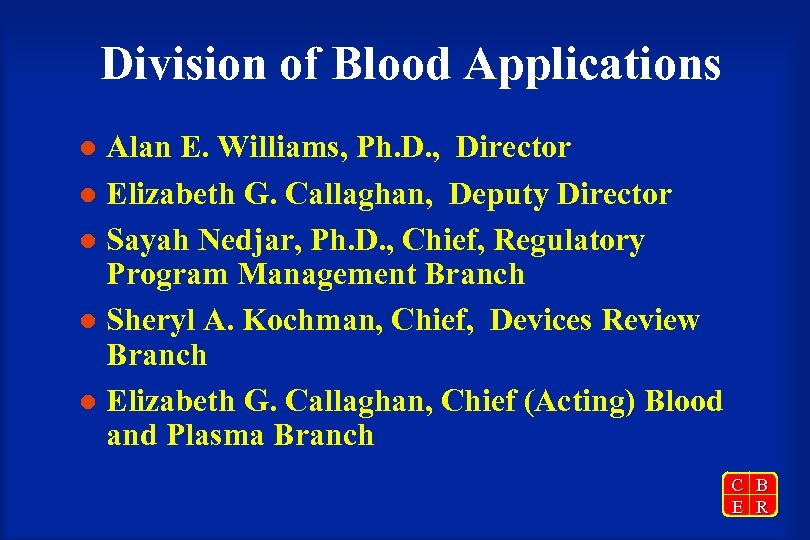
Division of Blood Applications Alan E. Williams, Ph. D. , Director l Elizabeth G. Callaghan, Deputy Director l Sayah Nedjar, Ph. D. , Chief, Regulatory Program Management Branch l Sheryl A. Kochman, Chief, Devices Review Branch l Elizabeth G. Callaghan, Chief (Acting) Blood and Plasma Branch l C B E R
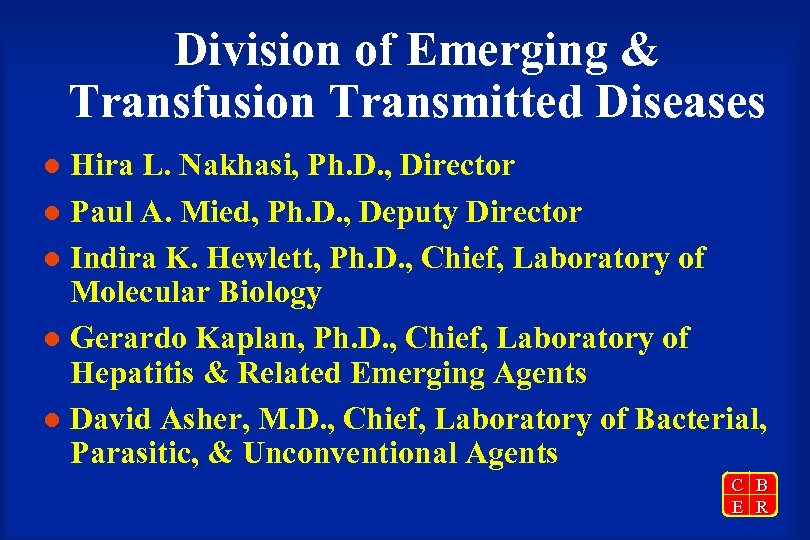
Division of Emerging & Transfusion Transmitted Diseases Hira L. Nakhasi, Ph. D. , Director l Paul A. Mied, Ph. D. , Deputy Director l Indira K. Hewlett, Ph. D. , Chief, Laboratory of Molecular Biology l Gerardo Kaplan, Ph. D. , Chief, Laboratory of Hepatitis & Related Emerging Agents l David Asher, M. D. , Chief, Laboratory of Bacterial, Parasitic, & Unconventional Agents l C B E R
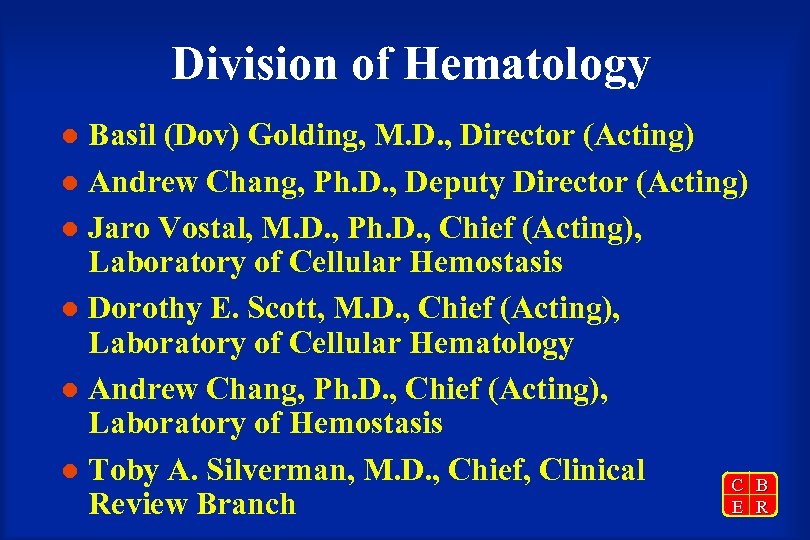
Division of Hematology Basil (Dov) Golding, M. D. , Director (Acting) l Andrew Chang, Ph. D. , Deputy Director (Acting) l Jaro Vostal, M. D. , Ph. D. , Chief (Acting), Laboratory of Cellular Hemostasis l Dorothy E. Scott, M. D. , Chief (Acting), Laboratory of Cellular Hematology l Andrew Chang, Ph. D. , Chief (Acting), Laboratory of Hemostasis l Toby A. Silverman, M. D. , Chief, Clinical C B E R Review Branch l
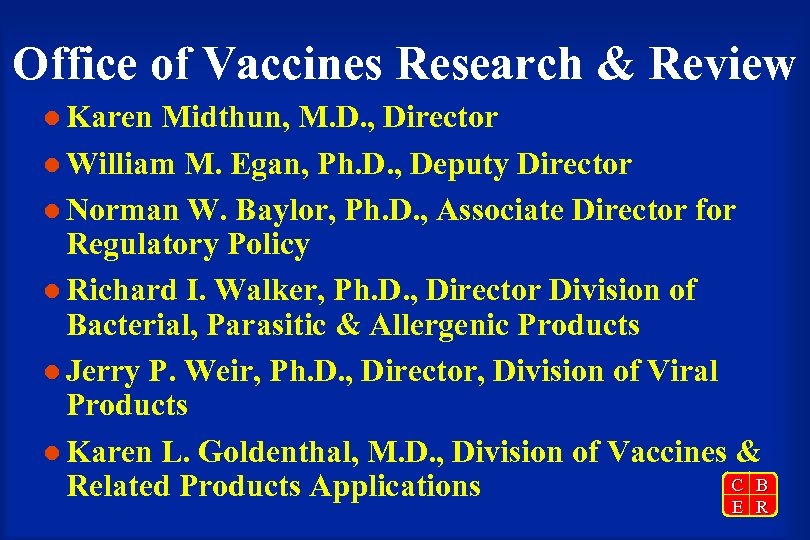
Office of Vaccines Research & Review l Karen Midthun, M. D. , Director l William M. Egan, Ph. D. , Deputy Director l Norman W. Baylor, Ph. D. , Associate Director for Regulatory Policy l Richard I. Walker, Ph. D. , Director Division of Bacterial, Parasitic & Allergenic Products l Jerry P. Weir, Ph. D. , Director, Division of Viral Products l Karen L. Goldenthal, M. D. , Division of Vaccines & C B Related Products Applications E R
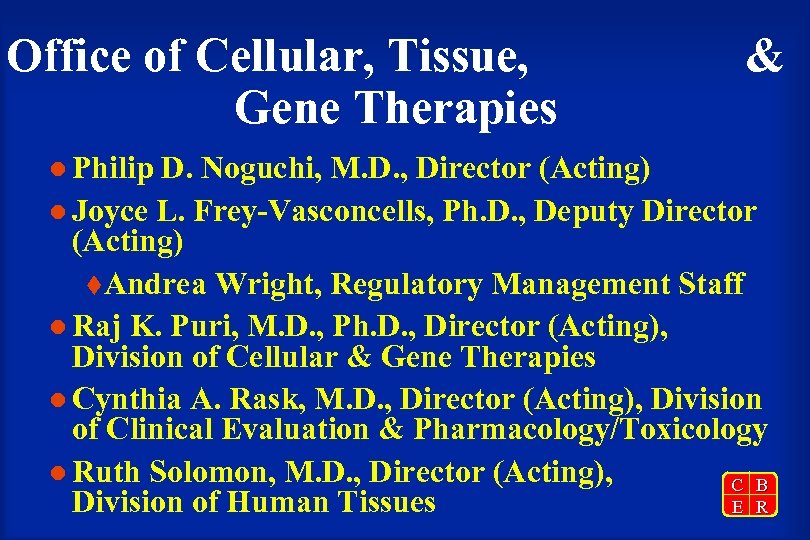
Office of Cellular, Tissue, Gene Therapies l Philip & D. Noguchi, M. D. , Director (Acting) l Joyce L. Frey-Vasconcells, Ph. D. , Deputy Director (Acting) t. Andrea Wright, Regulatory Management Staff l Raj K. Puri, M. D. , Ph. D. , Director (Acting), Division of Cellular & Gene Therapies l Cynthia A. Rask, M. D. , Director (Acting), Division of Clinical Evaluation & Pharmacology/Toxicology l Ruth Solomon, M. D. , Director (Acting), C B Division of Human Tissues E R
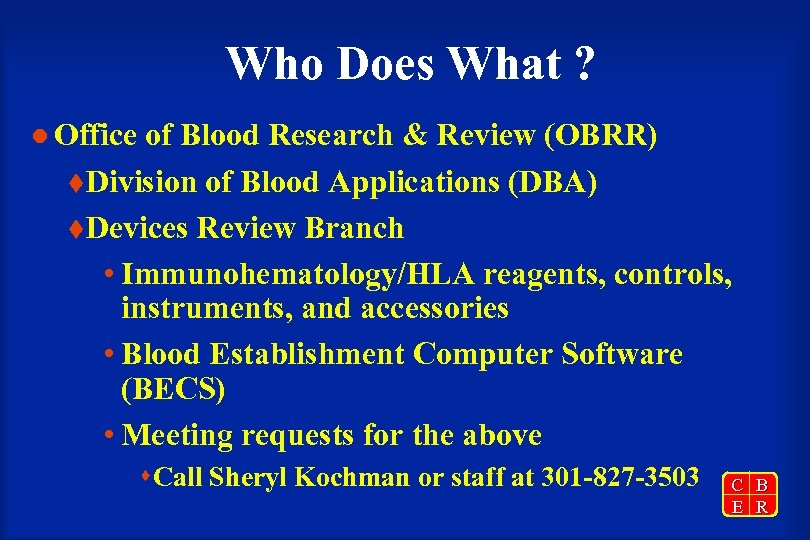
Who Does What ? l Office of Blood Research & Review (OBRR) t. Division of Blood Applications (DBA) t. Devices Review Branch • Immunohematology/HLA reagents, controls, instruments, and accessories • Blood Establishment Computer Software (BECS) • Meeting requests for the above s. Call Sheryl Kochman or staff at 301 -827 -3503 C B E R
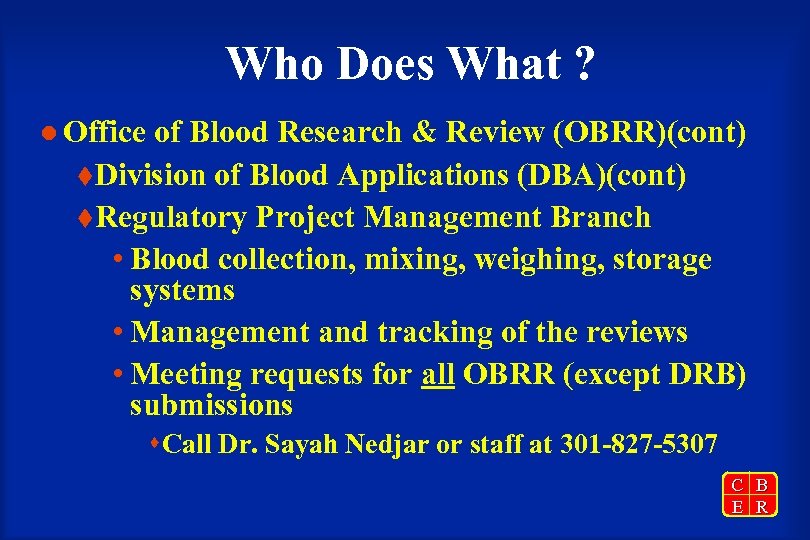
Who Does What ? l Office of Blood Research & Review (OBRR)(cont) t. Division of Blood Applications (DBA)(cont) t. Regulatory Project Management Branch • Blood collection, mixing, weighing, storage systems • Management and tracking of the reviews • Meeting requests for all OBRR (except DRB) submissions s. Call Dr. Sayah Nedjar or staff at 301 -827 -5307 C B E R
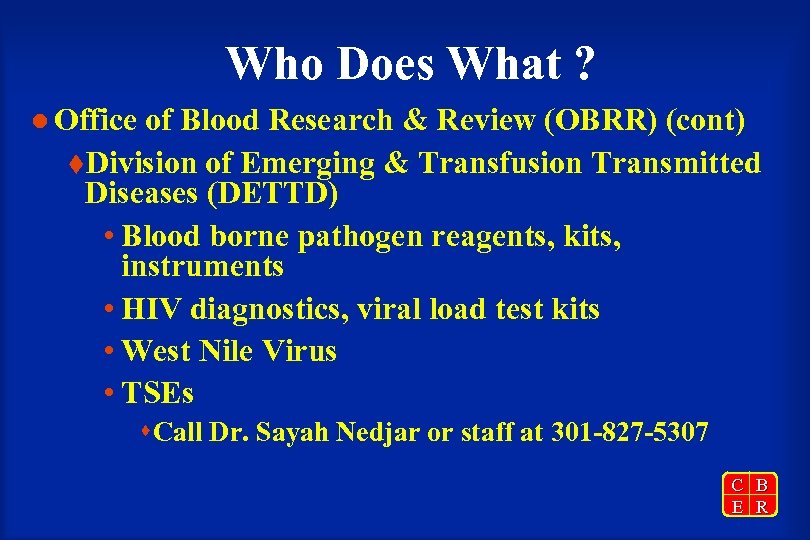
Who Does What ? l Office of Blood Research & Review (OBRR) (cont) t. Division of Emerging & Transfusion Transmitted Diseases (DETTD) • Blood borne pathogen reagents, kits, instruments • HIV diagnostics, viral load test kits • West Nile Virus • TSEs s. Call Dr. Sayah Nedjar or staff at 301 -827 -5307 C B E R
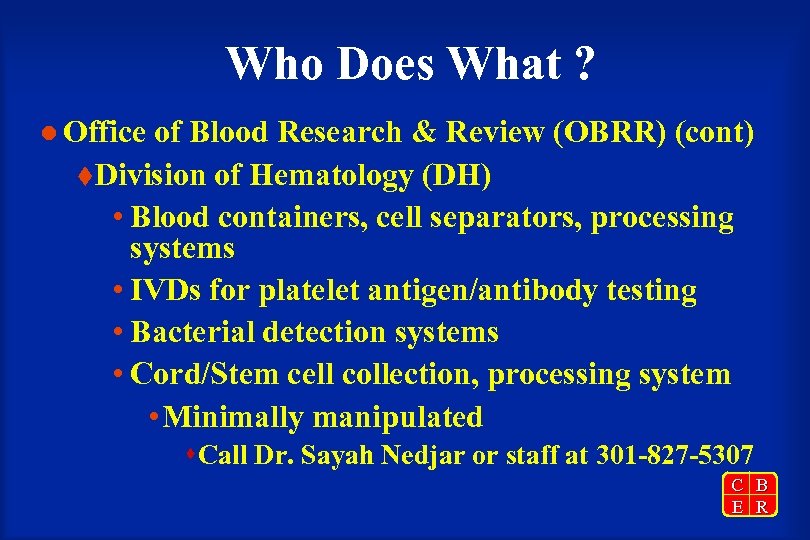
Who Does What ? l Office of Blood Research & Review (OBRR) (cont) t. Division of Hematology (DH) • Blood containers, cell separators, processing systems • IVDs for platelet antigen/antibody testing • Bacterial detection systems • Cord/Stem cell collection, processing system • Minimally manipulated s. Call Dr. Sayah Nedjar or staff at 301 -827 -5307 C B E R
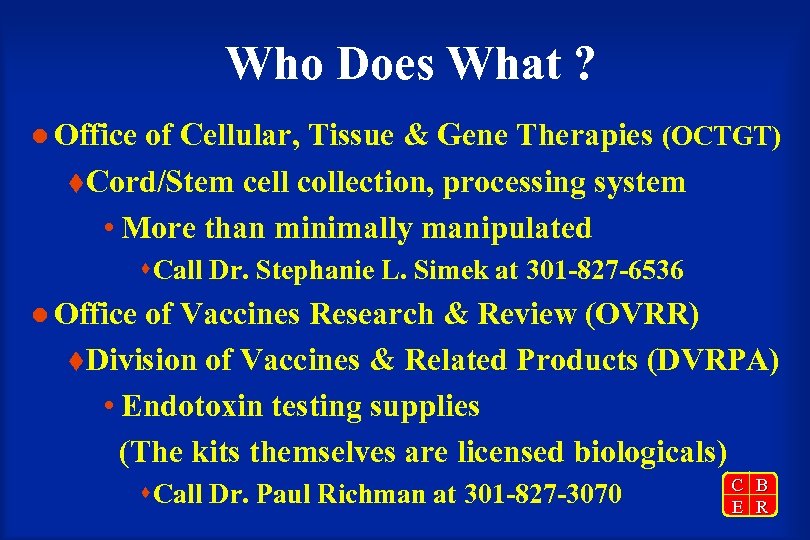
Who Does What ? l Office of Cellular, Tissue & Gene Therapies (OCTGT) t. Cord/Stem cell collection, processing system • More than minimally manipulated s. Call Dr. Stephanie L. Simek at 301 -827 -6536 l Office of Vaccines Research & Review (OVRR) t. Division of Vaccines & Related Products (DVRPA) • Endotoxin testing supplies (The kits themselves are licensed biologicals) s. Call Dr. Paul Richman at 301 -827 -3070 C B E R
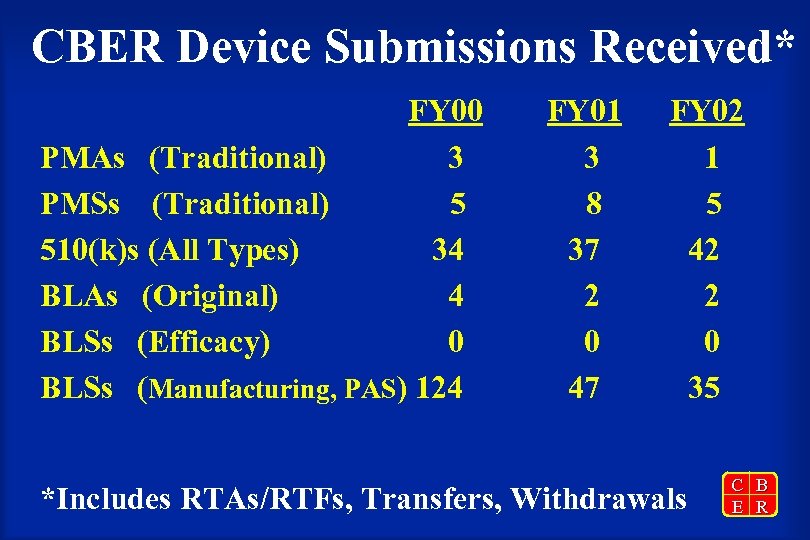
CBER Device Submissions Received* FY 00 PMAs (Traditional) 3 PMSs (Traditional) 5 510(k)s (All Types) 34 BLAs (Original) 4 BLSs (Efficacy) 0 BLSs (Manufacturing, PAS) 124 FY 01 3 8 37 2 0 47 FY 02 1 5 42 2 0 35 *Includes RTAs/RTFs, Transfers, Withdrawals C B E R
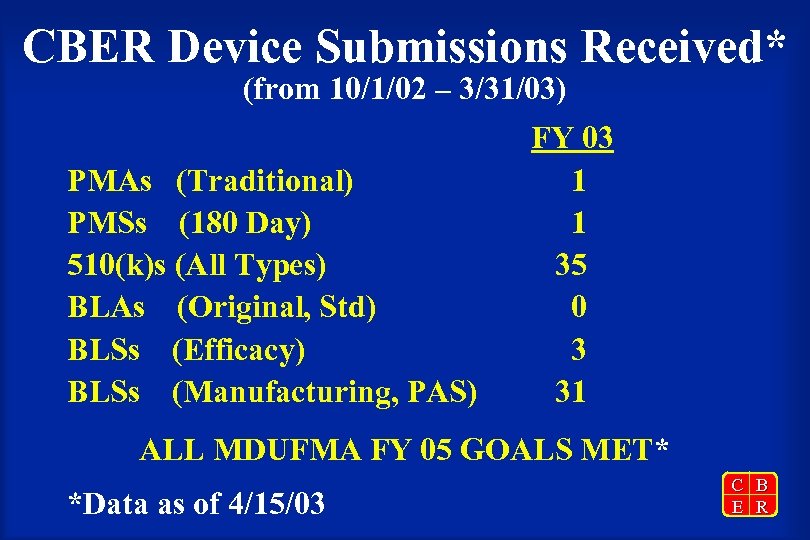
CBER Device Submissions Received* (from 10/1/02 – 3/31/03) PMAs (Traditional) PMSs (180 Day) 510(k)s (All Types) BLAs (Original, Std) BLSs (Efficacy) BLSs (Manufacturing, PAS) FY 03 1 1 35 0 3 31 ALL MDUFMA FY 05 GOALS MET* *Data as of 4/15/03 C B E R
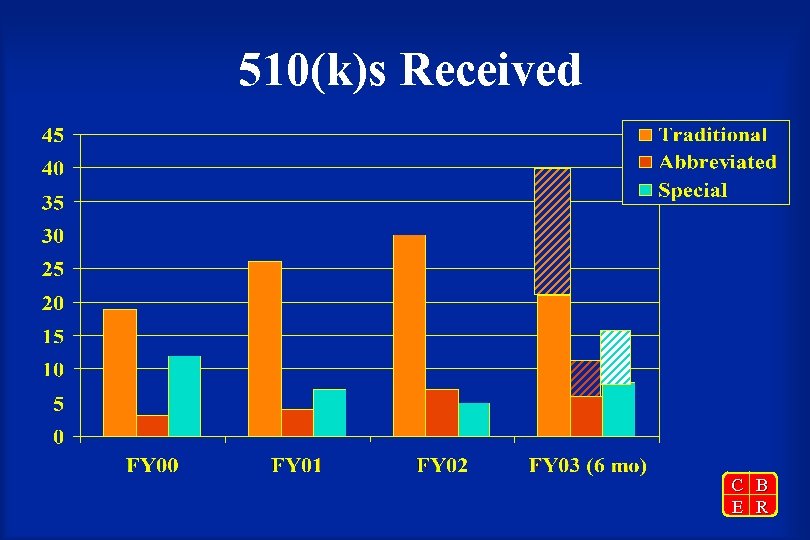
510(k)s Received C B E R
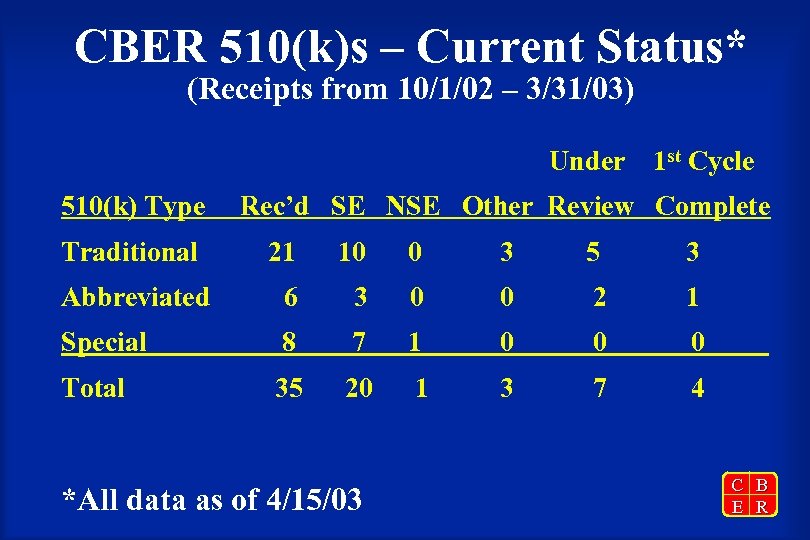
CBER 510(k)s – Current Status* (Receipts from 10/1/02 – 3/31/03) Under 510(k) Type Traditional 1 st Cycle Rec’d SE NSE Other Review Complete 21 10 0 3 5 3 Abbreviated 6 3 0 0 2 1 Special 8 7 1 0 0 0 Total 35 20 1 3 7 4 *All data as of 4/15/03 C B E R
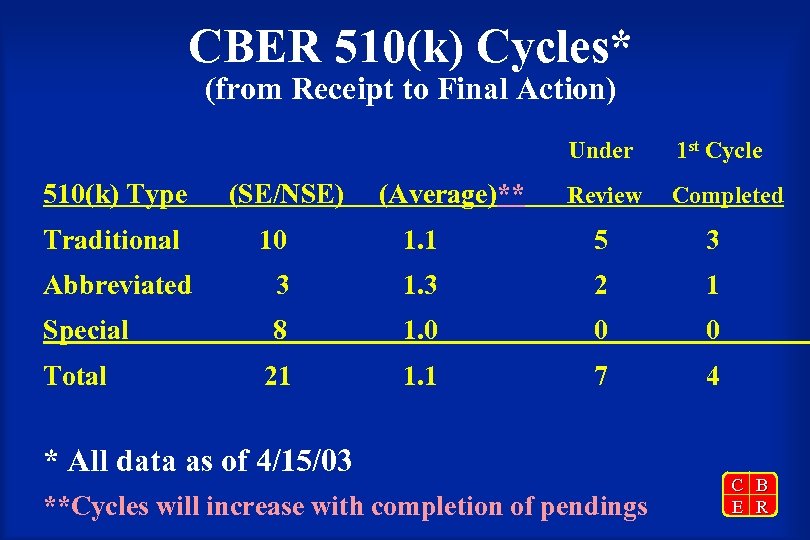
CBER 510(k) Cycles* (from Receipt to Final Action) Under 510(k) Type Traditional (SE/NSE) (Average)** 1 st Cycle Review Completed 10 1. 1 5 3 Abbreviated 3 1. 3 2 1 Special 8 1. 0 0 0 21 1. 1 7 4 Total * All data as of 4/15/03 **Cycles will increase with completion of pendings C B E R
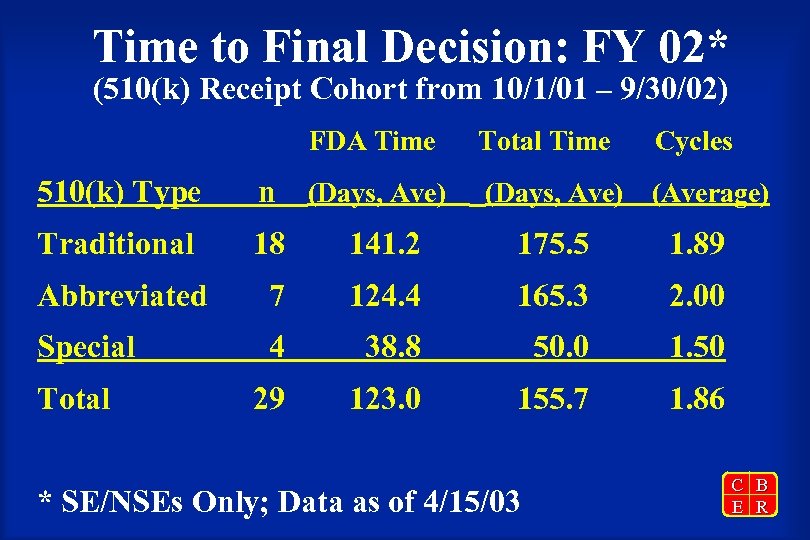
Time to Final Decision: FY 02* (510(k) Receipt Cohort from 10/1/01 – 9/30/02) FDA Time Total Time Cycles (Days, Ave) (Average) 510(k) Type n Traditional 18 141. 2 175. 5 1. 89 Abbreviated 7 124. 4 165. 3 2. 00 Special 4 38. 8 50. 0 1. 50 29 123. 0 155. 7 1. 86 Total * SE/NSEs Only; Data as of 4/15/03 C B E R
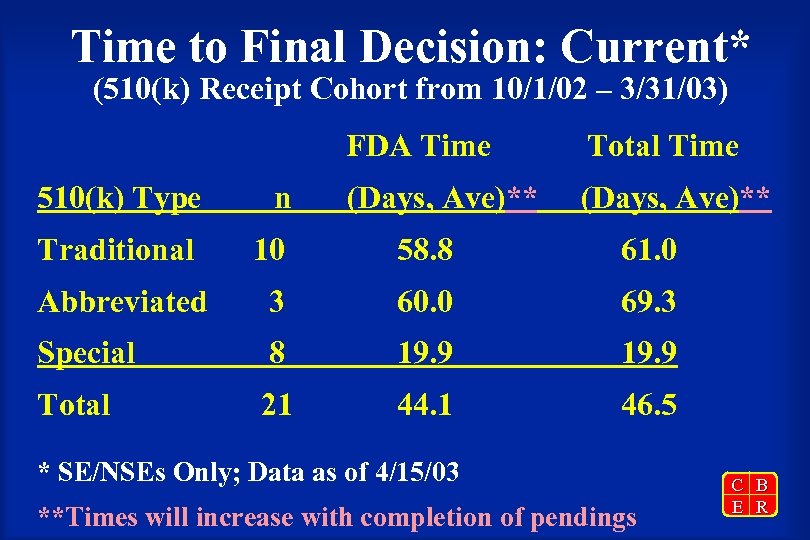
Time to Final Decision: Current* (510(k) Receipt Cohort from 10/1/02 – 3/31/03) FDA Time Total Time (Days, Ave)** 510(k) Type n Traditional 10 58. 8 61. 0 Abbreviated 3 60. 0 69. 3 Special 8 19. 9 Total 21 44. 1 46. 5 * SE/NSEs Only; Data as of 4/15/03 **Times will increase with completion of pendings C B E R
Acknowledgements l Dr. Mary Beth Jacobs, Ph. D. , CBER/OBRR/IOD l Michael A. Calabro, Ph. D. ; CBER/OBRR/IOD C B E R
Скачать презентацию CBER 510 k Issues Sheryl A Kochman MT ASCP Chief
728a2610db490c3f4a00b35bca2f92ee.ppt