 Скачать презентацию Cavity Processing R D at JLab C Reece cer
66027da2c4422f44e16785b264fd3006.ppt
- Количество слайдов: 35



Cavity Processing R&D at JLab C. Reece cer 20 Sept 2007 ILC Cavity KOM
General Cavity Processing Motivation • ILC – 35 MV/m, > 80% yield, 1 st test • ~80% of theoretical Nb limit, Hc 1, with RDR shape • Requires tight control specs – Material – Fabrication – Chemical processing – Contamination control • Prime concerns: – Surface smoothness – Field-emitting contaminants • Secondary but significant concern: – Chemical process contaminants degrading Q cer 20 Sept 2007 ILC Cavity KOM
General Cavity Processing Motivation • ILC • Requires tight control specs – Chemical processing » Need a defined protocol which always produces the same result, and that result enables 35 MV/m operation. – Contamination control » Need a set of protocols which assure the absence of field-emitting contaminants from the beamline surfaces. cer 20 Sept 2007 ILC Cavity KOM
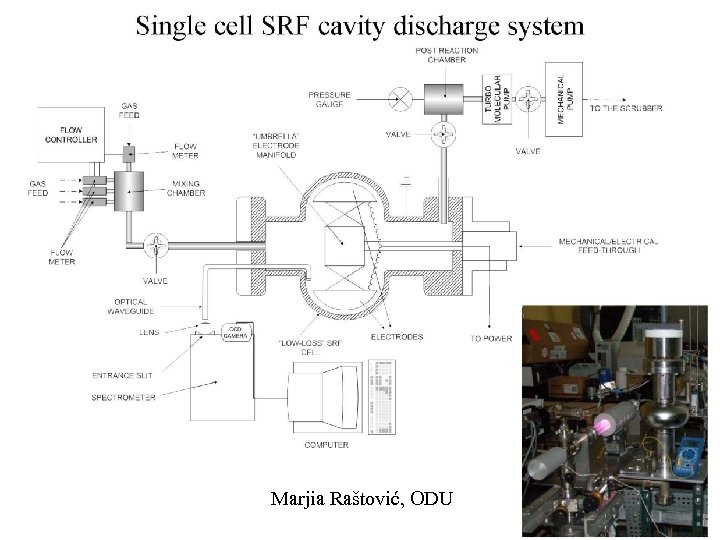
Cavity Process Analysis at JLab • Electropolishing process studies (with W&M, VTech) – – – • Preparation for field-emission contamination studies – – • Field Emission Viewer (FEViewer) commissioning Designed for rapid QA screening of samples to 40 MV/m Process dependence of surface oxide structure – – • Electrochemical approach Linking to 9 -cell monitoring Full-scale hydrodynamic modeling Electrochemical Impedance Spectroscopy (EIS) of Nb EP Scale-dependent quantitative roughness/smoothing … building an integrated picture to inform protocol improvement and system design Variable energy XPS @ NSLS (with W&M, Boston) BCP, EP, low-T bake, vacuum, air Collaboration on plasma etching – Old Dominion University, ILC University-based R&D 20 Sept 2007 cer
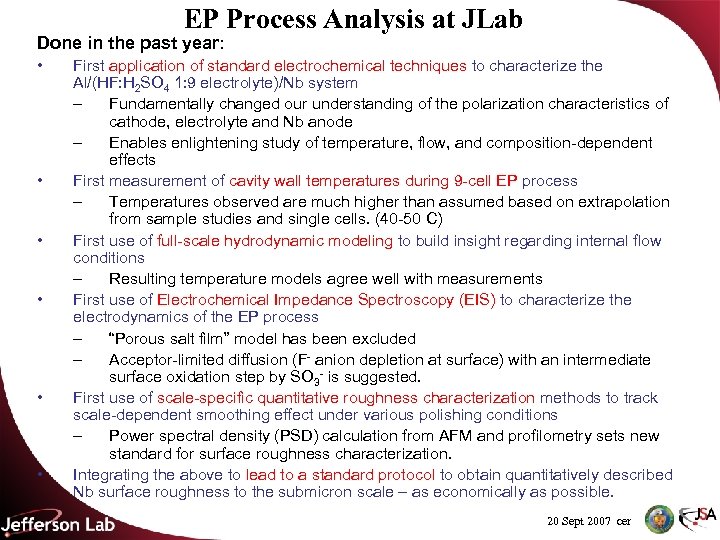
EP Process Analysis at JLab Done in the past year: • • • First application of standard electrochemical techniques to characterize the Al/(HF: H 2 SO 4 1: 9 electrolyte)/Nb system – Fundamentally changed our understanding of the polarization characteristics of cathode, electrolyte and Nb anode – Enables enlightening study of temperature, flow, and composition-dependent effects First measurement of cavity wall temperatures during 9 -cell EP process – Temperatures observed are much higher than assumed based on extrapolation from sample studies and single cells. (40 -50 C) First use of full-scale hydrodynamic modeling to build insight regarding internal flow conditions – Resulting temperature models agree well with measurements First use of Electrochemical Impedance Spectroscopy (EIS) to characterize the electrodynamics of the EP process – “Porous salt film” model has been excluded – Acceptor-limited diffusion (F- anion depletion at surface) with an intermediate surface oxidation step by SO 3 - is suggested. First use of scale-specific quantitative roughness characterization methods to track scale-dependent smoothing effect under various polishing conditions – Power spectral density (PSD) calculation from AFM and profilometry sets new standard for surface roughness characterization. Integrating the above to lead to a standard protocol to obtain quantitatively described Nb surface roughness to the submicron scale – as economically as possible. 20 Sept 2007 cer
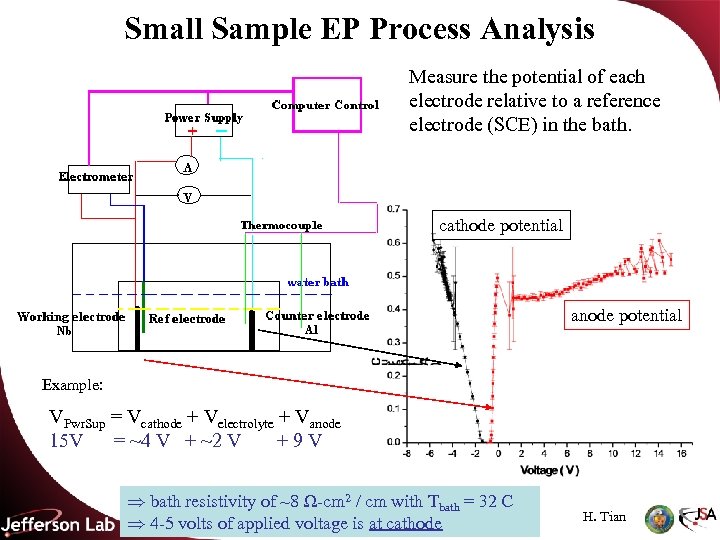
Small Sample EP Process Analysis • Provide an improved technical basis for specific process design, e. g. 9 -cell cavities. Measure the potential of each electrode relative to a reference electrode (SCE) in the bath. cathode potential anode potential Example: VPwr. Sup = Vcathode + Velectrolyte + Vanode 15 V = ~4 V + ~2 V +9 V Þ bath resistivity of ~8 Ω-cm 2 / cm with Tbath = 32 C Þ 4 -5 volts of applied voltage is at cathode H. Tian
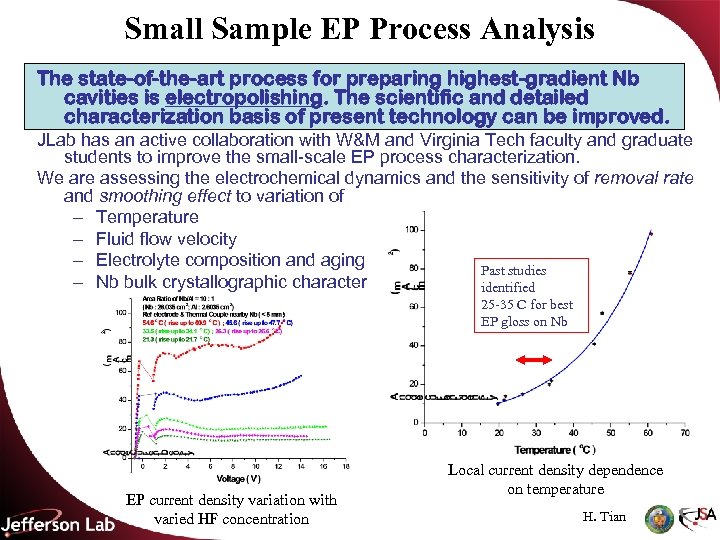
Small Sample EP Process Analysis The state-of-the-art process for preparing highest-gradient Nb cavities is electropolishing. The scientific and detailed characterization basis of present technology can be improved. JLab has an active collaboration with W&M and Virginia Tech faculty and graduate students to improve the small-scale EP process characterization. We are assessing the electrochemical dynamics and the sensitivity of removal rate and smoothing effect to variation of – Temperature – Fluid flow velocity – Electrolyte composition and aging Past studies – Nb bulk crystallographic character identified 25 -35 C for best EP gloss on Nb EP current density variation with varied HF concentration Local current density dependence on temperature H. Tian
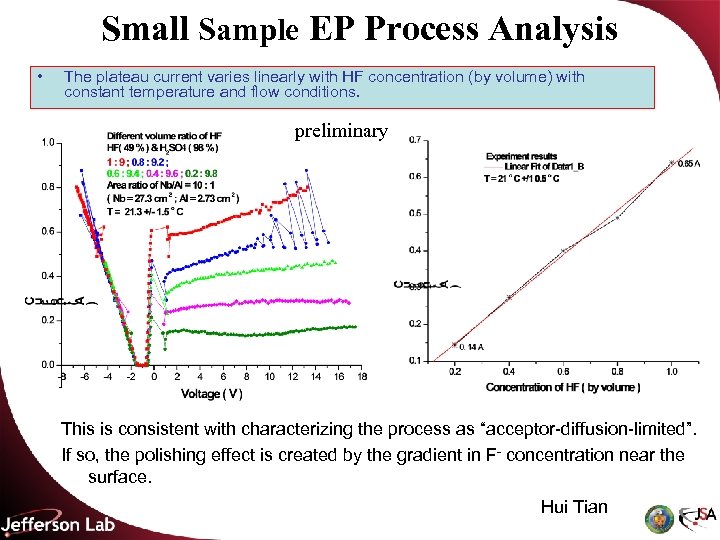
Small Sample EP Process Analysis • The plateau current varies linearly with HF concentration (by volume) with constant temperature and flow conditions. preliminary This is consistent with characterizing the process as “acceptor-diffusion-limited”. If so, the polishing effect is created by the gradient in F- concentration near the surface. Hui Tian
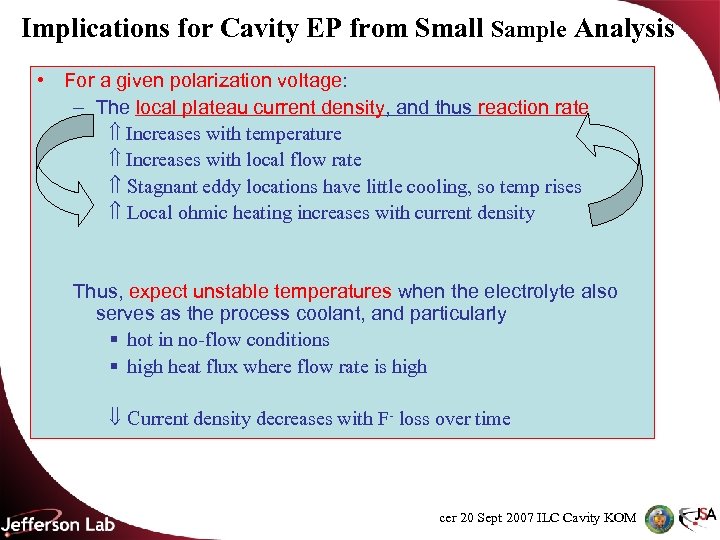
Implications for Cavity EP from Small Sample Analysis • For a given polarization voltage: – The local plateau current density, and thus reaction rate Increases with temperature Increases with local flow rate Stagnant eddy locations have little cooling, so temp rises Local ohmic heating increases with current density Thus, expect unstable temperatures when the electrolyte also serves as the process coolant, and particularly § hot in no-flow conditions § high heat flux where flow rate is high ß Current density decreases with F- loss over time cer 20 Sept 2007 ILC Cavity KOM
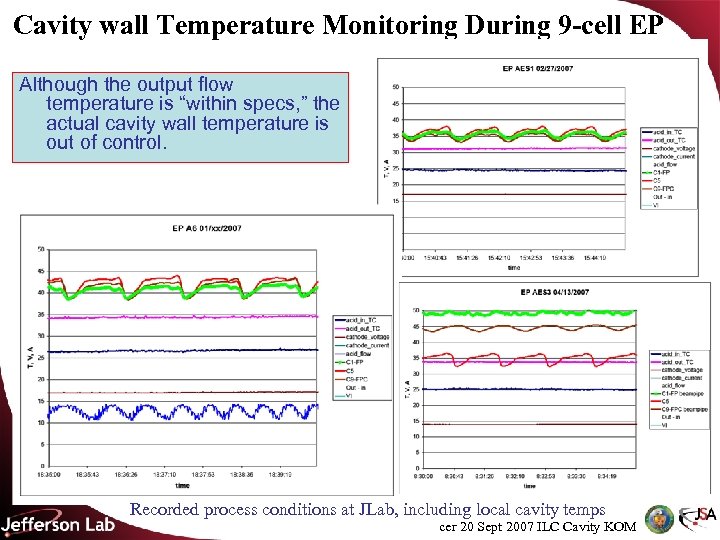
Cavity wall Temperature Monitoring During 9 -cell EP Although the output flow temperature is “within specs, ” the actual cavity wall temperature is out of control. Recorded process conditions at JLab, including local cavity temps cer 20 Sept 2007 ILC Cavity KOM
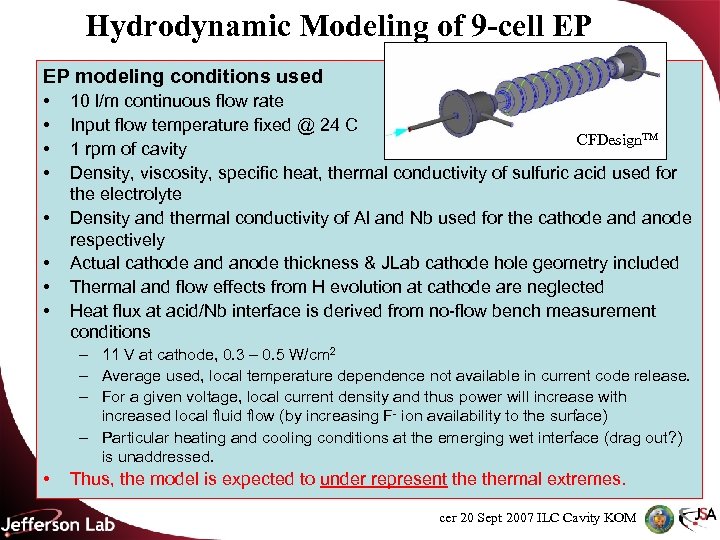
Hydrodynamic Modeling of 9 -cell EP EP modeling conditions used • • 10 l/m continuous flow rate Input flow temperature fixed @ 24 C CFDesign. TM 1 rpm of cavity Density, viscosity, specific heat, thermal conductivity of sulfuric acid used for the electrolyte Density and thermal conductivity of Al and Nb used for the cathode and anode respectively Actual cathode and anode thickness & JLab cathode hole geometry included Thermal and flow effects from H evolution at cathode are neglected Heat flux at acid/Nb interface is derived from no-flow bench measurement conditions – 11 V at cathode, 0. 3 – 0. 5 W/cm 2 – Average used, local temperature dependence not available in current code release. – For a given voltage, local current density and thus power will increase with increased local fluid flow (by increasing F- ion availability to the surface) – Particular heating and cooling conditions at the emerging wet interface (drag out? ) is unaddressed. • Thus, the model is expected to under represent thermal extremes. cer 20 Sept 2007 ILC Cavity KOM
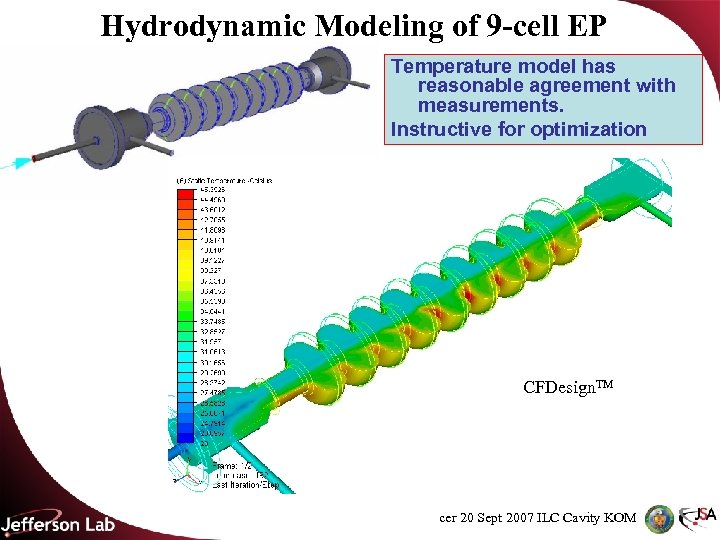
Hydrodynamic Modeling of 9 -cell EP Temperature model has reasonable agreement with measurements. Instructive for optimization CFDesign. TM cer 20 Sept 2007 ILC Cavity KOM
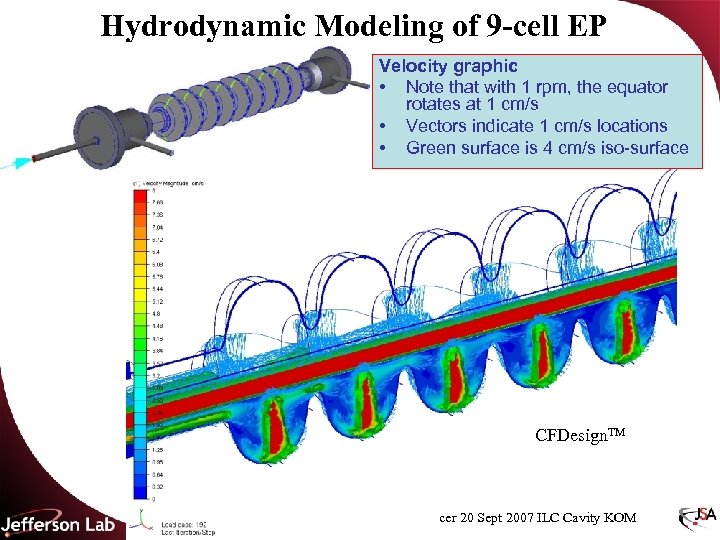
Hydrodynamic Modeling of 9 -cell EP Velocity graphic • Note that with 1 rpm, the equator rotates at 1 cm/s • Vectors indicate 1 cm/s locations • Green surface is 4 cm/s iso-surface CFDesign. TM cer 20 Sept 2007 ILC Cavity KOM
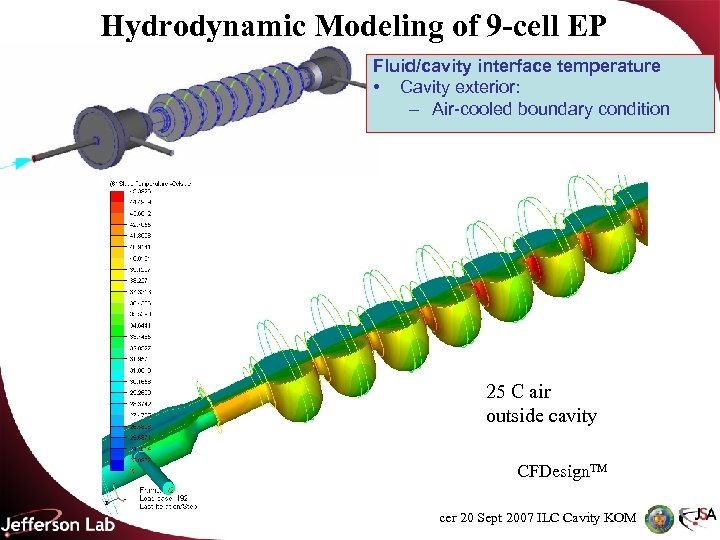
Hydrodynamic Modeling of 9 -cell EP Fluid/cavity interface temperature • Cavity exterior: – Air-cooled boundary condition 25 CCFDesign. TM air outside cavity CFDesign. TM cer 20 Sept 2007 ILC Cavity KOM
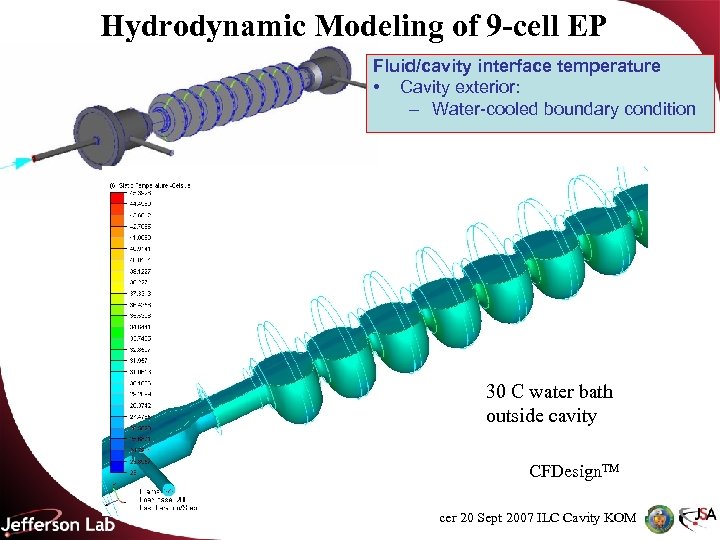
Hydrodynamic Modeling of 9 -cell EP Fluid/cavity interface temperature • Cavity exterior: – Water-cooled boundary condition 30 CCFDesign. TM water bath outside cavity CFDesign. TM cer 20 Sept 2007 ILC Cavity KOM
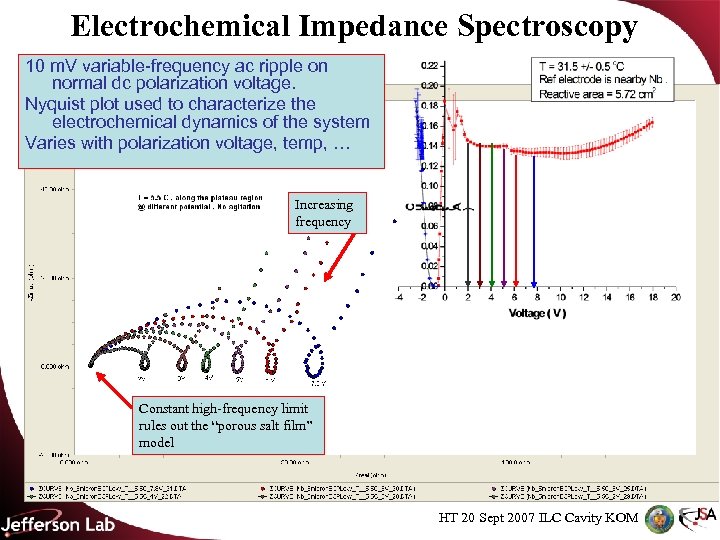
Electrochemical Impedance Spectroscopy 10 m. V variable-frequency ac ripple on normal dc polarization voltage. Nyquist plot used to characterize the electrochemical dynamics of the system Varies with polarization voltage, temp, … Increasing frequency Constant high-frequency limit rules out the “porous salt film” model HT 20 Sept 2007 ILC Cavity KOM
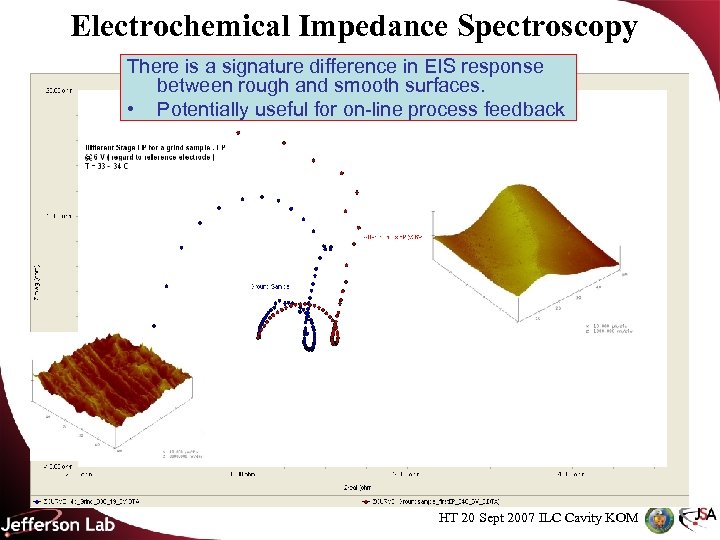
Electrochemical Impedance Spectroscopy There is a signature difference in EIS response between rough and smooth surfaces. • Potentially useful for on-line process feedback HT 20 Sept 2007 ILC Cavity KOM
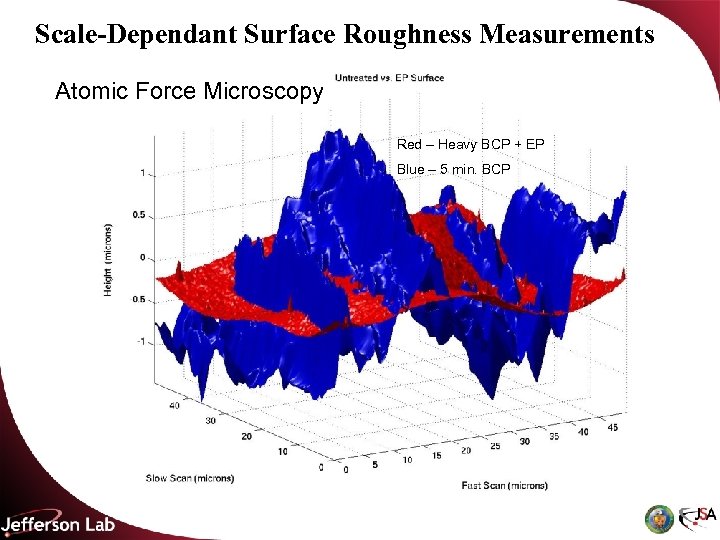
Scale-Dependant Surface Roughness Measurements Atomic Force Microscopy Red – Heavy BCP + EP Blue – 5 min. BCP
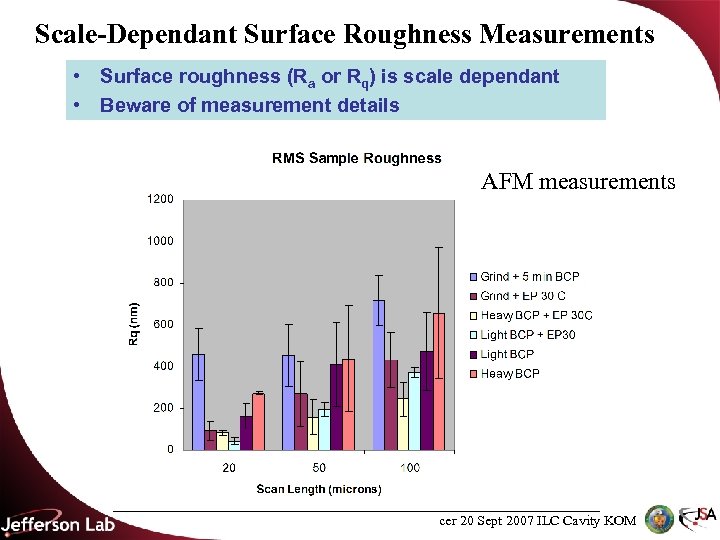
Scale-Dependant Surface Roughness Measurements • Surface roughness (Ra or Rq) is scale dependant • Beware of measurement details AFM measurements cer 20 Sept 2007 ILC Cavity KOM
Scale-Dependant Surface Roughness Measurements PSD (Power Spectral Density) has been designated as the preferred quantity for specifying surface roughness. Draft ISO 10110 Part 8: Surface Texture PSD is the ensemble average of the square of the Fourier spectrum of height measurements on a surface.
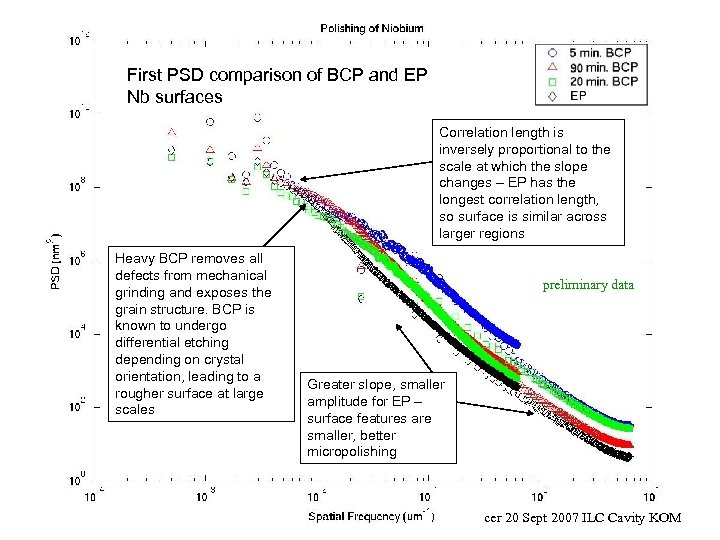
Scale-Dependant Surface Roughness Measurements First roughness is BCP and Surface PSD comparison of scale EP Nb surfaces dependant Beware of measurement details Correlation length is inversely proportional to the scale at which the slope changes – EP has the longest correlation length, so surface is similar across larger regions Heavy BCP removes all defects from mechanical grinding and exposes the grain structure. BCP is known to undergo differential etching depending on crystal orientation, leading to a rougher surface at large scales preliminary data Greater slope, smaller amplitude for EP – surface features are smaller, better micropolishing cer 20 Sept 2007 ILC Cavity KOM
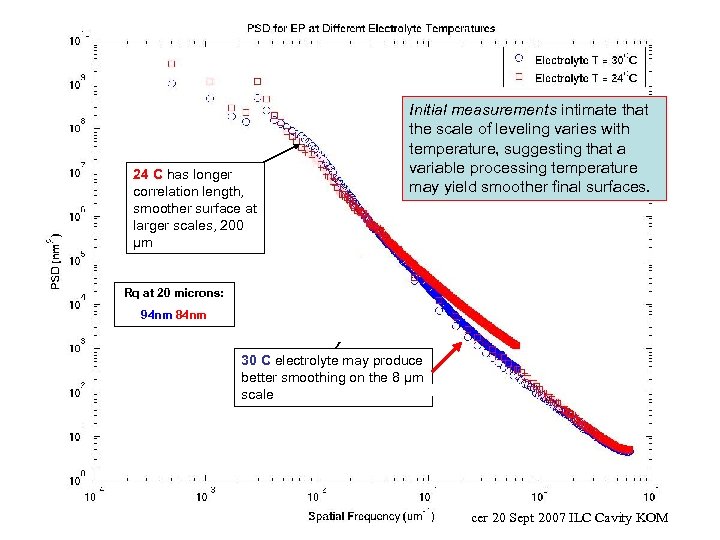
Scale-Dependant Surface Roughness Measurements Surface roughness is scale dependant Initial measurements intimate that Beware of measurement detailsthe scale of leveling varies with 24 C has longer correlation length, smoother surface at larger scales, 200 µm temperature, suggesting that a variable processing temperature may yield smoother final surfaces. Rq at 20 microns: 94 nm 84 nm 30 C electrolyte may produce better smoothing on the 8 µm scale cer 20 Sept 2007 ILC Cavity KOM
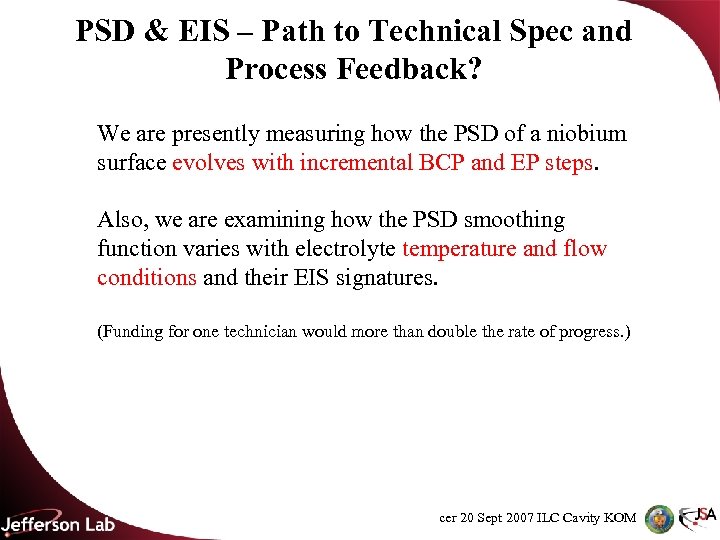
PSD & EIS – Path to Technical Spec and Process Feedback? We are presently measuring how the PSD of a niobium surface evolves with incremental BCP and EP steps. Also, we are examining how the PSD smoothing function varies with electrolyte temperature and flow conditions and their EIS signatures. (Funding for one technician would more than double the rate of progress. ) cer 20 Sept 2007 ILC Cavity KOM
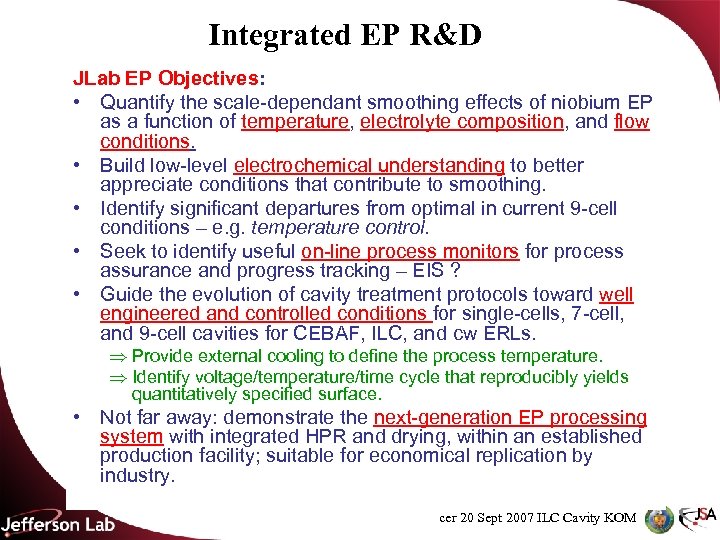
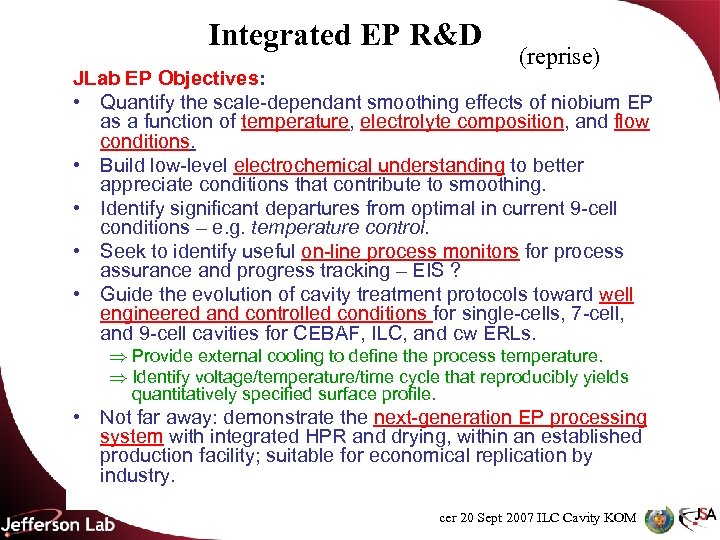
Integrated EP R&D JLab EP Objectives: • Quantify the scale-dependant smoothing effects of niobium EP as a function of temperature, electrolyte composition, and flow conditions. • Build low-level electrochemical understanding to better appreciate conditions that contribute to smoothing. • Identify significant departures from optimal in current 9 -cell conditions – e. g. temperature control. • Seek to identify useful on-line process monitors for process assurance and progress tracking – EIS ? • Guide the evolution of cavity treatment protocols toward well engineered and controlled conditions for single-cells, 7 -cell, and 9 -cell cavities for CEBAF, ILC, and cw ERLs. Þ Provide external cooling to define the process temperature. Þ Identify voltage/temperature/time cycle that reproducibly yields quantitatively specified surface. • Not far away: demonstrate the next-generation EP processing system with integrated HPR and drying, within an established production facility; suitable for economical replication by industry. cer 20 Sept 2007 ILC Cavity KOM
EP R&D Collaborators Hui Tian: Graduate student, College of William and Mary, Applied Science Department (supported by ILC University-base R&D grant) Prof. Michael Kelley: College of William and Mary, Virginia Tech, and half-time JLab Prof. Sean Corcoran: Virginia Tech – electrochemist Guilhem Ribeill: DOE SULI summer student, NC State Jun Ortega: Blue Ridge Numerics Inc. , CFDesign. TM consultant John Mammosser: initiated the modeling effort (now SNS) JLab: Charles Reece, Rong-Li Geng, Curtis Crawford, Andy Wu (BEP), Larry Phillips cer 20 Sept 2007 ILC Cavity KOM
General Cavity Processing Motivation • ILC – Chemical processing • We use EP to produce a “smooth” Nb surface. • What smoothness, where, matters? – High H-field regions are clearly most sensitive – RF currents run in top few hundred nm – What scale of topology matters near Hc 1? • What is the tolerance window in EP process parameters which will necessarily produce the required smoothness on the appropriate scale? • How can those EP conditions be confidently provided to 9 -cell ILC cavities? We must answer these questions to reach a defined protocol which always produces the same result, enabling 35 MV/m operation. cer 20 Sept 2007 ILC Cavity KOM
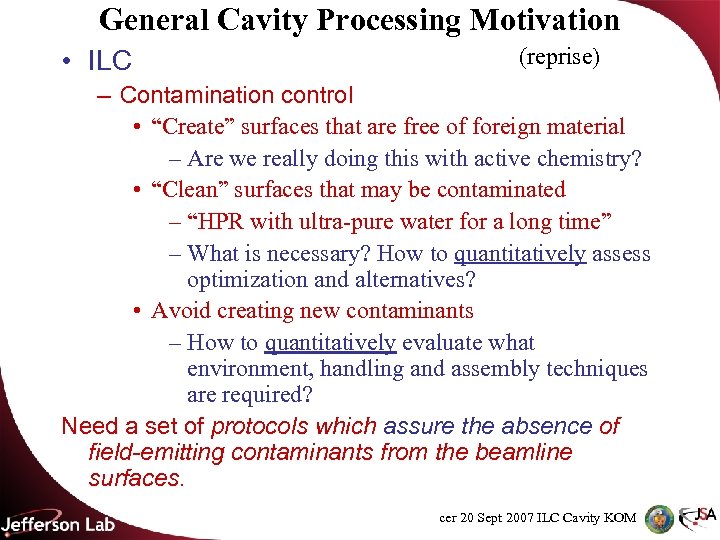
General Cavity Processing Motivation • ILC – Contamination control • “Create” surfaces that are free of foreign material – Are we really doing this with active chemistry? • “Clean” surfaces that may be contaminated – “HPR with ultra-pure water for a long time” – What is necessary? How to quantitatively assess optimization and alternatives? • Avoid creating new contaminants – How to quantitatively evaluate what environment, handling and assembly techniques are required? Need a set of protocols which assure the absence of field-emitting contaminants from the beamline surfaces. cer 20 Sept 2007 ILC Cavity KOM
Field Emission QA Objectives: • Need a convenient, i. e. no expert required, field emission QA system – State-of-the-art sensitivity is not required – 40 MV/m is good start (40 k. V @ 1 mm) – Run by production techs to get prompt feedback • Need a set of “standard FE contaminants” with which to assess our cleaning techniques – Get out of the “chasing rare events” cleaning mode – Learn how to remove “all” contaminants when the starting state is × 104 worse than a cavity • E. g. 2 -5 µm Al, stainless steel, sulfur power – Validate cleanroom protocols by challenge tests cer 20 Sept 2007 ILC Cavity KOM
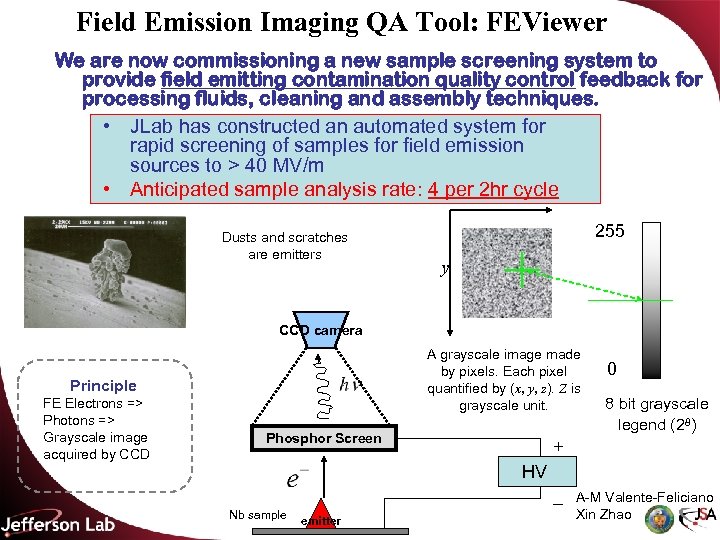
Field Emission Imaging QA Tool: FEViewer We are now commissioning a new sample screening system to provide field emitting contamination quality control feedback for processing fluids, cleaning and assembly techniques. • JLab has constructed an automated system for rapid screening of samples for field emission sources to > 40 MV/m • Anticipated sample analysis rate: 4 per 2 hr cycle Dusts and scratches are emitters 255 y CCD camera A grayscale image made by pixels. Each pixel quantified by (x, y, z). Z is grayscale unit. Principle FE Electrons => Photons => Grayscale image acquired by CCD Phosphor Screen 0 8 bit grayscale legend (28) + HV _ Nb sample emitter A-M Valente-Feliciano Xin Zhao
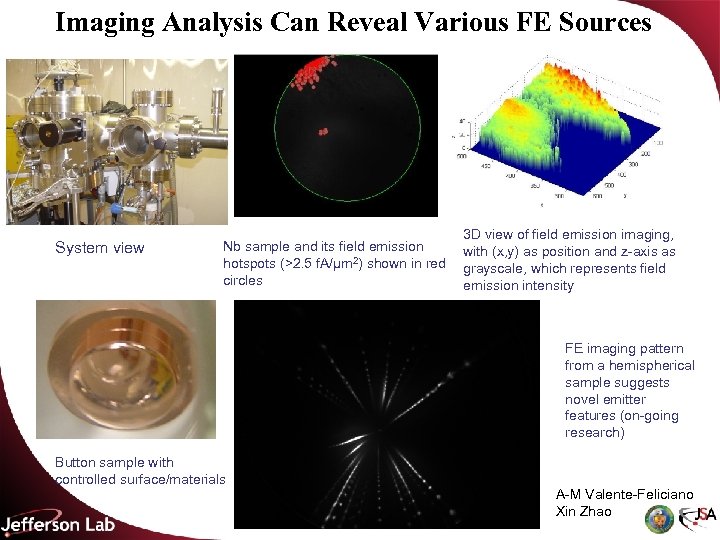
Imaging Analysis Can Reveal Various FE Sources System view Nb sample and its field emission hotspots (>2. 5 f. A/µm 2) shown in red circles 3 D view of field emission imaging, with (x, y) as position and z-axis as grayscale, which represents field emission intensity FE imaging pattern from a hemispherical sample suggests novel emitter features (on-going research) Button sample with controlled surface/materials A-M Valente-Feliciano Xin Zhao
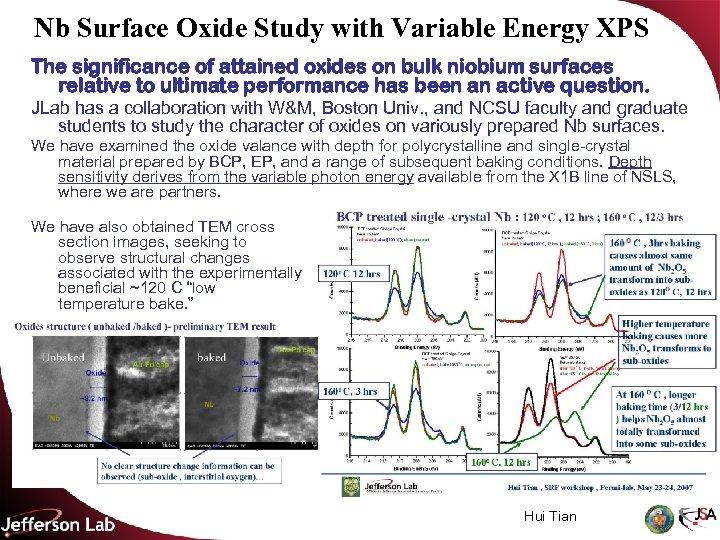
Nb Surface Oxide Study with Variable Energy XPS The significance of attained oxides on bulk niobium surfaces relative to ultimate performance has been an active question. JLab has a collaboration with W&M, Boston Univ. , and NCSU faculty and graduate students to study the character of oxides on variously prepared Nb surfaces. We have examined the oxide valance with depth for polycrystalline and single-crystal material prepared by BCP, EP, and a range of subsequent baking conditions. Depth sensitivity derives from the variable photon energy available from the X 1 B line of NSLS, where we are partners. We have also obtained TEM cross section images, seeking to observe structural changes associated with the experimentally beneficial ~120 C “low temperature bake. ” H. Tian Hui Tian
ARDPRM Marjia Raštović, ODU
General Cavity Processing Motivation • ILC (reprise) – Contamination control • “Create” surfaces that are free of foreign material – Are we really doing this with active chemistry? • “Clean” surfaces that may be contaminated – “HPR with ultra-pure water for a long time” – What is necessary? How to quantitatively assess optimization and alternatives? • Avoid creating new contaminants – How to quantitatively evaluate what environment, handling and assembly techniques are required? Need a set of protocols which assure the absence of field-emitting contaminants from the beamline surfaces. cer 20 Sept 2007 ILC Cavity KOM
Integrated EP R&D (reprise) JLab EP Objectives: • Quantify the scale-dependant smoothing effects of niobium EP as a function of temperature, electrolyte composition, and flow conditions. • Build low-level electrochemical understanding to better appreciate conditions that contribute to smoothing. • Identify significant departures from optimal in current 9 -cell conditions – e. g. temperature control. • Seek to identify useful on-line process monitors for process assurance and progress tracking – EIS ? • Guide the evolution of cavity treatment protocols toward well engineered and controlled conditions for single-cells, 7 -cell, and 9 -cell cavities for CEBAF, ILC, and cw ERLs. Þ Provide external cooling to define the process temperature. Þ Identify voltage/temperature/time cycle that reproducibly yields quantitatively specified surface profile. • Not far away: demonstrate the next-generation EP processing system with integrated HPR and drying, within an established production facility; suitable for economical replication by industry. cer 20 Sept 2007 ILC Cavity KOM
Скачать презентацию Cavity Processing R D at JLab C Reece cer
66027da2c4422f44e16785b264fd3006.ppt