



 CAUSES OF RUIN 1663
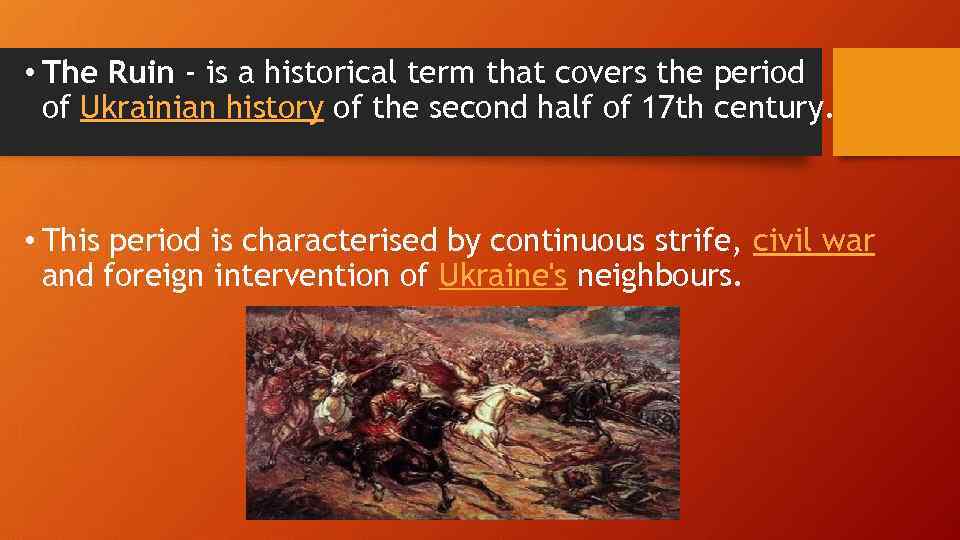 • The Ruin - is a historical term that covers the period of Ukrainian history of the second half of 17 th century. • This period is characterised by continuous strife, civil war and foreign intervention of Ukraine's neighbours.
 Background • The Ruin started after the death of hetman Bohdan Khmelnytsky (1657) While Khmelnytsky had operated as a charismatic and influential leader, clearly one of the prominent figures in Ukrainian history, he did not establish clear rules of succession and he favoured his son Yurii as the new hetman. Yurii Khmelnytsky (1641 -1685), young and inexperienced, clearly lacked the charisma and the leadership qualities of his father, as he showed during his attempts to rule.
 The history of Ukraine in this period became very complex. Basic themes included: • the failure to find a single leader of Ukraine who could pursue a consistent policy • the constant switching of alliances with outside powers who had their own interests • the conflict between the richer and poorer Cossacks • the influence of the Orthodox Church, which tended to favour co-religionist Moscow
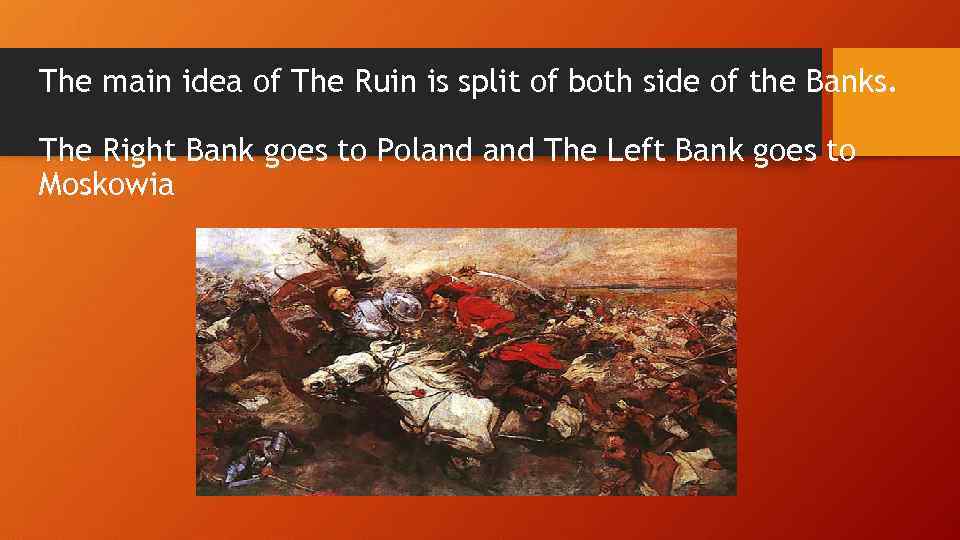 The main idea of The Ruin is split of both side of the Banks. The Right Bank goes to Poland The Left Bank goes to Moskowia
 Polish Right Bank 1663 -81 • 1663 -65: Teteria and Poland: Pavlo Teteria, who held only the right bank, followed a strongly pro-Polish policy. • 1665 -76: Doroshenko and the Turks: The goal of Petro Doroshenko was to re-unite the two halves of Ukraine. In 1667, Russia and Poland, without consulting the cossacks, signed the Treaty of Andrusovo which partitioned the cossack lands at the Dnieper river. In 1672 he helped the Turks annex Podolia. During the Russo-Turkish War (1676 -1681) he aided the Turks against Russia. September 1676, he gave up authority to Ivan Samoylovych of the left bank and went into exile in Russia.
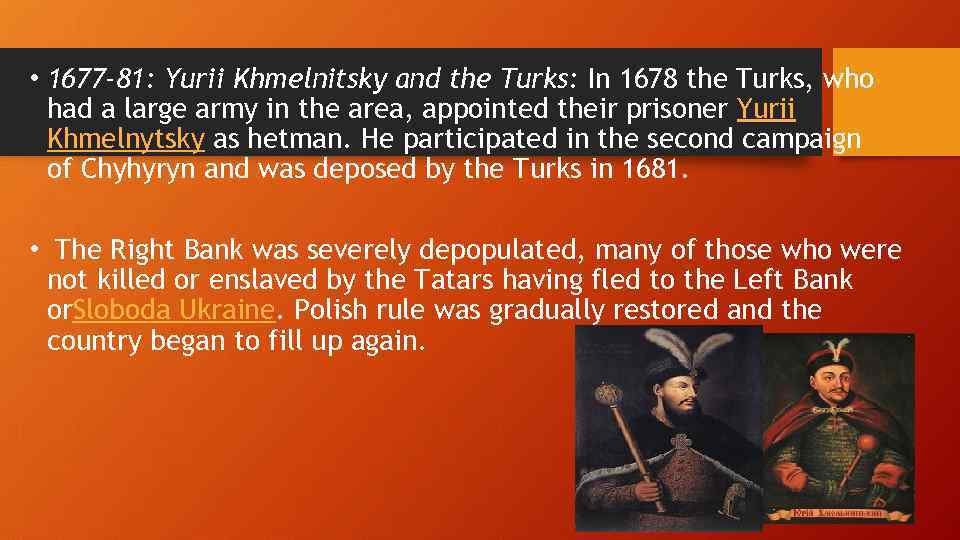 • 1677 -81: Yurii Khmelnitsky and the Turks: In 1678 the Turks, who had a large army in the area, appointed their prisoner Yurii Khmelnytsky as hetman. He participated in the second campaign of Chyhyryn and was deposed by the Turks in 1681. • The Right Bank was severely depopulated, many of those who were not killed or enslaved by the Tatars having fled to the Left Bank or. Sloboda Ukraine. Polish rule was gradually restored and the country began to fill up again.
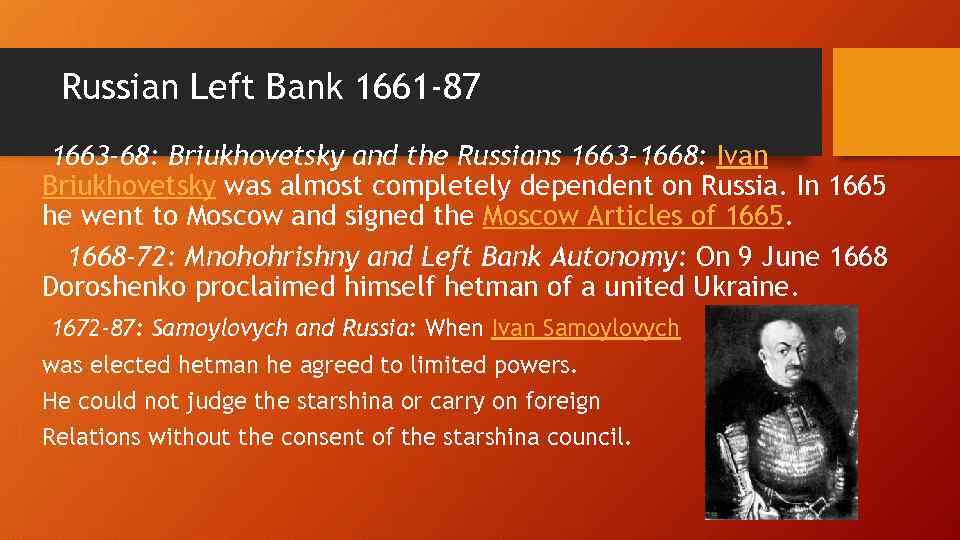 Russian Left Bank 1661 -87 1663 -68: Briukhovetsky and the Russians 1663 -1668: Ivan Briukhovetsky was almost completely dependent on Russia. In 1665 he went to Moscow and signed the Moscow Articles of 1665. 1668 -72: Mnohohrishny and Left Bank Autonomy: On 9 June 1668 Doroshenko proclaimed himself hetman of a united Ukraine. 1672 -87: Samoylovych and Russia: When Ivan Samoylovych was elected hetman he agreed to limited powers. He could not judge the starshina or carry on foreign Relations without the consent of the starshina council.
 Result • The attempt to create a Ruthenian Cossack state failed. • Ukraine was partitioned between Russia and Poland along the Dnieper. • Poland lost the left bank, was weakened and went into decline • Russia expanded to the south and somewhat to the southwest. • There was a major shift of Ruthenian population from the devastated right bank to the left bank and Sloboda Ukraine, thereby increasing the area under peasant agriculture. • Turkey briefly expanded its power into Ukraine (Doroshenko to about 1699).
 THANKS FOR YOUR ATTENTION