


 Скачать презентацию Causes and Consequences of Environmental Degradation Martin Donohoe
cf2b084ac151c6dc575370dcb2769965.ppt
- Количество слайдов: 102
 Causes and Consequences of Environmental Degradation Martin Donohoe
 Am I Stoned? A 1999 Utah anti-drug pamphlet warns: “Danger signs that your child may be smoking marijuana include excessive preoccupation with social causes, race relations, and environmental issues”
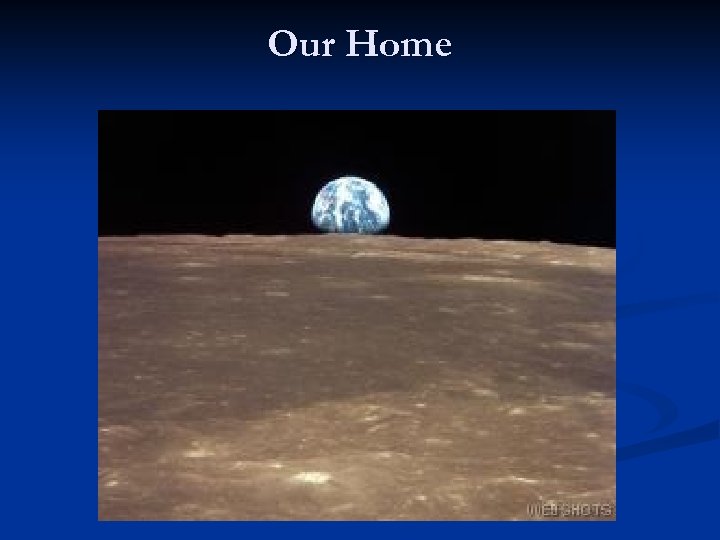 Our Home
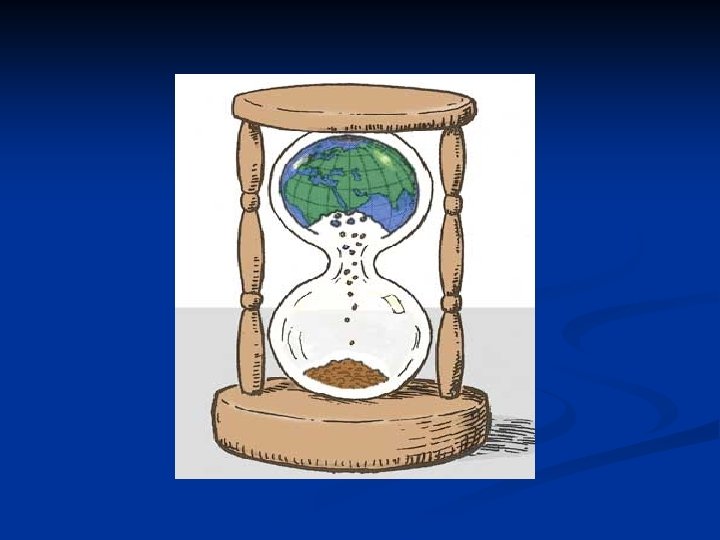
 Overpopulation n World population - exponential growth n 1 billion in 1800 n 2. 5 billion in 1950 n 6 billion in 2000 n 7 billion in 2011
 Overpopulation n n Africa, Asia, and Latin America primarily affected Causes: n Poverty n Women’s rights issues n impaired access to reproductive health care and education n political/legal/economic/social marginalization
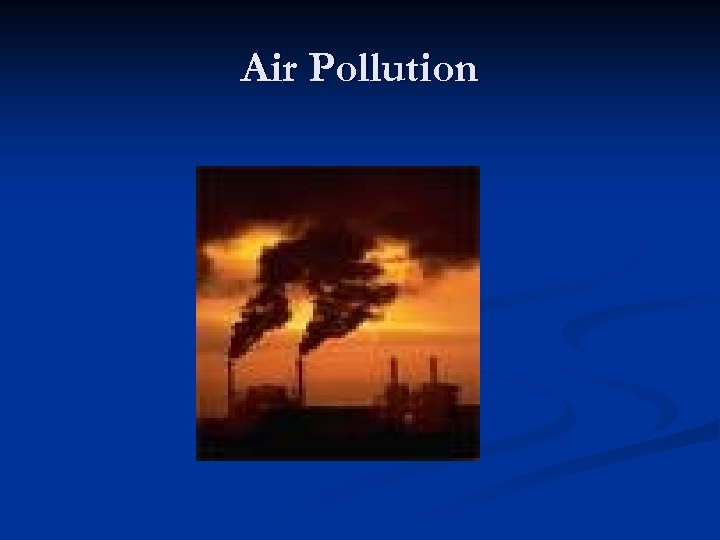 Air Pollution
 Health Effects of Air Pollution n Causes approximately 60, 000 - 75, 000 premature deaths/yr. in U. S. n 656, 000 in China n Over 2 million worldwide
 Health Effects of Air Pollution MI n CHF n Ventricular arrythmias n Asthma/COPD n PVD n Cerebrovascular disease n Multiple other illnesses n
 Air Pollution Indoor combustion of coal and biomass for cooking, heating and food preservation n 3 billion people worldwide n 2 million deaths/yr n Tobacco smoke n 5. 4 million deaths/yr worldwide (1/10 deaths) n
 Air Pollution: The Good News n Reductions in air pollution under Clean Air Act Account for up to 15% of overall increase in life expectancy in major U. S. metropolitan areas n Saved 160, 000 lives in 2010
 Effects of Ozone Destruction n Ozone hole over Antarctic (2½X size of Europe) n. Shrinking n Increased cataracts (UV damage) n Increased lifetime melanoma risk n 1/1500 - 1930 n 1/68 - today
 US Energy Consumption by Fuel Oil – 37% - peak oil production expected 2014 n Natural gas – 24% n Coal – 22% - peak coal production 1920 n Nuclear – 8. 5% n Renewables (mostly hydroelectric and biomass; small amounts of geothermal, wind, and solar) – 7. 3% n
 Oil and War n Countries that export oil are >40 times more likely to be engaged in civil war than those that do not n Gulf Wars I and II n The Future – Water Wars
 Toxins/Pesticides n 6 trillion tons of over 85, 000 chemicals produced annually n More than 90% have never been screened for toxicity n 5 billion lbs/yr pesticides worldwide n 1. 1 billion lbs/yr in U. S. n About 3 lbs/person/yr in U. S.
 Pesticides EPA: U. S. farm workers suffer up to 300, 000 pesticide-related acute illnesses and injuries per year n 25 million cases/yr worldwide n NAS: Pesticides in food could cause up to 1 million cancers in the current generation of Americans n WHO: 1, 000 people killed by pesticides over the last 6 years n
 Health Effects of Pesticides Autism n Parkinson’s Disease n Alzheimer’s disease n Diabetes n Obesity (with prenatal exposure) n Depression n ADHD n Endocrine/reproductive effects n
 Toxic Pollutants n 85, 000 known or suspected hazardous waste sites in the U. S. n Environmental Racism n Waste dumps/incinerators more common in lower SES neighborhoods n“Cancer Belt” (Baton Rogue to New Orleans)
 Infamous Industrial Disasters n Minimata, Japan n Love Canal n Bhopal, India n Chernobyl, USSR
 Infamous Industrial Disasters n Alaska, Exxon Valdez, 1989 n 2006 BP Alaskan pipeline rupture n 2010 BP Gulf disaster n 2011 – Yellowstone pipe rupture
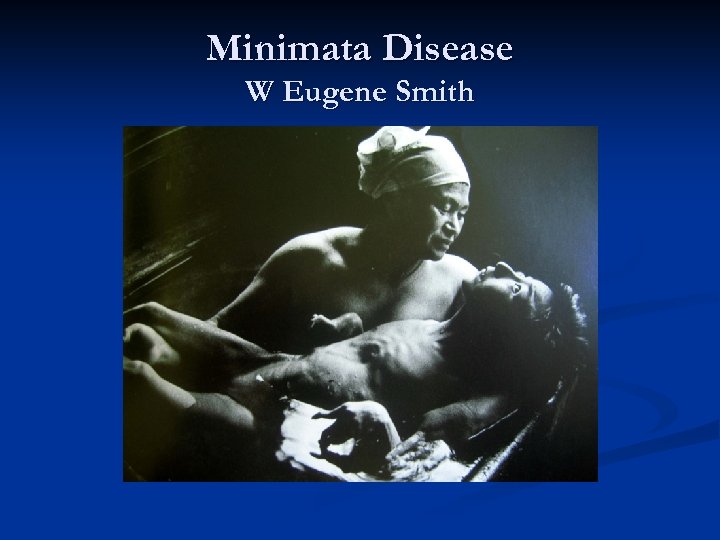 Minimata Disease W Eugene Smith
 Deforestation n Tropical forests constitute 7% of land surface area, contain > 50% of plant and animal species n Majority of tropical forests destroyed n One acre of world’s forest cut down every second n 50% of global wetlands destroyed (54% in U. S. )
 Deforestation n Historical -Easter Island (Polynesians), Middle East, U. S. Southwest (Anasazi Indians) n Contemporary -Mauritania, Ethiopia, Haiti deforested -Philippines and Thailand are now net importers of forest products, looking at Latin America
 Deforestation: Causes n New agricultural settlements (overpopulation, poverty, unsustainable farming practices) n Logging n Oil and gas exploration n Cattle ranching n Drug cultivation
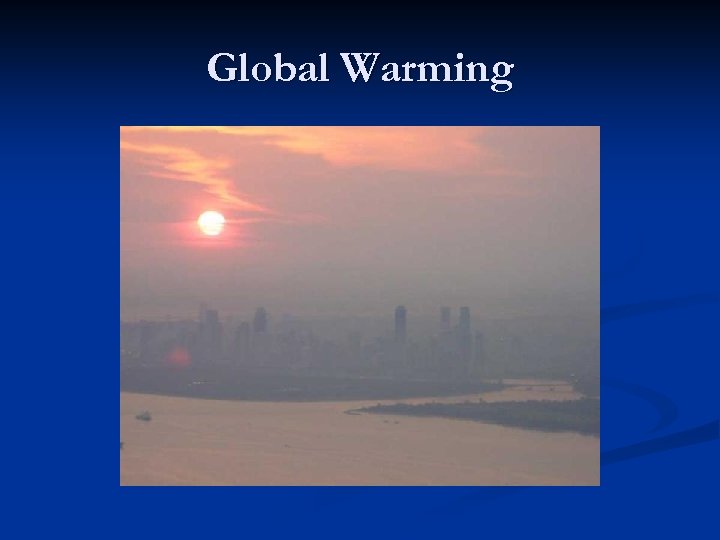 Global Warming
 Consequences of Global Warming n 160, 000 deaths and 5. 5 million disability- adjusted life years lost per year n WHO, UN Environment Program n Expected to double by 2020
 Consequences of Global Warming n Polar icecaps/glaciers/Greenland ice sheet/Himalayas/permafrost melting, sea levels rising n ↑ weather extremes/natural disasters/insurance claims n ↑ infectious diseases
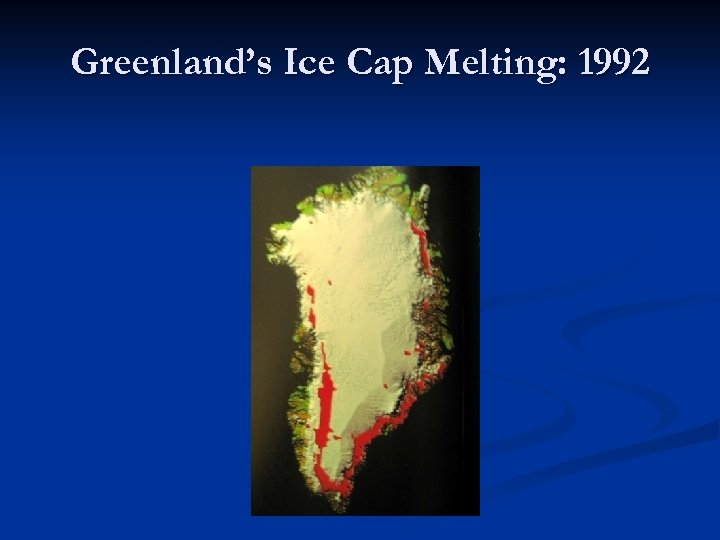 Greenland’s Ice Cap Melting: 1992
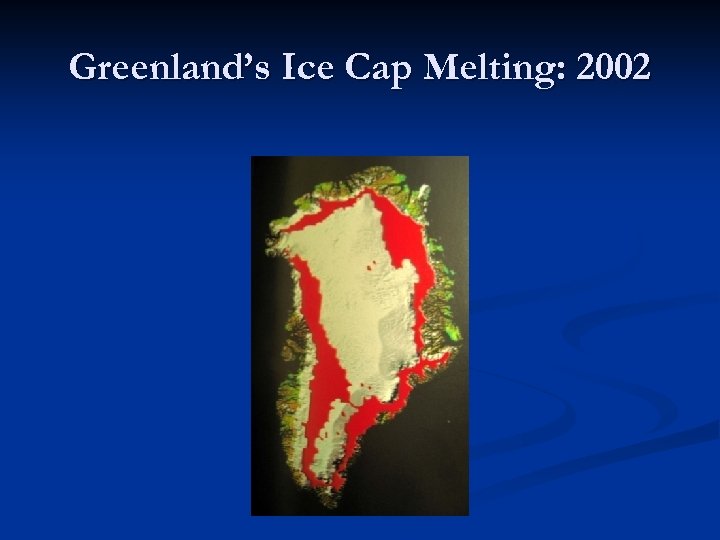 Greenland’s Ice Cap Melting: 2002
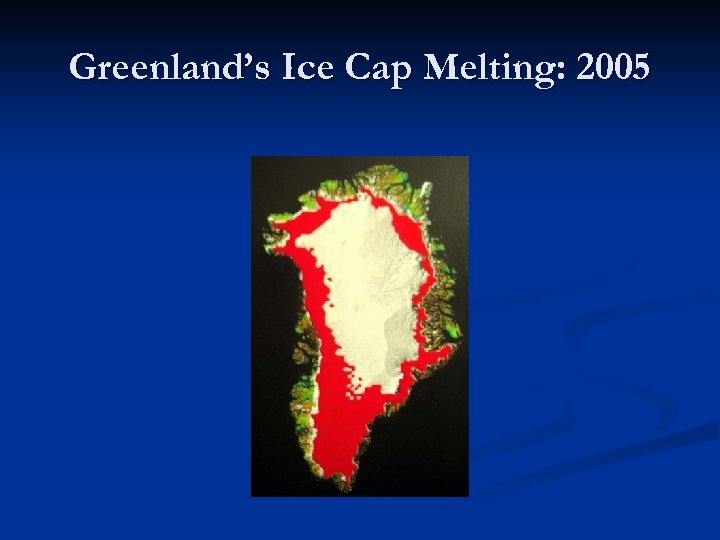 Greenland’s Ice Cap Melting: 2005
 Global Warming The top 1/5 of the world’s largest 145 countries account for 63% of global C 02 emissions (lowest 1/5 = 2%) n Countries most affected are those least responsible n Climate refugees n Disappearing locales: Tuvalu, Vanuatu, Kivalina (Alaska), Male (Maldives) n
 Agriculture n Global per capita cropland down over 50% from 1961 to present n Soil erosion exceeds soil formation n Decreasing crop diversity/genetic diversity n Consequences: vulnerability to disease, huge crop losses (e. g. , Irish potato famine)
 Factory Farming
 Factory Farming n Factory farms have replaced industrial factories as the # 1 polluters of American waterways n Agriculture accounts for 70% of U. S. antibiotic use n CDC: “Antibiotic use in food animals is the dominant source of antibiotic resistance among food-borne pathogens. ”
 Overfishing n Fisheries collapsing n Coral reef destruction n Aquaculture
 Species Loss n Rate of extinction = 4, 000 -6, 000 species/year n 1, 000 - 10, 000 X background rate of extinction
 Causes of Species Loss n Habitat loss (overpopulation, logging, etc. ) n Environmental pollution n Global warming n Exotic species invasions n Overhunting n Black market in endangered animals n HUMANS
 Maldistribution of Wealth n 500 billionaires worldwide n top 250 billionaires worth $1 trillion, the combined income of bottom 2. 5 billion people (45% of world’s population)
 Maldistribution of Wealth n U. S: Richest 1% of the population owns 50% of the country’s wealth -poorest 90% own 30% -widest gap of any industrialized nation n Associated with 880, 000 deaths per year over expected number if gap was same as in Western European nations
 Maldistribution of wealth n Less than 4% of the combined wealth of the 225 richest individuals in the world would pay for ongoing access to basic education, health care (including reproductive health care), adequate food, safe water, and adequate sanitation for all humans (UNDP)
 Declaration of Independence “All men are created equal. ”
 George Orwell “Some people are more equal than others”
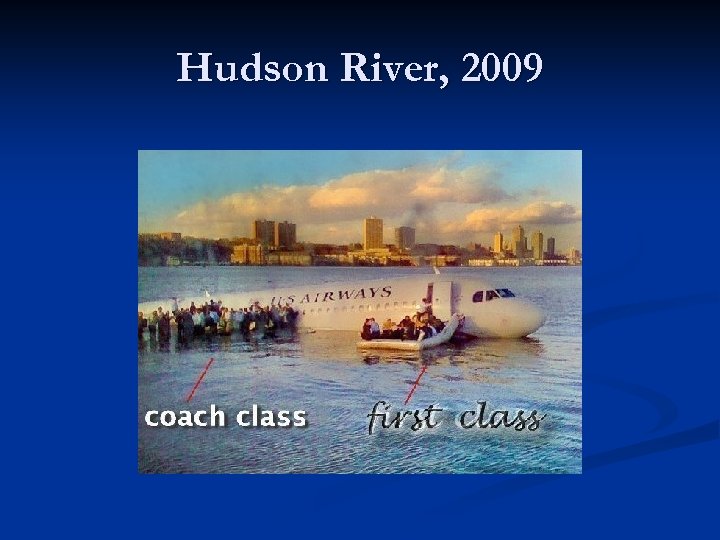 Hudson River, 2009
 Voltaire “The comfort of the rich rests upon an abundance of the poor”
 Maldistribution of Wealth/Resources Threatens National Security and Requires a Permanent War Economy n “The U. S. has about 50% of the world’s wealth, but only 6. 3% of its population. This situation cannot fail to be the object of envy and resentment. Our real task in the coming period is to devise a pattern of relationships which will permit us to maintain this position of disparity withoug positive detriment to our national security. ” n George Kennan, U. S. State Dept. Policy Planning Study, 1948
 Racial Disparities n Economic n Educational n Criminal justice system involvement n Discrimination
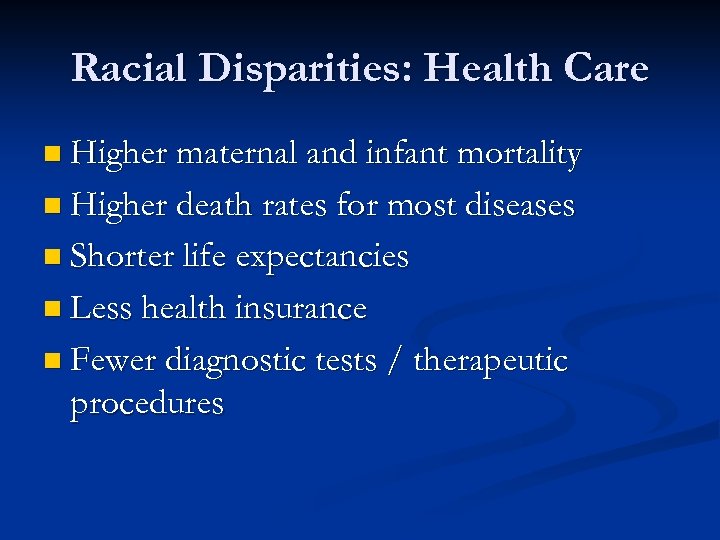 Racial Disparities: Health Care n Higher maternal and infant mortality n Higher death rates for most diseases n Shorter life expectancies n Less health insurance n Fewer diagnostic tests / therapeutic procedures
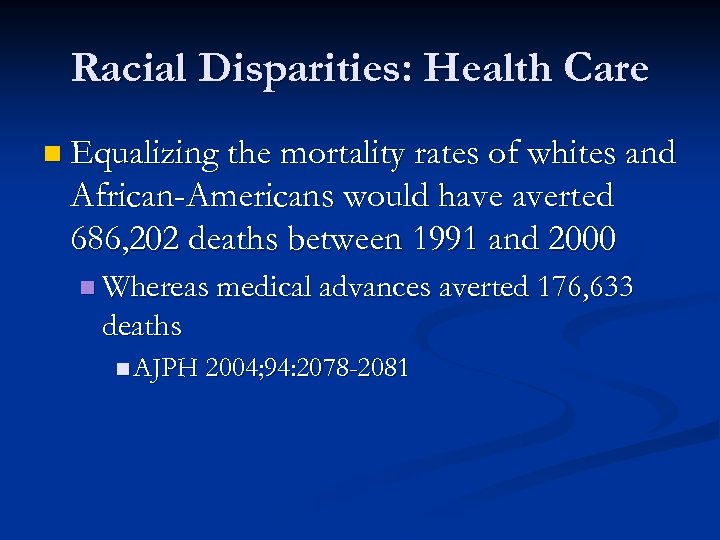 Racial Disparities: Health Care n Equalizing the mortality rates of whites and African-Americans would have averted 686, 202 deaths between 1991 and 2000 n Whereas medical advances averted 176, 633 deaths n AJPH 2004; 94: 2078 -2081
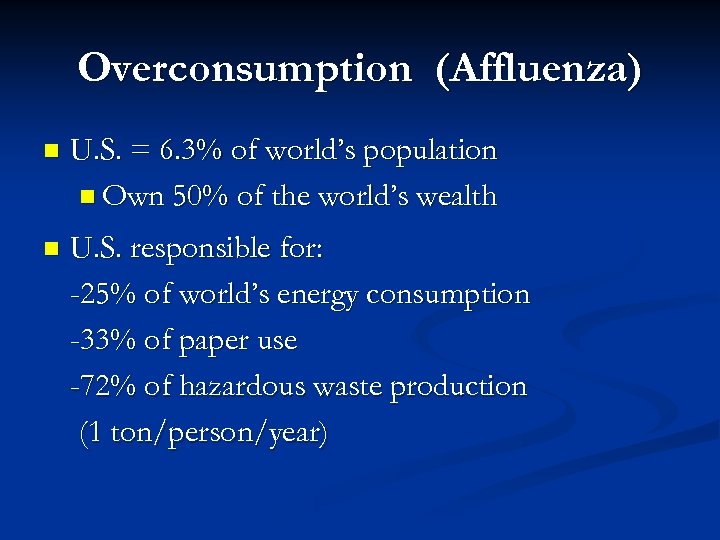 Overconsumption (Affluenza) n U. S. = 6. 3% of world’s population n Own 50% of the world’s wealth n U. S. responsible for: -25% of world’s energy consumption -33% of paper use -72% of hazardous waste production (1 ton/person/year)
 But are we happier? n Workloads increasing, vacation and free time decreasing n U. S. : Only OECD country not to guarantee paid vacation and sick leave n Erosion of social capital
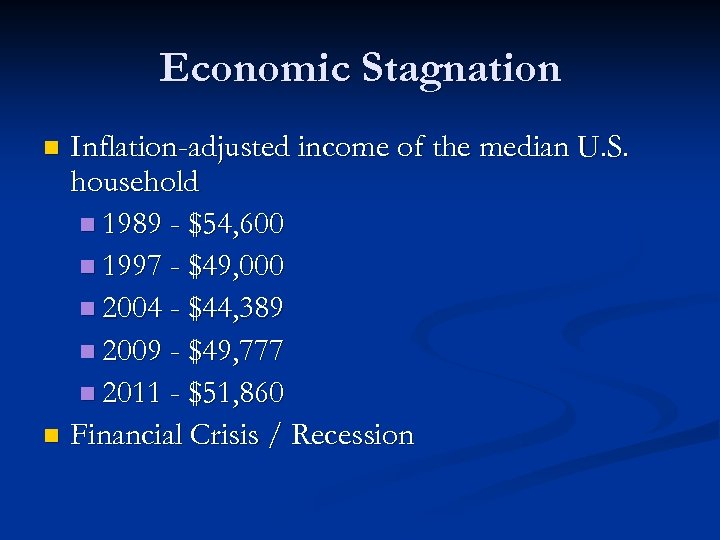 Economic Stagnation Inflation-adjusted income of the median U. S. household n 1989 - $54, 600 n 1997 - $49, 000 n 2004 - $44, 389 n 2009 - $49, 777 n 2011 - $51, 860 n Financial Crisis / Recession n
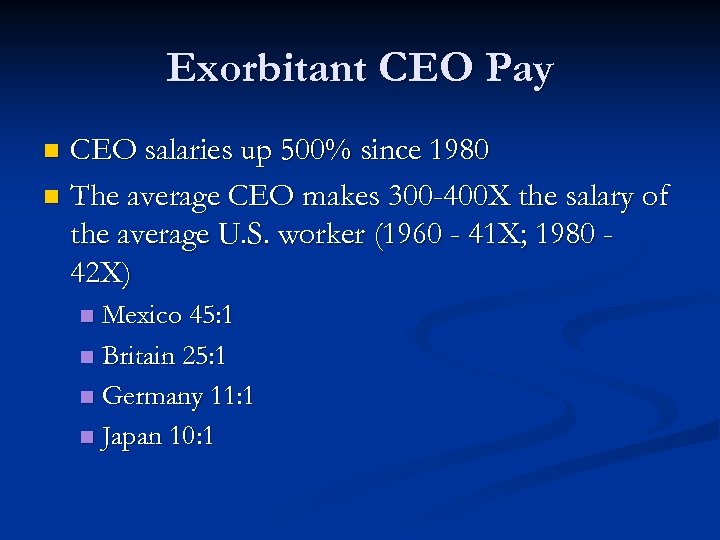 Exorbitant CEO Pay CEO salaries up 500% since 1980 n The average CEO makes 300 -400 X the salary of the average U. S. worker (1960 - 41 X; 1980 42 X) n Mexico 45: 1 n Britain 25: 1 n Germany 11: 1 n Japan 10: 1 n
 The “Global Economy” n 53 of the world’s 100 largest economies are private corporations; 47 are countries n Wal-Mart is larger than Israel and Greece n AT&T is larger than Malaysia and Ireland
 Corporations n Almost 6 million corporations n 500 companies control 70% of world trade
 Corporations n Internalize profits n Externalize health and environmental costs n Confidential legal settlements keep important public health and safety information secret n May delay governmental intervention, cause unnecessary morbidity and mortality
 Corporate Taxation n Corporations shouldered over 30% of the nation’s tax burden in 1950 vs. 6. 5% today (“real rate” = 2. 8% per U. S. Treasury Department) n Corporate taxes are at their lowest level since WW II
 Reasons for Inadequate Corporate Taxation n Tax breaks, corporate welfare, corporation- friendly tax laws, loopholes, transferring assets overseas n Cheating and under-payment common n Offshore tax havens shelter capital
 Ugland House, Cayman Islands 18, 000 Corporations Registered Here
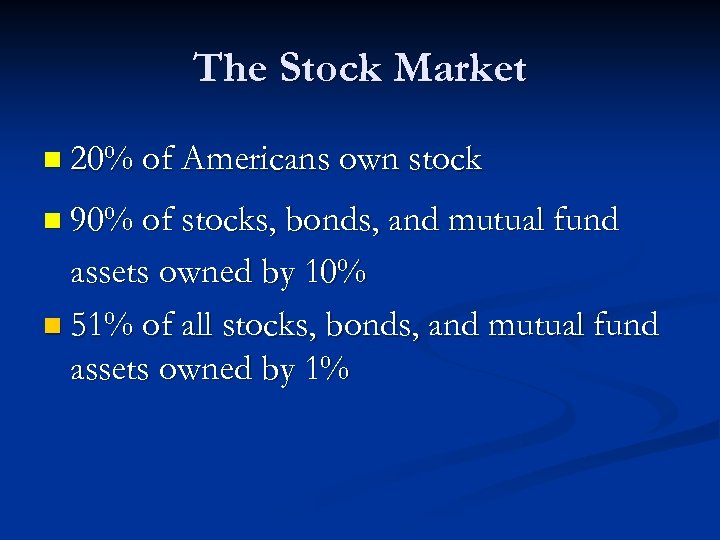 The Stock Market n 20% of Americans own stock n 90% of stocks, bonds, and mutual fund assets owned by 10% n 51% of all stocks, bonds, and mutual fund assets owned by 1%
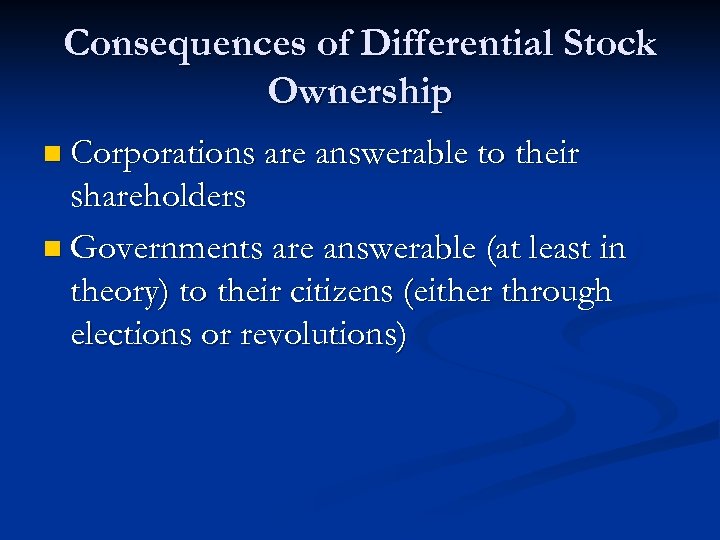 Consequences of Differential Stock Ownership n Corporations are answerable to their shareholders n Governments are answerable (at least in theory) to their citizens (either through elections or revolutions)
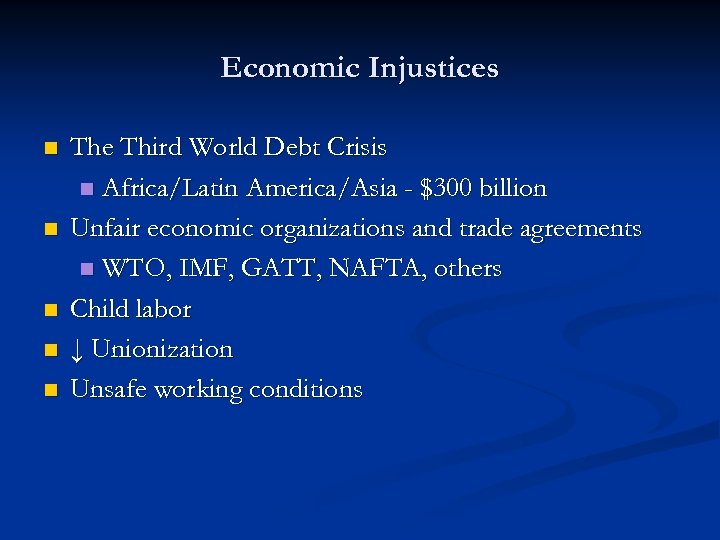 Economic Injustices n n n The Third World Debt Crisis n Africa/Latin America/Asia - $300 billion Unfair economic organizations and trade agreements n WTO, IMF, GATT, NAFTA, others Child labor ↓ Unionization Unsafe working conditions
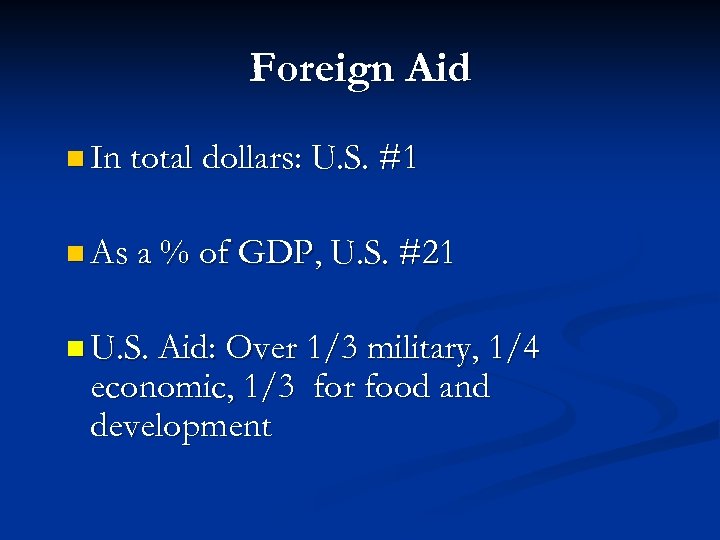 Foreign Aid n In total dollars: U. S. #1 n As a % of GDP, U. S. #21 n U. S. Aid: Over 1/3 military, 1/4 economic, 1/3 for food and development
 Foreign Aid n 0. 9% of the total federal budget n On average, Americans think that 24% of the federal budget goes toward foreign aid
 U. S. Charitable Giving n Approximately $250 billion/year n 2. 5% of income n 2. 9% at height of Great Depression
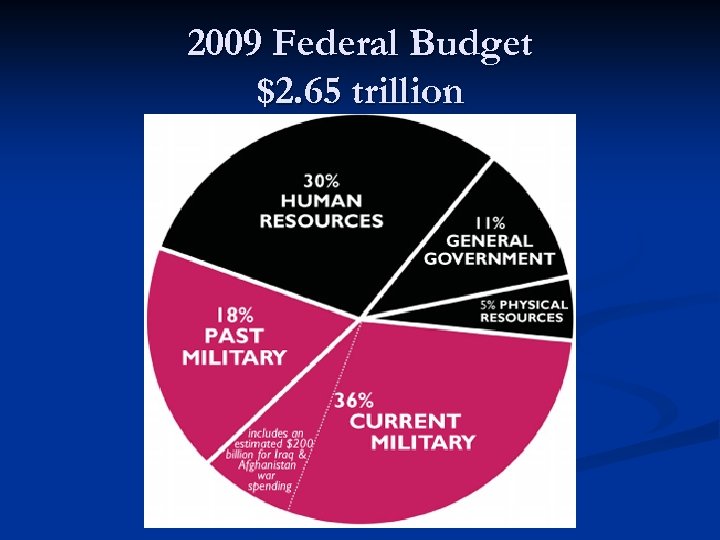 2009 Federal Budget $2. 65 trillion
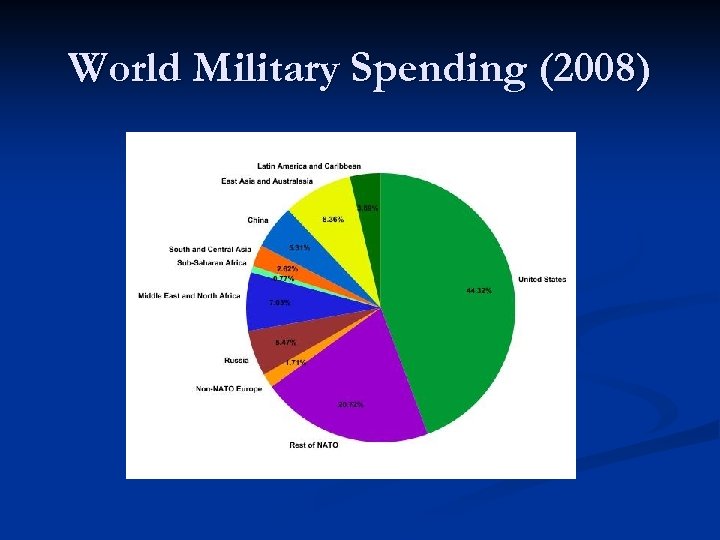 World Military Spending (2008)
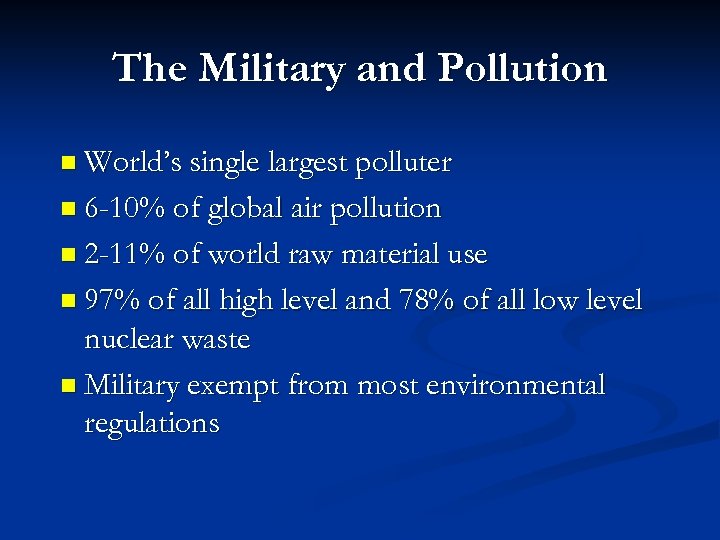 The Military and Pollution n World’s single largest polluter n 6 -10% of global air pollution n 2 -11% of world raw material use n 97% of all high level and 78% of all low level nuclear waste n Military exempt from most environmental regulations
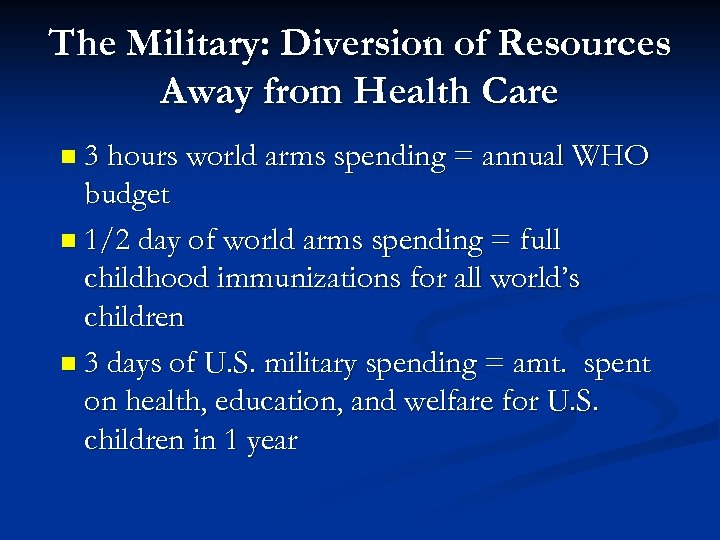 The Military: Diversion of Resources Away from Health Care n 3 hours world arms spending = annual WHO budget n 1/2 day of world arms spending = full childhood immunizations for all world’s children n 3 days of U. S. military spending = amt. spent on health, education, and welfare for U. S. children in 1 year
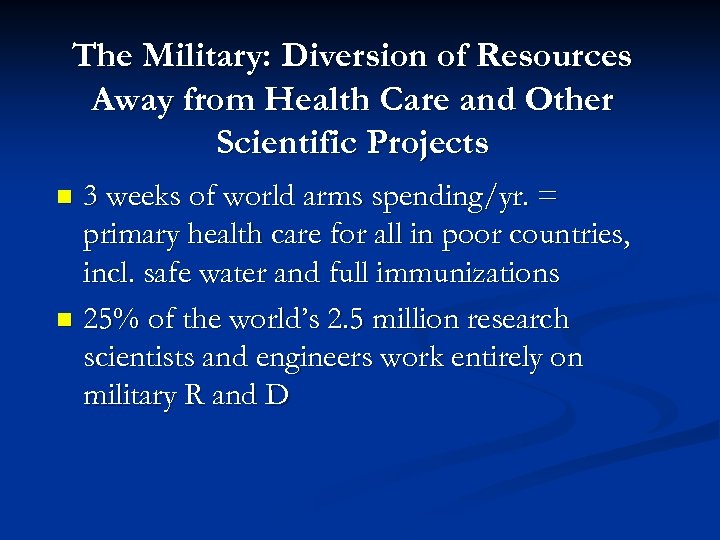 The Military: Diversion of Resources Away from Health Care and Other Scientific Projects 3 weeks of world arms spending/yr. = primary health care for all in poor countries, incl. safe water and full immunizations n 25% of the world’s 2. 5 million research scientists and engineers work entirely on military R and D n
 “Every gun that is made, every warship launched, every rocket fired, signifies in the final sense a theft from those who hunger and are not fed, those who are cold and not clothed. ” ~ Dwight D. Eisenhower
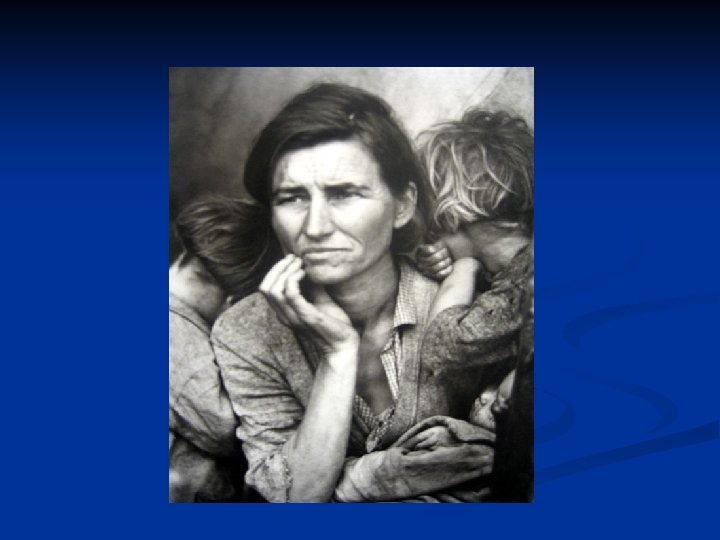
 Poverty and Hunger n US: 14% of residents and 20% of children live in poverty n Rates of poverty in Blacks and Hispanics = almost 3 X Whites n 17% (52 million people) lack health insurance (2011) n Poverty associated with worse physical and mental health
 Poverty n 1. 1 billion people lack access to safe, clean drinking water -1. 8 million child deaths/year n 2 billion have no electricity n 2. 6 billion do not have adequate sanitation services n Lack of clean water and sanitation cause 4 billion cases of diarrhea and 1. 6 million deaths per year
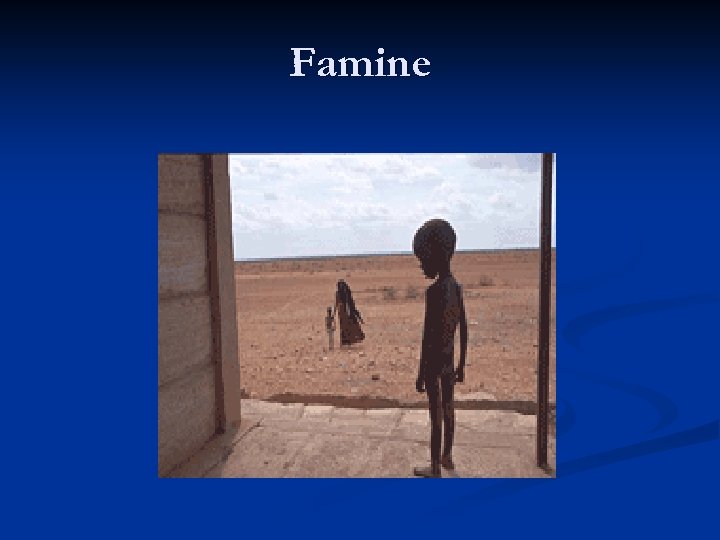 Famine
 Famine n 1. 5 billion malnourished n Hunger kills 18, 000 people per day, most under age 5 n Hunger-related causes kill as many people in 8 days as the atomic bomb killed at Hiroshima
 Poverty and Priorities n Amount of money needed each year (in addition to current expenditures) to provide water and sanitation for all people in developing nations = $9 billion n Amount of money spent annually on cosmetics in the U. S. = $8 billion
 Poverty and Priorities n Amount of money needed each year ( in addition to current expenditures) to provide reproductive health care for all women in developing countries = $12 billion n Amount of money spent annually on perfumes in Europe and the U. S. = $12 billion
 Medical Care n 50% of global health care budget spent in the U. S. n Per capita expenditure on health care: n U. S. = $8, 160 n Typical poor African/Asian country = $5 -10
 Medical Care n U. S. - 52 million uninsured n Ranks 24 th worldwide in overall population health (as judged by disability-adjusted life expectancy) n Ranks 42 nd in global life expectancy
 Headline from The Onion Uninsured Man Hopes His Symptoms Diagnosed This Week On House
 Would You Sign a Petition to Ban Dihydrogen Monoxide? 1. It can cause excessive sweating and vomiting 2. It is a major component in acid rain 3. It can cause severe burns in its gaseous state 4. It can kill you if accidentally inhaled 5. It contributes to erosion 6. It decreases effectiveness of automobile brakes 7. It has been found in tumors of terminal cancer patients
 Geographic Ignorance n Percent of US teens unable to locate the following on a map: n United States – 11% n Pacific Ocean – 29% n United Kingdom – 68%
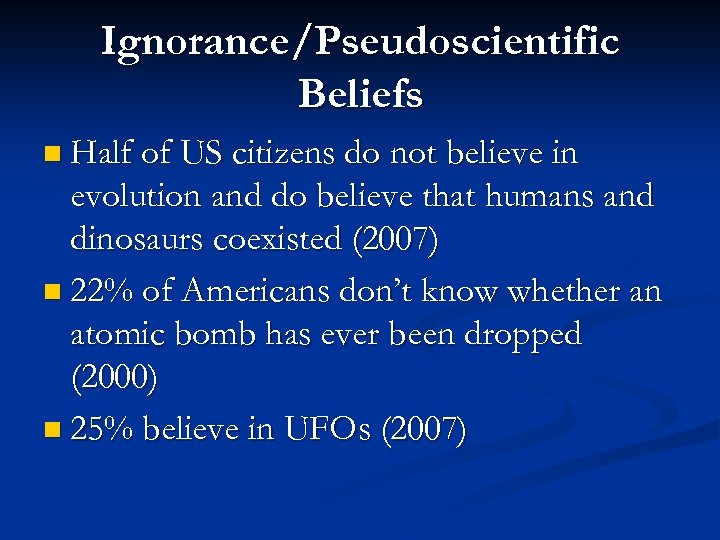 Ignorance/Pseudoscientific Beliefs n Half of US citizens do not believe in evolution and do believe that humans and dinosaurs coexisted (2007) n 22% of Americans don’t know whether an atomic bomb has ever been dropped (2000) n 25% believe in UFOs (2007)
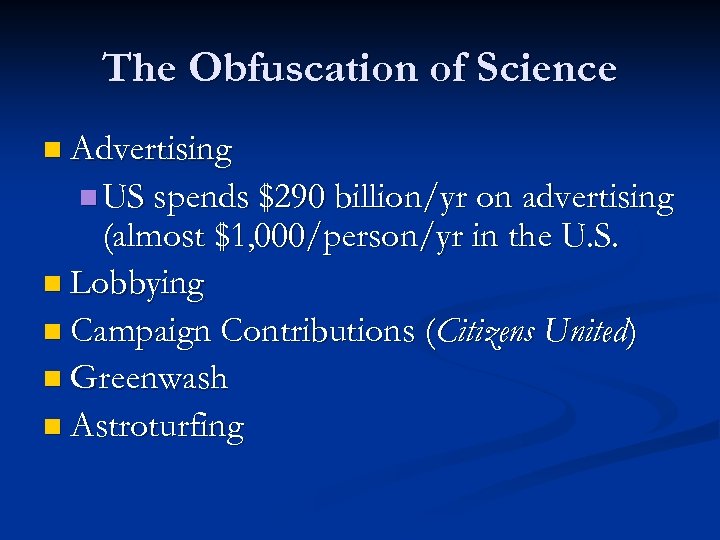 The Obfuscation of Science n Advertising n US spends $290 billion/yr on advertising (almost $1, 000/person/yr in the U. S. n Lobbying n Campaign Contributions (Citizens United) n Greenwash n Astroturfing
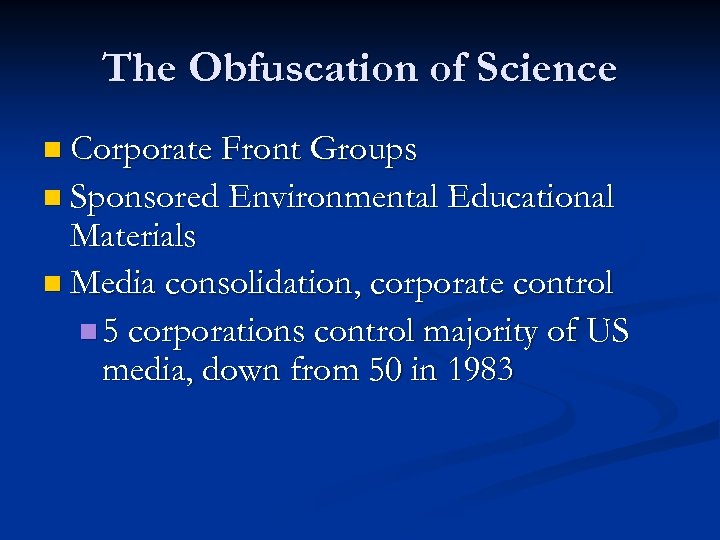 The Obfuscation of Science n Corporate Front Groups n Sponsored Environmental Educational Materials n Media consolidation, corporate control n 5 corporations control majority of US media, down from 50 in 1983
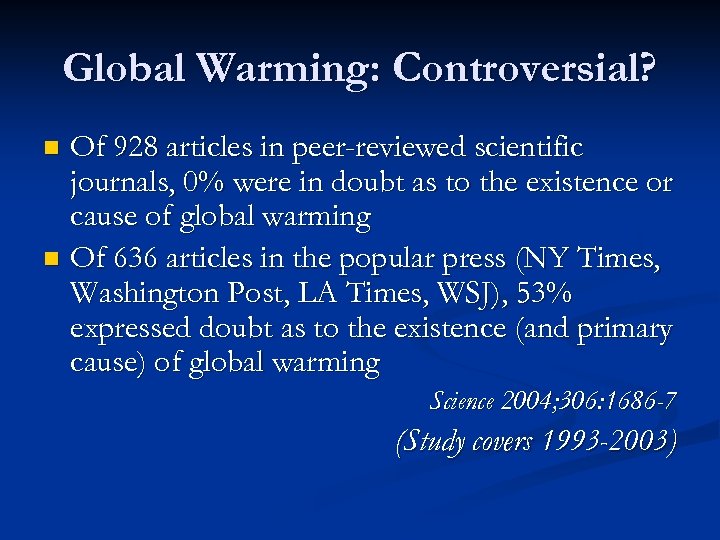 Global Warming: Controversial? Of 928 articles in peer-reviewed scientific journals, 0% were in doubt as to the existence or cause of global warming n Of 636 articles in the popular press (NY Times, Washington Post, LA Times, WSJ), 53% expressed doubt as to the existence (and primary cause) of global warming n Science 2004; 306: 1686 -7 (Study covers 1993 -2003)
 Lobbying n Over 15, 000 full-time lobbyists n Estimates of return on lobbying range from $28 to $100 for every $1 spent
 Lobbying n Lobbying groups spent 3. 5 billion in 2010 (federal lobbying, a record) All single issue ideological groups combined (e. g. , pro-choice, anti-abortion, feminist and consumer organizations, senior citizens, etc. ) = $76 million n SCOTUS’ Citizens United decision has opened the floodgates for unlimited corporate contributions n
 The Decline of Democracy n True democracy demands an informed citizenry (education), freedom of the press (media), and involvement (will, time, money) n Democracy is critical to the success of public health
 Corporations and International Agreements n Corporations attempt to influence writing and acceptance/rejection of international agreements n Through misinformation, lobbyists, revolving door between industry and government n Large behind the scenes role
 International Non. Cooperation/Isolationism n Failure to sign or approve: n Kyoto Protocol on Climate Change n International Covenant on Economic, Social, and Cultural Rights n Convention on the Prohibition of Anti. Personnel Land Mines
 International Non. Cooperation/Isolationism n Failure to sign or approve: n Treaty to ban cluster bombs Convention on the Rights of the Child n Convention on the Elimination of Discrimination Against Women
 International Non. Cooperation/Isolationism n Failure to sign or approve: n WHO Code of Conduct for Marketing Breast Milk Substitutes n Convention for the Suppression of Traffic in Persons n The Stockholm Convention on Persistent Organic Pollutants
 Primo Levi “A country is considered the more civilized the more the wisdom and efficiency of its laws hinder a weak man from becoming too weak or a powerful one too powerful. ”
 Solutions n Stronger environmental laws n Restructure tax system n Renewable energy n More equitable distribution of medical research funds and health care dollars n Single payer health care (PHM/PHC)
 Solutions n Improve status of women / access to reproductive health care n Living wage laws n E. g. , NY, LA, Chicago, and Philadelphia n Create maximum wage n Reform education
 Solutions n Publicly financed campaigns and campaign finance reform n Proportional representation n Instant runoff voting/cumulative voting/range (rating) voting
 Solutions: Vote US voter turnout low (139/172 worldwide) n Wealthy vote at almost twice rate of poor n Whites > Blacks > Hispanics n Old > Young n Property owners > Renters n Activism / Protesting / Whistleblowing n Work in Groups (PSR) n
 Günter Grass “The first job of a citizen is to keep your mouth open. ”
 Anita Roddick "If you think you are too small to have an impact, try going to bed with a mosquito in your tent"

 Public Health and Social Justice Website http: //www. publichealthandsocialjustice. org http: //www. phsj. org martindonohoe@phsj. org