


 Скачать презентацию Causative Construction in Magahi Deepak Alok M A
d1025b9852544980bab9fe388f67936d.ppt
- Количество слайдов: 35
 Causative Construction in Magahi Deepak Alok (M. A. Previous) Department of Linguistics Banaras Hindu University Email : deepak 113 alok@yahoo. co. in 3/16/2018 Deepak 1
 ABOUT THE TOPIC l Causative constructions play a significant role in different areas of the grammar of a language. l Some languages exhibit morphological causativization whereas some languages undergo complex syntactic processes to realize causative constructions. l Magahi like major indic language such as Hindi, Maithali, Bangla show morphological marking to realize causativization of a verb (ha. T ‘move’ -> ha. Taa ‘remove something/somebody’ -> ha. T-baa ‘cause/have somebody to remove something/somebody’). 3/16/2018 Deepak 2
 ABOUT THE TOPIC. . . CONT. l. Causative employs a process of causation, i. e, ‘we assume that there is an external factor, which has forced the normal situation to cause something’. 3/16/2018 Deepak 3
 Criteria to define a causative construction l It is a single event constituting of two sub-events. l These sub-events can be sequential. l One of the sub-event causes the other to happen, and l There must be some argument sharing between the two sub-events. 3/16/2018 Deepak 4
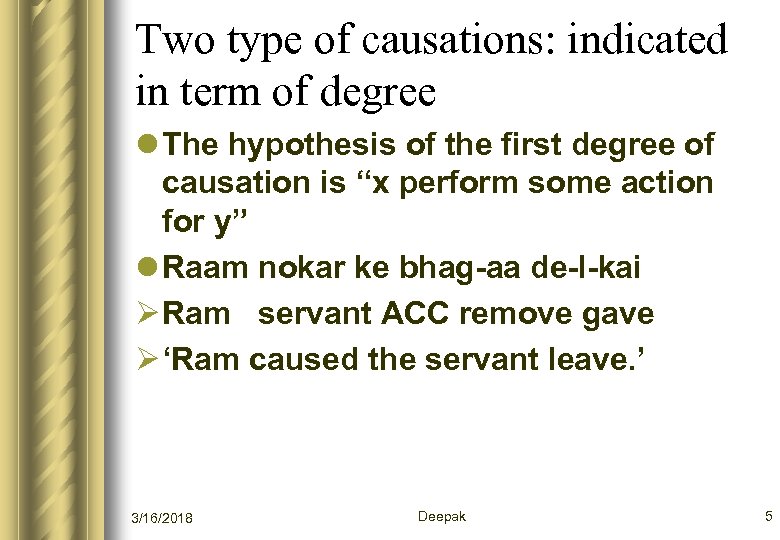 Two type of causations: indicated in term of degree l The hypothesis of the first degree of causation is “x perform some action for y” l Raam nokar ke bhag-aa de-l-kai Ø Ram servant ACC remove gave Ø ‘Ram caused the servant leave. ’ 3/16/2018 Deepak 5
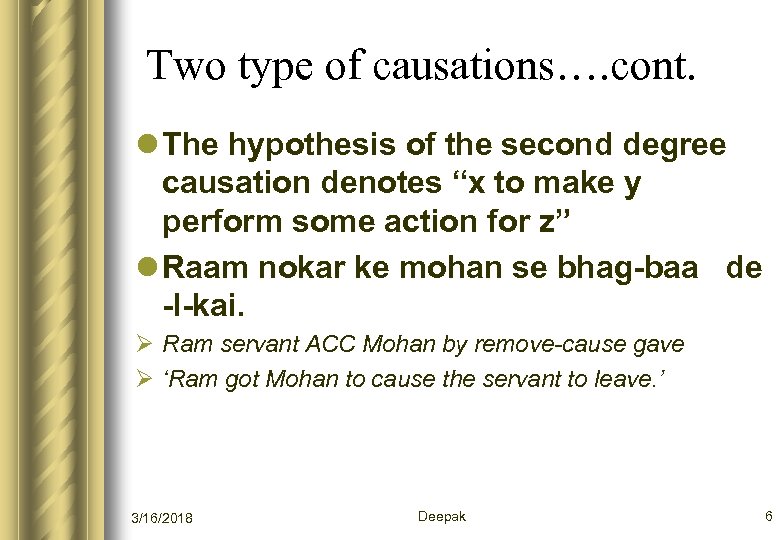 Two type of causations…. cont. l The hypothesis of the second degree causation denotes “x to make y perform some action for z” l Raam nokar ke mohan se bhag-baa de -l-kai. Ø Ram servant ACC Mohan by remove-cause gave Ø ‘Ram got Mohan to cause the servant to leave. ’ 3/16/2018 Deepak 6
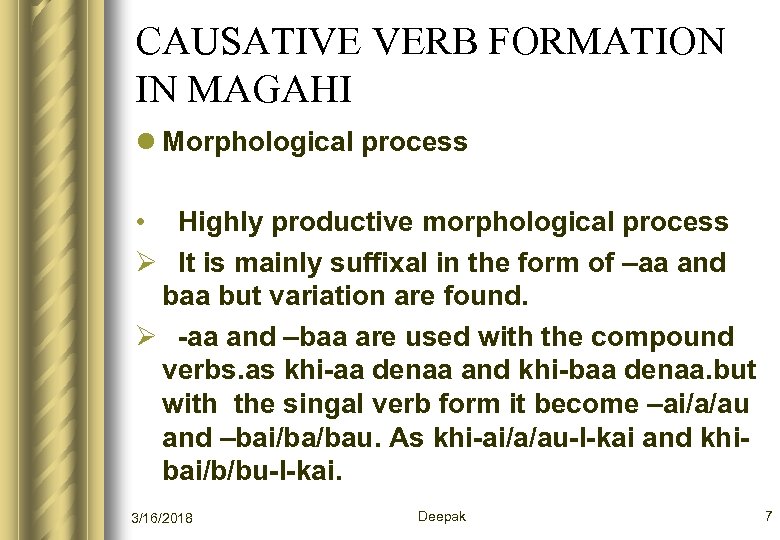 CAUSATIVE VERB FORMATION IN MAGAHI l Morphological process • Highly productive morphological process Ø It is mainly suffixal in the form of –aa and baa but variation are found. Ø -aa and –baa are used with the compound verbs. as khi-aa denaa and khi-baa denaa. but with the singal verb form it become –ai/a/au and –bai/ba/bau. As khi-ai/a/au-l-kai and khibai/b/bu-l-kai. 3/16/2018 Deepak 7
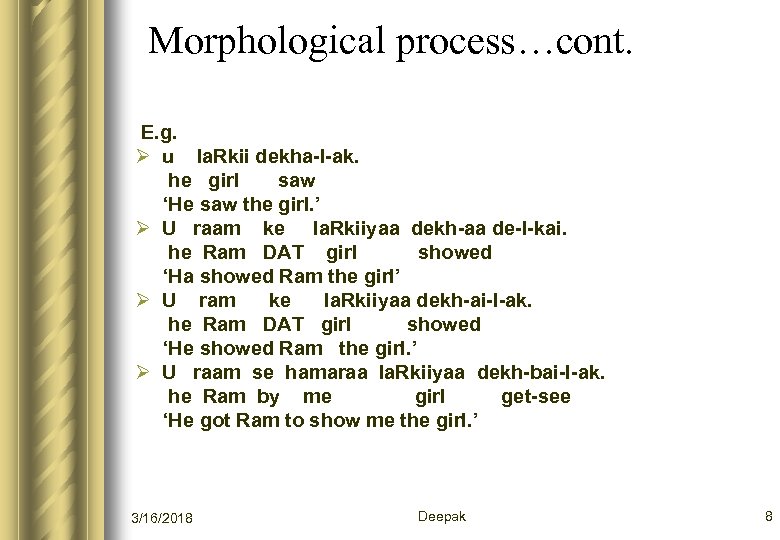 Morphological process…cont. E. g. Ø u la. Rkii dekha-l-ak. he girl saw ‘He saw the girl. ’ Ø U raam ke la. Rkiiyaa dekh-aa de-l-kai. he Ram DAT girl showed ‘Ha showed Ram the girl’ Ø U ram ke la. Rkiiyaa dekh-ai-l-ak. he Ram DAT girl showed ‘He showed Ram the girl. ’ Ø U raam se hamaraa la. Rkiiyaa dekh-bai-l-ak. he Ram by me girl get-see ‘He got Ram to show me the girl. ’ 3/16/2018 Deepak 8
 Morphological process. . cont. Ø I also used the –aa and the –baa suffix with stem to indicate derivied form likh ‘write’ -> likh-aa ‘dictate’ -> likh-baa ‘get written (by somebody)’ – dekh ‘see’ -> dekh-aa ‘show’ -> dekh-baa ‘get (somebody) see/show’ 3/16/2018 Deepak 9
 Morphological process…cont. Ø First causative is formed by adding the suffix ‘-aa’ to the non-causative verb stem which implies that the degree of closeness between cause and effect is immediate or direct. E. g. bhag-aa ‘to cause (somebody) to leave’ Ø The second causative is formed by adding the suffix ‘-baa’ to the non-causative verb stem which implies that the degree of closeness between cause and effect is mediated or less direct. E. g. bhaga-baa ‘to get (somebody) cause (somebody) to leave’ 3/16/2018 Deepak 10
 Magahi has mainly three contrasting verb forms l The basic non-causative verb form, E. g. Ø bhaag ‘to leave’ (intransitive), (it is a polysemous word, I ignore its other meanings) Ø dekh ‘see’(transitive) l The first causative form Ø bhag-aa ‘to cause leave’ Ø dekh-aa/dikh aapa. R-aa ‘to show’ 3/16/2018 Deepak 11
 Magahi has…. . cont. l The second causative form, E. g. bhag-baa ‘to get (sb) to cause (sb) leave’ dekh-baa‘to get (sb) show (st) to somebody’ l This is the view that can be applied only with the verb that have clear distinction between these two suffix-aa and –baa. 3/16/2018 Deepak 12
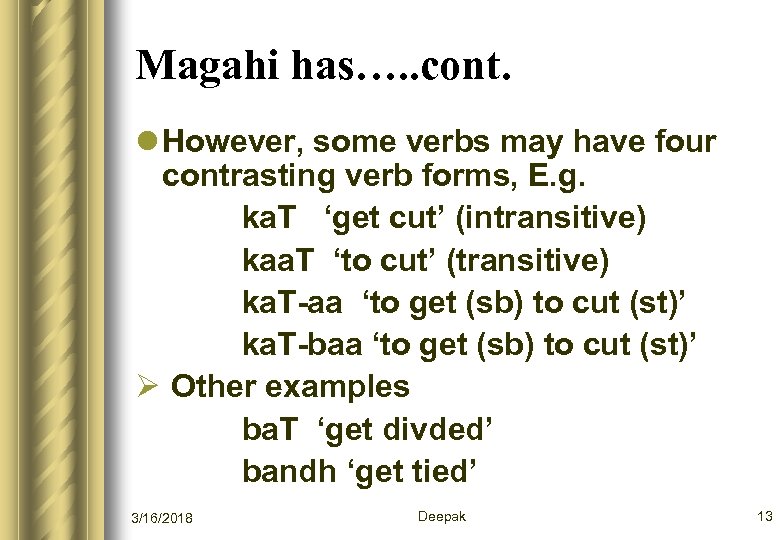 Magahi has…. . cont. l However, some verbs may have four contrasting verb forms, E. g. ka. T ‘get cut’ (intransitive) kaa. T ‘to cut’ (transitive) ka. T-aa ‘to get (sb) to cut (st)’ ka. T-baa ‘to get (sb) to cut (st)’ Ø Other examples ba. T ‘get divded’ bandh ‘get tied’ 3/16/2018 Deepak 13
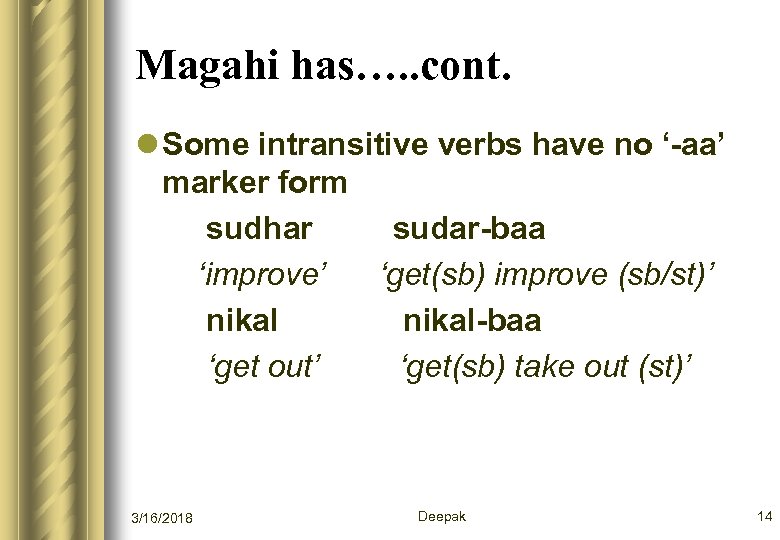 Magahi has…. . cont. l Some intransitive verbs have no ‘-aa’ marker form sudhar sudar-baa ‘improve’ ‘get(sb) improve (sb/st)’ nikal-baa ‘get out’ ‘get(sb) take out (st)’ 3/16/2018 Deepak 14
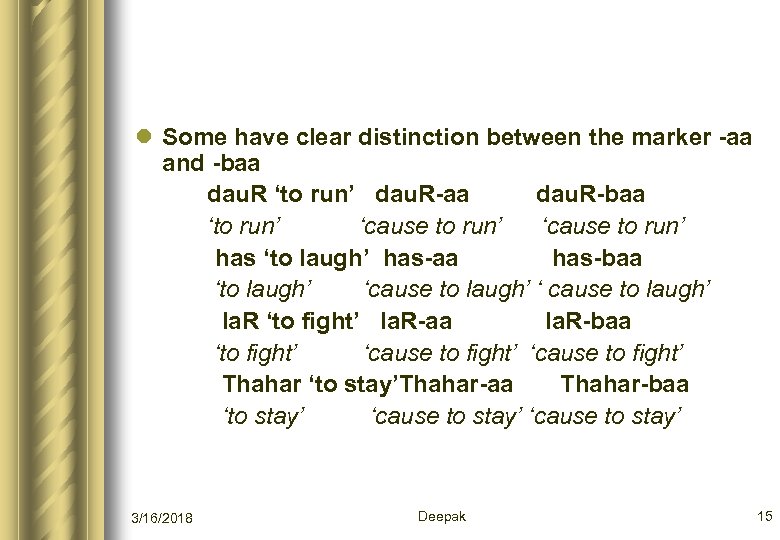 l Some have clear distinction between the marker -aa and -baa dau. R ‘to run’ dau. R-aa dau. R-baa ‘to run’ ‘cause to run’ has ‘to laugh’ has-aa has-baa ‘to laugh’ ‘cause to laugh’ ‘ cause to laugh’ la. R ‘to fight’ la. R-aa la. R-baa ‘to fight’ ‘cause to fight’ Thahar ‘to stay’Thahar-aa Thahar-baa ‘to stay’ ‘cause to stay’ 3/16/2018 Deepak 15
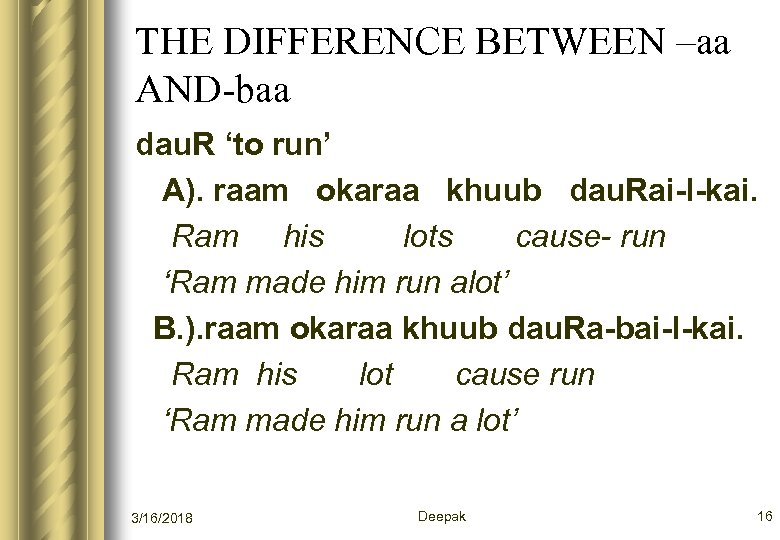 THE DIFFERENCE BETWEEN –aa AND-baa dau. R ‘to run’ A). raam okaraa khuub dau. Rai-l-kai. Ram his lots cause- run ‘Ram made him run alot’ B. ). raam okaraa khuub dau. Ra-bai-l-kai. Ram his lot cause run ‘Ram made him run a lot’ 3/16/2018 Deepak 16
 THE DIFFERENCE…. CONT. l In (A), the causer of the action is Ram and is closed/direct to the cause okaraa ‘him’. That is, Ram is directly involved in making the agent of run to perform the action. However, there may be other intermediate agents as causers. l In (B), on the other hand, Ram is causer of the action who is not directly involved in causing the action of running. There is an intermediate causer (implicit) who is directly causing the agent of run to perform the action. l The difference between (A) and (B) is that the intermediate cause is prominent in (B) whereas it is non-prominent in (A). 3/16/2018 Deepak 17
 THE DIFFERENCE…. CONT. (C) u nauaa se apan kes ka. T-ai-l-ak/ka. T-bai-l-ak. He barbar by self hair cut/got cut ‘He got his (own) hair cut by the barbar’ (D) u nauaa se okar kes *ka. T-ai-l-ak/ka. T-bai-l-ak He barbar by his hair cut/got cut ‘He got his hair cut by the barbar’. In preliminary examination, it appears that in (C) both the forms are permitted because the action affects the causer himself whereas in (D), the only second causative form is permitted when the affected entity other than the self. 3/16/2018 Deepak 18
 Transitive Verbs l In the case of transitive verbs, some verbs have the -aa and the -baa distinction (1), and some donot (2) Transitive Ditransitive Causative pa. R ‘read’ pa. R-aa ‘teach’ pa. R-baa khaa ‘eat’ khi-aa ‘feed’ khi-baa pi ‘drink’ pi-aa ‘give’ pi-baa Transitive Causative duh-aa/duh-baa kar-aa/kar-baa de di-aa/di-baa dil-aa/dil-baa jot-aa/jot-baa 3/16/2018 Deepak 19
 Lexical causation Magahi have also lexical causation. E. g Jaa(Intr) bhej-aa bhej-baa ‘go’ ‘send’ ‘get-send’ Tuu. T to. R-aa to. R-baa 3/16/2018 Deepak 20
 Argument Structure of Causativization in Magahi l To analize the argument structure of causativization in magahi, as we know that the causative construction increases the valency of the verb, I examine the following two issues— A. readjustment of grammatical relation i. e. sub, obj indirect obj, oblique obj etc and B. determining the case of the causee(s) 3/16/2018 Deepak 21
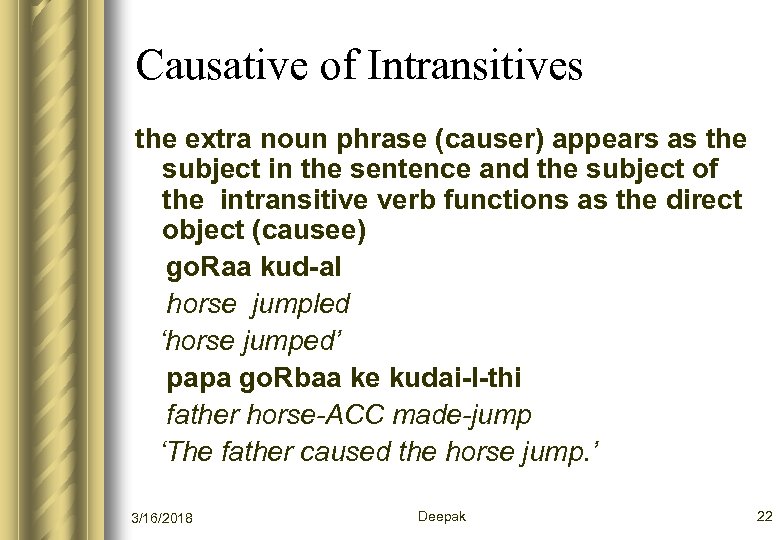 Causative of Intransitives the extra noun phrase (causer) appears as the subject in the sentence and the subject of the intransitive verb functions as the direct object (causee) go. Raa kud-al horse jumpled ‘horse jumped’ papa go. Rbaa ke kudai-l-thi father horse-ACC made-jump ‘The father caused the horse jump. ’ 3/16/2018 Deepak 22
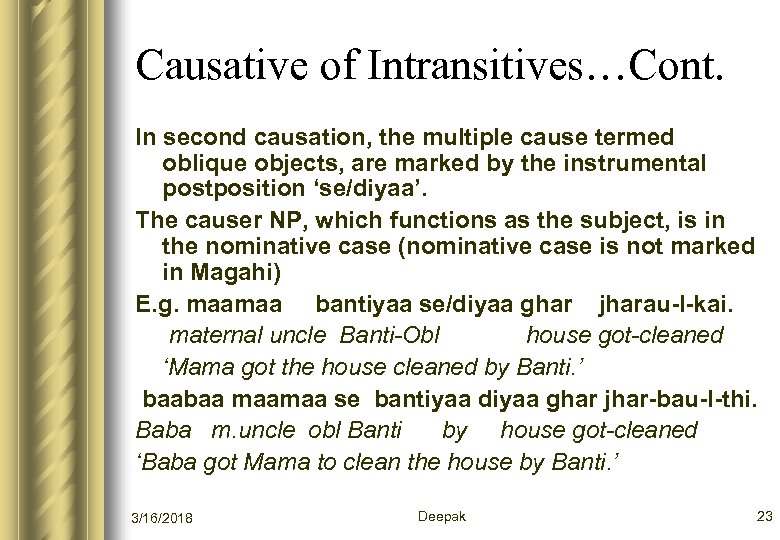 Causative of Intransitives…Cont. In second causation, the multiple cause termed oblique objects, are marked by the instrumental postposition ‘se/diyaa’. The causer NP, which functions as the subject, is in the nominative case (nominative case is not marked in Magahi) E. g. maamaa bantiyaa se/diyaa ghar jharau-l-kai. maternal uncle Banti-Obl house got-cleaned ‘Mama got the house cleaned by Banti. ’ baabaa maamaa se bantiyaa diyaa ghar jhar-bau-l-thi. Baba m. uncle obl Banti by house got-cleaned ‘Baba got Mama to clean the house by Banti. ’ 3/16/2018 Deepak 23
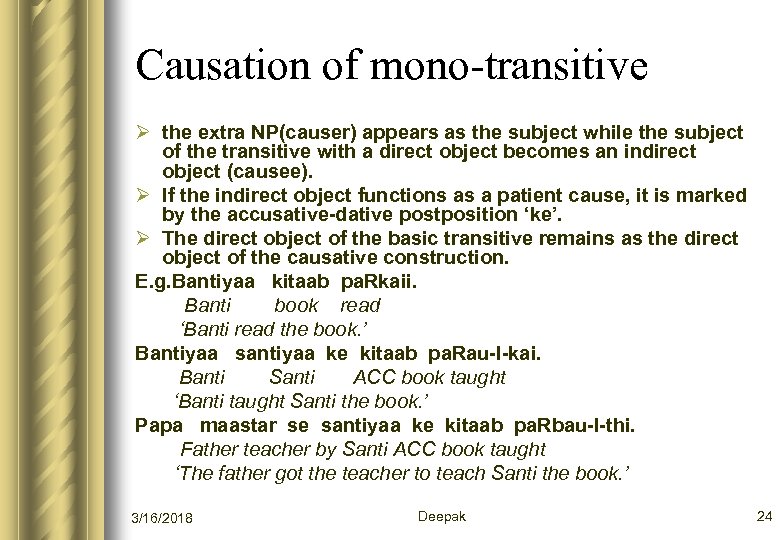 Causation of mono-transitive Ø the extra NP(causer) appears as the subject while the subject of the transitive with a direct object becomes an indirect object (causee). Ø If the indirect object functions as a patient cause, it is marked by the accusative-dative postposition ‘ke’. Ø The direct object of the basic transitive remains as the direct object of the causative construction. E. g. Bantiyaa kitaab pa. Rkaii. Banti book read ‘Banti read the book. ’ Bantiyaa santiyaa ke kitaab pa. Rau-l-kai. Banti Santi ACC book taught ‘Banti taught Santi the book. ’ Papa maastar se santiyaa ke kitaab pa. Rbau-l-thi. Father teacher by Santi ACC book taught ‘The father got the teacher to teach Santi the book. ’ 3/16/2018 Deepak 24
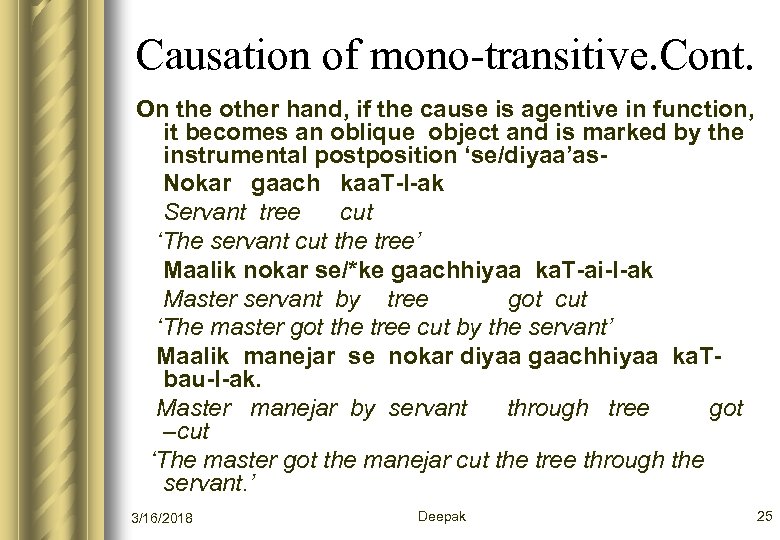 Causation of mono-transitive. Cont. On the other hand, if the cause is agentive in function, it becomes an oblique object and is marked by the instrumental postposition ‘se/diyaa’as. Nokar gaach kaa. T-l-ak Servant tree cut ‘The servant cut the tree’ Maalik nokar se/*ke gaachhiyaa ka. T-ai-l-ak Master servant by tree got cut ‘The master got the tree cut by the servant’ Maalik manejar se nokar diyaa gaachhiyaa ka. Tbau-l-ak. Master manejar by servant through tree got –cut ‘The master got the manejar cut the tree through the servant. ’ 3/16/2018 Deepak 25
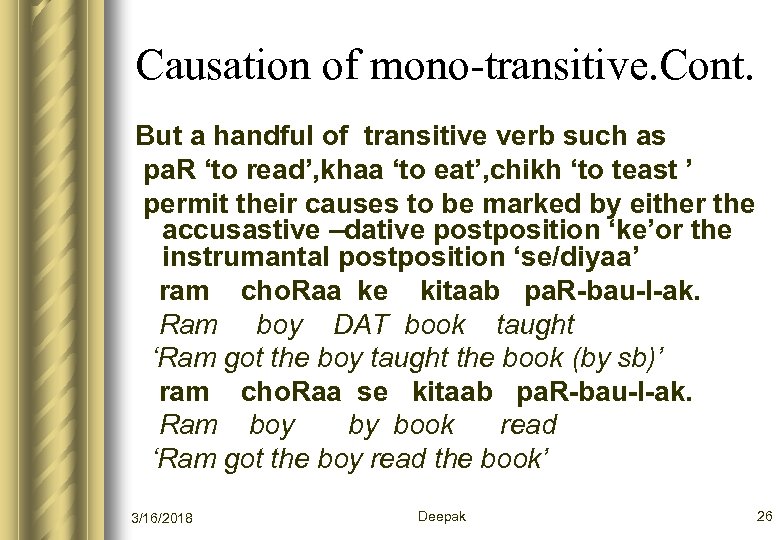 Causation of mono-transitive. Cont. But a handful of transitive verb such as pa. R ‘to read’, khaa ‘to eat’, chikh ‘to teast ’ permit their causes to be marked by either the accusastive –dative postposition ‘ke’or the instrumantal postposition ‘se/diyaa’ ram cho. Raa ke kitaab pa. R-bau-l-ak. Ram boy DAT book taught ‘Ram got the boy taught the book (by sb)’ ram cho. Raa se kitaab pa. R-bau-l-ak. Ram boy by book read ‘Ram got the boy read the book’ 3/16/2018 Deepak 26
 Causation of mono-transitive. Cont. But these two type of sentences differ in meaning. Using the accusativedative postposition allows the cause to described as the ‘beneficiary’ of the action. while the use of the instrumental postposition allows the cause to described as the ‘instrument’ of the action. 3/16/2018 Deepak 27
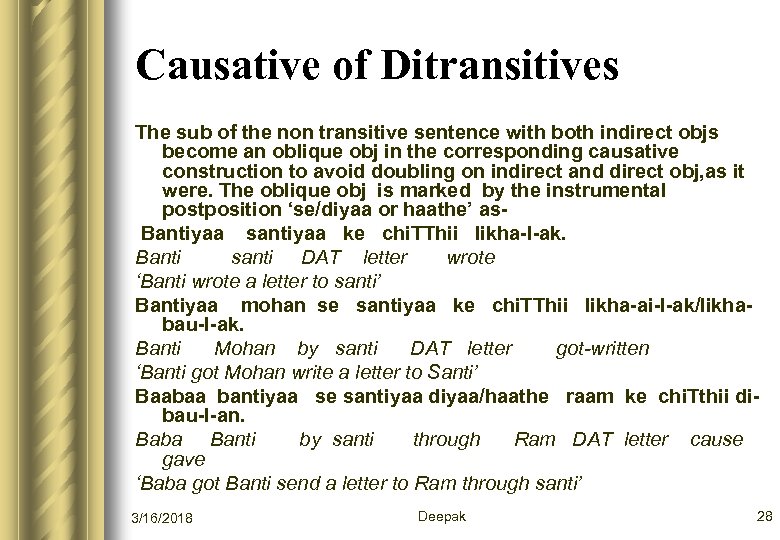 Causative of Ditransitives The sub of the non transitive sentence with both indirect objs become an oblique obj in the corresponding causative construction to avoid doubling on indirect and direct obj, as it were. The oblique obj is marked by the instrumental postposition ‘se/diyaa or haathe’ as. Bantiyaa santiyaa ke chi. TThii likha-l-ak. Banti santi DAT letter wrote ‘Banti wrote a letter to santi’ Bantiyaa mohan se santiyaa ke chi. TThii likha-ai-l-ak/likhabau-l-ak. Banti Mohan by santi DAT letter got-written ‘Banti got Mohan write a letter to Santi’ Baabaa bantiyaa se santiyaa diyaa/haathe raam ke chi. Tthii dibau-l-an. Baba Banti by santi through Ram DAT letter cause gave ‘Baba got Banti send a letter to Ram through santi’ 3/16/2018 Deepak 28
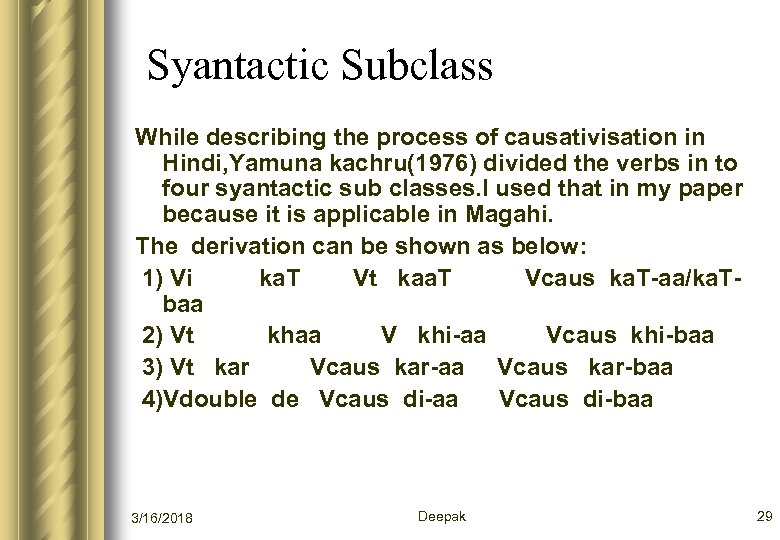 Syantactic Subclass While describing the process of causativisation in Hindi, Yamuna kachru(1976) divided the verbs in to four syantactic sub classes. I used that in my paper because it is applicable in Magahi. The derivation can be shown as below: 1) Vi ka. T Vt kaa. T Vcaus ka. T-aa/ka. Tbaa 2) Vt khaa V khi-aa Vcaus khi-baa 3) Vt kar Vcaus kar-aa Vcaus kar-baa 4)Vdouble de Vcaus di-aa Vcaus di-baa 3/16/2018 Deepak 29
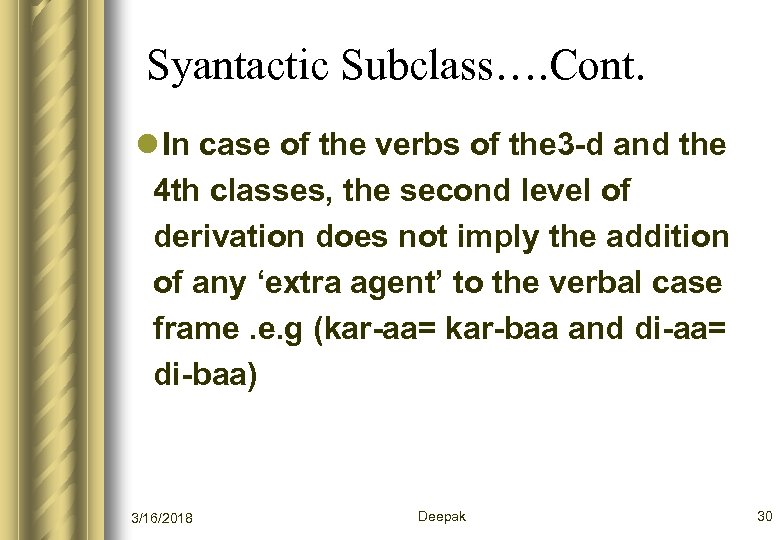 Syantactic Subclass…. Cont. l In case of the verbs of the 3 -d and the 4 th classes, the second level of derivation does not imply the addition of any ‘extra agent’ to the verbal case frame. e. g (kar-aa= kar-baa and di-aa= di-baa) 3/16/2018 Deepak 30
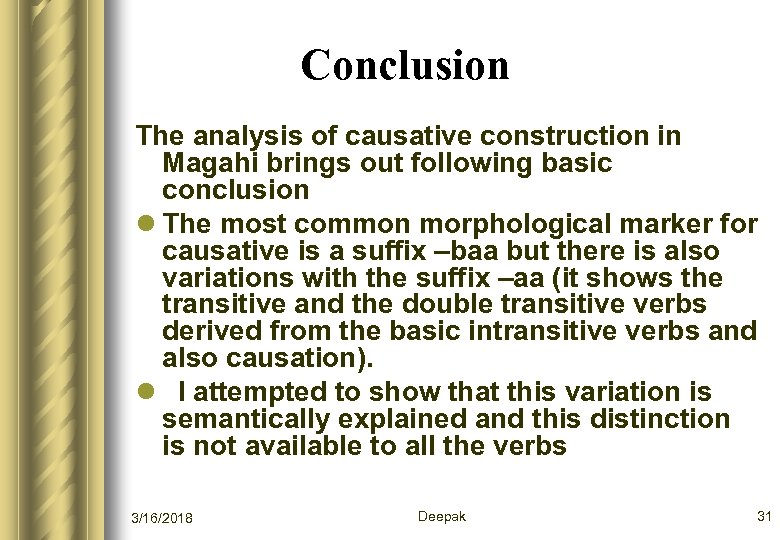 Conclusion The analysis of causative construction in Magahi brings out following basic conclusion l The most common morphological marker for causative is a suffix –baa but there is also variations with the suffix –aa (it shows the transitive and the double transitive verbs derived from the basic intransitive verbs and also causation). l I attempted to show that this variation is semantically explained and this distinction is not available to all the verbs 3/16/2018 Deepak 31
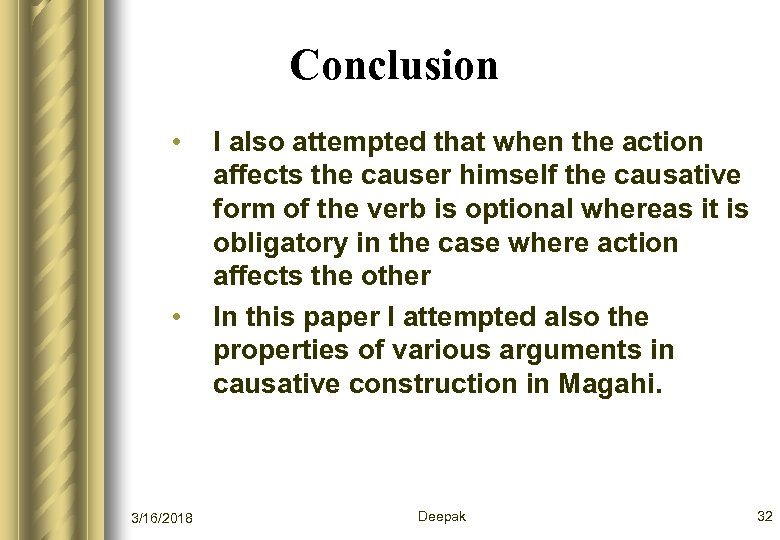 Conclusion • • 3/16/2018 I also attempted that when the action affects the causer himself the causative form of the verb is optional whereas it is obligatory in the case where action affects the other In this paper I attempted also the properties of various arguments in causative construction in Magahi. Deepak 32
 References Ø Amritavalli. R. (2001). Morphological Causatives. UTAH and Monoclausality. Linguistic Structure and Language Dynamics in South Asia, Papers from the Proceedings of SALA XIII Roundtable. Delhi: Motilal Banarsidass. PP. 389 -398. Ø Kachru, Yamuna (1973), Causative Sentences in Hindi Revisited. In Braj Kachru et al. (eds. ), Issues in Linguistics. Papers in Honour of Henry and Renee kahance. 377 -393. Urbana: University of Illinois Press. Ø Tripathi, Saroj (1993). “ Hindi aur Magahi Ki Vyakarnik Sanrachana” “Chandra Prakashan, Mauri, Patna, Bihar. ” 3/16/2018 Deepak 33
 References Ø Kachru, Yamuna (1976). On the Semantics of the Causative Construction in Hindi-Urdu. In masayoshi Shibatani (ed. ). Syntax and Semantics 6: The Grammar of Causative Constructions, 353 -369. New York: Academic Press. Ø The Grammar of Causative Constructions: A conspectus MASAYOSHI SHIBATANI “University of Southern California” Ø Kachru, Yamuna. “Hindi” “ University of Illinois at Urbana-Champaign” Ø Yadav, Ramawatar. “ A Reference Grammar of Maithili” 3/16/2018 Deepak 34
 THANK YOU 3/16/2018 Deepak 35