 Скачать презентацию Causal Network Models for Correlated Quantitative Traits Brian
85140af5332274f27a3da179f842137e.ppt
- Количество слайдов: 52



Causal Network Models for Correlated Quantitative Traits Brian S. Yandell UW-Madison October 2011 www. stat. wisc. edu/~yandell/statgen Jax Sys. Gen: Yandell © 2011 1
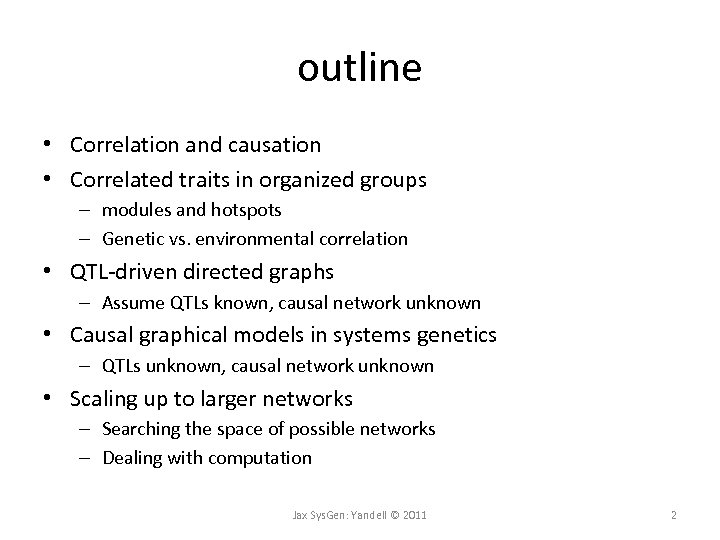
outline • Correlation and causation • Correlated traits in organized groups – modules and hotspots – Genetic vs. environmental correlation • QTL-driven directed graphs – Assume QTLs known, causal network unknown • Causal graphical models in systems genetics – QTLs unknown, causal network unknown • Scaling up to larger networks – Searching the space of possible networks – Dealing with computation Jax Sys. Gen: Yandell © 2011 2
“The old view of cause and effect … could only fail; things are not in our experience either independent or causative. All classes of phenomena are linked together, and the problem in each case is how close is the degree of association. ” Karl Pearson (1911) The Grammar of Science Jax Sys. Gen: Yandell © 2011 3
“The ideal … is the study of the direct influence of one condition on another …[when] all other possible causes of variation are eliminated. . The degree of correlation between two variables … [includes] all connecting paths of influence…. [Path coefficients combine] knowledge of … correlation among the variables in a system with … causal relations. Sewall Wright (1921) Correlation and causation. J Agric Res Jax Sys. Gen: Yandell © 2011 4
"Causality is not mystical or metaphysical. It can be understood in terms of simple processes, and it can be expressed in a friendly mathematical language, ready for computer analysis. ” Judea Pearl (2000) Causality: Models, Reasoning and Inference Jax Sys. Gen: Yandell © 2011 5
problems and controversies • Correlation does not imply causation. – Common knowledge in field of statistics. • Steady state (static) measures may not reflect dynamic processes. – Przytycka and Kim (2010) BMC Biol • Population-based estimates (from a sample of individuals) may not reflect processes within an individual. Jax Sys. Gen: Yandell © 2011 6
randomization and causation • RA Fisher (1926) Design of Experiments • control other known factors • randomize assignment of treatment – no causal effect of individuals on treatment – no common cause of treatment and outcome – reduce chance correlation with unknown factors • conclude outcome differences are caused by (due to) treatment Jax Sys. Gen: Yandell © 2011 7
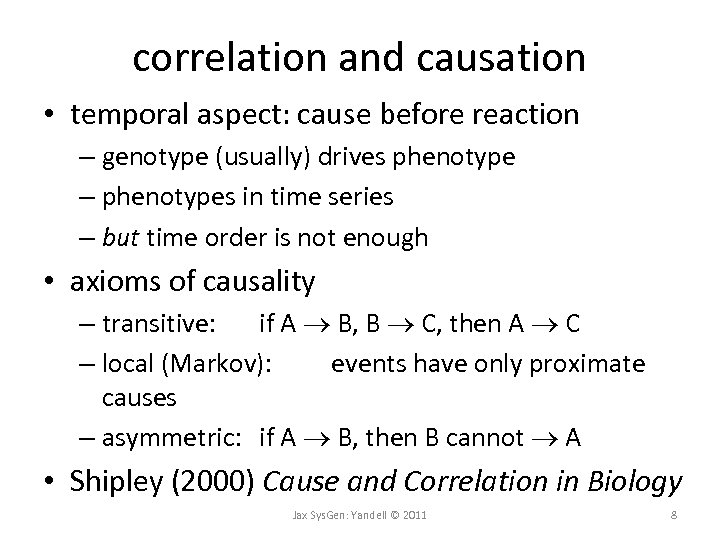
correlation and causation • temporal aspect: cause before reaction – genotype (usually) drives phenotype – phenotypes in time series – but time order is not enough • axioms of causality – transitive: if A B, B C, then A C – local (Markov): events have only proximate causes – asymmetric: if A B, then B cannot A • Shipley (2000) Cause and Correlation in Biology Jax Sys. Gen: Yandell © 2011 8
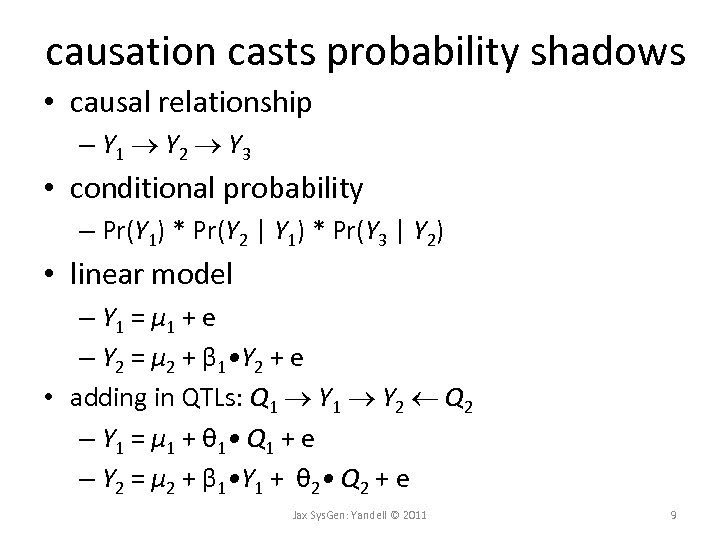
causation casts probability shadows • causal relationship – Y 1 Y 2 Y 3 • conditional probability – Pr(Y 1) * Pr(Y 2 | Y 1) * Pr(Y 3 | Y 2) • linear model – Y 1 = μ 1 + e – Y 2 = μ 2 + β 1 • Y 2 + e • adding in QTLs: Q 1 Y 2 Q 2 – Y 1 = μ 1 + θ 1 • Q 1 + e – Y 2 = μ 2 + β 1 • Y 1 + θ 2 • Q 2 + e Jax Sys. Gen: Yandell © 2011 9
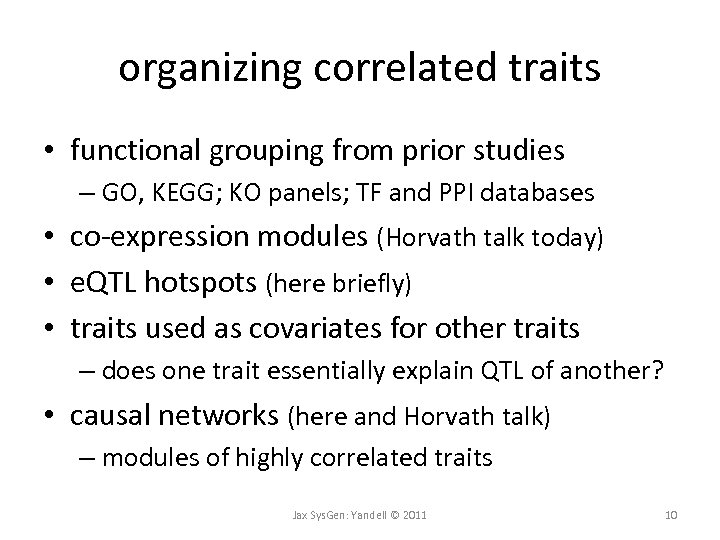
organizing correlated traits • functional grouping from prior studies – GO, KEGG; KO panels; TF and PPI databases • co-expression modules (Horvath talk today) • e. QTL hotspots (here briefly) • traits used as covariates for other traits – does one trait essentially explain QTL of another? • causal networks (here and Horvath talk) – modules of highly correlated traits Jax Sys. Gen: Yandell © 2011 10
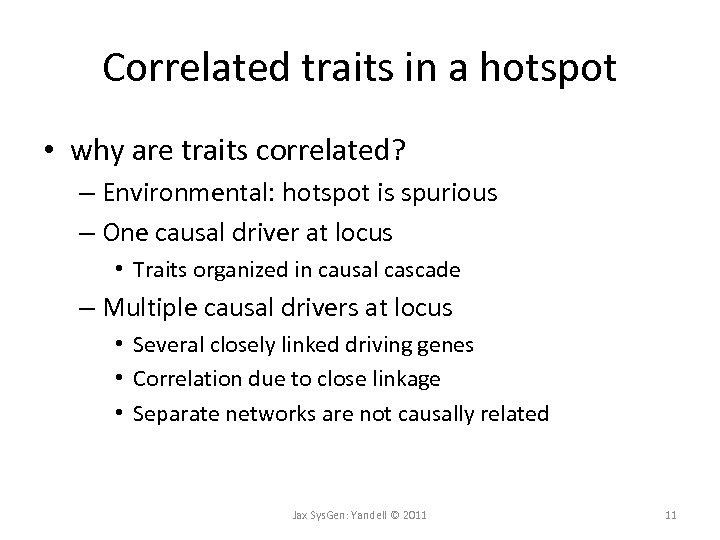
Correlated traits in a hotspot • why are traits correlated? – Environmental: hotspot is spurious – One causal driver at locus • Traits organized in causal cascade – Multiple causal drivers at locus • Several closely linked driving genes • Correlation due to close linkage • Separate networks are not causally related Jax Sys. Gen: Yandell © 2011 11
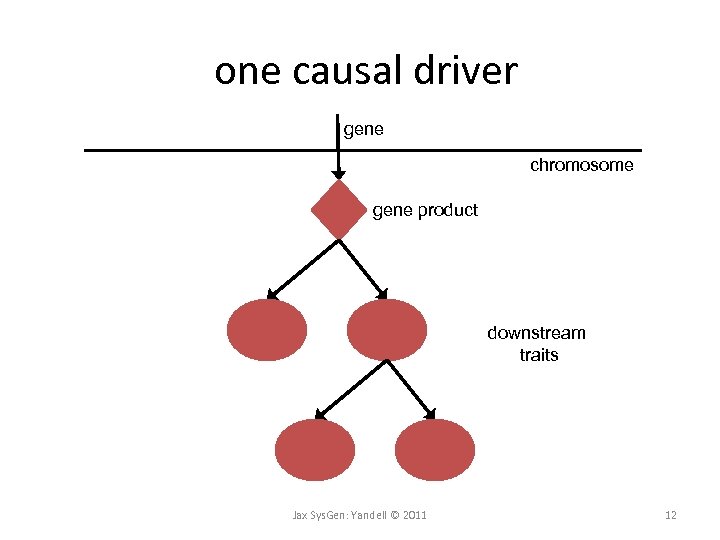
one causal driver gene chromosome gene product downstream traits Jax Sys. Gen: Yandell © 2011 12
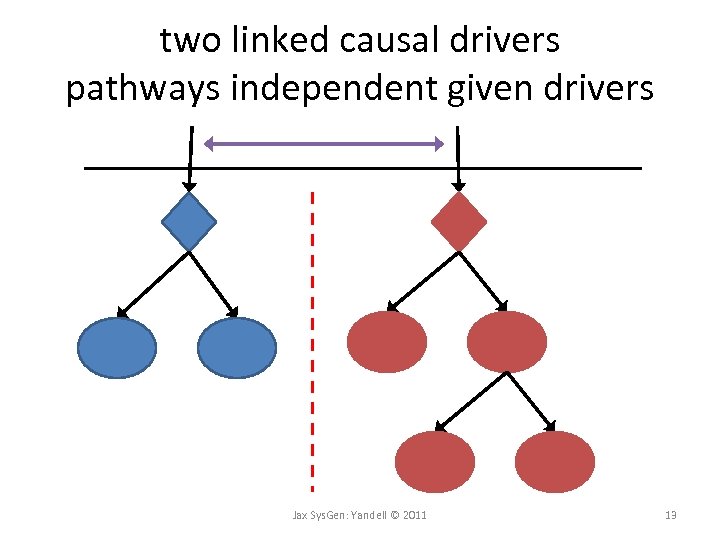
two linked causal drivers pathways independent given drivers Jax Sys. Gen: Yandell © 2011 13
hotspots of correlated traits • multiple correlated traits map to same locus – is this a real hotspot, or an artifact of correlation? – use QTL permutation across traits • references – Breitling R, Li Y, Tesson BM, Fu J, Wu C, Wiltshire T, Gerrits A, Bystrykh LV, de Haan G, Su AI, Jansen RC (2008) Genetical Genomics: Spotlight on QTL Hotspots. PLo. S Genetics 4: e 1000232. [doi: 10. 1371/journal. pgen. 1000232] – Chaibub Neto E, Keller MP, Broman AF, Attie AD, Jansen RC, Broman KW, Yandell BS, Quantile-based permutation thresholds for QTL hotspots. Genetics (in review). Jax Sys. Gen: Yandell © 2011 14
hotspot permutation test (Breitling et al. Jansen 2008 PLo. S Genetics) • for original dataset and each permuted set: – Set single trait LOD threshold T • Could use Churchill-Doerge (1994) permutations – Count number of traits (N) with LOD above T • Do this at every marker (or pseudomarker) • Probably want to smooth counts somewhat • find count with at most 5% of permuted sets above (critical value) as count threshold • conclude original counts above threshold are real Jax Sys. Gen: Yandell © 2011 15
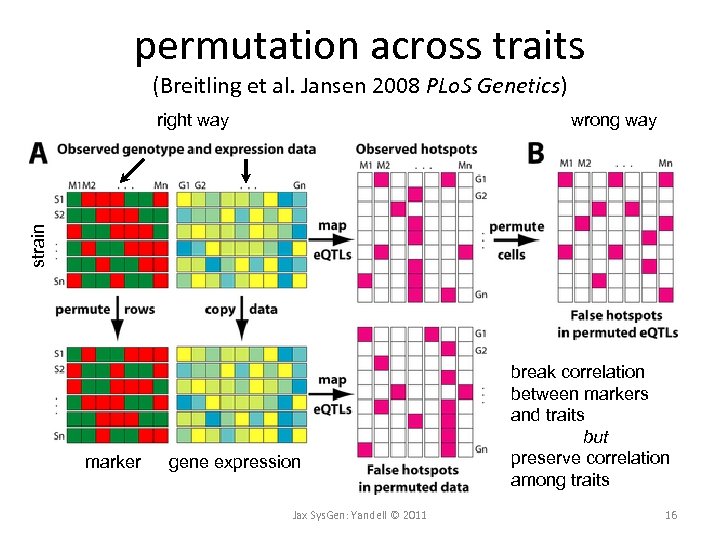
permutation across traits (Breitling et al. Jansen 2008 PLo. S Genetics) wrong way strain right way marker gene expression Jax Sys. Gen: Yandell © 2011 break correlation between markers and traits but preserve correlation among traits 16
quality vs. quantity in hotspots (Chaibub Neto et al. in review) • detecting single trait with very large LOD – control FWER across genome – control FWER across all traits • finding small “hotspots” with significant traits – all with large LODs – could indicate a strongly disrupted signal pathway • sliding LOD threshold across hotspot sizes Jax Sys. Gen: Yandell © 2011 17
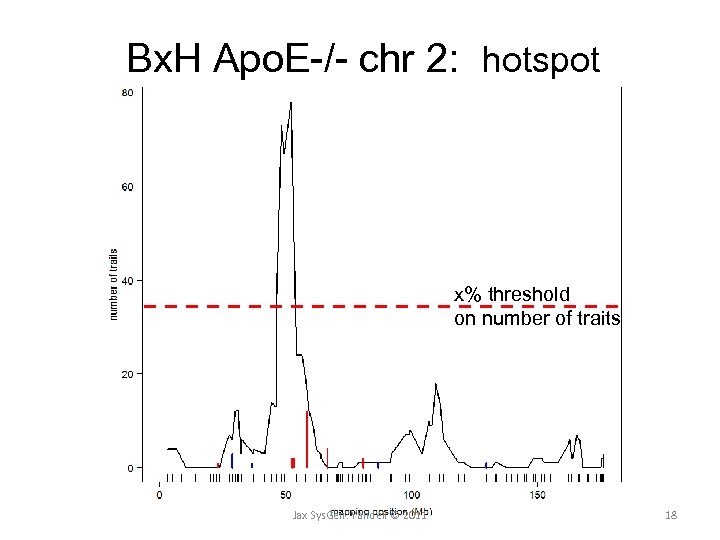
Bx. H Apo. E-/- chr 2: hotspot x% threshold on number of traits Jax Sys. Gen: Yandell © 2011 18
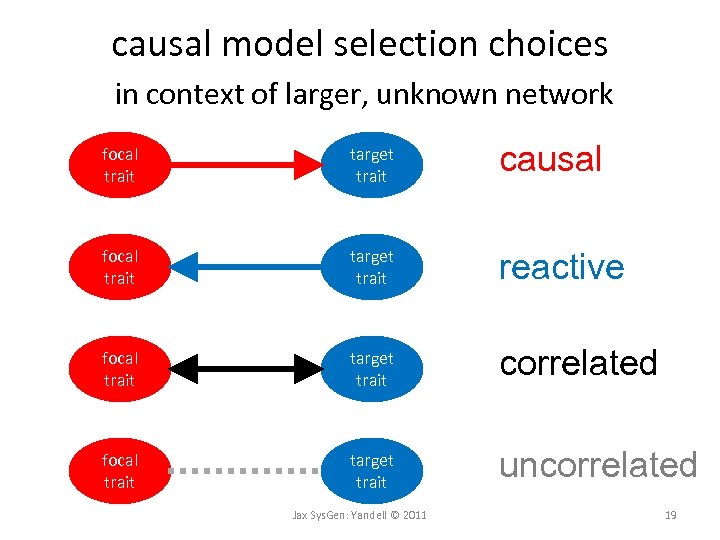
causal model selection choices in context of larger, unknown network focal trait target trait causal focal trait target trait reactive focal trait target trait correlated focal trait target trait uncorrelated Jax Sys. Gen: Yandell © 2011 19
causal architecture • how many traits are up/downstream of a trait? – focal trait causal to downstream target traits – record count at Mb position of focal gene – red = downstream, blue = upstream • what set of target traits to consider? – all traits – traits in module or hotspot Jax Sys. Gen: Yandell © 2011 20
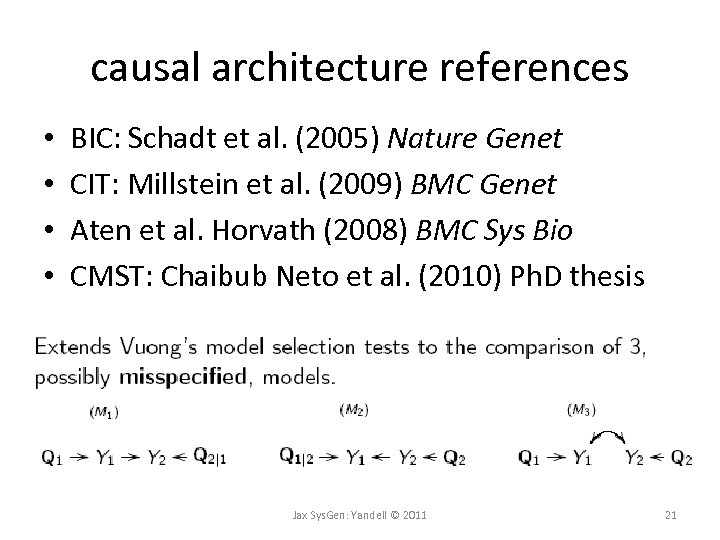
causal architecture references • • BIC: Schadt et al. (2005) Nature Genet CIT: Millstein et al. (2009) BMC Genet Aten et al. Horvath (2008) BMC Sys Bio CMST: Chaibub Neto et al. (2010) Ph. D thesis Jax Sys. Gen: Yandell © 2011 21
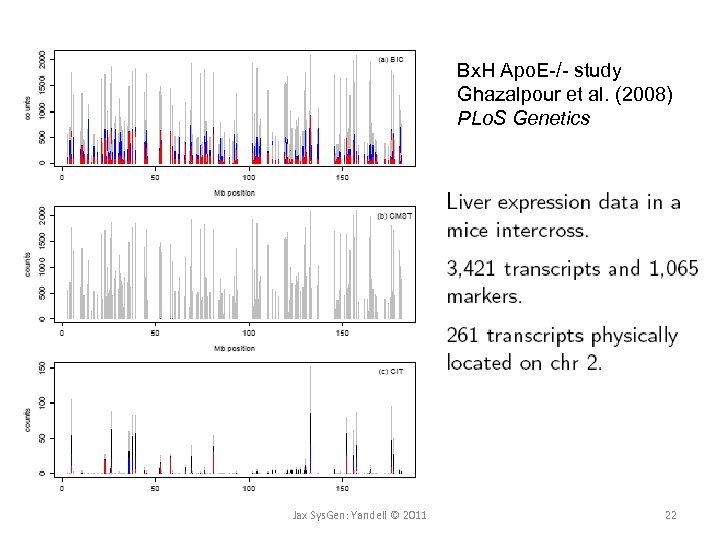
Bx. H Apo. E-/- study Ghazalpour et al. (2008) PLo. S Genetics Jax Sys. Gen: Yandell © 2011 22
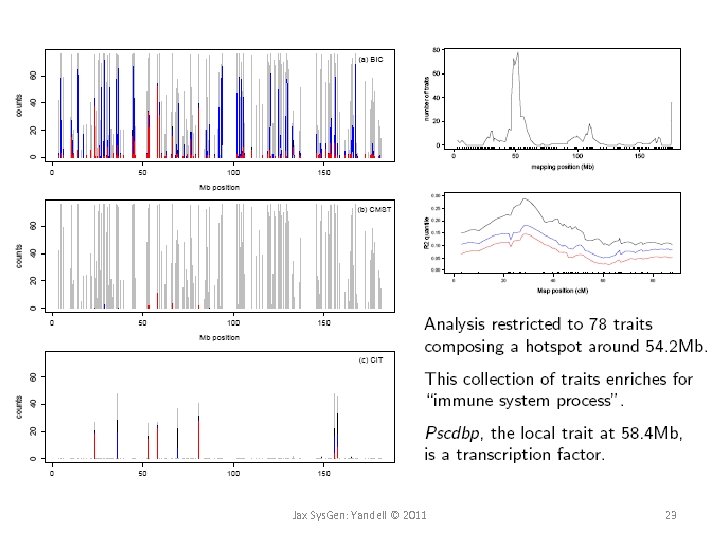
Jax Sys. Gen: Yandell © 2011 23
QTL-driven directed graphs • given genetic architecture (QTLs), what causal network structure is supported by data? • R/qdg available at www. github. org/byandell • references – Chaibub Neto, Ferrara, Attie, Yandell (2008) Inferring causal phenotype networks from segregating populations. Genetics 179: 1089 -1100. [doi: genetics. 107. 085167] – Ferrara et al. Attie (2008) Genetic networks of liver metabolism revealed by integration of metabolic and transcriptomic profiling. PLo. S Genet 4: e 1000034. [doi: 10. 1371/journal. pgen. 1000034] Jax Sys. Gen: Yandell © 2011 24
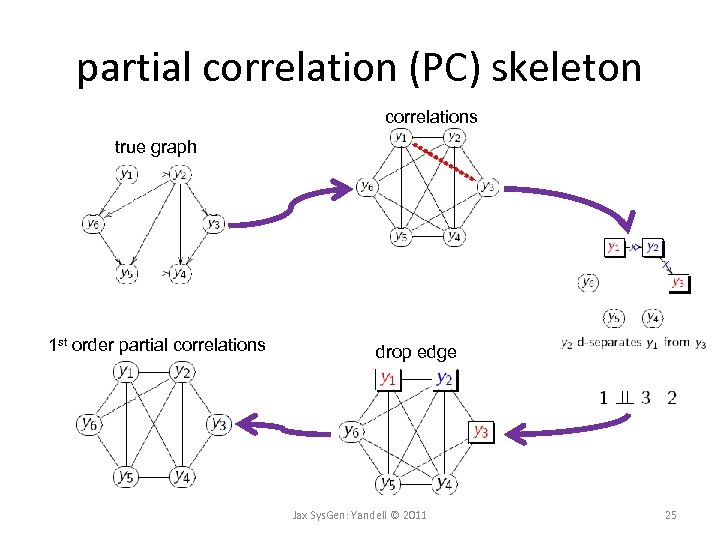
partial correlation (PC) skeleton correlations true graph 1 st order partial correlations drop edge Jax Sys. Gen: Yandell © 2011 25
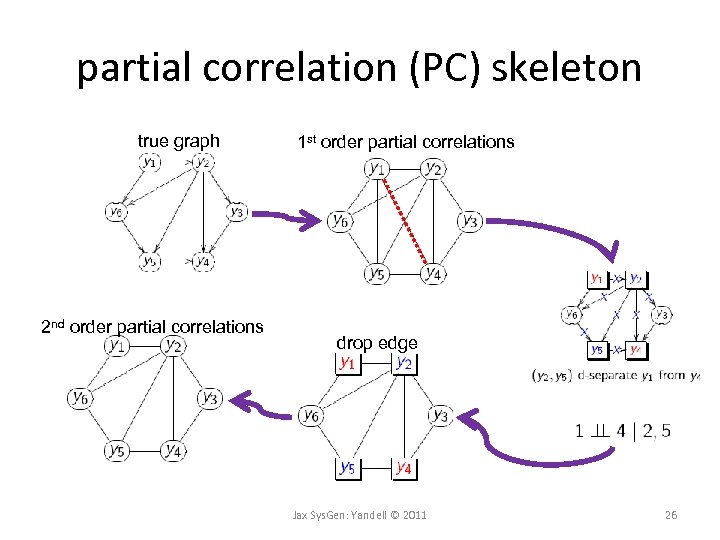
partial correlation (PC) skeleton true graph 2 nd order partial correlations 1 st order partial correlations drop edge Jax Sys. Gen: Yandell © 2011 26
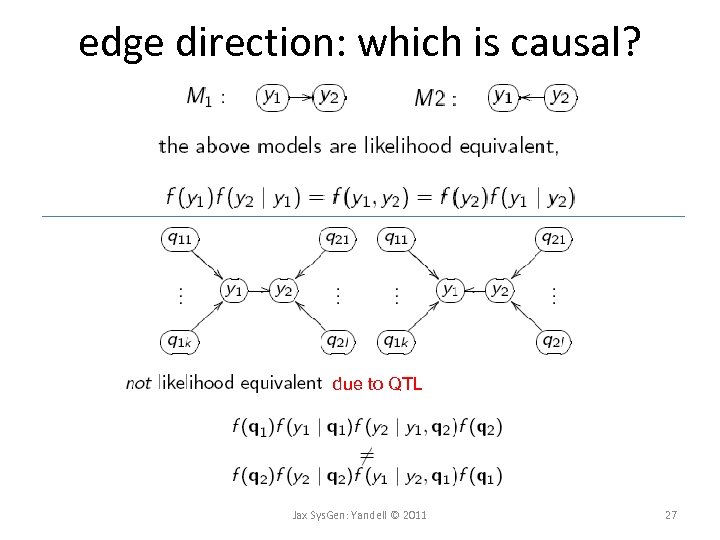
edge direction: which is causal? due to QTL Jax Sys. Gen: Yandell © 2011 27
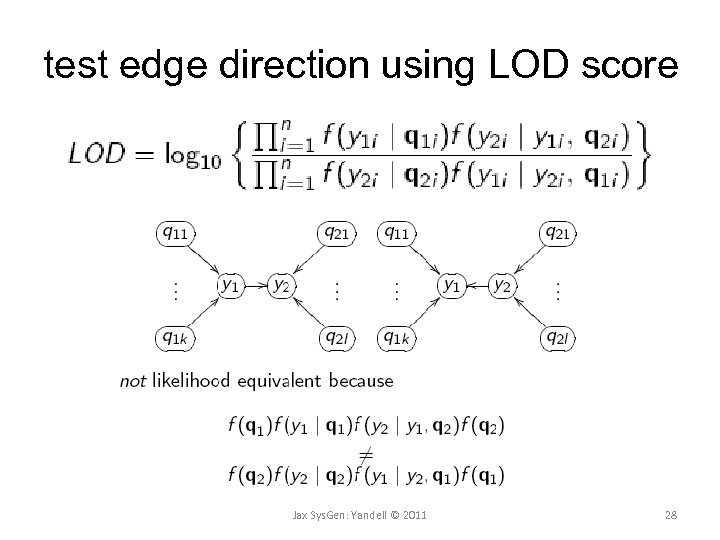
test edge direction using LOD score Jax Sys. Gen: Yandell © 2011 28
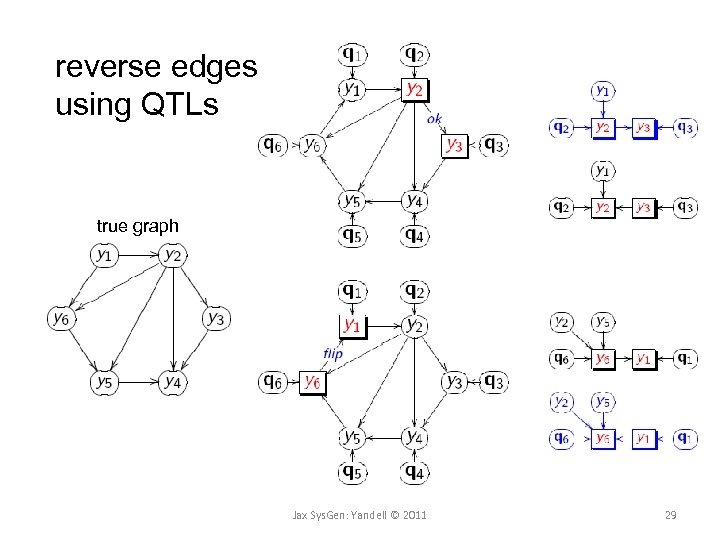
reverse edges using QTLs true graph Jax Sys. Gen: Yandell © 2011 29
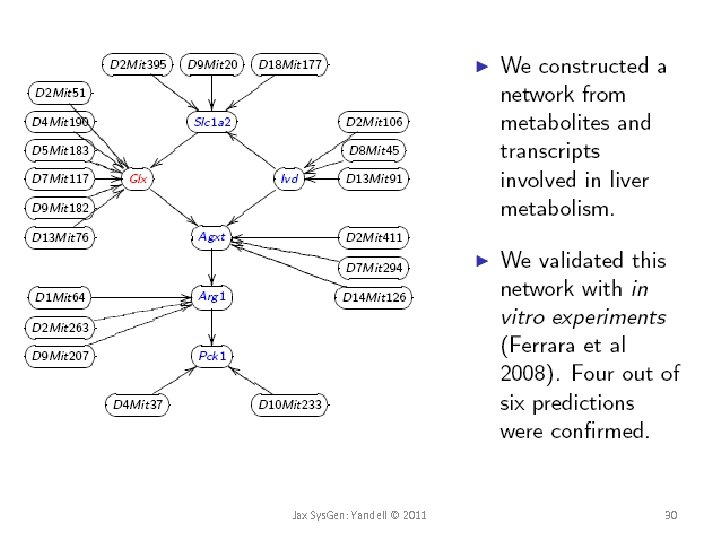
Jax Sys. Gen: Yandell © 2011 30
causal graphical models in systems genetics • What if genetic architecture and causal network are unknown? – jointly infer both using iteration • Chaibub Neto, Keller, Attie, Yandell (2010) Causal Graphical Models in Systems Genetics: a unified framework for joint inference of causal network and genetic architecture for correlated phenotypes. Ann Appl Statist 4: 320 -339. [doi: 10. 1214/09 -AOAS 288] • R/qtlnet available from www. github. org/byandell • Related references – Schadt et al. Lusis (2005 Nat Genet); Li et al. Churchill (2006 Genetics); Chen Emmert-Streib Storey(2007 Genome Bio); Liu de la Fuente Hoeschele (2008 Genetics); Winrow et al. Turek (2009 PLo. S ONE); Hageman et al. Churchill (2011 Genetics) Jax Sys. Gen: Yandell © 2011 31
Basic idea of QTLnet • iterate between finding QTL and network • genetic architecture given causal network – trait y depends on parents pa(y) in network – QTL for y found conditional on pa(y) • Parents pa(y) are interacting covariates for QTL scan • causal network given genetic architecture – build (adjust) causal network given QTL – each direction change may alter neighbor edges Jax Sys. Gen: Yandell © 2011 32
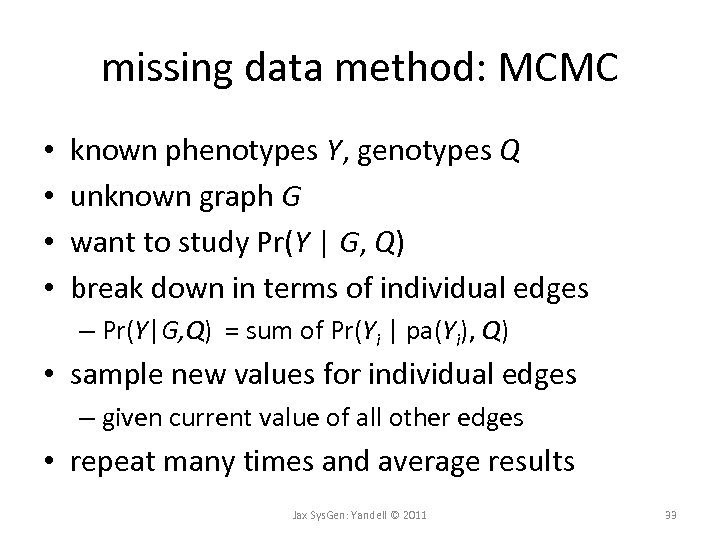
missing data method: MCMC • • known phenotypes Y, genotypes Q unknown graph G want to study Pr(Y | G, Q) break down in terms of individual edges – Pr(Y|G, Q) = sum of Pr(Yi | pa(Yi), Q) • sample new values for individual edges – given current value of all other edges • repeat many times and average results Jax Sys. Gen: Yandell © 2011 33
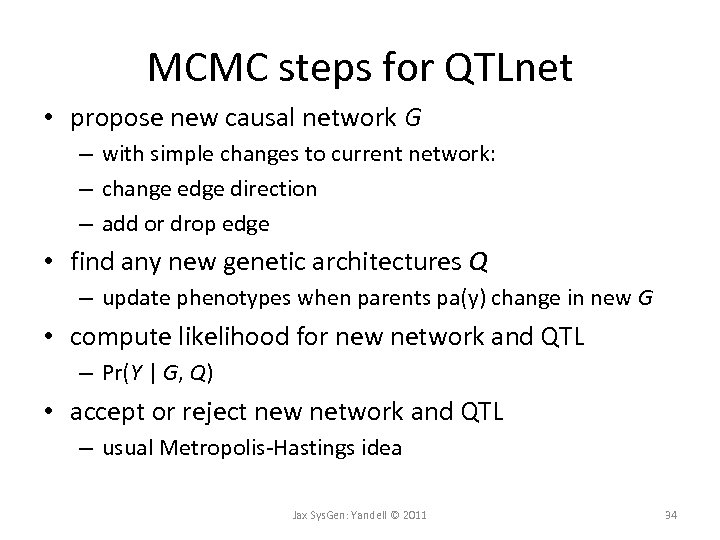
MCMC steps for QTLnet • propose new causal network G – with simple changes to current network: – change edge direction – add or drop edge • find any new genetic architectures Q – update phenotypes when parents pa(y) change in new G • compute likelihood for new network and QTL – Pr(Y | G, Q) • accept or reject new network and QTL – usual Metropolis-Hastings idea Jax Sys. Gen: Yandell © 2011 34
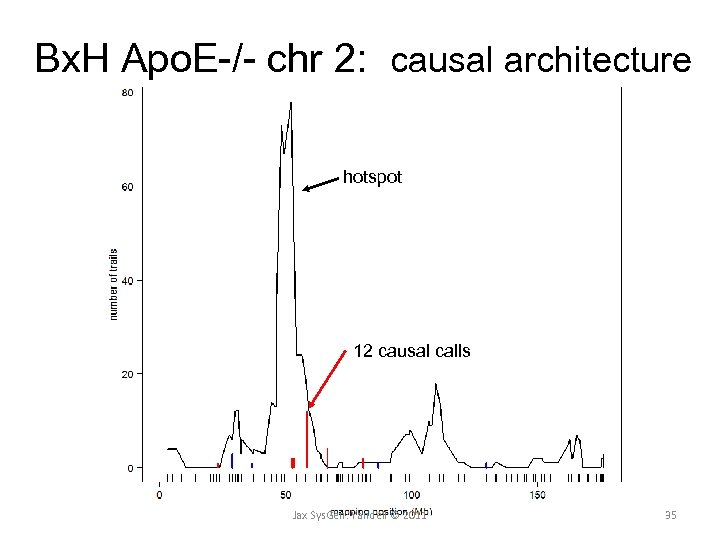
Bx. H Apo. E-/- chr 2: causal architecture hotspot 12 causal calls Jax Sys. Gen: Yandell © 2011 35
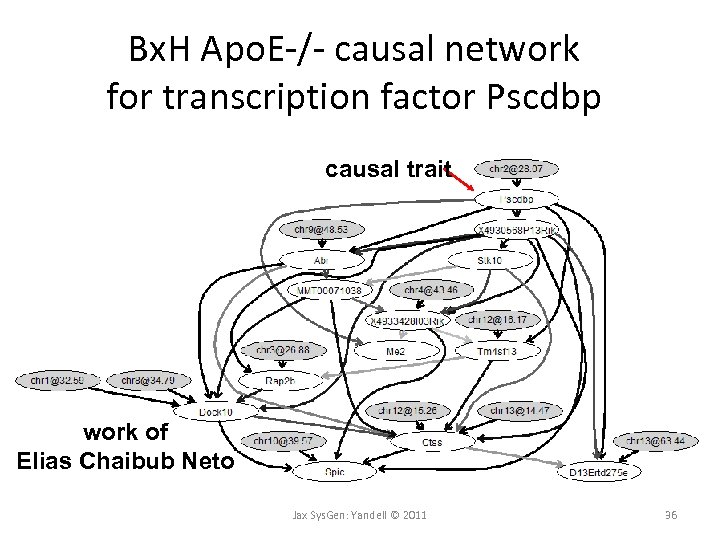
Bx. H Apo. E-/- causal network for transcription factor Pscdbp causal trait work of Elias Chaibub Neto Jax Sys. Gen: Yandell © 2011 36
scaling up to larger networks • reduce complexity of graphs – use prior knowledge to constrain valid edges – restrict number of causal edges into each node • make task parallel: run on many machines – pre-compute conditional probabilities – run multiple parallel Markov chains • rethink approach – LASSO, sparse PLS, other optimization methods Jax Sys. Gen: Yandell © 2011 37
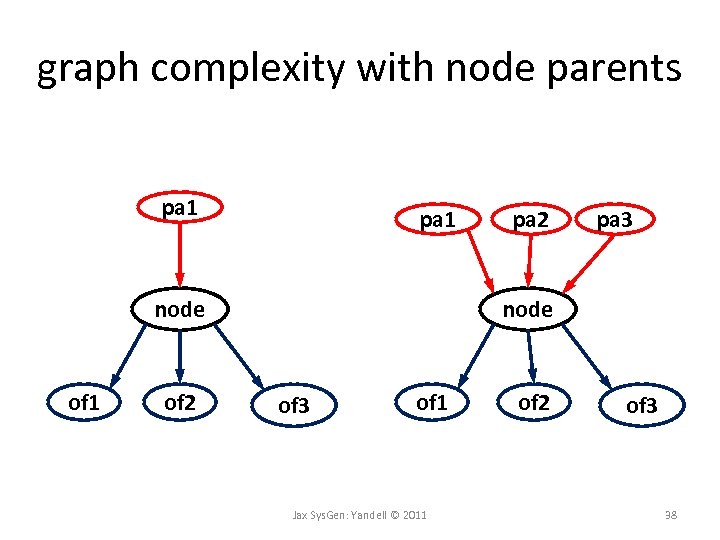
graph complexity with node parents pa 1 node of 1 of 2 pa 3 node of 3 of 1 Jax Sys. Gen: Yandell © 2011 of 2 of 3 38
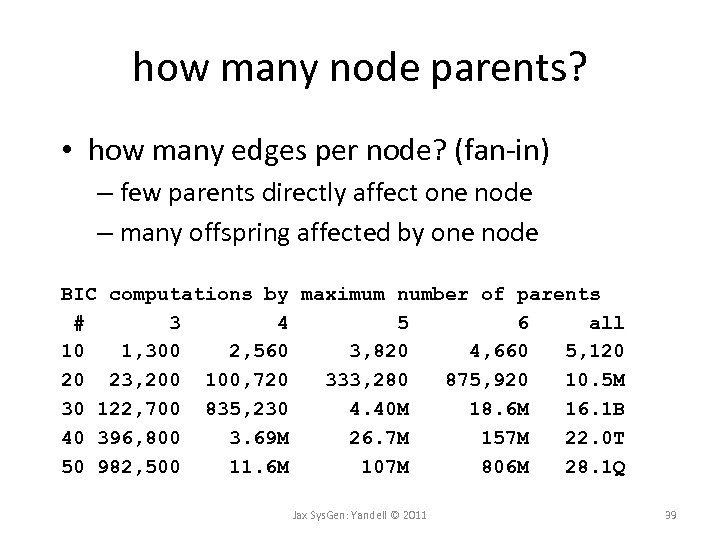
how many node parents? • how many edges per node? (fan-in) – few parents directly affect one node – many offspring affected by one node BIC computations by maximum number of parents # 3 4 5 6 all 10 1, 300 2, 560 3, 820 4, 660 5, 120 20 23, 200 100, 720 333, 280 875, 920 10. 5 M 30 122, 700 835, 230 4. 40 M 18. 6 M 16. 1 B 40 396, 800 3. 69 M 26. 7 M 157 M 22. 0 T 50 982, 500 11. 6 M 107 M 806 M 28. 1 Q Jax Sys. Gen: Yandell © 2011 39
BIC computation • each trait (node) has a linear model – Y ~ QTL + pa(Y) + other covariates • BIC = LOD – penalty – BIC balances data fit to model complexity – penalty increases with number of parents • limit complexity by allowing only 3 -4 parents Jax Sys. Gen: Yandell © 2011 40
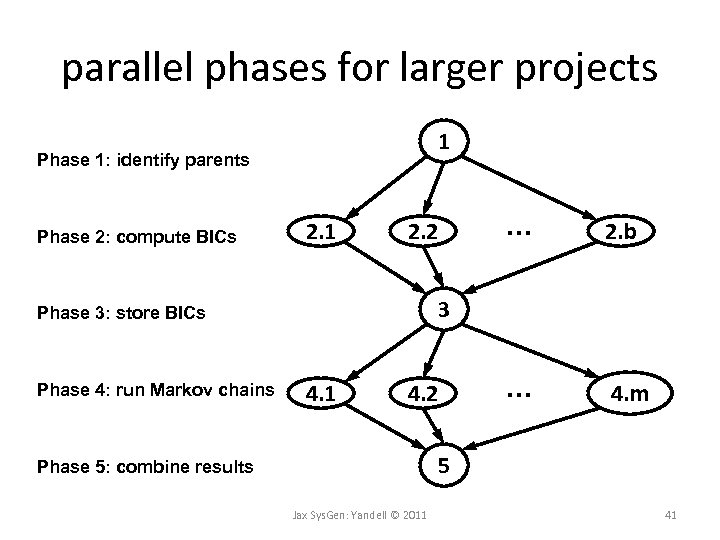
parallel phases for larger projects 1 Phase 1: identify parents Phase 2: compute BICs 2. 1 2. 2 2. b … 4. m 3 Phase 3: store BICs Phase 4: run Markov chains … 4. 1 4. 2 5 Phase 5: combine results Jax Sys. Gen: Yandell © 2011 41
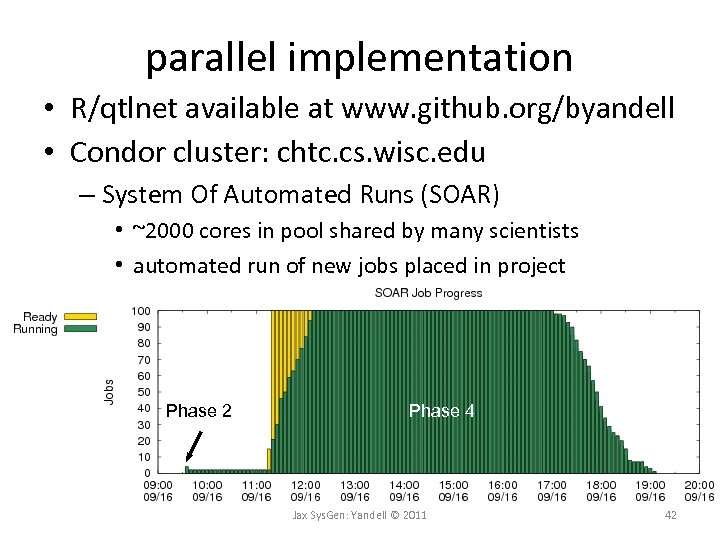
parallel implementation • R/qtlnet available at www. github. org/byandell • Condor cluster: chtc. cs. wisc. edu – System Of Automated Runs (SOAR) • ~2000 cores in pool shared by many scientists • automated run of new jobs placed in project Phase 2 Phase 4 Jax Sys. Gen: Yandell © 2011 42
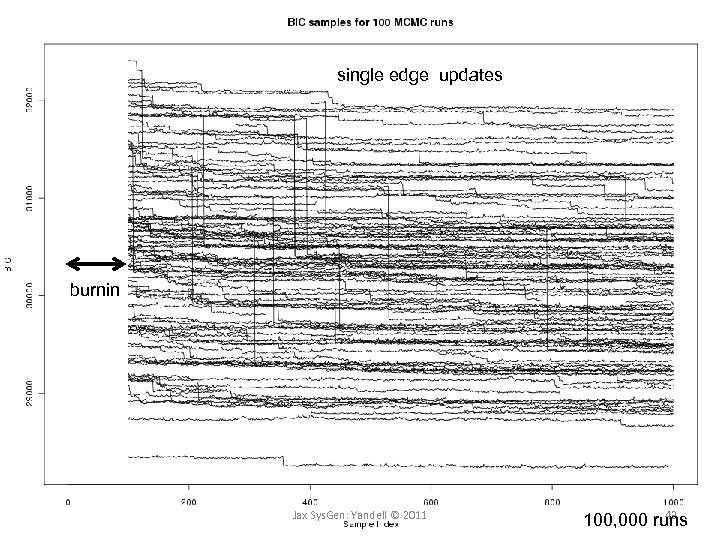
single edge updates burnin Jax Sys. Gen: Yandell © 2011 43 100, 000 runs
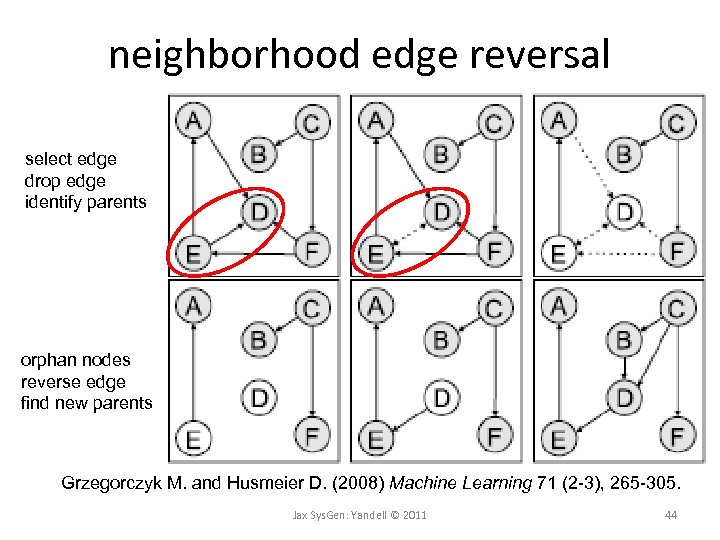
neighborhood edge reversal select edge drop edge identify parents orphan nodes reverse edge find new parents Grzegorczyk M. and Husmeier D. (2008) Machine Learning 71 (2 -3), 265 -305. Jax Sys. Gen: Yandell © 2011 44
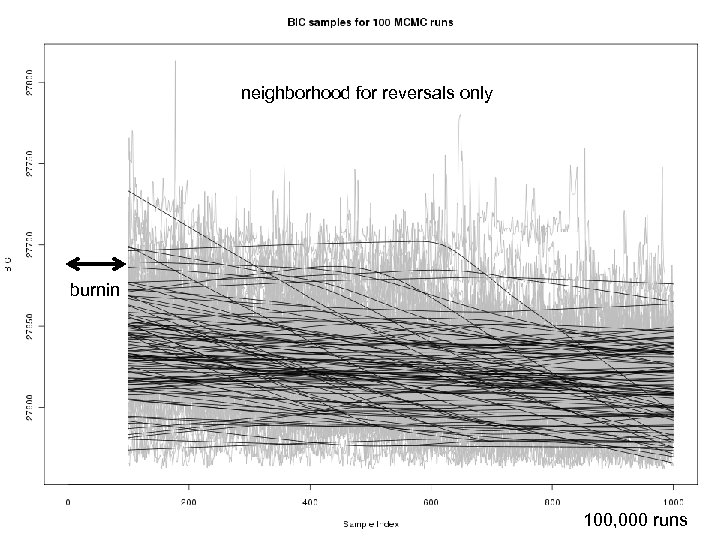
neighborhood for reversals only burnin Jax Sys. Gen: Yandell © 2011 45 100, 000 runs
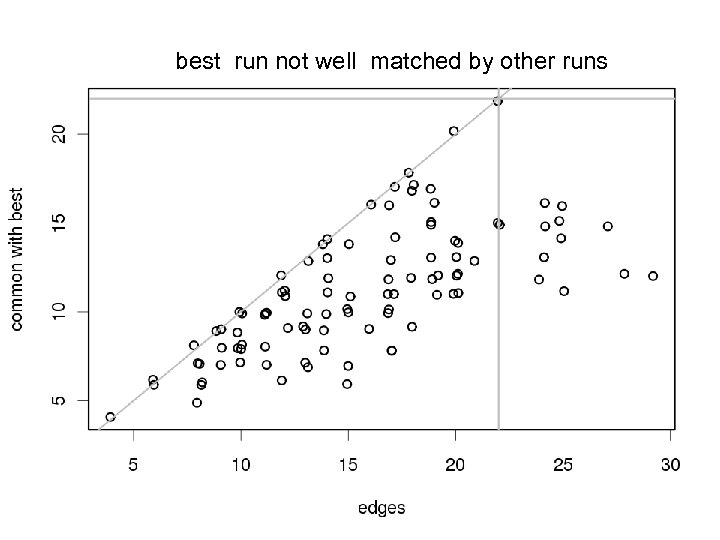
best run not well matched by other runs Jax Sys. Gen: Yandell © 2011 46
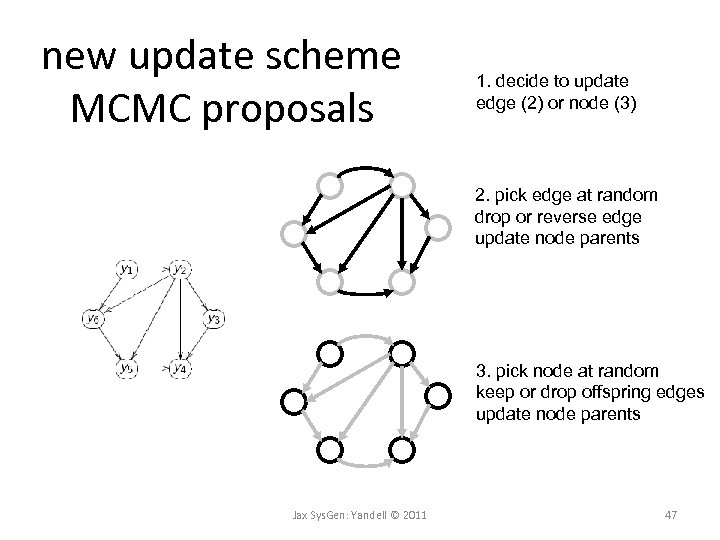
new update scheme MCMC proposals 1. decide to update edge (2) or node (3) 2. pick edge at random drop or reverse edge update node parents 3. pick node at random keep or drop offspring edges update node parents Jax Sys. Gen: Yandell © 2011 47
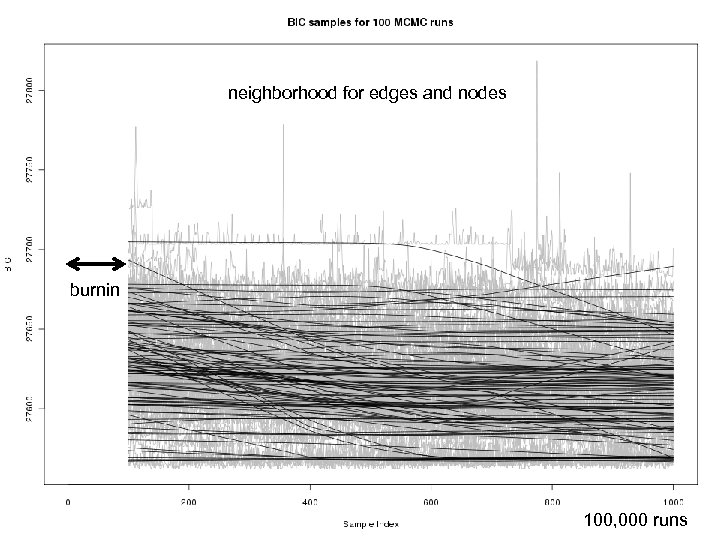
neighborhood for edges and nodes burnin Jax Sys. Gen: Yandell © 2011 48 100, 000 runs
how to use functional information? • functional grouping from prior studies – may or may not indicate direction – gene ontology (GO), KEGG – knockout (KO) panels – protein-protein interaction (PPI) database – transcription factor (TF) database • methods using only this information • priors for QTL-driven causal networks – more weight to local (cis) QTLs? Jax Sys. Gen: Yandell © 2011 49
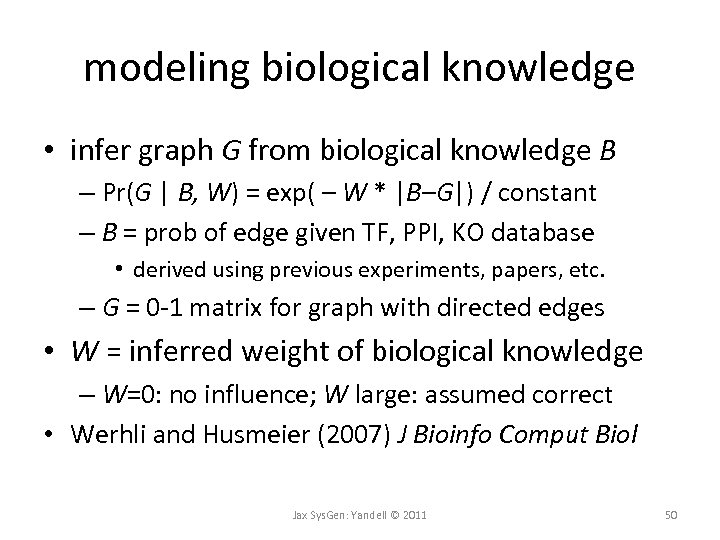
modeling biological knowledge • infer graph G from biological knowledge B – Pr(G | B, W) = exp( – W * |B–G|) / constant – B = prob of edge given TF, PPI, KO database • derived using previous experiments, papers, etc. – G = 0 -1 matrix for graph with directed edges • W = inferred weight of biological knowledge – W=0: no influence; W large: assumed correct • Werhli and Husmeier (2007) J Bioinfo Comput Biol Jax Sys. Gen: Yandell © 2011 50
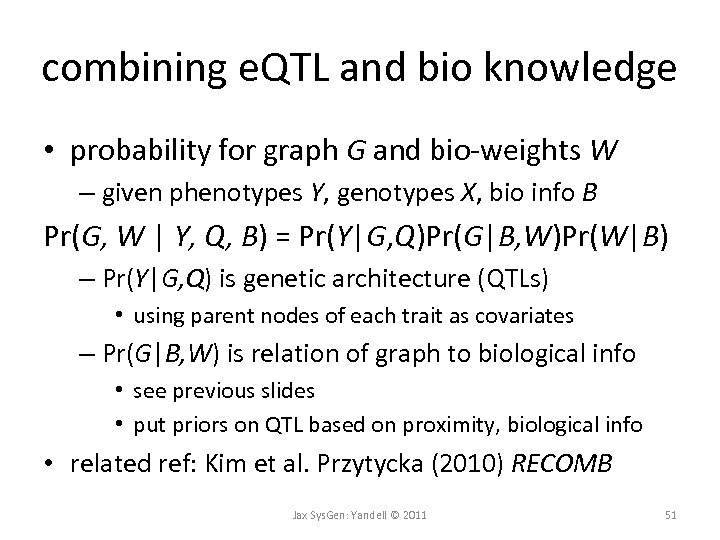
combining e. QTL and bio knowledge • probability for graph G and bio-weights W – given phenotypes Y, genotypes X, bio info B Pr(G, W | Y, Q, B) = Pr(Y|G, Q)Pr(G|B, W)Pr(W|B) – Pr(Y|G, Q) is genetic architecture (QTLs) • using parent nodes of each trait as covariates – Pr(G|B, W) is relation of graph to biological info • see previous slides • put priors on QTL based on proximity, biological info • related ref: Kim et al. Przytycka (2010) RECOMB Jax Sys. Gen: Yandell © 2011 51
future work • improve algorithm efficiency – Ramp up to 100 s of phenotypes • develop visual diagnostics to explore estimates • incorporate latent variables – Aten et al. Horvath (2008 BMC Sys Biol) • extend to outbred crosses, humans Jax Sys. Gen: Yandell © 2011 52
Скачать презентацию Causal Network Models for Correlated Quantitative Traits Brian
85140af5332274f27a3da179f842137e.ppt