


 Скачать презентацию Categorical Program Monitoring CPM Review An Ongoing Process
1a7773ba0847c7d6590f958d8c469f16.ppt
- Количество слайдов: 16
 Categorical Program Monitoring (CPM) Review, An Ongoing Process Fremont Unified School District Instructional Services Division Presentation to Principals, K-12 November 2008 Presenter: Juan Espinosa
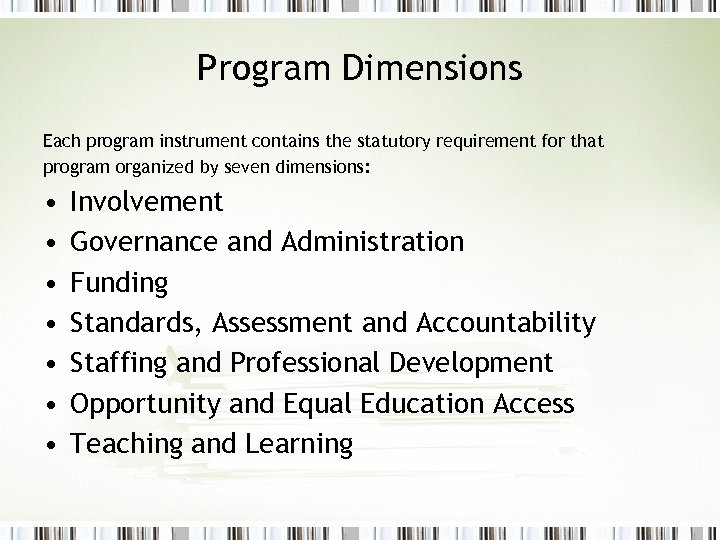 Program Dimensions Each program instrument contains the statutory requirement for that program organized by seven dimensions: • • Involvement Governance and Administration Funding Standards, Assessment and Accountability Staffing and Professional Development Opportunity and Equal Education Access Teaching and Learning
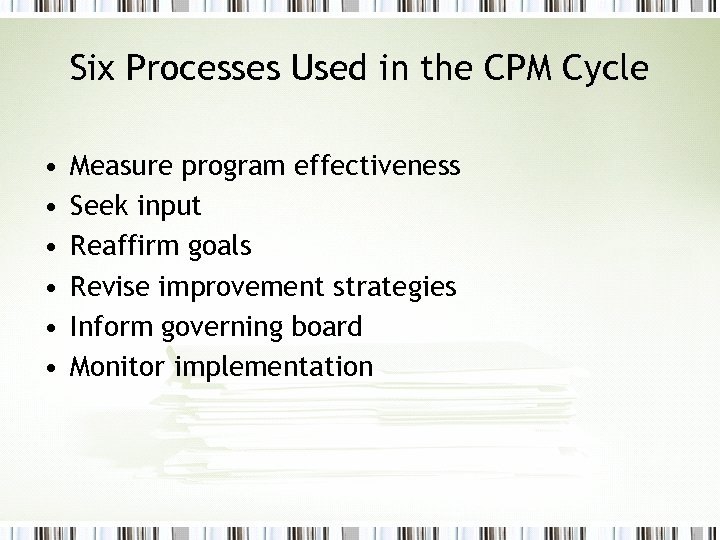 Six Processes Used in the CPM Cycle • • • Measure program effectiveness Seek input Reaffirm goals Revise improvement strategies Inform governing board Monitor implementation
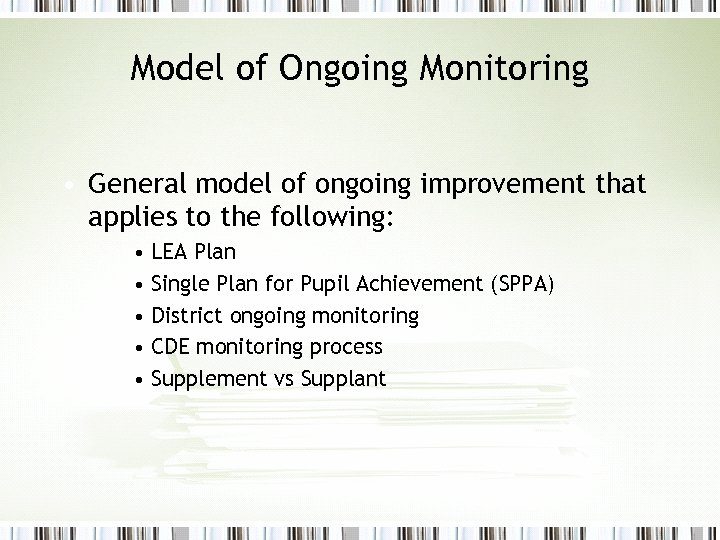 Model of Ongoing Monitoring • General model of ongoing improvement that applies to the following: • LEA Plan • Single Plan for Pupil Achievement (SPPA) • District ongoing monitoring • CDE monitoring process • Supplement vs Supplant
 CPM Ongoing Program Self-Evaluation Tool (OPSET) • The OPSET is the “study guide” to help the school pass the test for compliance. • It helps answer the question: "What must a program do to be considered compliant under this program dimension? "
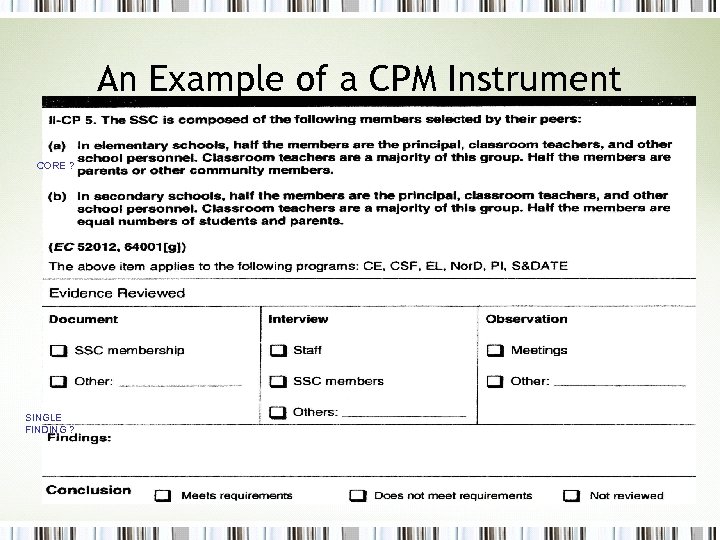 An Example of a CPM Instrument CORE ? SINGLE FINDING ?
 Criteria for School Selection for CPM • Academic Performance Index (API) and Adequate Yearly Progress (AYP) Data • Compliance History • Level of involvement in categorical programs • Participation in Title I Program Improvement • Significant subgroups not meeting criteria • Random selection
 District Office Level Review 08 -09 • • • Adult Ed Child Development Title I Cross Program Cal. Safe-Pregnant Teens Ed Equity English Learners HIV/AIDs Prevention Uniform Complaint
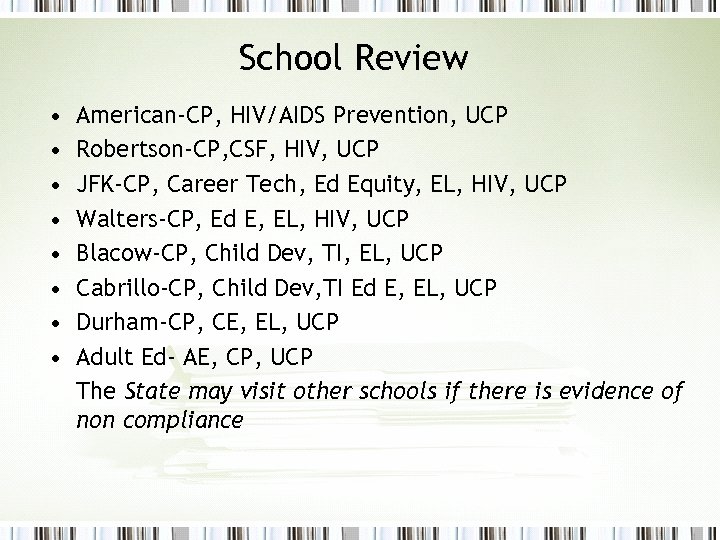 School Review • • American-CP, HIV/AIDS Prevention, UCP Robertson-CP, CSF, HIV, UCP JFK-CP, Career Tech, Ed Equity, EL, HIV, UCP Walters-CP, Ed E, EL, HIV, UCP Blacow-CP, Child Dev, TI, EL, UCP Cabrillo-CP, Child Dev, TI Ed E, EL, UCP Durham-CP, CE, EL, UCP Adult Ed- AE, CP, UCP The State may visit other schools if there is evidence of non compliance
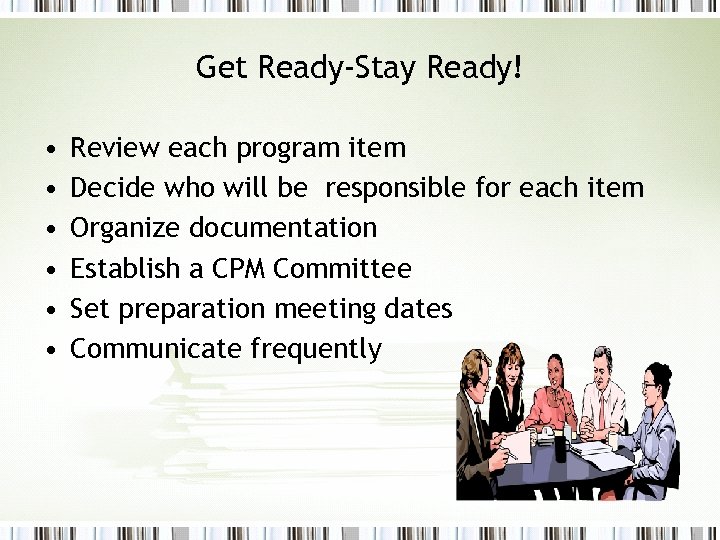 Get Ready-Stay Ready! • • • Review each program item Decide who will be responsible for each item Organize documentation Establish a CPM Committee Set preparation meeting dates Communicate frequently
 Get Ready-Stay Ready! Review for Compliance: ü School Plan ü Budgets ü School Site Council (SSC) Composition ü English Language Advisory Committee (ELAC) Composition ü Gifted and Talented (GATE)
 Get Ready-Stay Ready! Ensure that the entire school community is conversant with: • • • District core curriculum Funding sources School Plan Identification of program successes Program modifications Professional Development
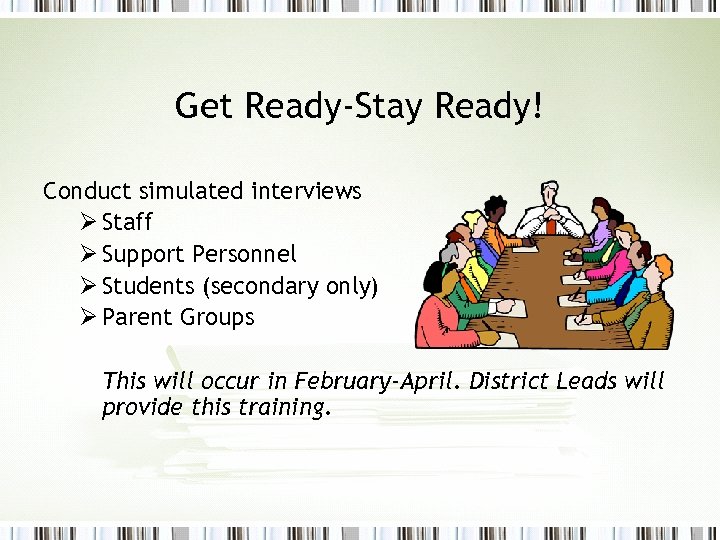 Get Ready-Stay Ready! Conduct simulated interviews Ø Staff Ø Support Personnel Ø Students (secondary only) Ø Parent Groups This will occur in February-April. District Leads will provide this training.
 The Validation Visit May 14 -May 22 • • • District Entrance Meeting School Entrance Meeting Document Review Observations Interviews Report of Findings 1. Compliance 2. Noncompliance 3. Compliance Resolution: Within 45 Days
 Major CPM noncompliant findings from the last two years • Time Reporting Documentation (Semi-annuals and/or Multi-funded Time Reporting Forms) • Equipment Inventory • Categorical Personnel Description of Duties • Evaluation of Program Effectiveness • Supplementing vs. Supplanting • ELAC Written Recommendations to SSC, ELAC Composition • Councils and Committees Composition • Parental Involvement Policy and School-Parent Compact • Career Tech-No Annual Evaluation • El Reclassification and Follow up-Sites • All ELs must receive ELD during the day • EL Program monitoring and program implementation
 Next Steps • October, district leads receive webinar training • November, Juan provides overview to K-12 principals • November, district leads begin to provide program information and direction to schools • January, district leads provide district wide training and expectations to schools being reviewed • February-April, district leads conduct in-house reviews • May, CDE conducts reviews • Late May-June, results are provided to all stakeholders • June-July, district responds to any non compliance and outlines what steps will be taken to resolve non compliance items • August, any action of non compliance is implemented