


 Скачать презентацию Cataloging Overview April 16 2009 1 Why
49f56320da46b1da689a13349ad500e1.ppt
- Количество слайдов: 121
 Cataloging Overview April 16, 2009 1
 Why Catalog? l l l 2 Direct Access “physical access” Indirect Access “bibliographic or bib access” Cataloging and classifying materials are the ways libraries create both types of access!
 The Process l Creation of a bib record = full description of the material and its contents – – l 3 Titles, authors, subject headings Language, publication information, notes, summaries, audience, reading programs Assignment of Call Number = Dewey Decimal number for subject organization on shelves
 Bibliographic Control The goal of bibliographic control in libraries is to : 1. Identify the materials the library owns 2. To manage these materials in an effective way This is achieved through the creation of “The Catalog” 4
 Functions of the Catalog by Charles A. Cutter (1876) 1. To enable a person to find a book by – – – 5 The author The title The subject
 Functions of the Catalog by Charles A. Cutter (1876) 2. To show what the library has – – – 6 By a given author On a given subject In a given kind of literature
 Functions of the Catalog by Charles A. Cutter (1876) 3. To assist in the choice of a book – – – 7 As to the edition As to the format As to its character (literary or topical)
 Authority Files l The creation of only one form of a name, subject, and series (LC Authority File) – – This brings together all works by an author, on a particular topic, and in the same series Uniform Titles bring together all variations of editions and versions http: //authorities. loc. gov/ 8
 Bibliographic Description Require the exact transcription of data from the item itself so the user knows he has the correct item (Anglo-American Cataloguing Rules, 2 nd ed. , 1998 revision (AACR 2 -98) http: //www. loc. gov/aba/ 9
 ISBD International Standard Bibliographic Description ISBD standardizes international cataloging 1. 2. 3. Records produced in one country or language can be understood in other countries All records can be integrated into catalogs of other locations Records written or printed can be converted into machine readable form http: //www. ifla. org/VII/s 13/pubs/isbdg 2004. pdf 10
 Levels of Description l l l 11 Level 1 = Minimal description Level 2 = Most but not all rules applied (this level is what most libraries do) Level 3 = All rules applied
 Chief Source of Information - Books Generally the title page and the colophon (usually found on the verso of the title page but in children’s books also found at the back of the book). ISBNs can be taken from any place from the book including the back cover. 12
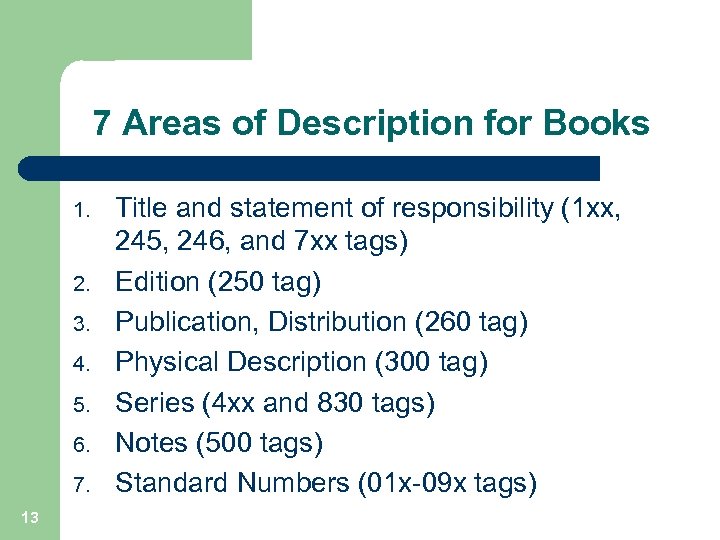 7 Areas of Description for Books 1. 2. 3. 4. 5. 6. 7. 13 Title and statement of responsibility (1 xx, 245, 246, and 7 xx tags) Edition (250 tag) Publication, Distribution (260 tag) Physical Description (300 tag) Series (4 xx and 830 tags) Notes (500 tags) Standard Numbers (01 x-09 x tags)
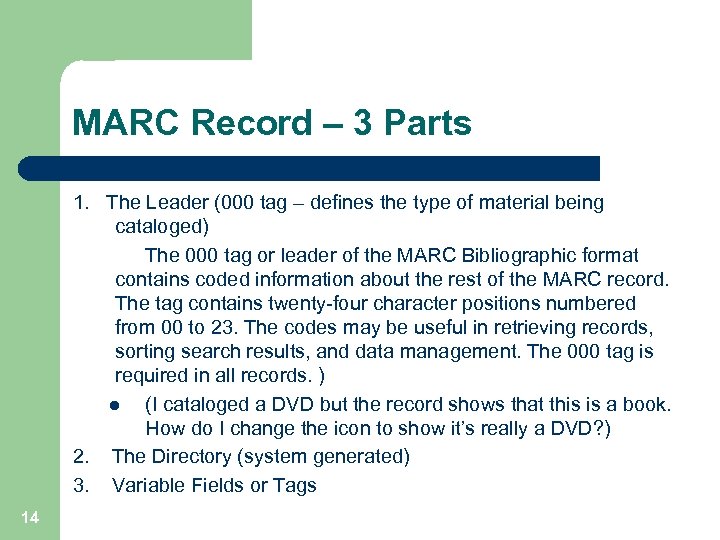 MARC Record – 3 Parts 1. The Leader (000 tag – defines the type of material being cataloged) The 000 tag or leader of the MARC Bibliographic format contains coded information about the rest of the MARC record. The tag contains twenty-four character positions numbered from 00 to 23. The codes may be useful in retrieving records, sorting search results, and data management. The 000 tag is required in all records. ) l (I cataloged a DVD but the record shows that this is a book. How do I change the icon to show it’s really a DVD? ) 2. The Directory (system generated) 3. Variable Fields or Tags 14
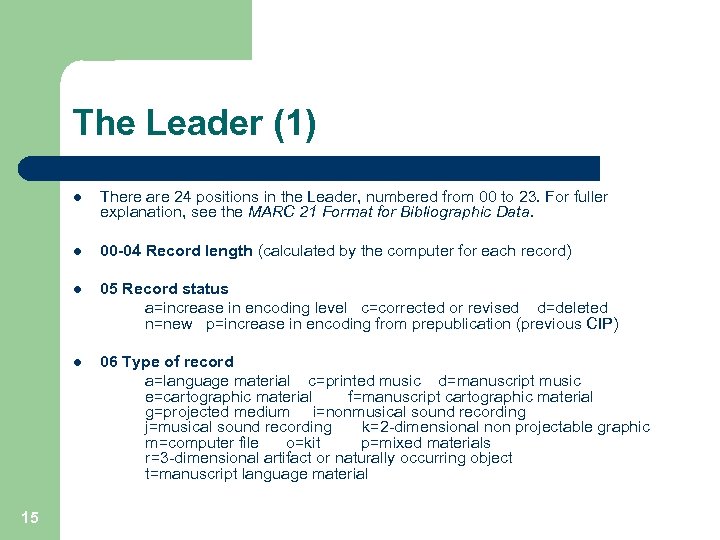 The Leader (1) l l 00 -04 Record length (calculated by the computer for each record) l 05 Record status a=increase in encoding level c=corrected or revised d=deleted n=new p=increase in encoding from prepublication (previous CIP) l 15 There are 24 positions in the Leader, numbered from 00 to 23. For fuller explanation, see the MARC 21 Format for Bibliographic Data. 06 Type of record a=language material c=printed music d=manuscript music e=cartographic material f=manuscript cartographic material g=projected medium i=nonmusical sound recording j=musical sound recording k=2 -dimensional non projectable graphic m=computer file o=kit p=mixed materials r=3 -dimensional artifact or naturally occurring object t=manuscript language material
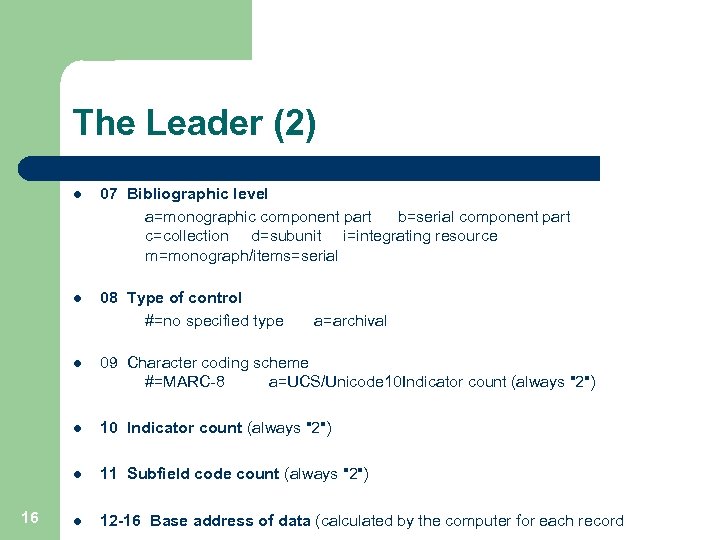 The Leader (2) l l 08 Type of control #=no specified type a=archival l 09 Character coding scheme #=MARC-8 a=UCS/Unicode 10 Indicator count (always "2") l 10 Indicator count (always "2") l 16 07 Bibliographic level a=monographic component part b=serial component part c=collection d=subunit i=integrating resource m=monograph/items=serial 11 Subfield code count (always "2") l 12 -16 Base address of data (calculated by the computer for each record
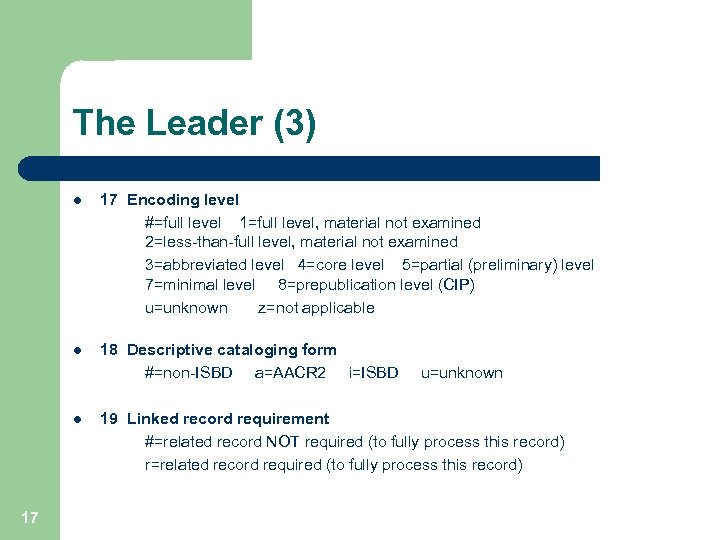 The Leader (3) l l 18 Descriptive cataloging form #=non-ISBD a=AACR 2 i=ISBD u=unknown l 17 17 Encoding level #=full level 1=full level, material not examined 2=less-than-full level, material not examined 3=abbreviated level 4=core level 5=partial (preliminary) level 7=minimal level 8=prepublication level (CIP) u=unknown z=not applicable 19 Linked record requirement #=related record NOT required (to fully process this record) r=related record required (to fully process this record)
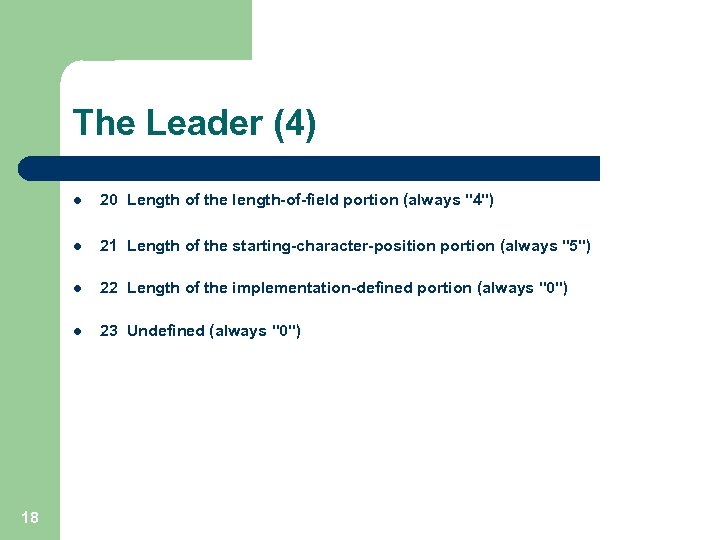 The Leader (4) l l 21 Length of the starting-character-position portion (always "5") l 22 Length of the implementation-defined portion (always "0") l 18 20 Length of the length-of-field portion (always "4") 23 Undefined (always "0")
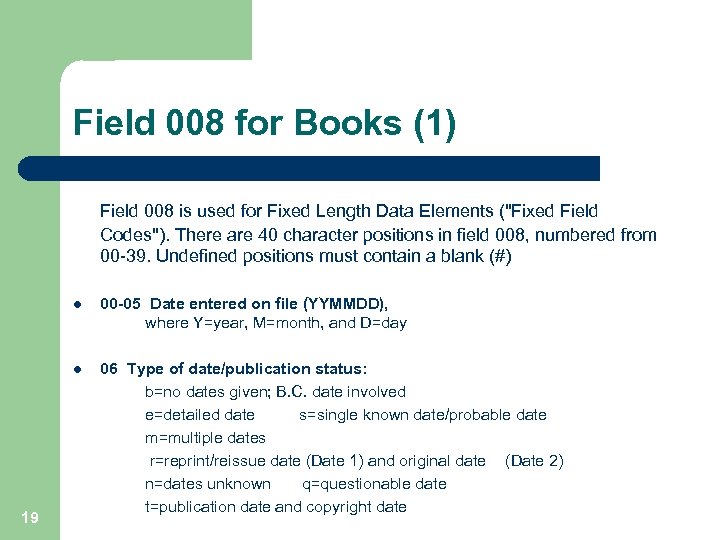 Field 008 for Books (1) Field 008 is used for Fixed Length Data Elements ("Fixed Field Codes"). There are 40 character positions in field 008, numbered from 00 -39. Undefined positions must contain a blank (#) l l 19 00 -05 Date entered on file (YYMMDD), where Y=year, M=month, and D=day 06 Type of date/publication status: b=no dates given; B. C. date involved e=detailed date s=single known date/probable date m=multiple dates r=reprint/reissue date (Date 1) and original date (Date 2) n=dates unknown q=questionable date t=publication date and copyright date
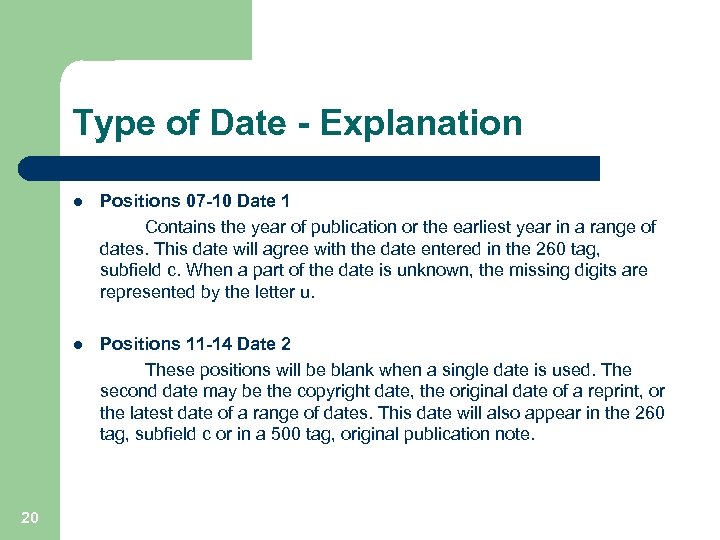 Type of Date - Explanation l l 20 Positions 07 -10 Date 1 Contains the year of publication or the earliest year in a range of dates. This date will agree with the date entered in the 260 tag, subfield c. When a part of the date is unknown, the missing digits are represented by the letter u. Positions 11 -14 Date 2 These positions will be blank when a single date is used. The second date may be the copyright date, the original date of a reprint, or the latest date of a range of dates. This date will also appear in the 260 tag, subfield c or in a 500 tag, original publication note.
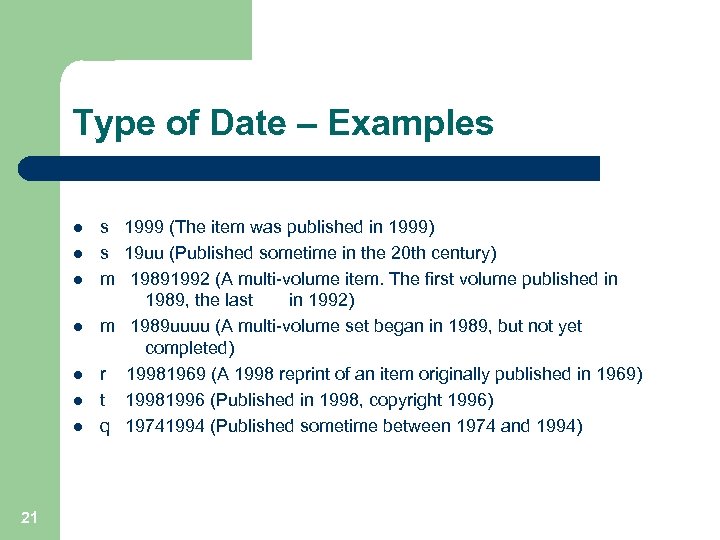 Type of Date – Examples l l l l 21 s 1999 (The item was published in 1999) s 19 uu (Published sometime in the 20 th century) m 19891992 (A multi-volume item. The first volume published in 1989, the last in 1992) m 1989 uuuu (A multi-volume set began in 1989, but not yet completed) r 19981969 (A 1998 reprint of an item originally published in 1969) t 19981996 (Published in 1998, copyright 1996) q 19741994 (Published sometime between 1974 and 1994)
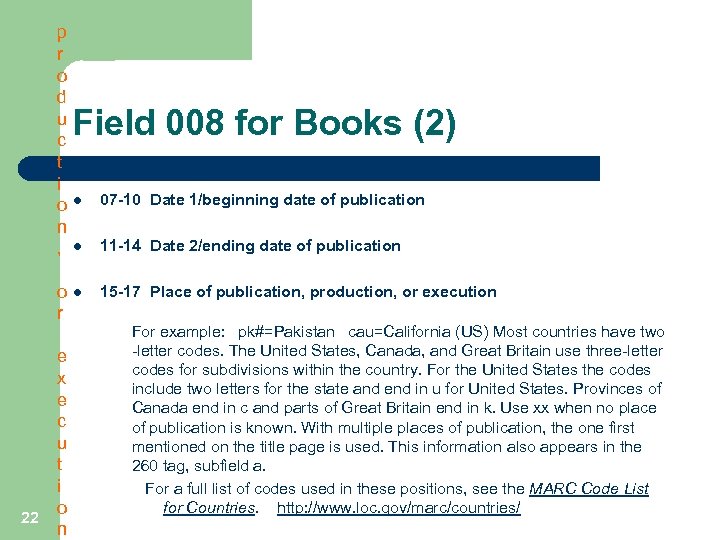 22 p r o d u c t i o n , o r e x e c u t i o n Field 008 for Books (2) l 07 -10 Date 1/beginning date of publication l 11 -14 Date 2/ending date of publication l 15 -17 Place of publication, production, or execution For example: pk#=Pakistan cau=California (US) Most countries have two -letter codes. The United States, Canada, and Great Britain use three-letter codes for subdivisions within the country. For the United States the codes include two letters for the state and end in u for United States. Provinces of Canada end in c and parts of Great Britain end in k. Use xx when no place of publication is known. With multiple places of publication, the one first mentioned on the title page is used. This information also appears in the 260 tag, subfield a. For a full list of codes used in these positions, see the MARC Code List for Countries. http: //www. loc. gov/marc/countries/
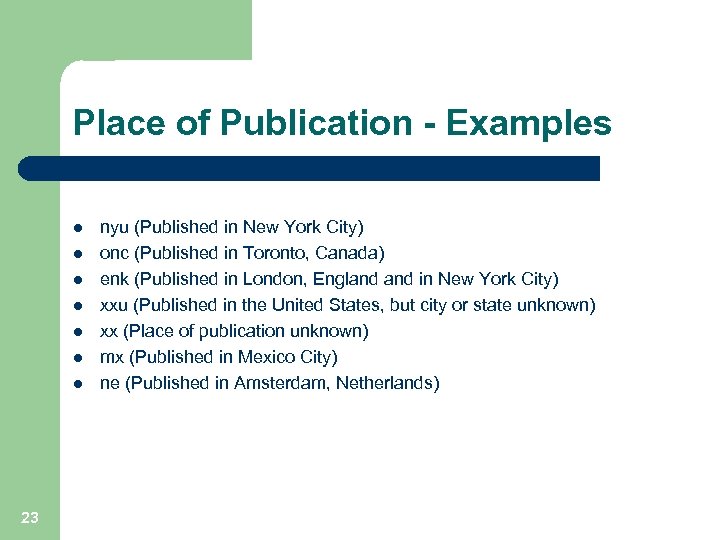 Place of Publication - Examples l l l l 23 nyu (Published in New York City) onc (Published in Toronto, Canada) enk (Published in London, England in New York City) xxu (Published in the United States, but city or state unknown) xx (Place of publication unknown) mx (Published in Mexico City) ne (Published in Amsterdam, Netherlands)
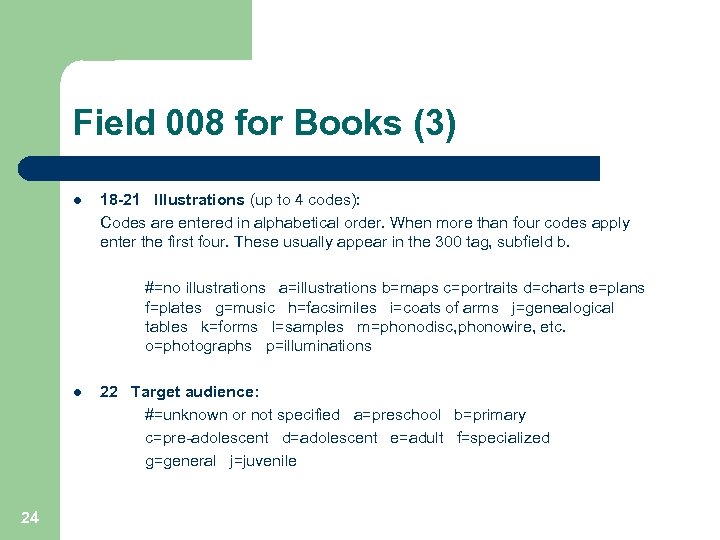 Field 008 for Books (3) l 18 -21 Illustrations (up to 4 codes): Codes are entered in alphabetical order. When more than four codes apply enter the first four. These usually appear in the 300 tag, subfield b. #=no illustrations a=illustrations b=maps c=portraits d=charts e=plans f=plates g=music h=facsimiles i=coats of arms j=genealogical tables k=forms l=samples m=phonodisc, phonowire, etc. o=photographs p=illuminations l 24 22 Target audience: #=unknown or not specified a=preschool b=primary c=pre-adolescent d=adolescent e=adult f=specialized g=general j=juvenile
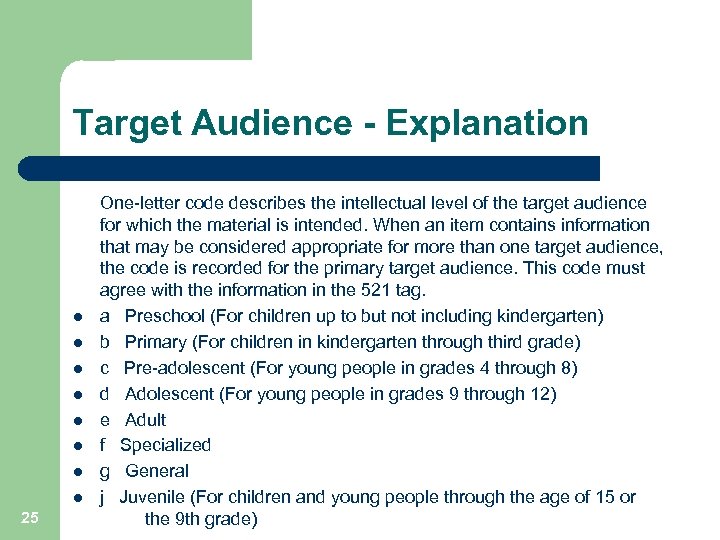 Target Audience - Explanation l l l l 25 One-letter code describes the intellectual level of the target audience for which the material is intended. When an item contains information that may be considered appropriate for more than one target audience, the code is recorded for the primary target audience. This code must agree with the information in the 521 tag. a Preschool (For children up to but not including kindergarten) b Primary (For children in kindergarten through third grade) c Pre-adolescent (For young people in grades 4 through 8) d Adolescent (For young people in grades 9 through 12) e Adult f Specialized g General j Juvenile (For children and young people through the age of 15 or the 9 th grade)
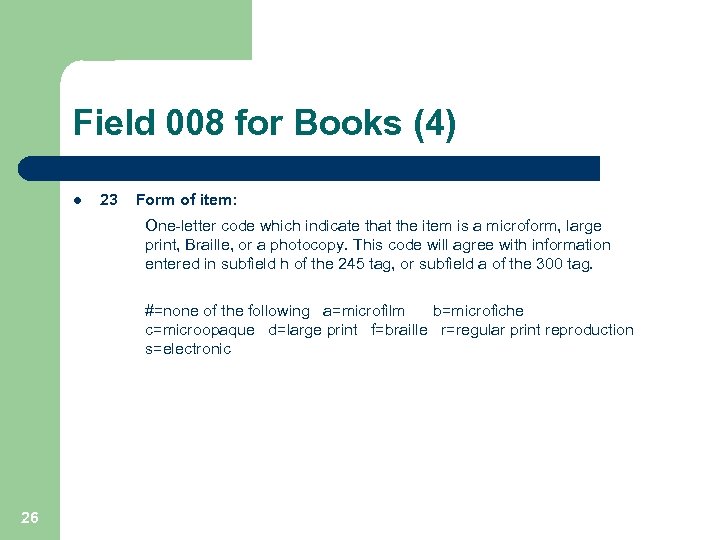 Field 008 for Books (4) l 23 Form of item: One-letter code which indicate that the item is a microform, large print, Braille, or a photocopy. This code will agree with information entered in subfield h of the 245 tag, or subfield a of the 300 tag. #=none of the following a=microfilm b=microfiche c=microopaque d=large print f=braille r=regular print reproduction s=electronic 26
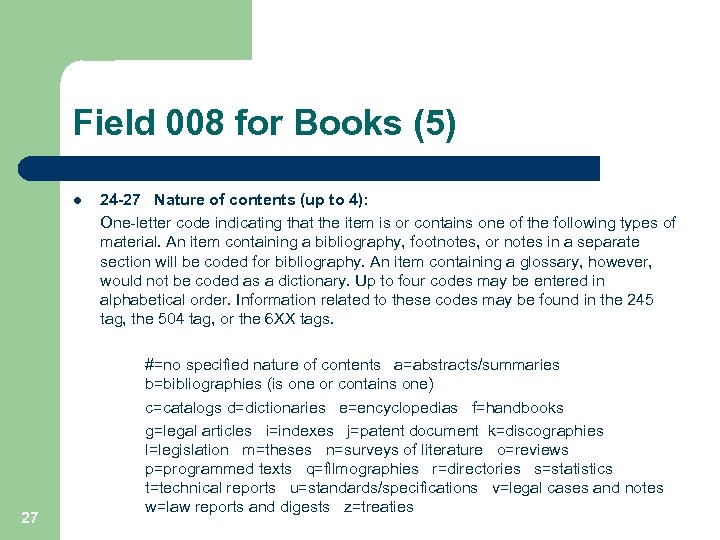 Field 008 for Books (5) l 24 -27 Nature of contents (up to 4): One-letter code indicating that the item is or contains one of the following types of material. An item containing a bibliography, footnotes, or notes in a separate section will be coded for bibliography. An item containing a glossary, however, would not be coded as a dictionary. Up to four codes may be entered in alphabetical order. Information related to these codes may be found in the 245 tag, the 504 tag, or the 6 XX tags. 27 #=no specified nature of contents a=abstracts/summaries b=bibliographies (is one or contains one) c=catalogs d=dictionaries e=encyclopedias f=handbooks g=legal articles i=indexes j=patent document k=discographies l=legislation m=theses n=surveys of literature o=reviews p=programmed texts q=filmographies r=directories s=statistics t=technical reports u=standards/specifications v=legal cases and notes w=law reports and digests z=treaties
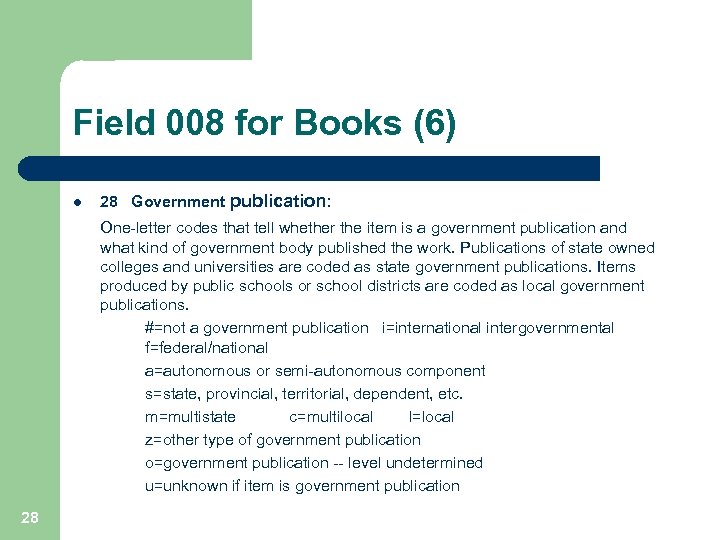 Field 008 for Books (6) l 28 Government publication: One-letter codes that tell whether the item is a government publication and what kind of government body published the work. Publications of state owned colleges and universities are coded as state government publications. Items produced by public schools or school districts are coded as local government publications. #=not a government publication i=international intergovernmental f=federal/national a=autonomous or semi-autonomous component s=state, provincial, territorial, dependent, etc. m=multistate c=multilocal l=local z=other type of government publication o=government publication -- level undetermined u=unknown if item is government publication 28
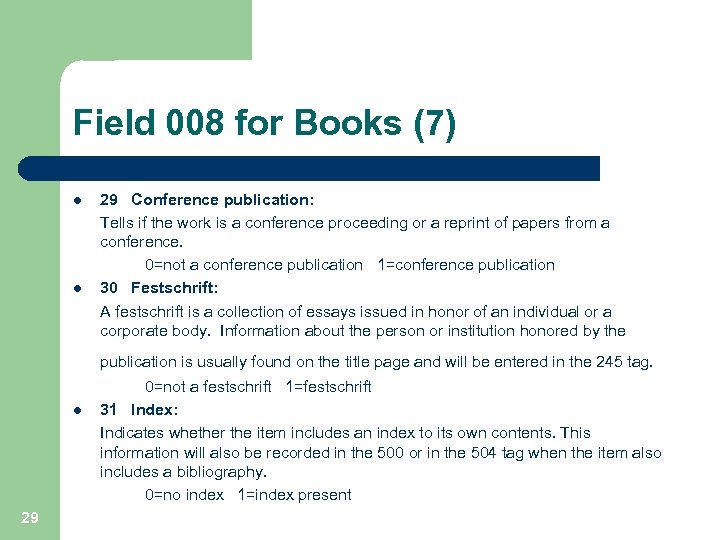 Field 008 for Books (7) l l 29 Conference publication: Tells if the work is a conference proceeding or a reprint of papers from a conference. 0=not a conference publication 1=conference publication 30 Festschrift: A festschrift is a collection of essays issued in honor of an individual or a corporate body. Information about the person or institution honored by the publication is usually found on the title page and will be entered in the 245 tag. l 29 0=not a festschrift 1=festschrift 31 Index: Indicates whether the item includes an index to its own contents. This information will also be recorded in the 500 or in the 504 tag when the item also includes a bibliography. 0=no index 1=index present
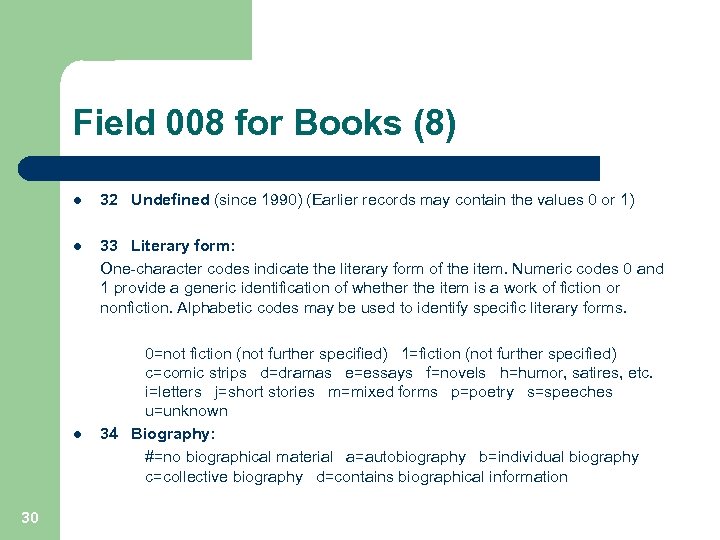 Field 008 for Books (8) l 32 Undefined (since 1990) (Earlier records may contain the values 0 or 1) l 33 Literary form: One-character codes indicate the literary form of the item. Numeric codes 0 and 1 provide a generic identification of whether the item is a work of fiction or nonfiction. Alphabetic codes may be used to identify specific literary forms. l 30 0=not fiction (not further specified) 1=fiction (not further specified) c=comic strips d=dramas e=essays f=novels h=humor, satires, etc. i=letters j=short stories m=mixed forms p=poetry s=speeches u=unknown 34 Biography: #=no biographical material a=autobiography b=individual biography c=collective biography d=contains biographical information
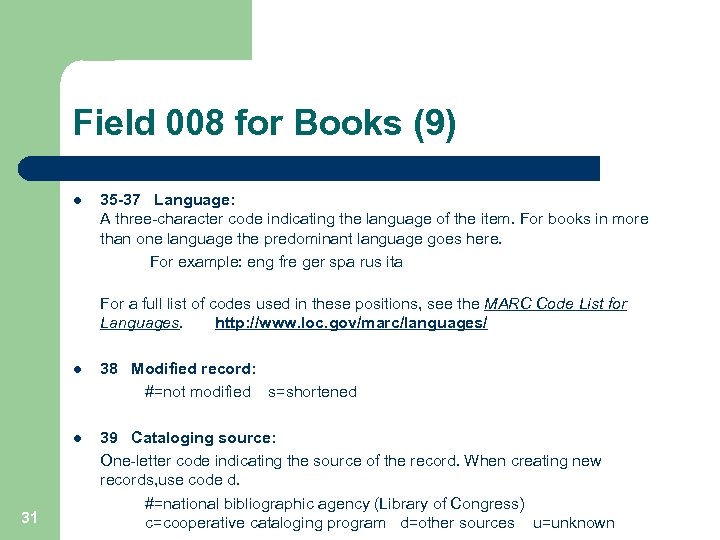 Field 008 for Books (9) l 35 -37 Language: A three-character code indicating the language of the item. For books in more than one language the predominant language goes here. For example: eng fre ger spa rus ita For a full list of codes used in these positions, see the MARC Code List for Languages. http: //www. loc. gov/marc/languages/ l l 31 38 Modified record: #=not modified s=shortened 39 Cataloging source: One-letter code indicating the source of the record. When creating new records, use code d. #=national bibliographic agency (Library of Congress) c=cooperative cataloging program d=other sources u=unknown
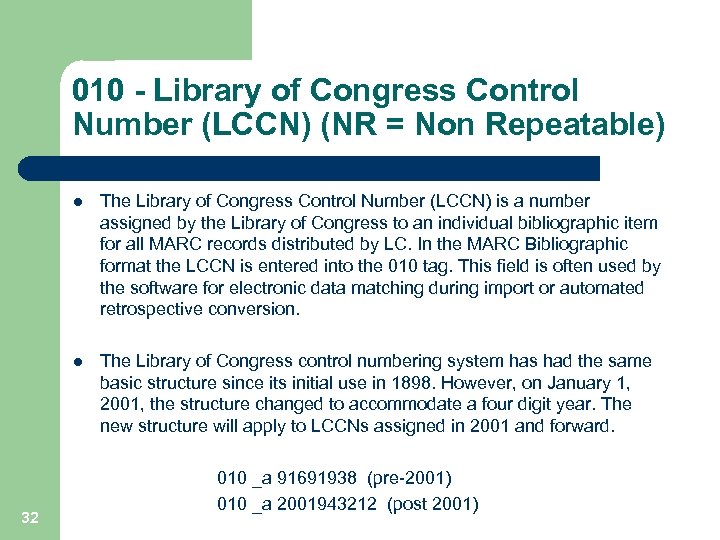 010 - Library of Congress Control Number (LCCN) (NR = Non Repeatable) l l 32 The Library of Congress Control Number (LCCN) is a number assigned by the Library of Congress to an individual bibliographic item for all MARC records distributed by LC. In the MARC Bibliographic format the LCCN is entered into the 010 tag. This field is often used by the software for electronic data matching during import or automated retrospective conversion. The Library of Congress control numbering system has had the same basic structure since its initial use in 1898. However, on January 1, 2001, the structure changed to accommodate a four digit year. The new structure will apply to LCCNs assigned in 2001 and forward. 010 _a 91691938 (pre-2001) 010 _a 2001943212 (post 2001)
 020 - International Standard Book Number (ISBN) (R = Repeatable) l l AACR 2 covers standard numbers and terms of availability in rule 1. 8 and in the X. 8 subsection in each chapter (2. 8, 3. 8, etc. ). Although originally created for books, ISBNs can be found in all formats except manuscripts. l 33 The 020 tag of the MARC bibliographic format contains the International Standard Book Number (ISBN), terms of availability, and any canceled or invalid ISBN related to the item. The International Standard Book Number consists of ten or thirteen digits.
 020 - International Standard Book Number (ISBN) - Examples l Book in cloth and paperback bindings with prices in U. S. 020 _a 0590582475 : _c$12. 95020 _a 0590205153 (pbk. ) : _c$4. 95 l Book with different ISBNs for each distributor 020 _a 0802850731 (Eerdmans) 020 _a 0865433771 (Africa World Press) l Book with price but no ISBN 020 _c$5. 95 (pbk. ) l ISBNs for set as well as for individual volumes 020 _a 0810392070 (set : acid-free paper) 020 _a 0810392119 (v. 1 : acid-free paper) 020 _a 0810392097 (v. 2 : acid-free paper) 020 _a 0810392100 (v. 3 : acid-free paper) 34
 022 International Standard Serial Number -- (ISSN) l l l AACR 2 covers ISSNs in rule 12. 8 B and in the X. 8 subsection in each chapter (2. 8, 3. 8, etc. ), as serials can occur in all formats, except manuscripts. The ISSN Network assigns the eight digit ISSN. The last digit of the ISSN is a check digit, 0 -9 or X (Roman Numeral for 10). The check digit allows computer systems to validate ISSNs. Subfields – – – a International Standard Serial Number (NR) y Incorrect ISSN (R) z Canceled ISSN (R) Examples: 022 _a 1077 -7199 022 _a 0029 -0564 _z 0360 -490 X 35
 040 Cataloging source -- (NR) l The Cataloging Source 040 tag of the MARC 21 bibliographic record contains the MARC code or the name of the organization that created the original record, assigned the MARC content designation (tags indicators, and subfield codes) and transcribed the record into machine -readable form or modified an existing MARC record. l Subfields – – a Original cataloging agency (NR) b Language of cataloging (NR) c Transcribing agency (NR) d Modifying agency (R) Example: 040 _a. DLC _c. DLC _d. RHC 36
 082 Dewey Decimal Call Number -- (R) l l 37 The 082 tag of the MARC bibliographic format contains a complete classification number assigned by the Library of Congress or another cataloging agency. Classification numbers are assigned from the Dewey Decimal Classification and Relative Index or the Abridged Dewey Decimal Classification and Relative Index edited and maintained by the Library of Congress and published by Forest Press (http: //www. oclc. org/oclc/fp/) Classification numbers serve a dual function for the library user. The classification number is a locator that tells a library user where an individual item is located in the library. Dewey Decimal Classification numbers are also subject classifications that tell library users where other items on the same or similar subjects may be located.
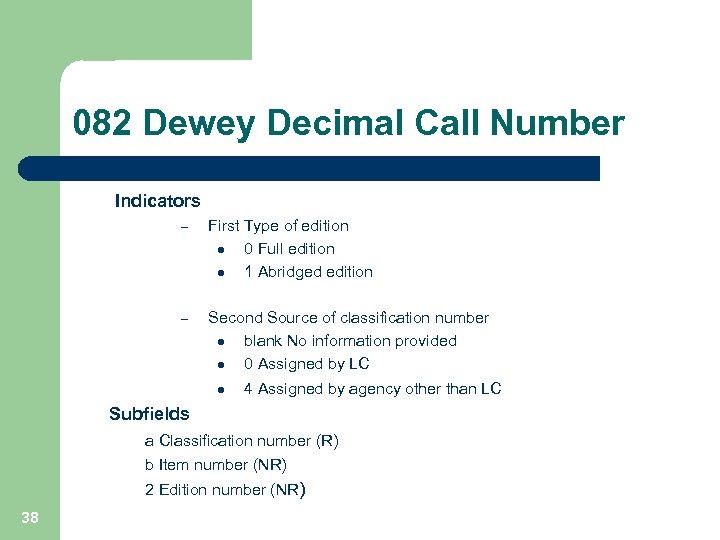 082 Dewey Decimal Call Number Indicators – First Type of edition l 0 Full edition l 1 Abridged edition – Second Source of classification number l blank No information provided l 0 Assigned by LC l 4 Assigned by agency other than LC Subfields a Classification number (R) b Item number (NR) 2 Edition number (NR) 38
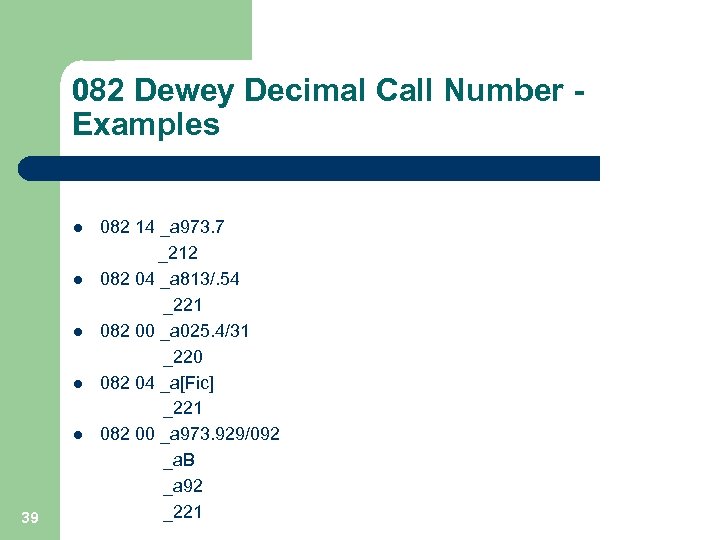 082 Dewey Decimal Call Number - Examples 082 14 _a 973. 7 _212 l 082 04 _a 813/. 54 _221 l 082 00 _a 025. 4/31 _220 l 082 04 _a[Fic] _221 l 082 00 _a 973. 929/092 _a. B _a 92 _221 l 39
 100 Main entry -- Personal name -- (primary author) (NR; there can be only one main entry) l l l 40 The Main Entry - Personal Name (100 tag) of the MARC bibliographic record contains a personal name heading for the individual responsible for the creation of the intellectual or artistic content of the work. AACR 2 covers main and added entries in chapter 21, "Choice of Access Points". The purpose of the main entry is to establish the form in which a work is to be uniformly cited. Many rules cover the choice of headings for the personal name main entry. Rule 21. 1 A 2 directs us to use the personal author, principal personal author, probable personal author, or the first person named as the main entry heading. Rules 21. 4 -21. 28 deal with choosing the main entry heading for works with single, shared, or mixed responsibility. Chapter 22, "Headings For Persons", contains rules for constructing names in AACR 2 form.
 100 Main entry -- Personal name l l 41 In many cases there is only one author associated with an item, and the choice of the main entry heading is simple. When there is more than one author responsible for an item, the name that should be chosen for the main entry heading is usually listed first or in larger type. If there are four or more authors, the title is selected as the main entry. Editors and compilers are not considered creators and therefore are not to be given main entry status. Some common rules are: for a classical recording use the composer as the main entry; for recordings of popular music use the principal musician or musical group as the main entry; and when a work is an adaptation, the person who adapted the work is used in the main entry heading and the original author is given an added entry.
 100 Main entry -- Personal name l Indicator 1: Type of personal name entry element – l Indicator 2 undefined. – l Indicator 2 became obsolete in 1990. Older records may display 0 or 1 Subfields used most often: – 42 0 -- Forename 1 -- Surname (this is the most common form) 3 -- Family name $a -- Personal name $b -- Numeration $c -- Titles and other words associated with a name (R) $q -- Fuller form of name $d -- Dates associated with a name (generally, year of birth)
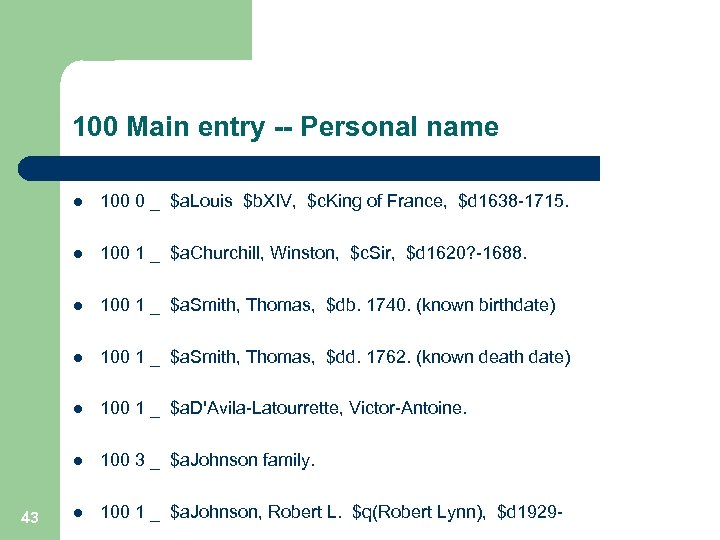 100 Main entry -- Personal name l l 100 1 _ $a. Churchill, Winston, $c. Sir, $d 1620? -1688. l 100 1 _ $a. Smith, Thomas, $db. 1740. (known birthdate) l 100 1 _ $a. Smith, Thomas, $dd. 1762. (known death date) l 100 1 _ $a. D'Avila-Latourrette, Victor-Antoine. l 43 100 0 _ $a. Louis $b. XIV, $c. King of France, $d 1638 -1715. 100 3 _ $a. Johnson family. l 100 1 _ $a. Johnson, Robert L. $q(Robert Lynn), $d 1929 -
 130 Main entry -- Uniform title -- (NR) l l l 44 The 130 tag contains a uniform title used as a main entry. There will be no 100, 110, or 111 field if the record contains a 130 tag. This occurs when the work is entered directly under title and the work appears under varying titles, necessitating that a particular title be chosen to represent the work. The Uniform Titles in the 130 field are primarily for sacred scriptures, creeds, liturgical works without an author/composer, and anonymous classics. The uniform title will bring all renditions of the title together in the title index.
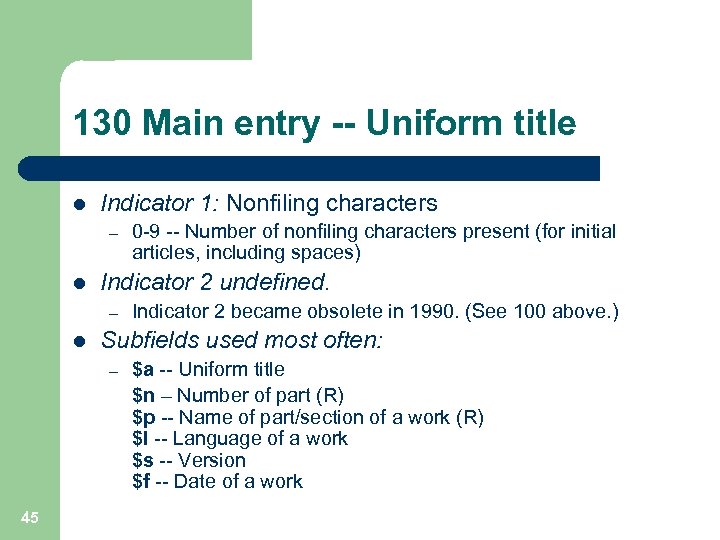 130 Main entry -- Uniform title l Indicator 1: Nonfiling characters – l Indicator 2 undefined. – l Indicator 2 became obsolete in 1990. (See 100 above. ) Subfields used most often: – 45 0 -9 -- Number of nonfiling characters present (for initial articles, including spaces) $a -- Uniform title $n – Number of part (R) $p -- Name of part/section of a work (R) $l -- Language of a work $s -- Version $f -- Date of a work
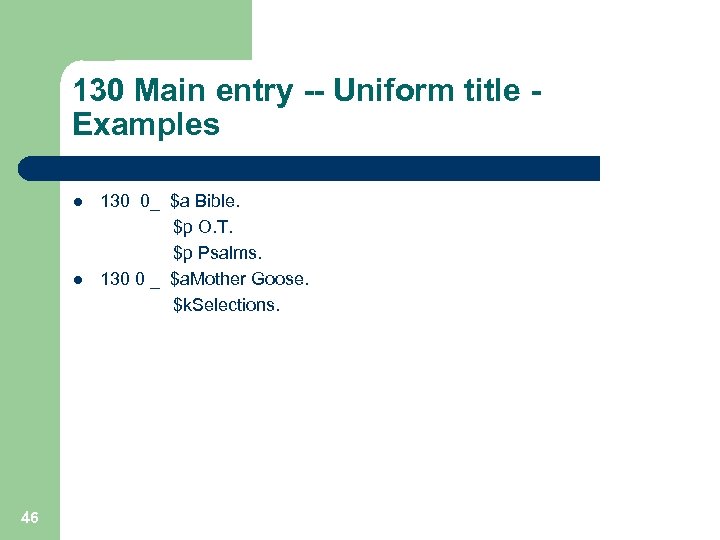 130 Main entry -- Uniform title - Examples 130 0_ $a Bible. $p O. T. $p Psalms. l 130 0 _ $a. Mother Goose. $k. Selections. l 46
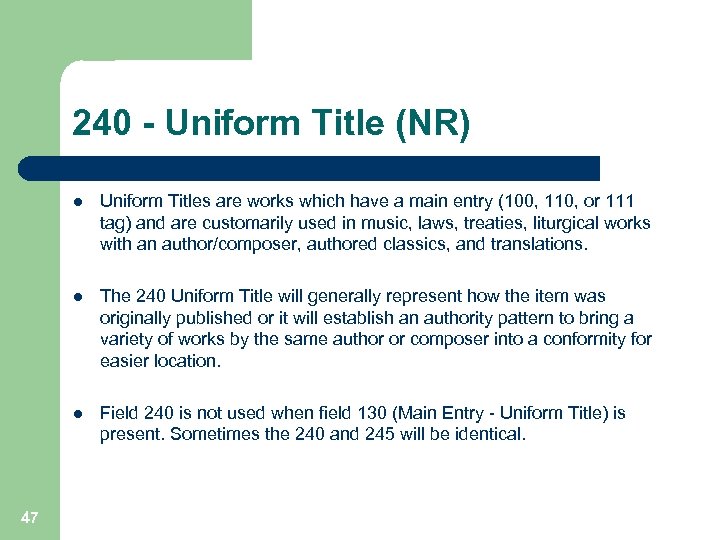 240 - Uniform Title (NR) l Uniform Titles are works which have a main entry (100, 110, or 111 tag) and are customarily used in music, laws, treaties, liturgical works with an author/composer, authored classics, and translations. l l 47 The 240 Uniform Title will generally represent how the item was originally published or it will establish an authority pattern to bring a variety of works by the same author or composer into a conformity for easier location. Field 240 is not used when field 130 (Main Entry - Uniform Title) is present. Sometimes the 240 and 245 will be identical.
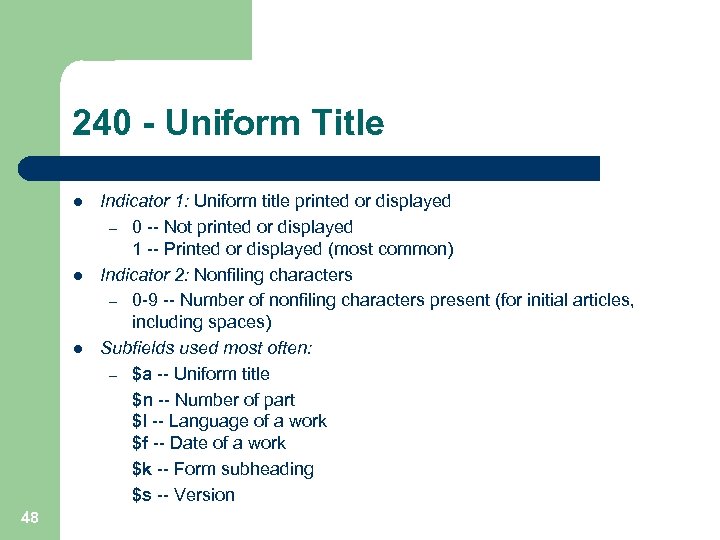 240 - Uniform Title l l l 48 Indicator 1: Uniform title printed or displayed – 0 -- Not printed or displayed 1 -- Printed or displayed (most common) Indicator 2: Nonfiling characters – 0 -9 -- Number of nonfiling characters present (for initial articles, including spaces) Subfields used most often: – $a -- Uniform title $n -- Number of part $l -- Language of a work $f -- Date of a work $k -- Form subheading $s -- Version
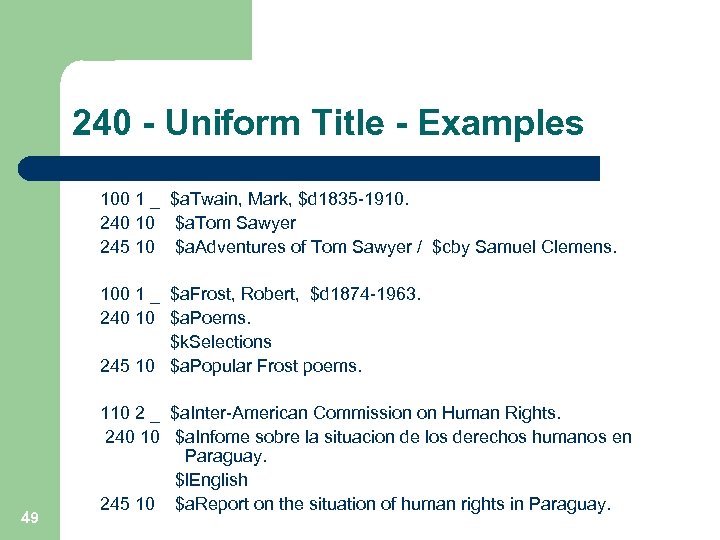 240 - Uniform Title - Examples 100 1 _ $a. Twain, Mark, $d 1835 -1910. 240 10 $a. Tom Sawyer 245 10 $a. Adventures of Tom Sawyer / $cby Samuel Clemens. 100 1 _ $a. Frost, Robert, $d 1874 -1963. 240 10 $a. Poems. $k. Selections 245 10 $a. Popular Frost poems. 49 110 2 _ $a. Inter-American Commission on Human Rights. 240 10 $a. Infome sobre la situacion de los derechos humanos en Paraguay. $l. English 245 10 $a. Report on the situation of human rights in Paraguay.
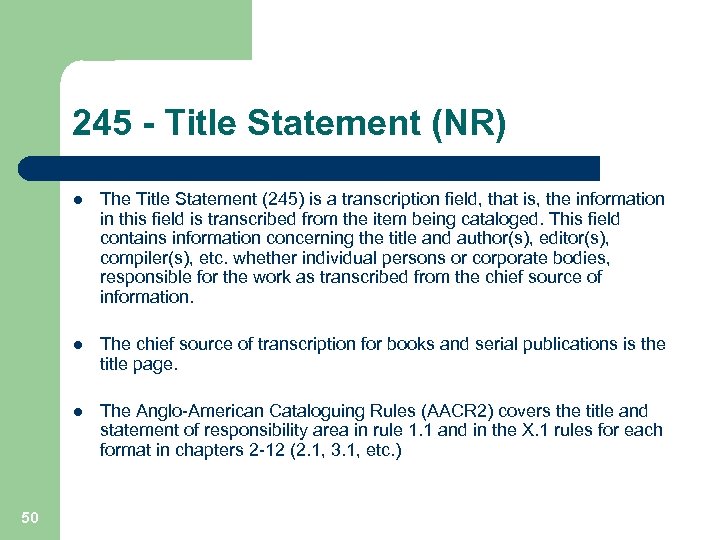 245 - Title Statement (NR) l l The chief source of transcription for books and serial publications is the title page. l 50 The Title Statement (245) is a transcription field, that is, the information in this field is transcribed from the item being cataloged. This field contains information concerning the title and author(s), editor(s), compiler(s), etc. whether individual persons or corporate bodies, responsible for the work as transcribed from the chief source of information. The Anglo-American Cataloguing Rules (AACR 2) covers the title and statement of responsibility area in rule 1. 1 and in the X. 1 rules for each format in chapters 2 -12 (2. 1, 3. 1, etc. )
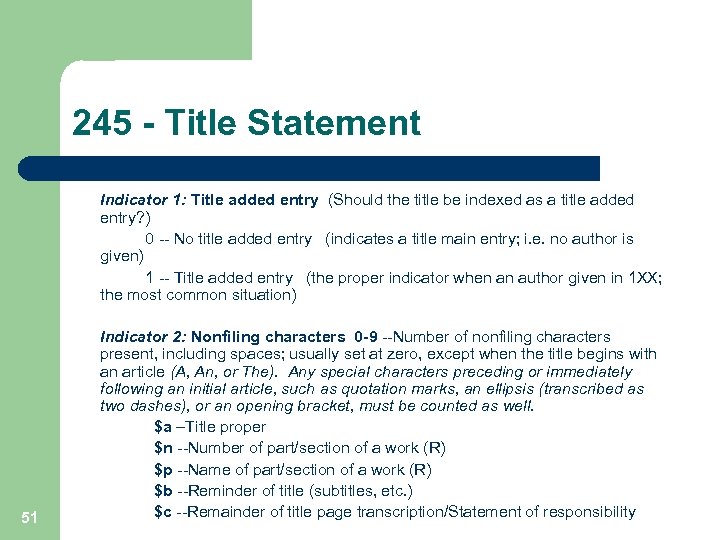 245 - Title Statement Indicator 1: Title added entry (Should the title be indexed as a title added entry? ) 0 -- No title added entry (indicates a title main entry; i. e. no author is given) 1 -- Title added entry (the proper indicator when an author given in 1 XX; the most common situation) 51 Indicator 2: Nonfiling characters 0 -9 --Number of nonfiling characters present, including spaces; usually set at zero, except when the title begins with an article (A, An, or The). Any special characters preceding or immediately following an initial article, such as quotation marks, an ellipsis (transcribed as two dashes), or an opening bracket, must be counted as well. $a –Title proper $n --Number of part/section of a work (R) $p --Name of part/section of a work (R) $b --Reminder of title (subtitles, etc. ) $c --Remainder of title page transcription/Statement of responsibility
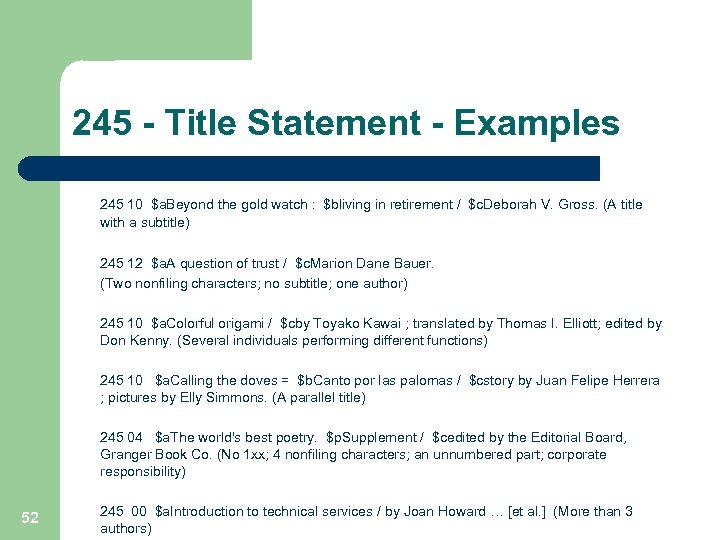 245 - Title Statement - Examples 245 10 $a. Beyond the gold watch : $bliving in retirement / $c. Deborah V. Gross. (A title with a subtitle) 245 12 $a. A question of trust / $c. Marion Dane Bauer. (Two nonfiling characters; no subtitle; one author) 245 10 $a. Colorful origami / $cby Toyako Kawai ; translated by Thomas I. Elliott; edited by Don Kenny. (Several individuals performing different functions) 245 10 $a. Calling the doves = $b. Canto por las palomas / $cstory by Juan Felipe Herrera ; pictures by Elly Simmons. (A parallel title) 245 04 $a. The world's best poetry. $p. Supplement / $cedited by the Editorial Board, Granger Book Co. (No 1 xx; 4 nonfiling characters; an unnumbered part; corporate responsibility) 52 245 00 $a. Introduction to technical services / by Joan Howard … [et al. ] (More than 3 authors)
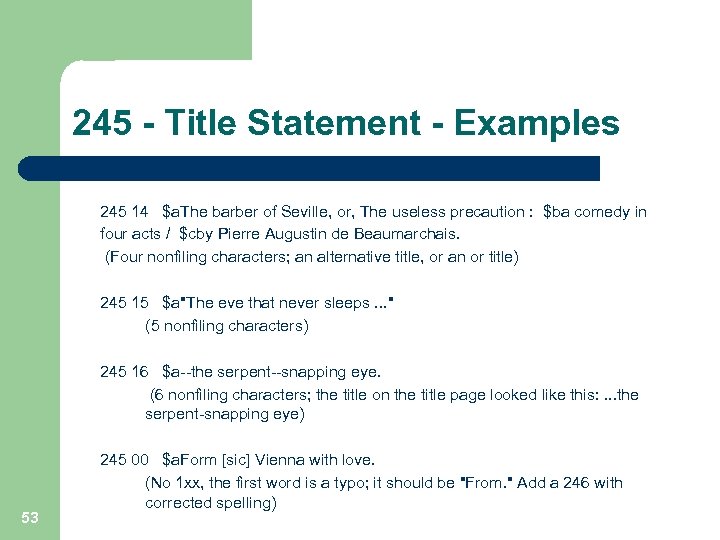 245 - Title Statement - Examples 245 14 $a. The barber of Seville, or, The useless precaution : $ba comedy in four acts / $cby Pierre Augustin de Beaumarchais. (Four nonfiling characters; an alternative title, or an or title) 245 15 $a"The eve that never sleeps. . . " (5 nonfiling characters) 245 16 $a--the serpent--snapping eye. (6 nonfiling characters; the title on the title page looked like this: . . . the serpent-snapping eye) 53 245 00 $a. Form [sic] Vienna with love. (No 1 xx, the first word is a typo; it should be "From. " Add a 246 with corrected spelling)
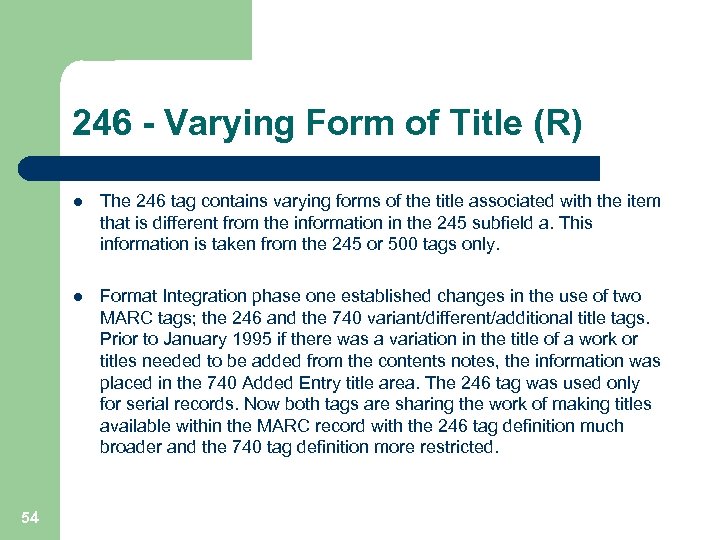 246 - Varying Form of Title (R) l l 54 The 246 tag contains varying forms of the title associated with the item that is different from the information in the 245 subfield a. This information is taken from the 245 or 500 tags only. Format Integration phase one established changes in the use of two MARC tags; the 246 and the 740 variant/different/additional title tags. Prior to January 1995 if there was a variation in the title of a work or titles needed to be added from the contents notes, the information was placed in the 740 Added Entry title area. The 246 tag was used only for serial records. Now both tags are sharing the work of making titles available within the MARC record with the 246 tag definition much broader and the 740 tag definition more restricted.
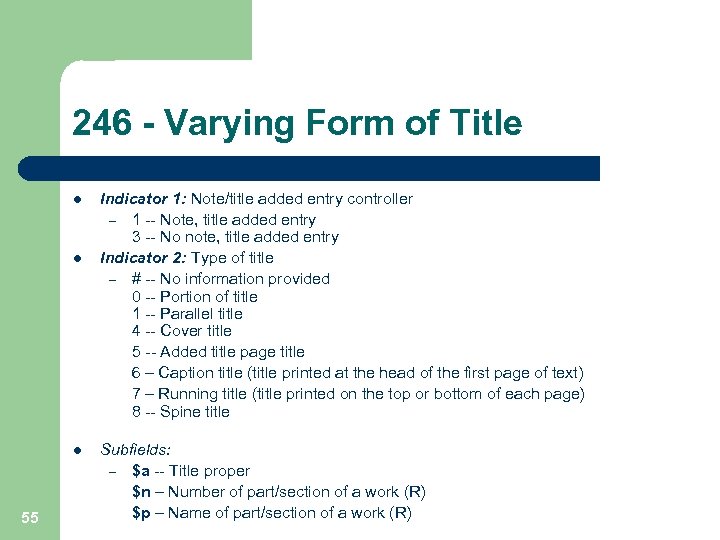 246 - Varying Form of Title l l l 55 Indicator 1: Note/title added entry controller – 1 -- Note, title added entry 3 -- No note, title added entry Indicator 2: Type of title – # -- No information provided 0 -- Portion of title 1 -- Parallel title 4 -- Cover title 5 -- Added title page title 6 – Caption title (title printed at the head of the first page of text) 7 – Running title (title printed on the top or bottom of each page) 8 -- Spine title Subfields: – $a -- Title proper $n – Number of part/section of a work (R) $p – Name of part/section of a work (R)
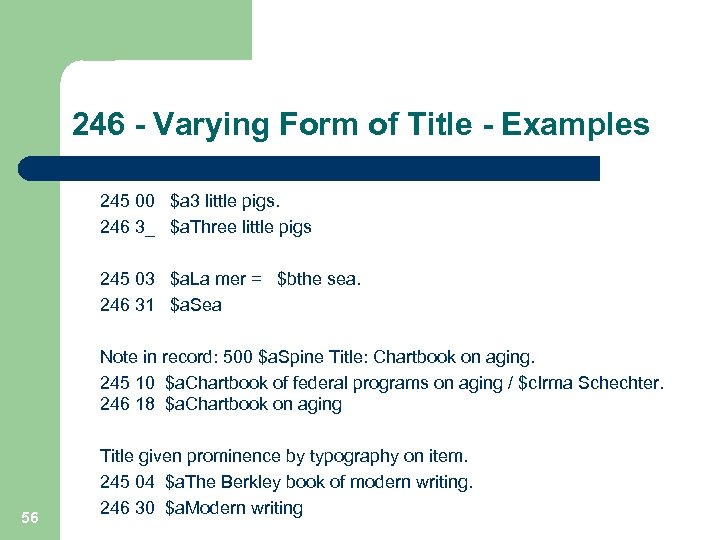 246 - Varying Form of Title - Examples 245 00 $a 3 little pigs. 246 3_ $a. Three little pigs 245 03 $a. La mer = $bthe sea. 246 31 $a. Sea Note in record: 500 $a. Spine Title: Chartbook on aging. 245 10 $a. Chartbook of federal programs on aging / $c. Irma Schechter. 246 18 $a. Chartbook on aging 56 Title given prominence by typography on item. 245 04 $a. The Berkley book of modern writing. 246 30 $a. Modern writing
 250 - Edition Statement (NR) l l l 57 The edition statement is generally identified through such words as edition, issue, or version, and any associated words such as revised and enlarged. Anglo-American Cataloging Rules (AACR 2) control the structure and information entered into the edition statement under General Rule 1. 2. The source of the edition statement is transcribed when it is found on the item and usually consists of alpha and numeric characters. Numbers expressed as words are entered as numerals and the standard abbreviations of rev. for revised, enl. for enlarged, and ed. for edition are used. Occasionally a statement of personal or corporate responsibility is added when it applies to one edition but not for the other editions of the work.
 250 - Edition Statement l l Indicators undefined. Subfield: – $a -- Edition statement $b – Remainder of statement Examples: 250 $a 3 rd ed. , rev. and enl. 250 $a. Large print ed. 250 $a 1 st English ed. 250 $a 14 th ed. / $bby Ivor H. Evans. 250 $a 20 th [ed. ]. 250 $a. Bantam pbk. ed. 58
 260 - Publication, Distribution, etc. (Imprint) l l l 59 The publication information of a MARC bibliographic record identifies the place of publication, the publisher, distributor, etc. , and the copyright date and/or the date of publication. If there is more than one place of publication or more than one publisher, this information is transcribed into one 260 tag with the individual pieces of information being entered into separate subfields. The structure of the information in this tag is determined by AACR 2 with the general rules found in Chapter 1. 4.
 260 - Publication, Distribution, etc. (Imprint) l Occasionally there will be multiple places of publication or publishers. If you are cataloging in the United States and there is a foreign place of publication and publisher listed first, enter the foreign place and publisher and then the first place and publisher in the United States that is listed. l If no information is found for the place of publication the initials [S. l. ] (sine loco) in brackets is used. l Each place and publisher will go in separate subfields. Be sure to have the place of publication and its publisher together. That is, if each publisher is located in a different city enter the first city then first publisher; followed by the second place of publication and second publisher. l 60 If no information is found for the publisher/distributor the initials [s. n. ] (sine nomine) in brackets is used.
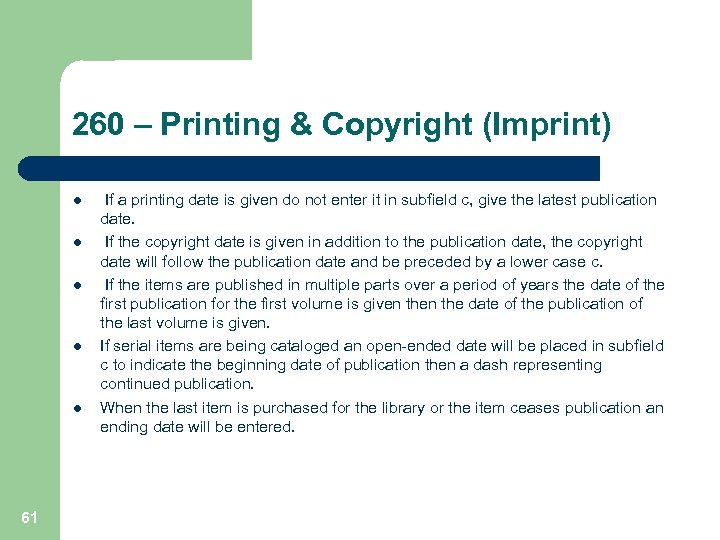 260 – Printing & Copyright (Imprint) l l l 61 If a printing date is given do not enter it in subfield c, give the latest publication date. If the copyright date is given in addition to the publication date, the copyright date will follow the publication date and be preceded by a lower case c. If the items are published in multiple parts over a period of years the date of the first publication for the first volume is given the date of the publication of the last volume is given. If serial items are being cataloged an open-ended date will be placed in subfield c to indicate the beginning date of publication then a dash representing continued publication. When the last item is purchased for the library or the item ceases publication an ending date will be entered.
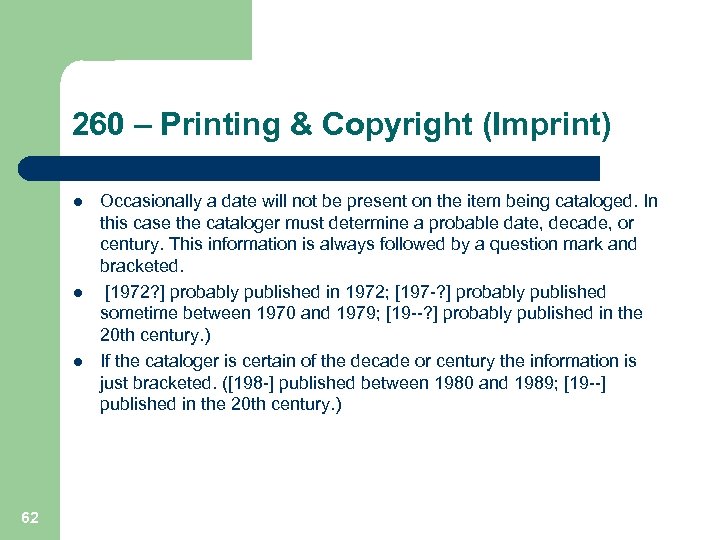 260 – Printing & Copyright (Imprint) l l l 62 Occasionally a date will not be present on the item being cataloged. In this case the cataloger must determine a probable date, decade, or century. This information is always followed by a question mark and bracketed. [1972? ] probably published in 1972; [197 -? ] probably published sometime between 1970 and 1979; [19 --? ] probably published in the 20 th century. ) If the cataloger is certain of the decade or century the information is just bracketed. ([198 -] published between 1980 and 1989; [19 --] published in the 20 th century. )
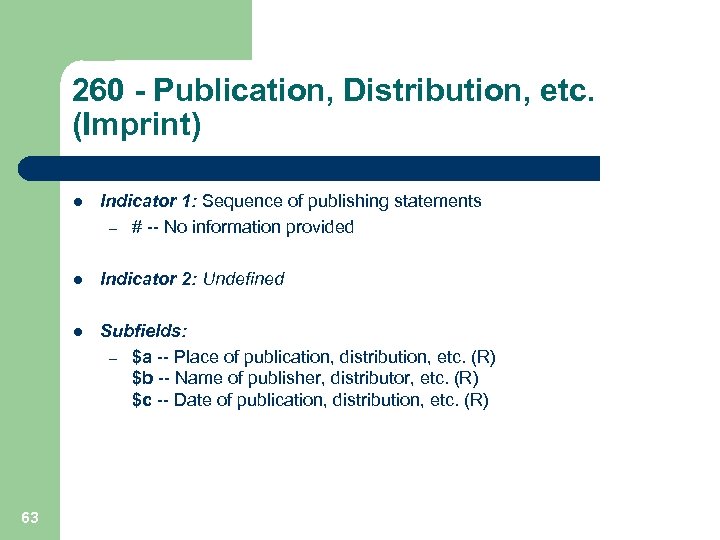 260 - Publication, Distribution, etc. (Imprint) l l Indicator 2: Undefined l 63 Indicator 1: Sequence of publishing statements – # -- No information provided Subfields: – $a -- Place of publication, distribution, etc. (R) $b -- Name of publisher, distributor, etc. (R) $c -- Date of publication, distribution, etc. (R)
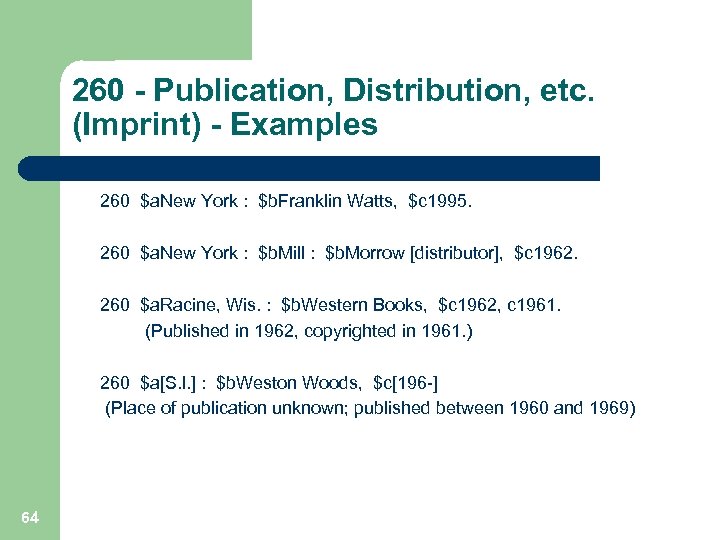 260 - Publication, Distribution, etc. (Imprint) - Examples 260 $a. New York : $b. Franklin Watts, $c 1995. 260 $a. New York : $b. Mill : $b. Morrow [distributor], $c 1962. 260 $a. Racine, Wis. : $b. Western Books, $c 1962, c 1961. (Published in 1962, copyrighted in 1961. ) 260 $a[S. l. ] : $b. Weston Woods, $c[196 -] (Place of publication unknown; published between 1960 and 1969) 64
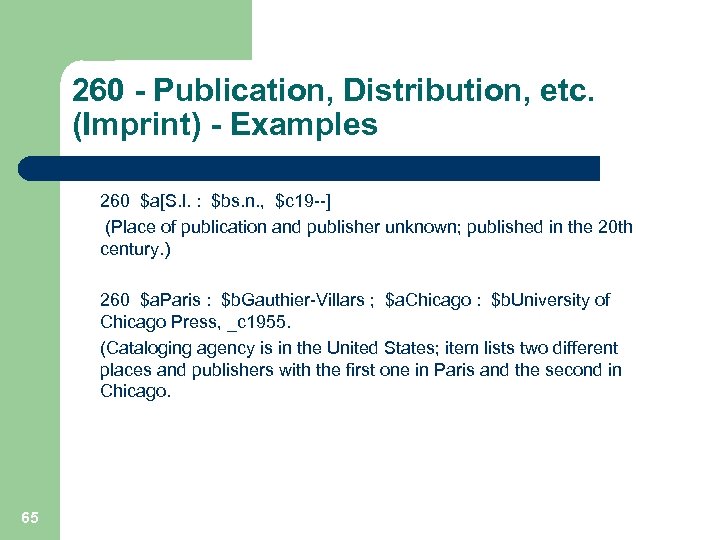 260 - Publication, Distribution, etc. (Imprint) - Examples 260 $a[S. l. : $bs. n. , $c 19 --] (Place of publication and publisher unknown; published in the 20 th century. ) 260 $a. Paris : $b. Gauthier-Villars ; $a. Chicago : $b. University of Chicago Press, _c 1955. (Cataloging agency is in the United States; item lists two different places and publishers with the first one in Paris and the second in Chicago. 65
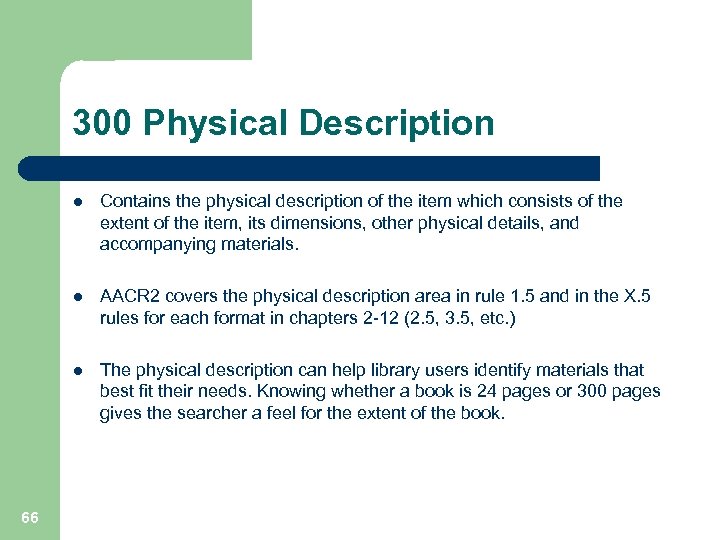 300 Physical Description l l AACR 2 covers the physical description area in rule 1. 5 and in the X. 5 rules for each format in chapters 2 -12 (2. 5, 3. 5, etc. ) l 66 Contains the physical description of the item which consists of the extent of the item, its dimensions, other physical details, and accompanying materials. The physical description can help library users identify materials that best fit their needs. Knowing whether a book is 24 pages or 300 pages gives the searcher a feel for the extent of the book.
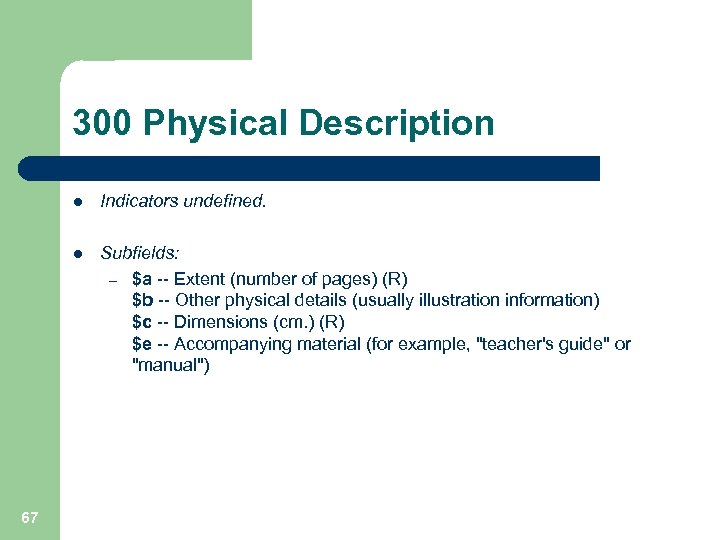 300 Physical Description l l 67 Indicators undefined. Subfields: – $a -- Extent (number of pages) (R) $b -- Other physical details (usually illustration information) $c -- Dimensions (cm. ) (R) $e -- Accompanying material (for example, "teacher's guide" or "manual")
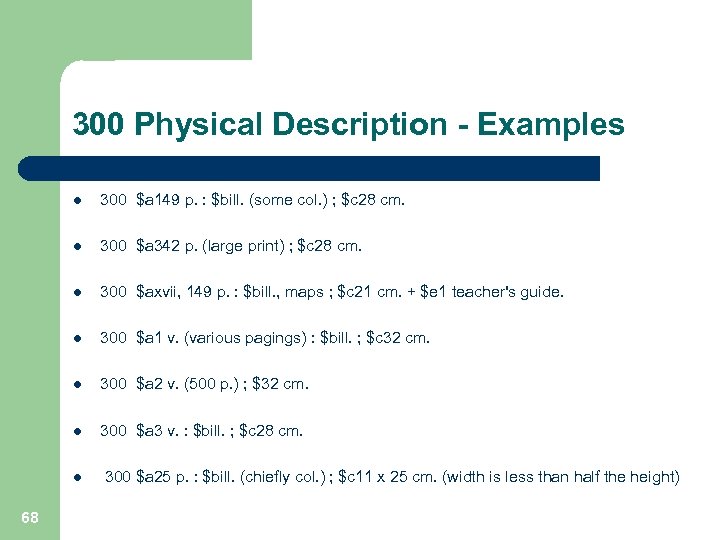 300 Physical Description - Examples l 300 $a 149 p. : $bill. (some col. ) ; $c 28 cm. l 300 $a 342 p. (large print) ; $c 28 cm. l l 300 $a 1 v. (various pagings) : $bill. ; $c 32 cm. l 300 $a 2 v. (500 p. ) ; $32 cm. l 300 $a 3 v. : $bill. ; $c 28 cm. l 68 300 $axvii, 149 p. : $bill. , maps ; $c 21 cm. + $e 1 teacher's guide. 300 $a 25 p. : $bill. (chiefly col. ) ; $c 11 x 25 cm. (width is less than half the height)
 440 Series statement / Added entry-Title (R) l l A series is defined as a group of individual items each bearing its own separate title proper and a collective title applying to the group as a whole. An item can belong to more than one series. A series may be part of another series, that is, a sub-series. l 69 This field was made obsolete in 2008 to simplify the series area so that all title series statements would be entered in the 490 field and all title series added entries in the 830. The 440 tag helps library users locate the individual titles in a series. If a library user reads a book from a fiction series, he or she may want to see what other titles from that series are available.
 440 Series statement / Added entry-Title (R) l l Field 440 is both a series statement and a series added entry. When a 440 field is present, a corresponding 830 field is not used since it would duplicate the 440 field. l 70 The record contains an indexed title of a series. The 440 tag may also include the number and name of a part or section of a series and the volume number of the item within the series. The series statement is taken from the chief source of information of the item.
 440 Series statement / Added entry-Title (R) l Indicator 1 undefined Indicator 2: Nonfiling characters – 0 -9 -- Number of nonfiling characters present (for initial articles, including spaces) l 71 Subfields: – $a -- Title $n – Number of part/section (preceded by a period) $p – Name of part/section (preceded by a period) $v -- Volume number (preceded by a space and semicolon)
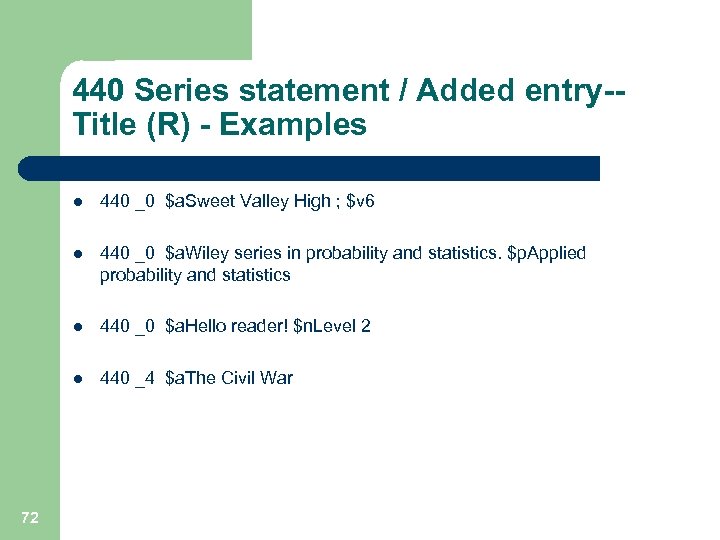 440 Series statement / Added entry-Title (R) - Examples l l 440 _0 $a. Wiley series in probability and statistics. $p. Applied probability and statistics l 440 _0 $a. Hello reader! $n. Level 2 l 72 440 _0 $a. Sweet Valley High ; $v 6 440 _4 $a. The Civil War
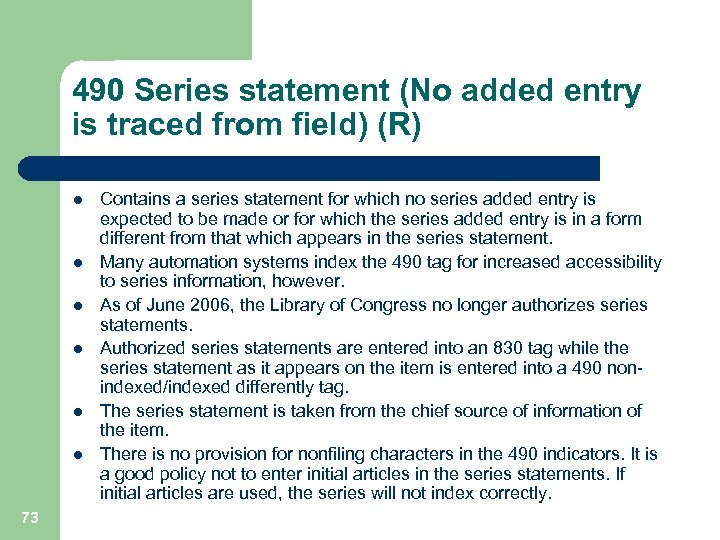 490 Series statement (No added entry is traced from field) (R) l l l 73 Contains a series statement for which no series added entry is expected to be made or for which the series added entry is in a form different from that which appears in the series statement. Many automation systems index the 490 tag for increased accessibility to series information, however. As of June 2006, the Library of Congress no longer authorizes series statements. Authorized series statements are entered into an 830 tag while the series statement as it appears on the item is entered into a 490 nonindexed/indexed differently tag. The series statement is taken from the chief source of information of the item. There is no provision for nonfiling characters in the 490 indicators. It is a good policy not to enter initial articles in the series statements. If initial articles are used, the series will not index correctly.
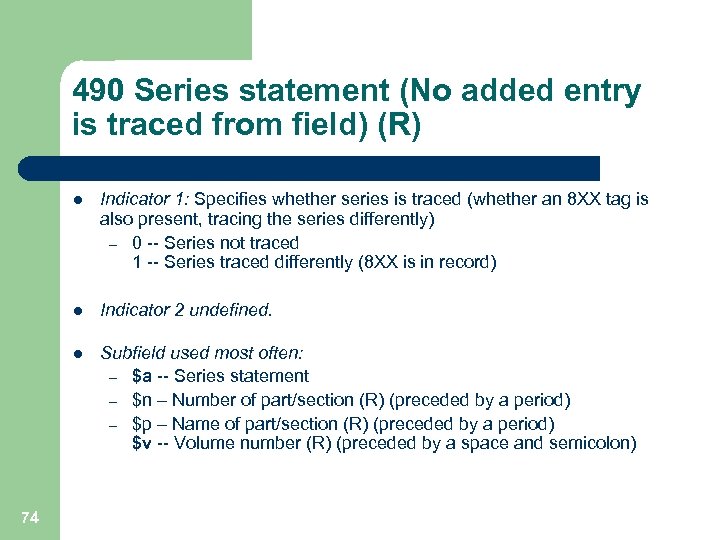 490 Series statement (No added entry is traced from field) (R) l l Indicator 2 undefined. l 74 Indicator 1: Specifies whether series is traced (whether an 8 XX tag is also present, tracing the series differently) – 0 -- Series not traced 1 -- Series traced differently (8 XX is in record) Subfield used most often: – $a -- Series statement – $n – Number of part/section (R) (preceded by a period) – $p – Name of part/section (R) (preceded by a period) $v -- Volume number (R) (preceded by a space and semicolon)
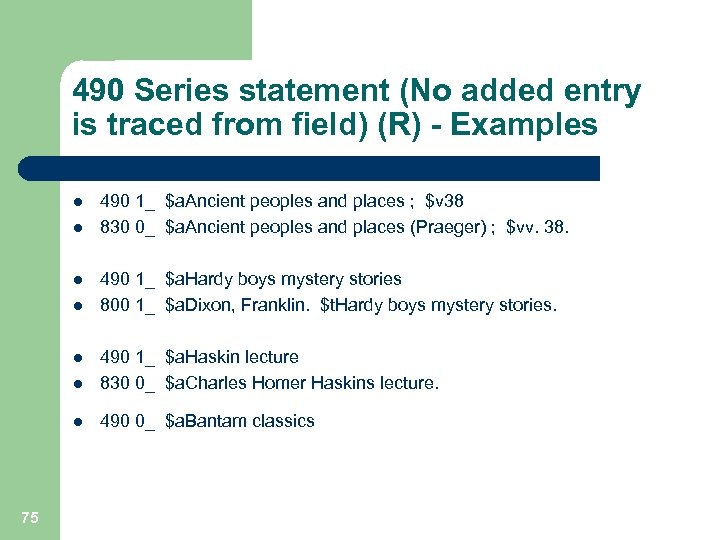 490 Series statement (No added entry is traced from field) (R) - Examples l l 490 1_ $a. Ancient peoples and places ; $v 38 830 0_ $a. Ancient peoples and places (Praeger) ; $vv. 38. l l 490 1_ $a. Hardy boys mystery stories 800 1_ $a. Dixon, Franklin. $t. Hardy boys mystery stories. l 490 1_ $a. Haskin lecture 830 0_ $a. Charles Homer Haskins lecture. l 490 0_ $a. Bantam classics l 75
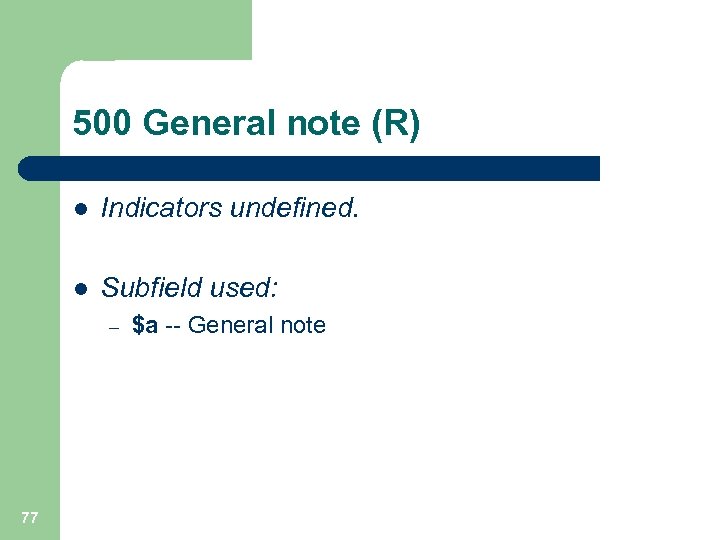
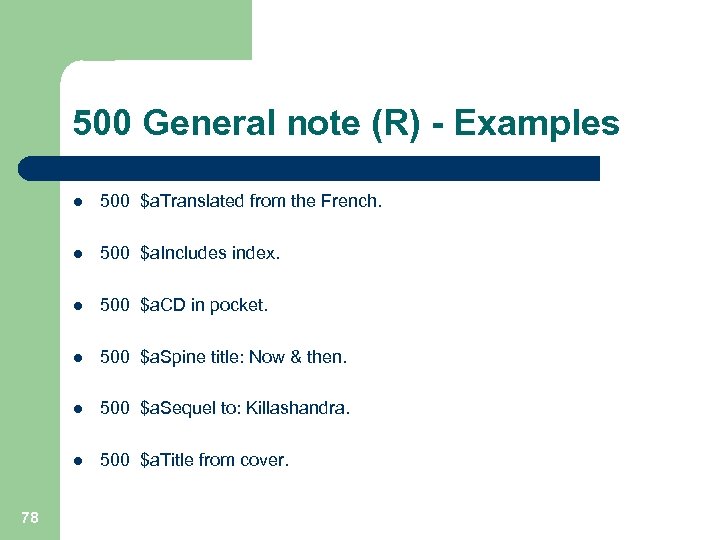
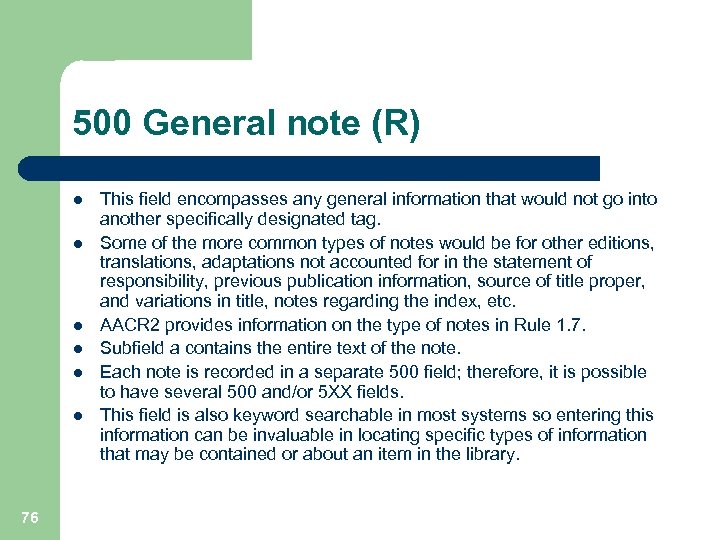 500 General note (R) l l l 76 This field encompasses any general information that would not go into another specifically designated tag. Some of the more common types of notes would be for other editions, translations, adaptations not accounted for in the statement of responsibility, previous publication information, source of title proper, and variations in title, notes regarding the index, etc. AACR 2 provides information on the type of notes in Rule 1. 7. Subfield a contains the entire text of the note. Each note is recorded in a separate 500 field; therefore, it is possible to have several 500 and/or 5 XX fields. This field is also keyword searchable in most systems so entering this information can be invaluable in locating specific types of information that may be contained or about an item in the library.
 500 General note (R) l Indicators undefined. l Subfield used: – 77 $a -- General note
 500 General note (R) - Examples l 500 $a. Translated from the French. l 500 $a. Includes index. l l 500 $a. Spine title: Now & then. l 500 $a. Sequel to: Killashandra. l 78 500 $a. CD in pocket. 500 $a. Title from cover.
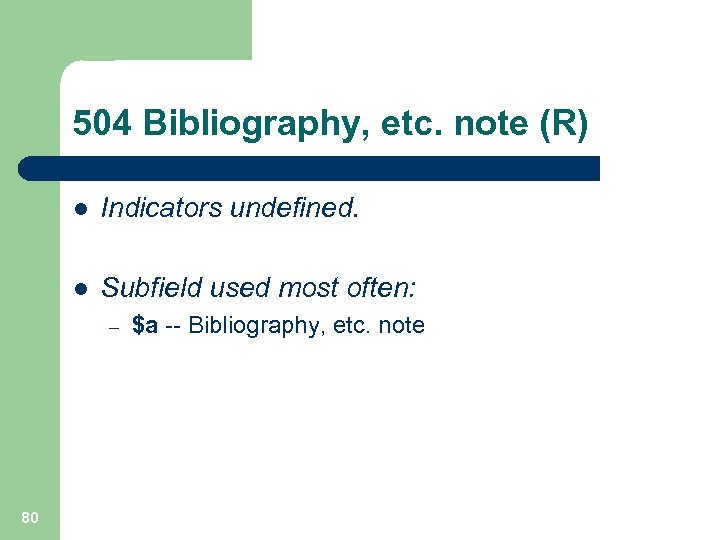
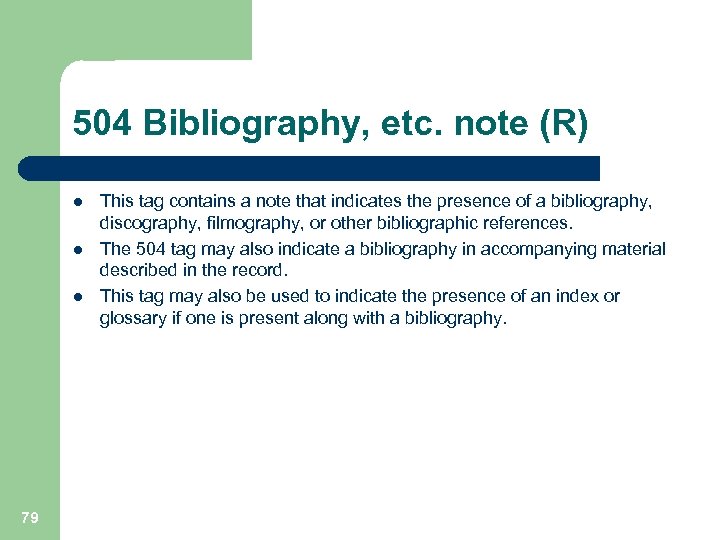 504 Bibliography, etc. note (R) l l l 79 This tag contains a note that indicates the presence of a bibliography, discography, filmography, or other bibliographic references. The 504 tag may also indicate a bibliography in accompanying material described in the record. This tag may also be used to indicate the presence of an index or glossary if one is present along with a bibliography.
 504 Bibliography, etc. note (R) l Indicators undefined. l Subfield used most often: – 80 $a -- Bibliography, etc. note
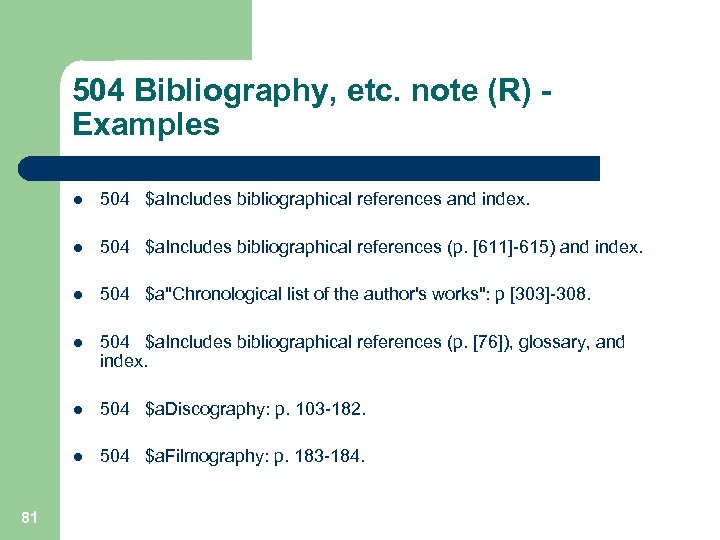 504 Bibliography, etc. note (R) - Examples l 504 $a. Includes bibliographical references and index. l l 504 $a"Chronological list of the author's works": p [303]-308. l 504 $a. Includes bibliographical references (p. [76]), glossary, and index. l 504 $a. Discography: p. 103 -182. l 81 504 $a. Includes bibliographical references (p. [611]-615) and index. 504 $a. Filmography: p. 183 -184.
 505 Formatted contents note (R) l l 82 This tag helps identify specific contents within a book or holding. Use this note to list the poems within a collection or the short stories within an anthology. The author's names may or may not be included in the contents note. The 505 tag can also be used to list the chapter headings from the table of contents if the headings would create better access to the contents of the book. AACR 2 governs the construction of the contents note with rule 1. 7 B 18.
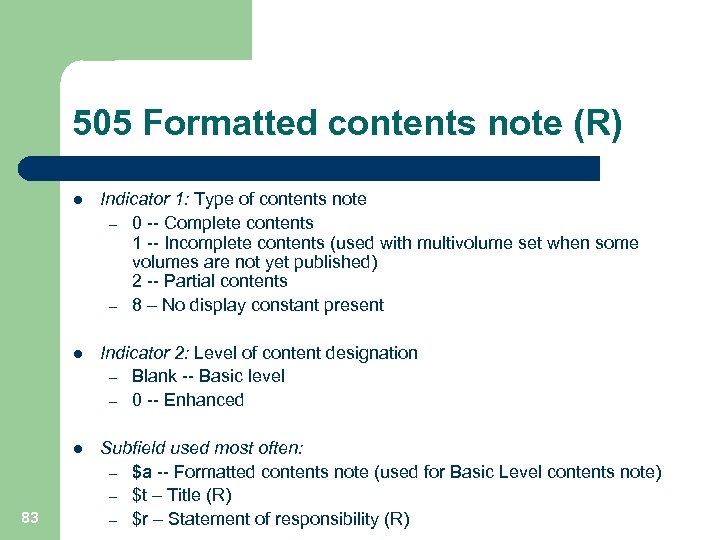 505 Formatted contents note (R) l l Indicator 2: Level of content designation – Blank -- Basic level – 0 -- Enhanced l 83 Indicator 1: Type of contents note – 0 -- Complete contents 1 -- Incomplete contents (used with multivolume set when some volumes are not yet published) 2 -- Partial contents – 8 – No display constant present Subfield used most often: – $a -- Formatted contents note (used for Basic Level contents note) – $t – Title (R) – $r – Statement of responsibility (R)
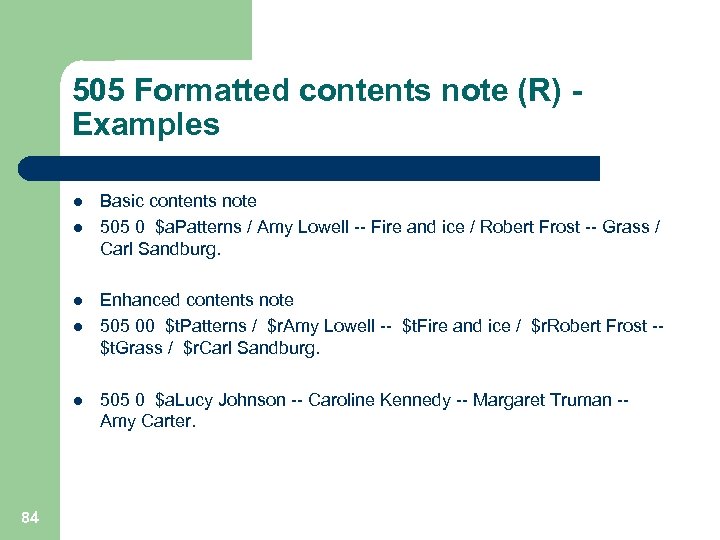 505 Formatted contents note (R) - Examples l l l 84 Basic contents note 505 0 $a. Patterns / Amy Lowell -- Fire and ice / Robert Frost -- Grass / Carl Sandburg. Enhanced contents note 505 00 $t. Patterns / $r. Amy Lowell -- $t. Fire and ice / $r. Robert Frost -- $t. Grass / $r. Carl Sandburg. 505 0 $a. Lucy Johnson -- Caroline Kennedy -- Margaret Truman -- Amy Carter.
 520 Summary, etc. note (R) l l l 85 This tag contains an unformatted note that describes the scope and general contents of a book or library holding. This could be a summary, abstract, annotation, review, or only a phrase describing the material. The Summary Note can provide a description of the plot, give the names of characters, or mention that photographs are present. The 520 tag is keyword searchable. The Summary Note may mention an alternate term or a more common term than the established subject heading. For instance, when "Inuit" is used as the subject heading, "Eskimos" might be used in the Summary Note. A Summary Note can list more specific topics. For a book that receives the subject heading "Animals, " the Summary Note might list some of the animals described in the holding. AACR 2 governs the construction of the Summary Note with rule 2. 7 B 17.
 520 Summary, etc. note (R) l l l 86 Indicator 1: Display constant controller – Blank -- Summary 1 -- Review 2 -- Scope and content 3 -- Abstract Indicator 2 undefined Subfield used : – $a -- Summary, abstract, or annotation
 520 Summary, etc. note (R) - Examples l l 520 8 _ $A guide to aircraft used by the American Air Force during this century. Entries are arranged alphabetically by manufacturer. Includes over 1, 000 photographs, diagrams, and plans. l 87 520 _ _ $a. Contains 800 short articles on individuals, organizations, events, and court cases focusing on the period since emancipation. 520 1 _a"Aronson's book is a wonderfully sympathetic, chronological record of Ginsberg's life and career as a poet, counterculture yoeman, and "cosmic social worker. " Along the way, aging subterranean friends bear fond witness to Ginsberg's literary power and moral courage. However, it is Ginsberg himself who is ultimately the most eloquent and insightful commentator on his life and times" - American Libraries, July/August, 1995.
 521 - Target Audience Note (R) l l l 88 This tag contains a note about the specific audience or intellectual level the item was created for. AACR 2 covers the Target Audience Note in rule 1. 7 B 14. Reading grade levels are entered as decimal numbers (1. 9, 6. 5, etc. ). The whole number represents the grade and the decimal represents the month within the grade that the title is appropriate. Interest age levels are entered in a range using three digits, a dash, and three digits (003 -008, 012 -102, 018 -up, etc. ). Interest grade levels are entered as a range of grades. (K-3, 3 -6, etc. )
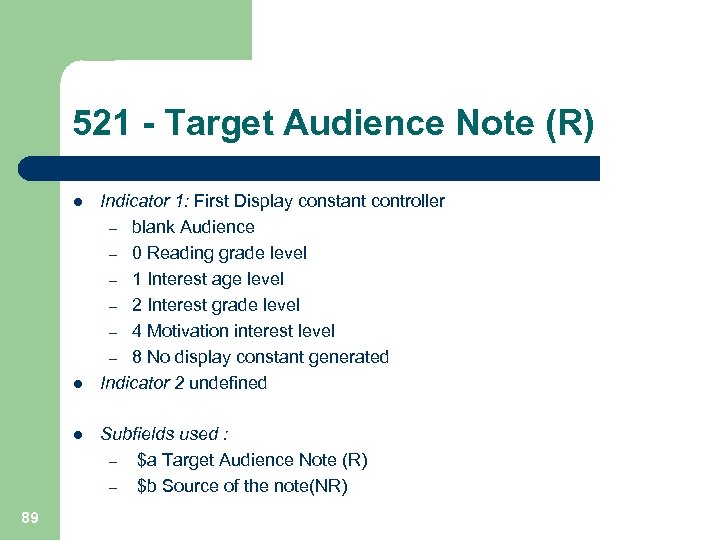 521 - Target Audience Note (R) l l l 89 Indicator 1: First Display constant controller – blank Audience – 0 Reading grade level – 1 Interest age level – 2 Interest grade level – 4 Motivation interest level – 8 No display constant generated Indicator 2 undefined Subfields used : – $a Target Audience Note (R) – $b Source of the note(NR)
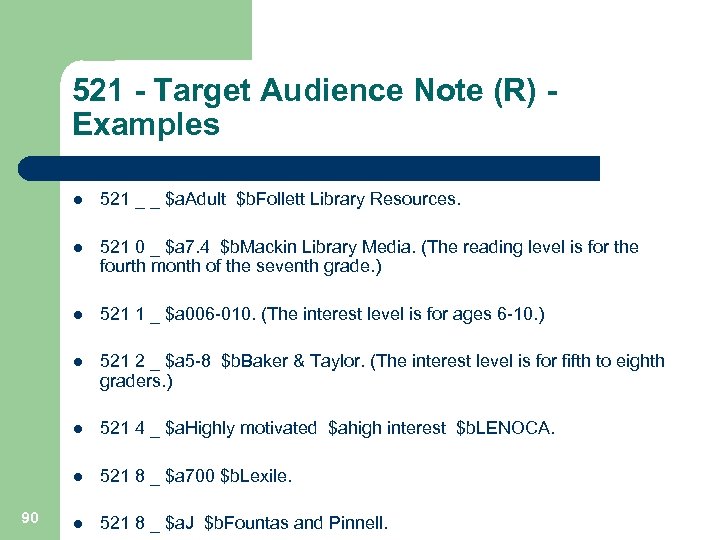 521 - Target Audience Note (R) - Examples l l 521 0 _ $a 7. 4 $b. Mackin Library Media. (The reading level is for the fourth month of the seventh grade. ) l 521 1 _ $a 006 -010. (The interest level is for ages 6 -10. ) l 521 2 _ $a 5 -8 $b. Baker & Taylor. (The interest level is for fifth to eighth graders. ) l 521 4 _ $a. Highly motivated $ahigh interest $b. LENOCA. l 90 521 _ _ $a. Adult $b. Follett Library Resources. 521 8 _ $a 700 $b. Lexile. l 521 8 _ $a. J $b. Fountas and Pinnell.
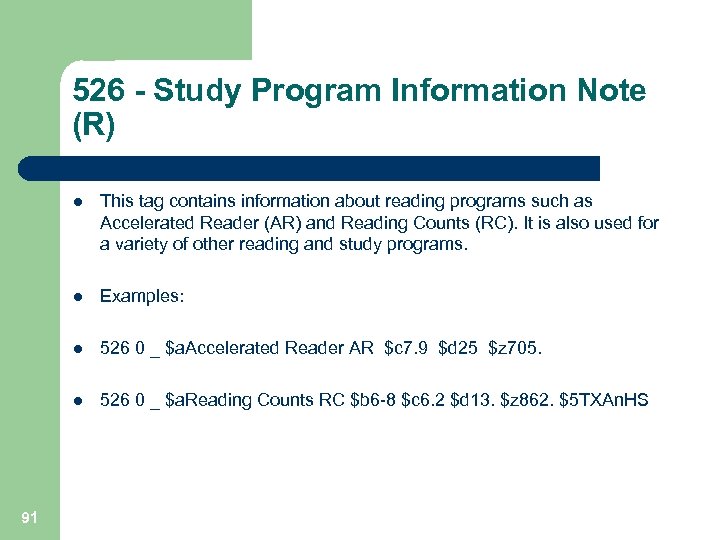 526 - Study Program Information Note (R) l l Examples: l 526 0 _ $a. Accelerated Reader AR $c 7. 9 $d 25 $z 705. l 91 This tag contains information about reading programs such as Accelerated Reader (AR) and Reading Counts (RC). It is also used for a variety of other reading and study programs. 526 0 _ $a. Reading Counts RC $b 6 -8 $c 6. 2 $d 13. $z 862. $5 TXAn. HS
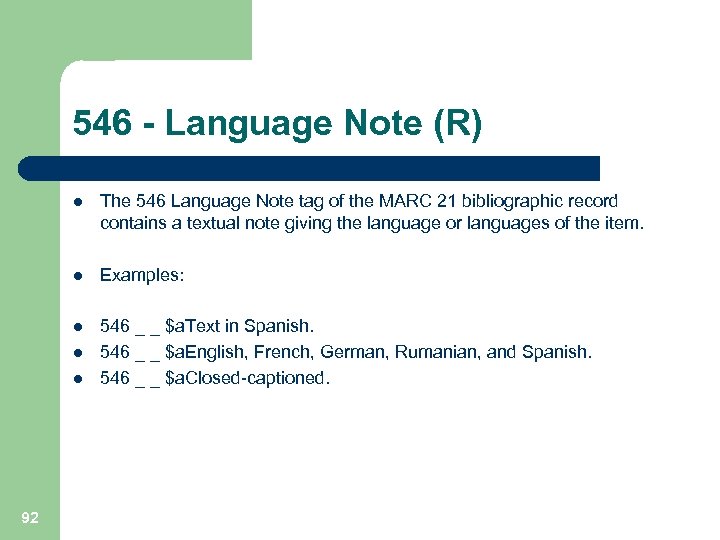 546 - Language Note (R) l The 546 Language Note tag of the MARC 21 bibliographic record contains a textual note giving the language or languages of the item. l Examples: l 546 _ _ $a. Text in Spanish. 546 _ _ $a. English, French, German, Rumanian, and Spanish. 546 _ _ $a. Closed-captioned. l l 92
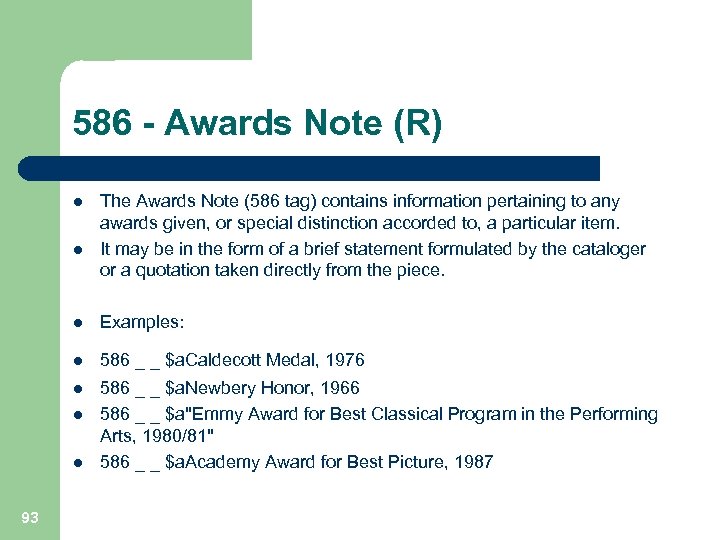 586 - Awards Note (R) l l The Awards Note (586 tag) contains information pertaining to any awards given, or special distinction accorded to, a particular item. It may be in the form of a brief statement formulated by the cataloger or a quotation taken directly from the piece. l Examples: l 586 _ _ $a. Caldecott Medal, 1976 l l l 93 586 _ _ $a. Newbery Honor, 1966 586 _ _ $a"Emmy Award for Best Classical Program in the Performing Arts, 1980/81" 586 _ _ $a. Academy Award for Best Picture, 1987
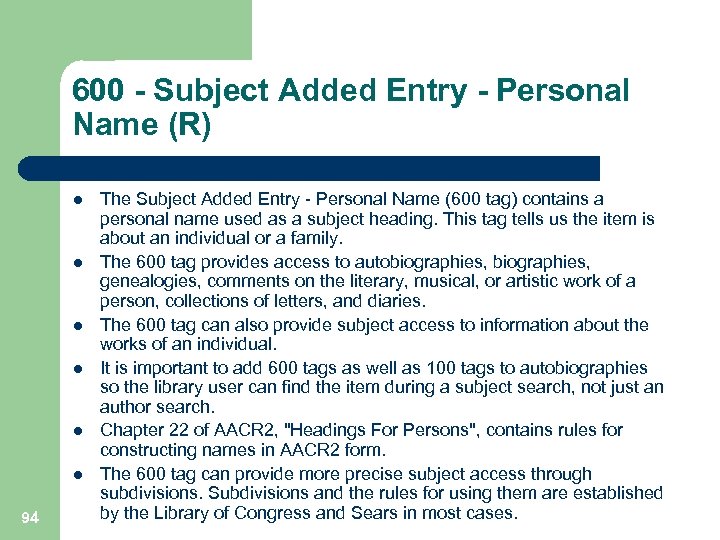 600 - Subject Added Entry - Personal Name (R) l l l 94 The Subject Added Entry - Personal Name (600 tag) contains a personal name used as a subject heading. This tag tells us the item is about an individual or a family. The 600 tag provides access to autobiographies, genealogies, comments on the literary, musical, or artistic work of a person, collections of letters, and diaries. The 600 tag can also provide subject access to information about the works of an individual. It is important to add 600 tags as well as 100 tags to autobiographies so the library user can find the item during a subject search, not just an author search. Chapter 22 of AACR 2, "Headings For Persons", contains rules for constructing names in AACR 2 form. The 600 tag can provide more precise subject access through subdivisions. Subdivisions and the rules for using them are established by the Library of Congress and Sears in most cases.
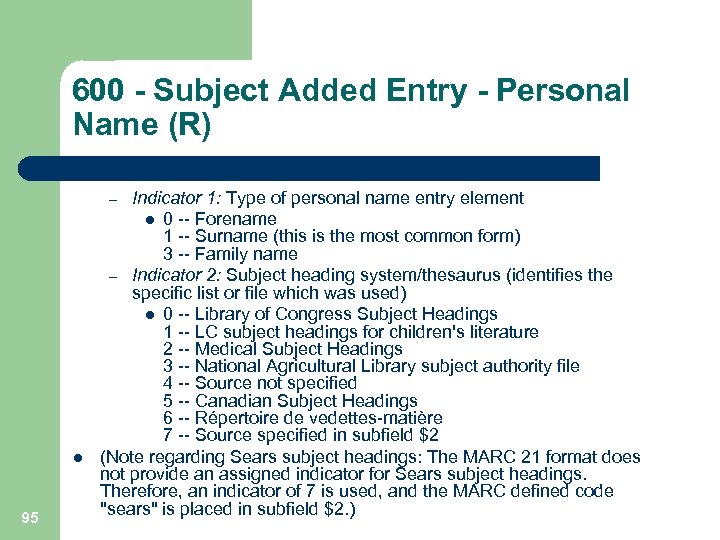 600 - Subject Added Entry - Personal Name (R) Indicator 1: Type of personal name entry element l 0 -- Forename 1 -- Surname (this is the most common form) 3 -- Family name – Indicator 2: Subject heading system/thesaurus (identifies the specific list or file which was used) l 0 -- Library of Congress Subject Headings 1 -- LC subject headings for children's literature 2 -- Medical Subject Headings 3 -- National Agricultural Library subject authority file 4 -- Source not specified 5 -- Canadian Subject Headings 6 -- Répertoire de vedettes-matière 7 -- Source specified in subfield $2 (Note regarding Sears subject headings: The MARC 21 format does not provide an assigned indicator for Sears subject headings. Therefore, an indicator of 7 is used, and the MARC defined code "sears" is placed in subfield $2. ) – l 95
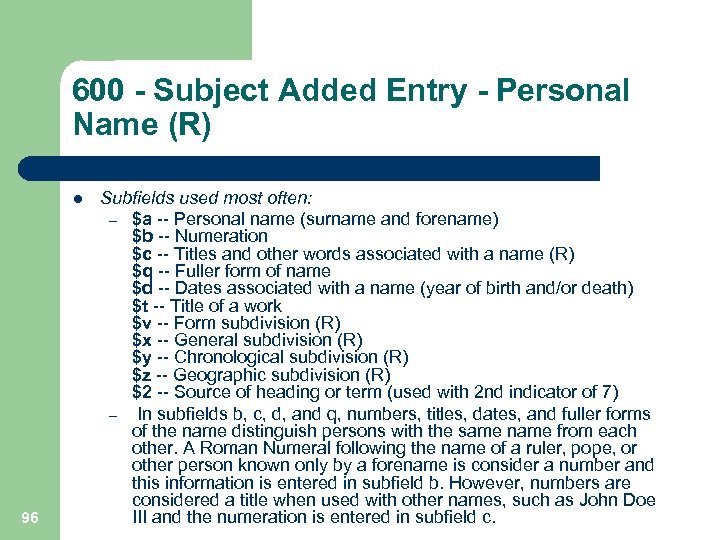 600 - Subject Added Entry - Personal Name (R) l 96 Subfields used most often: – $a -- Personal name (surname and forename) $b -- Numeration $c -- Titles and other words associated with a name (R) $q -- Fuller form of name $d -- Dates associated with a name (year of birth and/or death) $t -- Title of a work $v -- Form subdivision (R) $x -- General subdivision (R) $y -- Chronological subdivision (R) $z -- Geographic subdivision (R) $2 -- Source of heading or term (used with 2 nd indicator of 7) – In subfields b, c, d, and q, numbers, titles, dates, and fuller forms of the name distinguish persons with the same name from each other. A Roman Numeral following the name of a ruler, pope, or other person known only by a forename is consider a number and this information is entered in subfield b. However, numbers are considered a title when used with other names, such as John Doe III and the numeration is entered in subfield c.
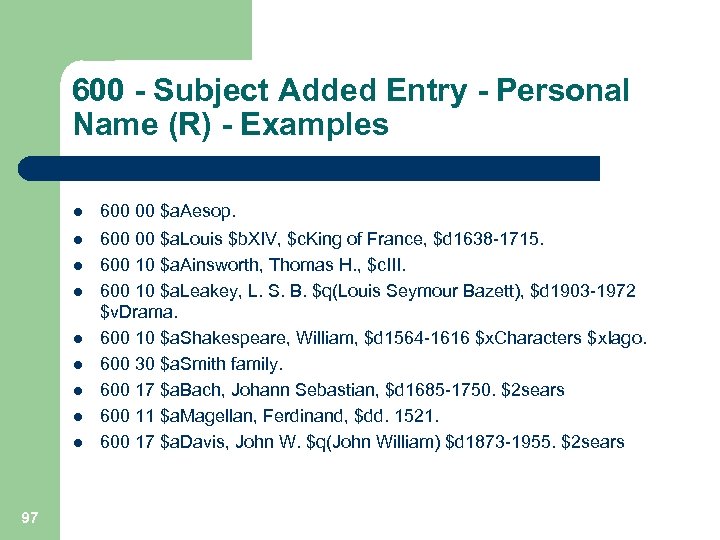 600 - Subject Added Entry - Personal Name (R) - Examples l l l l l 97 600 00 $a. Aesop. 600 00 $a. Louis $b. XIV, $c. King of France, $d 1638 -1715. 600 10 $a. Ainsworth, Thomas H. , $c. III. 600 10 $a. Leakey, L. S. B. $q(Louis Seymour Bazett), $d 1903 -1972 $v. Drama. 600 10 $a. Shakespeare, William, $d 1564 -1616 $x. Characters $x. Iago. 600 30 $a. Smith family. 600 17 $a. Bach, Johann Sebastian, $d 1685 -1750. $2 sears 600 11 $a. Magellan, Ferdinand, $dd. 1521. 600 17 $a. Davis, John W. $q(John William) $d 1873 -1955. $2 sears
 610 - Subject Added Entry - Corporate Name (R) l l 98 A corporate body is defined by AACR 2 as "an organization or group of persons that is identified by a particular name and that acts, or may act as an entity. Typical examples of corporate bodies are associations, institutions, business firms, nonprofit enterprises, governments, government agencies, religious bodies, local churches, and conferences. “ Chapter 24 of AACR 2, "Headings For Corporate Bodies", contains rules for constructing corporate names in AACR 2 form.
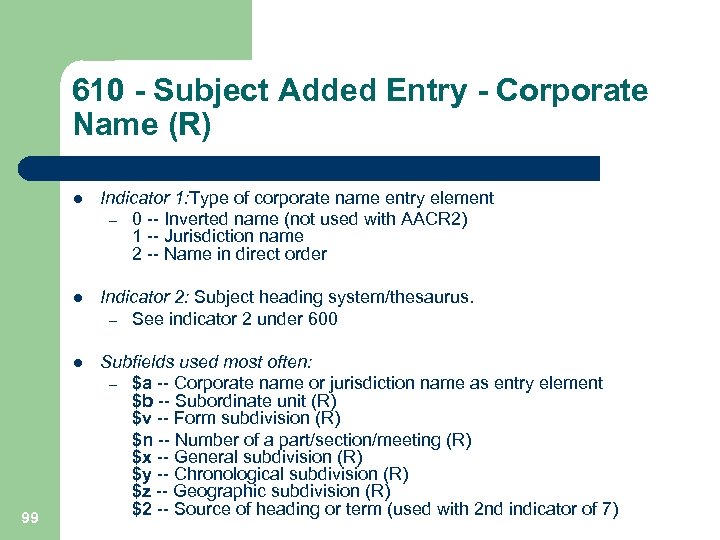 610 - Subject Added Entry - Corporate Name (R) l l Indicator 2: Subject heading system/thesaurus. – See indicator 2 under 600 l 99 Indicator 1: Type of corporate name entry element – 0 -- Inverted name (not used with AACR 2) 1 -- Jurisdiction name 2 -- Name in direct order Subfields used most often: – $a -- Corporate name or jurisdiction name as entry element $b -- Subordinate unit (R) $v -- Form subdivision (R) $n -- Number of a part/section/meeting (R) $x -- General subdivision (R) $y -- Chronological subdivision (R) $z -- Geographic subdivision (R) $2 -- Source of heading or term (used with 2 nd indicator of 7)
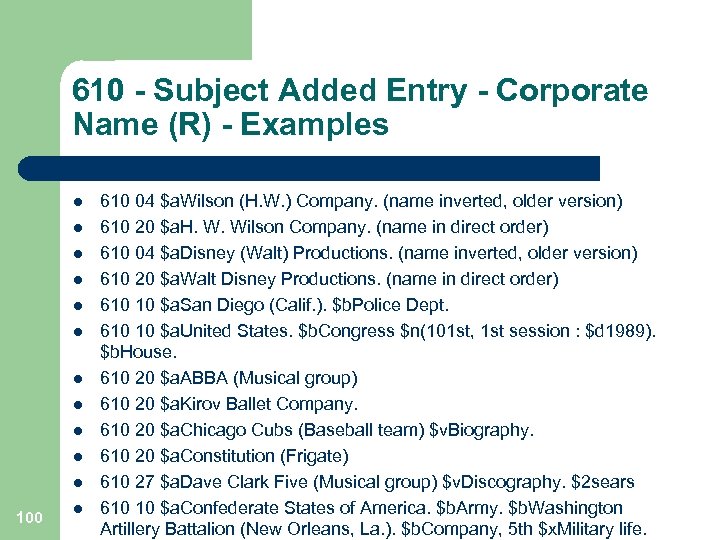 610 - Subject Added Entry - Corporate Name (R) - Examples l l l 100 l 610 04 $a. Wilson (H. W. ) Company. (name inverted, older version) 610 20 $a. H. W. Wilson Company. (name in direct order) 610 04 $a. Disney (Walt) Productions. (name inverted, older version) 610 20 $a. Walt Disney Productions. (name in direct order) 610 10 $a. San Diego (Calif. ). $b. Police Dept. 610 10 $a. United States. $b. Congress $n(101 st, 1 st session : $d 1989). $b. House. 610 20 $a. ABBA (Musical group) 610 20 $a. Kirov Ballet Company. 610 20 $a. Chicago Cubs (Baseball team) $v. Biography. 610 20 $a. Constitution (Frigate) 610 27 $a. Dave Clark Five (Musical group) $v. Discography. $2 sears 610 10 $a. Confederate States of America. $b. Army. $b. Washington Artillery Battalion (New Orleans, La. ). $b. Company, 5 th $x. Military life.
 650 - Subject Added Entry - Topical Term (R) l l 101 Library users can search by different subjects that describe in a word or a phrase the contents of a particular item. If library users want books about cats they could look under the subject "Cats". This makes the collection more accessible because the library users would not have to know the title or the author of individual items to locate the information they need. The 650 tag provides topical or general subject headings, phrase subject headings including general names of meetings, events, or objects, and phrase topics that begin with a geographic name. This subject heading would NOT include personal names of real people, specific meetings and events, corporate bodies, or geographic places. Subject headings are derived from a controlled vocabulary list such as Sears List of Subject Headings or Library of Congress Subject Headings. Not using a controlled vocabulary list of subject heading terms can cause confusion and frustration for library searchers.
 650 - Subject Added Entry - Topical Term (R) l Indicator 1: Level of subject – # -- No information provided l Indicator 2: Subject heading system/thesaurus. – See indicator 2 under 600 – 102 Subfields used most often: l $a -- Topical term $v -- Form subdivision (R) $x -- General subdivision (R) $y -- Chronological subdivision (R) $z -- Geographic subdivision (R) $2 -- Source of heading or term used with 2 nd indicator of 7)
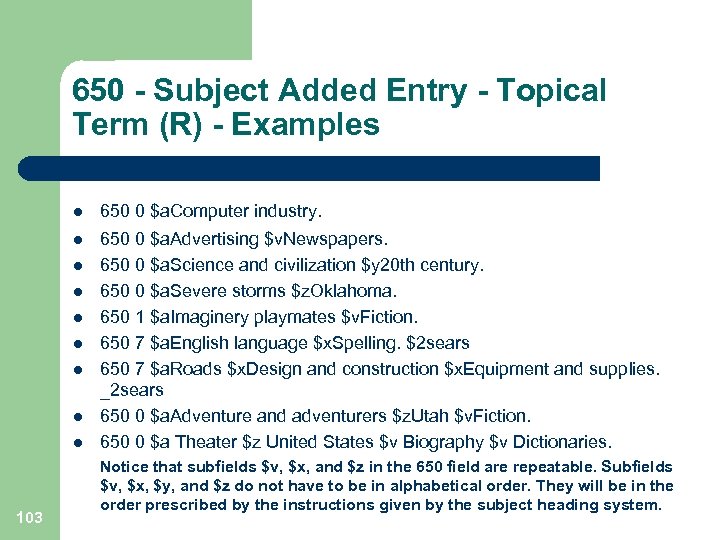 650 - Subject Added Entry - Topical Term (R) - Examples l l l l l 103 650 0 $a. Computer industry. 650 0 $a. Advertising $v. Newspapers. 650 0 $a. Science and civilization $y 20 th century. 650 0 $a. Severe storms $z. Oklahoma. 650 1 $a. Imaginery playmates $v. Fiction. 650 7 $a. English language $x. Spelling. $2 sears 650 7 $a. Roads $x. Design and construction $x. Equipment and supplies. _2 sears 650 0 $a. Adventure and adventurers $z. Utah $v. Fiction. 650 0 $a Theater $z United States $v Biography $v Dictionaries. Notice that subfields $v, $x, and $z in the 650 field are repeatable. Subfields $v, $x, $y, and $z do not have to be in alphabetical order. They will be in the order prescribed by the instructions given by the subject heading system.
 651 - Subject Added Entry - Geographic Name (R) l l 104 The 651 tag provides geographic names as subject headings. Users can do a subject search on the name of a city, state, country, river, mountain range, region, or other geographical feature. AACR 2 provides rules for setting up geographic names in chapter 23. Many geographic names are established in controlled vocabulary lists such as Sears List of Subject Headings or Library of Congress Subject Headings. The Library of Congress also establishes geographic names in the LC Name Authority List.
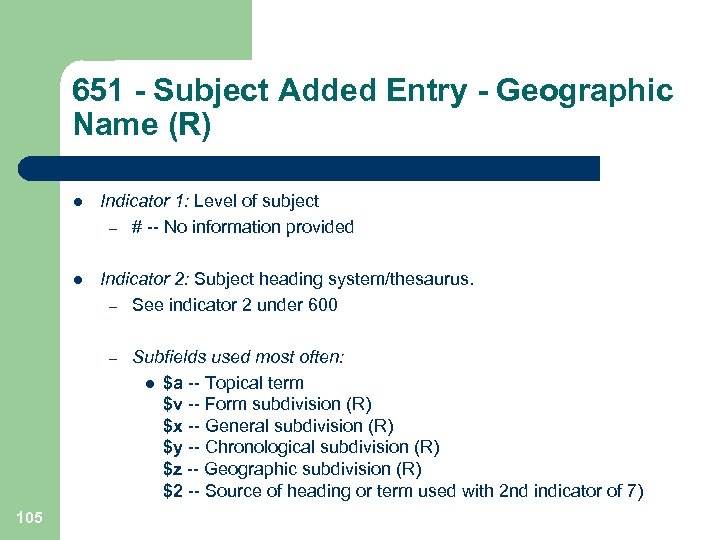 651 - Subject Added Entry - Geographic Name (R) l Indicator 1: Level of subject – # -- No information provided l Indicator 2: Subject heading system/thesaurus. – See indicator 2 under 600 – 105 Subfields used most often: l $a -- Topical term $v -- Form subdivision (R) $x -- General subdivision (R) $y -- Chronological subdivision (R) $z -- Geographic subdivision (R) $2 -- Source of heading or term used with 2 nd indicator of 7)
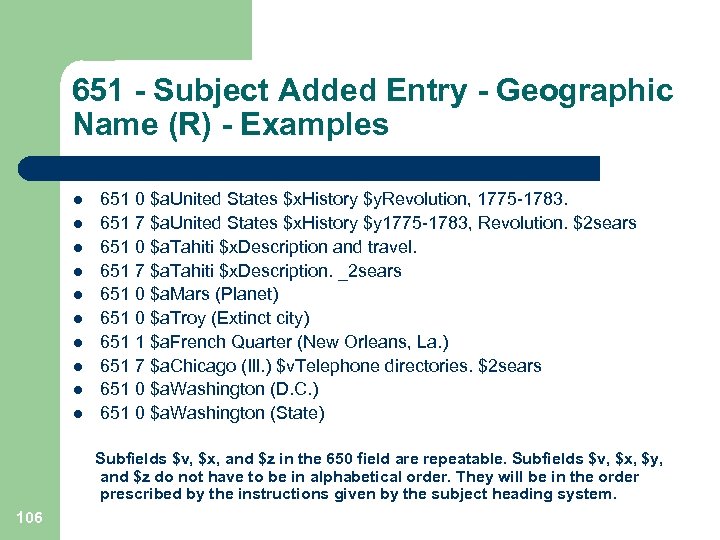 651 - Subject Added Entry - Geographic Name (R) - Examples l l l l l 651 0 $a. United States $x. History $y. Revolution, 1775 -1783. 651 7 $a. United States $x. History $y 1775 -1783, Revolution. $2 sears 651 0 $a. Tahiti $x. Description and travel. 651 7 $a. Tahiti $x. Description. _2 sears 651 0 $a. Mars (Planet) 651 0 $a. Troy (Extinct city) 651 1 $a. French Quarter (New Orleans, La. ) 651 7 $a. Chicago (Ill. ) $v. Telephone directories. $2 sears 651 0 $a. Washington (D. C. ) 651 0 $a. Washington (State) Subfields $v, $x, and $z in the 650 field are repeatable. Subfields $v, $x, $y, and $z do not have to be in alphabetical order. They will be in the order prescribed by the instructions given by the subject heading system. 106
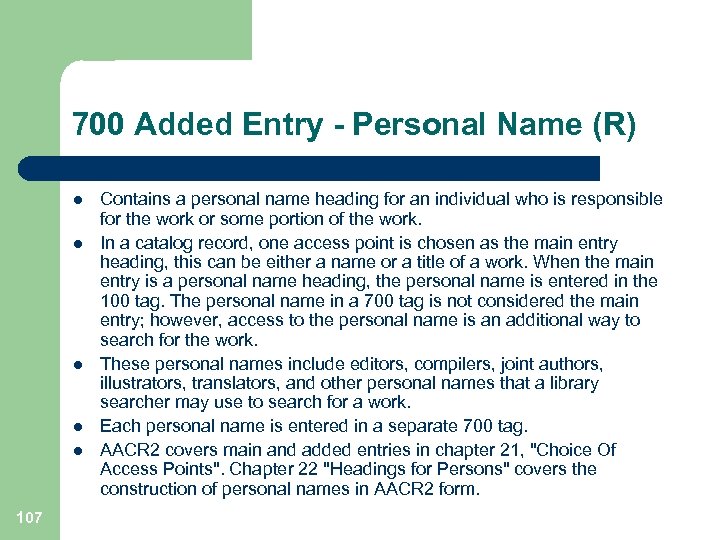 700 Added Entry - Personal Name (R) l l l 107 Contains a personal name heading for an individual who is responsible for the work or some portion of the work. In a catalog record, one access point is chosen as the main entry heading, this can be either a name or a title of a work. When the main entry is a personal name heading, the personal name is entered in the 100 tag. The personal name in a 700 tag is not considered the main entry; however, access to the personal name is an additional way to search for the work. These personal names include editors, compilers, joint authors, illustrators, translators, and other personal names that a library searcher may use to search for a work. Each personal name is entered in a separate 700 tag. AACR 2 covers main and added entries in chapter 21, "Choice Of Access Points". Chapter 22 "Headings for Persons" covers the construction of personal names in AACR 2 form.
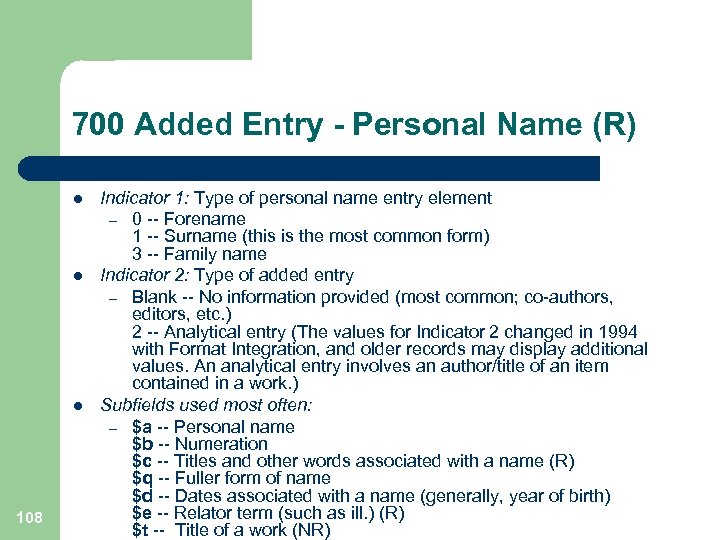 700 Added Entry - Personal Name (R) l l l 108 Indicator 1: Type of personal name entry element – 0 -- Forename 1 -- Surname (this is the most common form) 3 -- Family name Indicator 2: Type of added entry – Blank -- No information provided (most common; co-authors, editors, etc. ) 2 -- Analytical entry (The values for Indicator 2 changed in 1994 with Format Integration, and older records may display additional values. An analytical entry involves an author/title of an item contained in a work. ) Subfields used most often: – $a -- Personal name $b -- Numeration $c -- Titles and other words associated with a name (R) $q -- Fuller form of name $d -- Dates associated with a name (generally, year of birth) $e -- Relator term (such as ill. ) (R) $t -- Title of a work (NR)
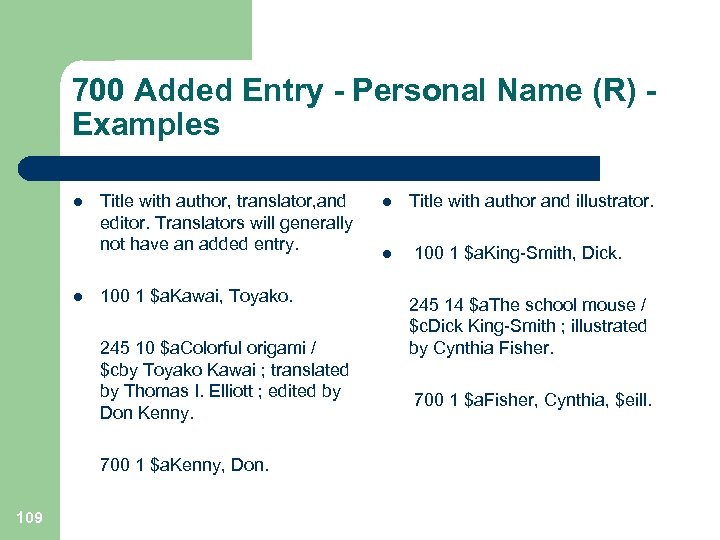 700 Added Entry - Personal Name (R) - Examples l l Title with author, translator, and editor. Translators will generally not have an added entry. 100 1 $a. Kawai, Toyako. 245 10 $a. Colorful origami / $cby Toyako Kawai ; translated by Thomas I. Elliott ; edited by Don Kenny. 700 1 $a. Kenny, Don. 109 l Title with author and illustrator. l 100 1 $a. King-Smith, Dick. 245 14 $a. The school mouse / $c. Dick King-Smith ; illustrated by Cynthia Fisher. 700 1 $a. Fisher, Cynthia, $eill.
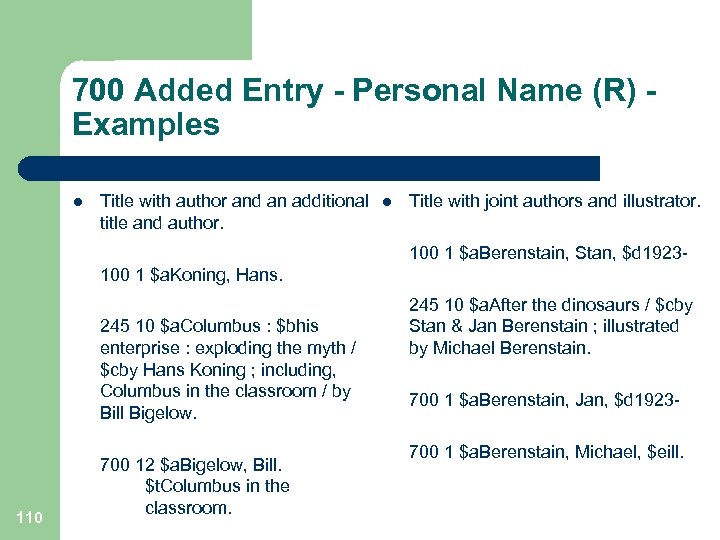 700 Added Entry - Personal Name (R) - Examples l Title with author and an additional title and author. l Title with joint authors and illustrator. 100 1 $a. Berenstain, Stan, $d 1923 - 100 1 $a. Koning, Hans. 245 10 $a. After the dinosaurs / $cby Stan & Jan Berenstain ; illustrated by Michael Berenstain. 245 10 $a. Columbus : $bhis enterprise : exploding the myth / $cby Hans Koning ; including, Columbus in the classroom / by Bill Bigelow. 110 700 12 $a. Bigelow, Bill. $t. Columbus in the classroom. 700 1 $a. Berenstain, Jan, $d 1923 - 700 1 $a. Berenstain, Michael, $eill.
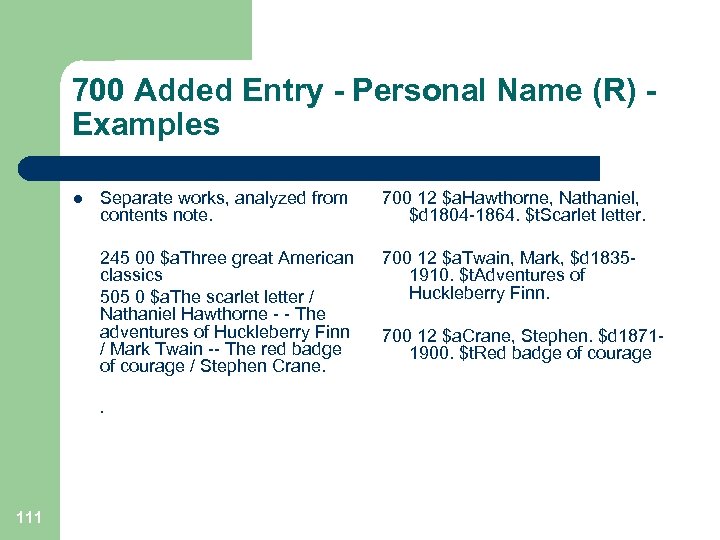 700 Added Entry - Personal Name (R) - Examples l Separate works, analyzed from contents note. 245 00 $a. Three great American classics 505 0 $a. The scarlet letter / Nathaniel Hawthorne - - The adventures of Huckleberry Finn / Mark Twain -- The red badge of courage / Stephen Crane. . 111 700 12 $a. Hawthorne, Nathaniel, $d 1804 -1864. $t. Scarlet letter. 700 12 $a. Twain, Mark, $d 18351910. $t. Adventures of Huckleberry Finn. 700 12 $a. Crane, Stephen. $d 18711900. $t. Red badge of courage
 710 - Added Entry - Corporate Name (R) l l l 112 See slides 98, 99, and 100 for main coverage. When the main entry is a corporate name heading, the corporate name is entered in the 110 tag. The corporate name in a 710 tag is not considered the main entry; however, access to the corporate name is an additional way to search for the work. AACR 2 covers main and added entries in chapter 21, "Choice of Access Points". Chapter 24, "Headings for Corporate Bodies", covers the construction of corporate names in AACR 2 form.
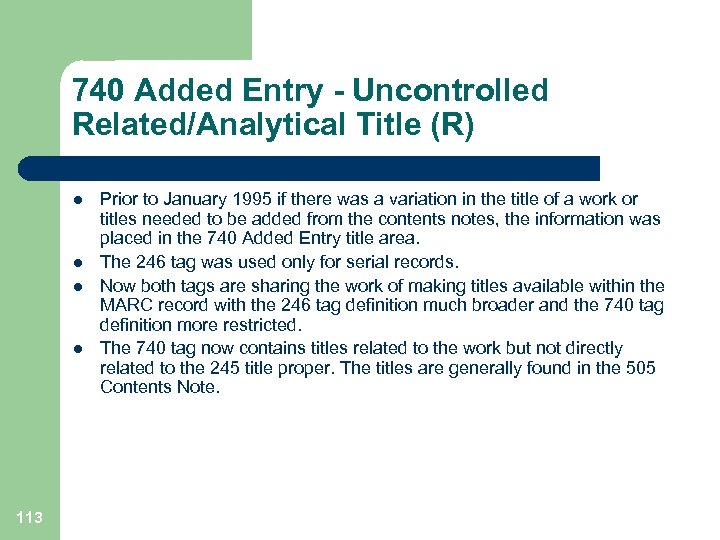 740 Added Entry - Uncontrolled Related/Analytical Title (R) l l 113 Prior to January 1995 if there was a variation in the title of a work or titles needed to be added from the contents notes, the information was placed in the 740 Added Entry title area. The 246 tag was used only for serial records. Now both tags are sharing the work of making titles available within the MARC record with the 246 tag definition much broader and the 740 tag definition more restricted. The 740 tag now contains titles related to the work but not directly related to the 245 title proper. The titles are generally found in the 505 Contents Note.
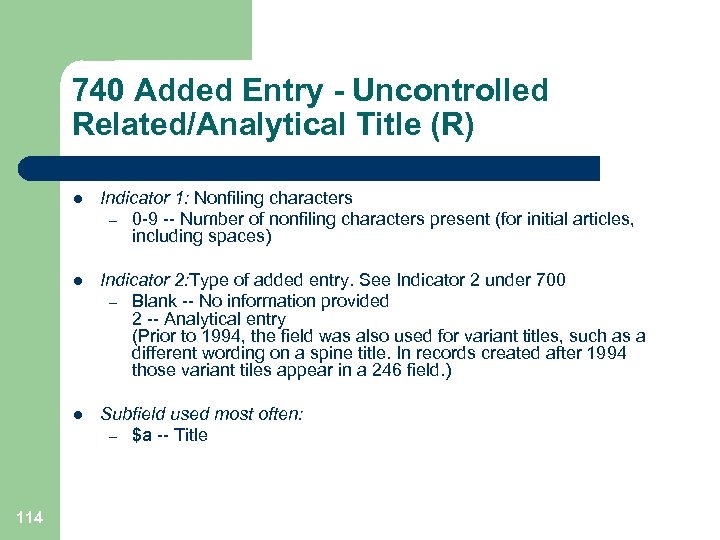 740 Added Entry - Uncontrolled Related/Analytical Title (R) l l Indicator 2: Type of added entry. See Indicator 2 under 700 – Blank -- No information provided 2 -- Analytical entry (Prior to 1994, the field was also used for variant titles, such as a different wording on a spine title. In records created after 1994 those variant tiles appear in a 246 field. ) l 114 Indicator 1: Nonfiling characters – 0 -9 -- Number of nonfiling characters present (for initial articles, including spaces) Subfield used most often: – $a -- Title
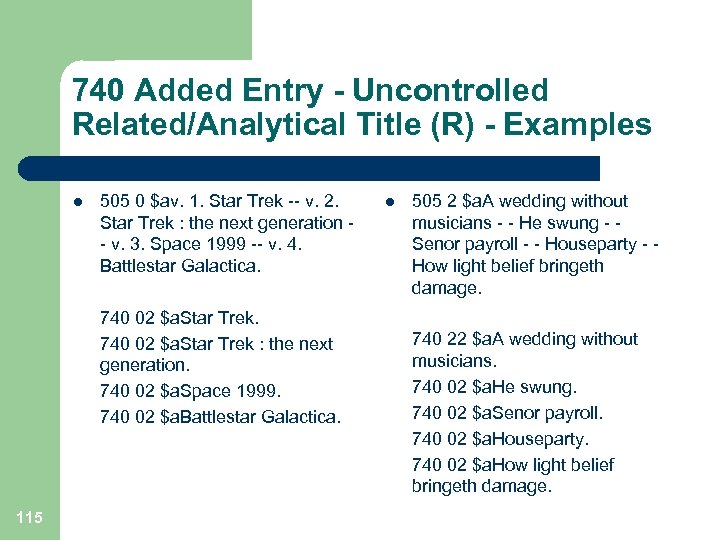 740 Added Entry - Uncontrolled Related/Analytical Title (R) - Examples l 115 505 0 $av. 1. Star Trek -- v. 2. Star Trek : the next generation - v. 3. Space 1999 -- v. 4. Battlestar Galactica. 740 02 $a. Star Trek : the next generation. 740 02 $a. Space 1999. 740 02 $a. Battlestar Galactica. l 505 2 $a. A wedding without musicians - - He swung - - Senor payroll - - Houseparty - - How light belief bringeth damage. 740 22 $a. A wedding without musicians. 740 02 $a. He swung. 740 02 $a. Senor payroll. 740 02 $a. Houseparty. 740 02 $a. How light belief bringeth damage.
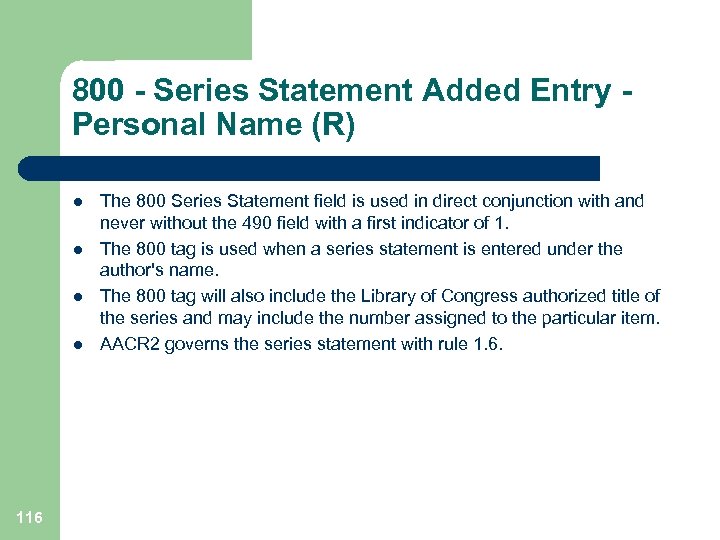 800 - Series Statement Added Entry - Personal Name (R) l l 116 The 800 Series Statement field is used in direct conjunction with and never without the 490 field with a first indicator of 1. The 800 tag is used when a series statement is entered under the author's name. The 800 tag will also include the Library of Congress authorized title of the series and may include the number assigned to the particular item. AACR 2 governs the series statement with rule 1. 6.
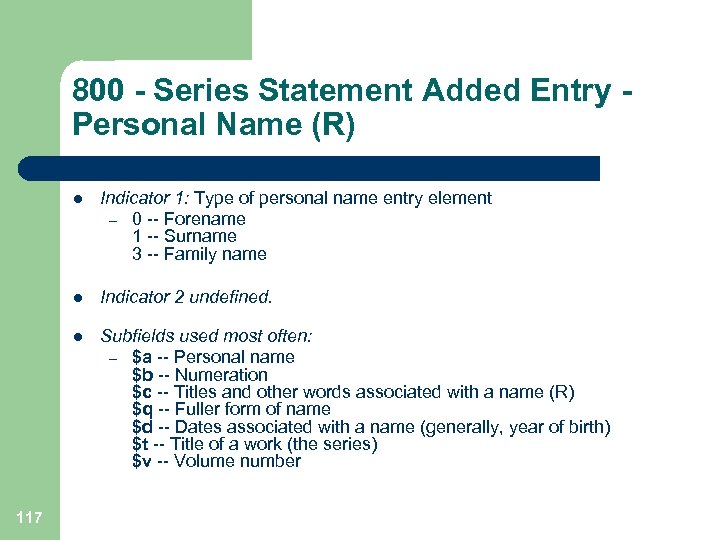 800 - Series Statement Added Entry - Personal Name (R) l l Indicator 2 undefined. l 117 Indicator 1: Type of personal name entry element – 0 -- Forename 1 -- Surname 3 -- Family name Subfields used most often: – $a -- Personal name $b -- Numeration $c -- Titles and other words associated with a name (R) $q -- Fuller form of name $d -- Dates associated with a name (generally, year of birth) $t -- Title of a work (the series) $v -- Volume number
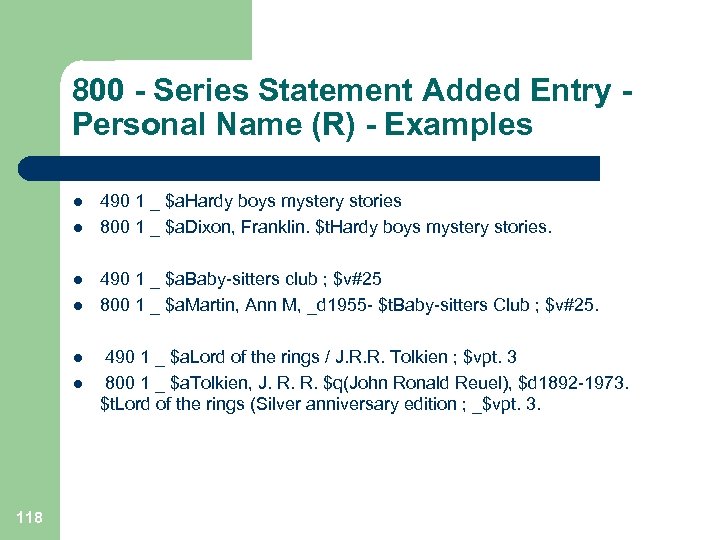 800 - Series Statement Added Entry - Personal Name (R) - Examples l l l 118 490 1 _ $a. Hardy boys mystery stories 800 1 _ $a. Dixon, Franklin. $t. Hardy boys mystery stories. 490 1 _ $a. Baby-sitters club ; $v#25 800 1 _ $a. Martin, Ann M, _d 1955 - $t. Baby-sitters Club ; $v#25. 490 1 _ $a. Lord of the rings / J. R. R. Tolkien ; $vpt. 3 800 1 _ $a. Tolkien, J. R. R. $q(John Ronald Reuel), $d 1892 -1973. $t. Lord of the rings (Silver anniversary edition ; _$vpt. 3.
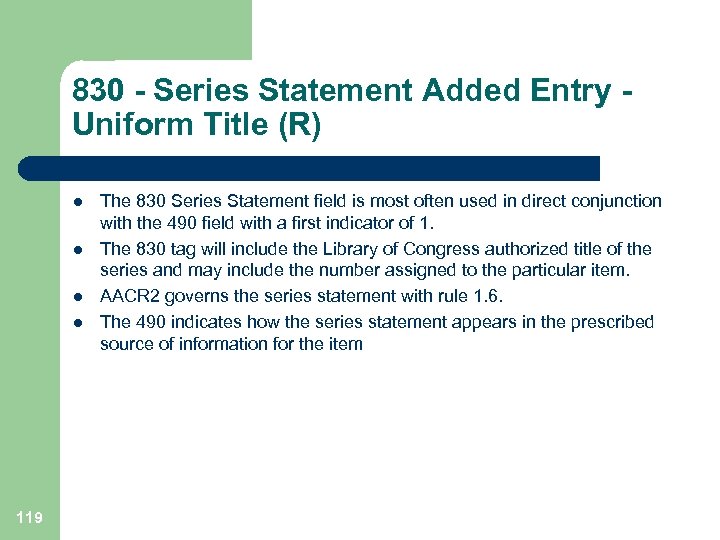 830 - Series Statement Added Entry - Uniform Title (R) l l 119 The 830 Series Statement field is most often used in direct conjunction with the 490 field with a first indicator of 1. The 830 tag will include the Library of Congress authorized title of the series and may include the number assigned to the particular item. AACR 2 governs the series statement with rule 1. 6. The 490 indicates how the series statement appears in the prescribed source of information for the item
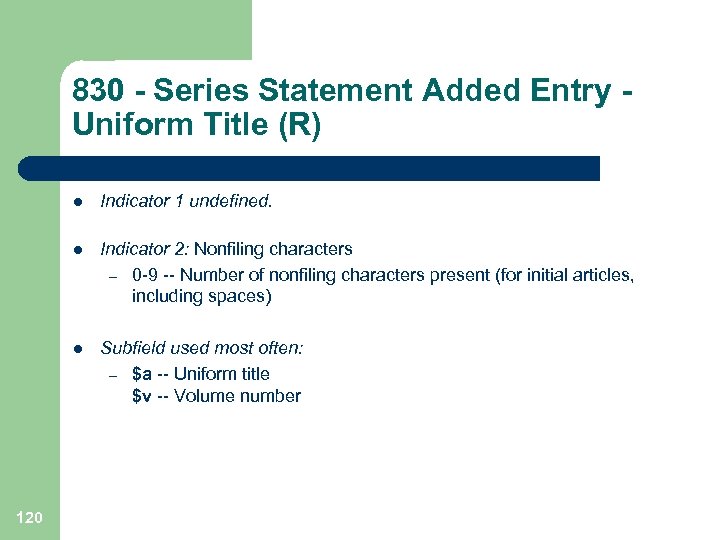 830 - Series Statement Added Entry - Uniform Title (R) l l Indicator 2: Nonfiling characters – 0 -9 -- Number of nonfiling characters present (for initial articles, including spaces) l 120 Indicator 1 undefined. Subfield used most often: – $a -- Uniform title $v -- Volume number
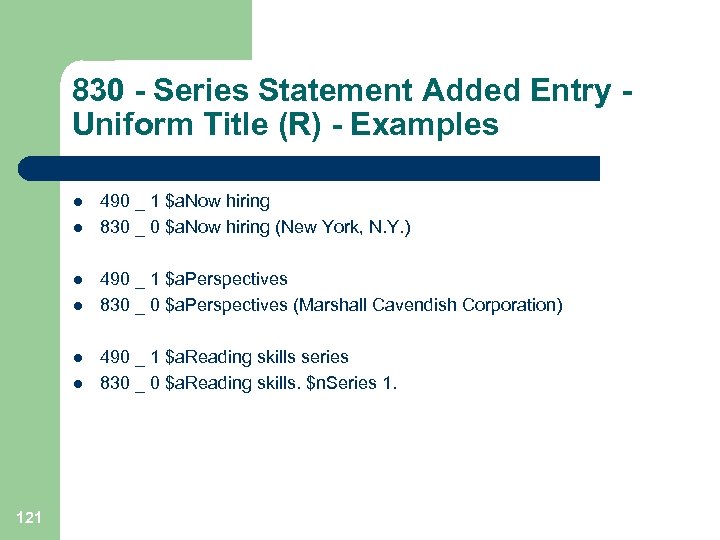 830 - Series Statement Added Entry - Uniform Title (R) - Examples l l l 121 490 _ 1 $a. Now hiring 830 _ 0 $a. Now hiring (New York, N. Y. ) 490 _ 1 $a. Perspectives 830 _ 0 $a. Perspectives (Marshall Cavendish Corporation) 490 _ 1 $a. Reading skills series 830 _ 0 $a. Reading skills. $n. Series 1.