


 Скачать презентацию Casing Discussion CHASE Construction Products TAPECOAT ROYSTON
71f07c60496f141b5547c76af97dd795.ppt
- Количество слайдов: 33
 Casing Discussion CHASE Construction Products TAPECOAT / ROYSTON BY John Williams The Tapecoat / Royston Company
 Casing Discussion Format § § Casing Background & History ECDA Filling a Casing Conclusions
 Casing Background § Casing installation began for the following: 1. Potential for stress damage to the pipeline caused from heavy loads, trains and trucks. 2. Unstable soils 3. Corrosion caused by oxygen concentration cells because of road building processes 4. Ease of removal and replacement of pipelines 5. Venting of dangerous gasses away from road side
 SP 0 – 200 DEFINITIONS § Carrier Pipe: The pipe or piping that is pushed through the casing or sleeve. § Casing: A metallic pipe (normally steel) installed to contain a pipe or piping. § Metallic Short: Direct or indirect metallic contact between two metallic structures. § Electrolytic Contact: Ionic contact between two metallic structures via an electrolyte (water).
 NACE SP 0 – 200 - 2008 § 1. 1 Steel casings are used to install and maintain pipeline crossings such as those at road and railroad rights of way. This standard details acceptable practices for the design, fabrication, installation, and maintenance of steel-cased pipelines. § 1. 2 Use of cased crossings should be avoided unless required by load considerations, unstable soil conditions, or when their use is dictated by sound engineering practices. § 1. 3 This standard does not imply that utilization of casings is mandatory or necessary.
 NACE SP 0 – 200 - 2008 § 3. 2. 3 Uncoated casing pipe is normally used. The use of coated or nonmetallic casing pipe is not recommended, due to potential shielding problems. § 3. 2. 4 Vent pipes should be installed on both ends of a casing. § 3. 2. 5 The casing vent hole should be at least one-half the diameter of the vent pipe (25 mm [1. 0 in] minimum). The casing vent pipe should be a minimum of 50 mm (2 in) in diameter. § 3. 2. 6 The casing and carrier pipe shall be properly supported for the entire length of the pipe, especially near the ends, to prevent sagging, metallic contact, and to avoid carrier pipe stress. Refer to Paragraphs 4. 3 and 4. 4. § 3. 2. 7 Properly designed casing end seals shall be installed to prevent ingress of water and debris. § Of course this rarely happens!
 Historic Casing Practices § § § Common Practice started w/ RR Crossings Highway requirements came later End Seal Types § § Concrete or Enamel w/ Rope Today: Wraps, Shrink Sleeves and Link Seal types § Spacer Types § § Metallic Concrete coated pipe Wooden Today: Plastics
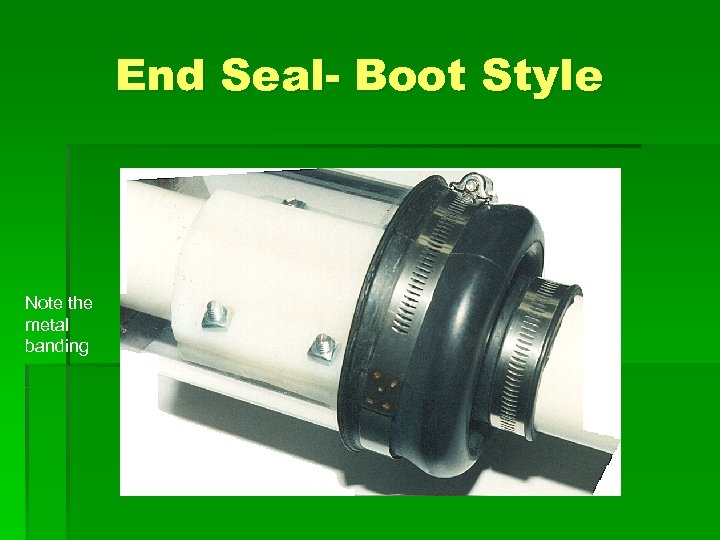 End Seal- Boot Style Note the metal banding
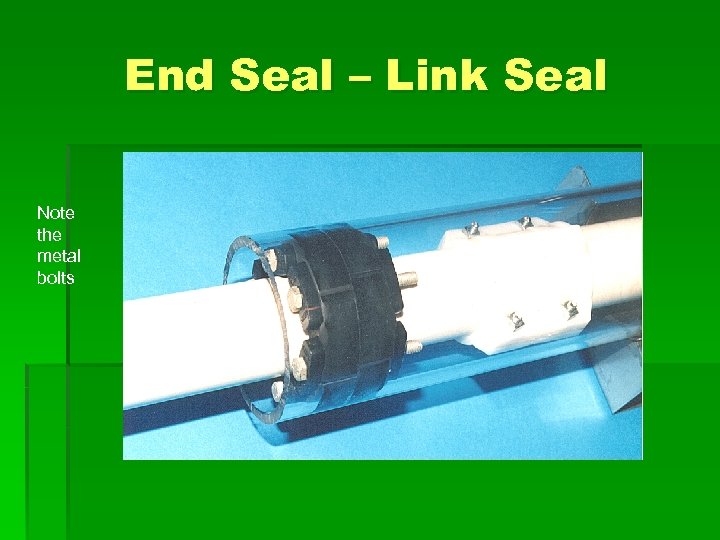 End Seal – Link Seal Note the metal bolts
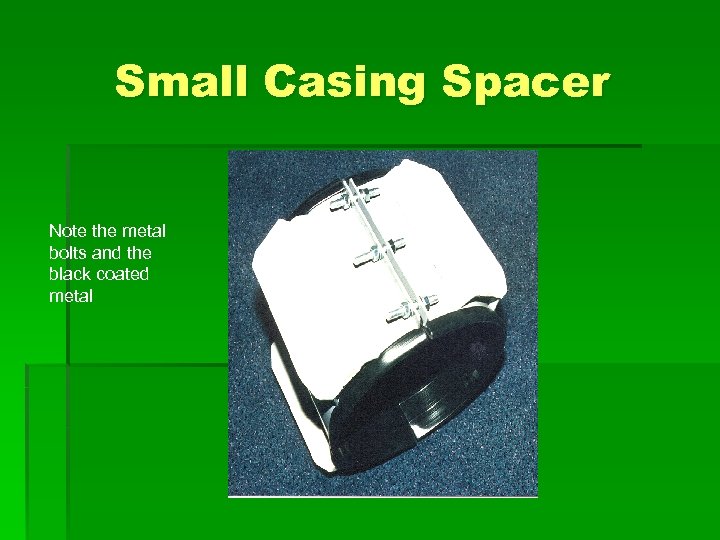 Small Casing Spacer Note the metal bolts and the black coated metal
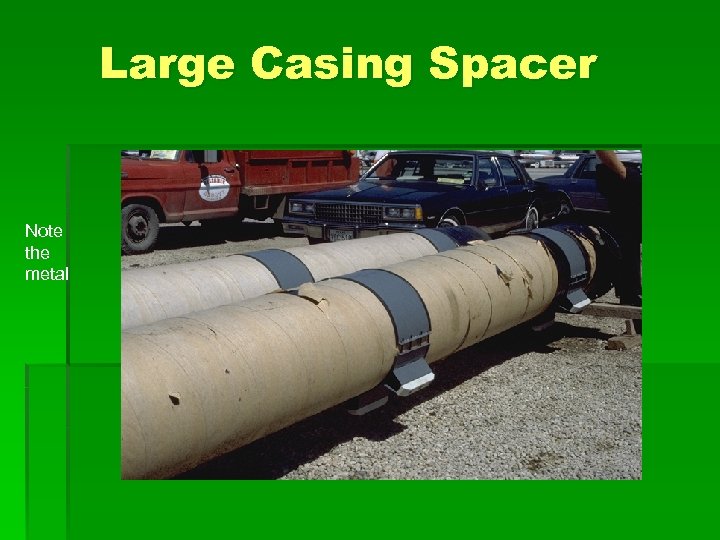 Large Casing Spacer Note the metal
 How does a casing short to a pipeline? 1. End seals crush or deteriorate allowing water to enter 2. Pipe spacers crush or wrong type used such as metal or metal components 3. Test leads make contact in the test station 4. Vent pipes connected to the pipeline or supported on the pipeline 5. Other possible problems such as metal tools left inside the pipe.
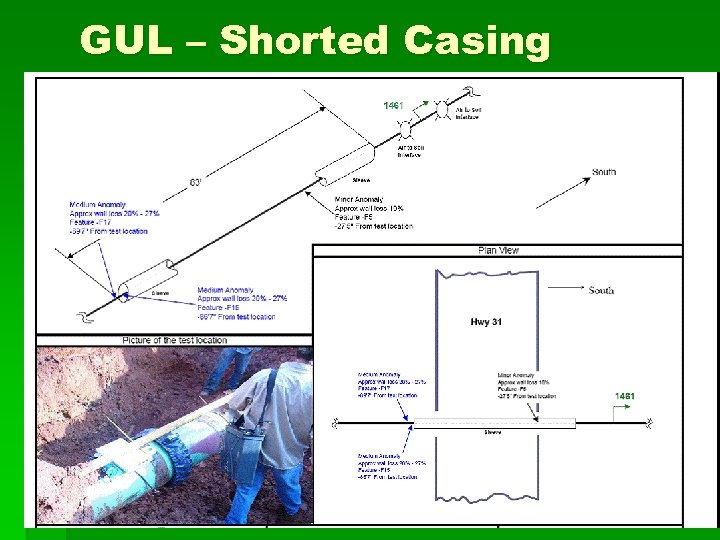
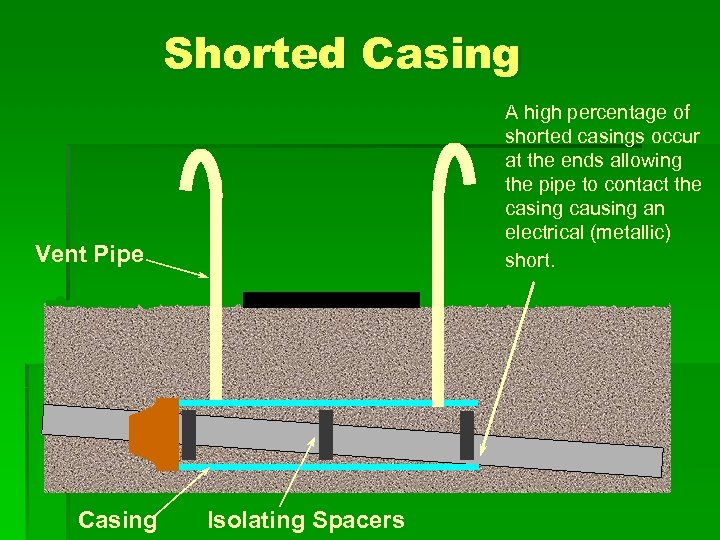 Shorted Casing A high percentage of shorted casings occur at the ends allowing the pipe to contact the casing causing an electrical (metallic) short. Vent Pipe Casing Isolating Spacers
 PROBLEMS WITH CASED PIPELINES § Once water enters a casing: § Corrosion can develop § Even if the casing is not shorted, the current may not be enough to adequately protect the pipe. § Any current passing through the casing will only provide some protection to that part of the pipe immersed in the water. § No way to properly monitor the potential inside the casing.
 PROBLEMS WITH CASED PIPELINES § Corrosion occurs on the external surfaces of pipelines inside casings whether the casing is shorted to the pipe or not! § US Department of Transportation agrees that there almost as many leaks in un-shorted casings as in shorted casings.
 Direct Assessment: The four steps for assessing casings Pre-Assessment, Indirect Inspection, Direct Examination, Post Assessment 1. Pre-Assessment § Use Historical data to develop a scenario § § Coating Type Quality of Pipe Water Table Filled or not
 Direct Assessment 2. Indirect Inspection § Survey the casing § PCM / A-Frame § Results categorized into four areas § § Severe Moderate Minor Clear
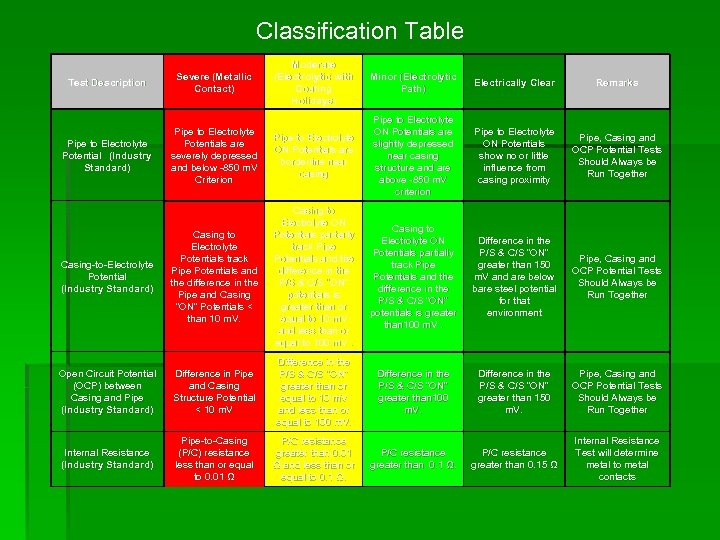 Classification Table Moderate (Electrolytic with Coating Holidays) Minor (Electrolytic Path) Electrically Clear Remarks Pipe to Electrolyte ON Potentials show no or little influence from casing proximity Pipe, Casing and OCP Potential Tests Should Always be Run Together Test Description Severe (Metallic Contact) Pipe to Electrolyte Potential (Industry Standard) Pipe to Electrolyte Potentials are severely depressed and below -850 m. V Criterion Pipe to Electrolyte ON Potentials are borderline near casing Pipe to Electrolyte ON Potentials are slightly depressed near casing structure and are above -850 m. V criterion Casing to Electrolyte Potentials track Casing-to-Electrolyte Pipe Potentials and Potential the difference in the (Industry Standard) Pipe and Casing "ON" Potentials < than 10 m. V. Casing to Electrolyte ON Potentials partially track Pipe Potentials and the difference in the P/S & C/S "ON" potentials is greater than or equal to 10 m. V and less than or equal to 100 m. V. Casing to Electrolyte ON Potentials partially track Pipe Potentials and the difference in the P/S & C/S "ON" potentials is greater than 100 m. V. Difference in the P/S & C/S "ON" greater than 150 m. V and are below bare steel potential for that environment Pipe, Casing and OCP Potential Tests Should Always be Run Together Open Circuit Potential (OCP) between Casing and Pipe (Industry Standard) Difference in Pipe and Casing Structure Potential < 10 m. V Difference in the P/S & C/S "ON" greater than or equal to 10 m. V and less than or equal to 100 m. V. Difference in the P/S & C/S "ON" greater than 150 m. V. Pipe, Casing and OCP Potential Tests Should Always be Run Together Internal Resistance (Industry Standard) Pipe-to-Casing (P/C) resistance less than or equal to 0. 01 Ω P/C resistance greater than 0. 01 Ω and less than or equal to 0. 1 Ω. P/C resistance greater than 0. 15 Ω Internal Resistance Test will determine metal to metal contacts
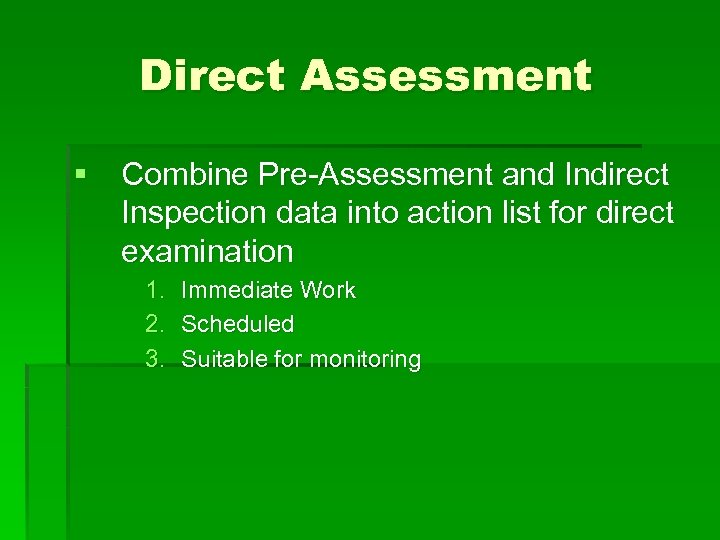 Direct Assessment § Combine Pre-Assessment and Indirect Inspection data into action list for direct examination 1. Immediate Work 2. Scheduled 3. Suitable for monitoring
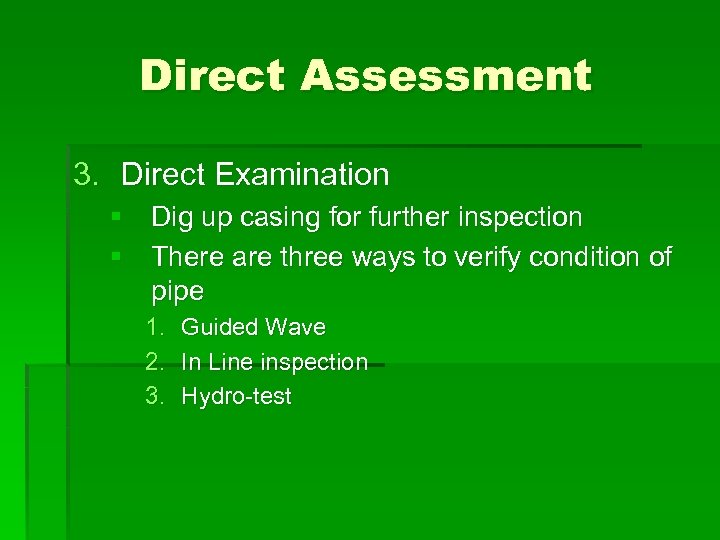 Direct Assessment 3. Direct Examination § Dig up casing for further inspection § There are three ways to verify condition of pipe 1. 2. 3. Guided Wave In Line inspection Hydro-test
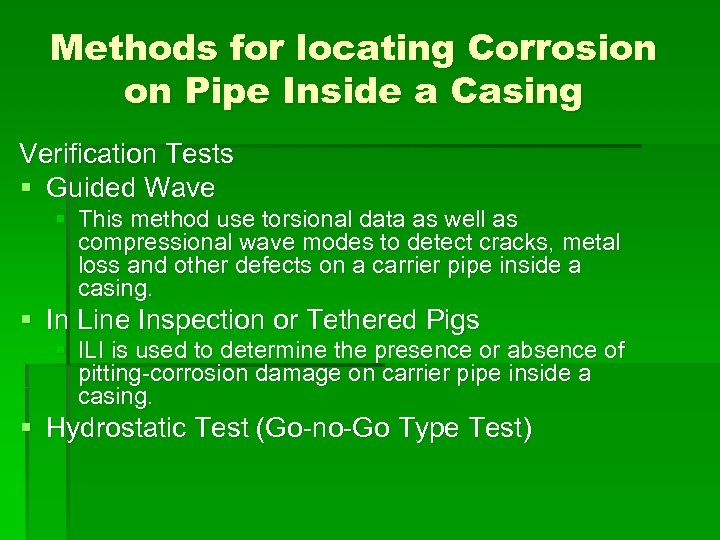 Methods for locating Corrosion on Pipe Inside a Casing Verification Tests § Guided Wave § This method use torsional data as well as compressional wave modes to detect cracks, metal loss and other defects on a carrier pipe inside a casing. § In Line Inspection or Tethered Pigs § ILI is used to determine the presence or absence of pitting-corrosion damage on carrier pipe inside a casing. § Hydrostatic Test (Go-no-Go Type Test)
 GUL – Shorted Casing
 WHAT TO DO WHEN THE CASING CAN NOT BE REMOVED 1. Correct shorted casing when possible § Most casings are shorted at the end(s) where the end seals or supports have collapsed. § Inspect the test lead wires. They may be shorted to the vent pipes or to each other. § Make sure vent pipes are not welded to the pipe. § Reposition the pipe and replace the end seals.
 WHAT TO DO WHEN THE CASING CAN NOT BE REMOVED 2. Add more CP to the pipeline to meet criteria. 3. Monitor with vapor leak test at vent pipes at required intervals to determine if a leaks exists. 4. Use cameras to determine where short is located and if corrosion exists. 5. ILI can determine if corrosion on pipe is present.
 WHAT TO DO WHEN THE CASING CAN NOT BE REMOVED OR • Clean and fill the casing with a wax type filler § Make sure vent pipes have sufficient (2”) openings to the inside of the casing in the proper configuration for best fill. § Clean out casing using air, power washer, or suction truck. § Remove old End Seals to assist the cleaning, then replace with new seals. § Pressure Test Seals with minimum 5 psi. In one vent and out the other to ensure quality fill.
 PHMSA § 192. 467 “Except for unprotected copper inserted in ferrous pipe, each pipeline must be electrically isolated from metallic casings that are a part of the underground system. However, if isolation is not achieved because it is impractical, other measures must be taken to minimize corrosion of the pipeline inside the casing. ” 20
 Types of Casing Fillers 1. Hot applied Wax based materials with corrosion inhibitors 2. Cold Applied Wax based materials with corrosion inhibitors 3. Gels with corrosion inhibitors 4. Inert gas (casing must be sealed to provide positive pressure). Practical? 5. Inject vapor and or water based type inhibitor in annulus. Practical?
 Requirements for filling a casing § § Diameter and length of casing and carrier Location of casing(s) Access to reach vents Preparation of casing including: § Evaluation of vents to be set up in best configuration for successful fill § New End Seals with 170 F temperature rating if using a Hot Wax Casing Filler (Most Shrink Sleeves do not meet the temp requirement) § Air pressure test of 5 psi, no spacer blockage, no vent blockage
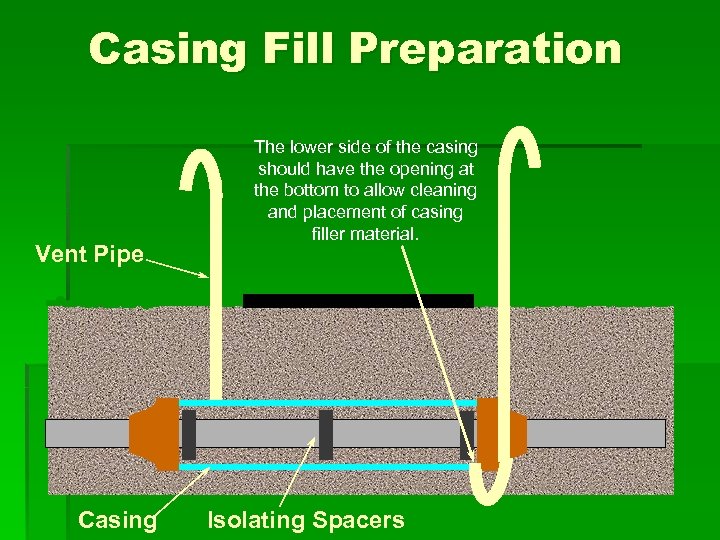 Casing Fill Preparation Vent Pipe Casing The lower side of the casing should have the opening at the bottom to allow cleaning and placement of casing filler material. Isolating Spacers
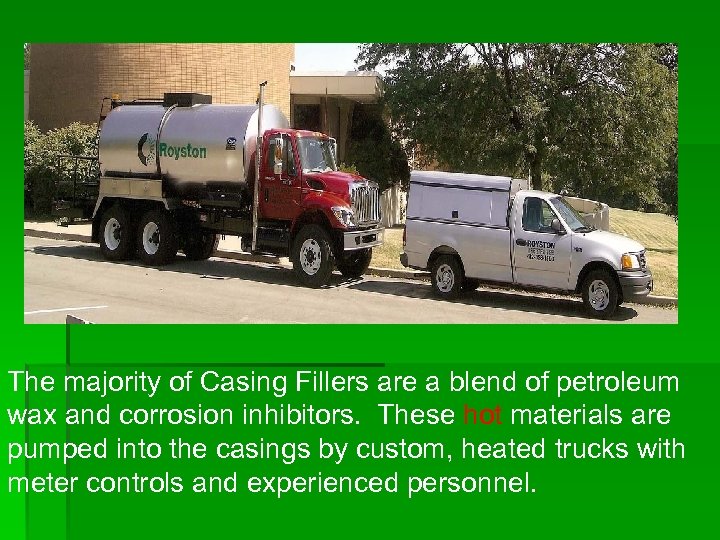 The majority of Casing Fillers are a blend of petroleum wax and corrosion inhibitors. These hot materials are pumped into the casings by custom, heated trucks with meter controls and experienced personnel.
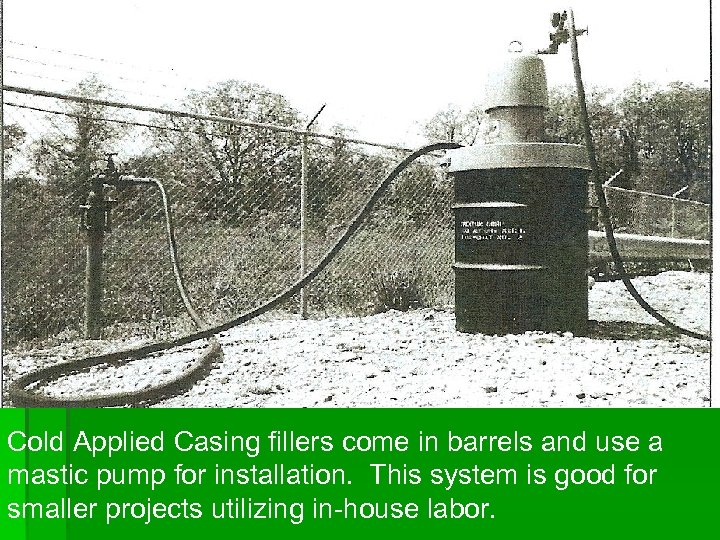 Cold Applied Casing fillers come in barrels and use a mastic pump for installation. This system is good for smaller projects utilizing in-house labor.
 INSTALLATION OF NEW CASING AND PIPE § Do not install casing unless absolutely necessary. § If installation is required, be sure to install properly coated pipe with enough supports to keep the pipe separate from the casing. § Insure the end seals are properly installed. § Attach vent pipes of proper size and location to provide installation of casing filler. § Install casing filler as part of the project to help prevent corrosion in the future.
 CONCLUSIONS § § § All casings are a problem shorted or not shorted. Remove casings when possible, shorted or not. When you must install a new casing, fill it as part of the construction project cost § Corrosion occurs almost as often in non-shorted casings as in shorted casings. § Water is present in nearly all casings § Filling a casing will remove the electrolyte / water from the equation and stop any further corrosion