 Скачать презентацию Cashflow Breakeven Special thanks to Geoff Leese
93a3959dd73cb25436952526110e749a.ppt
- Количество слайдов: 22



Cashflow & Breakeven Special thanks to Geoff Leese 1
Financial Aspects of Business n n n 2 This block of six lectures covers financial aspects of business The mission of all business is to make a profit Clear monitoring and control is needed to ensure that this can happen This means that you need to set up a good Information System from the start These lectures cover the tools and skills necessary to monitor and control the money
Software n n n 3 Businesses use software for their accounting Excel spreadsheets are widely used for simple accounts. You need to know something about accounting to set up the sheets and use the functions Specialist software also requires a knowledge of accounting practices. GIGO! Sage software is a widely sold specialist range of accounting packages, for all sizes of business Microsoft Money is inexpensive and popular for small businesses
Accounts n n 4 These are the profit and loss account and the balance sheet of a company An account is a statement of indebtedness from one person or company to another Companies are required by law to keep accounts, which are audited annually by persons who are members of an authorised body Accounts are kept in books (see Excel terminology), hence bookkeeping
Topics in this lecture n The Flow of Money n The Death Valley curve n Managing cash flow n 5 Break even analysis and “contribution”
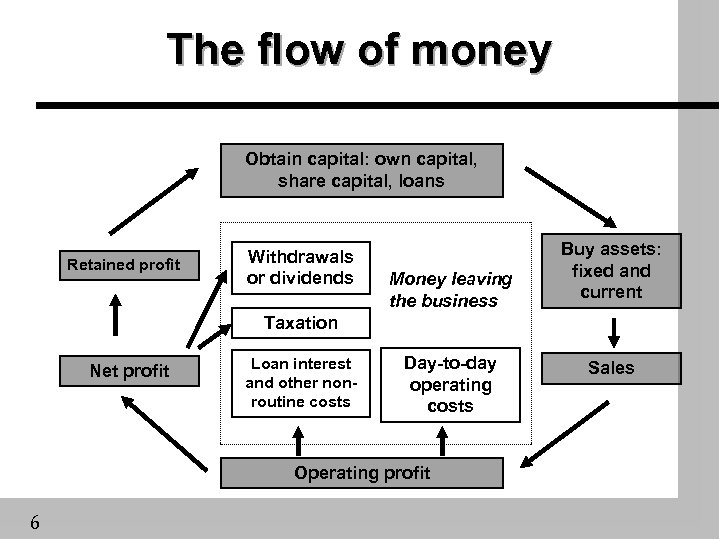
The flow of money Obtain capital: own capital, share capital, loans Retained profit Withdrawals or dividends Money leaving the business Buy assets: fixed and current Taxation Net profit Loan interest and other nonroutine costs Day-to-day operating costs Operating profit 6 Sales
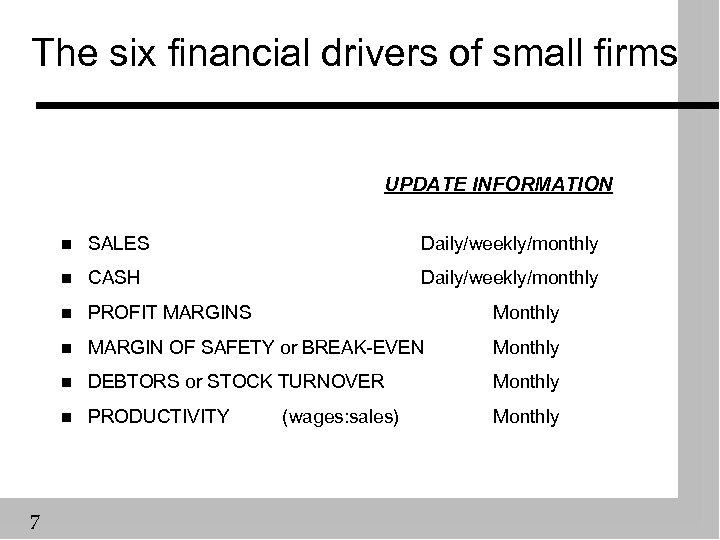
The six financial drivers of small firms UPDATE INFORMATION n Daily/weekly/monthly n CASH Daily/weekly/monthly n PROFIT MARGINS Monthly n MARGIN OF SAFETY or BREAK-EVEN Monthly n DEBTORS or STOCK TURNOVER Monthly n 7 SALES PRODUCTIVITY Monthly (wages: sales)
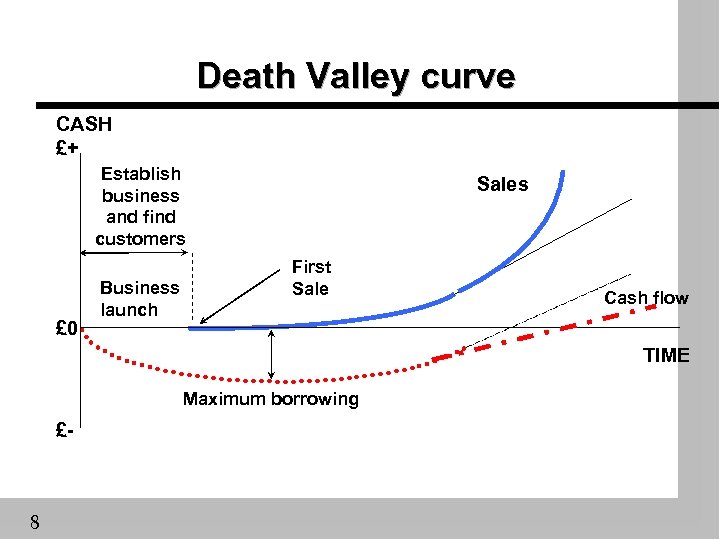
Death Valley curve CASH £+ Establish business and find customers £ 0 Business launch Sales First Sale Cash flow TIME Maximum borrowing £- 8
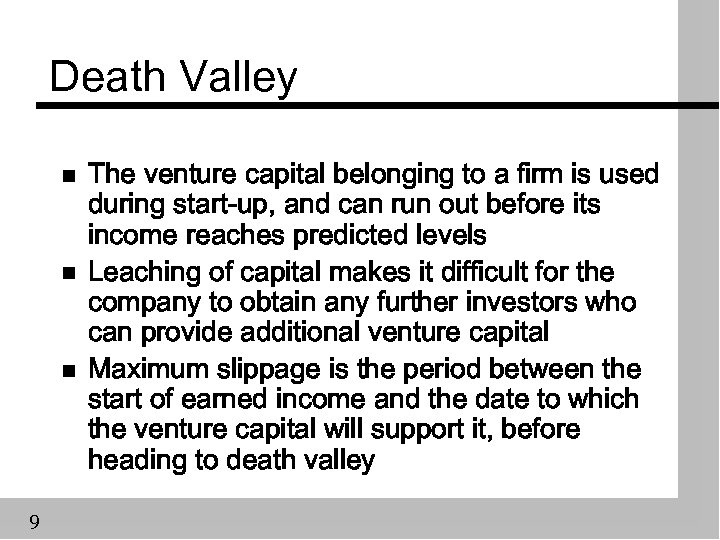
Death Valley n n n 9 The venture capital belonging to a firm is used during start-up, and can run out before its income reaches predicted levels Leaching of capital makes it difficult for the company to obtain any further investors who can provide additional venture capital Maximum slippage is the period between the start of earned income and the date to which the venture capital will support it, before heading to death valley
Cash flow n n n 10 Cash flow is the life blood of a business; it pays all the bills, including salaries and wages. But many firms run low, particularly small businesses You can be making a profit and still run out of cash which means that bills go unpaid Start ups face the danger of Death Valley Cash flow projection lists all expected payments and receipts over a stated period Managers use cash flow projections to plan payments of creditors (and employees)
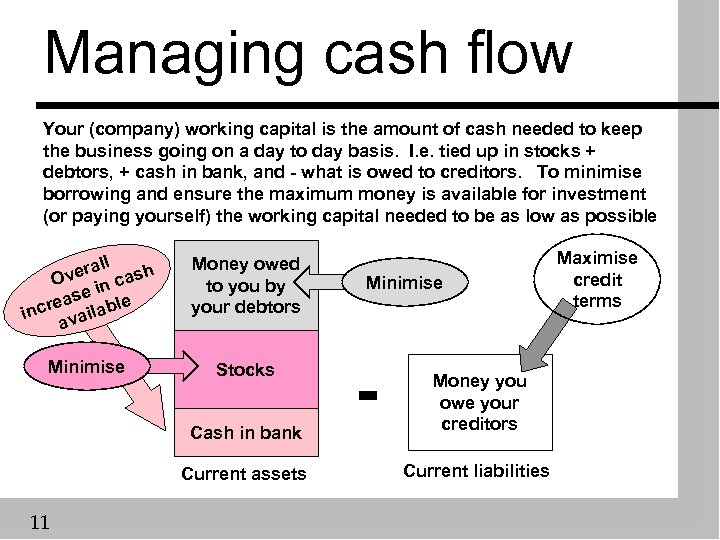
Managing cash flow Your (company) working capital is the amount of cash needed to keep the business going on a day to day basis. I. e. tied up in stocks + debtors, + cash in bank, and - what is owed to creditors. To minimise borrowing and ensure the maximum money is available for investment (or paying yourself) the working capital needed to be as low as possible ll vera cash O in ase ble e incr vaila a Money owed to you by your debtors Minimise Stocks Cash in bank Current assets 11 Minimise - Money you owe your creditors Current liabilities Maximise credit terms
Managing cash flow Debtors - minimise outstanding debt Creditors - maximise credit terms Stocks - minimise stock levels 12
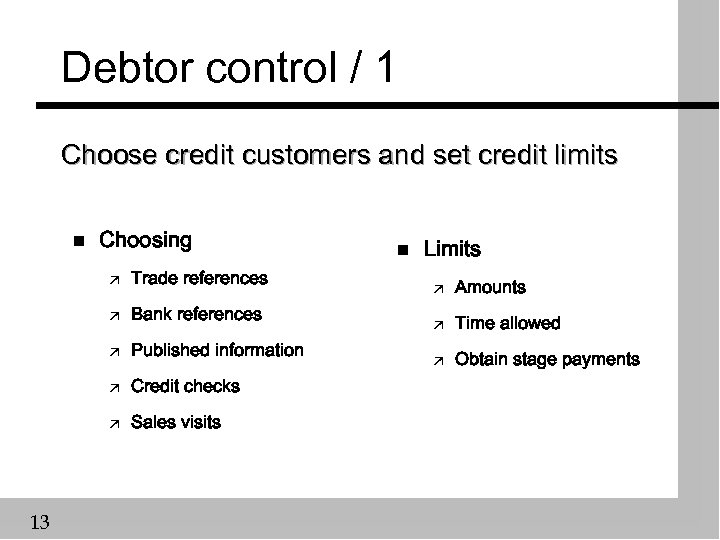
Debtor control / 1 Choose credit customers and set credit limits n Choosing ä ä Bank references ä Published information ä Credit checks ä 13 Trade references Sales visits n Limits ä Amounts ä Time allowed ä Obtain stage payments
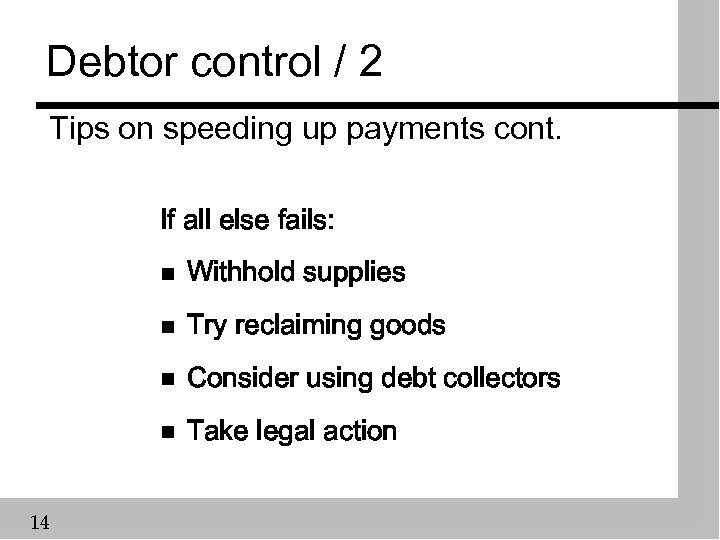
Debtor control / 2 Tips on speeding up payments cont. If all else fails: n n Try reclaiming goods n Consider using debt collectors n 14 Withhold supplies Take legal action
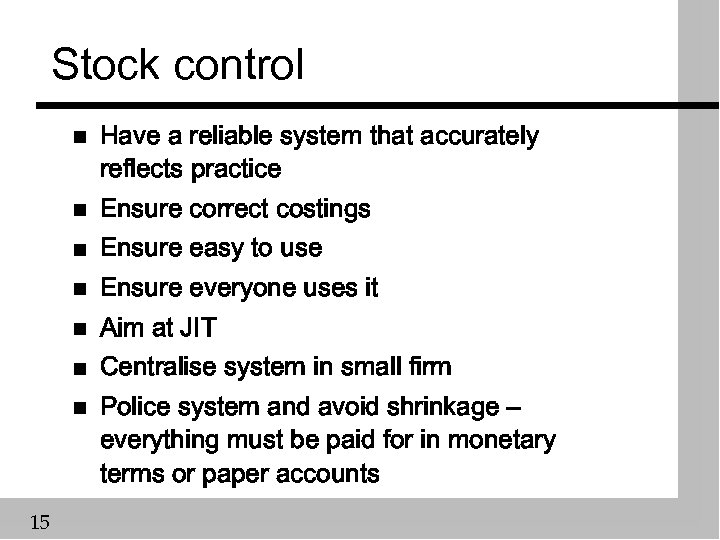
Stock control n n Ensure correct costings n Ensure easy to use n Ensure everyone uses it n Aim at JIT n Centralise system in small firm n 15 Have a reliable system that accurately reflects practice Police system and avoid shrinkage – everything must be paid for in monetary terms or paper accounts
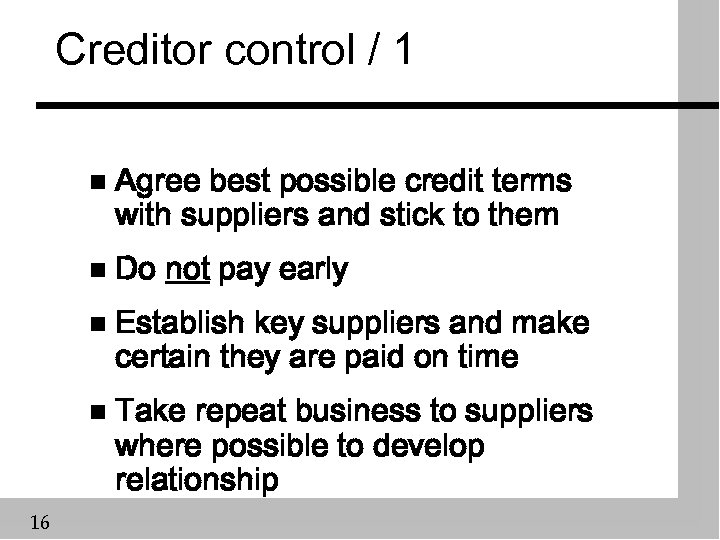
Creditor control / 1 n n Do not pay early n Establish key suppliers and make certain they are paid on time n 16 Agree best possible credit terms with suppliers and stick to them Take repeat business to suppliers where possible to develop relationship
Creditor control / 2 n If there are problems: Work with creditors (eg agree part payments) Keep bank informed Remember that the Inland Revenue and Customs and Excise are the most likely organisations to put a firm into liquidation, so keep them informed and paid 17
Insolvency n Inability to pay debts when they are due ä Shows need for good cash flow analysis Individuals – may lead to bankruptcy n Companies – may lead to liquidation n Trustee in bankruptcy or liquidator – specialist – appointed n Gathers and disposes of all assets available, to pay creditors n 18
Breakeven analysis n n 19 Cost-volume-profit analysis CVP Costs analysed into fixed costs and variable costs Compared with potential sales revenue to determine the output level at which the business makes neither a profit or a loss (breakeven point) Unit contribution is sale price less variable cost; when total contributions exceed fixed overheads, all further contribution is profit
Some Definitions n Total costs = variable costs + fixed costs n Variable costs are related to each item sold (usually direct materials and labour) n Fixed costs are all other costs n Revenue = selling price * volume sold n Breakeven point = the volume of sales at which the total costs are equal to revenue 20
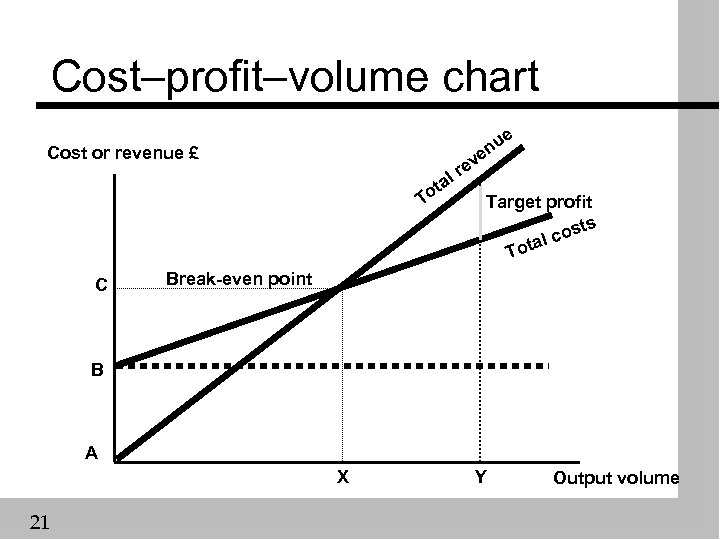
Cost–profit–volume chart Cost or revenue £ v e lr a ot T C e nu e Target profit ts cos al Tot Break-even point B A X 21 Y Output volume
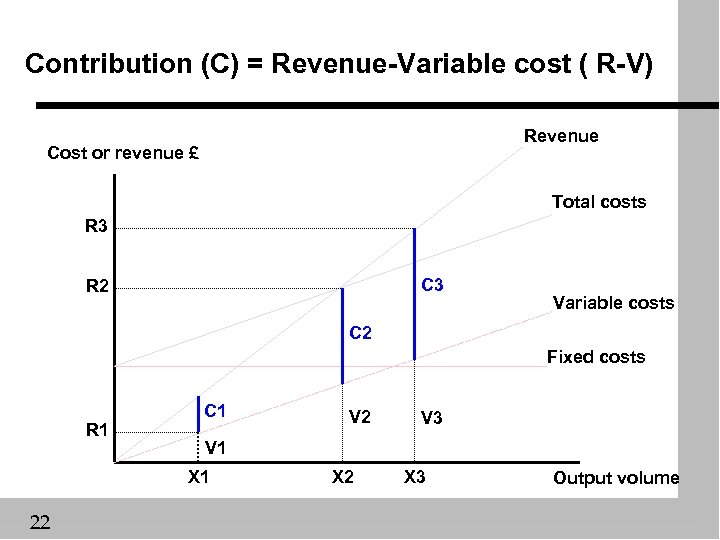
Contribution (C) = Revenue-Variable cost ( R-V) Revenue Cost or revenue £ Total costs R 3 C 3 R 2 Variable costs C 2 Fixed costs R 1 C 1 V 3 V 1 X 1 22 V 2 X 3 Output volume
Скачать презентацию Cashflow Breakeven Special thanks to Geoff Leese
93a3959dd73cb25436952526110e749a.ppt