


 Скачать презентацию Casemate Museum and Museum Campus Overview FMFADA 16
f2e11c3c5b50d51d4a56329488d43d20.ppt
- Количество слайдов: 11
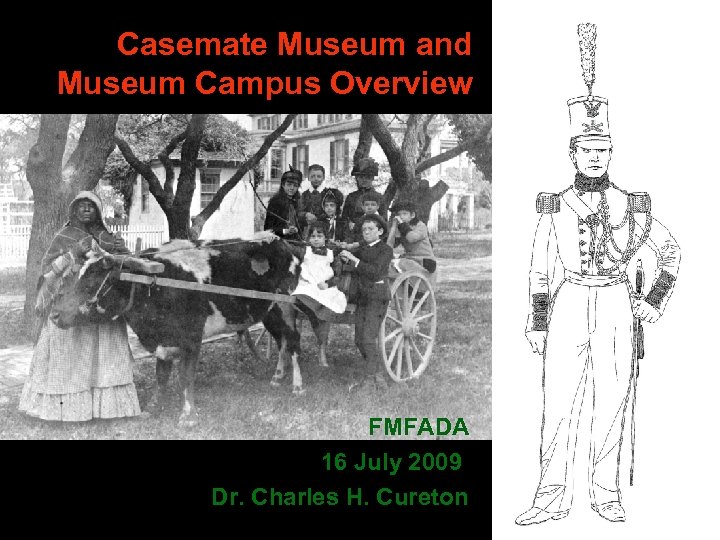 Casemate Museum and Museum Campus Overview FMFADA 16 July 2009 Dr. Charles H. Cureton 1
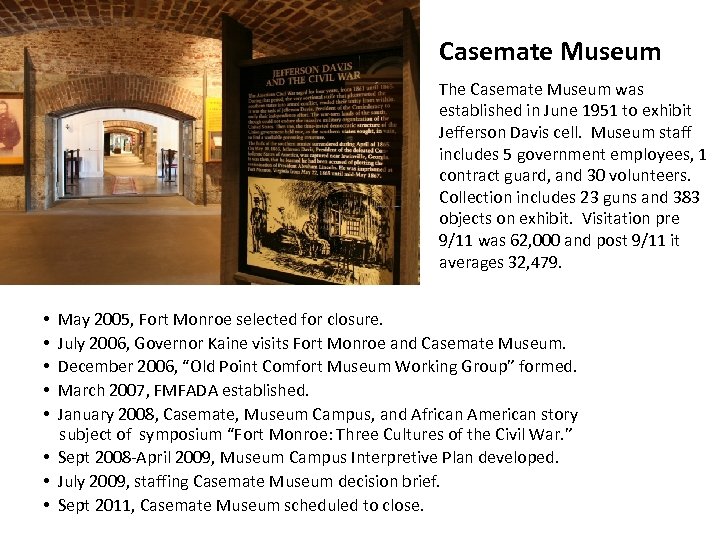 Casemate Museum The Casemate Museum was established in June 1951 to exhibit Jefferson Davis cell. Museum staff includes 5 government employees, 1 contract guard, and 30 volunteers. Collection includes 23 guns and 383 objects on exhibit. Visitation pre 9/11 was 62, 000 and post 9/11 it averages 32, 479. May 2005, Fort Monroe selected for closure. July 2006, Governor Kaine visits Fort Monroe and Casemate Museum. December 2006, “Old Point Comfort Museum Working Group” formed. March 2007, FMFADA established. January 2008, Casemate, Museum Campus, and African American story subject of symposium “Fort Monroe: Three Cultures of the Civil War. ” • Sept 2008 -April 2009, Museum Campus Interpretive Plan developed. • July 2009, staffing Casemate Museum decision brief. • Sept 2011, Casemate Museum scheduled to close. • • •
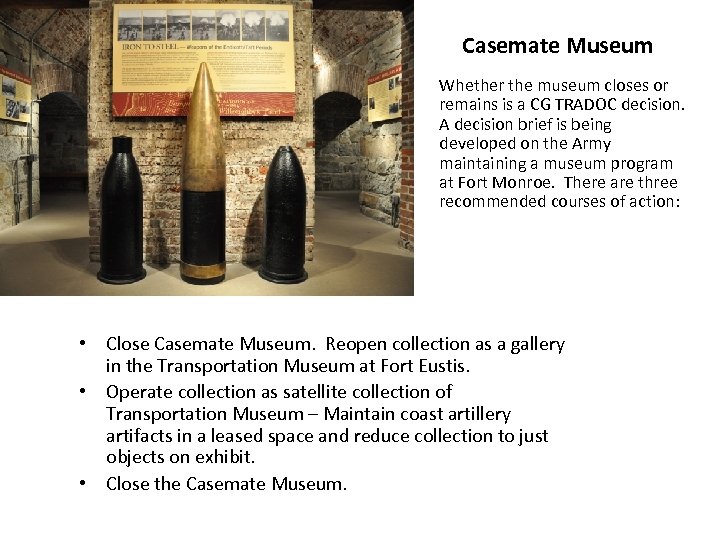 Casemate Museum Whether the museum closes or remains is a CG TRADOC decision. A decision brief is being developed on the Army maintaining a museum program at Fort Monroe. There are three recommended courses of action: • Close Casemate Museum. Reopen collection as a gallery in the Transportation Museum at Fort Eustis. • Operate collection as satellite collection of Transportation Museum – Maintain coast artillery artifacts in a leased space and reduce collection to just objects on exhibit. • Close the Casemate Museum.
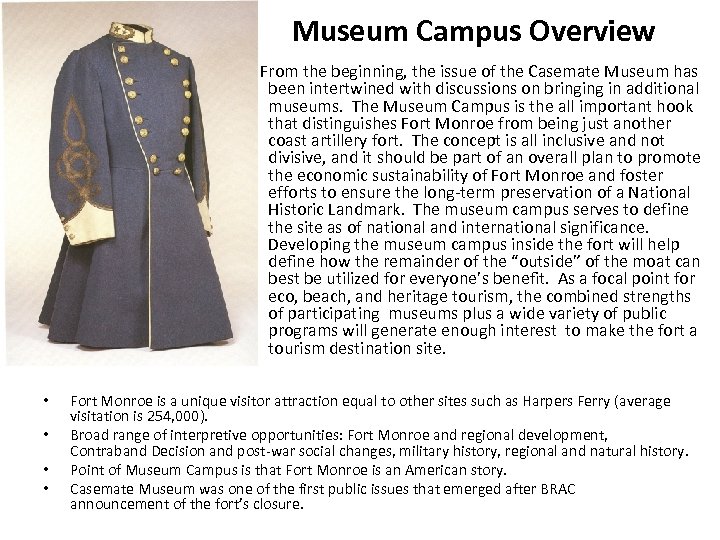 Museum Campus Overview From the beginning, the issue of the Casemate Museum has been intertwined with discussions on bringing in additional museums. The Museum Campus is the all important hook that distinguishes Fort Monroe from being just another coast artillery fort. The concept is all inclusive and not divisive, and it should be part of an overall plan to promote the economic sustainability of Fort Monroe and foster efforts to ensure the long-term preservation of a National Historic Landmark. The museum campus serves to define the site as of national and international significance. Developing the museum campus inside the fort will help define how the remainder of the “outside” of the moat can best be utilized for everyone’s benefit. As a focal point for eco, beach, and heritage tourism, the combined strengths of participating museums plus a wide variety of public programs will generate enough interest to make the fort a tourism destination site. • • Fort Monroe is a unique visitor attraction equal to other sites such as Harpers Ferry (average visitation is 254, 000). Broad range of interpretive opportunities: Fort Monroe and regional development, Contraband Decision and post-war social changes, military history, regional and natural history. Point of Museum Campus is that Fort Monroe is an American story. Casemate Museum was one of the first public issues that emerged after BRAC announcement of the fort’s closure.
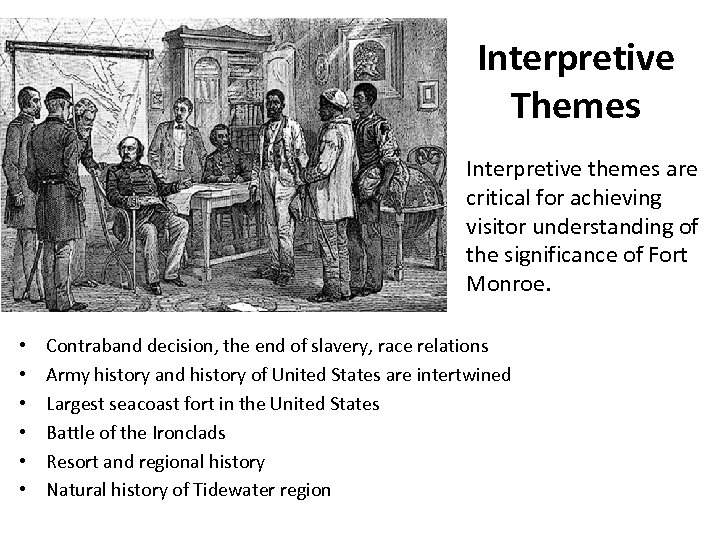 Interpretive Themes Interpretive themes are critical for achieving visitor understanding of the significance of Fort Monroe. • • • Contraband decision, the end of slavery, race relations Army history and history of United States are intertwined Largest seacoast fort in the United States Battle of the Ironclads Resort and regional history Natural history of Tidewater region
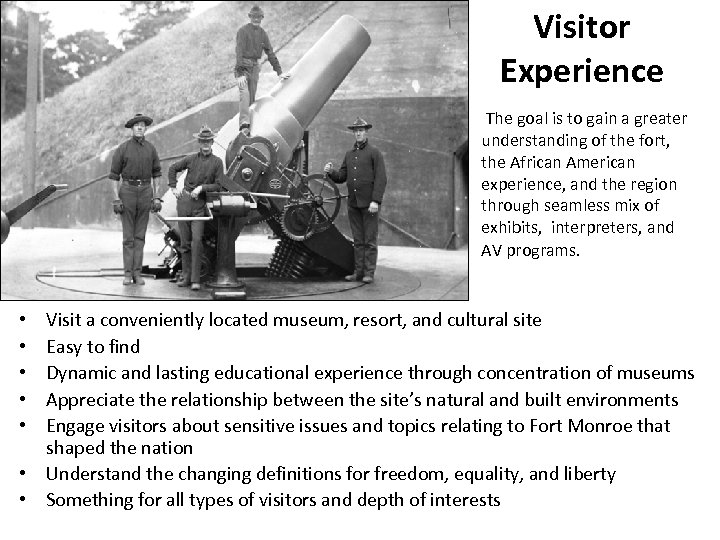 Visitor Experience The goal is to gain a greater understanding of the fort, the African American experience, and the region through seamless mix of exhibits, interpreters, and AV programs. Visit a conveniently located museum, resort, and cultural site Easy to find Dynamic and lasting educational experience through concentration of museums Appreciate the relationship between the site’s natural and built environments Engage visitors about sensitive issues and topics relating to Fort Monroe that shaped the nation • Understand the changing definitions for freedom, equality, and liberty • Something for all types of visitors and depth of interests • • •
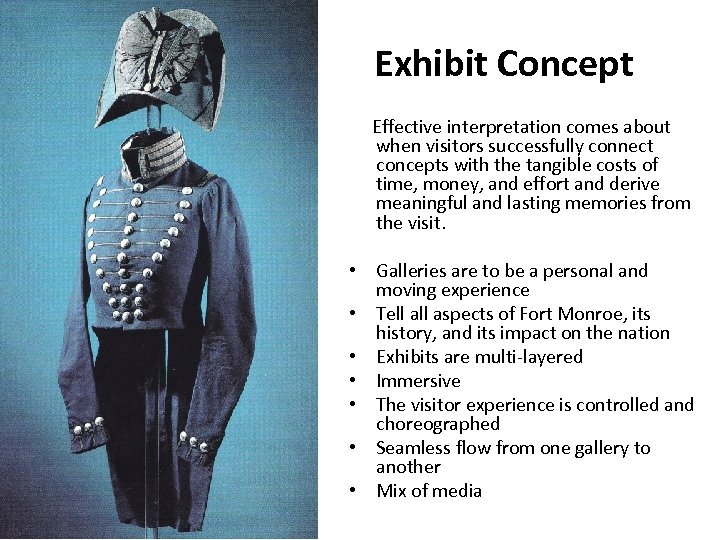 Exhibit Concept Effective interpretation comes about when visitors successfully connect concepts with the tangible costs of time, money, and effort and derive meaningful and lasting memories from the visit. • Galleries are to be a personal and moving experience • Tell aspects of Fort Monroe, its history, and its impact on the nation • Exhibits are multi-layered • Immersive • The visitor experience is controlled and choreographed • Seamless flow from one gallery to another • Mix of media
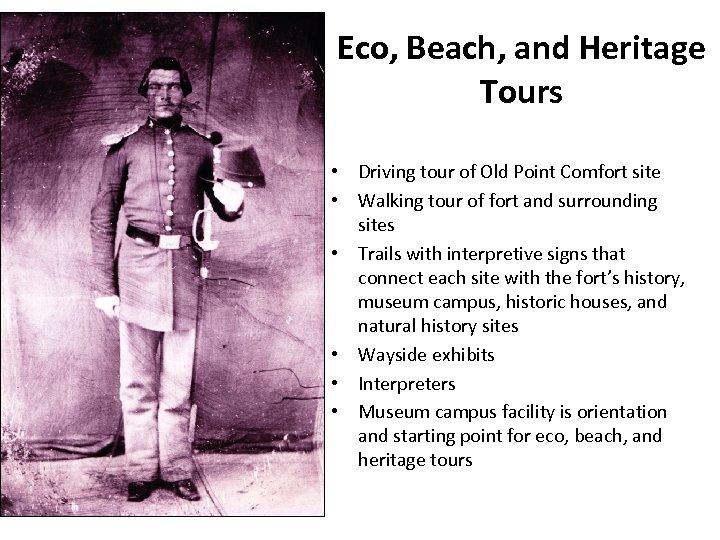 Eco, Beach, and Heritage Tours • Driving tour of Old Point Comfort site • Walking tour of fort and surrounding sites • Trails with interpretive signs that connect each site with the fort’s history, museum campus, historic houses, and natural history sites • Wayside exhibits • Interpreters • Museum campus facility is orientation and starting point for eco, beach, and heritage tours
 Economic Impact Size and scope of museum campus makes Fort Monroe a visitor destination that would be part of a regional historical quadrangle. Tourism is second largest industry in Virginia and the Museum campus supports all forms of tourism: eco, beach, and heritage tourists. • • • Civil War site tourists put over $100 a day into local economies Estimated 100, 000 to 275, 000 visitors. Civil War Trust study discovered that sites having museums experienced visitor stays that were twice as long. Admissions at $12 person results in $1. 8 M for every 150, 000 visitors Gift shop sales average $9 each would total sales at $1. 4 M Guided tours at $12 would total $1. 8 M for every 150, 000 patrons Educational programs at $10 each student would total $400, 000
 Summary Casemate Museum is not enough on its own to make Fort Monroe self-sustaining. The museum campus must be an important part of the overall plan to promote the economic sustainability of Fort Monroe that will ensure the long-term preservation of the site. Museums are a business that brings business. • Participating museum organizations include: Hampton History Museum, Virginia Museum of Natural History, Museum of the Confederacy, Virginia War Museum, Casemate Museum, and the Company of Military Historians. • Along with military history, regional history, and natural history, the Contraband story is unique to the site’s importance and central to making Fort Monroe into a major site of national significance.
 Questions ? 11