


 Скачать презентацию Case study on accreditation the GMC s perspective Martin
78b4b2f387c08f410bf92ce86f137aee.ppt
- Количество слайдов: 23
 Case study on accreditation: the GMC’s perspective Martin Hart Assistant Director Education
 Agenda § What GMC does § How doctors are educated and trained § How we accredit and quality assure § Strengths of our process § Issues and challenges
 Our purpose ‘to protect, promote and maintain the health and safety of the public by ensuring proper standards in the practice of medicine’
 Our aim < To secure a regulatory system which: ¡ Enhances patient safety ¡ Fosters professionalism ¡ Commands the confidence of all stakeholders ¡ Is independent, fair, efficient and effective
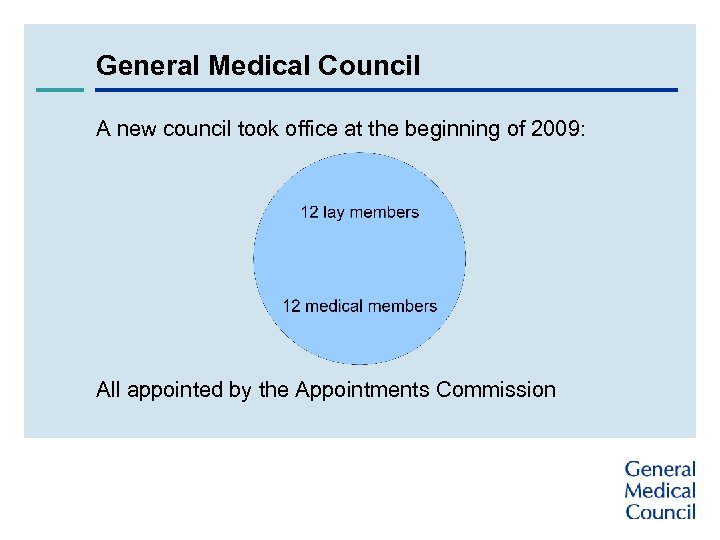 General Medical Council A new council took office at the beginning of 2009: All appointed by the Appointments Commission
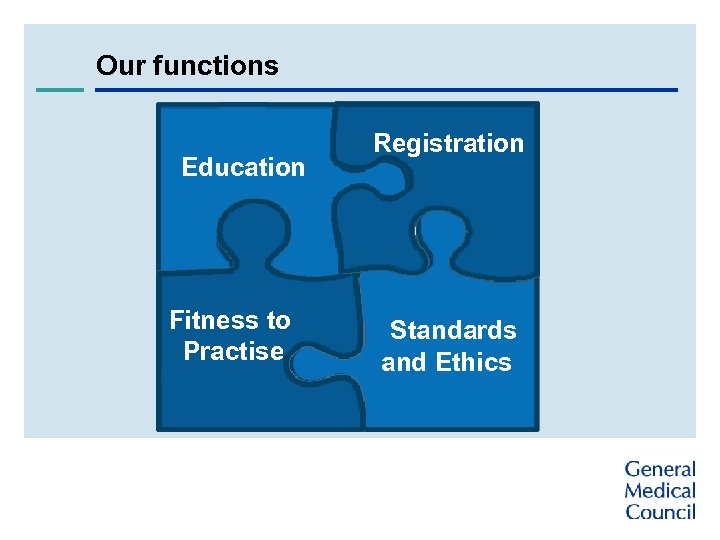 Our functions Education Fitness to Practise Registration Standards and Ethics
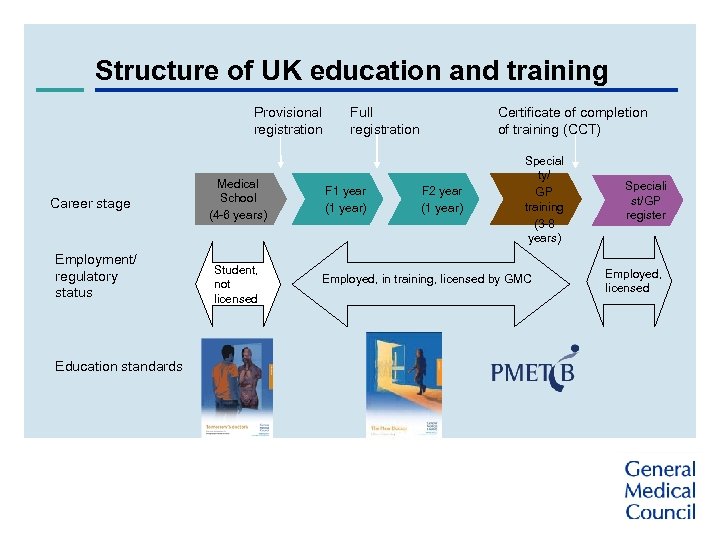 Structure of UK education and training Provisional registration Career stage Employment/ regulatory status Education standards Medical School (4 -6 years) Student, not licensed Full registration F 1 year (1 year) Certificate of completion of training (CCT) F 2 year (1 year) Special ty/ GP training (3 -8 years) Employed, in training, licensed by GMC Speciali st/GP register Employed, licensed
 The GMC’s role in medical education
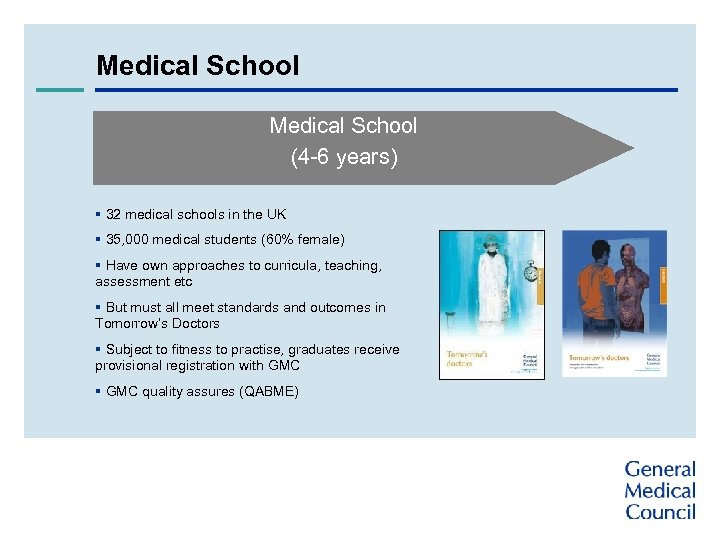 Medical School (4 -6 years) § 32 medical schools in the UK § 35, 000 medical students (60% female) § Have own approaches to curricula, teaching, assessment etc § But must all meet standards and outcomes in Tomorrow’s Doctors § Subject to fitness to practise, graduates receive provisional registration with GMC § GMC quality assures (QABME)
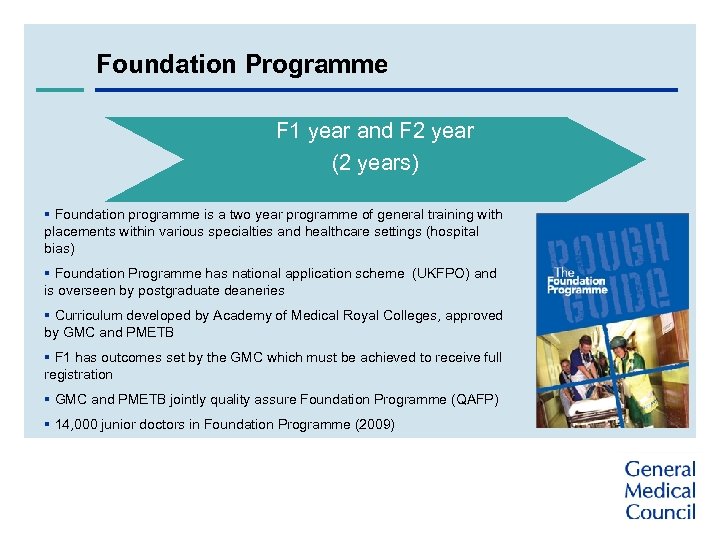 Foundation Programme F 1 year and F 2 year (2 years) § Foundation programme is a two year programme of general training with placements within various specialties and healthcare settings (hospital bias) § Foundation Programme has national application scheme (UKFPO) and is overseen by postgraduate deaneries § Curriculum developed by Academy of Medical Royal Colleges, approved by GMC and PMETB § F 1 has outcomes set by the GMC which must be achieved to receive full registration § GMC and PMETB jointly quality assure Foundation Programme (QAFP) § 14, 000 junior doctors in Foundation Programme (2009)
 Specialty training Specialty/GP training (3 -8 years) § Medical royal colleges draw up criteria for specialist and GP training and assessments, which are approved by PMETB § National competition for selection, training overseen by postgraduate deans § PMETB* certifies completion of training, leads to entry on GMC GP or specialist register and eligibility to work as a consultant § PMETB* quality assures specialist training *GMC from 2010
 Maintaining Standards: Quality Assurance § Two quality assurance processes: § Foundation Programme (QAFP) § Medical Schools (QABME) § Focussed on the institution, not students and trainees § Key elements are analysis of documentation, interviews with academic staff, students and clinicians Quality assurance of specialty training currently undertaken by PMETB
 Quality Assurance of Medical Education § Make sure institutions comply with standards § Identify examples of innovation and good practice § Identify concerns and help to resolve them. § Identify changes institutions need to make to comply with and a timetable for their implementation § Promote equality and diversity in medical education
 QA Visit Processes QABME n Medical Schools Quality Management n Curriculum content n Examination framework n 8 – 10 visitors n Minimum 4 days visit over 6 months QAFP n Joint process with PMETB n Postgraduate Deaneries quality management n 6 visitors n 4 -day visit over 4 sites in one week
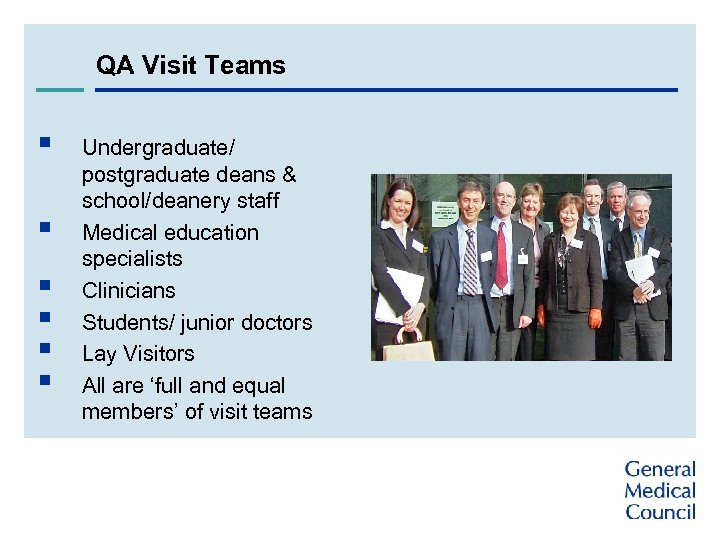 QA Visit Teams § § § Undergraduate/ postgraduate deans & school/deanery staff Medical education specialists Clinicians Students/ junior doctors Lay Visitors All are ‘full and equal members’ of visit teams
 QA visit teams ¡ ¡ ¡ Consistent approach to recruitment Same contracts (responsibilities, payment and time) Mandatory annual training Same performance management framework Annual appraisal Share competencies
 QA Monitoring Process § Targeted action plans & updates § Annual Returns of information § PMETB Survey of Trainees (for QAFP) § Data from all three sources published on GMC website
 Strengths of QABME at the end of 5 years § In depth evaluation of School § Wide range of team expertise § Interactive with School § Triangulation from multiple sources § Seen as important and generally supportive by § Schools Transparent process and status of schools’ progress on requirements is available to students and the public
 Strengths of QAFP midway through § Has galvanised postgraduate deaneries to evaluate § § § and demonstrate improvements in quality management Has given trainees a greater voice in the quality management and assurance of their training Has identified areas where improvements are needed particularly in the supervision of trainees Postgraduate deaneries have reported the process as challenging and helpful – perhaps particularly the self assessment
 Issues in GMC accreditation QABME & QAFP: § Resource intensive – GMC and institutions § Maintaining team focus/knowledge over cycle § Potential variability of teams § Potentially insufficient involvement of employers and § patients in the QA process Disseminating good practice/innovation
 Challenges for accreditation generally § Is the QA focus on institutions sufficient for maintaining a register of professionals? § Sanctions – ‘nuclear option’: removal of accreditation § Reliance on others: can the GMC’s QA processes effectively identify areas of poor practice? § Deaneries and Schools measure the quality of individual students and junior doctors § Health systems regulator measures quality of care (and by extension doctors)
 Issues for the future: Student Registration?
 www. gmc-uk. org/education