 Скачать презентацию Case study International Best Practice South Africa RSA
c33c051c5513a7c342d58870c31f7f01.ppt
- Количество слайдов: 54



Case study International Best Practice: South Africa (RSA) Gabriele Sauberer (Term. Net)
gsauberer@termnet. org 1. Executive Secretary of Term. Net Projects, Business development & PR 2. Interdisciplinary research & training at the University of Vienna, Centre for Translation Studies Intercultural management, project management & diversity management 3. Board member of EAFT 2007 -07 -28 EAFT Seminar Dublin 2
Content of presentation §Introduction: role of terminology §Policies & Frameworks in RSA §Practice, Projects & Training 2007 -07 -28 EAFT Seminar Dublin 3
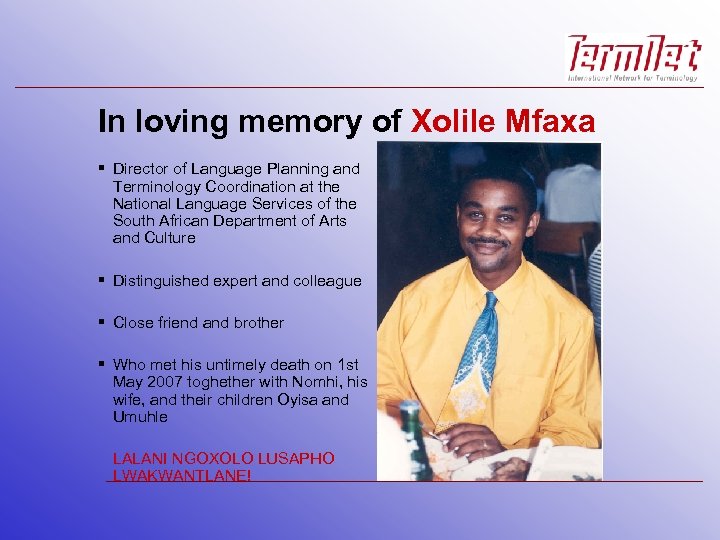
In loving memory of Xolile Mfaxa § Director of Language Planning and Terminology Coordination at the National Language Services of the South African Department of Arts and Culture § Distinguished expert and colleague § Close friend and brother § Who met his untimely death on 1 st May 2007 toghether with Nomhi, his wife, and their children Oyisa and Umuhle LALANI NGOXOLO LUSAPHO LWAKWANTLANE!
“South Africa has eleven official languages. The challenge is to translate this constitutional provision into living reality. ” (Dr Pallo Jordan, South Africa´s Minister of Arts and Culture) 2007 -07 -28 EAFT Seminar Dublin 5
That´s what terminology development, management & training in RSA is all about: to empower people to translate human rights into reality. e. g. by enabling access to legal and other public information in people´s mother tongues. 2007 -07 -28 EAFT Seminar Dublin 6
Role of Terminology § The language we use and need to understand in public and business life is less “general language” than “specialized language” § characterized by the terms of the respective subject fields § e. g. legal texts, parliament speeches, court terminology, science and technology, etc. 2007 -07 -28 EAFT Seminar Dublin 7
Role of Terminology § Terminology skills: § a key qualification of information professionals and language practitioners, particularly in RSA and SADC § applies to all levels of information and knowledge creation, storing and processing 2007 -07 -28 EAFT Seminar Dublin 8
Role of Terminology § ranging from basic terminology teaching to applied terminology in sophisticated Information and Communication Technology (ICT) industries and §. . . in Human Language Technologies (HLT) §. . . in the Semantic Web §. . . in e-Business, e-Health, etc. 2007 -07 -28 EAFT Seminar Dublin 9
Role of Terminology Important part of the translation of a “constitutional provision into living reality”: to develop terminology in the indigenous languages of African languages communities. 2007 -07 -28 EAFT Seminar Dublin 10
Policies & Frameworks 1. South African Languages Bill 2. Pan South African Language Board Act 2007 -07 -28 EAFT Seminar Dublin 11
Constitution § The Constitution of the Republic of South Africa (1996, section 6) recognises the principle of multilingualism by providing for eleven official languages of South Africa and for all official languages to enjoy parity of esteem and to be treated equitably; 2007 -07 -28 EAFT Seminar Dublin 12
2. South African Languages Bill To provide for an enabling framework for promoting South Africa’s linguistic diversity and encouraging respect for language rights within the framework of building and consolidating a united, democratic South African nation, taking into account the broad acceptance of linguistic diversity, social justice, 2007 -07 -28 EAFT Seminar Dublin 13
2. South African Languages Bill the principle of equal access to public services and programmes, respect for language rights, the establishment of language services at all levels of government, the powers and functions of such services, and matters connected therewith. 2007 -07 -28 EAFT Seminar Dublin 14
Language policy § 5(1) All official languages shall be used equitably and enjoy parity of esteem. § (2) Without derogating from the provision in subsection (1), the national government must use not less than four languages for any given purpose as provided for in section 7(b), provided that these languages shall be selected by each organ of state from each of the four categories of official languages in subsection (3) on a rotational basis, except when it is reasonably necessary to follow an alternative policy in the interest of effective governance or communication. 2007 -07 -28 EAFT Seminar Dublin 15
Language policy § (3) The categories of languages referred to in subsection (2) are – (a) the Nguni group (isi. Ndebele, isi. Xhosa, isi. Zulu and si. Swati) (b) the Sotho group (Sepedi, Sesotho and Setswana) (c) Tshivenda/Xitsonga (d) Afrikaans/English 2007 -07 -28 EAFT Seminar Dublin 16
Language units § 6(1) Within three years after the commencement of this Act, a language unit must be established – (a) for each department of the national government; and (b) for each province. 2007 -07 -28 EAFT Seminar Dublin 17
Language units § 7(1) A language unit shall have the powers and functions to – (a) implement and monitor the implementation of regulations made in fulfillment of the obligations imposed by this Act; (b) take effective and positive measures for the implementation of the national language policy as determined in section 5 in regard to the following: …. 2007 -07 -28 EAFT Seminar Dublin 18
Language units § (c) conduct language surveys and audits relevant to its sphere of activity (. . . ); § (d) inform the public, (. . . ), of the content and implementation of the language policy of the relevant organ of state; § (e) do all things incidental to or necessary for the proper fulfillment of the obligations referred to in paragraphs (a) to (d). 2007 -07 -28 EAFT Seminar Dublin 19
Development of indigenous languages §and South African Sign Language/s § 8 Subject to the provisions of section 9(a), the Minister shall take practical and positive measures for the development of the indigenous languages and South African Sign Language/s, in particular to – 2007 -07 -28 EAFT Seminar Dublin 20
Development of indigenous languages § (a) identify priority areas for the development of these languages; § (b) support existing structures involved in the development of these languages; § (c) establish new structures and programmes for the development of these languages, and § (d) support cross-border projects for the development of these languages in the Southern African region. 2007 -07 -28 EAFT Seminar Dublin 21
Pan. SALB – ACT §To provide for the recognition, implementation and furtherance of multilingualism in the Republic of South Africa; and the development of previously marginalised languages; to establish a Pan South African Language Board; and to provide for matters connected therewith. 2007 -07 -28 EAFT Seminar Dublin 22
Pan. SALB § The Board shall have the following objects: (a) To promote respect for and ensure the implementation of the following principles: (i) The creation of conditions for the development and for the promotion of the equal use and enjoyment of all the official South African languages; 2007 -07 -28 EAFT Seminar Dublin 23
Pan. SALB (iv) the promotion of§ (aa) multilingualism; and § (bb) the provision of translation and interpreting facilities; § (v) the fostering of respect for languages spoken in the Republic other than the official languages, and the encouragement of their use in appropriate circumstances; and 2007 -07 -28 EAFT Seminar Dublin 24
Pan. SALB and (vi) the non-diminution of rights relating to language and the status of languages existing before 27 April 1994; 2007 -07 -28 EAFT Seminar Dublin 25
Pan. SALB § (b) to further the development of the official South African languages; § (c) to promote respect for and the development of other languages used by communities in South Africa, and languages used for religious purposes; 2007 -07 -28 EAFT Seminar Dublin 26
§ (d) to promote knowledge of and respect for the provisions and principles of the Constitution relating directly or indirectly to language matters; § (e) to promote respect for multilingualism in general; and § (f) to promote the utilisation of South Africa's language resources. 2007 -07 -28 EAFT Seminar Dublin 27
(2) The Board shall- (a) initiate studies and research aimed at promoting and creating conditions for the development and use of- (i) all the official languages of the Republic; (ii) the Khoe and San languages; and § (iii) sign language; 2007 -07 -28 EAFT Seminar Dublin 28
(2) The Board shall§ (b) promote and ensure respect for- (i) all other languages commonly used by communities in South Africa, including German, Greek, Gujarati, Hindi, Portuguese, Tamil, Telegu and Urdu; (ii) Arabic, Hebrew, Sanskrit and other languages used for religious purposes in South Africa; (…) 2007 -07 -28 EAFT Seminar Dublin 29
Pan. SALB § terminology mentioned in a definition: §'acknowledged, practising language worker' means a person with extensive experience and training in interpreting or translation or terminology or lexicography or literacy teaching or language teaching; 2007 -07 -28 EAFT Seminar Dublin 30
Other Frameworks: Networking language resources in Africa: Future plans and proposals Justus Roux Stellenbosch University Centre for Language and Speech Technology Term. Train Workshop March 2006 Pretoria Copyright JC Roux 31
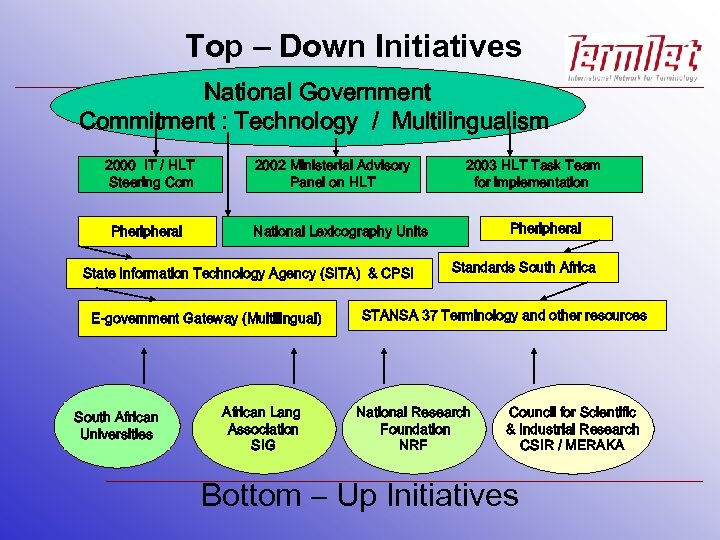
Top – Down Initiatives National Government Commitment : Technology / Multilingualism 2000 IT / HLT Steering Com Pheripheral 2002 Ministerial Advisory Panel on HLT Pheripheral National Lexicography Units State Information Technology Agency (SITA) & CPSI E-government Gateway (Multilingual) South African Universities 2003 HLT Task Team for implementation African Lang Association SIG Standards South Africa STANSA 37 Terminology and other resources National Research Foundation NRF Council for Scientific & Industrial Research CSIR / MERAKA Bottom – Up Initiatives
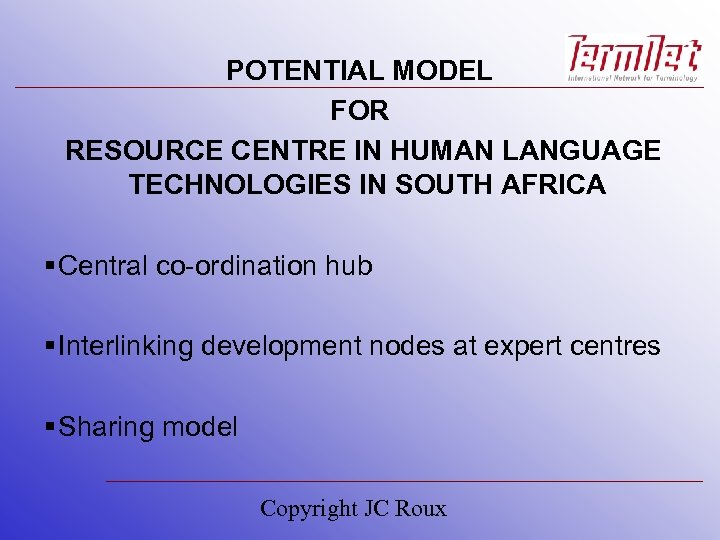
POTENTIAL MODEL FOR RESOURCE CENTRE IN HUMAN LANGUAGE TECHNOLOGIES IN SOUTH AFRICA § Central co-ordination hub § Interlinking development nodes at expert centres § Sharing model Copyright JC Roux
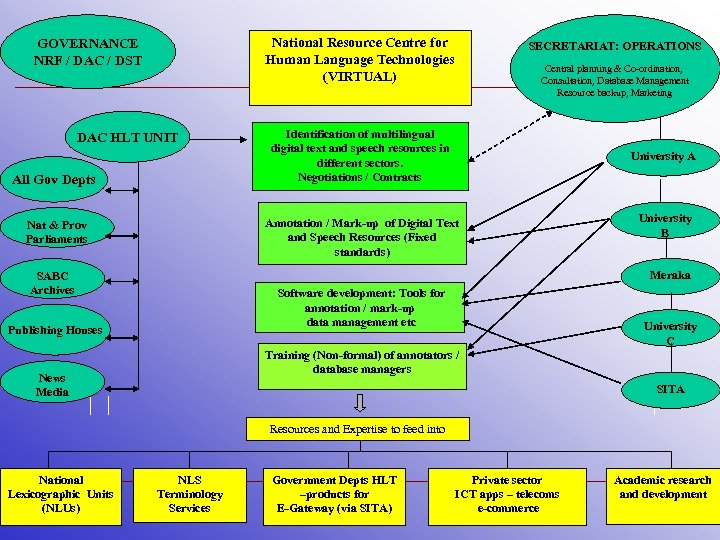
National Resource Centre for Human Language Technologies (VIRTUAL) GOVERNANCE NRF / DAC / DST DAC HLT UNIT All Gov Depts SECRETARIAT: OPERATIONS Central planning & Co-ordination, Consultation, Database Management Resource backup, Marketing Identification of multilingual digital text and speech resources in different sectors. Negotiations / Contracts University A Annotation / Mark-up of Digital Text and Speech Resources (Fixed standards) Nat & Prov Parliaments University B Meraka SABC Archives Software development: Tools for annotation / mark-up data management etc Publishing Houses University C Training (Non-formal) of annotators / database managers News Media SITA Resources and Expertise to feed into National Lexicographic Units (NLUs) NLS Terminology Services Government Depts HLT –products for E-Gateway (via SITA) Private sector ICT apps – telecoms e-commerce Academic research and development
Practice, Projects & Training 1) Multilingual terminology process in RSA ©Mapula Gaffane, National Language Service (NLS) within the Department of Arts and Culture 2007 -07 -28 EAFT Seminar Dublin 35
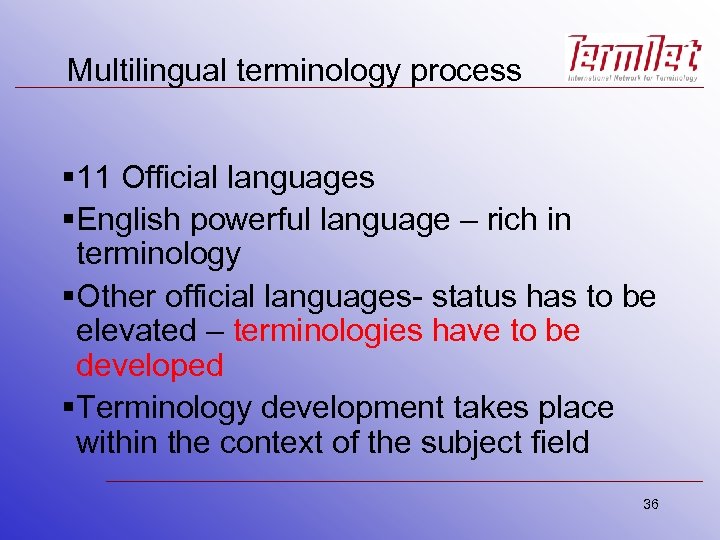
Multilingual terminology process § 11 Official languages §English powerful language – rich in terminology §Other official languages- status has to be elevated – terminologies have to be developed §Terminology development takes place within the context of the subject field 36
Developing terminologies for developing languages §Multilingual terminology collections for developed languages match existing equivalents §Developing terminology for developing languages requires interactive collaboration between linguists and subject specialists to find suitable equivalents 37
Developing terminologies for developing languages §Developed language with well established terms in a subject field is used as source language §In situations of language disparity the most prominent need is to have translation equivalents 2007 -07 -28 EAFT Seminar Dublin 38
Secondary term creation §An interactive consultative process of linguists, terminologists and subject specialists working together §Many challenges have to be successfully managed – language & human resources §Term recognition part of the overall picture of processing terminological data 39
Different steps in developing terminology §Process which entails two major phases §Ground text production §Target text production 2007 -07 -28 EAFT Seminar Dublin 40
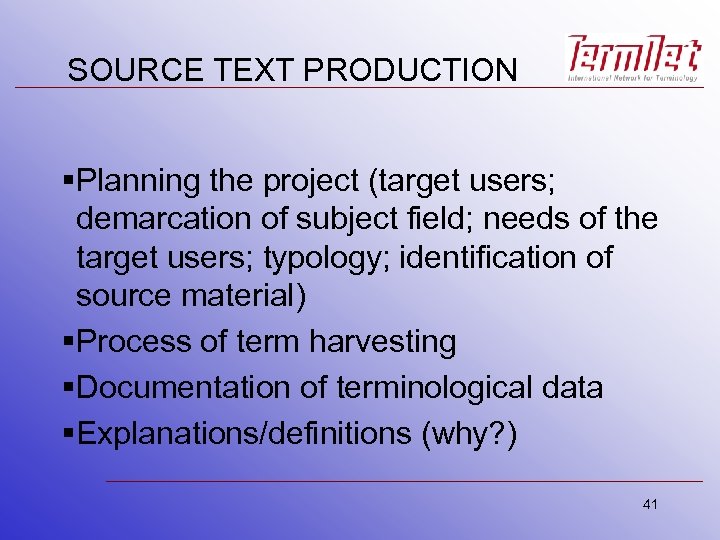
SOURCE TEXT PRODUCTION §Planning the project (target users; demarcation of subject field; needs of the target users; typology; identification of source material) §Process of term harvesting §Documentation of terminological data §Explanations/definitions (why? ) 41
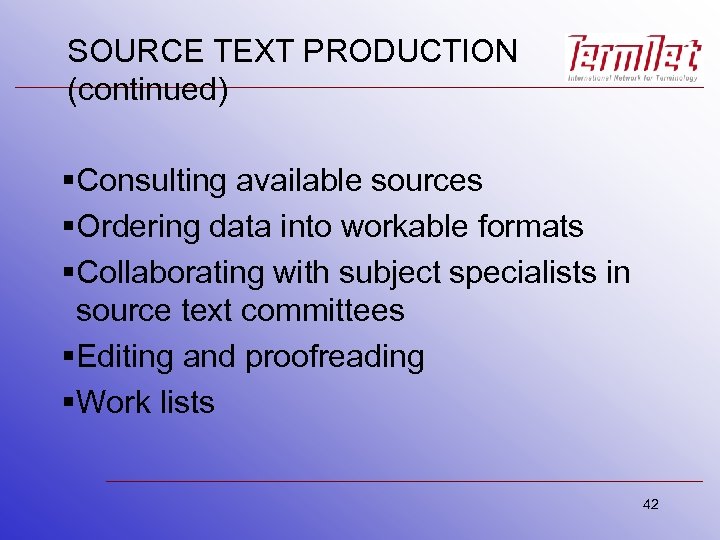
SOURCE TEXT PRODUCTION (continued) §Consulting available sources §Ordering data into workable formats §Collaborating with subject specialists in source text committees §Editing and proofreading §Work lists 42
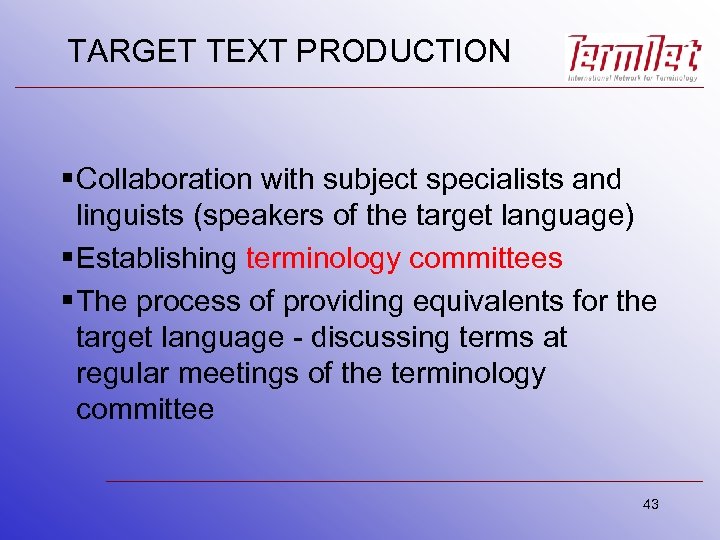
TARGET TEXT PRODUCTION §Collaboration with subject specialists and linguists (speakers of the target language) §Establishing terminology committees §The process of providing equivalents for the target language - discussing terms at regular meetings of the terminology committee 43
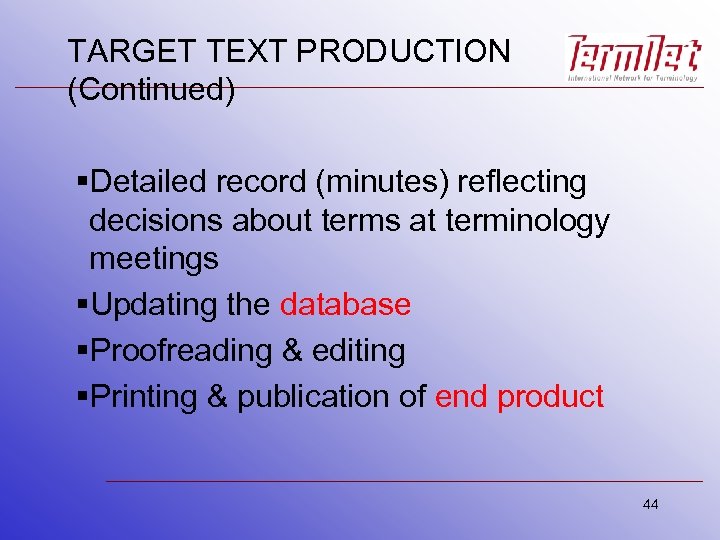
TARGET TEXT PRODUCTION (Continued) §Detailed record (minutes) reflecting decisions about terms at terminology meetings §Updating the database §Proofreading & editing §Printing & publication of end product 44
2) Projects & Examples "Telephone Interpreting Service for South Africa" (TISSA) – initiative of the NLS within the Department of Arts and Culture (DAC) and jointly funded by the Pan South African Language Board (PANSALB). 2007 -07 -28 EAFT Seminar Dublin 45
Example HLT Applications Telephone based information systems (automated) • Tourism & Travel: Hotel booking systems (AST project); train, air, bus schedules • Health services: First level medical help lines, Aids hotlines, TB hotlines • Public services: Applications for pensions, travel documents, car registrations; telephone accounts, telephone number enquiries Copyright JC Roux
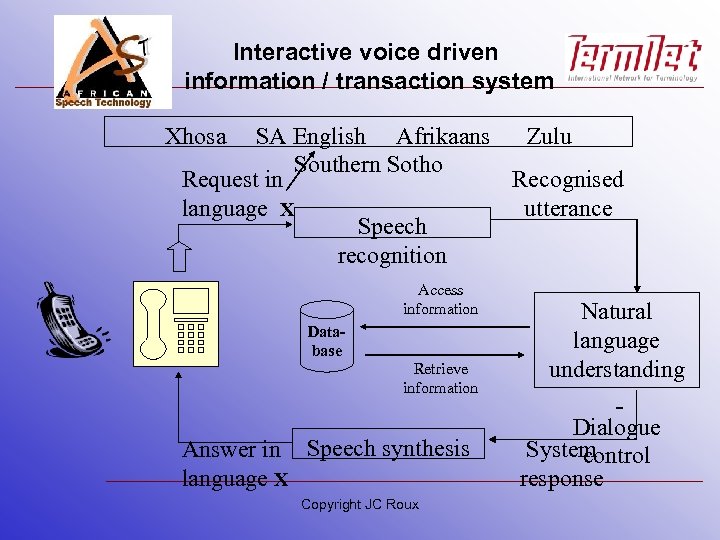
Interactive voice driven information / transaction system Xhosa SA English Afrikaans Zulu Southern Sotho Request in Recognised language X utterance Speech recognition Access information Database Retrieve information Answer in Speech synthesis language X Copyright JC Roux Natural language understanding Dialogue System control response
Examples ICT & HLT §. . . e. g. spellcheckers: The Centre for Text Technology at the North West University in South Africa has released four new spellcheckers in indigenous languages – Setswana, isi. Zulu, isi. Xhosa and Sesotho sa Leboa. 2007 -07 -28 EAFT Seminar Dublin 48
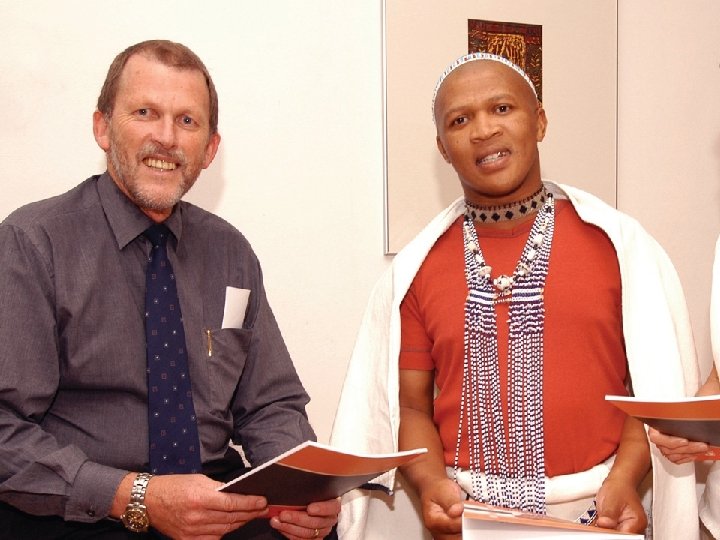
University Example §project performed by the Unit for isi. Xhosa in Stellenbosch University's Language Centre: to develop isi. Xhosa as an academic language. §Mr Pumlani Sibula – head of the unit. 2007 -07 -28 EAFT Seminar Dublin 49
2007 -07 -28 EAFT Seminar Dublin 50
Training & Awareness § September 2005 in Johannesburg: training within the framework of awareness raising event “Advancing multilingualism through terminology development” sponsored by the Department of Arts and Culture of South Africa § four-days Training course on the basic principles of terminology and terminography, (project)management and terminology market(s) 2007 -07 -28 EAFT Seminar Dublin 51
Term. Train § Another piece of the puzzle of terminology activities in RSA: Term. Train § Overall goal: To perform a train-the-trainer pilot project for capacity-building in the field of specialized language and specialized knowledge for language communities in Africa. § Target groups: subject advisors and curriculum facilitators on behalf of Governmental departments. 2007 -07 -28 EAFT Seminar Dublin 52
What is Term. Train? §Full project name: “Design and implementation of practice oriented terminology trainings for two groups of information professionals: 1) ICT trainers and 2) language trainers in language communities of Africa (Term. Train)” 2007 -07 -28 EAFT Seminar Dublin 53
What is Term. Train? §A pilot project for capacity-building in African countries §co-financed by UNESCO's intergovernmental Programme Information for All (IFAP) and project partners §initiated and managed by Term. Net § Further information: http: //www. termnet. org/english/projects/Term. Train. php 2007 -07 -28 EAFT Seminar Dublin 54
Скачать презентацию Case study International Best Practice South Africa RSA
c33c051c5513a7c342d58870c31f7f01.ppt