 Скачать презентацию Case study Done by Ushkempirov Bakhyt 402 group
Ushkempirov B. 402 - case study.pptx
- Количество слайдов: 17



Case study Done by: Ushkempirov Bakhyt 402 group
Plan: What is Case study? Types of Case Studies Case Study Methods How to Design and Conduct a Case Study How to Analyze the Results Is there a difference between the case method and a case study? Process of case study Steps of preparing a case study When to use a case study Case Teaching Methods Conclusion
What is Case study? Basically, a case study is an in depth study of a particular situation rather than a sweeping statistical survey. It is a method used to narrow down a very broad field of research into one easily researchable topic. In a case study, nearly every aspect of the subject's life and history is analyzed to seek patterns and causes for behavior. The hope is that learning gained from studying one case can be generalized to many others. Unfortunately, case studies tend to be highly subjective and it is difficult to generalize results to a larger population.
Types of Case Studies Explanatory: Used to do causal investigations. Exploratory: A case study that is sometimes used as a prelude to further, more in-depth research. This allows researchers to gather more information before developing their research questions and hypotheses. Descriptive: Involves starting with a descriptive theory. The subjects are then observed and the information gathered is compared to the pre-existing theory. Intrinsic: A type of case study in which the researcher has a personal interest in the case. Collective: Involves studying a group of individuals. Instrumental: Occurs when the individual or group allows researchers to understand more than what is initially obvious to observers.
Case Study Methods Prospective: A type of case study in which an individual or group of people is observed in order to determine outcomes. For example, a group of individuals might be watched over an extended period of time to observe the progression of a particular disease. Retrospective: A type of case study that involves looking at historical information. For example, researchers might start with an outcome, such as a disease, and then backwards at information about the individuals life to determine risk factors that may have contributed to the onset of the illness.
How to Design and Conduct a Case Study The advantage of the case study research design is that you can focus on specific and interesting cases. This may be an attempt to test a theory with a typical case or it can be a specific topic that is of interest. Research should be thorough and note taking should be meticulous and systematic. In the design of a case study, it is important to plan and design how you are going to address the study and make sure that all collected data is relevant. Unlike a scientific report, there is no strict set of rules so the most important part is making sure that the study is focused and concise; otherwise you will end up having to wade through a lot of irrelevant information.
How to Analyze the Results Analyzing results for a case study tends to be more opinion based than statistical methods. The usual idea is to try and collate your data into a manageable form and construct a narrative around it. Use examples in your narrative whilst keeping things concise and interesting. It is useful to show some numerical data but remember that you are only trying to judge trends and not analyze every last piece of data. Constantly refer back to your bullet points so that you do not lose focus. It is always a good idea to assume that a person reading your research may not possess a lot of knowledge of the subject so try to write accordingly. In addition, unlike a scientific study which deals with facts, a case study is based on opinion and is very much designed to provoke reasoned debate. There really is no right or wrong answer in a case study.
Is there a difference between the case method and a case study? While the case study and the case method are often confused and the terms used interchangeably, they actually are not the same thing. The difference becomes critical when considered in terms of learning. A case study is a story about a situation or event that contains a problem or issue, usually a real situation. Did you now that the case method used extensively at business schools, and in particular, at the Harvard Business School, was originally introduced around 1910? It has been an established instructional method for a century. The case method also presents a situation or problem space, and need not be taken from real life. However, it does not tell the learners "what was done", and neither does it provide any solutions at all. It is up to the learners to generate possible solutions that might fit the case facts.
Process of case study 1. Gaining familiarity with the case situation (critical case facts, persons, activities, contexts) 2. Recognizing the symptoms (what are things that are not as expected, or as they should be? ) 3. Identifying goals/objectives 4. Conducting the analysis 5. Making the diagnosis (identifying problems, i. e. , discrepancies between goals and performance, prioritizing problems etc. ) 6. Preparing the action plan (identifying feasible action alternatives, selecting a course of action, implementation planning, plan for monitoring implementation)
Steps of preparing a case study 1. Determine and define the research questions 2. Select the cases and determine data gathering and analysis techniques 3. Prepare to collect the data 4. Collect data in the field 5. Evaluate and analyze the data 6. Prepare the report
When to use a case study • The research question focuses on “how” or “why” • To explore, describe, or explain • When researcher has little control over behaviors • When the issue is contemporary • To understand complex social phenomena and for teachers it is the student.
Case Teaching Methods Writing cases Backwards design Open ended, no one right answer Presents enough information for analysis Presents, not evaluates problem Allows for multiple realistic positions Use and edit Student cases Experience with cases in class Heightens benefits of case teaching Best cases
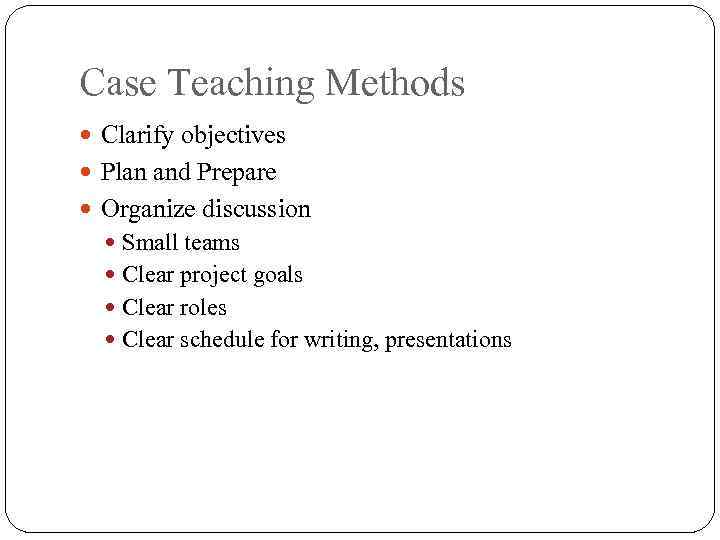
Case Teaching Methods Clarify objectives Plan and Prepare Organize discussion Small teams Clear project goals Clear roles Clear schedule for writing, presentations
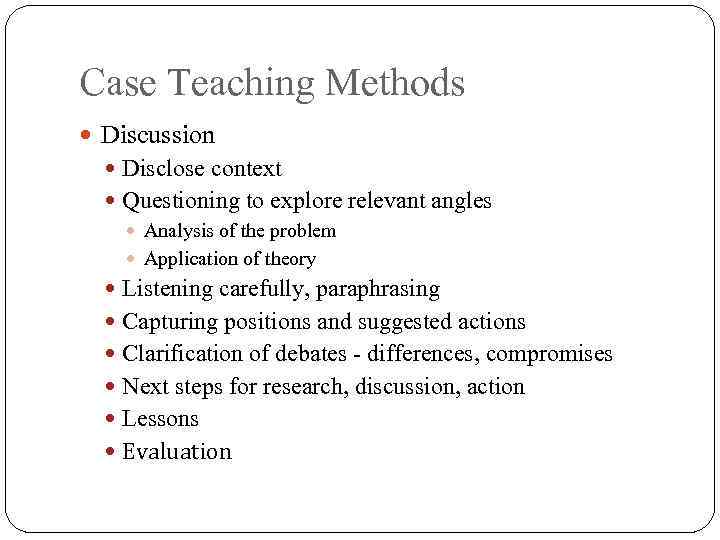
Case Teaching Methods Discussion Disclose context Questioning to explore relevant angles Analysis of the problem Application of theory Listening carefully, paraphrasing Capturing positions and suggested actions Clarification of debates - differences, compromises Next steps for research, discussion, action Lessons Evaluation
Conclusion Though being time consuming and a rigorous it’s diagnostic nature makes it the necessary pre-condition to conduct a remedial teaching. Case study is generally done by following the steps of experimental method so the findings are generally considered as true. It is also helpful in keeping a proper record of a student. As the student is promoted to the next class the new teacher can easily outline the need of the particular student. The parents of the student also come to know about the problem hence their role is determined through this.
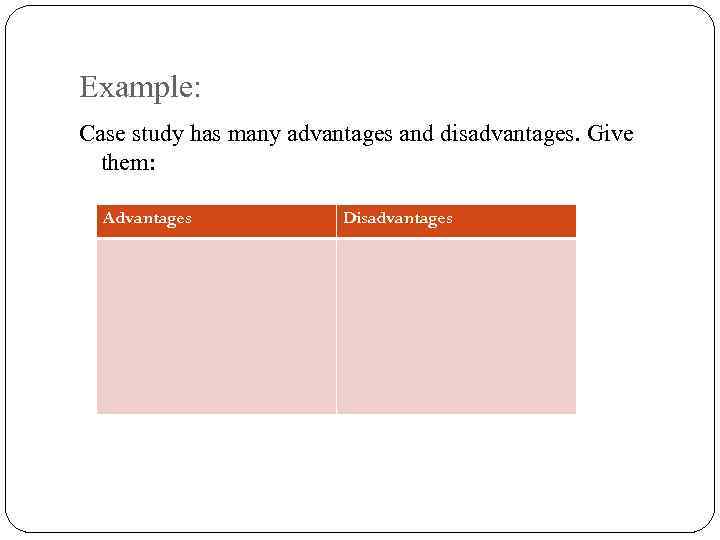
Example: Case study has many advantages and disadvantages. Give them: Advantages Disadvantages
References http: //psychology. about. com/od/cindex/g/casestudy. htm https: //explorable. com/case-study-research-design http: //thetrainingworld. com/faq/casemethod. htm
Скачать презентацию Case study Done by Ushkempirov Bakhyt 402 group
Ushkempirov B. 402 - case study.pptx