


 Скачать презентацию Case Presentation The modern management of oligodendrogliomas James
853cb9c9c945bfa2a0a8494db833c7f1.ppt
- Количество слайдов: 15
 Case Presentation: The modern management of oligodendrogliomas James Manfield B. S. University College London
 Background • Pt 25 y/o male marine • CC First seizure • HPC Otherwise well. No abnormal findings o/e. No significant PHM, FHM, DH, SH. • Underwent biopsy low-grade oligodendroglioma (1 p 19 q not initially requested) • Referred to Dr. Wenke for debulking. • Successful stereotactic volumetric resection c. iop CT leaving 1 cm margins.
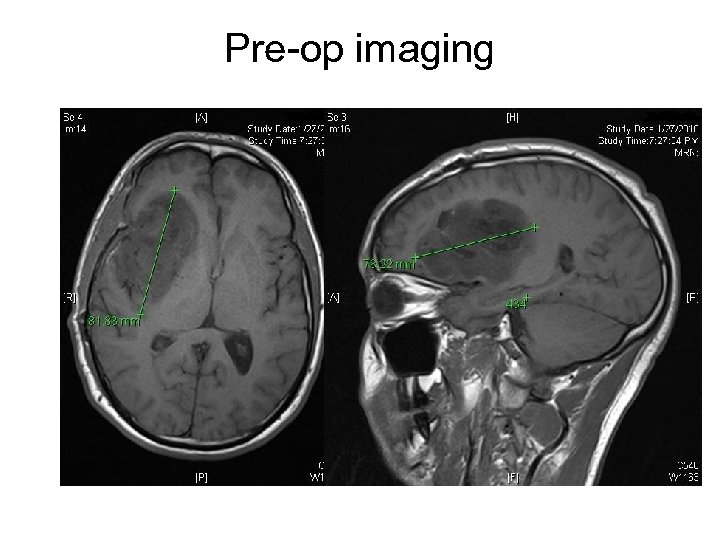 Pre-op imaging
 Oligodendrogliomas • Primary glial brain tumors. Grade II and Grade III (anaplastic) • Aetiology poorly understood • 5 -19% of all intracranial tumors; 25% of all gliomas. M: F 2: 1. Median age at D. 40 -50 years. • Most common CC seizure (low grade), focal deficits, ↑ICP or cognitive deficits (high grade).
 1 p/19 q: Why does it matter? • 1 p/19 q co-deletion, mediated by an unbalanced translocation of 19 p to 1 q. • Combined loss present in 60 -70% of all ODs (Smith et al. 2000) • 1 st CNS neoplasm in which a better genetic signature was correlated with outcome in phase III trials (Cairncross et al. 2006, Van den Bent et al. 2006).
 Summary of data • Low grade OD/OA median 11. 9 years with codeletion vs. 10. 3 without [Shaw et. al 2002] • 5 years survival 50% higher [Fontaine et al 2008]. Confounding variables. • EORTC 26951: AOD 6 -7 years c. co-deletion vs. 2 -2. 8 without combined loss [Cairncross et al. 2006, van den Bent et al. 2006]. • 1 p 19 q found to be most powerful predictor of outcome [Kouwenhoven et al. 2009]. • Multiple studies now consistently show longer survival time. • Not prognostic but predictive [Weller et al. 2007]
 Management: Surgery • • 3 aims: tissue, mass effect ? better px No RCT data Retrospective study data has limitations 1 uncontrolled study- complete resection in low-grade OD associated with longer disease-free intervals [Berger et al. 1994]. • Another study- subtotal resection improves survival [Shaw et al. 1997] • In contrast other studies looking at gross total resection have shown no survival benefit [Daumas-Duport 1997 & Kros et al. 1994]. • Nevertheless remains the standard of care.
 Management: Radiotherapy Low grade • One large study on early vs. delayed RT observed an improved progression-free survival after early RT but no increase in overall survival [van den Bent 2005] Anaplastic • Mixed results • 1 p 19 q status relevant
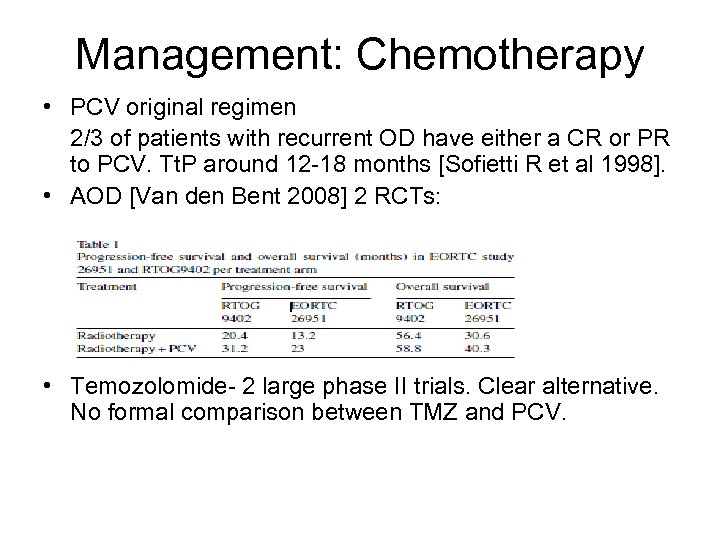 Management: Chemotherapy • PCV original regimen 2/3 of patients with recurrent OD have either a CR or PR to PCV. Tt. P around 12 -18 months [Sofietti R et al 1998]. • AOD [Van den Bent 2008] 2 RCTs: • Temozolomide- 2 large phase II trials. Clear alternative. No formal comparison between TMZ and PCV.
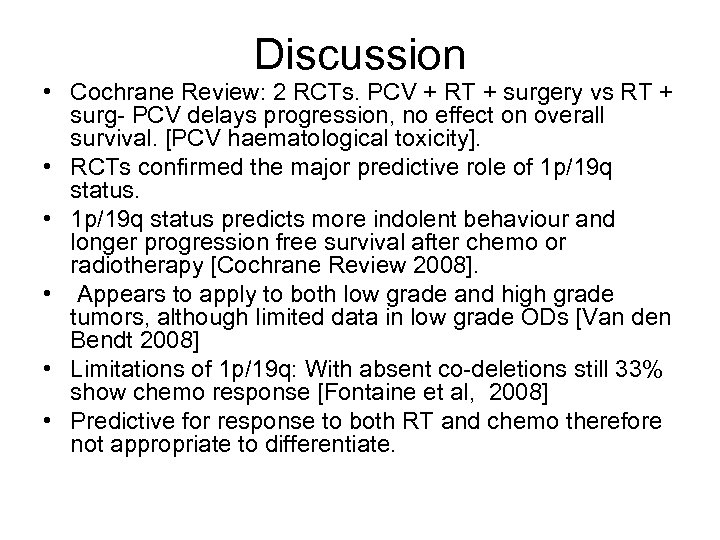 Discussion • Cochrane Review: 2 RCTs. PCV + RT + surgery vs RT + surg- PCV delays progression, no effect on overall survival. [PCV haematological toxicity]. • RCTs confirmed the major predictive role of 1 p/19 q status. • 1 p/19 q status predicts more indolent behaviour and longer progression free survival after chemo or radiotherapy [Cochrane Review 2008]. • Appears to apply to both low grade and high grade tumors, although limited data in low grade ODs [Van den Bendt 2008] • Limitations of 1 p/19 q: With absent co-deletions still 33% show chemo response [Fontaine et al, 2008] • Predictive for response to both RT and chemo therefore not appropriate to differentiate.
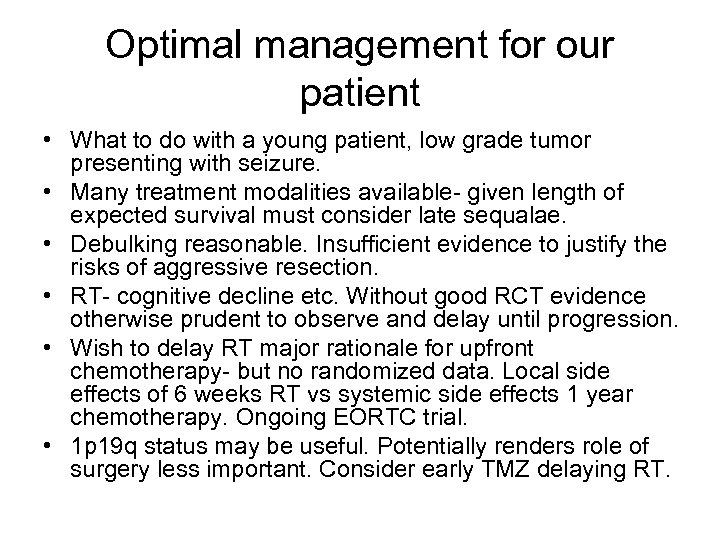 Optimal management for our patient • What to do with a young patient, low grade tumor presenting with seizure. • Many treatment modalities available- given length of expected survival must consider late sequalae. • Debulking reasonable. Insufficient evidence to justify the risks of aggressive resection. • RT- cognitive decline etc. Without good RCT evidence otherwise prudent to observe and delay until progression. • Wish to delay RT major rationale for upfront chemotherapy- but no randomized data. Local side effects of 6 weeks RT vs systemic side effects 1 year chemotherapy. Ongoing EORTC trial. • 1 p 19 q status may be useful. Potentially renders role of surgery less important. Consider early TMZ delaying RT.
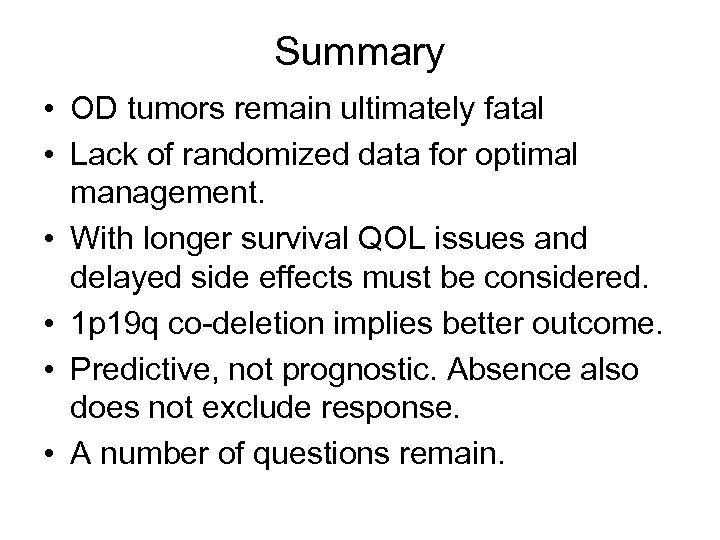 Summary • OD tumors remain ultimately fatal • Lack of randomized data for optimal management. • With longer survival QOL issues and delayed side effects must be considered. • 1 p 19 q co-deletion implies better outcome. • Predictive, not prognostic. Absence also does not exclude response. • A number of questions remain.
 References • • • Smith JS, Perry A, Borell TJ, at al. Alterations of chromosome arms 1 p and 19 q as predictors of survival in oligodendrogliomas, astrocytomas, and mixed oligoastrocytomas. J Clin Oncol. 2000 Feb; 18(3): 636 -45. Cairncross G, Berkey B, Shaw E, et al. Phase III trial of chemotherapy plus radiotherapy compared with radiotherapy alone for pure and mixed anaplastic oligodendroglioma: Intergroup Radiation Therapy Oncology Group Trial 9402. J Clin Oncol 2006 Jun 20; 24 (18): 2707 -14. van den Bent MJ, Carpentier AF, Brandes AA, et al. Adjuvant procarbazine, lomustine, and vincristine improves progression-free survival but not overall survival in newly diagnosed anaplastic oligodendrogliomas and oligoastrocytomas: a randomized European Organisation for Research and Treatment of Cancer phase III trial. J Clin Oncol. 2006 Jun 20; 24(18): 2715 -22. Shaw E, Arusell R, Scheithauer B, et al. Prospective randomized trial of low- versus high-dose radiation therapy in adults with supratentorial low-grade glioma: initial report of a North Central Cancer Treatment Group/Radiation Therapy Oncology Group/Eastern Cooperative Oncology Group study. J Clin Oncol. 2002 May 1; 20(9): 2267 -76. Fontaine D, Vandenbos F, Lebrun C, et al. Diagnostic and prognostic values of 1 p and 19 q deletions in adult gliomas: critical review of the literature and implications in daily clinical practice. Rev Neurol (Paris). 2008 Jun. Jul; 164(6 -7): 595 -604. Epub 2008 May 21. Kouwenhoven MC, Gorlia T, Kros JM, et al. Molecular analysis of anaplastic oligodendroglial tumors in a prospective randomized study: A report from EORTC study 26951. Neuro Oncol. 2009 Dec; 11(6): 737 -46. Weller M, Berger H, Hartmann C, et al. Combined 1 p/19 q loss in oligodendroglial tumors: predictive or prognostic biomarker? Clin Cancer Res. 2007 Dec 1; 13(23): 6933 -7. Berger MS, Deliganis AV, Dobbins J, Keles GE. The effect of extent of resection on recurrence in patients with low grade cerebral hemisphere gliomas. Cancer. 1994 Sep 15; 74(6): 1784 -91. Daumas-Duport C, Tucker ML, Kolles H, et al. Oligodendrogliomas. Part II: A new grading system based on morphological and imaging criteria. J Neurooncol. 1997 Aug; 34(1): 61 -78. Kros JM, Pieterman H, van Eden CG, Avezaat CJ. Oligodendroglioma: the Rotterdam-Dijkzigt experience. Neurosurgery. 1994 Jun; 34(6): 959 -66; discussion 966. van den Bent MJ, Afra D, de Witte O, et al. Long-term efficacy of early versus delayed radiotherapy for low-grade astrocytoma and oligodendroglioma in adults: the EORTC 22845 randomised trial. Lancet. 2005 Sep 1723; 366(9490): 985 -90.
 References cont. • • • Soffietti R, Rudà R, Bradac GB, Schiffer D. PCV chemotherapy for recurrent oligodendrogliomas and oligoastrocytomas. Neurosurgery. 1998 Nov; 43(5): 1066 -73. Van den Bent MJ, Reni M, Gatta G, Vecht C. Oligodendroglioma. Crit Rev Oncol Hematol. 2008 Jun; 66(3): 262 -72. Epub 2008 Feb 12. Quon H, Abdulkarim B. Adjuvant treatment of anaplastic oligodendrogliomas and oligoastrocytomas. Cochrane Database of Systematic Reviews 2008, Issue 2. Art. No. : CD 007104. DOI: 10. 1002/14651858. CD 007104.
 Thank you! • Questions?