


 Скачать презентацию Case Markers Contrast Tafseer Ahmed Khan The role
6d55c05f7f877618d5e9c47f4cc7c72f.ppt
- Количество слайдов: 21
 Case Markers Contrast Tafseer Ahmed Khan The role of semantic fields in the development of postpositions and case markers
 Research Goals • Understand the semantic space of case in contrast with postpositional usages. § Diachronic perspective (Reanalysis of nouns/participles as case markers via postpositions) § Cross linguistic comparison
 Presentation Plan • History of case in Indo-Aryan • Urdu case marker ko • Urdu word (ke) liye • “Ablative” and “Instrumental” case markers: Cross linguistically
 Case in Indo-Aryan • Old Indo-Aryan used morphology to express case. Sanskrit had eight cases: Nominative, Accusative, Dative, Ablative, Instrumental, Genitive, Locative and Vocative. • Middle Indo-Aryan lost almost all case inflections. • Then New Indo-Aryan languages mostly use clitics as case markers. These clitics originated from old Indo-Aryan nouns and verbs, that became postpositions and clitics during the passage of time.
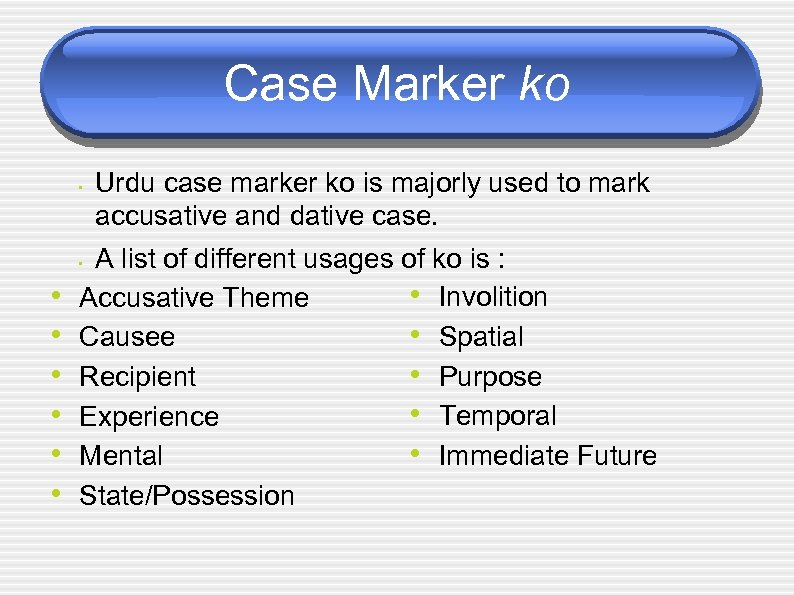 Case Marker ko • A list of different usages of ko is : • Involition Accusative Theme • Spatial Causee • Purpose Recipient • Temporal Experience • Immediate Future Mental State/Possession • • Urdu case marker ko is majorly used to mark accusative and dative case.
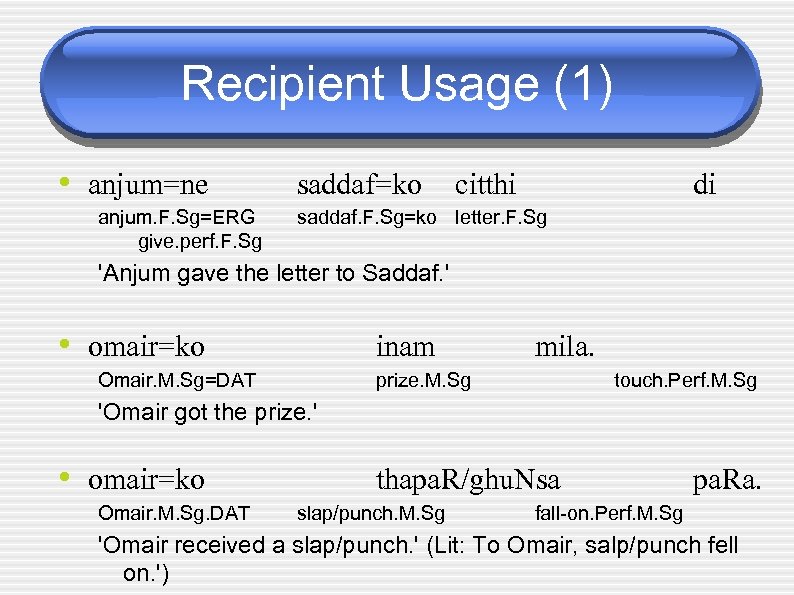 Recipient Usage (1) • anjum=ne anjum. F. Sg=ERG give. perf. F. Sg saddaf=ko citthi di saddaf. F. Sg=ko letter. F. Sg 'Anjum gave the letter to Saddaf. ' • omair=ko inam Omair. M. Sg=DAT mila. prize. M. Sg touch. Perf. M. Sg 'Omair got the prize. ' • omair=ko Omair. M. Sg. DAT thapa. R/ghu. Nsa slap/punch. M. Sg pa. Ra. fall-on. Perf. M. Sg 'Omair received a slap/punch. ' (Lit: To Omair, salp/punch fell on. ')
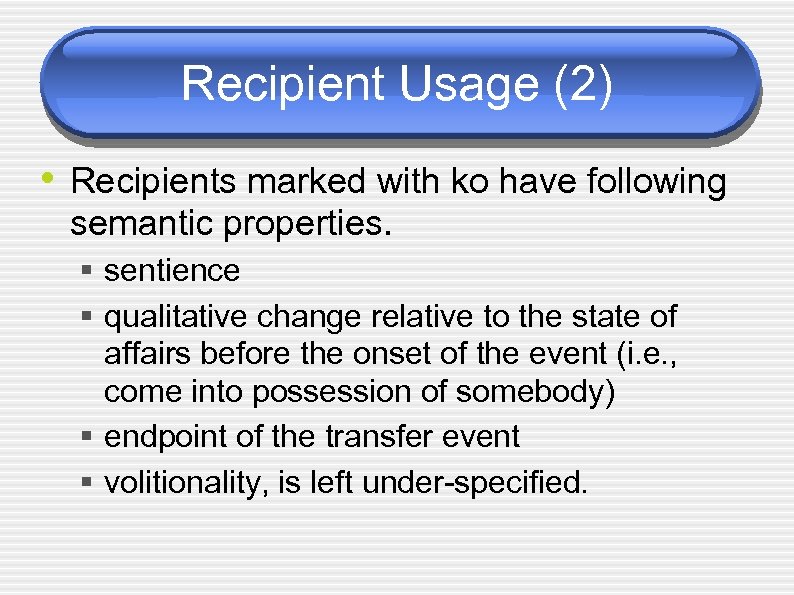 Recipient Usage (2) • Recipients marked with ko have following semantic properties. § sentience § qualitative change relative to the state of affairs before the onset of the event (i. e. , come into possession of somebody) § endpoint of the transfer event § volitionality, is left under-specified.
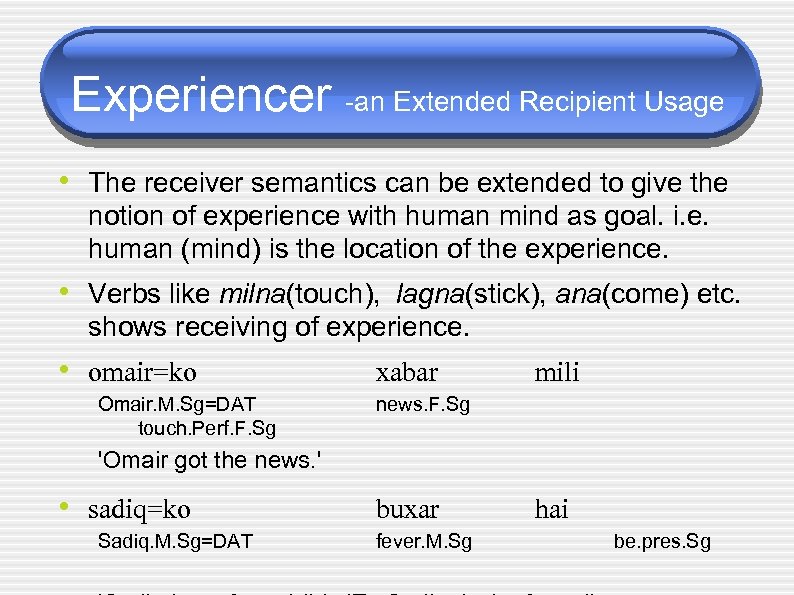 Experiencer -an Extended Recipient Usage • The receiver semantics can be extended to give the notion of experience with human mind as goal. i. e. human (mind) is the location of the experience. • Verbs like milna(touch), lagna(stick), ana(come) etc. shows receiving of experience. • omair=ko Omair. M. Sg=DAT touch. Perf. F. Sg xabar mili news. F. Sg 'Omair got the news. ' • sadiq=ko Sadiq. M. Sg=DAT buxar fever. M. Sg hai be. pres. Sg
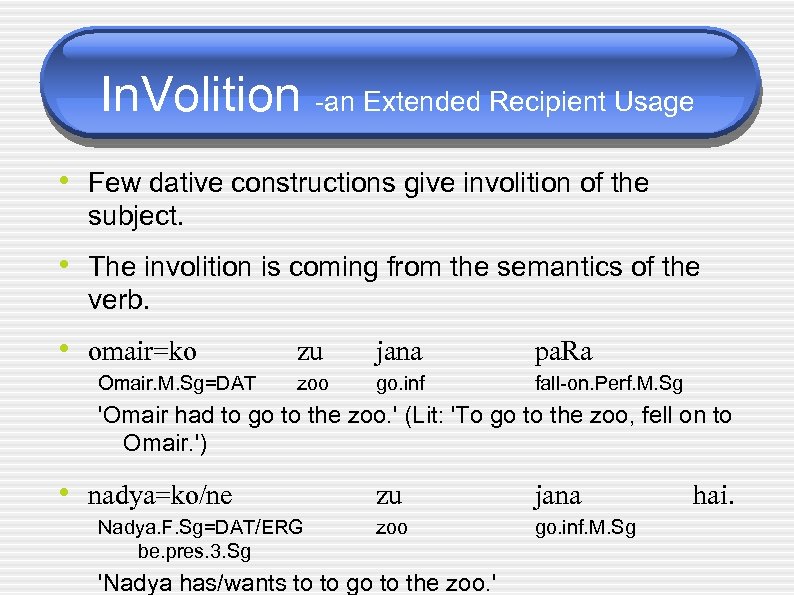 In. Volition -an Extended Recipient Usage • Few dative constructions give involition of the subject. • The involition is coming from the semantics of the verb. • omair=ko Omair. M. Sg=DAT zu jana pa. Ra zoo go. inf fall-on. Perf. M. Sg 'Omair had to go to the zoo. ' (Lit: 'To go to the zoo, fell on to Omair. ') • nadya=ko/ne Nadya. F. Sg=DAT/ERG be. pres. 3. Sg zu jana zoo go. inf. M. Sg 'Nadya has/wants to to go to the zoo. ' hai.
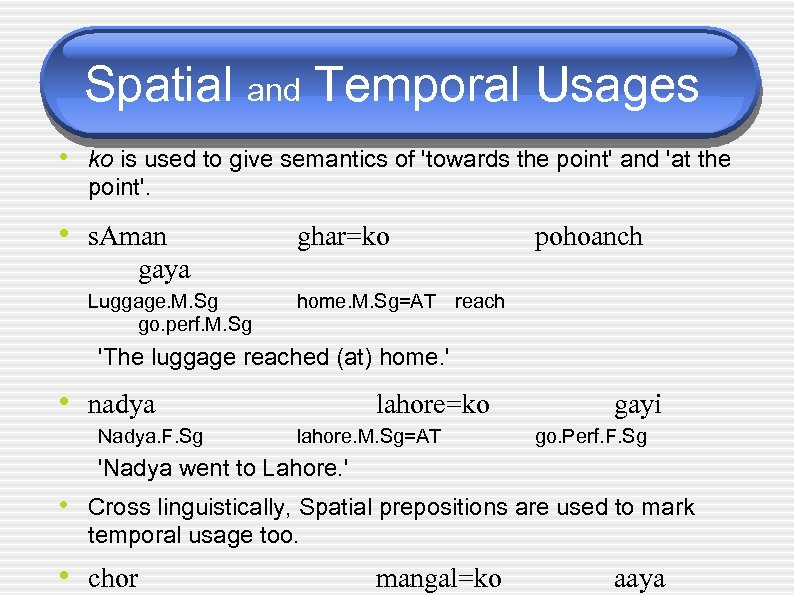 Spatial and Temporal Usages • ko is used to give semantics of 'towards the point' and 'at the point'. • s. Aman ghar=ko pohoanch gaya Luggage. M. Sg go. perf. M. Sg home. M. Sg=AT reach 'The luggage reached (at) home. ' • nadya Nadya. F. Sg lahore=ko lahore. M. Sg=AT gayi go. Perf. F. Sg 'Nadya went to Lahore. ' • Cross linguistically, Spatial prepositions are used to mark temporal usage too. • chor mangal=ko aaya
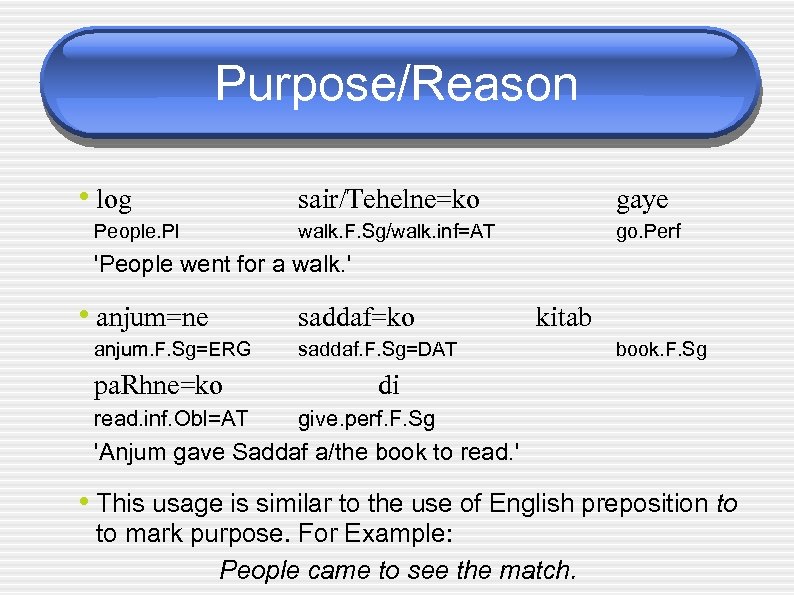 Purpose/Reason • log People. Pl sair/Tehelne=ko gaye walk. F. Sg/walk. inf=AT go. Perf 'People went for a walk. ' • anjum=ne anjum. F. Sg=ERG pa. Rhne=ko read. inf. Obl=AT saddaf=ko kitab saddaf. F. Sg=DAT book. F. Sg di give. perf. F. Sg 'Anjum gave Saddaf a/the book to read. ' • This usage is similar to the use of English preposition to to mark purpose. For Example: People came to see the match.
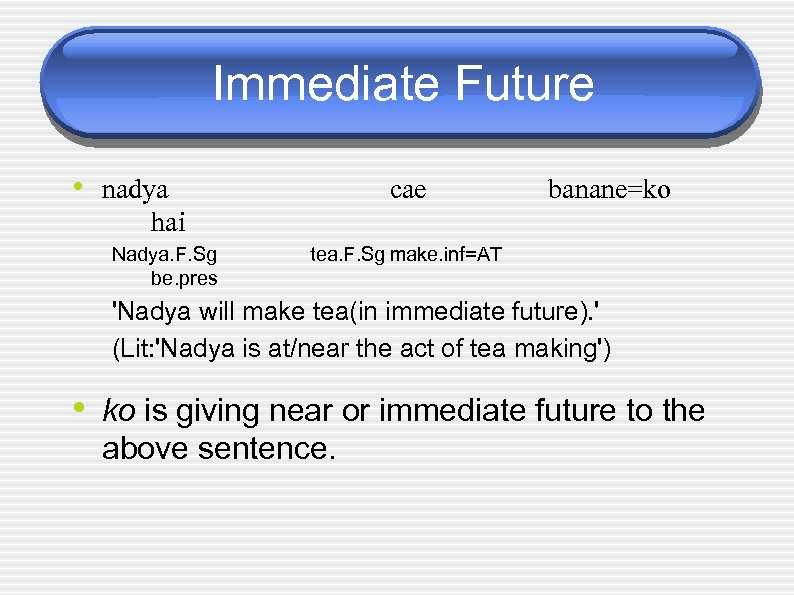 Immediate Future • nadya cae banane=ko hai Nadya. F. Sg be. pres tea. F. Sg make. inf=AT 'Nadya will make tea(in immediate future). ' (Lit: 'Nadya is at/near the act of tea making') • ko is giving near or immediate future to the above sentence.
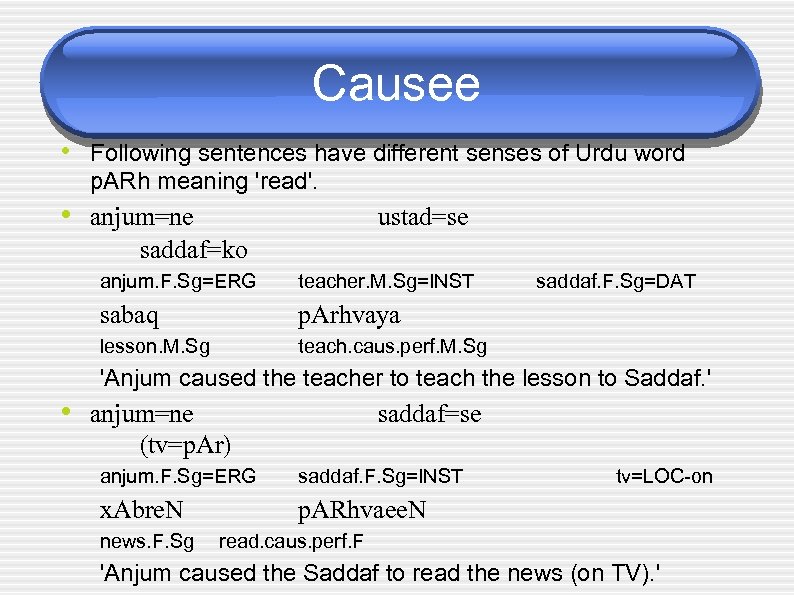 Causee • Following sentences have different senses of Urdu word p. ARh meaning 'read'. • anjum=ne ustad=se saddaf=ko anjum. F. Sg=ERG teacher. M. Sg=INST sabaq p. Arhvaya lesson. M. Sg saddaf. F. Sg=DAT teach. caus. perf. M. Sg 'Anjum caused the teacher to teach the lesson to Saddaf. ' • anjum=ne saddaf=se (tv=p. Ar) anjum. F. Sg=ERG saddaf. F. Sg=INST x. Abre. N p. ARhvaee. N news. F. Sg tv=LOC-on read. caus. perf. F 'Anjum caused the Saddaf to read the news (on TV). '
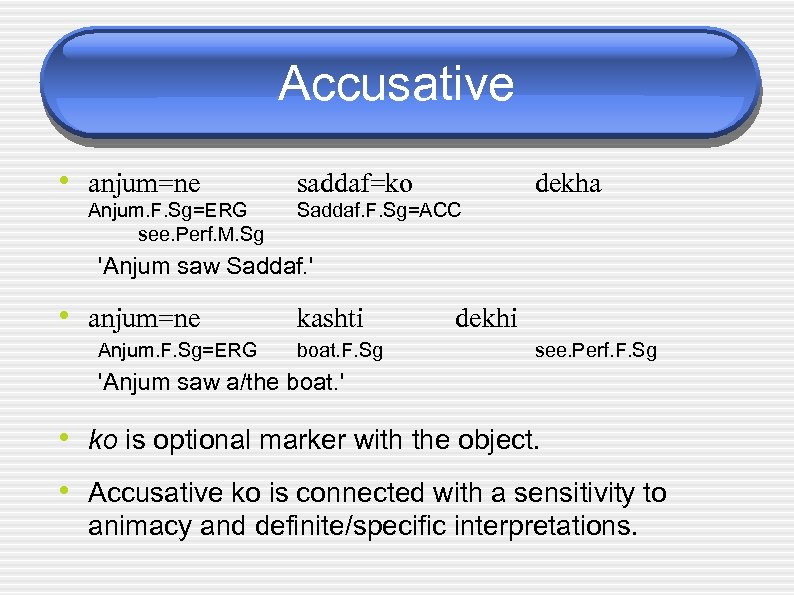 Accusative • anjum=ne Anjum. F. Sg=ERG see. Perf. M. Sg saddaf=ko dekha Saddaf. F. Sg=ACC 'Anjum saw Saddaf. ' • anjum=ne Anjum. F. Sg=ERG kashti boat. F. Sg dekhi see. Perf. F. Sg 'Anjum saw a/the boat. ' • ko is optional marker with the object. • Accusative ko is connected with a sensitivity to animacy and definite/specific interpretations.
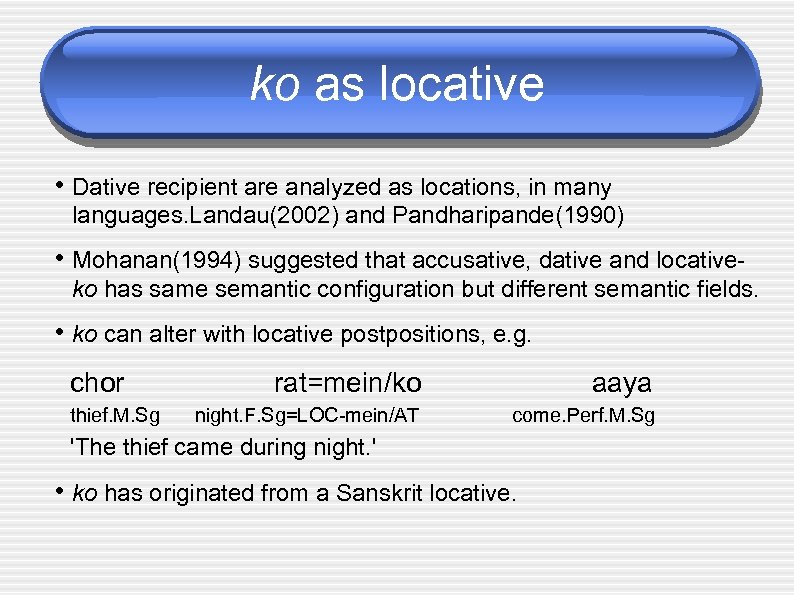 ko as locative • Dative recipient are analyzed as locations, in many languages. Landau(2002) and Pandharipande(1990) • Mohanan(1994) suggested that accusative, dative and locativeko has same semantic configuration but different semantic fields. • ko can alter with locative postpositions, e. g. chor thief. M. Sg rat=mein/ko aaya night. F. Sg=LOC-mein/AT come. Perf. M. Sg 'The thief came during night. ' • ko has originated from a Sanskrit locative.
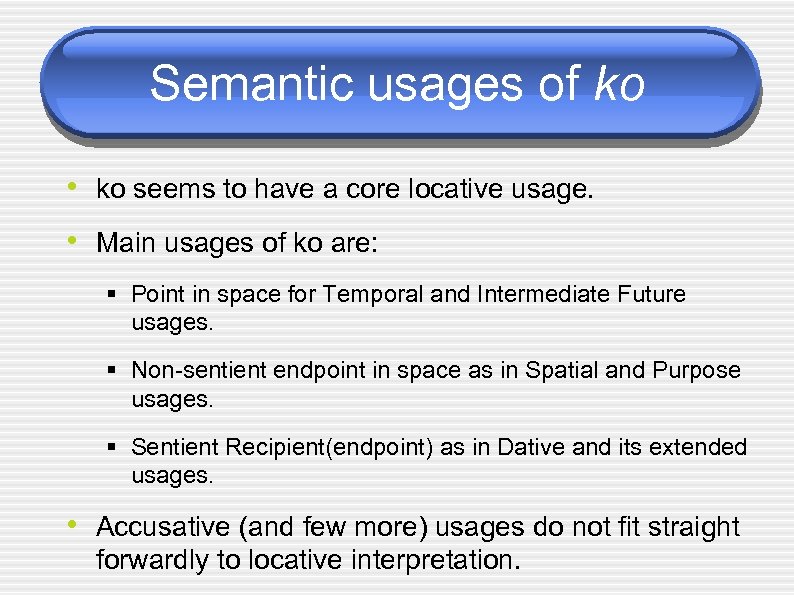 Semantic usages of ko • ko seems to have a core locative usage. • Main usages of ko are: § Point in space for Temporal and Intermediate Future usages. § Non-sentient endpoint in space as in Spatial and Purpose usages. § Sentient Recipient(endpoint) as in Dative and its extended usages. • Accusative (and few more) usages do not fit straight forwardly to locative interpretation.
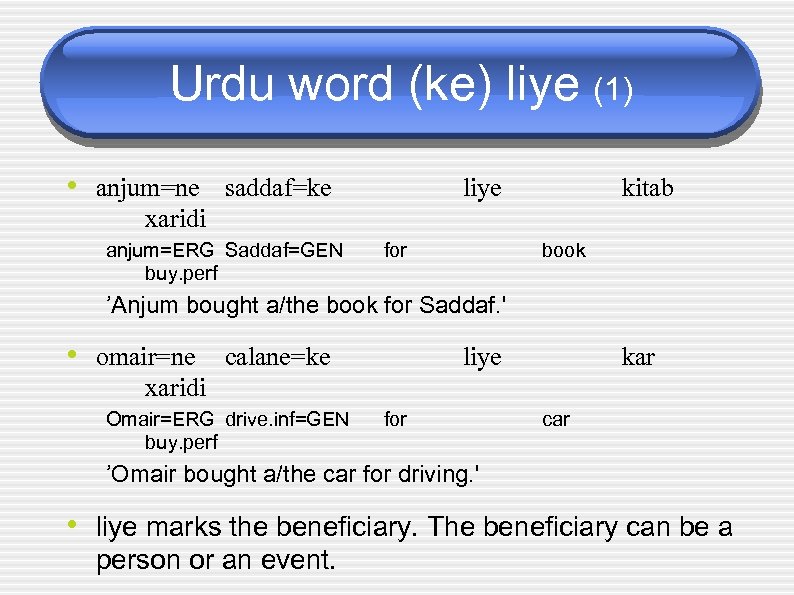 Urdu word (ke) liye (1) • anjum=ne saddaf=ke liye kitab xaridi anjum=ERG Saddaf=GEN buy. perf for book ’Anjum bought a/the book for Saddaf. ' • omair=ne calane=ke liye kar xaridi Omair=ERG drive. inf=GEN buy. perf for car ’Omair bought a/the car for driving. ' • liye marks the beneficiary. The beneficiary can be a person or an event.
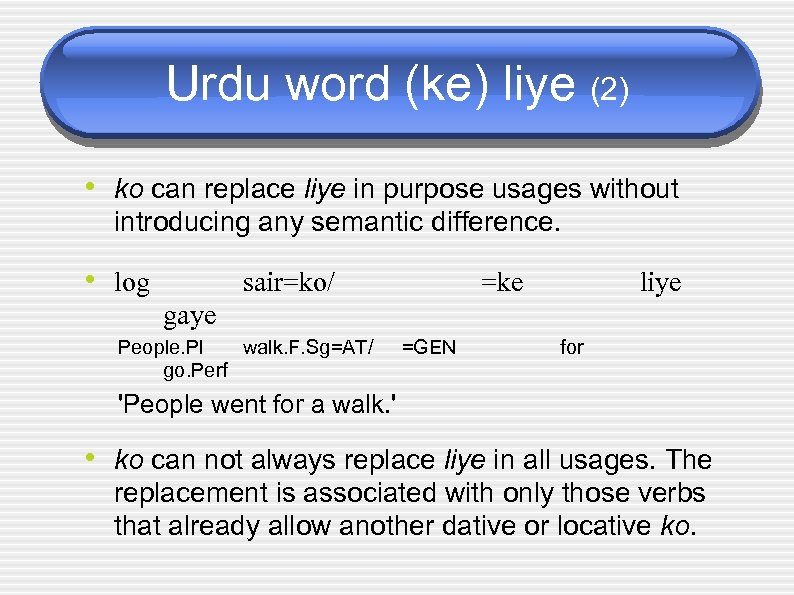 Urdu word (ke) liye (2) • ko can replace liye in purpose usages without introducing any semantic difference. • log sair=ko/ =ke liye gaye People. Pl walk. F. Sg=AT/ go. Perf =GEN for 'People went for a walk. ' • ko can not always replace liye in all usages. The replacement is associated with only those verbs that already allow another dative or locative ko.
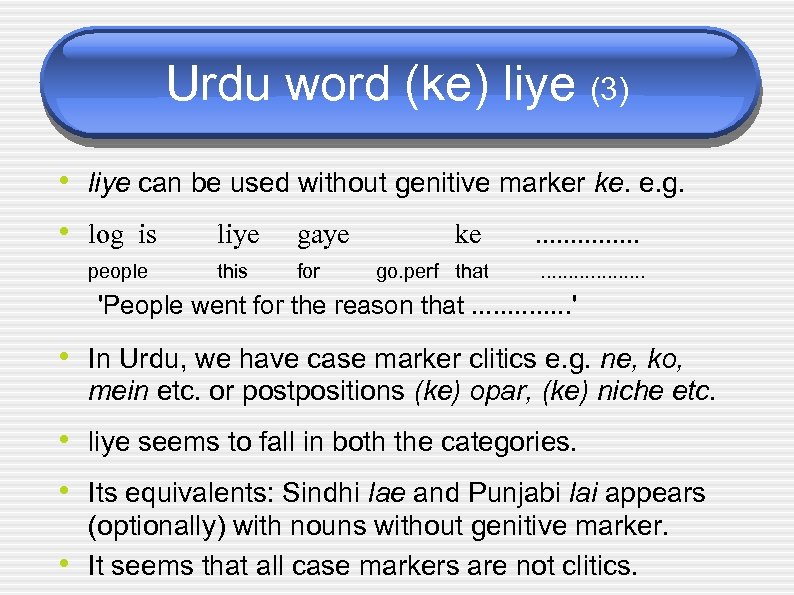 Urdu word (ke) liye (3) • liye can be used without genitive marker ke. e. g. • log is liye gaye ke. . . . people this for go. perf that . . 'People went for the reason that. . . ' • In Urdu, we have case marker clitics e. g. ne, ko, mein etc. or postpositions (ke) opar, (ke) niche etc. • liye seems to fall in both the categories. • Its equivalents: Sindhi lae and Punjabi lai appears • (optionally) with nouns without genitive marker. It seems that all case markers are not clitics.
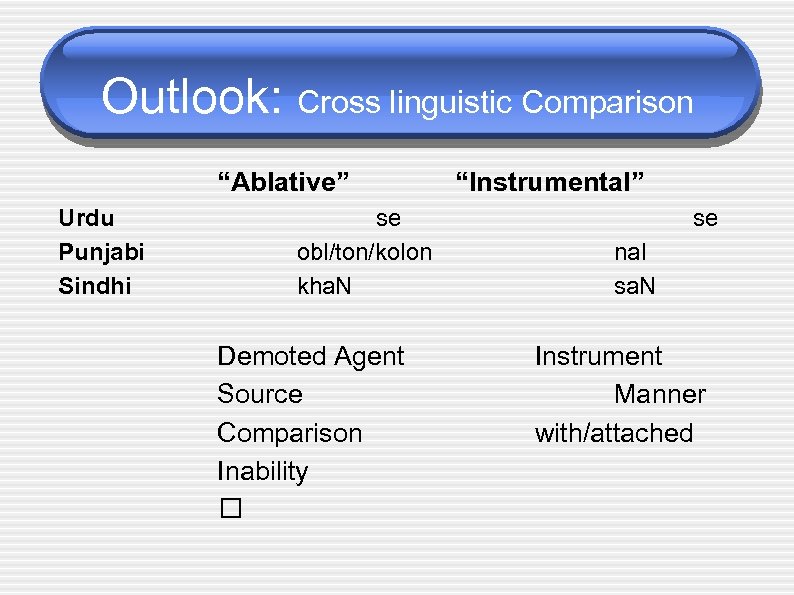 Outlook: Cross linguistic Comparison “Ablative” Urdu Punjabi Sindhi se obl/ton/kolon kha. N Demoted Agent Source Comparison Inability “Instrumental” se nal sa. N Instrument Manner with/attached
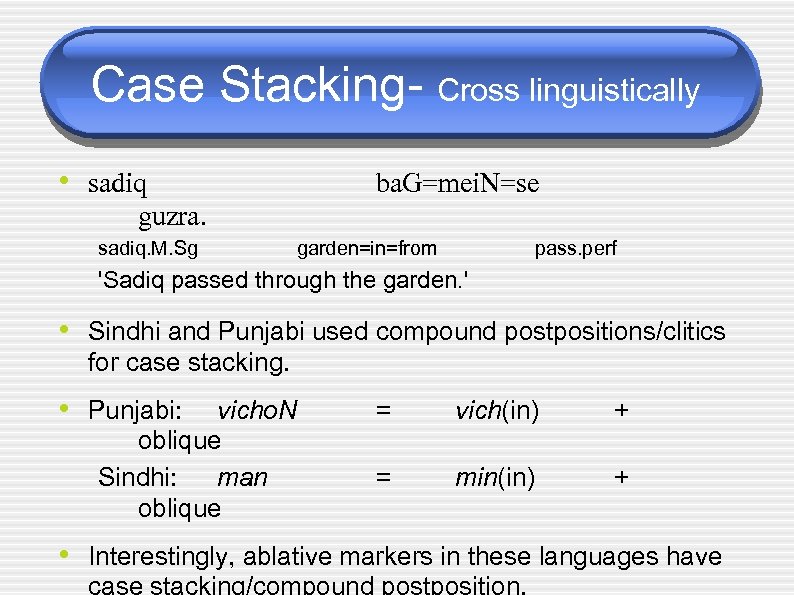 Case Stacking- Cross linguistically • sadiq ba. G=mei. N=se guzra. sadiq. M. Sg garden=in=from pass. perf 'Sadiq passed through the garden. ' • Sindhi and Punjabi used compound postpositions/clitics for case stacking. • Punjabi: vicho. N oblique Sindhi: man oblique = vich(in) + = min(in) + • Interestingly, ablative markers in these languages have