Скачать презентацию CAS LX 522 Syntax I Week 9 5
4e2a8fd92f705059eeed78a9cca6b3d7.ppt
- Количество слайдов: 12
 CAS LX 522 Syntax I Week 9. 5. Relative clauses
 Finishing up from last week… • Last week, we covered wh-movement in questions like: – Whati did Bill buy ti? • and – Whati did Mary think Bill bought ti? • And we looked at conditions on wh-movement, including Subjacency (you can’t move out of two bounding nodes in a single step) and the ECP (the trace of wh-movement must be licensed).
 Relative clauses • Another place where we see wh-movement, besides in explicit questions (either in the main clause or embedded) is in relative clauses. • The book which I read • The woman who(m) I met • These consist of a head noun (book, woman) and then what appears to be a wh-question that further specifies the referent of the head noun.
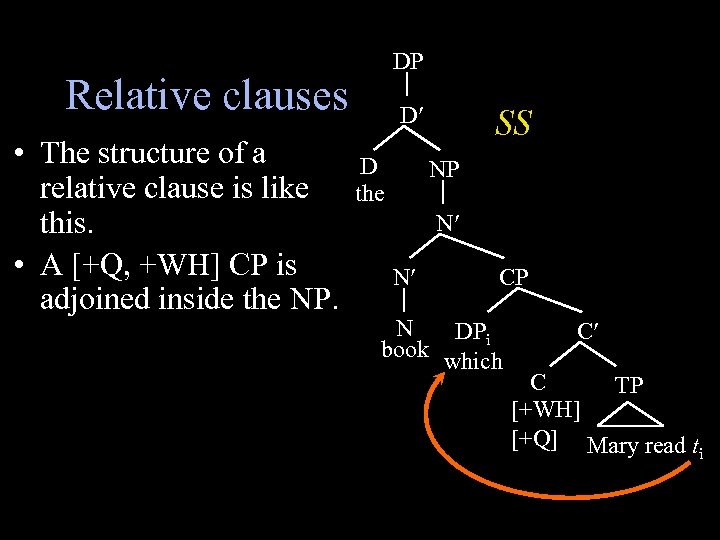 DP Relative clauses • The structure of a relative clause is like this. • A [+Q, +WH] CP is adjoined inside the NP. D D the SS NP N N CP N DPi book which C C TP [+WH] [+Q] Mary read t i
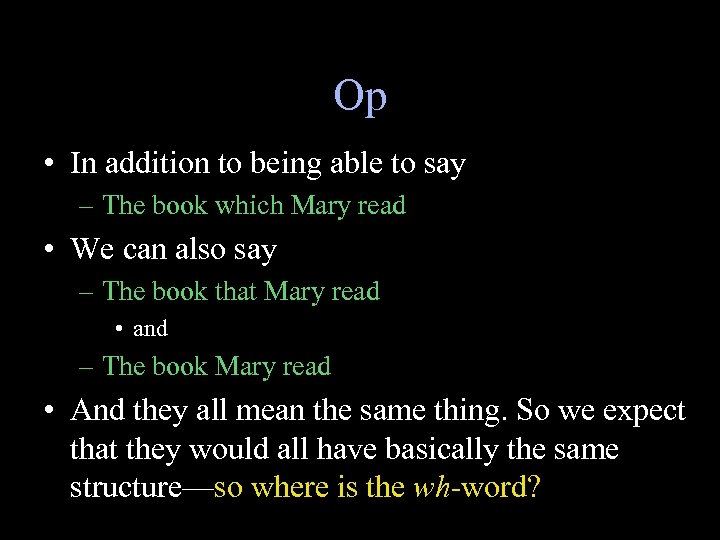 Op • In addition to being able to say – The book which Mary read • We can also say – The book that Mary read • and – The book Mary read • And they all mean the same thing. So we expect that they would all have basically the same structure—so where is the wh-word?
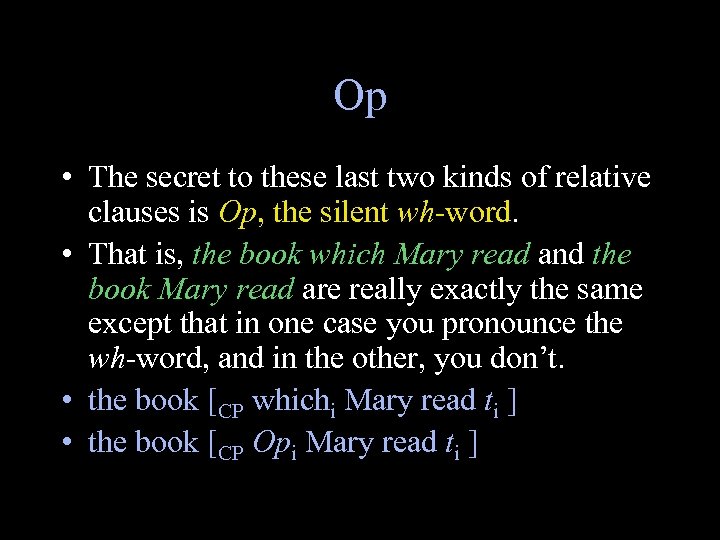 Op • The secret to these last two kinds of relative clauses is Op, the silent wh-word. • That is, the book which Mary read and the book Mary read are really exactly the same except that in one case you pronounce the wh-word, and in the other, you don’t. • the book [CP whichi Mary read ti ] • the book [CP Opi Mary read ti ]
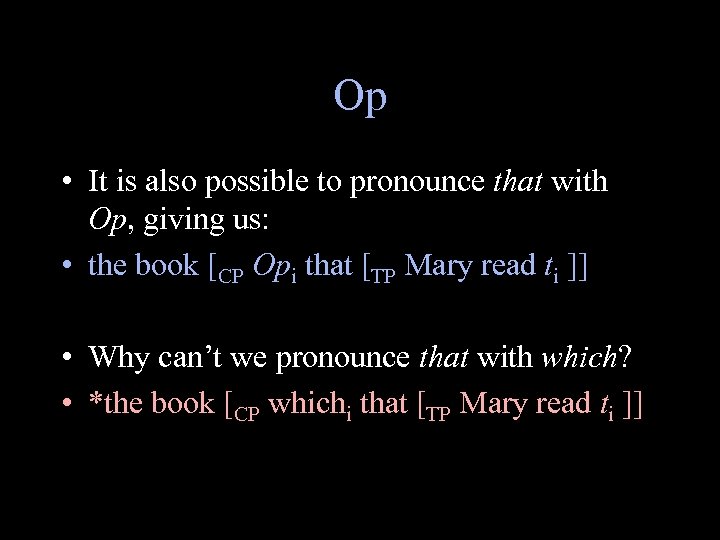 Op • It is also possible to pronounce that with Op, giving us: • the book [CP Opi that [TP Mary read ti ]] • Why can’t we pronounce that with which? • *the book [CP whichi that [TP Mary read ti ]]
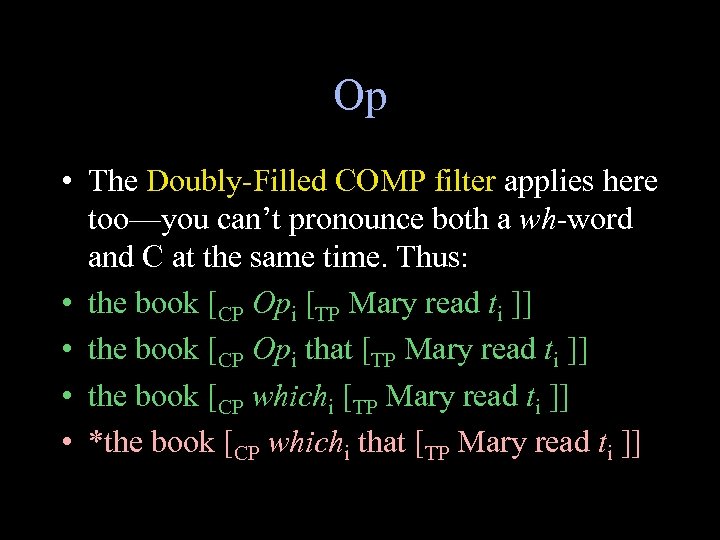 Op • The Doubly-Filled COMP filter applies here too—you can’t pronounce both a wh-word and C at the same time. Thus: • the book [CP Opi [TP Mary read ti ]] • the book [CP Opi that [TP Mary read ti ]] • the book [CP whichi [TP Mary read ti ]] • *the book [CP whichi that [TP Mary read ti ]]
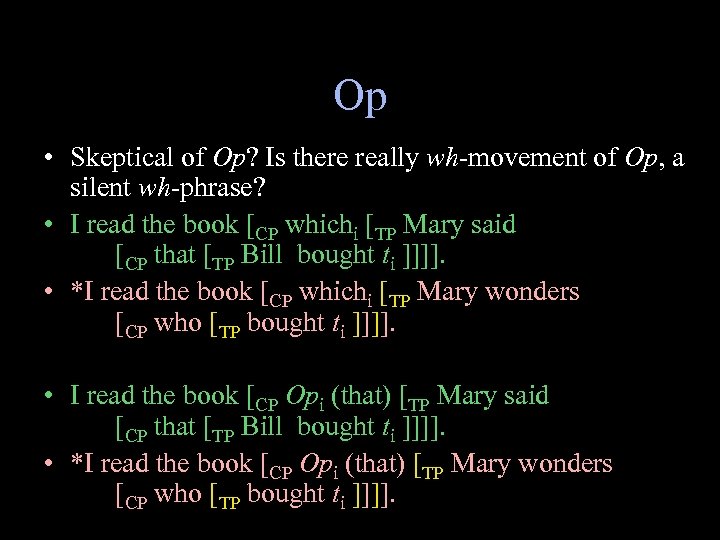 Op • Skeptical of Op? Is there really wh-movement of Op, a silent wh-phrase? • I read the book [CP whichi [TP Mary said [CP that [TP Bill bought ti ]]]]. • *I read the book [CP whichi [TP Mary wonders [CP who [TP bought ti ]]]]. • I read the book [CP Opi (that) [TP Mary said [CP that [TP Bill bought ti ]]]]. • *I read the book [CP Opi (that) [TP Mary wonders [CP who [TP bought ti ]]]].
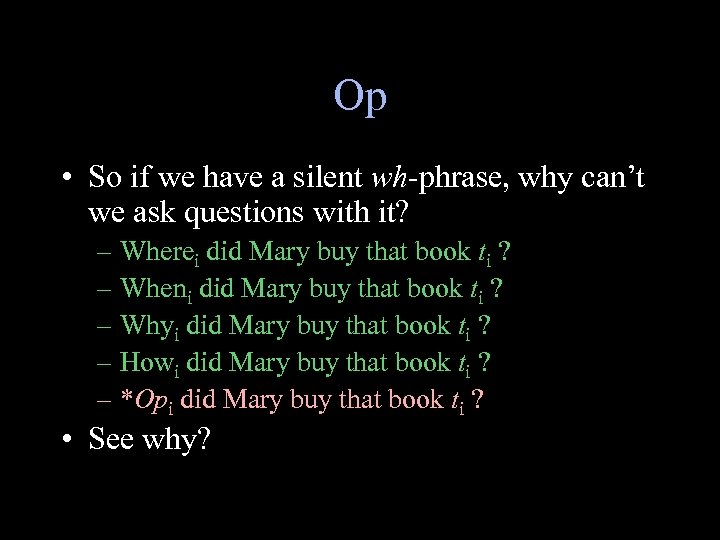 Op • So if we have a silent wh-phrase, why can’t we ask questions with it? – Wherei did Mary buy that book ti ? – Wheni did Mary buy that book ti ? – Whyi did Mary buy that book ti ? – Howi did Mary buy that book ti ? – *Opi did Mary buy that book ti ? • See why?
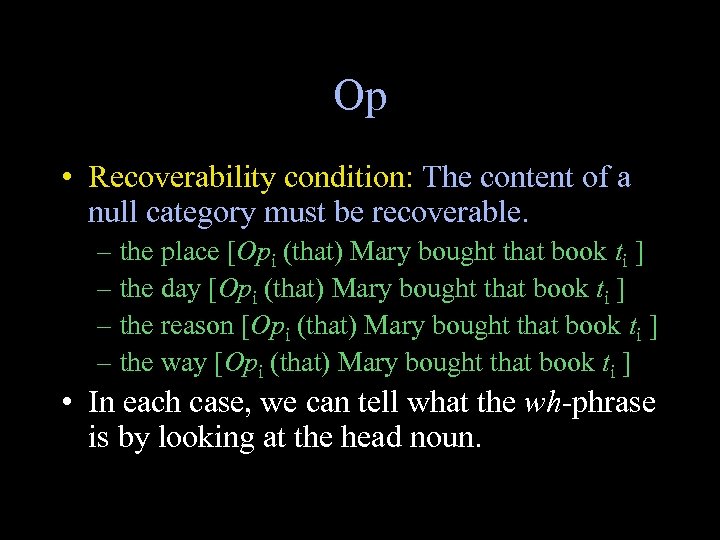 Op • Recoverability condition: The content of a null category must be recoverable. – the place [Opi (that) Mary bought that book ti ] – the day [Opi (that) Mary bought that book ti ] – the reason [Opi (that) Mary bought that book ti ] – the way [Opi (that) Mary bought that book ti ] • In each case, we can tell what the wh-phrase is by looking at the head noun.