Скачать презентацию CAS LX 502 Semantics 9 a Tense and
58fa6546b4efaecff7c34b5c2d853a93.ppt
- Количество слайдов: 31
 CAS LX 502 Semantics 9 a. Tense and aspect Ch. 8 etc.
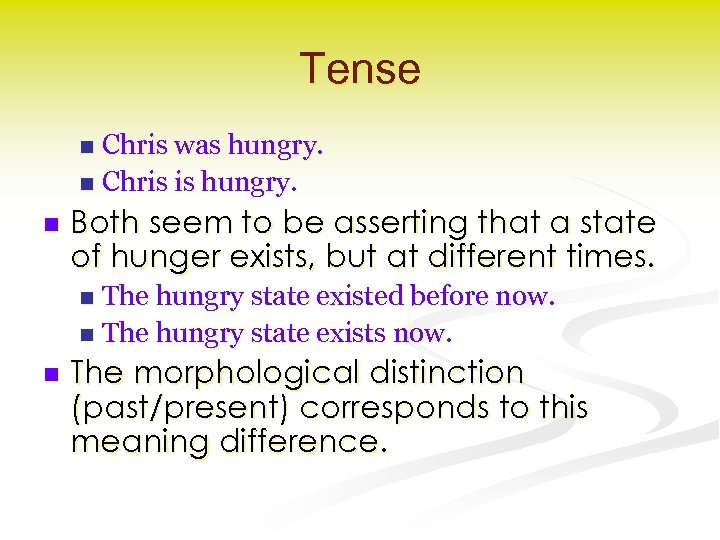 Tense Chris was hungry. n Chris is hungry. n n Both seem to be asserting that a state of hunger exists, but at different times. The hungry state existed before now. n The hungry state exists now. n n The morphological distinction (past/present) corresponds to this meaning difference.
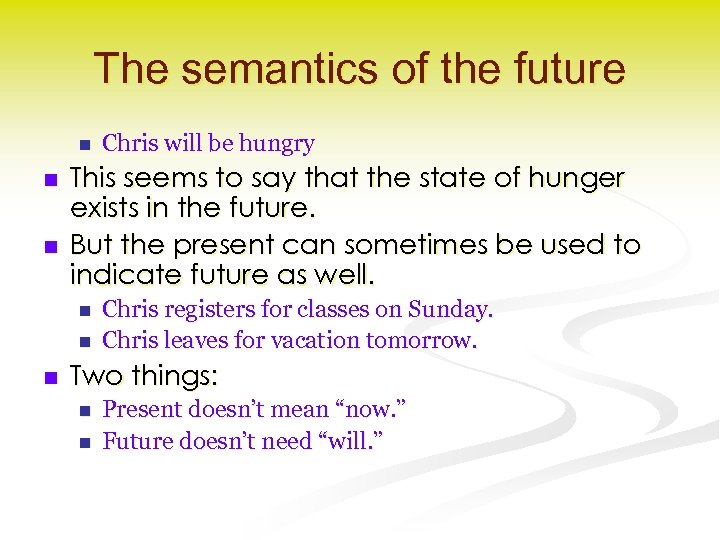 The semantics of the future n n n This seems to say that the state of hunger exists in the future. But the present can sometimes be used to indicate future as well. n n n Chris will be hungry Chris registers for classes on Sunday. Chris leaves for vacation tomorrow. Two things: n n Present doesn’t mean “now. ” Future doesn’t need “will. ”
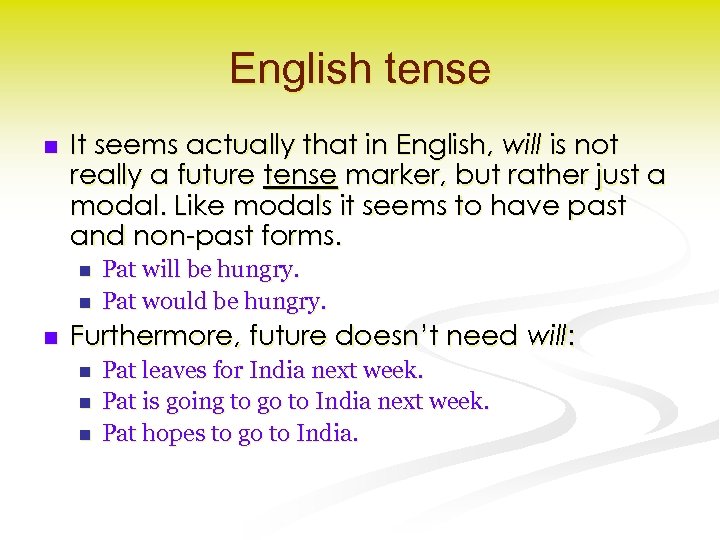 English tense n It seems actually that in English, will is not really a future tense marker, but rather just a modal. Like modals it seems to have past and non-past forms. n n n Pat will be hungry. Pat would be hungry. Furthermore, future doesn’t need will: n n n Pat leaves for India next week. Pat is going to go to India next week. Pat hopes to go to India.
 Past vs. non-past n English past really does seem to mean something like “before now” (or at least somehow “anterior”), but English “present” seems to be just non-past (rather than “now”).
 Connecting time to sentences The simplest way to think of time is as a specification of an event/state. n So, a verb describes an event/state, and tense tells us something about when that event/state is in time relative to the speech time. n Past would mean the event time precedes the speech time. n
 Turning off the stove n n n I didn’t turn off the stove. Clearly this means something more sophisticated than “I have never turned off the stove. ” It seems to be limited to some contextually relevant time. Partee suggested that tense is a bit like a pronoun that “points” to something— something like “they” does. A relevant time (interval). n n Every girl dropped her lollipop. Every time John left, he left the door open.
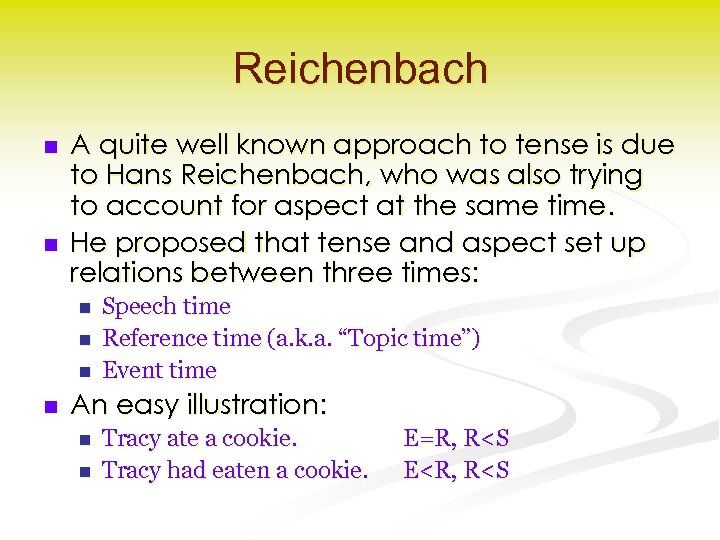 Reichenbach n n A quite well known approach to tense is due to Hans Reichenbach, who was also trying to account for aspect at the same time. He proposed that tense and aspect set up relations between three times: n n Speech time Reference time (a. k. a. “Topic time”) Event time An easy illustration: n n Tracy ate a cookie. Tracy had eaten a cookie. E=R, R
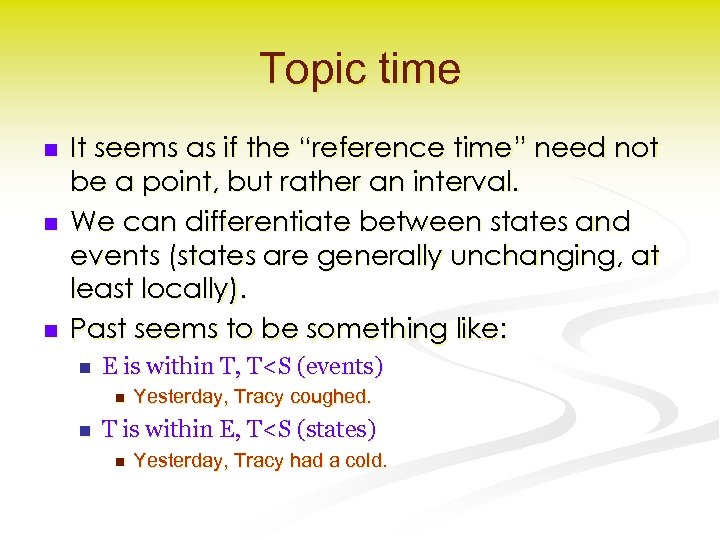 Topic time n n n It seems as if the “reference time” need not be a point, but rather an interval. We can differentiate between states and events (states are generally unchanging, at least locally). Past seems to be something like: n E is within T, T
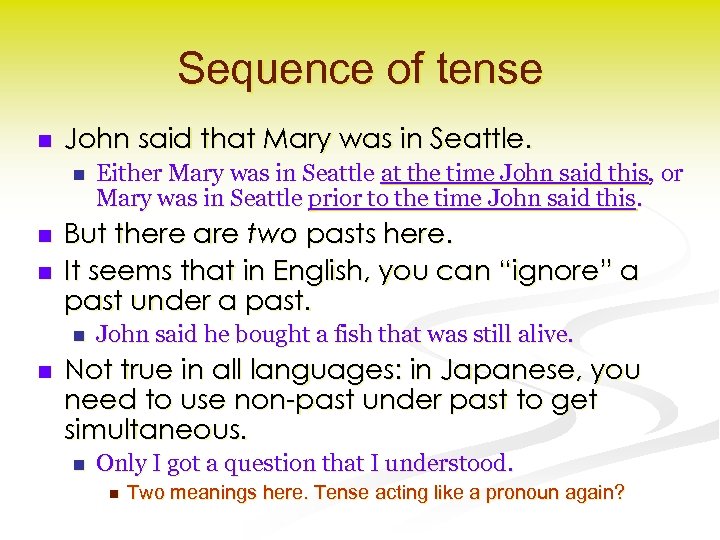 Sequence of tense n John said that Mary was in Seattle. n n n But there are two pasts here. It seems that in English, you can “ignore” a past under a past. n n Either Mary was in Seattle at the time John said this, or Mary was in Seattle prior to the time John said this. John said he bought a fish that was still alive. Not true in all languages: in Japanese, you need to use non-past under past to get simultaneous. n Only I got a question that I understood. n Two meanings here. Tense acting like a pronoun again?
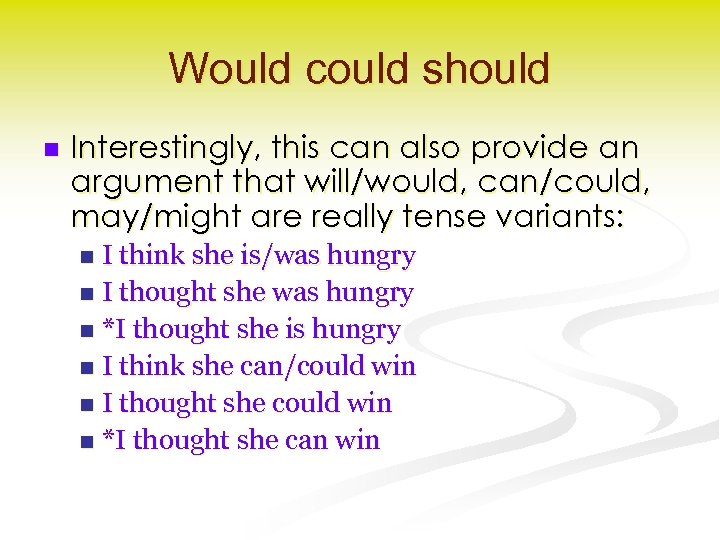 Would could should n Interestingly, this can also provide an argument that will/would, can/could, may/might are really tense variants: I think she is/was hungry n I thought she was hungry n *I thought she is hungry n I think she can/could win n I thought she could win n *I thought she can win n
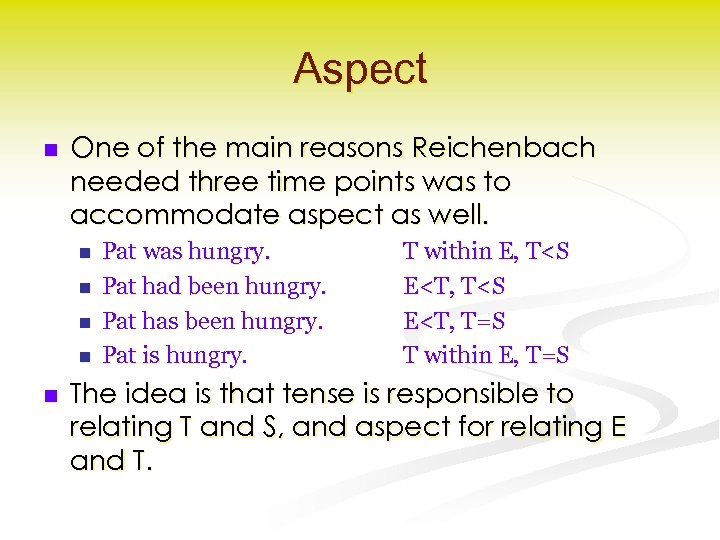 Aspect n One of the main reasons Reichenbach needed three time points was to accommodate aspect as well. n n n Pat was hungry. Pat had been hungry. Pat has been hungry. Pat is hungry. T within E, T
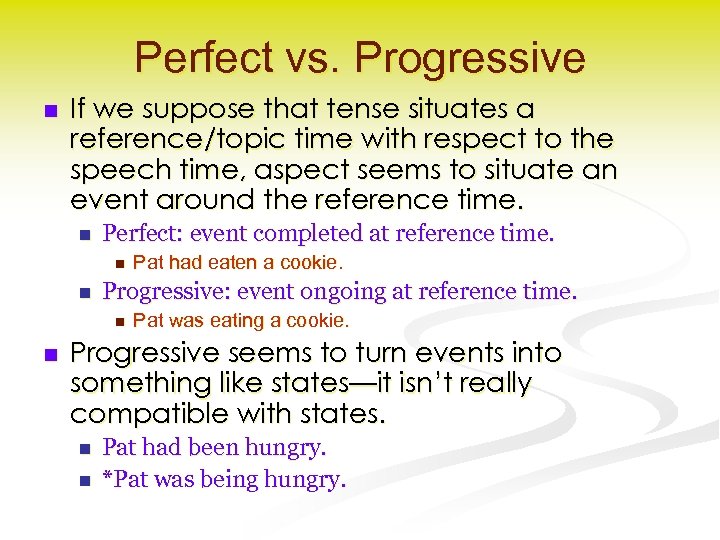 Perfect vs. Progressive n If we suppose that tense situates a reference/topic time with respect to the speech time, aspect seems to situate an event around the reference time. n Perfect: event completed at reference time. n n Progressive: event ongoing at reference time. n n Pat had eaten a cookie. Pat was eating a cookie. Progressive seems to turn events into something like states—it isn’t really compatible with states. n n Pat had been hungry. *Pat was being hungry.
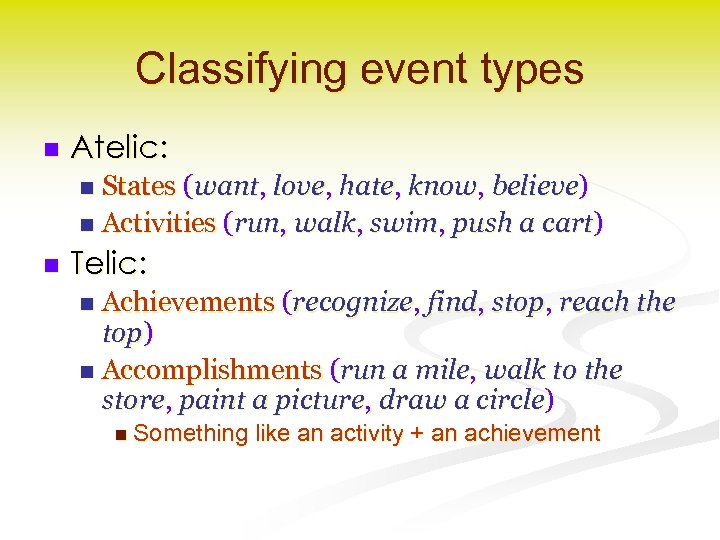 Classifying event types n Atelic: States (want, love, hate, know, believe) n Activities (run, walk, swim, push a cart) n n Telic: Achievements (recognize, find, stop, reach the top) n Accomplishments (run a mile, walk to the store, paint a picture, draw a circle) n n Something like an activity + an achievement
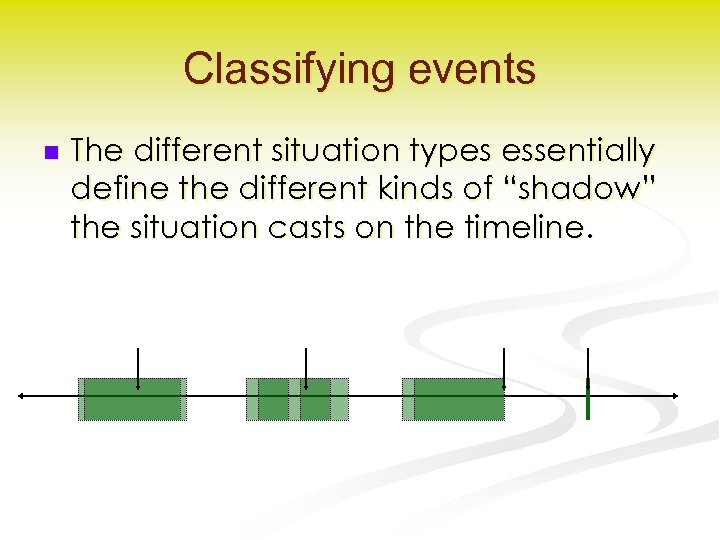 Classifying events n The different situation types essentially define the different kinds of “shadow” the situation casts on the timeline.
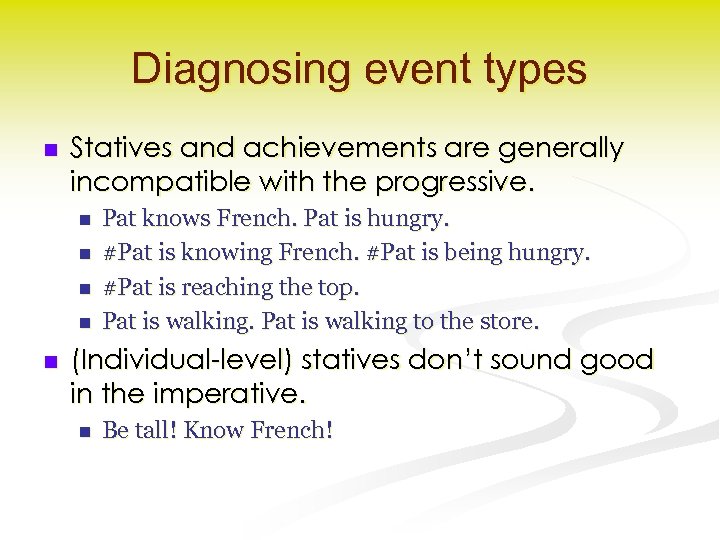 Diagnosing event types n Statives and achievements are generally incompatible with the progressive. n n n Pat knows French. Pat is hungry. #Pat is knowing French. #Pat is being hungry. #Pat is reaching the top. Pat is walking to the store. (Individual-level) statives don’t sound good in the imperative. n Be tall! Know French!
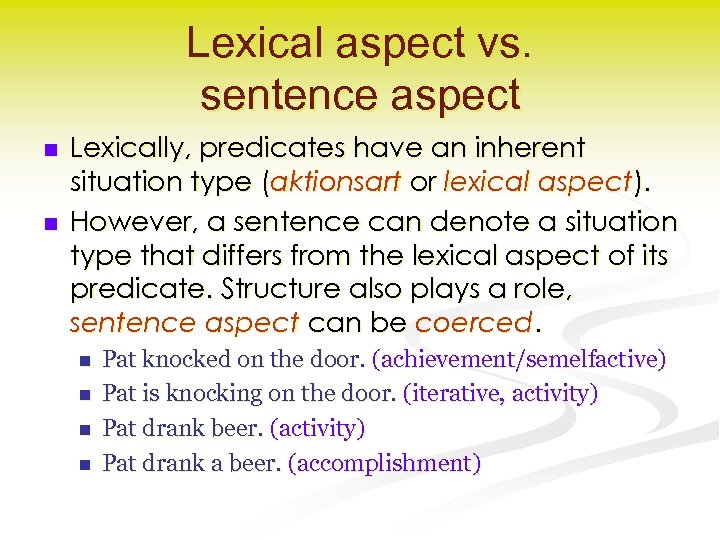 Lexical aspect vs. sentence aspect n n Lexically, predicates have an inherent situation type (aktionsart or lexical aspect). However, a sentence can denote a situation type that differs from the lexical aspect of its predicate. Structure also plays a role, sentence aspect can be coerced. n n Pat knocked on the door. (achievement/semelfactive) Pat is knocking on the door. (iterative, activity) Pat drank beer. (activity) Pat drank a beer. (accomplishment)
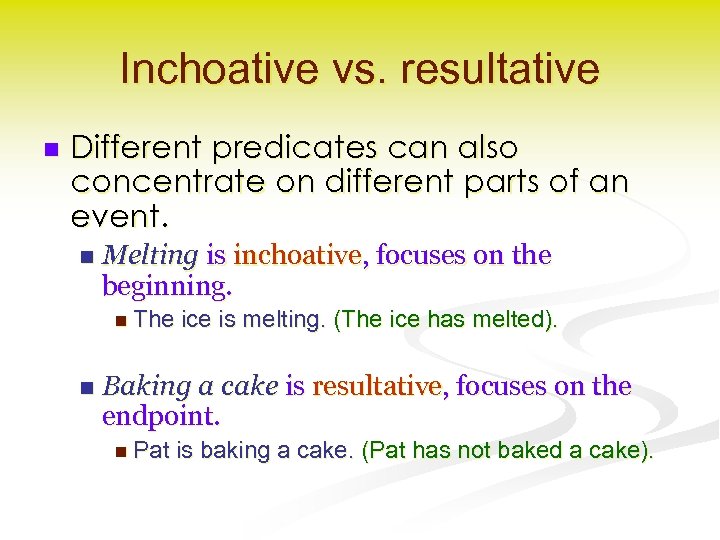 Inchoative vs. resultative n Different predicates can also concentrate on different parts of an event. n Melting is inchoative, focuses on the beginning. n The n ice is melting. (The ice has melted). Baking a cake is resultative, focuses on the endpoint. n Pat is baking a cake. (Pat has not baked a cake).
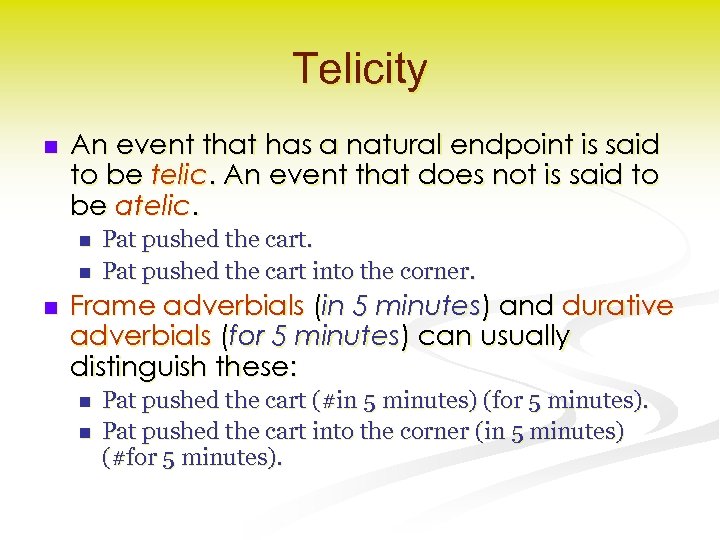 Telicity n An event that has a natural endpoint is said to be telic. An event that does not is said to be atelic. n n n Pat pushed the cart into the corner. Frame adverbials (in 5 minutes) and durative adverbials (for 5 minutes) can usually distinguish these: n n Pat pushed the cart (#in 5 minutes) (for 5 minutes). Pat pushed the cart into the corner (in 5 minutes) (#for 5 minutes).
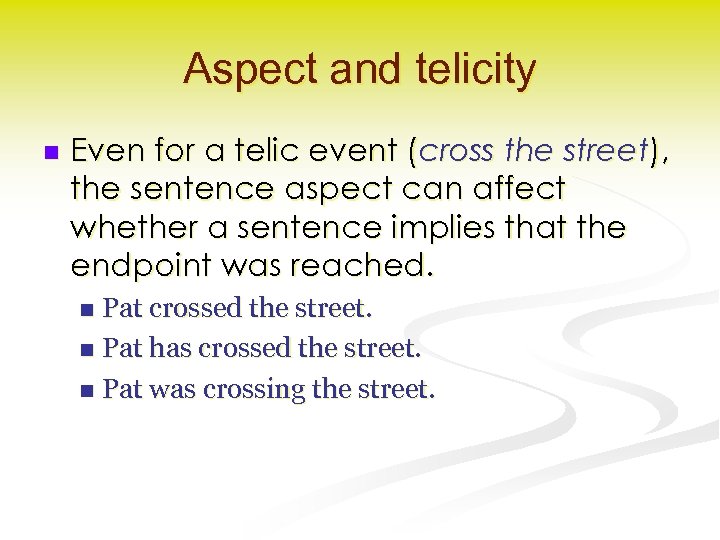 Aspect and telicity n Even for a telic event (cross the street), the sentence aspect can affect whether a sentence implies that the endpoint was reached. Pat crossed the street. n Pat has crossed the street. n Pat was crossing the street. n
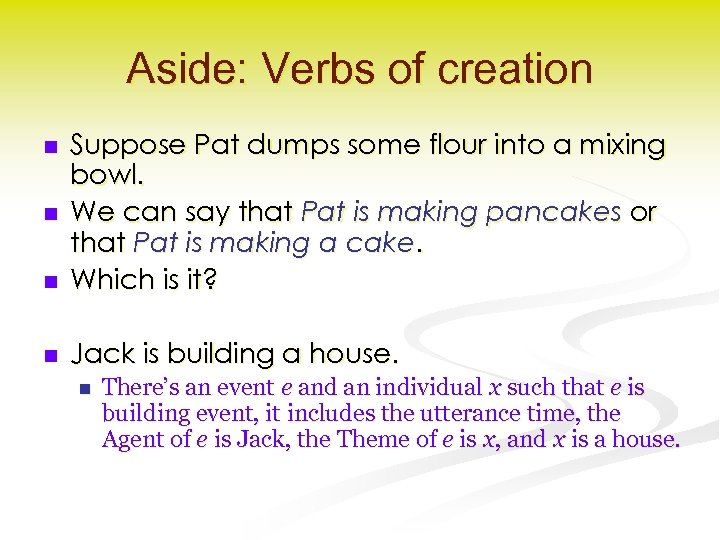 Aside: Verbs of creation n Suppose Pat dumps some flour into a mixing bowl. We can say that Pat is making pancakes or that Pat is making a cake. Which is it? n Jack is building a house. n n n There’s an event e and an individual x such that e is building event, it includes the utterance time, the Agent of e is Jack, the Theme of e is x, and x is a house.
 The house Jack London was building when he died. n In northern California, one can visit Jack London State Park and see the house that Jack London was building when he died. At least this is what the tourist guides say. It isn’t much of a house—only a foundation and parts of some walls. But native speakers of English call it a house. Ordinary language seems to be governed here by something like Plato’s theory of forms: material things that “aspire after” ideals are named after those ideals, in spite of their failure to live up to the ideal itself. In short, people describe unfinished houses as “houses, ” and my analysis assumes that this is the correct usage. The problem is not ontological—everyone agrees that the thing in question exists. The issue is whether it is a house. (Parsons 1990: 174) n Cf also Douglas Adams, Last Chance to See, p. 146.
 Was Max crossing the street? n n It seems that simply venturing out into the road isn’t necessarily crossing the street. But the beginnings are the same. And if there’s a catastrophe with a bus, the road is never actually crossed. Yet it seems that Max was crossing the street, when he was hit by the bus. Not simply venturing into the road. n There seems to be some kind of modality here: Crossing the street is the “normal” conclusion of what Max was doing, even if he doesn’t make it in every possible world.
 Predicates and objects n n n If we think about the denotation of apples as compared to an apple, only the latter has a definite boundary. How big is an apple? How big is apples? Similarly, how big is soup? Events are sort of like this too. A telic event has a size, a boundary. Reach the top vs. climb. We can think of events as sort of like abstract individuals. n n I saw Pat eat lunch. Fido’s barking kept me awake.
 Mass and count n Nouns can be distinguished into two types, those that can be counted (count), and those that can’t (mass). n n n I have two tomatoes. #I have two barleys. One thing that differentiates them is what happens if you cut them in half: n n If you divide your tomato, neither resulting thing is a tomato. If you divide your barley, both resulting things are barley.
 Homogeneity n n Soup + soup = soup Tomato + tomato = 2 tomatoes. We can call the property that mass nouns have homogeneity. Pretty much the same property can be said to hold of states and activities, but not accomplishments or achievements. n n Eating + eating = eating Being tall + being tall = being tall Walking to the store + walking to the store = walking to the store twice. Finding a quarter + finding a quarter = finding two quarters
 Combining predicates and objects n Interestingly, for something like eat (an activity, homogeneous), if it is combined with a homogeneous object, the result is a homogeneous activity, but when it is combined with a bounded object, the result is a bounded event (accomplishment). Pat ate soup (for an hour) (#in an hour). n Pat ate the apple (? ? for an hour) (in an hour). n
 Coercion/shifting n Things that are normally count nouns can be treated as mass nouns if coerced, and vice versa. There is too much apple in the salad. n I ordered two soups. n n And, then: I ate a soup in five minutes. n I ate apple for five minutes. n
 Sentences as denoting events n One way of looking at what sentences mean is as event descriptions. Pat ate an apple. n (There was) an eating, it affected an apple, it was instigated by Pat. n n Like definite descriptions denote individuals, sentences denote events. n The student in the corner.
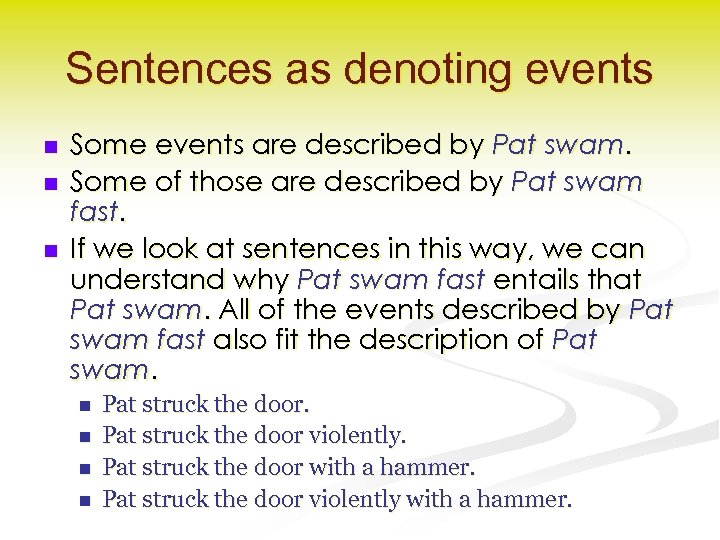 Sentences as denoting events n n n Some events are described by Pat swam. Some of those are described by Pat swam fast. If we look at sentences in this way, we can understand why Pat swam fast entails that Pat swam. All of the events described by Pat swam fast also fit the description of Pat swam. n n Pat struck the door violently. Pat struck the door with a hammer. Pat struck the door violently with a hammer.