Скачать презентацию CAS LX 400 Second Language Acquisition Week 9
31dd85f2cfbb197d06b7c385a84db91a.ppt
- Количество слайдов: 38
 CAS LX 400 Second Language Acquisition Week 9 a. Code switching and code mixing and a tiny amount of L 2 A
 Code switching and mixing • Fluent bilingual individuals conversing, using both languages at once. • Code switching: changing languages between sentences. • Code mixing: changing languages within a sentence. • ≠Borrowing: using non-native words as if they were native vocabulary.
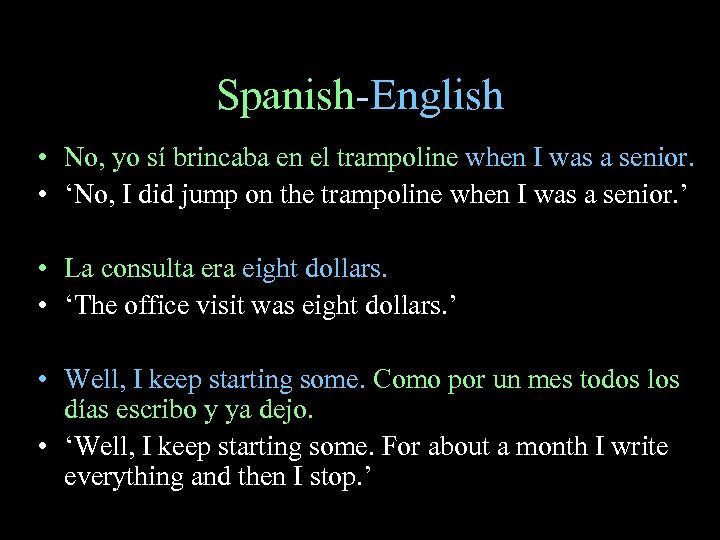 Spanish-English • No, yo sí brincaba en el trampoline when I was a senior. • ‘No, I did jump on the trampoline when I was a senior. ’ • La consulta era eight dollars. • ‘The office visit was eight dollars. ’ • Well, I keep starting some. Como por un mes todos los días escribo y ya dejo. • ‘Well, I keep starting some. For about a month I write everything and then I stop. ’
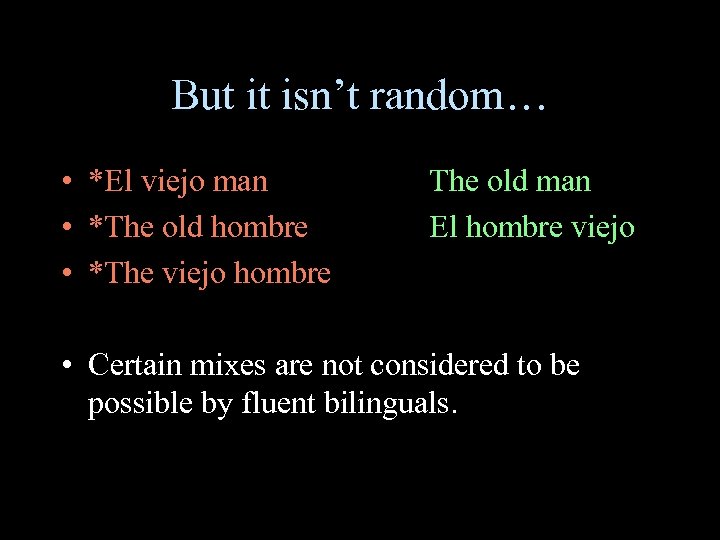 But it isn’t random… • *El viejo man • *The old hombre • *The viejo hombre The old man El hombre viejo • Certain mixes are not considered to be possible by fluent bilinguals.
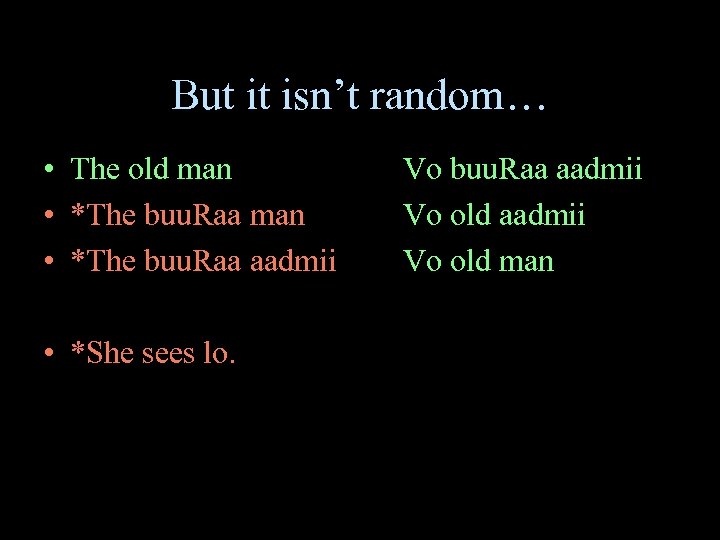 But it isn’t random… • The old man • *The buu. Raa aadmii • *She sees lo. Vo buu. Raa aadmii Vo old man
 Prior efforts • Many proposals have been offered to account for what are good mixes and what aren’t, but it appears to be a hard problem. • The equivalence constraint? Codes will tend to be switched at points where the surface structure of the languages map onto each other. • The free morpheme constraint? A switch may occur at any point in the discourse at which it is possible to make a surface constituent cut and still retain a free morpheme.
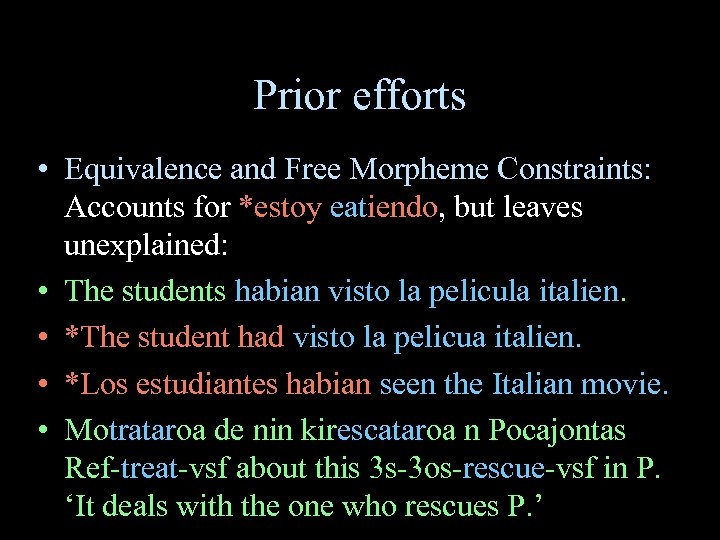 Prior efforts • Equivalence and Free Morpheme Constraints: Accounts for *estoy eatiendo, but leaves unexplained: • The students habian visto la pelicula italien. • *The student had visto la pelicua italien. • *Los estudiantes habian seen the Italian movie. • Motrataroa de nin kirescataroa n Pocajontas Ref-treat-vsf about this 3 s-3 os-rescue-vsf in P. ‘It deals with the one who rescues P. ’
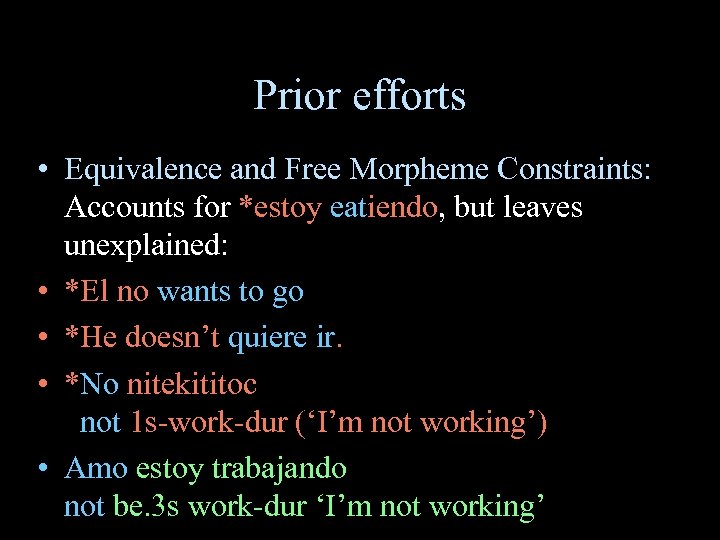 Prior efforts • Equivalence and Free Morpheme Constraints: Accounts for *estoy eatiendo, but leaves unexplained: • *El no wants to go • *He doesn’t quiere ir. • *No nitekititoc not 1 s-work-dur (‘I’m not working’) • Amo estoy trabajando not be. 3 s work-dur ‘I’m not working’
 Mac. Swan 1999 • Perhaps the most currently comprehensive and promising account, building on recent developments in syntactic theory. • One of the basic premises is that language parameters are properties of lexical items (not of a language-wide grammar). E. g. , verbmovement is due to a property of the tense morpheme in French, not shared by the tense morpheme in English.
 Mac. Swan 1999 • The broad (“minimalist”) approach to grammar takes language to consist of two primary components. • Computational system (builds trees), language invariant. • Lexicon, language particular. Functional elements of the lexicon encode the parameters of variation.
 Mac. Swan 1999 • Mac. Swan’s proposal is that there are no constraints on code mixing over and above constraints found on monolingual sentences. (His only constraint which obliquely refers to code mixing is the one we turn to next, roughly that within a word, the language must be coherent. ) • We can determine what are possible mixes by looking at the properties of the (functional elements) of the lexicons of the two mixed languages.
 Mac. Swan 1999 • The model of code mixing is then just like monolingual speech—the only difference being that the words and functional elements are not always drawn from the lexicon belonging to a single language. • Where requirements conflict between languages is where mixing will be prohibited.
 Clitics, bound morphemes • Some lexical items in some languages are clitics, they depend (usually phonologically) on neighboring words. Similar to the concept of bound morpheme. • John’s book. • I shouldn’t go. • Clitics essentially fuse with their host.
 Clitics, bound morphemes • Clitics generally cannot be stressed. – *John’S book – *I could. N’T go. • Clitics generally form an inseparable unit with their host. – Shouldn’t I go? – Should I not go? – *Should I n’t go?
 Spanish no • It turns out that Spanish no appears to be a clitic (despite spelling conventions). • ¿Qué no dijo Juan? ‘What didn’t J say? ’ • *¿Qué sólo leyó Juan? (‘What did J only read? ’) • *¿Qué meramente leyó Juan? (‘What did J merely read? ’) • *Juan no ha no hecho la tarea. (‘J hasn’t not done the task. ’)
 Nahuatl amo • In Nahuatl, amo ‘not’ does not appear to be a clitic. • Amo nio amo niktati nowelti. Not 1 s-go not 1 s-3 Os-see my-sister ‘I’m not going to not see my sister. ’
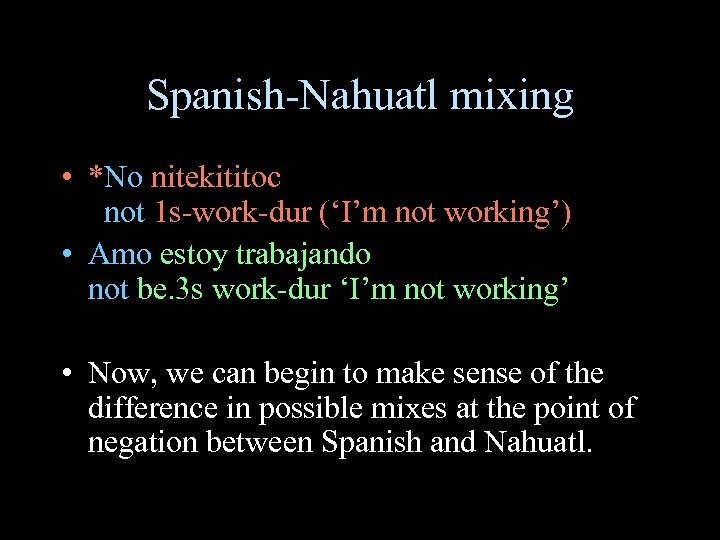 Spanish-Nahuatl mixing • *No nitekititoc not 1 s-work-dur (‘I’m not working’) • Amo estoy trabajando not be. 3 s work-dur ‘I’m not working’ • Now, we can begin to make sense of the difference in possible mixes at the point of negation between Spanish and Nahuatl.
 Mac. Swan 1999 • Mac. Swan proposes essentially that it is not possible to code-mix within a (word-like) phonological unit. This is essentially a restriction on what are “pronouncable” trees. • Since Spanish no fuses with the following verb, it can’t be followed by a Nahuatl verb. • Since Nahuatl amo does not fuse with the following verb, it is free to be followed by a Spanish verb.
 English-Spanish • This also explains Spanish-English (well, Spanishanything) • *El no wants to go • What about English-Spanish? • *He doesn’t quiere ir. • *He doesn’t wants to go.
 Agreement • In languages that code agreement between subject and verb, it also appears that mixing is only possible where the agreement relationship is not disrupted. • *He doesn’t quiere ir. • English negation: agreement appears on do, Spanish negation: agreement appears on the verb. • You can’t have extra agreement: one subject, one agreement. They need to match.
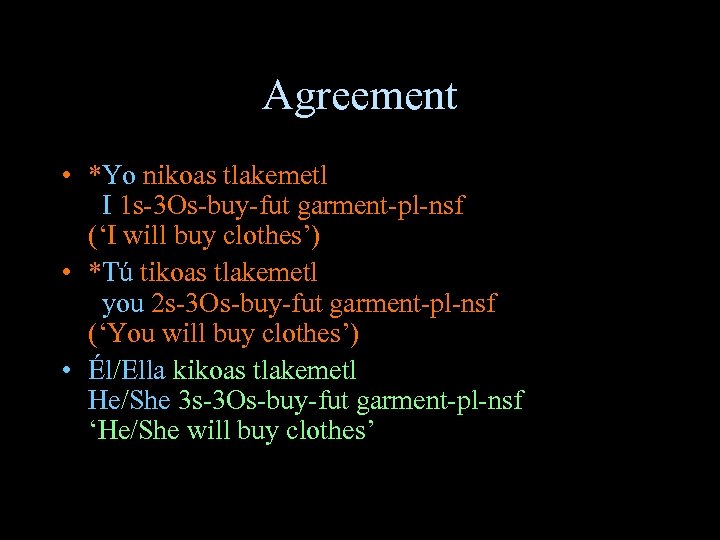 Agreement • *Yo nikoas tlakemetl I 1 s-3 Os-buy-fut garment-pl-nsf (‘I will buy clothes’) • *Tú tikoas tlakemetl you 2 s-3 Os-buy-fut garment-pl-nsf (‘You will buy clothes’) • Él/Ella kikoas tlakemetl He/She 3 s-3 Os-buy-fut garment-pl-nsf ‘He/She will buy clothes’
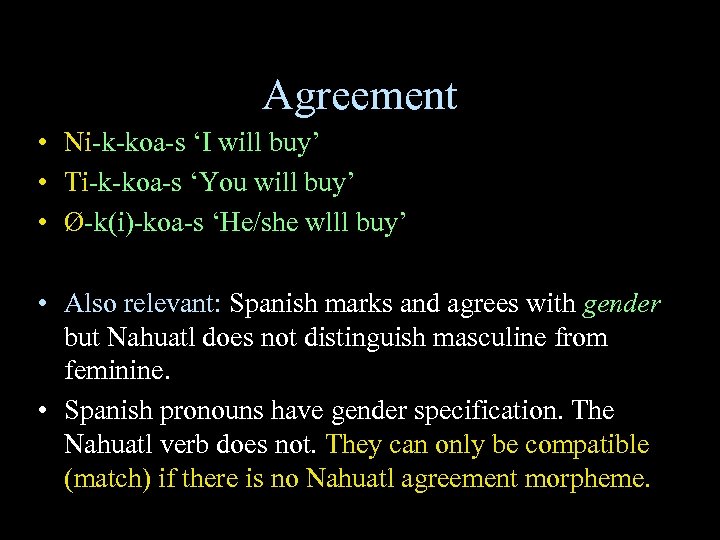 Agreement • Ni-k-koa-s ‘I will buy’ • Ti-k-koa-s ‘You will buy’ • Ø-k(i)-koa-s ‘He/she wlll buy’ • Also relevant: Spanish marks and agrees with gender but Nahuatl does not distinguish masculine from feminine. • Spanish pronouns have gender specification. The Nahuatl verb does not. They can only be compatible (match) if there is no Nahuatl agreement morpheme.
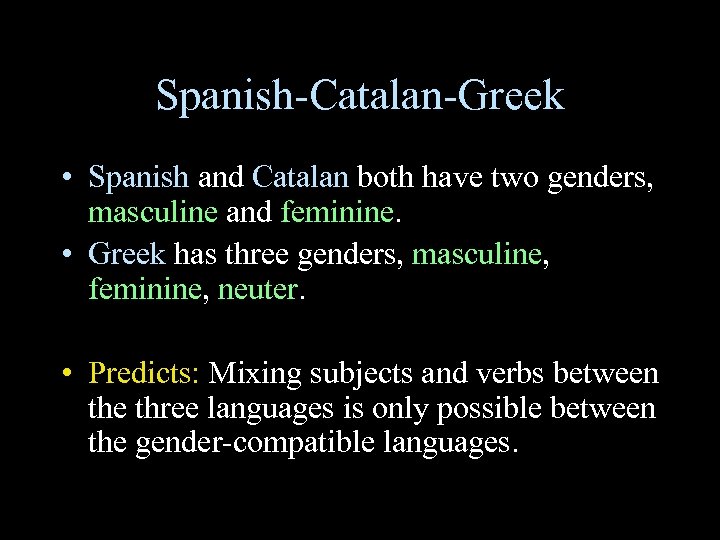 Spanish-Catalan-Greek • Spanish and Catalan both have two genders, masculine and feminine. • Greek has three genders, masculine, feminine, neuter. • Predicts: Mixing subjects and verbs between the three languages is only possible between the gender-compatible languages.
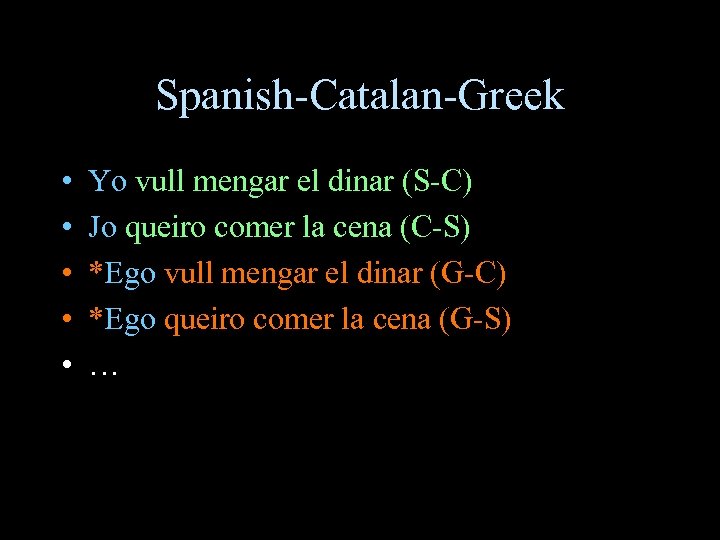 Spanish-Catalan-Greek • • • Yo vull mengar el dinar (S-C) Jo queiro comer la cena (C-S) *Ego vull mengar el dinar (G-C) *Ego queiro comer la cena (G-S) …
 Mixing and L 2 A? • Code mixing as discussed so far is generally a property of the speech of fluent bilinguals (often native bilinguals) and reflects properties of universal language knowledge. • We can now return to our old question and ask: Does the knowledge of second language learners also have the restrictions on code mixing? To the extent that this is “part of UG”, is this aspect of UG active for L 2’ers?
 Toribio & Rubin • Beginning, intermediate, and advanced learners of Spanish (English L 1), asked to imitate code-mixed utterances. – Beginning: Processing errors everywhere. – Intermediate: Repeated everything equally fluently. – Advanced: Repeated good mixes fluently, tripped up or unknowingly corrected improper mixes. • Looks like the constraints emerge, but intermediates are probably translating to L 1 and doing any judgments there.
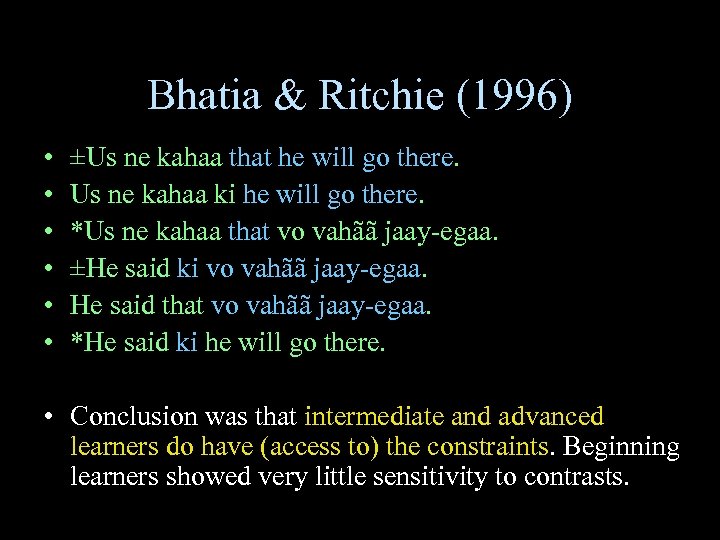 Bhatia & Ritchie (1996) • • • ±Us ne kahaa that he will go there. Us ne kahaa ki he will go there. *Us ne kahaa that vo vahãã jaay-egaa. ±He said ki vo vahãã jaay-egaa. He said that vo vahãã jaay-egaa. *He said ki he will go there. • Conclusion was that intermediate and advanced learners do have (access to) the constraints. Beginning learners showed very little sensitivity to contrasts.
 Functions • A great deal of the study of code mixing/switching is less concerned with what is a possible mix and more concerned with under what conditions a mix is used. • What would cause a speaker to code-mix? What communicative function does it have?
 Functions • Quotations, reported speech. Generally indicating the language of the speaker (not necessarily verbatim) – She doesn’t speak English, so, dice que la reganan: “Si se les va olvidar el idioma a las criaturas. ” • ‘She doesn’t speak English. So, she says they would scold her: “The children are surely going to forget their language. ”
 Functions • Addressee identification. Picking out addressee among several possibilities. (Not a particularly interesting use, but it counts as code switching). – D to B: Everyday, you know kào taim. • ‘Everyday, you know, at nine o’clock’ – D to A: lì khi á. • ‘You go. ’
 Functions • Interjections. – I mean, unconsciously, subconsciously, kari jaande ãã, you know, par I wish, you know, ke mãi pure punjabi bol sakãã. • ‘I mean, unconsciously, subconsciously, we keep doing it, you know, but I wish, you know, that I could speak pure Punjabi. ’ – I told him, I pay you more a bit la. He wants one thousand no less la.
 Functions • Reiteration/clarification. – The three old ones spoke nothing but Spanish. No hablaban ingles. • ‘The three old ones spoke nothing but Spanish. They did not speak English. ’ – (Father to young son): Keep straight. Siidhe jaao! • ‘Keep straight. Go straight!’
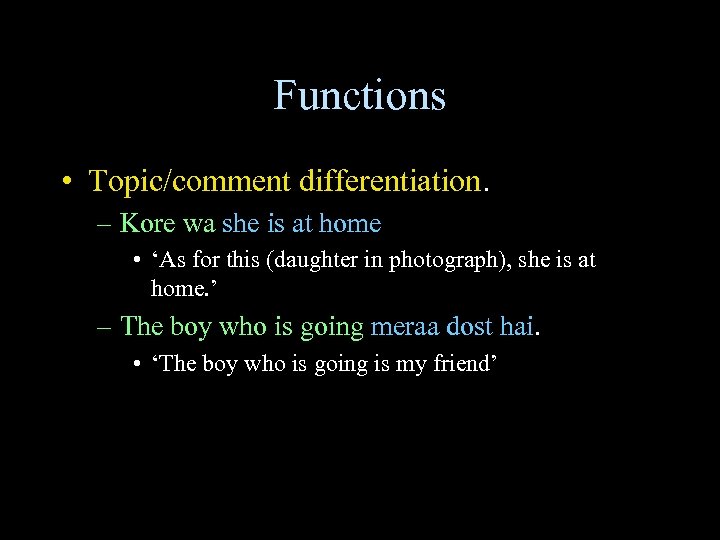 Functions • Topic/comment differentiation. – Kore wa she is at home • ‘As for this (daughter in photograph), she is at home. ’ – The boy who is going meraa dost hai. • ‘The boy who is going is my friend’
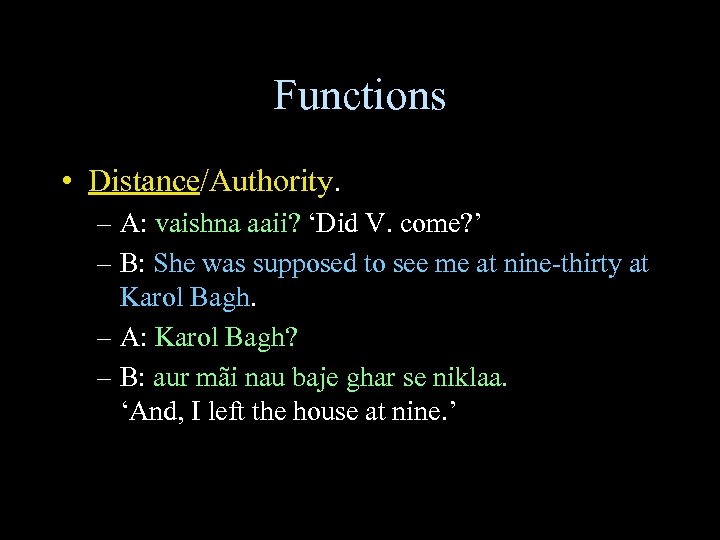 Functions • Distance/Authority. – A: vaishna aaii? ‘Did V. come? ’ – B: She was supposed to see me at nine-thirty at Karol Bagh. – A: Karol Bagh? – B: aur mãi nau baje ghar se niklaa. ‘And, I left the house at nine. ’
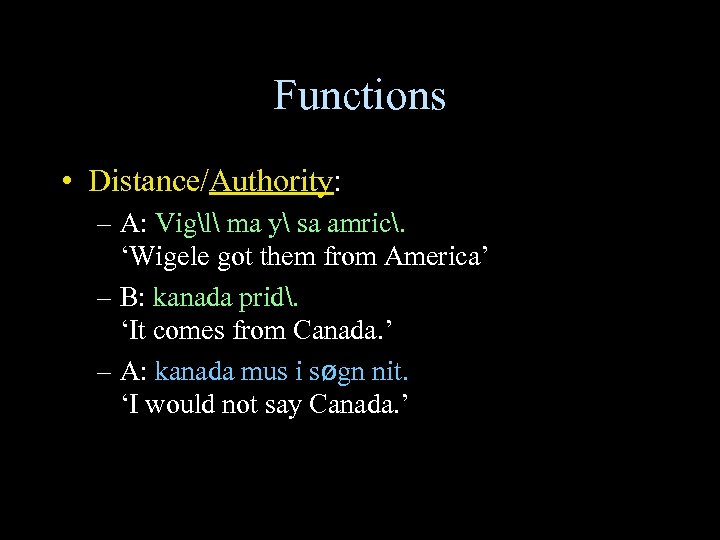 Functions • Distance/Authority: – A: Vigl ma y sa amric. ‘Wigele got them from America’ – B: kanada prid. ‘It comes from Canada. ’ – A: kanada mus i søgn nit. ‘I would not say Canada. ’
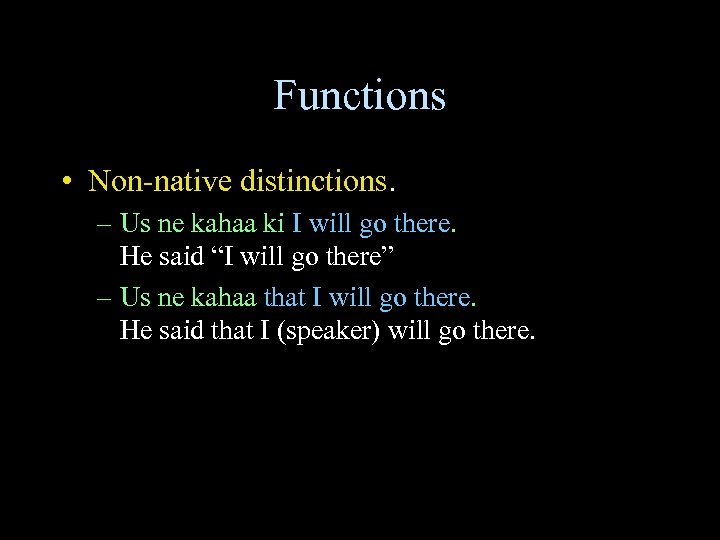 Functions • Non-native distinctions. – Us ne kahaa ki I will go there. He said “I will go there” – Us ne kahaa that I will go there. He said that I (speaker) will go there.
 So… • Code switching/mixing is quite systematic, and moreover quite normal behavior fluent bilinguals. • It also gives us hints about how languages are represented, to what degrees they’re kept separate.