


 Скачать презентацию Carter s Presidency The Main Idea Jimmy Carter used
1771f0b8a727ffd3e02b8e1b4a13c116.ppt
- Количество слайдов: 14
 Carter’s Presidency The Main Idea Jimmy Carter used his reputation for honesty to win the presidency in 1976, but he soon met challenges that required other qualities as well. Reading Focus • What were some of the difficult domestic challenges facing Carter and the nation in the late 1970 s? • What were Carter’s greatest foreign-policy triumphs and challenges? • How did international crises affect Carter’s presidency?
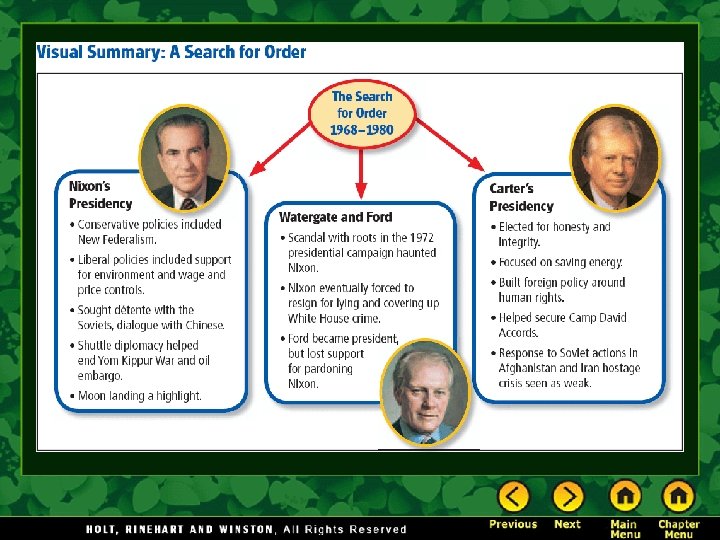
 Carter Faces Domestic Challenges • Jimmy Carter was an honest man who tried to break down barriers between the presidency and ordinary Americans • Carter immediately tried to help the nation heal some of the wounds of the past. – Ex. He issued a pardon to thousands of Vietnam War draft dodgers. • Carter tackled problems in the economy and with energy. • Finally, Carter tried to deal with environmental issues.
 Challenges Facing the Nation The Economy and Energy • Inflation and unemployment were high. • Wanted to ease dependence on foreign oil through energy conservation, developing new energy supplies, and loosening government regulation of the American oil industry • Promoted the development of alternative energy sources The Impact • The economy added many new jobs to help battle unemployment. • Carter was unable to bring down inflation, in fact, it got worse. • Carter’s energy policies were successful at helping reduce American dependence on foreign oil.
 Environmental Concerns Environmental Wins Environmental Losses • Believed that conserving fuel was a key way to avoid plundering the environment • In 1979 a mishap at a nuclear power plant on Three Mile Island terrified the nation. • Passed the Alaska National Interest Lands Conservation Act • Although little radiation was released, public concern about the safety of nuclear power grew. • The act protected more than 100 million acres of land doubled the size of the nation’s park and wildlife refuge system. • Chemicals that a company dumped in New York began to seep up through the ground at Love Canal and were linked to high rates of birth defects. • Three Mile Island Love Canal were both environmental crises that marred the Carter presidency
 Carter’s Foreign Policy • Carter promised that the concept of human rights would be at the forefront of his foreign policy. – This was different from Nixon in that Nixon based foreign policy on realistic views of national interest • Carter worked to strengthen ties between the United States and the Soviet Union and China. • Carter gave control of the Panama Canal back to Panama. • Carter helped Egypt and Israel deal with some of the divisions that caused conflicts between their countries.
 Carter’s Foreign Policy Human Rights Soviet Relations Recognizing China • Basic ideas outlined in the United Nations Declaration of Human Rights • Carter wrote to Brezhnev about his concerns with Soviet human rights issues. • Carter expected friends and enemies alike to uphold the highest standards in the treatment of their citizens. • Brezhnev politely said that each country should mind their own business. • Formally recognized the government of the Communist People’s Republic of China • Concluded SALT II talks in 1979 that limited nuclear weapons – This began under the Nixon administration • Ended recognition of the Republic of China on Taiwan
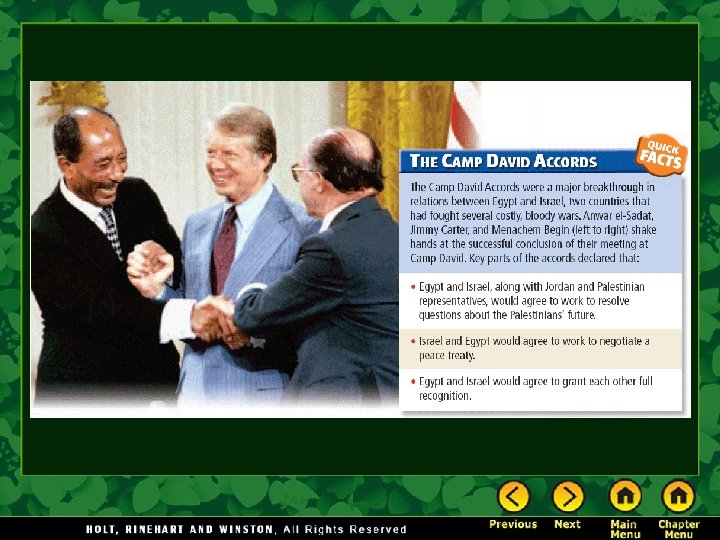
 Carter’s Foreign Policy Panama Canal • American control of the Panama Canal had been a source of conflict between the two countries. • In 1977 Carter and Panama’s leader agreed that the US would control the canal until 1999 • For some Americans, loss of control of the canal represented a decline in American power. Camp David Accords • Greatest foreign-policy achievement • Conflict between Egypt and Israel continued. Egypt would not recognize Israel and Israel continued to occupy Egyptian territory. • Carter guided Anwar el. Sadat and Menachem Begin to a historic agreement that came to be called the Camp David Accords. • Begin and Sadat won the Nobel Peace Prize in 1979.
 How did international crises affect Carter’s presidency? In 1979 a series of events occurred that seemed to overwhelm Carter’s presidency. In 1979 the Soviet Union invaded Afghanistan. On November 4, 1979, a mob attacked the American embassy in Tehran, Iran’s capital, and took several dozen Americans hostage.
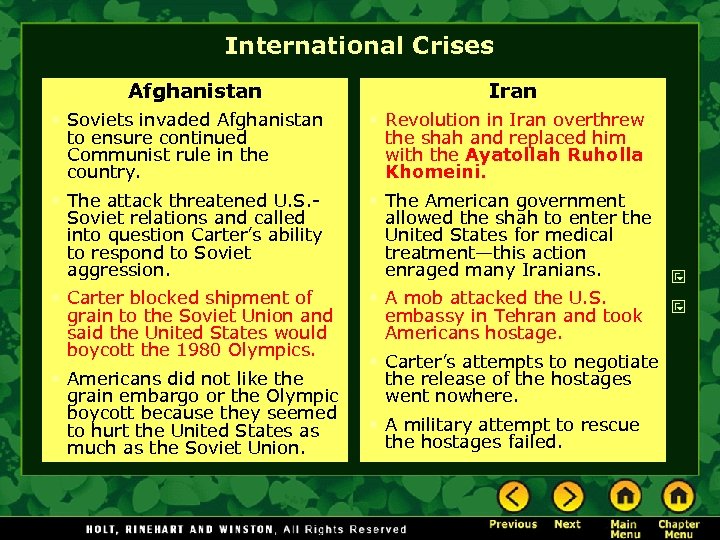 International Crises Afghanistan Iran • Soviets invaded Afghanistan to ensure continued Communist rule in the country. • Revolution in Iran overthrew the shah and replaced him with the Ayatollah Ruholla Khomeini. • The attack threatened U. S. Soviet relations and called into question Carter’s ability to respond to Soviet aggression. • The American government allowed the shah to enter the United States for medical treatment—this action enraged many Iranians. • Carter blocked shipment of grain to the Soviet Union and said the United States would boycott the 1980 Olympics. • A mob attacked the U. S. embassy in Tehran and took Americans hostage. • Americans did not like the grain embargo or the Olympic boycott because they seemed to hurt the United States as much as the Soviet Union. • Carter’s attempts to negotiate the release of the hostages went nowhere. • A military attempt to rescue the hostages failed.
 A Crisis of Confidence • The Iranian Hostage situation dragged on throughout the presidential election year of 1980. • The situation in Iran also drove up gasoline prices so that prices of goods in the United States went up and inflation soared. • Many voters held Carter responsible for the problems and the downcast mood of the country.
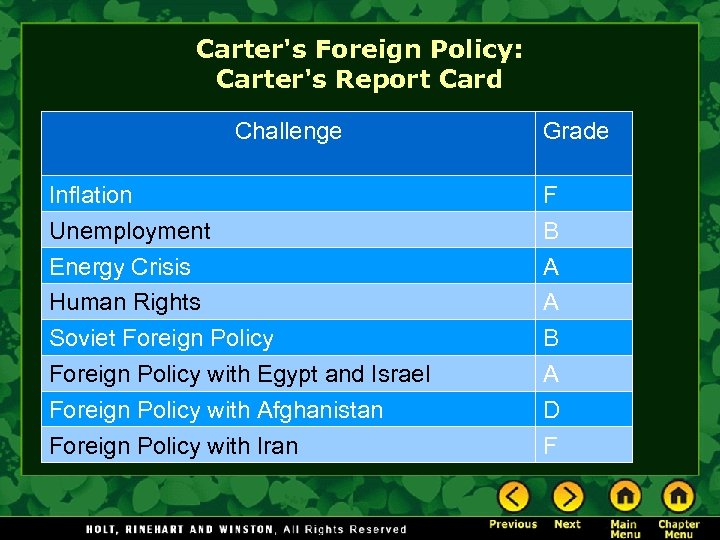
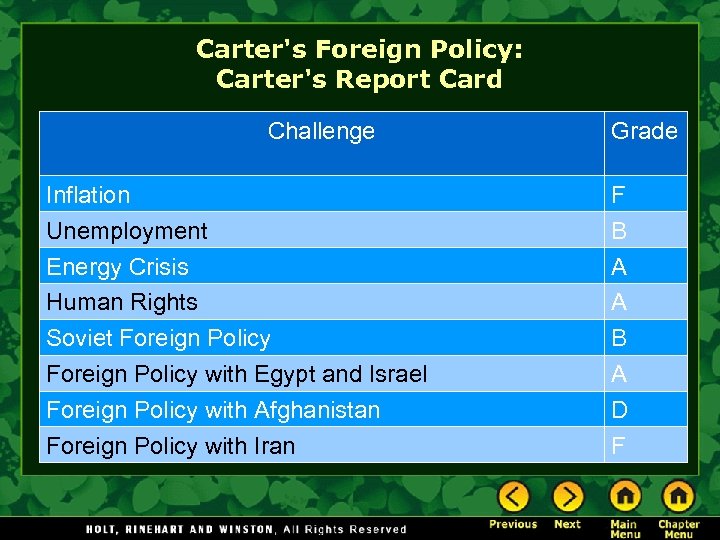 Carter's Foreign Policy: Carter's Report Card Challenge Inflation Unemployment Energy Crisis Human Rights Soviet Foreign Policy with Egypt and Israel Foreign Policy with Afghanistan Foreign Policy with Iran Grade F B A A B A D F
 Carter's Foreign Policy: Carter's Report Card Challenge Inflation Unemployment Energy Crisis Human Rights Soviet Foreign Policy with Egypt and Israel Foreign Policy with Afghanistan Foreign Policy with Iran Grade F B A A B A D F