 Скачать презентацию CARRIAGE OF GOODS BY SEA FEATURES
98868a656d2ee155f448420741d90ab9.ppt
- Количество слайдов: 58



CARRIAGE OF GOODS BY SEA
FEATURES • Sea transport involves carriage of goods by ship to the port of discharge. • The contract of carriage of goods by sea refers to the contract between the shipper and the shipping line for transportation of goods against payment of remuneration to the carrier. • One who sends the shipment is called the consignor/shipper and the person to whom goods are shipped is called the consignee.
• The shipper may be seller (exporter) of goods or any other person sending shipment on behalf of the exporter. • The consignee may be the buyer or a clearing agent or any other person acting for the importer. • The legal carrier of the goods is the party contracting with the shipper to carry goods, the carrier may be the actual carrier or may arrange for shipment by another carrier. • The amount of freight may be paid by the shipper or it may be paid by the consignee of the goods.
SEA AND COMBINED TRANSPORT
MEANING • Combined transport is the combination of at least two types of transport in a uniform transport chain that does not involve the changing of transport units. Most of the journey is by rail, inland waterways or sea and any initial and/or final legs carried out with road transport are kept as short as possible. Where the means of transport are changed, individual consignments do not need to be reloaded.
• Combined transport means that each mode of transport takes over that part of the transport task that it can perform best. • Combined transport groups single consignments together into large standardized loading units that can be easily transferred between ship, wagon and truck. • Combined transport offers today different loading units: Intercontinental trade using deep sea transport uses normally freight containers of 20 feet (6, 1 m) or 40 ft. (12, 2 m) length. • Freight container transport through sea-ports offers a special advantageous situation for combined transport organization: the freight flow is already concentrated when the containers arrive in the seaport, and no costly pick-up and consolidation operation is needed.
INTERNATIONAL CONVENTIONS AND INDIAN LAW
INTERNATIONAL CONVENTIONS • • UNCLOS London Convention / London Protocol Noumea/SPREP Convention MARPOL
UNCLOS • The United Nations Convention on Law of the Sea (UNCLOS), also called the Law of the Sea Convention and the Law of the Sea Treaty, is the international agreement that resulted from the third United Nations took place from 1973 through 1982. • The Law of the Sea Convention defines the rights and responsibilities of nations in their use of the world's oceans, establishing guidelines for businesses, the environment, and the management of marine natural resources. • The Convention concluded in 1982 replaced four 1958 treaties. UNCLOS came into force in 1994, a year after Guyana became the 60 th state to sign the treaty. • To date 155 countries and the European Community have joined in the Convention.
UNCLOS • Legal order for the seas and oceans, to promote equitable and efficient utilisation of resources • Addresses all marine areas, airspace above and seabed and sub-seabed; • Defines maritime zones, territorial waters, EEZ – hence relevant to loss of territory of small island States - jeopardizing economic rights, Statehood; changes in sea ice in Arctic likely to cause friction • Two main environmental objectives: – To prevent, reduce, control marine pollution – To conserve and manage marine living resources
UNCLOS • ‘Pollution’ defined as: introduction by man, directly or indirectly, of substances or energy into the marine environment. . . which is likely to result in – harm to living resources and marine life – hazards to human health – hindrance to marine activities, including fishing – impairment of quality for uses of sea water … • Obligations to protect the marine environment from: – Pollution from land-based activities, sea bed activities, dumping, vessels – Pollution through the atmosphere • Many global and regional conventions implement UNCLOS on both marine pollution and marine living resources (fisheries)
UNCLOS I • In 1956, the United Nations held its first Conference on the Law of the Sea (UNCLOS I) at Geneva, Switzerland. UNCLOS I resulted in four treaties concluded in 1958: • Convention on the Territorial Sea and Contiguous Zone, entry into force: 10 September 1964 • , entry into force: 10 June 1964 • , entry into force: 30 September 1962 • Convention on Fishing and Conservation of Living Resources of the High Seas, entry into force: 20 March 1966 • Although UNCLOS I was considered a success, it left open the important issue of breadth of territorial waters.
UNCLOS II • In 1960, the United Nations held the second Conference on the Law of the Sea (“UNCLOS II”); however, the six-week Geneva conference did not result in any new agreements. Generally speaking, developing nations and third world countries participated only as clients, allies, or dependents of United States or the Soviet Union, with no significant voice of their own.
UNCLOS III • The issue of varying claims of territorial waters was raised in the UN in 1967 by Arvid Pardo, of Malta, and in 1973 the Third United Nations Conference on the Law of the Sea was convened in New York. In an attempt to reduce the possibility of groups of nation-states dominating the negotiations, the conference used a consensus process rather than majority vote. With more than 160 nations participating, the conference lasted until 1982. The resulting convention came into force on November 16, 1994, one year after the sixtieth state, Guyana, signed the treaty.
UNCLOS III • The convention introduced a number of provisions. The most significant issues covered were setting limits, navigation, archipelagic status and transit regimes, exclusive economic zones (EEZs), continental shelf jurisdiction, deep seabed mining, the exploitation regime, protection of the marine environment, scientific research, and settlement of disputes.
LONDON PROTOCOL, 1996 • Objective: protect the marine environment from all sources of pollution and to eliminate pollution caused by dumping • Dumping includes ‘any deliberate disposal into the sea of wastes or other matter from vessels, aircraft, platforms, or other man-made structures’ or storage of wastes in the sea bed and subsoil • CO 2 now recognized to contribute to acidification of oceans
LONDON PROTOCOL, 1996 • CO 2 waste streams now permitted for ‘dumping’ into sub-surface geological storage cavities, as a measure to reduce air pollution and acidification of the oceans (as of late 2006) • Carbon capture and storage seen as a mitigation measure under UNFCCC • Scientific Committee: GESAMP
NOUMEA (SPREP) CONVENTION • Addresses pollution in the Pacific Region, recognizes unique ecosystems of Pacific; Parties include Pacific island countries, as well as Australia, France, New Zealand United States. • Definition of "pollution'' similar to UNCLOS, London Convention - introduction by man, directly or indirectly, of substances or energy into the marine environment …which results or likely to result in harm to living resources and marine life etc • Parties shall take all appropriate measures to prevent, reduce and control pollution in the Convention Area (Pacific) resulting from discharges into the atmosphere from activities under their jurisdiction. • Parties required to co-operate in adopting rules and procedures for liability and compensation for damage resulting from pollution of the Convention Area (Art. 20)
MARPOL • Marpol 73/78 is the International Convention for the Prevention of Pollution From Ships, 1973 as modified by the Protocol of 1978. ("Marpol" is short for marine pollution and 73/78 short for the years 1973 and 1978. )
MARPOL • Marpol 73/78 is one of the most important international marine environmental conventions. It was designed to minimise pollution of the seas, including dumping, oil and exhaust pollution. Its stated object is: to preserve the marine environment through the complete elimination of pollution by oil and other harmful substances and the minimization of accidental discharge of such substances. • The original MARPOL Convention was signed on 17 February 1973, but did not come into force. The current Convention is a combination of 1973 Convention and the 1978 Protocol. It entered into force on 2 October 1983. As at 31 December 2005, 136 countries, representing 98% of the world's shipping tonnage, are parties to the Convention.
Liability for Carriage of Goods by Sea • Historically, carrier absolutely liable – Carriers used exculpatory clauses – Legal limitations on such clauses – Hague Rules – 1924 Convention defines liability for ocean carriers • US Carriage of Goods by Sea Act, 1936 codifies Hague Rules – Covers liability from loading to unloading (“tackle to tackle”) – Parties can extend application beyond “tackle to tackle” by provisions in Bill of Lading (B/L) – Invalidates all exculpatory clauses in B/L
COGSA Principles • Carrier must use due diligence in providing seaworthy vessel at beginning of voyage – Carrier liable for failure to use due diligence – But carrier not liable for damage due to fire, storms, and negligence in navigating or managing ship
COGSA Principles • Delivery of damaged cargo: shipper must give written notice to carrier at port of discharge – For visible damage: give notice before or at time goods taken from carrier’s custody – If damage not apparent or visible, give written notice within 3 days of delivery – Failure to give notice creates presumption goods delivered in good condition • Suit must be brought within 1 year • P must show goods loaded in good condition and lost or unloaded in damaged condition – Clean B/L establishes presumption goods delivered to carrier in good condition – shifts burden to carrier – Problem with sealed containers: clean B/L only establishes outer condition of container
Other COGSA Provisions • COGSA holds carrier liable for a material deviation unless necessary to save lives or property at sea – Material deviation from terms of B/L causes carrier to lose protection under COGSA – Stowage of cargo above deck unless B/L so provides is material deviation – but not for sealed container • Himalaya Clauses: clause in B/L extending Hague Rules protection to agents, indpt. contractors, etc. – Recognized in US – Not recognized in UK and Canada
Ocean Shipping Reform Act 1998 • Amends Shipping Act of 1984 to allow carriers greater flexibility in contracting – Carriers can enter “service contracts”: confidential bargained freight rates instead of posted tariff schedules – Service contracts function as contracts of carriage – no need to issue B/L – Carriers not acting as common carriers, so not subject to COGSA; can negotiate own liability terms – Ocean carriers exempted from antitrust laws – Carriers must treat FF’s and NVOCC’s as shippers – Carriers may not unreasonably refuse to deal or negotiate with shippers or intermediaries
MARITIME FRAUDS AND UNETHICAL PARACTICES
MEANING • An international trade transaction involves several parties like traders, ship owners, agents, bankers, insurers, port authorities and custom authorities. • The maritime fraud occurs when one of these parties succeeds, illegally, in obtaining money or goods from the other party to whom he has undertaken specific trade, transportation.
TYPES OF FRAUDS • Maritime Piracy – these are illegal acts of violence or detention of the crew or passengers of a private ship against another ship committed in the high seas outside the jurisdiction of any state, or within the territorial waters of any state. In the event of this case happening in within the territorial waters of any state, the jurisdiction of that state is used –the state may intervene and the jurisdiction is governed by the law of that state.
TYPES OF FRAUDS • Deviation Fraud –arises through theft of cargo by the shipowners by directing the cargo to another destination. This also involves the change of name of the importer and the non-arrival of the cargo at destination. • Marine Insurance Fraud –concerns the deliberate scuttling of an over insured vessel.
TYPES OF FRAUDS • Charter Party Fraud –committed by the Charters against the shipowners. • Bill of Lading Fraud –involves the forgery of bills of lading for non-existence goods, or differences in the quantity or quality of the goods. It can be fraud by the seller or Buyer against the shipowner or the carrier. • Other Documentary Fraud – this involves the fraud in various documents used in • Agency Fraud –involves the impersonation of agents and the concealing of identities.
CATEGORIES OF FRAUDS • Fraud committed by a trader against another trader, bank or insurer • Fraud committed by a charterer against a shipowner. • Fraud committed by a shipowner or trader against insurers. • Fraud committed by a charterer or shipowner against a trader.
CAUSES • Multiplicity of the parties involved. • Too much trust leading to lack of verification of documents • Use of various types of transportation in carrying them from one destination to another. • Lack of timely detection leading to lack of timely action • Inadequacy and lack of timely surveys and expert evidence • Lack of sharing information. • Indifferent attitude of concerned governments
PROTECTION • Various parties should be more vigilant in keeping a check on the genuineness of various documents. • They should also closely monitor the transactions through its various stages so as to prevent, if not eliminate the possibility of fraud and cheat.
BUYERS AND SELLERS • Shipment of goods by well established shipping companies and other reliable transportation companies should be encouraged and when chartered vessels are used the trader should insist on chartering only through agents. • The terms of shipment should be carefully selected. • The goods should be properly packed so as to prevent any damage. • A transshipment inspection of the goods should be carried out by independent inspectors who are not in anyway connected with the buyer and seller. • The contract should specifically highlight as to which party shall bear the total cost of insurance
BANKS • Banks encounter two types of frauds -presentation of genuine document but with subsequent fraudulent action by a third party in respect of goods. -presentation of fraudulent documents in respect of inferior goods or non-existent goods • Not possible for bank to check the genuineness of any such document including the bills of lading or the signatures. • Such checks are made impracticable by shipping companies and their agents • Carefully choice of a carrier or a forwarding agent greatly reduces the risk of fraud
FREIGHT FORWARDERS • Freight forwarders himself must take the necessary precautions and make the necessary checks before proposing a particular a maritime service to his customers.
INSURER • The insurer should state very clearly his requirement that the name of the vessel must be declared to him at the earliest possible time and unless the insured fulfills his obligation to do so.
INTERNATIONAL CHAMBERS OF COMMERCE • The International Chamber of Commerce (ICC) is an international organization that works to promote and support global trade and globalization. • It serves as an advocate of world business in the global economy, in the interests of economic growth, job creation, and prosperity. • As a global business organization, made up of member states, it helps the development of global outlooks on business matters. • ICC has direct access to national governments worldwide through its national committees among others.
ICC AGENCIES FOR DETECTING AND PREVENTING MARITIME FRAUDS
Commercial Crime Bureau Specific tasks by CCB are -Authentication of documents -Analysis of financial transactions -Recovery of assets -Providing expert testimony in courts of law -Organising, training, seminars and lectures
Countering Intelligence Bureau • Gathering and evaluating intelligence • Investigating sources and distribution of fake products • Providing expert advice and training
Cyber Crime Unit -keep track of criminal method and CCS members. -Provide expert advice on security of information system -Identify criminal interference in corporate computer network. -Work closely with national and international law enforcement agencies.
Commission on maritime transport -Brings together shippers, carriers, intermediaries, ports to tackle issues such as liberalisation, competition and the environment. -Promotes market access to trade in maritime services and explore the possibilities of further liberalisation including issues affecting maritime and regulatory developments affecting shipping worldwide.
INTERNATIONAL MARITIME BUREAU It covers all types of frauds and malpractices in trading and transport. Some of the specific tasks performed by IMB are: • Authentication of suspected bills of lading and other documents • Providing legal advice and support for legal litigation • Raising awareness of the dangers of maritime crime and providing training in counter measures. • Offering due diligence advice.
IMB PIRACY REPORTING CENTRE • Following tasks are to be performed: - Reporting of piracy incidents and armed robbery at sea to law enforcement agencies - Locating vessels that have been seized by pirates and recover stolen cargos - Helping ship owners to get justice - Assisting owners and crew of ships that have been attacked - Collating information on piracy in all parts of the world
CARGO INTERMEDIARIES
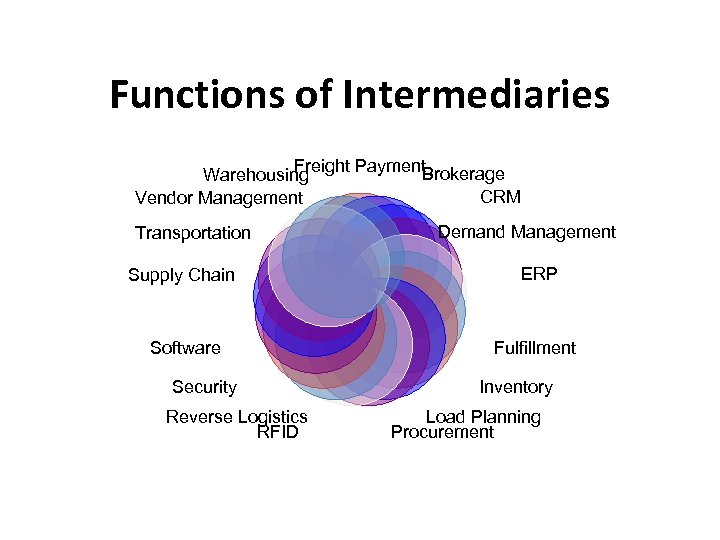
Functions of Intermediaries Freight Payment Brokerage Warehousing CRM Vendor Management Transportation Demand Management Supply Chain ERP Software Fulfillment Security Reverse Logistics RFID Inventory Load Planning Procurement
TYPES OF OF CARGO NTERMEDIARIES • • Freight forwarders/ Clearing and Forwarding agents Custom brokers Freight brokers NVOCC’s
FREIGHT FORWARDERS / CLEARING & FORWARDING AGENTS • Manage logistics between exporter and buyer. • Network of agents and warehouses overseas • Forwarders’ purchasing power means lower prices for the exporter – Ensures cost effective transportation • Close relationships with carriers, ports and terminals, and Customs – Ensures compliance with regulations – Ensures efficient transportation
FREIGHT FORWARDERS SERVICES Ensure compliance with domestic and foreign trade regulations Advice on the most appropriate mode of transport and most suitable carrier Advice on packaging and packing Take care of the documentation process Have up to date information on any changes in regulations / prices / procedures
FREIGHT FORWARDERS SERVICES • Some forwarders offer consultancy services to assist exporters or potential exporters in assessing and accessing foreign markets – Assess & monitor companies’ export transactions – Minimise financial impediments – Maximise any opportunities for financial assistance
FREIGHT FORWARDERS OPTIONAL SERVICES • Assistance to bring the goods back to the exporter if the situation so demands. • Assistance to locate the goods in case the shipment is misplaced or the cargo is stranded at some port.
CUSTOM BROKERS • Customs Brokerage is a profession that involves the 'clearing' of goods through customs barriers for importers and exporters (usually businesses). • This involves the preparation of documents and/or electronic submissions, the calculation (and usually the payment) on behalf of the client of taxes, duties and excises, and facilitating communication between the importer/exporter and governmental authorities. • Customs brokers act on behalf of the importer to clear goods through customs and deliver the items to the importer's warehouse or final destination. • Some freight forwarders are also customs brokers.
CUSTOM BROKERS • Many customs brokers specialize in certain types of transactions, such as wearing apparel, perishables, or clearing the crew and manifest of large cargo vessels. • Customs brokers can be located at inland "ports" to clear merchandise sent "in bond" but most are located at major airports and harbors with international traffic. • Customs brokers normally arrange the transshipment or local delivery of cleared merchandise through relationships with trucking companies and others. • Customs brokers must pass an examination and background check to become licensed. • Customs brokers are not government employees and should not be confused with Customs agents, although in some countries the term customs agent may mean customs broker.
FREIGHT BROKERS • A freight broker is an individual or company that serves as a liaison between another individual or company that needs shipping services and an authorized motor carrier. • Though a freight broker plays an important role in the movement of cargo, the broker doesn't function as a shipper or a carrier. • Instead, a freight broker works to determine the needs of a shipper and connects that shipper with a carrier willing to transport the items at an acceptable price. • Freight brokers are also expected to carry insurance to protect both their business clients and their customers from loss.
FREIGHT BROKERS • Freight brokers help shippers find reliable carriers that might otherwise be difficult to locate. They assist motor carriers in filling their trucks and earning money for transporting a wide variety of items. For their efforts, freight brokers earn commissions. • Freight brokers use their knowledge of the shipping industry and technological resources to help shippers and carriers accomplish their goals. Many companies find the services provided by freight brokers indispensable. In fact, some companies hire brokers to coordinate all of their shipping needs.
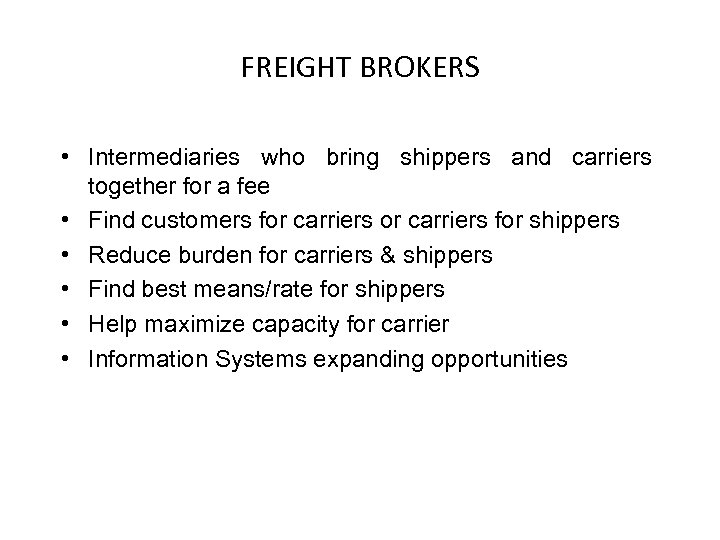
FREIGHT BROKERS • Intermediaries who bring shippers and carriers together for a fee • Find customers for carriers for shippers • Reduce burden for carriers & shippers • Find best means/rate for shippers • Help maximize capacity for carrier • Information Systems expanding opportunities
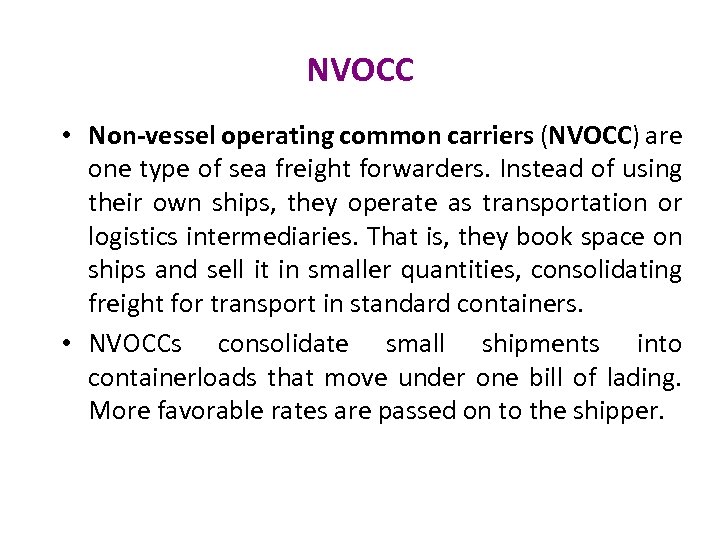
NVOCC • Non-vessel operating common carriers (NVOCC) are one type of sea freight forwarders. Instead of using their own ships, they operate as transportation or logistics intermediaries. That is, they book space on ships and sell it in smaller quantities, consolidating freight for transport in standard containers. • NVOCCs consolidate small shipments into containerloads that move under one bill of lading. More favorable rates are passed on to the shipper.
Скачать презентацию CARRIAGE OF GOODS BY SEA FEATURES
98868a656d2ee155f448420741d90ab9.ppt