


 Скачать презентацию Carnival Shrove Tuesday in Australia Shrove Tuesday is
Carnival.ppt
- Количество слайдов: 8
 Carnival/Shrove Tuesday in Australia
 Shrove Tuesday is known as Pancake Day in Australia. It is the last day before Lent for many Christians. The day may fall close to or within the dates for an annual Mardi Gras festival in Sydney.
 What do people do? • Many Australians make and share pancakes on Shrove Tuesday. Selling pancakes to raise money for charity is a popular activity. Some churches, businesses and charities hold Pancake Day events by making fresh pancakes and selling them. Proceeds from these events go towards various causes, such as support for low-income families who are experiencing tough times. Pancake Day events may also include pancake tossing races. • The Sydney Gay and Lesbian Mardi Gras may fall around the time of (but does not necessarily coincide with) Shrove Tuesday. International celebrities and pop groups have flown to Sydney to sing at the event. Sydney’s Mardi Gras parade, which features elaborate costumes and dance music, is one of the city’s highlights. However, it has attracted political opposition from various conservative Christian groups.
 • Many Christian observances and traditions, such as Shrove Tuesday, in Australia stem from the United Kingdom. Shrove Tuesday is the last day before Lent, which is a time when people traditionally fasted and avoided food containing eggs and dairy products. Families would have a feast on Shrove Tuesday. It was a time for them to eat food that contained these ingredients so that meals would not be wasted. • Pancakes became associated with Shrove Tuesday because they were a dish that could use up perishable foodstuffs such as eggs, fats and milk. Pancake races are thought to have begun in 1445. A general article about Shrove Tuesday worldwide covers more information about its background and symbols.
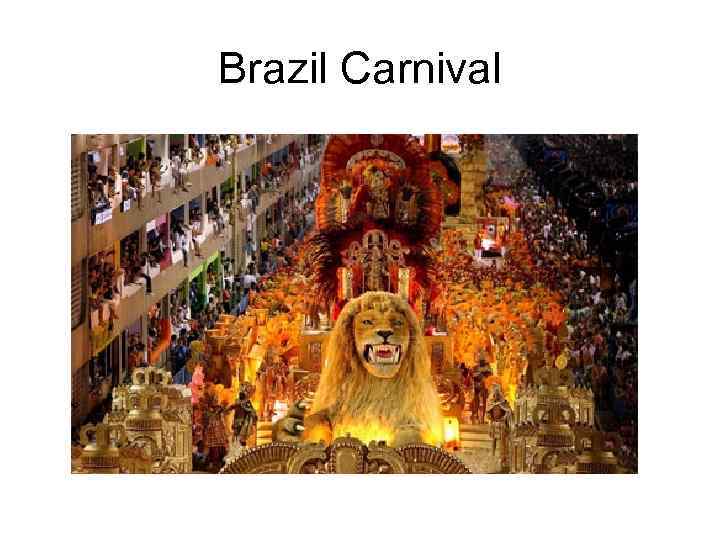 Brazil Carnival
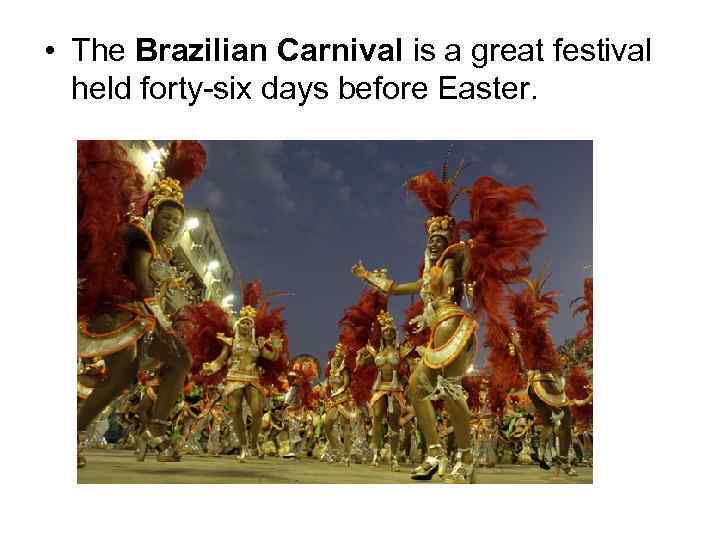 • The Brazilian Carnival is a great festival held forty-six days before Easter.
 Carnival's history • Roman Catholics and some other Christians traditionally abstained from the consumption of meat and poultry. • Carnival have roots in the pagan festival of Saturnalia, which, adapted to Christianity, became a farewell to bad things in a season of religious discipline to practice repentance and prepare for Christ's death and resurrection.
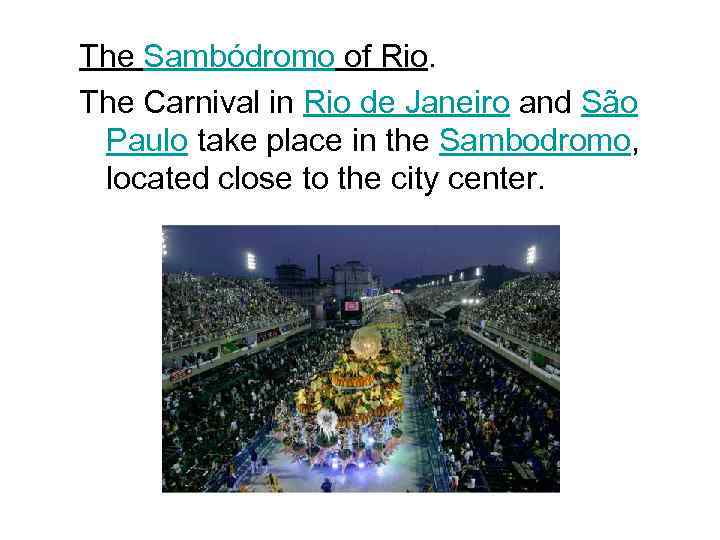 The Sambódromo of Rio. The Carnival in Rio de Janeiro and São Paulo take place in the Sambodromo, located close to the city center.