

Carnival roots Ch-t-11 -5 R Burkitbaeyeva


Carnival roots Ch-t-11 -5 R Burkitbaeyeva Madina
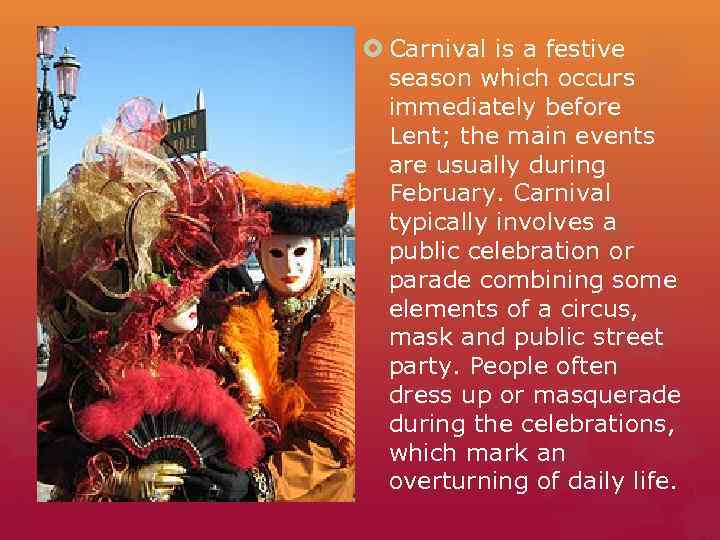
Carnival is a festive season which occurs immediately before Lent; the main events are usually during February. Carnival typically involves a public celebration or parade combining some elements of a circus, mask and public street party. People often dress up or masquerade during the celebrations, which mark an overturning of daily life.
The Lenten period of the Liturgical year Church calendar, being the six weeks directly before Easter, was marked by fasting and other pious or penitential practices. Traditionally during Lent, no parties or other celebrations were held, and people refrained from eating rich foods, such as meat, dairy, fats and sugar. The forty days of Lent, recalling the Gospel accounts of the forty days that Jesus spent in the wilderness, serve to mark an annual time of turning. In the days before Lent, all rich food and drink had to be disposed of. The consumption of this, in a giant party that involved the whole community, is thought to be the origin of Carnival.
Some of the best-known traditions, including carnival parades and masquerade ball masquerading, were first recorded in medieval Italy. The carnival of Venice was for a long time the most famous carnival. From Italy, carnival traditions spread to the Catholic nations of Spain, Portugal, and France. From France, they spread to the Rhineland of Germany, and to New France in North America. From Spain and Portugal, they spread with Catholic colonization to the Caribbean and Latin America.
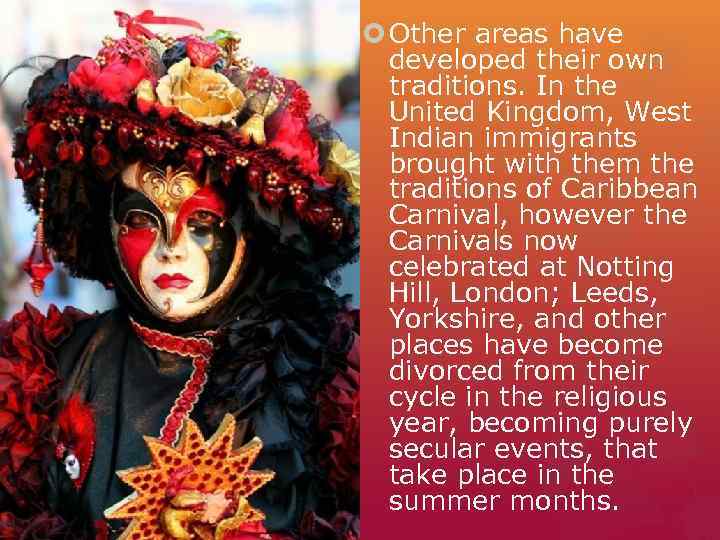
Other areas have developed their own traditions. In the United Kingdom, West Indian immigrants brought with them the traditions of Caribbean Carnival, however the Carnivals now celebrated at Notting Hill, London; Leeds, Yorkshire, and other places have become divorced from their cycle in the religious year, becoming purely secular events, that take place in the summer months.
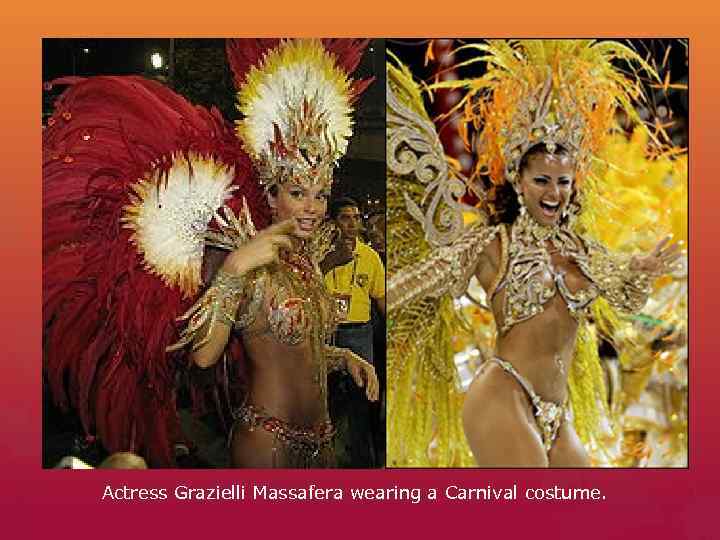
Actress Grazielli Massafera wearing a Carnival costume.
Thus, the most famous and iconic expression of the Brazilian Carnival takes place in the Rio Carnival, with samba schools parading in the Sambadrome ("sambódromo" in Portuguese). It's the largest Carnival event in this country, considered to be the largest of the kind in the world. Called "One of the biggest shows of the Earth", the festival attracts millions of tourists, both Brazilians and foreigners who come from everywhere to participate and enjoy the great show. Samba Schools are large, social entities with thousands of members and a theme for their song and parade each year. Some of the most famous samba- schools include GRES Estação Primeira de Mangueira, GRES Portela, GRES Imperatriz Leopoldinense, GRES Beija-Flor de Nilópolis, GRES Mocidade Independente de Padre Miguel, and recently, Unidos da Tijuca and GRES União da Ilha do Governador Local tourists are allowed to participate, paying ($500– 950), depending on the costume, to buy a Samba costume and dance in the parade through the Sambadrome with one of the schools.
The price paid is used to buy the tourist's own costume and also the costumes of the people who do not have the money to afford it. Blocos are generally small informal groups also with a definite theme in their samba, usually satirical of the current political situation. But there also a lot, about 30 of them in Rio de Janeiro, that are very big in number of participants, gathering hundreds of thousands of people. There are more than 440 blocos in Rio de Janeiro. Bandas are samba musical bands, also called "street carnival bands", usually (but not necessarily ) formed by enthusiasts in the same neighborhood or common musical back-ground. The Rio and Brazilian Carnival, is going "global" as a recent article by "Market Watch / The Wall Street Journal". which explained how the Carnival industry chain amassed in 2012 almost US$ 1 billion in revenues
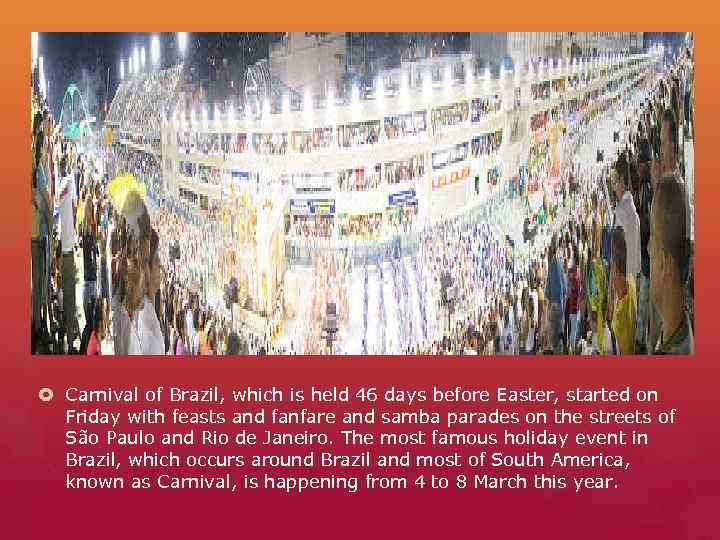
Carnival of Brazil, which is held 46 days before Easter, started on Friday with feasts and fanfare and samba parades on the streets of São Paulo and Rio de Janeiro. The most famous holiday event in Brazil, which occurs around Brazil and most of South America, known as Carnival, is happening from 4 to 8 March this year.

Thanks for attention!
 Скачать презентацию Carnival roots Ch-t-11 -5 R Burkitbaeyeva
Мадин_Карнавал (истоки).pptx
- Количество слайдов: 10