


 Скачать презентацию Carnegie Mellon Virtual Memory III 15 -213 18 -243
3c8f6aa89bd93cee27e8cfa1b471ec12.ppt
- Количество слайдов: 44
 Carnegie Mellon Virtual Memory III 15 -213/18 -243: Introduction to Computer Systems 17 th Lecture, 23 March 2010 Instructors: Bill Nace and Gregory Kesden (c) 1998 - 2010. All Rights Reserved. All work contained herein is copyrighted and used by permission of the authors. Contact 15 -213 -staff@cs. cmu. edu for permission or for more information.
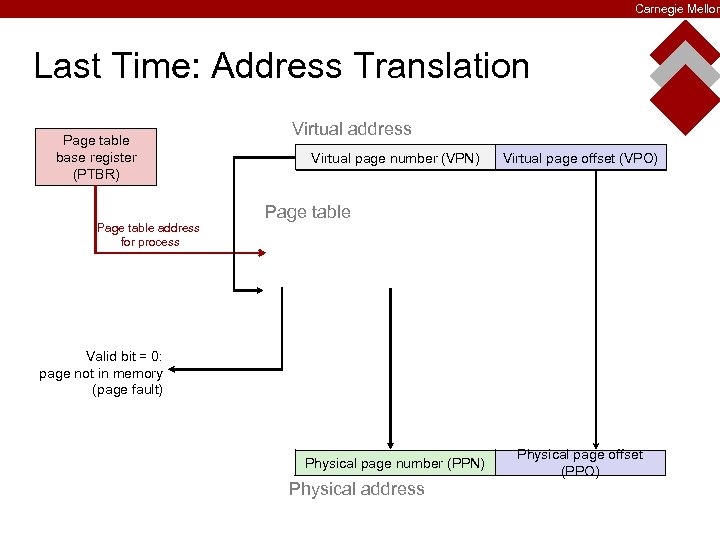 Carnegie Mellon Last Time: Address Translation Page table base register (PTBR) Page table address for process Virtual address Virtual page number (VPN)Address page offset (VPO) Virtual Page table Valid bit = 0: page not in memory (page fault) Physical page offset Physical Address Physical page number (PPN) (PPO) Physical address
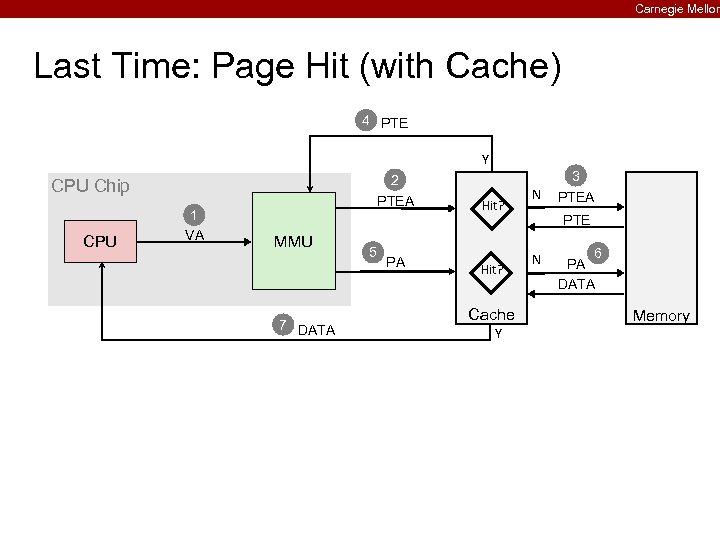 Carnegie Mellon Last Time: Page Hit (with Cache) 4 PTE Y 2 PTEA CPU Chip CPU 1 VA MMU 7 DATA 5 PA Hit? Cache Y N 3 PTEA PTE N 6 PA DATA Memory
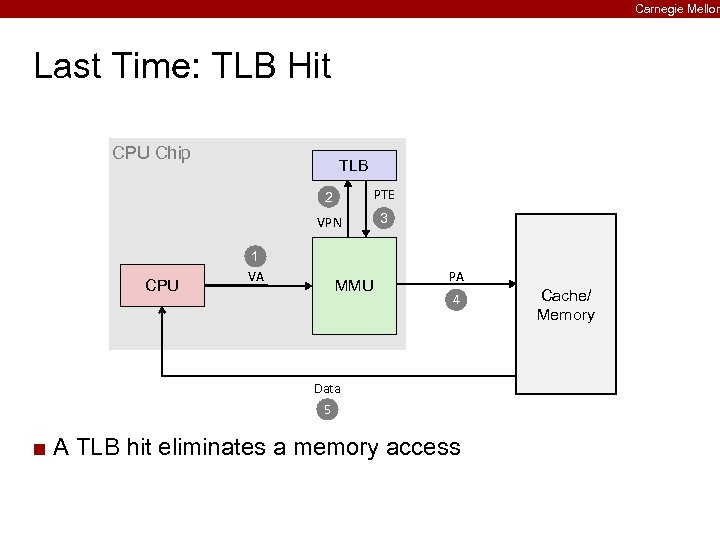 Carnegie Mellon Last Time: TLB Hit CPU Chip TLB 2 VPN CPU PTE 3 1 VA MMU PA 4 Data 5 ¢ A TLB hit eliminates a memory access Cache/ Memory
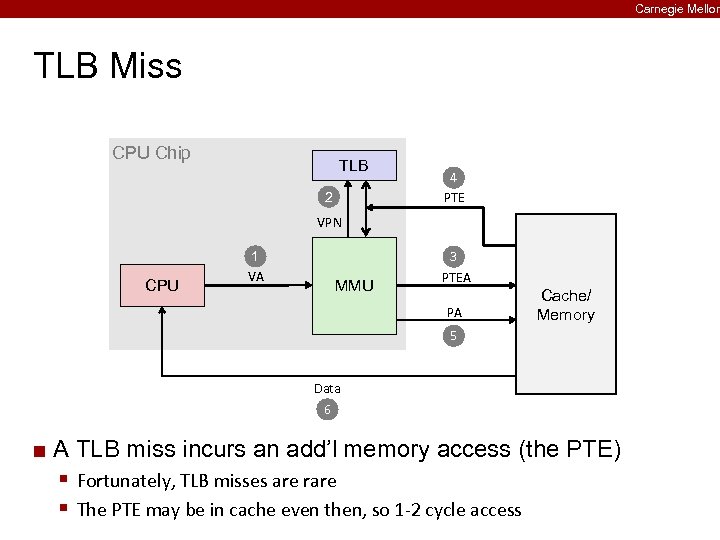 Carnegie Mellon TLB Miss CPU Chip TLB 2 4 PTE VPN CPU 1 VA MMU 3 PTEA PA Cache/ Memory 5 Data 6 ¢ A TLB miss incurs an add’l memory access (the PTE) § Fortunately, TLB misses are rare § The PTE may be in cache even then, so 1 -2 cycle access
 Carnegie Mellon Today Linux VM system ¢ Case study: VM system on P 6 ¢ Performance optimization for VM system ¢
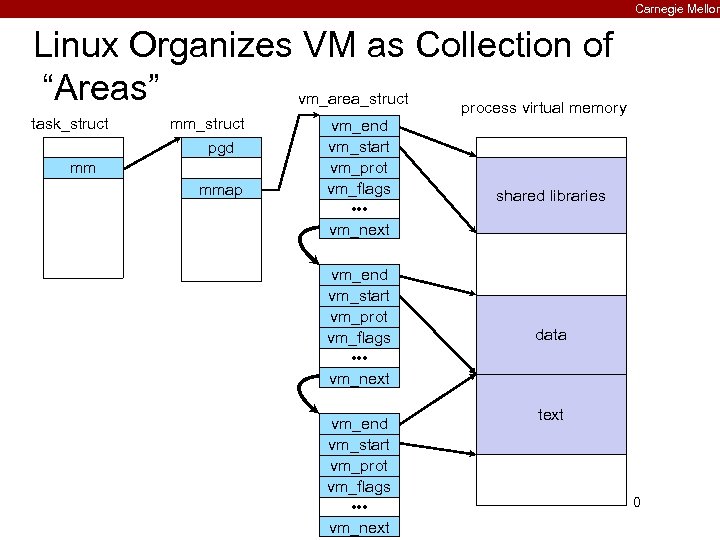 Carnegie Mellon Linux Organizes VM as Collection of “Areas” vm_area_struct process virtual memory task_struct mm_struct pgd mm mmap vm_end vm_start vm_prot vm_flags • • • vm_next shared libraries data text 0
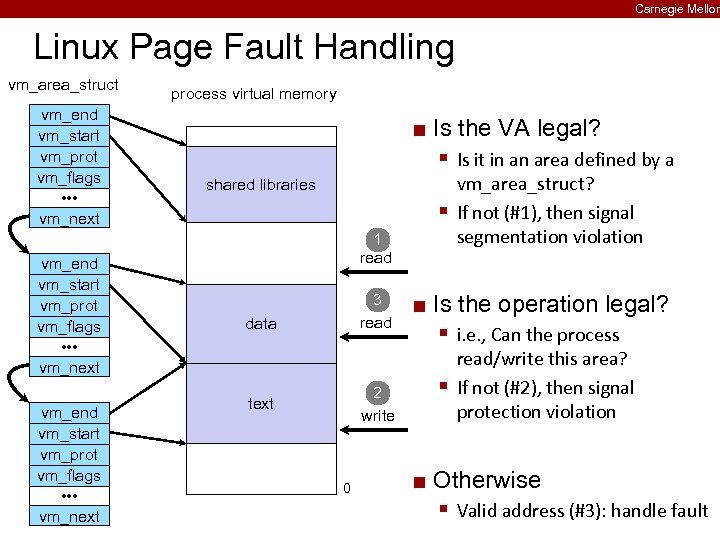 Carnegie Mellon Linux Page Fault Handling vm_area_struct vm_end vm_start vm_prot vm_flags • • • vm_next process virtual memory ¢ Is the VA legal? § Is it in an area defined by a vm_area_struct? § If not (#1), then signal segmentation violation shared libraries 1 read 3 read data ¢ § i. e. , Can the process read/write this area? § If not (#2), then signal protection violation 2 write text 0 Is the operation legal? ¢ Otherwise § Valid address (#3): handle fault
 Carnegie Mellon Memory Mapping ¢ Creation of new VM area done via “memory mapping” § Create new vm_area_struct and page tables for area ¢ Area can be backed by (i. e. , get its initial values from): § Regular file on disk (e. g. , an executable object file) Initial page bytes come from a section of a file § Nothing (e. g. , . bss) § First fault will allocate a physical page full of 0's (demand-zero) § Once the page is written to (dirtied), it is like any other page § Dirty pages are swapped back and forth between a special swap file ¢ Key point: no virtual pages are copied into physical memory until they are referenced! ¢ § Known as “demand paging” § Crucial for time and space efficiency
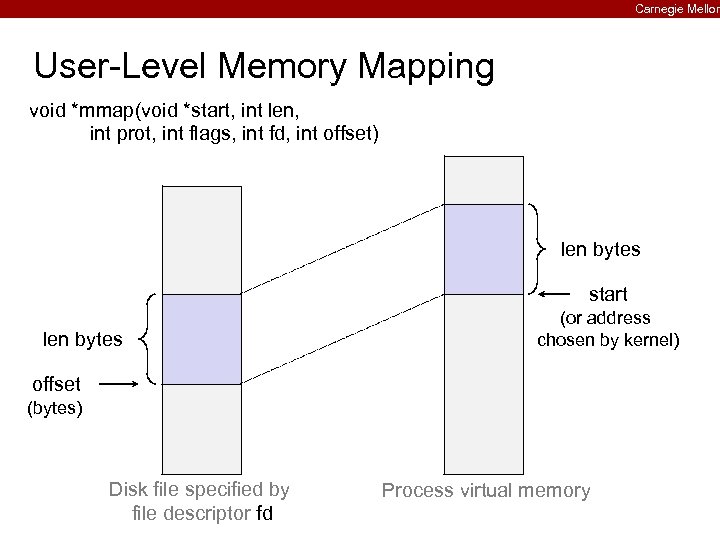 Carnegie Mellon User-Level Memory Mapping void *mmap(void *start, int len, int prot, int flags, int fd, int offset) len bytes start len bytes (or address chosen by kernel) offset (bytes) Disk file specified by file descriptor fd Process virtual memory
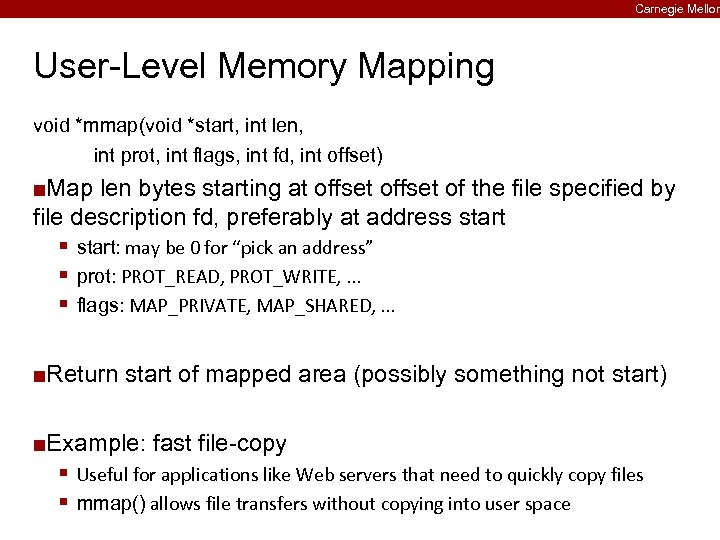 Carnegie Mellon User-Level Memory Mapping void *mmap(void *start, int len, int prot, int flags, int fd, int offset) Map len bytes starting at offset of the file specified by file description fd, preferably at address start ¢ § start: may be 0 for “pick an address” § prot: PROT_READ, PROT_WRITE, . . . § flags: MAP_PRIVATE, MAP_SHARED, . . . ¢ Return start of mapped area (possibly something not start) ¢ Example: fast file-copy § Useful for applications like Web servers that need to quickly copy files § mmap() allows file transfers without copying into user space
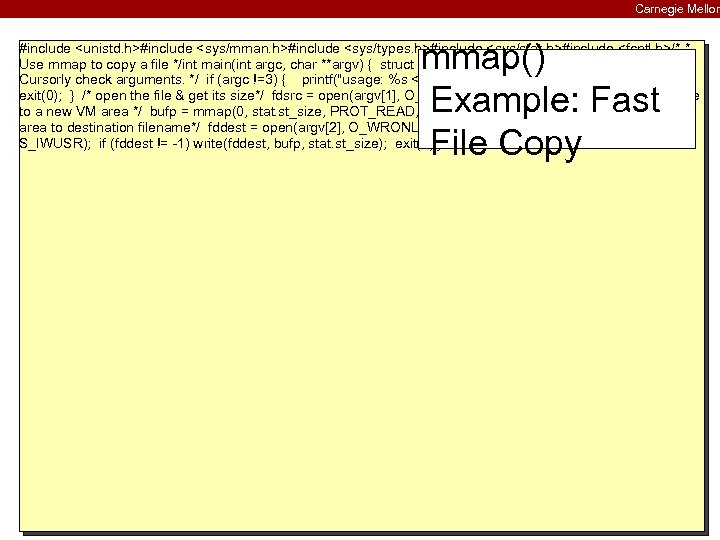 Carnegie Mellon mmap() Example: Fast File Copy #include
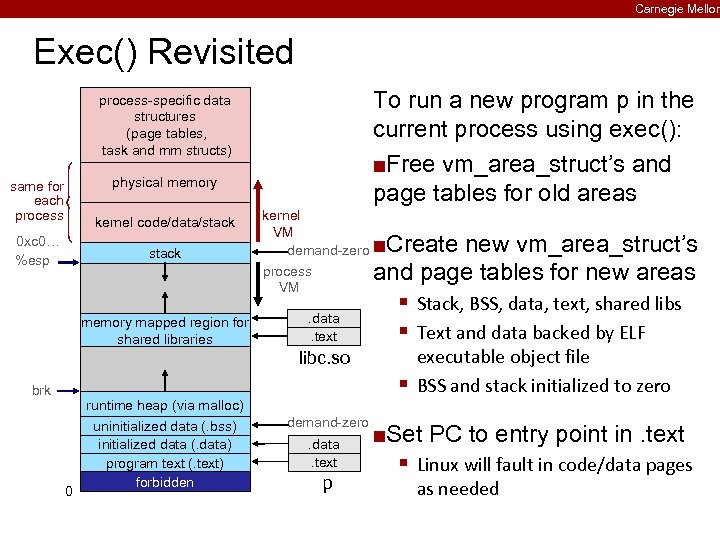 Carnegie Mellon Exec() Revisited To run a new program p in the current process using exec(): ¢Free vm_area_struct’s and page tables for old areas process-specific data structures (page tables, task and mm structs) physical memory same for each process stack kernel VM demand-zero ¢ process VM memory mapped region for shared libraries . data. text kernel code/data/stack 0 xc 0… %esp Create new vm_area_struct’s and page tables for new areas executable object file § BSS and stack initialized to zero libc. so brk § Stack, BSS, data, text, shared libs § Text and data backed by ELF runtime heap (via malloc) 0 uninitialized data (. bss) initialized data (. data) program text (. text) forbidden demand-zero. data. text p ¢ Set PC to entry point in. text § Linux will fault in code/data pages as needed
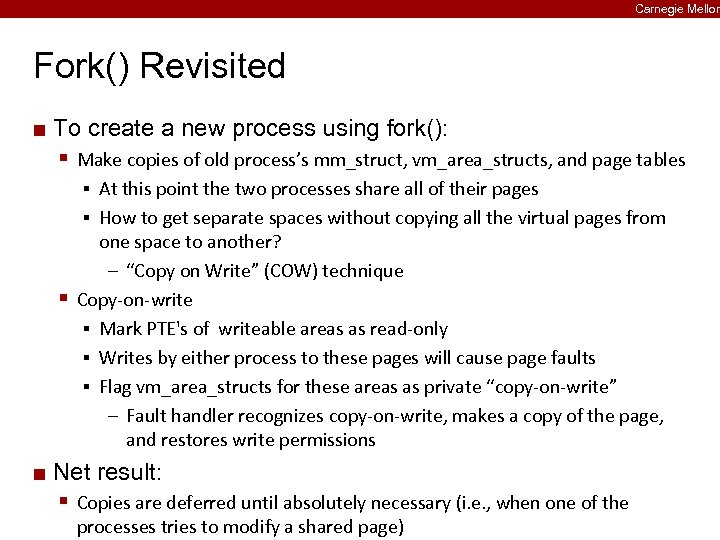 Carnegie Mellon Fork() Revisited ¢ To create a new process using fork(): § Make copies of old process’s mm_struct, vm_area_structs, and page tables At this point the two processes share all of their pages § How to get separate spaces without copying all the virtual pages from one space to another? – “Copy on Write” (COW) technique § Copy-on-write § Mark PTE's of writeable areas as read-only § Writes by either process to these pages will cause page faults § Flag vm_area_structs for these areas as private “copy-on-write” – Fault handler recognizes copy-on-write, makes a copy of the page, and restores write permissions § ¢ Net result: § Copies are deferred until absolutely necessary (i. e. , when one of the processes tries to modify a shared page)
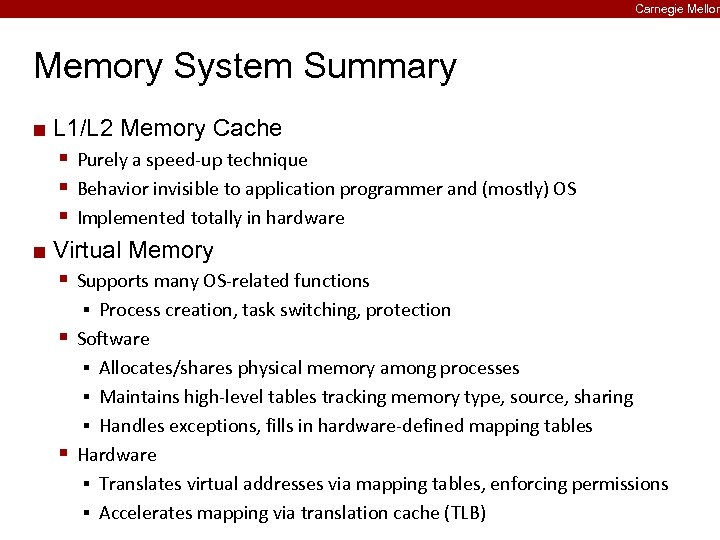 Carnegie Mellon Memory System Summary ¢ L 1/L 2 Memory Cache § Purely a speed-up technique § Behavior invisible to application programmer and (mostly) OS § Implemented totally in hardware ¢ Virtual Memory § Supports many OS-related functions Process creation, task switching, protection § Software § Allocates/shares physical memory among processes § Maintains high-level tables tracking memory type, source, sharing § Handles exceptions, fills in hardware-defined mapping tables § Hardware § Translates virtual addresses via mapping tables, enforcing permissions § Accelerates mapping via translation cache (TLB) §
 Carnegie Mellon Today Linux VM system ¢ Case study: VM system on P 6 ¢ Performance optimization for VM system ¢
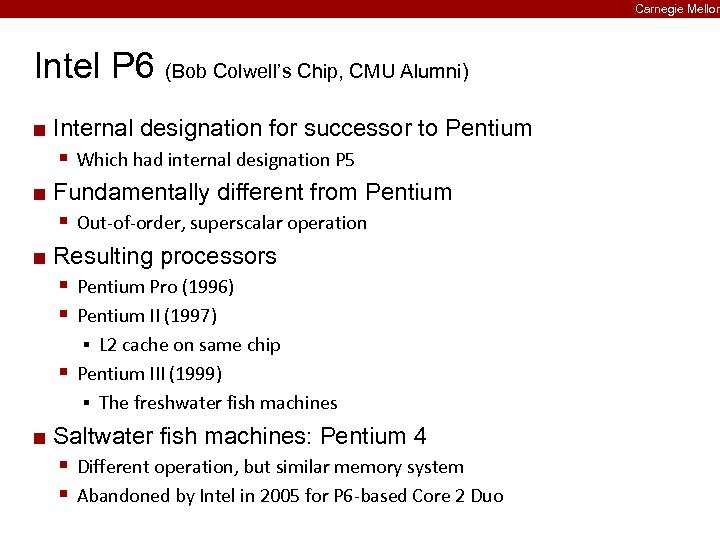 Carnegie Mellon Intel P 6 (Bob Colwell’s Chip, CMU Alumni) ¢ Internal designation for successor to Pentium § Which had internal designation P 5 ¢ Fundamentally different from Pentium § Out-of-order, superscalar operation ¢ Resulting processors § Pentium Pro (1996) § Pentium II (1997) L 2 cache on same chip § Pentium III (1999) § The freshwater fish machines § ¢ Saltwater fish machines: Pentium 4 § Different operation, but similar memory system § Abandoned by Intel in 2005 for P 6 -based Core 2 Duo
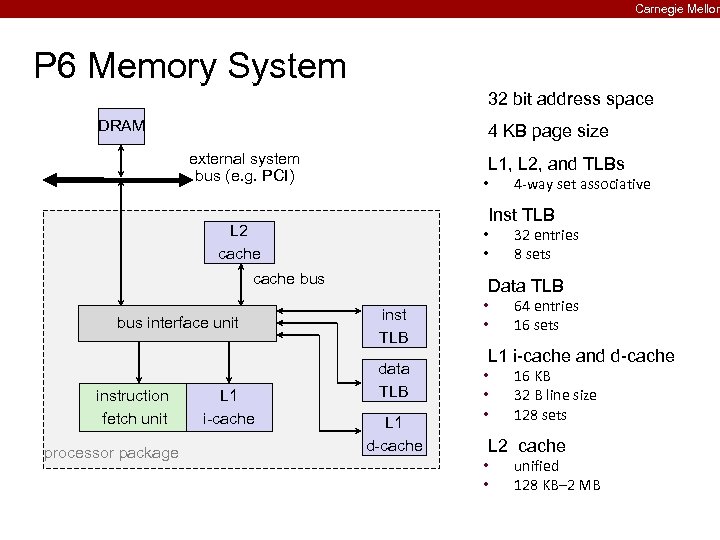 Carnegie Mellon P 6 Memory System 32 bit address space DRAM 4 KB page size external system bus (e. g. PCI) L 1, L 2, and TLBs • 4 -way set associative Inst TLB • 32 entries • 8 sets L 2 cache bus interface unit instruction fetch unit processor package L 1 i-cache inst TLB data TLB L 1 d-cache Data TLB • 64 entries • 16 sets L 1 i-cache and d-cache • 16 KB • 32 B line size • 128 sets L 2 cache • unified • 128 KB– 2 MB
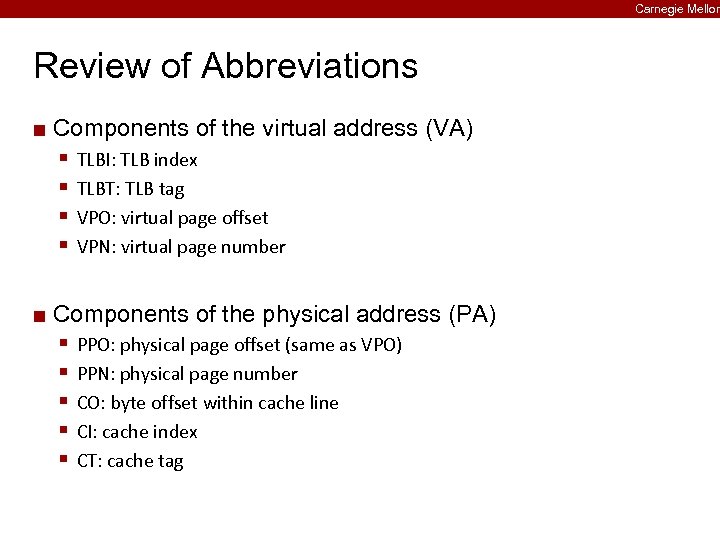 Carnegie Mellon Review of Abbreviations ¢ Components of the virtual address (VA) § § ¢ TLBI: TLB index TLBT: TLB tag VPO: virtual page offset VPN: virtual page number Components of the physical address (PA) § § § PPO: physical page offset (same as VPO) PPN: physical page number CO: byte offset within cache line CI: cache index CT: cache tag
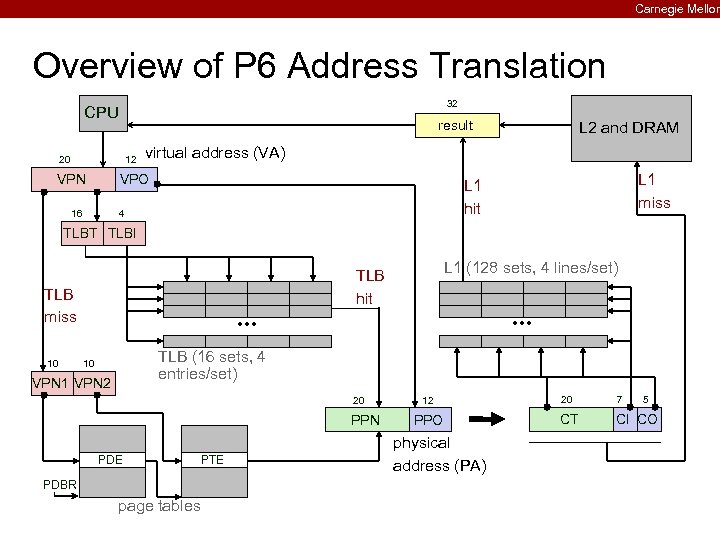 Carnegie Mellon Overview of P 6 Address Translation 32 CPU result 20 12 VPN virtual address (VA) VPO 16 L 2 and DRAM L 1 miss L 1 hit 4 TLBT TLBI TLB miss 10 L 1 (128 sets, 4 lines/set) TLB hit • • • TLB (16 sets, 4 entries/set) 10 VPN 1 VPN 2 20 PPN PDE PTE PDBR page tables 12 20 7 PPO CT CI CO physical address (PA) 5
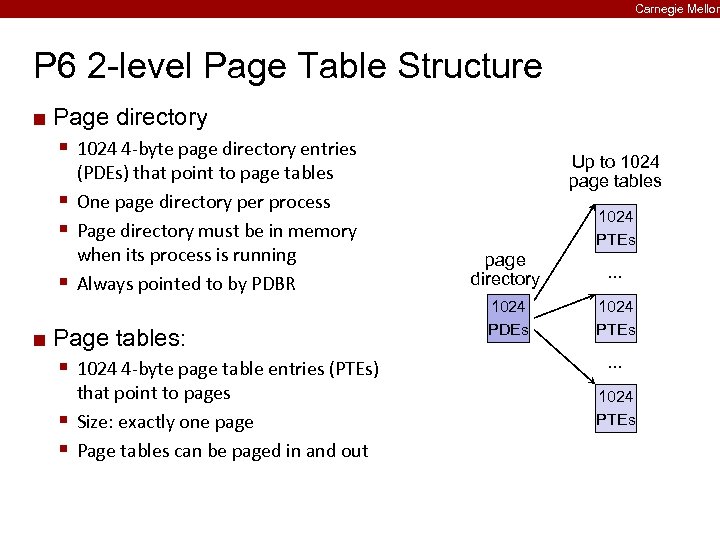 Carnegie Mellon P 6 2 -level Page Table Structure ¢ Page directory § 1024 4 -byte page directory entries (PDEs) that point to page tables § One page directory per process § Page directory must be in memory when its process is running § Always pointed to by PDBR ¢ Page tables: § 1024 4 -byte page table entries (PTEs) that point to pages § Size: exactly one page § Page tables can be paged in and out Up to 1024 page tables 1024 PTEs page directory . . . 1024 PDEs 1024 PTEs . . . 1024 PTEs
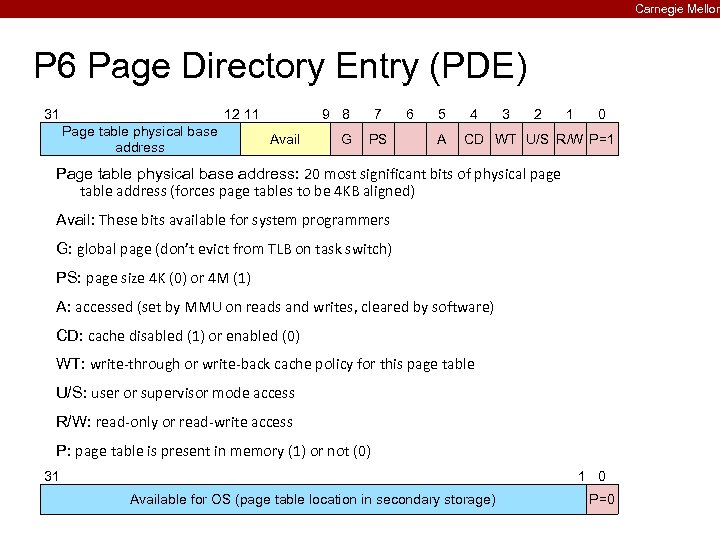 Carnegie Mellon P 6 Page Directory Entry (PDE) 31 12. 11 Page table physical base address 9. 8 Avail G 7 PS 6 5 A 4 3 2 1 0 CD WT U/S R/W P=1 Page table physical base address: 20 most significant bits of physical page table address (forces page tables to be 4 KB aligned) Avail: These bits available for system programmers G: global page (don’t evict from TLB on task switch) PS: page size 4 K (0) or 4 M (1) A: accessed (set by MMU on reads and writes, cleared by software) CD: cache disabled (1) or enabled (0) WT: write-through or write-back cache policy for this page table U/S: user or supervisor mode access R/W: read-only or read-write access P: page table is present in memory (1) or not (0) 31 1. 0 Available for OS (page table location in secondary storage) P=0
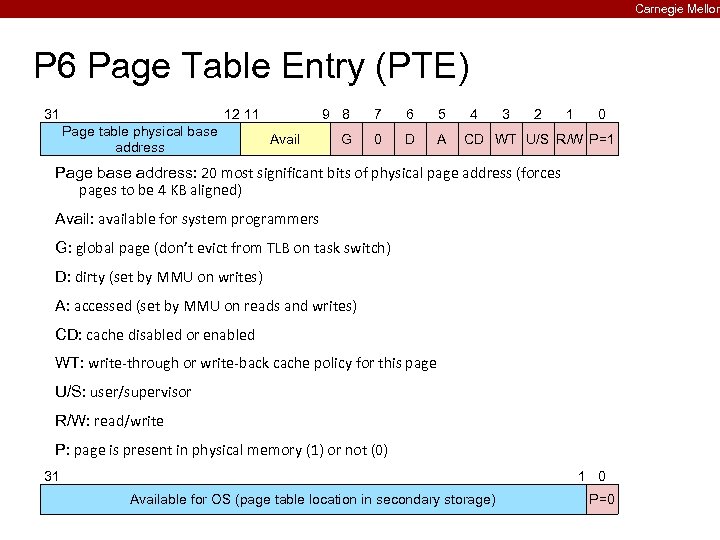 Carnegie Mellon P 6 Page Table Entry (PTE) 31 12. 11 Page table physical base address 9. 8 Avail 7 6 5 G 0 D A 4 3 2 1 0 CD WT U/S R/W P=1 Page base address: 20 most significant bits of physical page address (forces pages to be 4 KB aligned) Avail: available for system programmers G: global page (don’t evict from TLB on task switch) D: dirty (set by MMU on writes) A: accessed (set by MMU on reads and writes) CD: cache disabled or enabled WT: write-through or write-back cache policy for this page U/S: user/supervisor R/W: read/write P: page is present in physical memory (1) or not (0) 31 1. 0 Available for OS (page table location in secondary storage) P=0
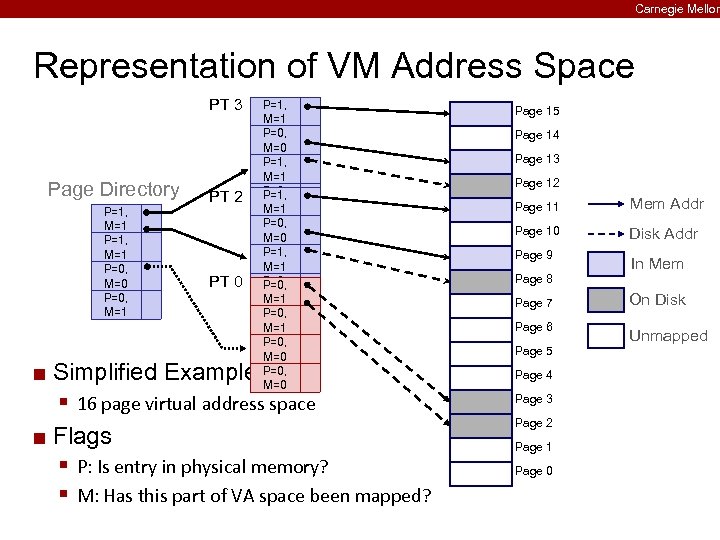 Carnegie Mellon Representation of VM Address Space PT 3 Page Directory P=1, M=1 P=0, M=0 P=0, M=1 ¢ PT 2 PT 0 Simplified Example P=1, M=1 P=0, M=0 P=1, M=1 P=0, M=1 P=0, M=0 § 16 page virtual address space ¢ Flags § P: Is entry in physical memory? § M: Has this part of VA space been mapped? Page 15 Page 14 Page 13 Page 12 Page 11 Mem Addr Page 10 Disk Addr Page 9 In Mem Page 8 Page 7 Page 6 Page 5 Page 4 Page 3 Page 2 Page 1 Page 0 On Disk Unmapped
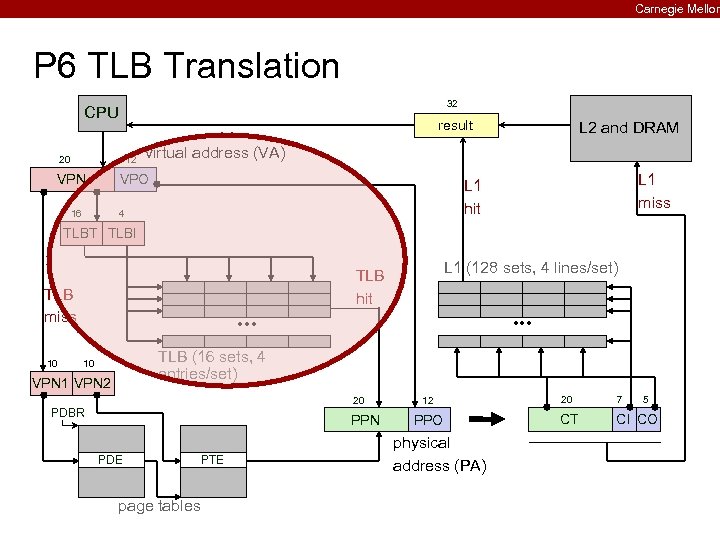 Carnegie Mellon P 6 TLB Translation 32 CPU result 20 12 VPN virtual address (VA) VPO 16 L 2 and DRAM L 1 miss L 1 hit 4 TLBT TLBI TLB miss 10 L 1 (128 sets, 4 lines/set) TLB hit • • • TLB (16 sets, 4 entries/set) 10 VPN 1 VPN 2 20 PDBR PPN PDE page tables PTE 12 20 7 PPO CT CI CO physical address (PA) 5
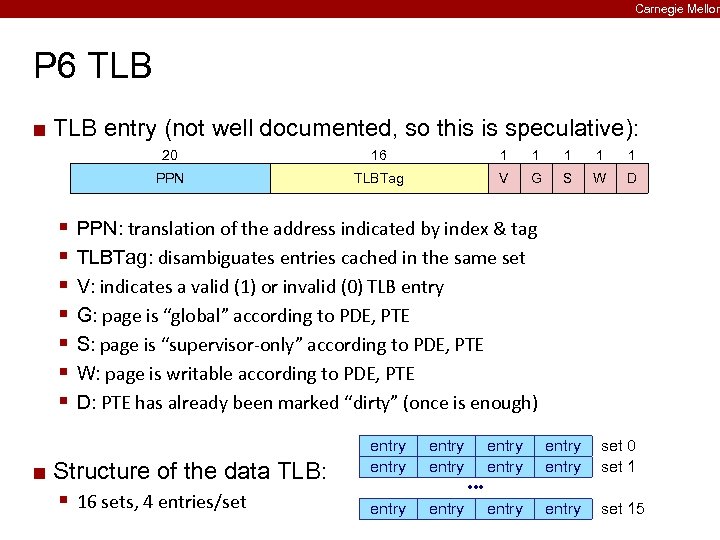 Carnegie Mellon P 6 TLB ¢ TLB entry (not well documented, so this is speculative): 20 ¢ 1 1 1 PPN § § § § 16 TLBTag V G S W D PPN: translation of the address indicated by index & tag TLBTag: disambiguates entries cached in the same set V: indicates a valid (1) or invalid (0) TLB entry G: page is “global” according to PDE, PTE S: page is “supervisor-only” according to PDE, PTE W: page is writable according to PDE, PTE D: PTE has already been marked “dirty” (once is enough) Structure of the data TLB: § 16 sets, 4 entries/set entry entry set 0 set 1 entry set 15 • • • entry
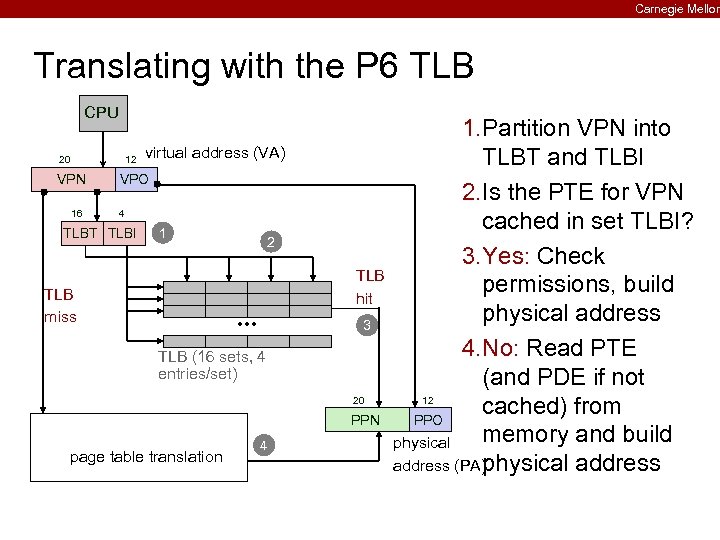 Carnegie Mellon Translating with the P 6 TLB CPU 20 12 VPN 16 virtual address (VA) VPO 4 TLBT TLBI 1 2 TLB hit TLB miss • • • 3 TLB (16 sets, 4 entries/set) 20 PPN page table translation 4 1. Partition VPN into TLBT and TLBI 2. Is the PTE for VPN cached in set TLBI? 3. Yes: Check permissions, build physical address 4. No: Read PTE (and PDE if not 12 cached) from PPO memory and build physical address (PA) physical address
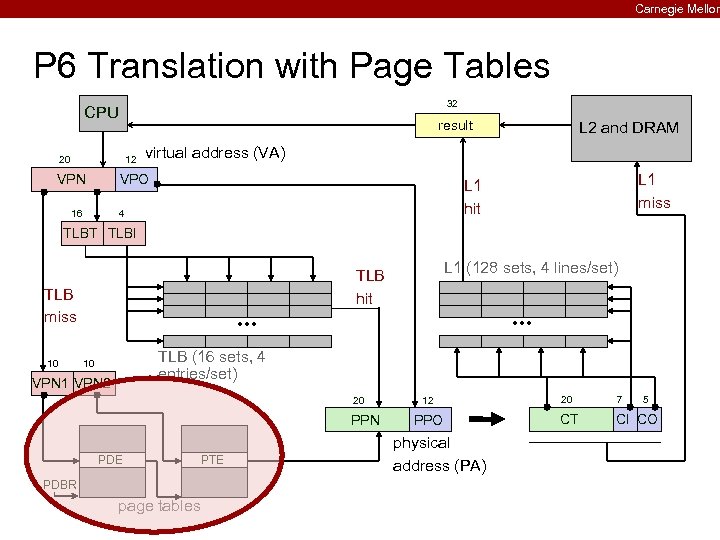 Carnegie Mellon P 6 Translation with Page Tables 32 CPU result 20 12 VPN virtual address (VA) VPO 16 L 2 and DRAM L 1 miss L 1 hit 4 TLBT TLBI TLB miss 10 L 1 (128 sets, 4 lines/set) TLB hit • • • TLB (16 sets, 4 entries/set) 10 VPN 1 VPN 2 20 PPN PDE PTE PDBR page tables 12 20 7 PPO CT CI CO physical address (PA) 5
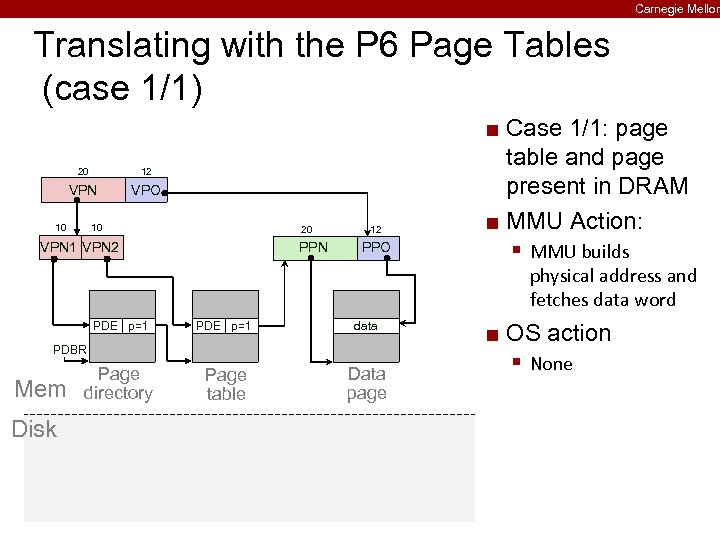 Carnegie Mellon Translating with the P 6 Page Tables (case 1/1) Case 1/1: page table and page present in DRAM ¢ MMU Action: ¢ 20 12 VPN VPO 10 10 20 VPN 1 VPN 2 PPN 12 § MMU builds PPO physical address and fetches data word PDE p=1 data Page directory Page table Data page PDBR Mem Disk ¢ OS action § None
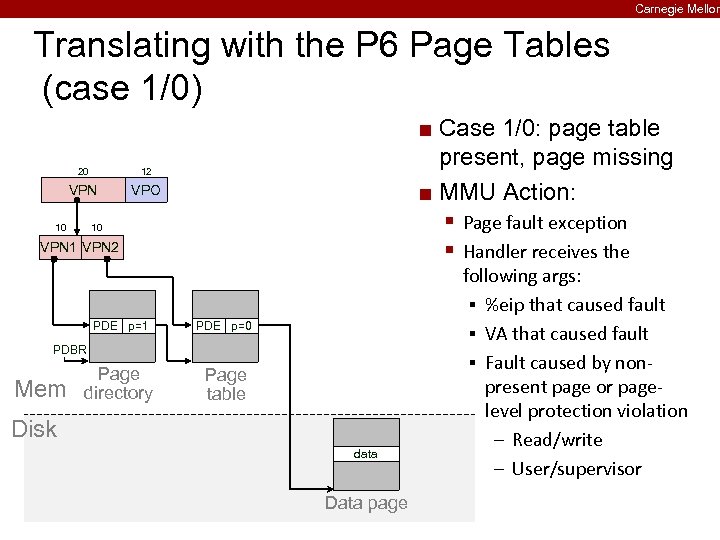 Carnegie Mellon Translating with the P 6 Page Tables (case 1/0) Case 1/0: page table present, page missing ¢ MMU Action: ¢ 20 12 VPN VPO 10 § Page fault exception § Handler receives the 10 VPN 1 VPN 2 PDE p=1 PDE p=0 Page directory Page table PDBR Mem Disk data Data page following args: § %eip that caused fault § VA that caused fault § Fault caused by nonpresent page or pagelevel protection violation – Read/write – User/supervisor
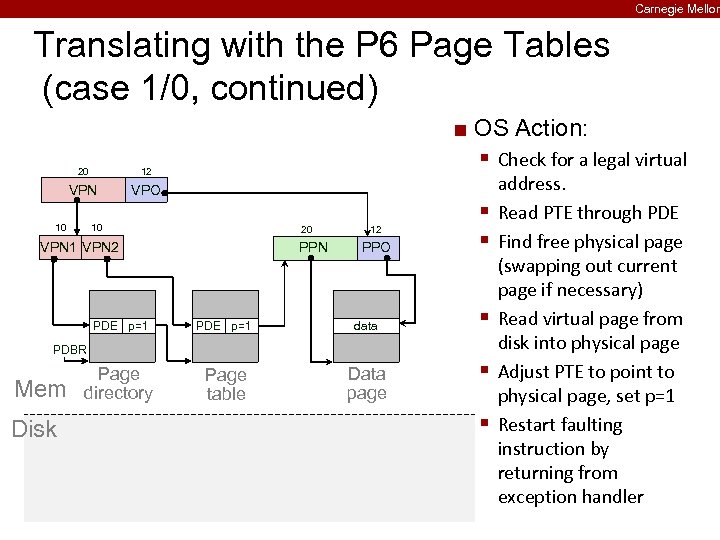 Carnegie Mellon Translating with the P 6 Page Tables (case 1/0, continued) ¢ 20 § Check for a legal virtual 12 VPN OS Action: VPO 10 10 20 VPN 1 VPN 2 PPN 12 PPO PDE p=1 data Page directory Page table Data page § § § PDBR Mem Disk § § address. Read PTE through PDE Find free physical page (swapping out current page if necessary) Read virtual page from disk into physical page Adjust PTE to point to physical page, set p=1 Restart faulting instruction by returning from exception handler
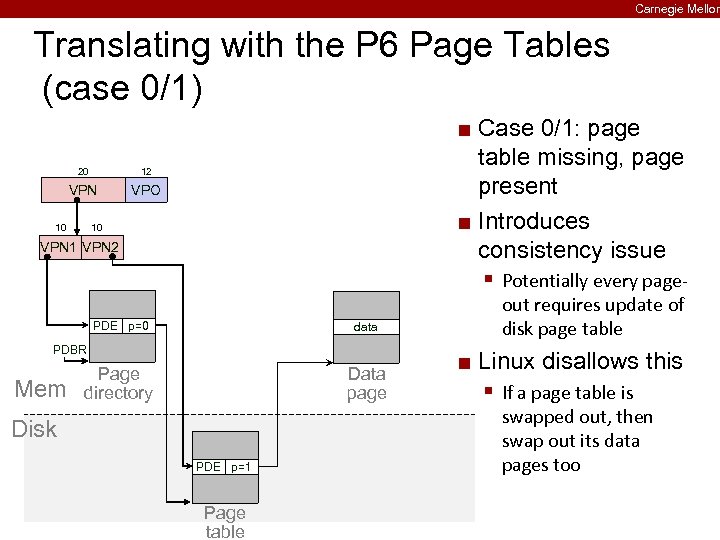 Carnegie Mellon Translating with the P 6 Page Tables (case 0/1) Case 0/1: page table missing, page present ¢ Introduces consistency issue ¢ 20 12 VPN VPO 10 10 VPN 1 VPN 2 § Potentially every page. PDE p=0 data Page directory Data page out requires update of disk page table PDBR Mem Disk PDE p=1 Page table ¢ Linux disallows this § If a page table is swapped out, then swap out its data pages too
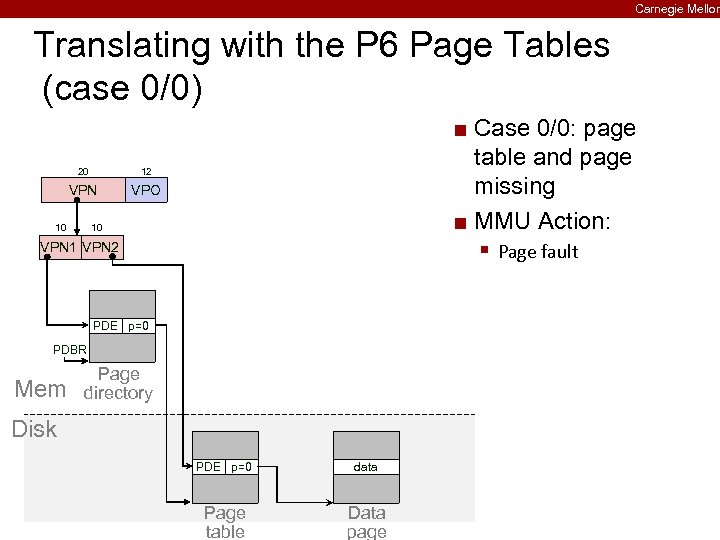 Carnegie Mellon Translating with the P 6 Page Tables (case 0/0) Case 0/0: page table and page missing ¢ MMU Action: ¢ 20 12 VPN VPO 10 10 § Page fault VPN 1 VPN 2 PDE p=0 PDBR Mem Page directory Disk PDE p=0 data Page table Data page
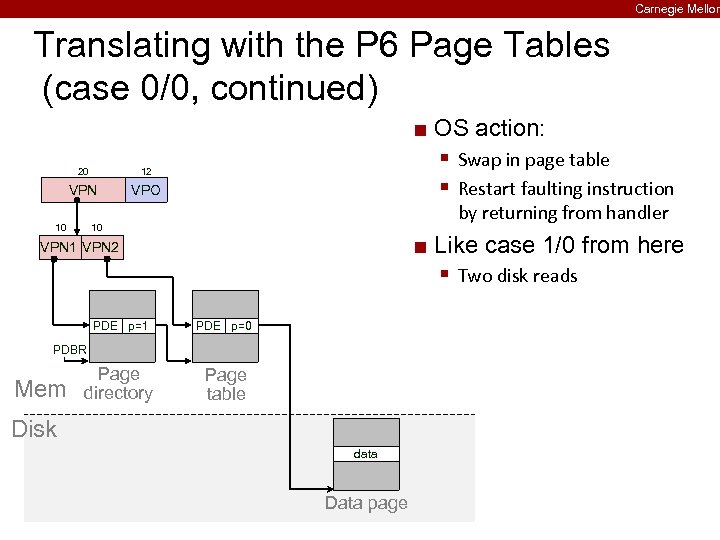 Carnegie Mellon Translating with the P 6 Page Tables (case 0/0, continued) ¢ 20 § Swap in page table § Restart faulting instruction 12 VPN VPO 10 OS action: by returning from handler 10 VPN 1 VPN 2 ¢ Like case 1/0 from here § Two disk reads PDE p=1 PDE p=0 Page directory Page table PDBR Mem Disk data Data page
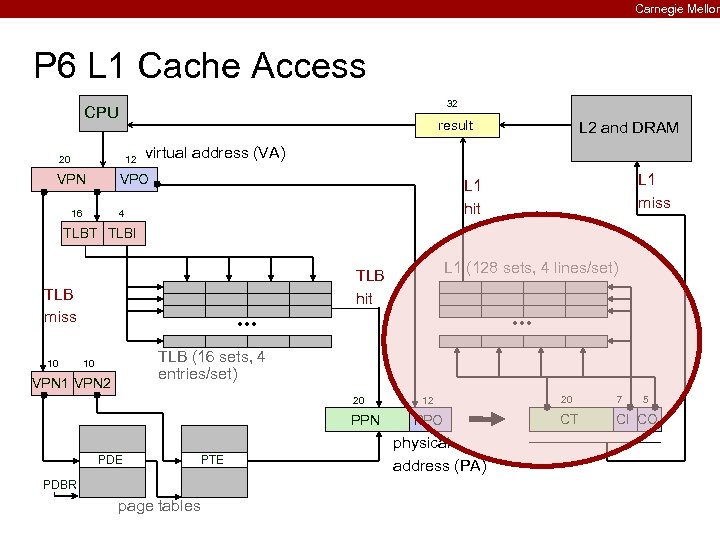 Carnegie Mellon P 6 L 1 Cache Access 32 CPU result 20 12 VPN virtual address (VA) VPO 16 L 2 and DRAM L 1 miss L 1 hit 4 TLBT TLBI TLB miss 10 L 1 (128 sets, 4 lines/set) TLB hit • • • TLB (16 sets, 4 entries/set) 10 VPN 1 VPN 2 20 PPN PDE PTE PDBR page tables 12 20 7 PPO CT CI CO physical address (PA) 5
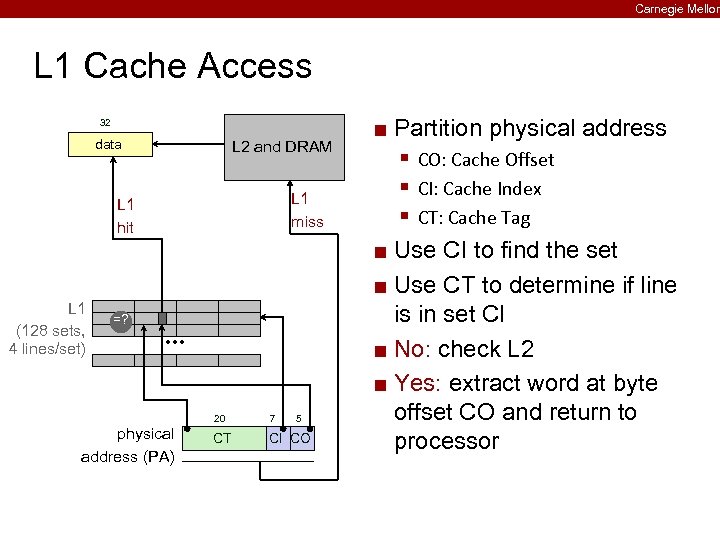 Carnegie Mellon L 1 Cache Access 32 data L 2 and DRAM ¢ § CO: Cache Offset § CI: Cache Index § CT: Cache Tag L 1 miss L 1 hit Use CI to find the set ¢ Use CT to determine if line is in set CI ¢ No: check L 2 ¢ Yes: extract word at byte offset CO and return to processor ¢ L 1 (128 sets, 4 lines/set) =? • • • 20 physical address (PA) 7 5 CT CI CO Partition physical address
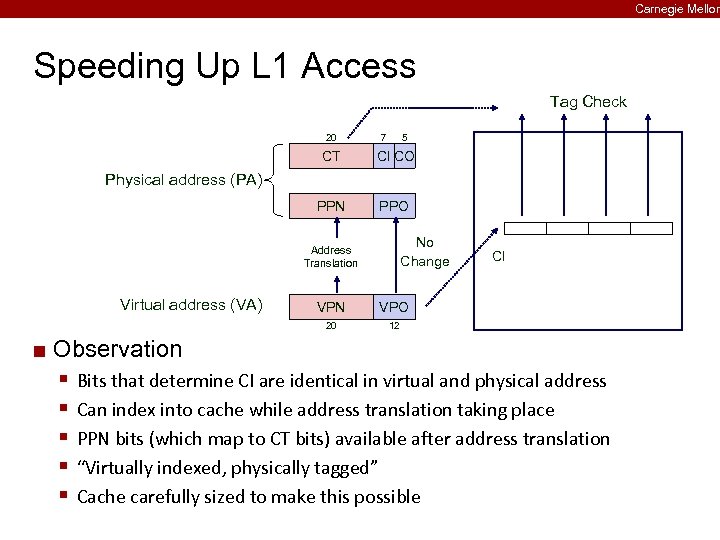 Carnegie Mellon Speeding Up L 1 Access Tag Check 20 7 5 CT CI CO PPN PPO Physical address (PA) No Change Address Translation Virtual address (VA) VPO 20 ¢ VPN CI 12 Observation § § § Bits that determine CI are identical in virtual and physical address Can index into cache while address translation taking place PPN bits (which map to CT bits) available after address translation “Virtually indexed, physically tagged” Cache carefully sized to make this possible
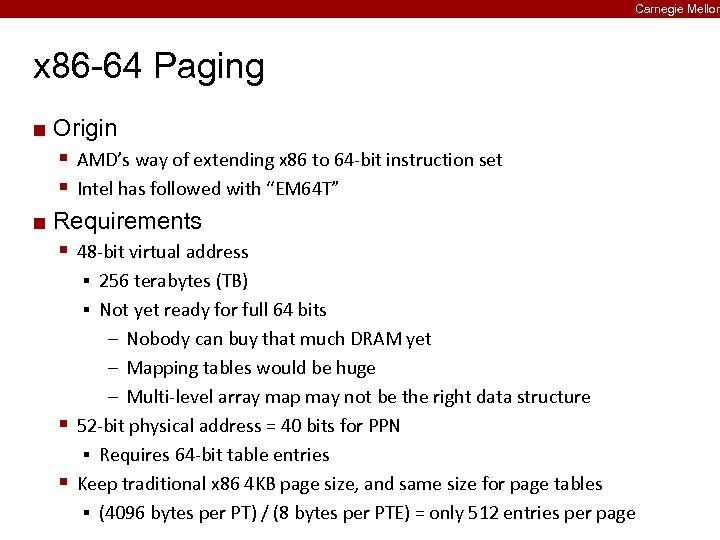 Carnegie Mellon x 86 -64 Paging ¢ Origin § AMD’s way of extending x 86 to 64 -bit instruction set § Intel has followed with “EM 64 T” ¢ Requirements § 48 -bit virtual address 256 terabytes (TB) § Not yet ready for full 64 bits – Nobody can buy that much DRAM yet – Mapping tables would be huge – Multi-level array map may not be the right data structure § 52 -bit physical address = 40 bits for PPN § Requires 64 -bit table entries § Keep traditional x 86 4 KB page size, and same size for page tables § (4096 bytes per PT) / (8 bytes per PTE) = only 512 entries per page §
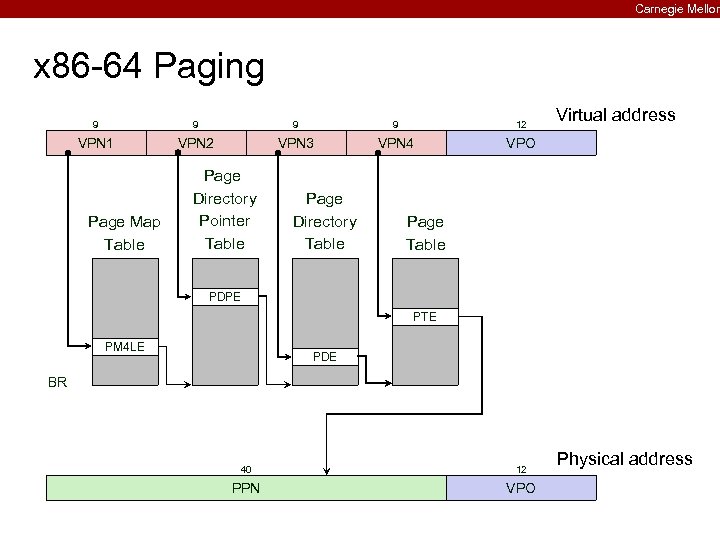 Carnegie Mellon x 86 -64 Paging 9 9 12 VPN 1 VPN 2 VPN 3 VPN 4 Virtual address VPO Page Map Table Page Directory Pointer Table Page Directory Table Page Table PDPE PTE PM 4 LE PDE BR 40 12 PPN VPO Physical address
 Carnegie Mellon Today Linux VM system ¢ Case study: VM system on P 6 ¢ Performance optimization for VM system ¢
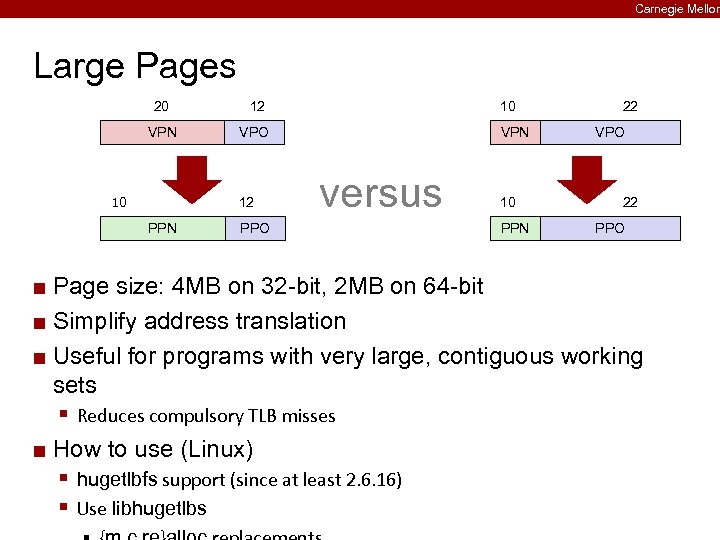 Carnegie Mellon Large Pages 20 12 VPN VPO 10 12 PPN 10 VPN versus PPO 10 PPN 22 VPO 22 PPO Page size: 4 MB on 32 -bit, 2 MB on 64 -bit ¢ Simplify address translation ¢ Useful for programs with very large, contiguous working sets ¢ § Reduces compulsory TLB misses ¢ How to use (Linux) § hugetlbfs support (since at least 2. 6. 16) § Use libhugetlbs
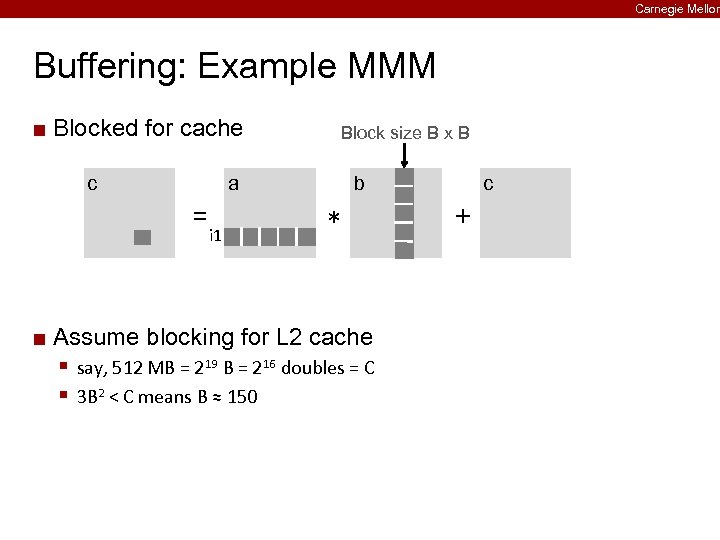 Carnegie Mellon Buffering: Example MMM ¢ Blocked for cache c ¢ = i 1 Block size B x B a b * Assume blocking for L 2 cache § say, 512 MB = 219 B = 216 doubles = C § 3 B 2 < C means B ≈ 150 + c
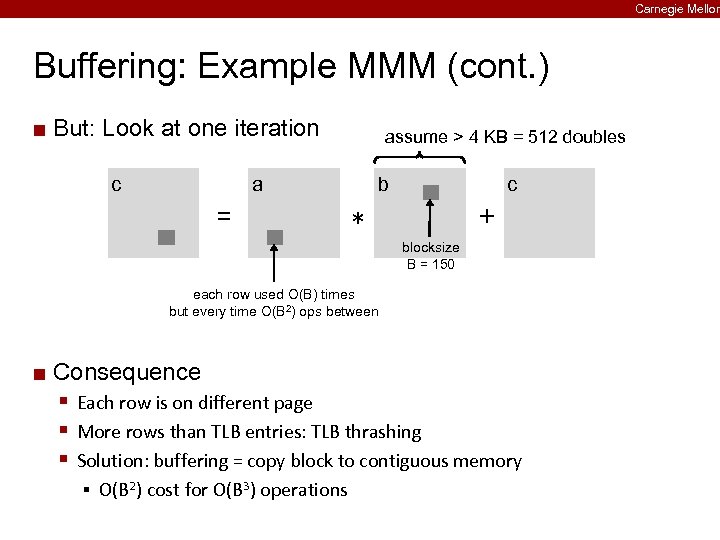 Carnegie Mellon Buffering: Example MMM (cont. ) ¢ But: Look at one iteration c = assume > 4 KB = 512 doubles a b * + c blocksize B = 150 each row used O(B) times but every time O(B 2) ops between ¢ Consequence § Each row is on different page § More rows than TLB entries: TLB thrashing § Solution: buffering = copy block to contiguous memory § O(B 2) cost for O(B 3) operations
 Carnegie Mellon Summary Linux VM system ¢ Case study: VM system on P 6 ¢ Performance optimization for VM system ¢ ¢ Next Time: Dynamic Memory Allocation (1 of 2) § Explicit / Implicit memory management § malloc and free § Fragmentation