

Carl Sandberg «And all poets love dust and

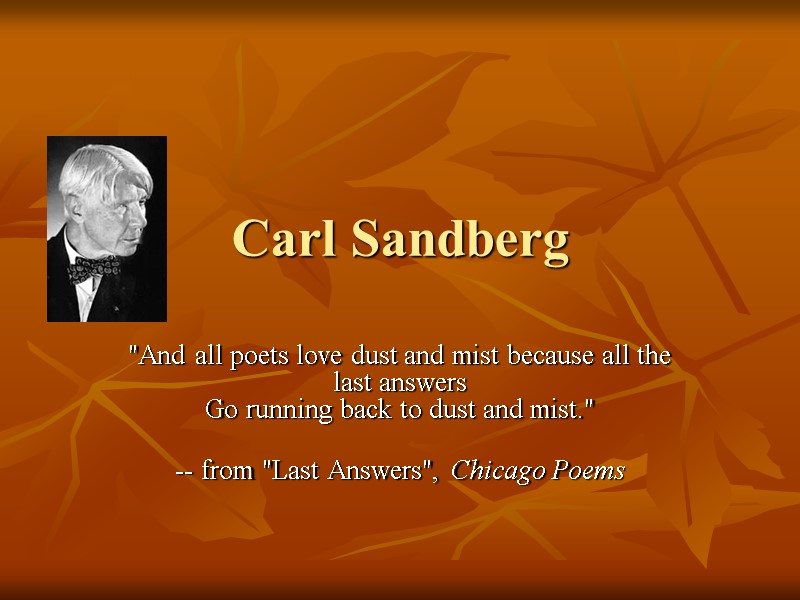
Carl Sandberg "And all poets love dust and mist because all the last answers Go running back to dust and mist." -- from "Last Answers", Chicago Poems
1878 Carl Sandburg was born in Galesburg, Illinois on January 6, 1878. He lived to become a Pulitzer Prize winning poet and biographer of Abraham Lincoln, novelist, journalist, children's author, and troubador of American folk songs. He grew up in the fields of Illinois, travelled the box cars of the midwest, campaigned for the Socialist party, was film critic and Chicago advocate. (1910s-20s) Carl Sandburg's poetry expresses the hearty, earthy nature of America, finding both soft and harsh beauty amongst her people.
1916 The Sandburgs soon moved to Chicago, where Carl became an editorial writer for the Chicago Daily News. Harriet Monroe had just started Poetry: A Magazine of Verse, and began publishing Sandburg's poems, encouraging him to continue writing in the free-verse, Whitman-like style he had cultivated in college. Monroe liked the poems' homely speech, which distinguished Sandburg from his predecessors. It was during this period that Sandburg was recognized as a member of the Chicago literary renaissance, which included Ben Hecht, Theodore Dreiser, Sherwood Anderson, and Edgar Lee Masters.
1916 He established his reputation with Chicago Poems (1916), and then Cornhuskers (1918). Soon after the publication of these volumes Sandburg wrote Smoke and Steel (1920), his first prolonged attempt to find beauty in modern industrialism. With these three volumes, Sandburg became known for his free verse poems celebrating industrial and agricultural America, American geography and landscape, and the American common people.
In the 1920s In the twenties, he started some of his most ambitious projects, including his study of Abraham Lincoln. From childhood, Sandburg loved and admired the legacy of President Lincoln. For thirty years he sought out and collected material, and gradually began the writing of the six-volume definitive biography of the former president. The twenties also saw Sandburg's collections of American folklore, the ballads in The American Songbag and The New American Songbag (1950), and books for children. These later volumes contained pieces collected from brief tours across America which Sandburg took each year, playing his banjo or guitar, singing folk-songs, and reciting poems.
In the 1930s In the 1930s, Sandburg continued his celebration of America with Mary Lincoln, Wife and Widow (1932), The People, Yes (1936), and the second part of his Lincoln biography, Abraham Lincoln: The War Years (1939), for which he was awarded the Pulitzer Prize. He received a second Pulitzer Prize for his Complete Poems in 1950. His final volumes of verse were Harvest Poems, 1910-1960 (1960) and Honey and Salt (1963). Carl Sandburg died in 1967.
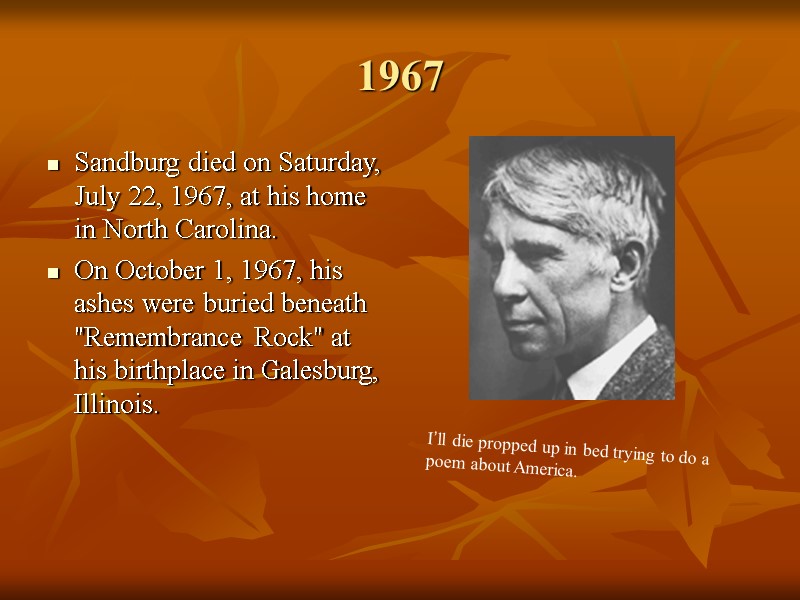
1967 Sandburg died on Saturday, July 22, 1967, at his home in North Carolina. On October 1, 1967, his ashes were buried beneath "Remembrance Rock" at his birthplace in Galesburg, Illinois. I’ll die propped up in bed trying to do a poem about America.
Carl Sandburg’s Works: Carl Sandburg celebrated his romance with America in these three early collections. Chicago Poems. 1916. http://www.bartleby.com/165/ Cornhuskers. 1918. http://www.bartleby.com/134/ Smoke and Steel. 1920. http://www.bartleby.com/231/
Chicago HOG Butcher for the World, Tool Maker, Stacker of Wheat, Player with Railroads and the Nation’s Freight Handler; Stormy, husky, brawling, City of the Big Shoulders:
They tell me you are wicked and I believe them, for I have seen your painted women under the gas lamps luring the farm boys. And they tell me you are crooked and I answer: Yes, it is true I have seen the gunman kill and go free to kill again. And they tell me you are brutal and my reply is: On the faces of women and children I have seen the marks of wanton hunger. And having answered so I turn once more to those who sneer at this my city, and I give them back the sneer and say to them:
Come and show me another city with lifted head singing so proud to be alive and coarse and strong and cunning. 10 Flinging magnetic curses amid the toil of piling job on job, here is a tall bold slugger set vivid against the little soft cities; Fierce as a dog with tongue lapping for action, cunning as a savage pitted against the wilderness,
Bareheaded, Shoveling, Wrecking, 15 Planning, Building, breaking, rebuilding,
Laughing even as an ignorant fighter laughs who has never lost a battle, 20 Bragging and laughing that under his wrist is the pulse. and under his ribs the heart of the people, Laughing! Laughing the stormy, husky, brawling laughter of Youth, half-naked, sweating, proud to be Hog Butcher, Tool Maker, Stacker of Wheat, Player with Railroads and Freight Handler to the Nation.
HAPPINESS I ASKED the professors who teach the meaning of life to tell me what is happiness. And I went to famous executives who boss the work of thousands of men. They all shook their heads and gave me a smile as though I was trying to fool with them And then one Sunday afternoon I wandered out along the Desplaines river And I saw a crowd of Hungarians under the trees with their women and children and a keg of beer and an accordion.
THE HARBOR PASSING through huddled and ugly walls By doorways where women Looked from their hunger-deep eyes, Haunted with shadows of hunger-hands, Out from the huddled and ugly walls, I came sudden, at the city's edge, On a blue burst of lake, Long lake waves breaking under the sun On a spray-flung curve of shore; And a fluttering storm of gulls, Masses of great gray wings And flying white bellies Veering and wheeling free in the open
STYLE STYLE--go ahead talking about style. You can tell where a man gets his style just as you can tell where Pavlowa got her legs or Ty Cobb his batting eye. Go on talking. Only don't take my style away. It's my face. Maybe no good but anyway, my face. I talk with it, I sing with it, I see, taste and feel with it, I know why I want to keep it. Kill my style and you break Pavlowa's legs, and you blind Ty Cobb's batting eye.
ON THE WAY LITTLE one, you have been buzzing in the books, Flittering in the newspapers and drinking beer with lawyers And amid the educated men of the clubs you have been getting an earful of speech from trained tongues. Take an earful from me once, go with me on a hike Along sand stretches on the great inland sea here And while the eastern breeze blows on us and the restless surge Of the lake waves on the breakwater breaks with an ever fresh monotone, Let us ask ourselves: What is truth? what do you or I know? How much do the wisest of the world's men know about where the massed human procession is going? You have heard the mob laughed at? I ask you: Is not the mob rough as the mountains are rough? And all things human rise from the mob and relapse and rise again as rain to the sea.
JOY LET a joy keep you. Reach out your hands And take it when it runs by, As the Apache dancer Clutches his woman. I have seen them Live long and laugh loud, Sent on singing, singing, Smashed to the heart Under the ribs With a terrible love. Joy always, Joy everywhere-- Let joy kill you! Keep away from the little deaths.
At a Window Give me hunger, O you gods that sit and give The world its orders. Give me hunger, pain and want, Shut me out with shame and failure From the doors of gold and fame, Give me your shabbiest, weariest hunger!
But leave me a little love, A voice to speak to me in the day end, A hand to touch me in the dark room Breaking the long loneliness. In the dusk of day-shapes Blurring the sunset, One little wandering, western star Thrust out from the changing shores of shadow. Let me go to the window, Watch there the day-shapes of dusk And wait and know the coming Of a little love.
Cool Tombs
Pocahontas' body, lovely as a poplar, sweet as a red haw in November or a pawpaw in May, did she wonder? does she remember?... in the dust, in the cool tombs? Take any streetful of people buying clothes and groceries, cheering a hero or throwing confetti and blowing tin horns ... tell me if the lovers are losers ... tell me if any get more than the lovers ... in the dust ... in the cool tombs.
Fog THE fog comes on little cat feet. It sits looking over harbor and city on silent haunches 5 and then moves on.
Grass PILE the bodies high at Austerlitz and Waterloo. Shovel them under and let me work— I am the grass; I cover all. And pile them high at Gettysburg And pile them high at Ypres and Verdun. 5 Shovel them under and let me work. Two years, ten years, and passengers ask the conductor: What place is this? Where are we now? I am the grass. 10 Let me work.
Nocturne in a Deserted Brickyard STUFF of the moon Runs on the lapping sand Out to the longest shadows. Under the curving willows, And round the creep of the wave line, 5 Fluxions of yellow and dusk on the waters Make a wide dreaming pansy of an old pond in the night.
Links Texts of Carl Sandburg’s poems http://www.poets.org/poets/poets.cfm?45442B7C000C040C Carl Sandburg exhibits elsewhere on the web: Cornhuskers From the Columbia University Bartleby Library. http://www.bartleby.com/people/Sandburg.html Carl Sandburg (1878-1967) A collection of critical, historical, and biographical information at the Modern American Poetry site. http://www.english.uiuc.edu/maps/poets/s_z/sandburg/sandburg.htm Carl Sandburg Chicago Poems Chicago Poems, a short biography, the Carl Sandburg Discussion Group, and more. http://carl-sandburg.com/ "At a Window" From can we have our ball back? 3. http://www.canwehaveourballback.com/sandburg.htm Carl Sandburg’s Life: http://www.anb.org/articles/16/16-01435.html; American National Biography Online Feb. 2000. Access Date: Sun Mar 18 11:41:36 2001 Copyright (c) 2000 American Council of Learned Societies. Published by Oxford University Press.
 Скачать презентацию Carl Sandberg «And all poets love dust and
24508-carl_sandberg_03112002.ppt
- Количество слайдов: 26