 Скачать презентацию Caribbean Research and Education Networking Carib REN Report
b11ddce14099e488c6e76e9bafa44516.ppt
- Количество слайдов: 27



Caribbean Research and Education Networking (Carib. REN) Report Fall 2007 Internet 2 Member Meeting October 8, 2007 San Diego, California Dr. Heidi L. Alvarez heidi@fiu. edu Florida International University October 8, 2007
Caribbean Special Interest Group Presentation Agenda Network Infrastructure: • CIARA AMPATH IXP, WHREN-LILA • Red. CLARA - Florencio Utreras • CKLN • SMITCOMS: Eastern Caribbean IPv 6 Network - Curtis Haynes, Managing Director and Eldert Louisa, lead network engineer Participating Institutions & Applications: • Sint Maartin & The Netherlands Tele-Medicine - Hans Zandbergen • University of Puerto Rico - Jose Conde • Arecibo Observatory, Puerto Rico - Arun Venkataraman • SETI @ Home - Dan Werthimer, University of California, Berkeley • University of the Virgin Islands - Kelley Harrigan • e-VLBI antennae St. Croix - Alan Whitney from MIT 2
About the Caribbean Research & Education Networking (Carib. REN) Special Interest Group • Mission: To advance the state of high-performance networking for research and education in the Caribbean. • Membership is open to all institutions and individuals with an interest in supporting, contributing, or learning more about the mission of the Carib. REN SIG. • Current membership ranges from Caribbean interests, US and Latin American research & education networks, scientists, and educators. 3
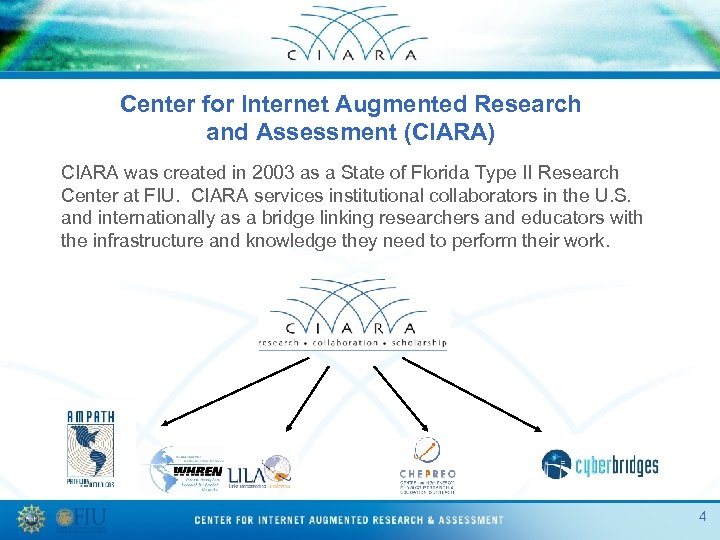
Center for Internet Augmented Research and Assessment (CIARA) CIARA was created in 2003 as a State of Florida Type II Research Center at FIU. CIARA services institutional collaborators in the U. S. and internationally as a bridge linking researchers and educators with the infrastructure and knowledge they need to perform their work. 4
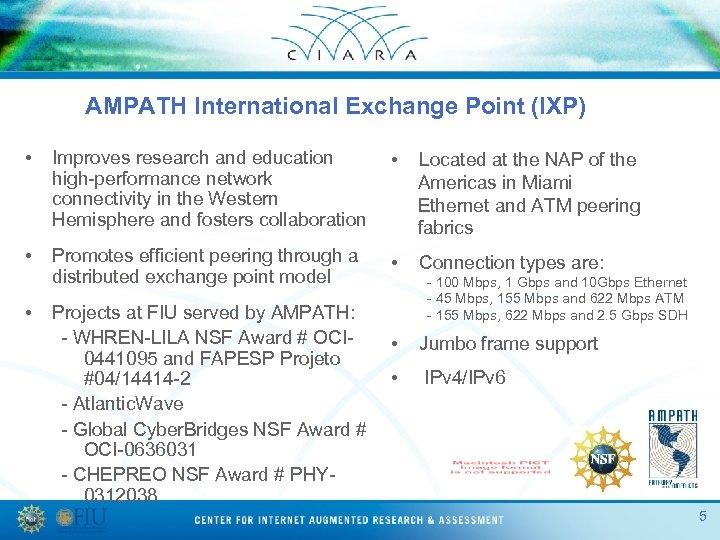
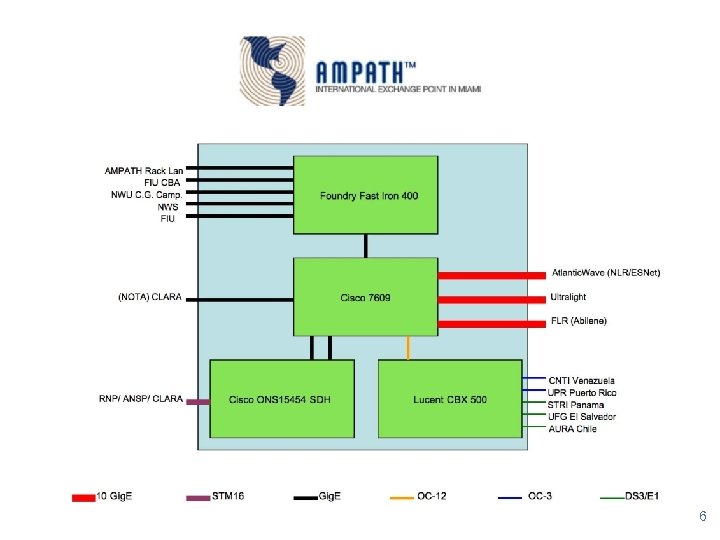
AMPATH International Exchange Point (IXP) • Improves research and education high-performance network connectivity in the Western Hemisphere and fosters collaboration • Located at the NAP of the Americas in Miami Ethernet and ATM peering fabrics • Promotes efficient peering through a distributed exchange point model • Connection types are: • Projects at FIU served by AMPATH: - WHREN-LILA NSF Award # OCI 0441095 and FAPESP Projeto #04/14414 -2 - Atlantic. Wave - Global Cyber. Bridges NSF Award # OCI-0636031 - CHEPREO NSF Award # PHY 0312038 - 100 Mbps, 1 Gbps and 10 Gbps Ethernet - 45 Mbps, 155 Mbps and 622 Mbps ATM - 155 Mbps, 622 Mbps and 2. 5 Gbps SDH • Jumbo frame support • IPv 4/IPv 6 5
6
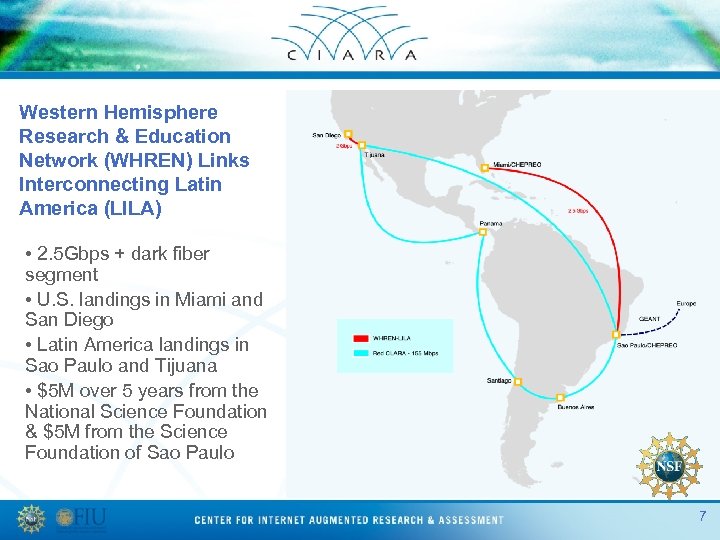
Western Hemisphere Research & Education Network (WHREN) Links Interconnecting Latin America (LILA) • 2. 5 Gbps + dark fiber segment • U. S. landings in Miami and San Diego • Latin America landings in Sao Paulo and Tijuana • $5 M over 5 years from the National Science Foundation & $5 M from the Science Foundation of Sao Paulo 7
Red. CLARA ALICE Project • • • 18 Latin American Countries and 4 European NRENs Creation of CLARA, the organization of LA NREN’s - 18 (100%) LA Countries - Legally established in Uruguay - Management structure in place Establishment of Red. CLARA - The Network - The Operations are carried out by CUDI in Mexico - The Engineering is subcontracted to RNP in Brazil - The Information Systems is subcontracted to REUNA in Chile http: //www. redclara. net Florencio Utreras, CLARA 8
Red. CLARA WHREN/LILA Project • WHREN: Western Hemisphere Research and Education Network • LILA Links Interconnecting Latin America • IRNC Project funded by NSF and leaded by FIU and CENIC in the US. • CLARA, CUDI, RNP, ANSP from Latin America • Acquired IRU of Dark fiber Tijuana-San Diego. Running Gb. E on top of it. (to Pacific Wave) • 2. 4 Gbps Sao Paulo-Miami shared with CHEPREO & ANSP (to Atlantic Wave) 9
Caribbean Knowledge and Learning Network (CKLN) • Launched by the Caribbean Community (CARICOM) and the Organization of Eastern Caribbean States (OECS) in 2004, the Caribbean Knowledge and Learning Network (CKLN) is a multilateral project, supported by the OAS, the World Bank, the European Union and the Canadian International Development Agency (CIDA). • The project is designed to enhance the competitiveness of Caribbean countries, using information and communication technologies to connect the Caribbean to the global pool of knowledge, developing human resources and facilitating greater regional integration 10
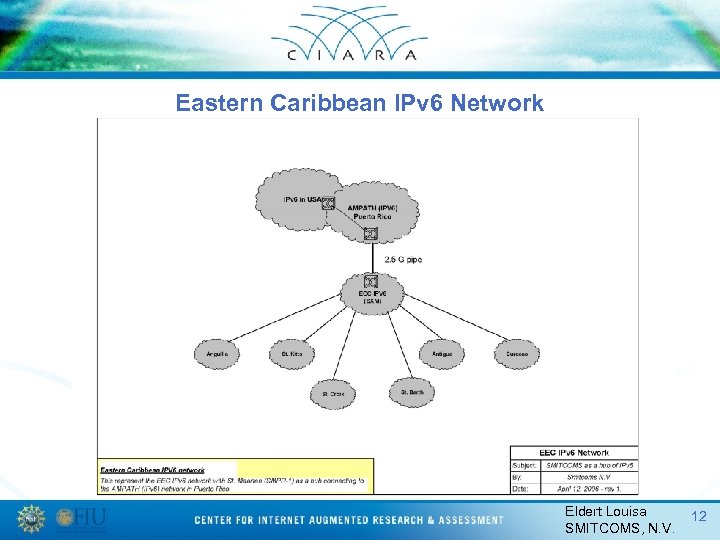
Eastern Caribbean IPv 6 Network • The St. Maarten Medical Center is currently connected on a 4 Mb pipe that is used to query medical database. • The center is upgrading its connection on fiber to provide faster and better quality. The project is expected to be completed in the 2 nd week of October. Eldert Louisa SMITCOMS, N. V. 11
Eastern Caribbean IPv 6 Network Eldert Louisa SMITCOMS, N. V. 12
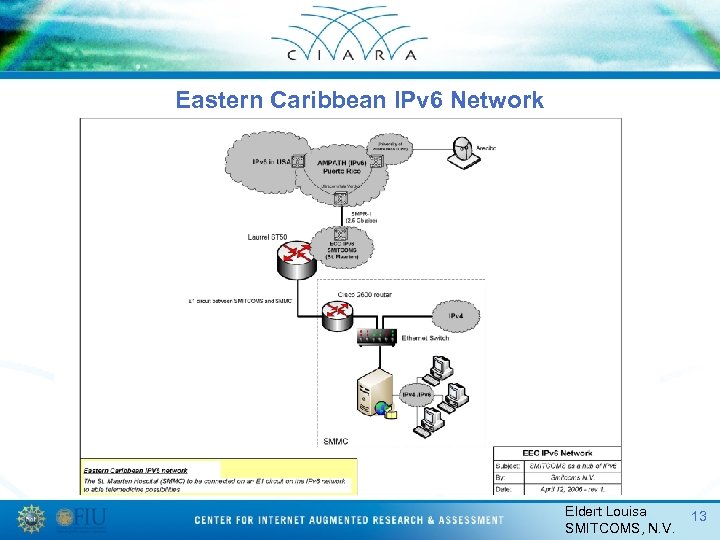
Eastern Caribbean IPv 6 Network Eldert Louisa SMITCOMS, N. V. 13
Carib. REN SIG Institutions & Applications • Sint Maartin & The Netherlands Tele-Medicine - Click to Meet Radio Oncology • University of Puerto Rico - Jose Conde • Arecibo Observatory, Puerto Rico - Arun • University of the Virgin Islands - Kelley Harragan • e-VLBI antennae St. Croix - Alan Whitney from MIT 14
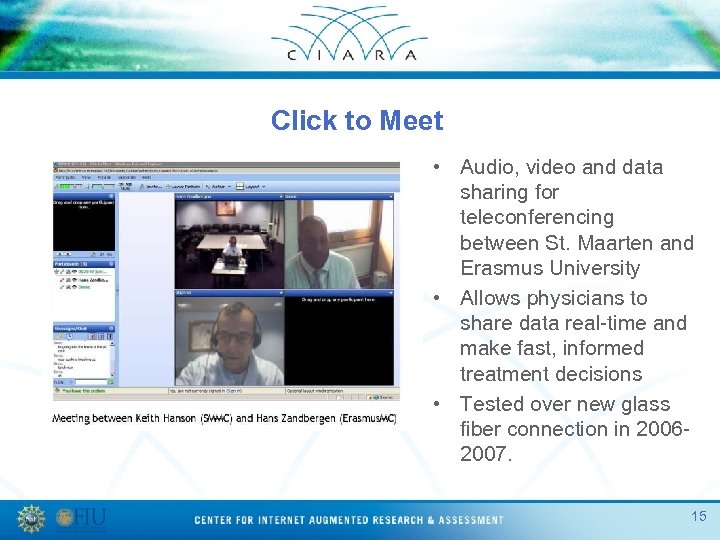
Click to Meet • Audio, video and data sharing for teleconferencing between St. Maarten and Erasmus University • Allows physicians to share data real-time and make fast, informed treatment decisions • Tested over new glass fiber connection in 20062007. 15
University of Puerto Rico (UPR) 16
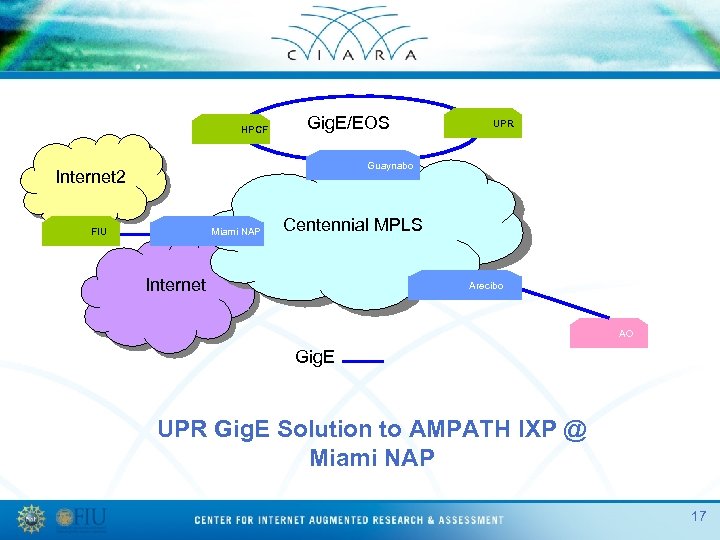
HPCF Gig. E/EOS UPR Guaynabo Internet 2 FIU Miami NAP Centennial MPLS Internet Arecibo AO Gig. E UPR Gig. E Solution to AMPATH IXP @ Miami NAP 17
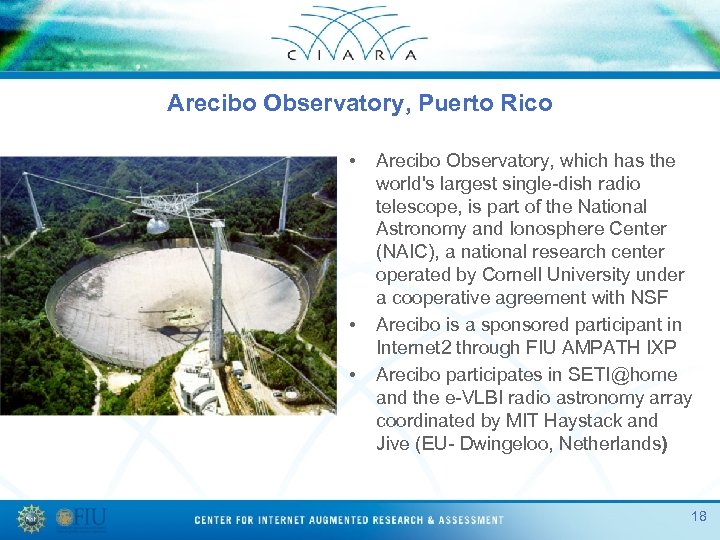
Arecibo Observatory, Puerto Rico • • • Arecibo Observatory, which has the world's largest single-dish radio telescope, is part of the National Astronomy and Ionosphere Center (NAIC), a national research center operated by Cornell University under a cooperative agreement with NSF Arecibo is a sponsored participant in Internet 2 through FIU AMPATH IXP Arecibo participates in SETI@home and the e-VLBI radio astronomy array coordinated by MIT Haystack and Jive (EU- Dwingeloo, Netherlands) 18
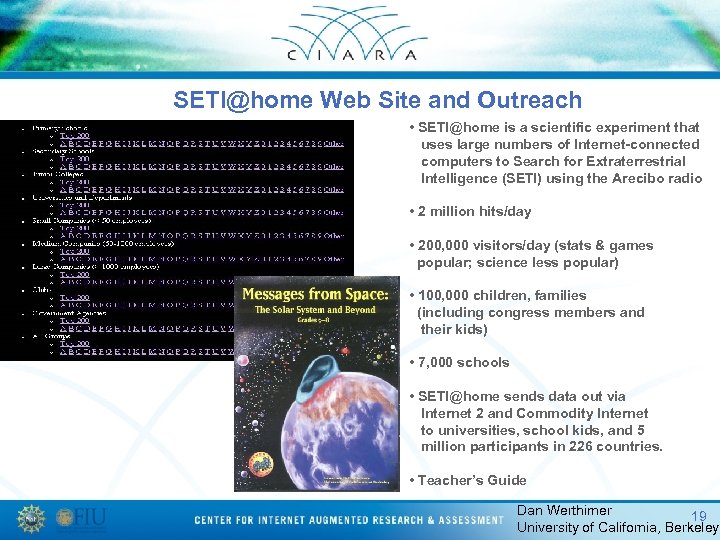
SETI@home Web Site and Outreach • SETI@home is a scientific experiment that uses large numbers of Internet-connected computers to Search for Extraterrestrial Intelligence (SETI) using the Arecibo radio • 2 million hits/day • 200, 000 visitors/day (stats & games popular; science less popular) • 100, 000 children, families (including congress members and their kids) • 7, 000 schools • SETI@home sends data out via Internet 2 and Commodity Internet to universities, school kids, and 5 million participants in 226 countries. • Teacher’s Guide Dan Werthimer 19 University of California, Berkeley
Arecibo Observatory, Puerto Rico EXPRe. S • EXPRe. S is a three-year project to create a distributed astronomical instrument of continental and intercontinental dimensions using e. VLBI. • e-VLBI (European VLBI Network) is an interferrometric array of radio telescopes spread throughout Europe and beyond, including at Arecibo, which conducts unique, high resolution, radio astronomical observations of cosmic radio sources. • It is the most sensitive VLBI array in the world, thanks to the collection of extremely large telescopes that contribute to the network. EXPRe. S is made possible through the support of the European Commission (DG-INFSO), Sixth Framework Programme, Contract #026642 Arun Venkataraman, National 20 Astronomy and Ionosphere Center
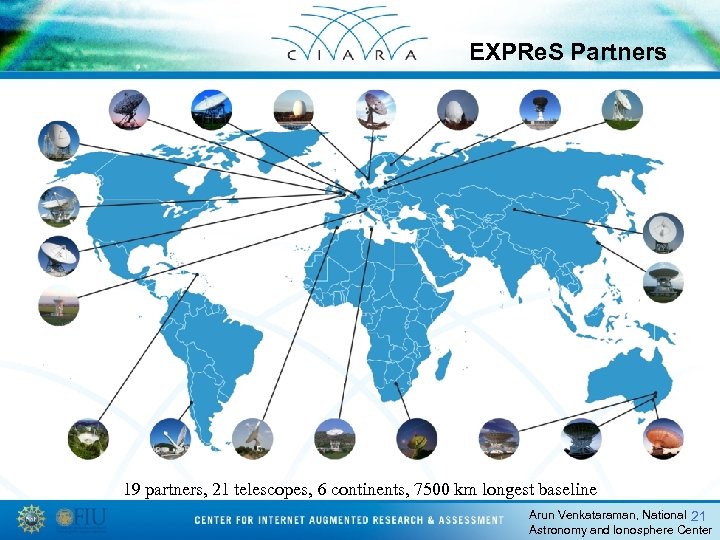
EXPRe. S Partners 19 partners, 21 telescopes, 6 continents, 7500 km longest baseline Arun Venkataraman, National 21 Astronomy and Ionosphere Center
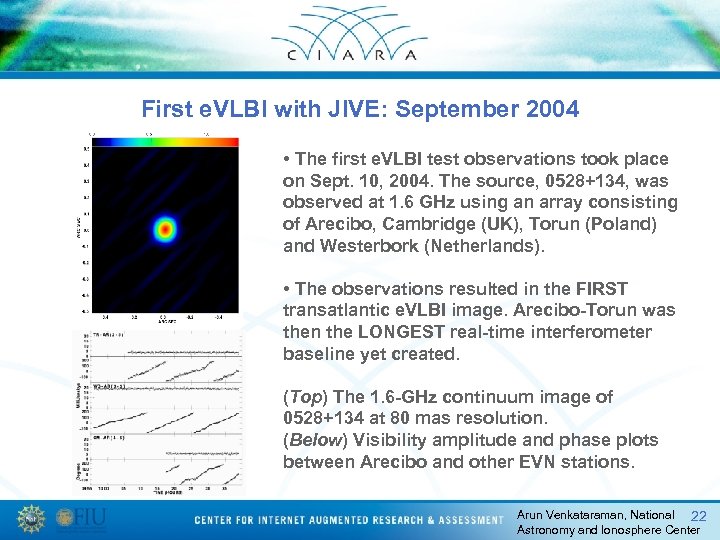
First e. VLBI with JIVE: September 2004 • The first e. VLBI test observations took place on Sept. 10, 2004. The source, 0528+134, was observed at 1. 6 GHz using an array consisting of Arecibo, Cambridge (UK), Torun (Poland) and Westerbork (Netherlands). • The observations resulted in the FIRST transatlantic e. VLBI image. Arecibo-Torun was then the LONGEST real-time interferometer baseline yet created. (Top) The 1. 6 -GHz continuum image of 0528+134 at 80 mas resolution. (Below) Visibility amplitude and phase plots between Arecibo and other EVN stations. Arun Venkataraman, National 22 Astronomy and Ionosphere Center
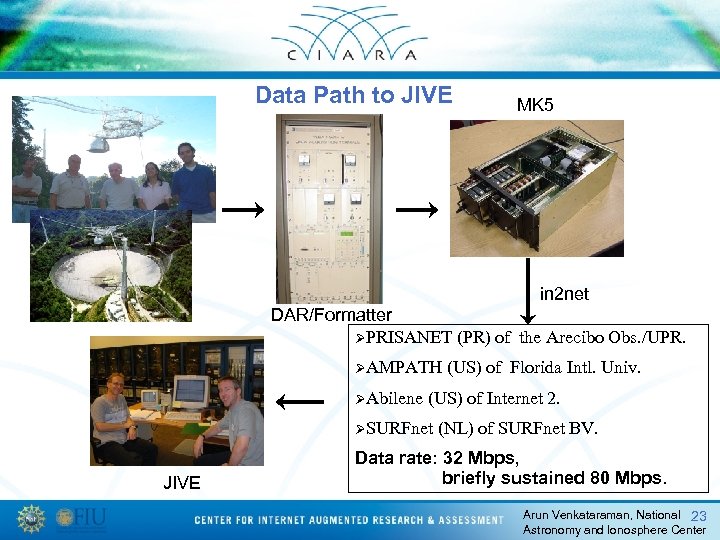
Data Path to JIVE MK 5 in 2 net DAR/Formatter ØPRISANET (PR) of the Arecibo Obs. /UPR. ØAMPATH ØAbilene (US) of Internet 2. ØSURFnet JIVE (US) of Florida Intl. Univ. (NL) of SURFnet BV. Data rate: 32 Mbps, briefly sustained 80 Mbps. Arun Venkataraman, National 23 Astronomy and Ionosphere Center
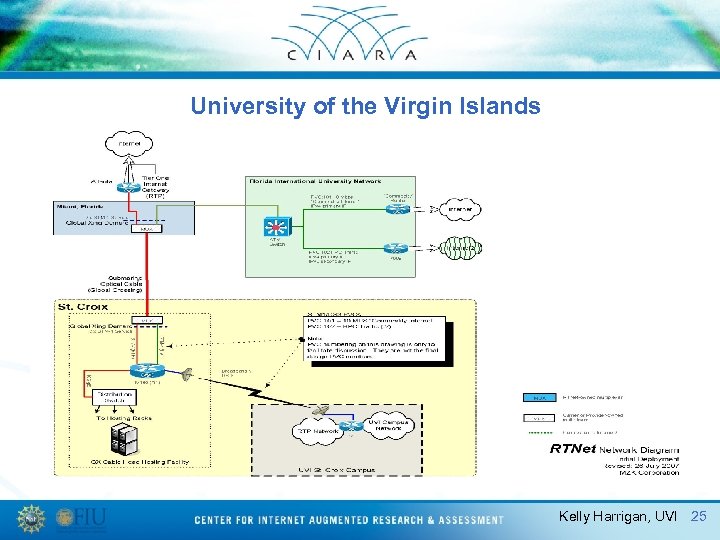
University of the Virgin Islands (UVI) • • • EPSCo. R Grant (NSF) $4. 5 million – designed to expand enhance the research capability of scientists to compete more successfully for a portion of the nation's federal academic research and development budget. Master of Marine & Environmental Science EPSCo. R is investing in research infrastructure at UVI, including: - new computer system for high performance ocean modeling (HYCOM); improving UVI’s intranet and internet capacity on St. Thomas and St. Croix; - developing high speed internet connectivity at UVI’s field station on St. John; and - trials of electronic delivery of rapid full-text journal access for researchers. Kelly Harrigan, UVI 24
University of the Virgin Islands Kelly Harrigan, UVI 25
Next Steps • Continue with monthly meetings • Update the Carib. REN web site with more information about members • Work with all potential collaborators • Have a face-to-face Meeting in the Caribbean • Discussion Q&A 26
Thank you! Email: caribinterest@internet 2. edu Website: http: //international. internet 2. edu/intl_connect/carib_sig. html Please subscribe to the mailing list and join our SIG 27
Скачать презентацию Caribbean Research and Education Networking Carib REN Report
b11ddce14099e488c6e76e9bafa44516.ppt