 Скачать презентацию Caribbean Group of Securities Regulators 10 th Annual
e28ac79f5bd686678235ff52615c10ce.ppt
- Количество слайдов: 29



Caribbean Group of Securities Regulators 10 th Annual Conference and Workshop Risk Based Capital Adequacy Framework for Securities Regulators Session 2 Richard Britton Montego Bay, Jamaica November 2013
Scope of the second session • Risk-based on-site examinations to include – A presentation by Shuchane Johnson of the FSC’s approach – Joint inspections of banks • Action in the event of financial failure of an intermediary – The Australian approach • Retail repo – liquidity risk in a shadow banking product • Regional issues - CXN
Risk-based on-site examinations Objectives – better profiling of intermediary’s risk position and its possible impact on the market – adjust the scope and intensity of supervision in relation to the level of risk exposed – integrated supervisory regimes-efficient use/effective allocation of scarce resources – a more pro-active approach – promote confidence in the system as a whole
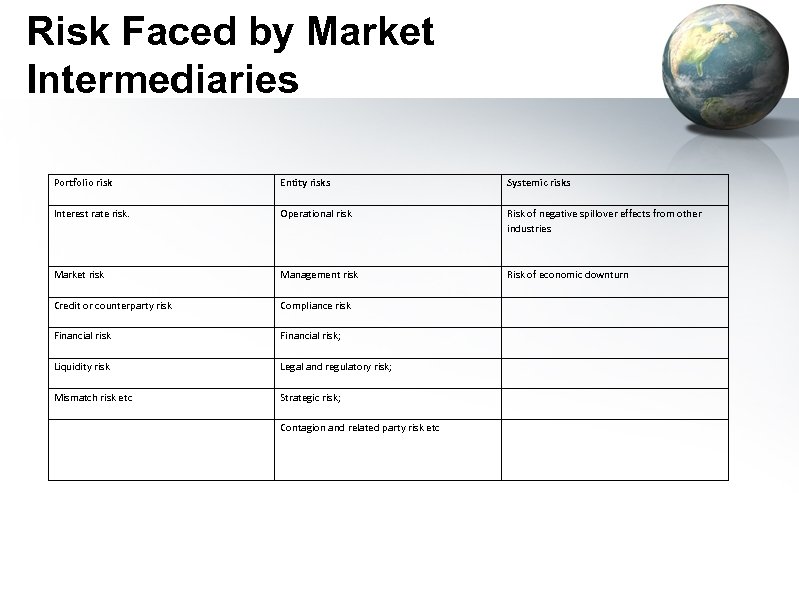
Risk Faced by Market Intermediaries Portfolio risk Entity risks Systemic risks Interest rate risk. Operational risk Risk of negative spillover effects from other industries Market risk Management risk Risk of economic downturn Credit or counterparty risk Compliance risk Financial risk; Liquidity risk Legal and regulatory risk; Mismatch risk etc Strategic risk; Contagion and related party risk etc
Tools of a risk-based regulatory approach: • Market entry controls • Capital adequacy or solvency standards • Close scrutiny of the quality and strategy of management • Requirements for risk management controls • Reliance on professional experts such as external auditors • Regular reporting and disclosure requirements • Better surveillance and enforcement powers
OR Principles - Role of Supervisors • Principle 8: The regulator should require that all licenseess, regardless of size, have an effective framework in place to identify, assess, monitor and control/mitigate material operational risks as part of an overall approach to risk management. • Principle 9: The regulator should conduct, directly or indirectly, regular independent evaluation of a licensees’s policies, procedures and practices related to operational risks. The regulator should ensure that there appropriate mechanisms in place which allows it to remain apprised of developments at licensees.
Liquidity Risk Management Monitoring Processes • Maturity gap analysis • Cash flow forecasting • Rollover rates • Scenario planning • Stress testing Financial Ratio analysis • • • Liquid assets to total assets Volatile liabilities to total assets Liquid assets to volatile liabilities Net liquid assets to total assets Unpledged eligible collateral to total assets
Allocation of Scarce Supervisory Resources • Risk based assessments potentially maximise the utility of resources • Structured mechanism for determining frequency and scope of inspections • Prioritising intermediaries and markets that have higher risk and higher impact • Inspection “checklists” ensure consistency of the areas inspected – Must be capable of adaptation to suit the risks and specific objectives of each inspection • One size does not fit all
Intermediaries “buy in” is essential • Boards and senior management need to fully engage in the process – Move away from a legally driven rules based compliance programme – New focus on managing the delivery of defined outcomes in a more flexible regulatory environment • Firms must be prepared – Data quality and reliability – Demonstrable soundness of systems – appropriateness of risk control mechanisms and supporting human resources.
Malaysia • Securities Commission supervision is risk based – Risk profiling framework • Quantitative and qualitative elements • Frequency of inspections based on risk profile • Supported by extensive off-site monitoring • Bursa Malaysia fully engaged in supervising its members – Subject to Securities Commission oversight • Collective investment scheme managers included in the risk profiling framework
Jointly regulated entities (banks) • A single risk based capital model is an advantage • On-site inspections of risk management and internal controls can still be problematic • Who is the lead regulator? • Scheduling – joint or separate? • Process management – Are the securities regulator’s priorities fully dealt with? • Fair treatment of clients • Client money – Rectification and sanctions (if any)
The Bahamas • Joint On-Site Examination Programme • Joint Examinations Committee – Senior on-site examinations staff of the Commission and the Central Bank • Objectives – the planning, timing and scope of examinations of these institutions; – the reporting of examination findings and recommendations; – follow-up and enforcement actions, if any.
Process • Notification Letter – Sent by Central Bank – Includes Commission instructions on how to prepare for the securities related elements • Examiner in Charge (from Central Bank) – Coordinates with the Senior Examiner of the Commission • Post examination – Joint Report on Examination prepared and dispatched
Financial Services Commission of Jamaica Presentation by Shuchane Johnson
Action in the event of financial failure of an intermediary Financial crises no longer just involve banks – and banking supervisors • Various securities market products are now “money”. – Asset backed commercial paper – Money market funds (especially those with a constant NAV) – Repurchase agreements (repo) – Structured finance (securitisation) • A broker’s failure may not be a “quarantinable” event
A crisis management plan is an essential tool • Components – Research based – history does repeat itself – Create a crisis handbook • Responses to issues • detailed actions – taking control, reorganization, transferring client accounts – interaction with other stakeholders » CCP, central bank, government, foreign regulators, media – Include the list of contacts and coordinates – standard forms for court orders, account freezing actions etc
Update and test • Assign responsibility for updating • Conduct regular simulation – – “War Games” Identify the crisis team Develop the scenario discovery of massive fraud, political crisis, media allegations – Play the game • Document and evaluate outcomes • Improve systems
The Australian approach • Twin peaks model - ASIC, APRA plus the exchanges and the central bank • Early warning system • Risk Assessment Detection and Response (RADAR) system • Risk profiles on larger Market Participants updated frequently while a RADAR on smaller Market Participants may be conducted every three years. • This is not just a documents review off-site. To risk profile effectively the analysts visit firm specifically for this purpose. • The issues identified influence not just individual inspections but also thematic surveillance projects undertaken by Market and Participants Supervision
Reporting obligations • Monthly reporting to ASIC, ASX Clear or ASX Clear (Futures) • More frequent reporting as follows: – Weekly (or daily) reports where ASX/ASX Clear Participant’s capital has dropped to less than 1. 2 times the minimum required level – A report (potentially daily) where ASX 24/ASX Clear (Futures) Participant’s capital has dropped below 1. 5 times the minimum required level; – A report (potentially daily) where the ASX Clear (Futures) Participant’s capital level falls by more than 20 percent since the previous report – An ad hoc report where ASX Clear, ASX Clear (Futures) or ASIC (as appropriate) so requests. Failure to comply with any of its additional reporting requirements, ASIC, ASX Clear or ASX Clear (Futures) results in sanctions including closure.
Contingency Plans • Financial Institution Response Plan (FIRP) – Joint agency plan to deal with systemically important institutions • Significant Market Event Response Plan (SMERP) – For ASIC licensees of little or no systemic importance Both plans Includes public information dissemination policy and procedures
Intervention powers • Licensing restriction, suspension and revocation – No need for a hearing if the licensee has become insolvent or ceased to carry on financial services business • Freezing of a licensee’s bank accounts – Via court order – In Australia or overseas • Winding up – Requires a court order • Moving client accounts – Use of direction powers under the Companies Act
Retail repo: overview of a shadow banking product • Client “purchases” government securities from a broker • Client pays the broker • Broker agrees to buy the securities back from the client in 30 days (or similar) • Broker agrees to pay the client an agreed rate of interest on the money he has “borrowed” for 30 days • Broker retains ownership of the securities • Broker commits to transferring ownership of the bonds to the client should he be unable to repay the funds at 30 days
Success of the business relies on confidence • Brokers retaining the confidence of their customers in their credit worthiness • Customers having no reason to doubt that the terms of their client agreements will be met in the event of a default by a broker; ie the collateral will become theirs to dispose of as they wish • The Government maintaining the confidence of their citizens and foreign bond holders in their commitment and ability to meet its obligations as they fall due.
Risks in the business model • Brokers are generally undercapitalised for this business • A retail repo contract (unlike a wholesale repo contract) does not include a legal transfer of ownership of the collateral at the time of “sale” • In the event of a broker’s default transfers of collateral may be challenged • Risk management practices at broker dealers active in this business vary and may not be sufficiently robust • Clients using repo as a short term cash deposit do not want to own long term and possibly illiquid bonds • There is no insurance scheme for repo, whereas in many jurisdictions retail bank deposits are protected
Regional issues - CXN What is the current state of play? Mr Marlon E. Yarde, C. E. O. & General Manager of the Barbados Stock Exchange at the Fifth Annual CGSR Conference in 2008 raised several issues. • The Barbados Securities Commission had told him that full reciprocity of registration, reliance among regulators and fees would come • In the meantime brokers were to be limited to trading on behalf of investors only in their domicile. • Barbados Stock Exchange had to ensure that all brokers who applied to trade on the exchange via CXN had appropriate indemnity insurance coverage. The current Caribbean Exchanges Network (CXN) Guidelines on the web site of the Trinidad and Tobago Stock Exchange are detailed and complex. Is this still work in progress?
Lessons from history • If the stakes are high enough, someone will always break the rules or go too far. • Managements of firms will ignore danger signs if the individuals or departments are producing high revenues/returns • Firms are run by salesmen and traders not risk managers • A firm’s management does not think in systemic risk terms • So while regulators must know their firms individually they must also place the firm within the bigger picture
Bibliography • • • Methodology for assessing implementation of the IOSCO Objectives and Principles of Securities Regulation: IOSCO, 2011 Guidance to Emerging Market Regulators Regarding Capital Adequacy Requirements for Financial Intermediaries: IOSCO EMC, December 2006 Amendment to the Capital Accord to Incorporate Market Risks: Basle Committee on Banking Supervision, January 1996: Sound Practices for the Management and Supervision of Operational Risk: BIS, February 2003 Recognising the Risk-Mitigating Impact of Insurance in Operational Risk Modelling: BIS, October 2010 International Convergence of Capital Measurement and Capital Standards - a Revised Framework: BCBS: June 2004 Funding and Liquidity Risk Management Practices - Regulatory Notice 10 -57: FINRA, November 2010 International Framework for Liquidity Risk Measurement, Standards and Monitoring: BIS, Dec 2009 Liquidity Management for Security Dealers that are not Licensed Deposit Takers: FSC Jamaica, November, 2004 The Leverage Ratio: Policy Note Number 11 Katia D’Hulster, World Bank Group, December 2009
Regulators are judged by their failures and not by their successes

The End Thank you very much
Скачать презентацию Caribbean Group of Securities Regulators 10 th Annual
e28ac79f5bd686678235ff52615c10ce.ppt