


 Скачать презентацию Careers work in school evidence from the Netherlands
f63eb50563273d1223d8fd4e06bbf719.ppt
- Количество слайдов: 13
 Careers work in school: evidence from the Netherlands Frans Meijers London 12 June 2017
 Teachers responsible 1. Since 1965 teachers are responsible for careers guidance in schools 2. Careers guidance outside schools is gradually disappeared due to marketisation 3. Most youngsters (or their parents) can’t afford to ‘buy’ career services
 Matching of student with job/education is dominant • A good choice is an informed choice • Information about self (psychometric tests, portfolio’s, personal development plans) • Information about the labour market • Underlying assumption: individuals behave like rational actors
 Two problems with this approach • Humans aren’t rational actors • The ‘disappearance’ of labour
 Determinants of (career) decision making 1. Experiences (>60%) • Personal experience • Experience of relevant others (especially parents) 2. Rumours 3. Contamination by mass media Attribution of incorrect characteristics to a profession or education 4. Objective information Only of interest after a choice is made
 The ‘disappearance’ of labour 1. Work has migrated from residential to industrial areas 2. Many occupations disappeared 1976: 5, 500 occupations and 2, 000 vague job titles 1998: 1, 178 occupations and 25, 000 vague job titles 3. School as a pedagogical reserve Based on (a) theory before experience and practice and (b) simple learning situations before complex ones. 4. Extended youth phase: being young = having fun
 Decision-making as a learning process • Goal: more self-directiveness (employability, career resilience, optimism) • Needed: meaning-oriented instead of reproductive learning • Meaning-oriented learning is attaching personal meaning to information
 A learning environment for selfdirectedness • real-life problems (and not by professional requirements) are the starting point of the career-learning process, followed by • a dialogue in which meaning is attached by the student to his/her experiences
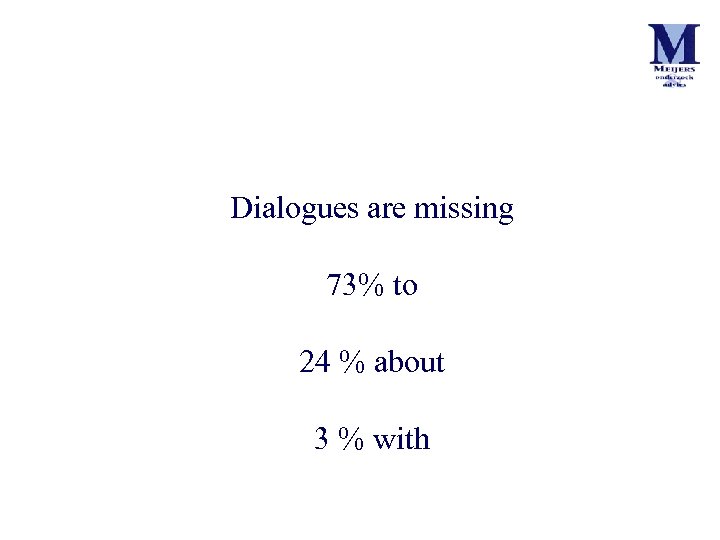 Dialogues are missing 73% to 24 % about 3 % with
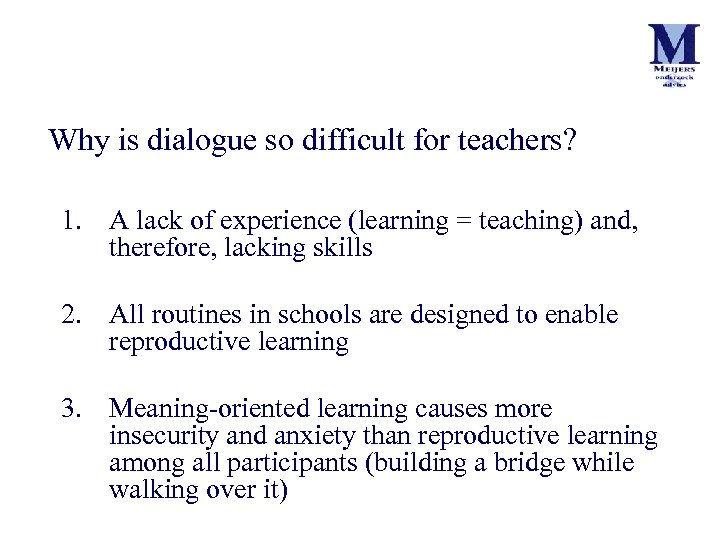 Why is dialogue so difficult for teachers? 1. A lack of experience (learning = teaching) and, therefore, lacking skills 2. All routines in schools are designed to enable reproductive learning 3. Meaning-oriented learning causes more insecurity and anxiety than reproductive learning among all participants (building a bridge while walking over it)
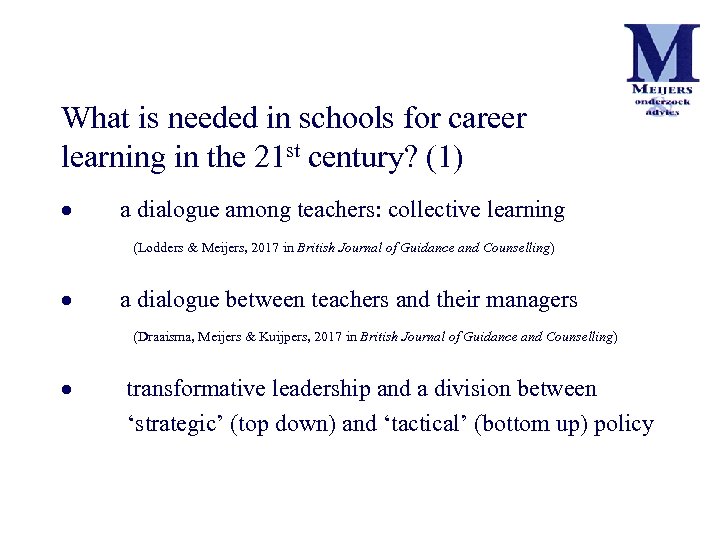 What is needed in schools for career learning in the 21 st century? (1) · a dialogue among teachers: collective learning (Lodders & Meijers, 2017 in British Journal of Guidance and Counselling) · a dialogue between teachers and their managers (Draaisma, Meijers & Kuijpers, 2017 in British Journal of Guidance and Counselling) · transformative leadership and a division between ‘strategic’ (top down) and ‘tactical’ (bottom up) policy
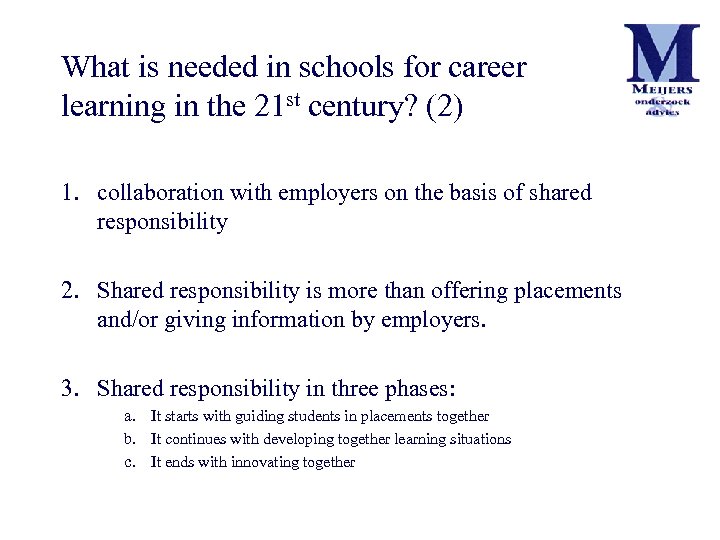 What is needed in schools for career learning in the 21 st century? (2) 1. collaboration with employers on the basis of shared responsibility 2. Shared responsibility is more than offering placements and/or giving information by employers. 3. Shared responsibility in three phases: a. It starts with guiding students in placements together b. It continues with developing together learning situations c. It ends with innovating together
 www. frans-meijers. nl