


 Скачать презентацию Careers in Psychology University of Montana April 2004
c6e5f5f07b45dce0a98ac3cf83ccdb85.ppt
- Количество слайдов: 12
 Careers in Psychology University of Montana April 2004 John Blattner, Ph. D.
 The “Demand” Side Tens of thousands of business, educational and human service organizations that need to: – Select, integrate, train, develop, motivate and retain staff – Increase effectiveness of teams – Manage change effectively – Integrate people and processes in mergers – Accelerate learning and knowledge transfer – Use behavioral science expertise to make decisions and function better
 The “Supply” Side • 377 APA-Approved Doctoral Programs • 49 APA-Approved Internships in Psychology – 328 in Clinical, Counseling, School and Combined Scientific/Professional – 49 in I/O Psychology • 2 -3, 000 New Ph. D. Psychologists/year • <5, 000 Full-time Psychologists in business • Thousands of Consultants and Coaches without advanced degrees in Psychology
 The Job Landscape • External Consultancy – The “human capital” practices in large management consulting firms – National/International management psychology firms – Regional and local practices • Internal Consulting – – Fortune 1, 000 companies Universities and school systems Government, military and public sector Non-profits
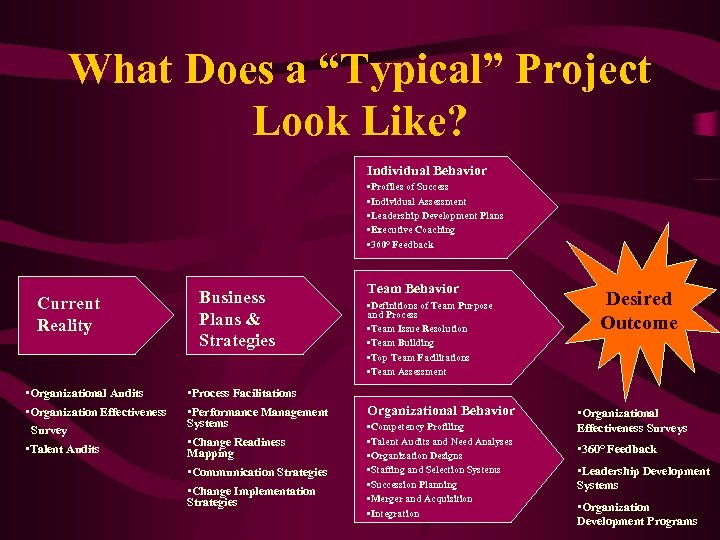 What Does a “Typical” Project Look Like? Individual Behavior • Profiles of Success • Individual Assessment • Leadership Development Plans • Executive Coaching • 360° Feedback Current Reality • Organizational Audits • Organization Effectiveness Survey • Talent Audits Business Plans & Strategies • Process Facilitations • Performance Management Systems • Change Readiness Mapping • Communication Strategies • Change Implementation Strategies Team Behavior • Definitions of Team Purpose and Process • Team Issue Resolution • Team Building • Top Team Facilitations • Team Assessment Organizational Behavior • Competency Profiling • Talent Audits and Need Analyses • Organization Designs • Staffing and Selection Systems • Succession Planning • Merger and Acquisition • Integration Desired Outcome • Organizational Effectiveness Surveys • 360° Feedback • Leadership Development Systems • Organization Development Programs
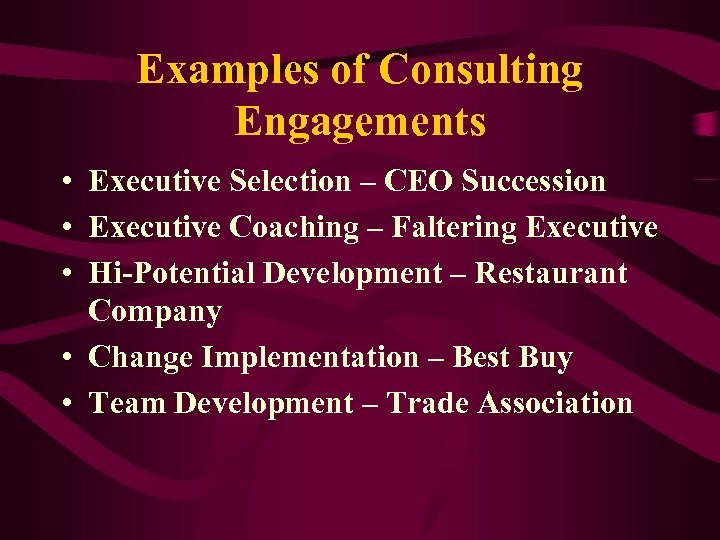 Examples of Consulting Engagements • Executive Selection – CEO Succession • Executive Coaching – Faltering Executive • Hi-Potential Development – Restaurant Company • Change Implementation – Best Buy • Team Development – Trade Association
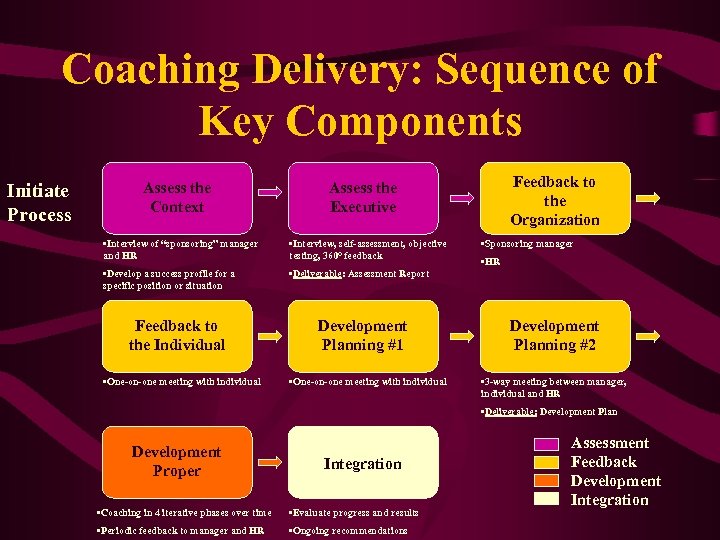 Coaching Delivery: Sequence of Key Components Initiate Process Assess the Context Feedback to the Organization Assess the Executive • Interview of “sponsoring” manager and HR • Interview, self-assessment, objective testing, 360° feedback • Develop a success profile for a specific position or situation • Deliverable: Assessment Report Feedback to the Individual • One-on-one meeting with individual Development Planning #1 • One-on-one meeting with individual • Sponsoring manager • HR Development Planning #2 • 3 -way meeting between manager, individual and HR • Deliverable: Development Plan Development Proper Integration • Coaching in 4 iterative phases over time • Evaluate progress and results • Periodic feedback to manager and HR • Ongoing recommendations Assessment Feedback Development Integration
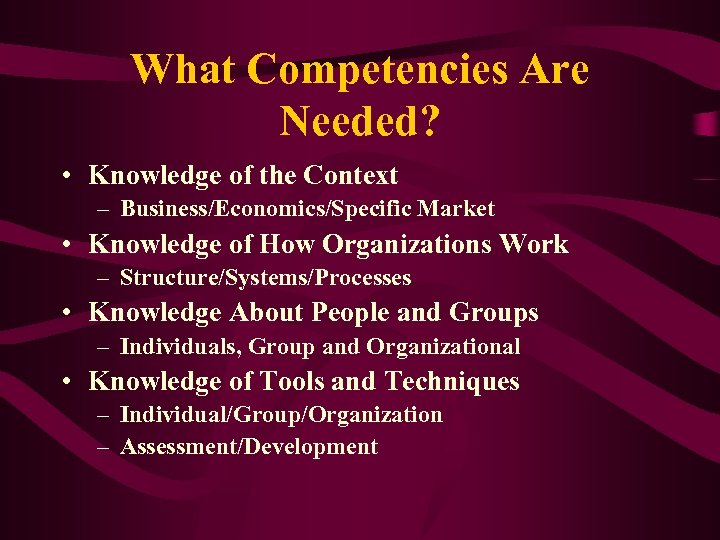 What Competencies Are Needed? • Knowledge of the Context – Business/Economics/Specific Market • Knowledge of How Organizations Work – Structure/Systems/Processes • Knowledge About People and Groups – Individuals, Group and Organizational • Knowledge of Tools and Techniques – Individual/Group/Organization – Assessment/Development
 Personal Attributes • What Companies Look For: – Intelligence, quick study, “helicopter” range – Passion for excellence, service and impact – Credible rapport with business executives – Insight into self and desire to develop – Strong work ethic, personal maturity, team orientation and stamina
 How to Prepare • Classes – Core curriculum (learning, social, developmental, personality, etc. ) – Business school (organizational behavior, strategy, human resources, finance, and marketing, etc. ) • Faculty and Personal Networking • Research/Read (Business & Professional Literature • Consulting Experience/Client Exposure • Professional Conferences • Part-time/Volunteer Consulting Assignments
 Additional Resources • www. apa. org/div 13 – – Journal of Consulting Psychology August and Mid-Winter Conferences Shared Interest Groups Listserve • www. siop. org – 2004 Annual Conference in Chicago • Handbook of Organizational Consulting Psychology (Lowman, ed. ; Jossey-Bass, 2002)
 Personal Preparation • Cultivate Self-Awareness – Understand your motives – Learn your strengths and weaknesses – Seek feedback from others • Construct a Development Plan – Identify specific objectives and action steps • Execute with Patience and Persistence