


 Скачать презентацию Career Pathways The Convergence of Transformations March 4
a932b23c1376211557299987f8383bbd.ppt
- Количество слайдов: 42
 Career Pathways: The Convergence of Transformations March 4, 2007 Dr. Keith W. Bird, Chancellor Kentucky Community and Technical College System 1
 Presentation Outline n Workplace transformations n Sorting through the reports and critiques n n n So what does this mean? What are the implications? “No Silver Bullet” – Building a new system through a convergence of transformations Where do career pathways fit? 2
 Workforce Transformations n Changing nature of the workplace and workforce demographics n Globalization and digitization n Rapid (accelerated) rate of change n Challenges of an insufficient and under prepared “pipeline” of workers n The new skills requirements – beyond problem solving and critical thinking to innovation, adaptive expertise and “hyperhuman” skills 3
 “Sorting Through the Critiques” (John Simpson-IHE) n Rising Above the Gathering Storm (National Academy of Science, National Academy of Engineering, and Institute of Medicine, 2006) n n Sec. of Ed. ’s Commission on the Future of Higher Education Reports/Studies by Achieve (ADP); Education Trust; National Conference of State Legislatures 4
 ACT Studies n n Crisis at the Core: Preparing All Students For College and Work Developing the STEM Education Pipeline ** Ready for College and Ready for Work: Same or Different? 5
 And More Reports… n n Are They Really Ready for Work? Employers’ Perspectives on the Basic Knowledge and Applied Skills of New Entrants to the 21 st Century U. S Workforce 2005 Skills Gap Report—A Survey of the American Manufacturing Workforce (NAM) 6
 And More reports… n n Tapping America’s Potential: The Education for Innovation Initiative In December 2006 ---Tough Choices 2006 --or Tough Times (National Center on Education and the Economy) 7
 And More reports… n And in February 2007 ---America’s 2007 --Perfect Storm: Three Forces Changing Our Nation’s Future (Educational Testing Service) 8
 So what are the common threads in these reports? What are the implications? 9
 1. The SYSTEM is Obsolete n n Tweaking at the edges will not be enough The one thing that is indispensable is a new system. The problem is not with our educators. It is within the system in which they work. [Tough Choices or [ Tough Times] 10
 1. The SYSTEM is Obsolete America’s high schools are obsolete. By obsolete, I don’t just mean that our high schools are broken, flawed, and under-funded – though a case could be made for every one of those points. By obsolete, I mean that our high schools – even when they’re working exactly as designed – cannot teach our kids what they need to know today. Training the workforce of tomorrow with the high schools of today is like trying to teach kids about today’s computers on a 50 -year-old mainframe. It’s the wrong tool for the times. Our high schools were designed fifty years ago to meet the needs of another age. Until we design them to meet the needs of the 21 st century, we will keep limiting – even ruining – the lives of millions of Americans every year. [Bill Gates, 11 National Summit on High Schools, February
 2. The Education Pipeline is Leaking and Broken n Not enough STEM graduates n College going and completion rates inadequate n Sex ratios in college (Where are the men? ) n n Young Hispanic men drop out of high school at alarming rates (low-income and minority access. Promise Abandoned) The inescapable conclusion is that we are losing the race on both the quantity and quality [of educational attainment] relative to our competitors. (Tough Choices or Tough Times) 12
 3. All Students/Workers Must be Well Prepared for 21 st Century Jobs n Changing Demographics – fewer in the pipeline • Cultural and generational differences • Not enough workers with right skill sets and the level of skills needed n n Our workforce and economic competitiveness is dependent on higher skills for all Higher skills necessary to earn a living wage (Washington State Tipping Point Study- one year postsecondary plus a credential) 13
 4. The “New Skills” Requirements: Beyond Problem Solving and Critical Thinking n “Hyper-human” skills – The Futurist (Nov/Dec 2005) • Discovery, creativity, implementation, influence, physical action n Expert thinking / Complex communication • Identify the right problem and choose a solution technique – computers can solve the problem • Frank Levy, MIT (Oct. 2006) 14
 4. The “New Skills” Requirements: Beyond Problem Solving and Critical Thinking n “Adaptive Expertise” – Vanderbilt University • Goes beyond “routine" problem solving; having flexible knowledge to invent new ways to solve familiar problems and identify and solve new problems (the “Virtuoso”) n Creativity, innovation and the ability to deal easily with ideas – Tough Choices or Tough Times 15
 5. Increased Emphasis on Soft Skills, Foundation Skills and Employability Skills n “Learning to learn” – flexibility • Career Pathways provide a structured mechanism to assist workers in maneuvering job changes as the opportunities change in the workplace n n n Increased rigor and relevance in academic skills in K-12– math, communication, science, etc. Berufliche Handlungskompetenz Work. Keys ® - The foundation skills based on SCANS and soon to be released Work. Keys ® Personal Skills Assessment 16
 6. Preparation for Work and Postsecondary Education n It is the same rigorous skills • Many still do not believe this! n Ready for College and Ready for Work: Same or Different? (ACT, Inc. , 2006) n American Diploma Project 2004) (Achieve, 17
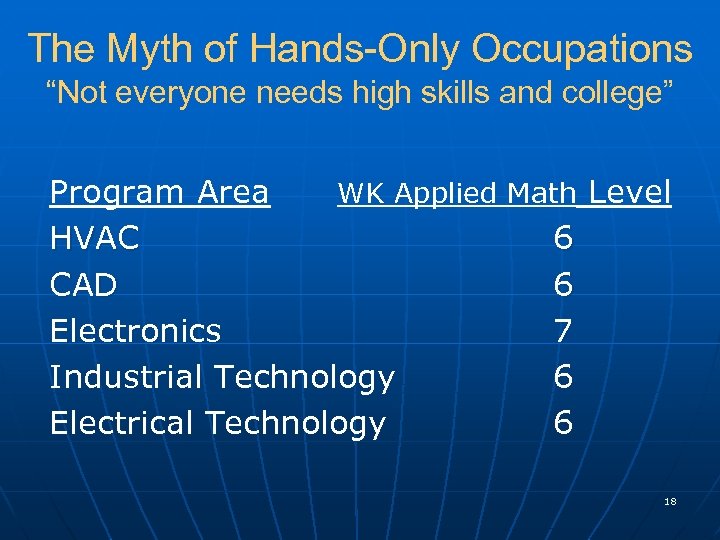 The Myth of Hands-Only Occupations “Not everyone needs high skills and college” Program Area WK Applied Math Level HVAC 6 CAD 6 Electronics 7 Industrial Technology 6 Electrical Technology 6 18
 7. Increased Emphasis on Standards and Credentials n Industry Based Credentials n National Career Readiness Certificate n CRC Consortium n Core Content Standards in K-12 n Develop standards, assessments and curriculum that reflect today’s needs and tomorrow’s requirements (Tough Choices or Tough Times) • State Qualifying Board Examinations • How do you assess creativity and innovation, self-discipline, etc? 19
 A Convergence of Transformations n n “There is no silver bullet”, but we must create a sense of urgency Combination of transformational system change strategies -(“these are not flavors of the month”) • Career Pathways as a systemic framework for transformation • Rigorous standards and credentialing 20
 Career Pathways A new national movement… But why are they so important within the context of these transformations? TECH-PREP Pipeline CP Re-Entry CP CCTI A new way of doing business and transforming our institutions to meet the changing external environment! 21
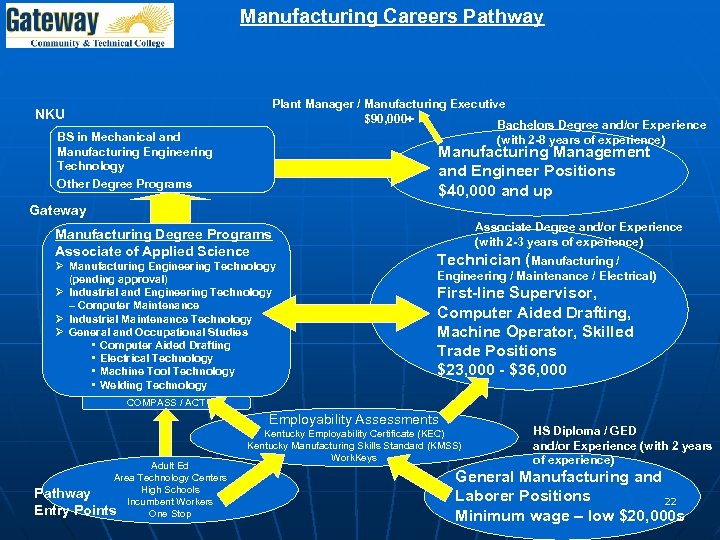 Manufacturing Careers Pathway NKU BS in Mechanical and Manufacturing Engineering Technology Other Degree Programs Plant Manager / Manufacturing Executive $90, 000+ Bachelors Degree and/or Experience (with 2 -8 years of experience) Manufacturing Management and Engineer Positions $40, 000 and up Gateway Manufacturing Degree Programs Associate of Applied Science Ø Manufacturing Engineering Technology (pending approval) Ø Industrial and Engineering Technology – Computer Maintenance Ø Industrial Maintenance Technology Ø General and Occupational Studies • Computer Aided Drafting • Electrical Technology • Machine Tool Technology • Welding Technology Associate Degree and/or Experience (with 2 -3 years of experience) Technician (Manufacturing / Engineering / Maintenance / Electrical) First-line Supervisor, Computer Aided Drafting, Machine Operator, Skilled Trade Positions $23, 000 - $36, 000 COMPASS / ACT Employability Assessments Adult Ed Area Technology Centers High Schools Pathway Incumbent Workers Entry Points One Stop Kentucky Employability Certificate (KEC) Kentucky Manufacturing Skills Standard (KMSS) Work. Keys HS Diploma / GED and/or Experience (with 2 years of experience) General Manufacturing and Laborer Positions 22 Minimum wage – low $20, 000 s
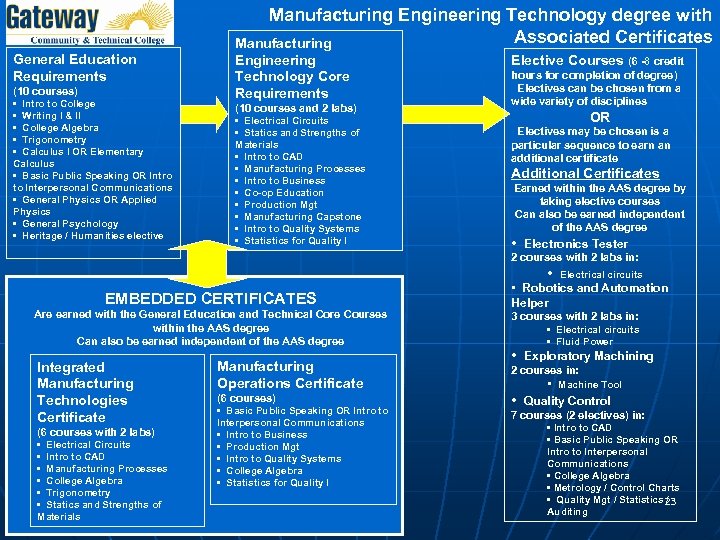 Manufacturing Engineering Technology degree with Associated Certificates Manufacturing General Education Requirements (10 courses) • Intro to College • Writing I & II • College Algebra • Trigonometry • Calculus I OR Elementary Calculus • Basic Public Speaking OR Intro to Interpersonal Communications • General Physics OR Applied Physics • General Psychology • Heritage / Humanities elective Engineering Technology Core Requirements (10 courses and 2 labs) • Electrical Circuits • Statics and Strengths of Materials • Intro to CAD • Manufacturing Processes • Intro to Business • Co-op Education • Production Mgt • Manufacturing Capstone • Intro to Quality Systems • Statistics for Quality I Elective Courses (6 -8 credit hours for completion of degree) Electives can be chosen from a wide variety of disciplines OR Electives may be chosen is a particular sequence to earn an additional certificate Additional Certificates Earned within the AAS degree by taking elective courses Can also be earned independent of the AAS degree • Electronics Tester 2 courses with 2 labs in: • EMBEDDED CERTIFICATES Are earned with the General Education and Technical Core Courses within the AAS degree Can also be earned independent of the AAS degree Integrated Manufacturing Technologies Certificate (6 courses with 2 labs) • Electrical Circuits • Intro to CAD • Manufacturing Processes • College Algebra • Trigonometry • Statics and Strengths of Materials Manufacturing Operations Certificate (6 courses) • Basic Public Speaking OR Intro to Interpersonal Communications • Intro to Business • Production Mgt • Intro to Quality Systems • College Algebra • Statistics for Quality I Electrical circuits • Robotics and Automation Helper 3 courses with 2 labs in: • Electrical circuits • Fluid Power • Exploratory Machining 2 courses in: • Machine Tool • Quality Control 7 courses (2 electives) in: • Intro to CAD • Basic Public Speaking OR Intro to Interpersonal Communications • College Algebra • Metrology / Control Charts • Quality Mgt / Statistics 23 / Auditing
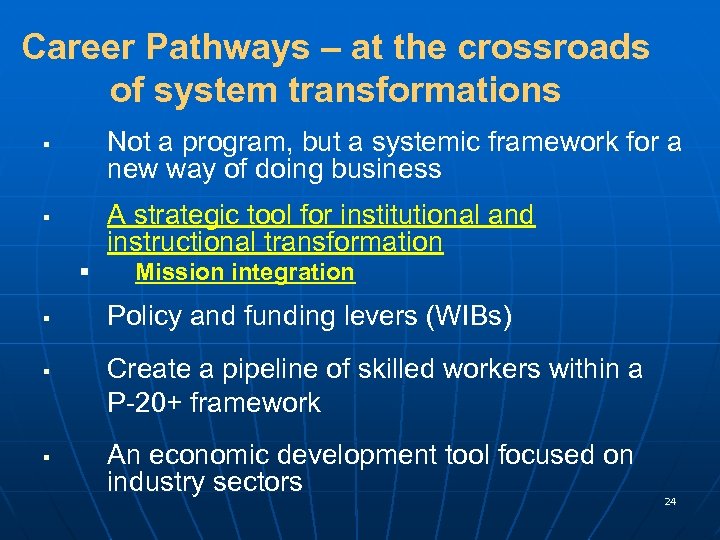 Career Pathways – at the crossroads of system transformations Not a program, but a systemic framework for a new way of doing business § A strategic tool for institutional and instructional transformation § § § Mission integration Policy and funding levers (WIBs) Create a pipeline of skilled workers within a P-20+ framework An economic development tool focused on industry sectors 24
 Career Pathways (cont. ) § § A tool to strengthen and formalize connections to business A tool to enhance community strategic partnerships, with particular focus on the public workforce investment system and adult education § An upward mobility tool for individuals § An accountability tool 25
 The Case for Mission Integration n All students will enter the workplace Separation of institutional missions in workforce, academic, remediation, student affairs and categorical programs promotes silos with impact on student and employer (and society’s customers) Public policy reinforces these silos; and changes in public policy can improve mission integration 26
![Mission Integration …is n what Mission Integration Does [John Colburn – Ford Foundation] Students](https://present5.com/presentation/a932b23c1376211557299987f8383bbd/image-27.jpg "Mission Integration …is n what Mission Integration Does [John Colburn – Ford Foundation] Students") Mission Integration …is n what Mission Integration Does [John Colburn – Ford Foundation] Students starting in one mission area transfer seamlessly to another. n n n High percentage of associates degrees conferred to students who started in remedial and vocational programs. “Credit-izing” non-credit courses. Learning is accelerated and high quality. n n n Integrated instruction methods (“learning communities. ”) Recognition of prior learning policies. “Chunking” credit courses. 27
Mission Integration …is n what Mission Integration Does [John Colburn – Ford Foundation] Students starting in one mission area transfer seamlessly to another. n n n High percentage of associates degrees conferred to students who started in remedial and vocational programs. “Credit-izing” non-credit courses. Learning is accelerated and high quality. n n n Integrated instruction methods (“learning communities. ”) Recognition of prior learning policies. “Chunking” credit courses. 27
 Mission Integration (2) n n Scheduling, student support, and financial assistance support students across mission areas. Larger numbers of students are prepared for further education AND the workplace. • Pathways enable disadvantaged students to attend four-year institutions. • Industry partnership programs place students in career jobs. 28
 Kentucky’s Mission Integration Quotient A tool assessing the status of: n Employer Engagement n Partner Engagement n Student Support Services Integration n Instructional Transformation n Continuous Improvement n Sustainability 29
 Institutional Transformation n High leverage policy areas: • Award college credit for business training (BIT) • Seat time does not = competency • Expedited program approval process • Create a system of industry-based certifications (including employability skills certifications) 30
 Institutional Transformation n Alignment and integration: • Align and connect company training requirements with college courses • Modularize courses/fractional credit/ dual credit/Corporate Colleges • Eliminate internal silos (mission integration) • Non-traditional delivery (blended learning, simulation, evening and weekend classes, business on-site classes) 31
 Instructional Re-engineering n Learner-centered, innovative instruction n Multiple entry/exit points n “Chunking” curriculum n Embedded certificates n Alternative delivery systems n Adaptive expertise (reducing cycle time of learning) 32
 And Career Pathways Make Economic Sense: Kentucky’s Projected ROI (July 2004 – February 2007) n 22 Pathways (to date) • • • n Allied Health (14) Advanced Manufacturing (3) Construction (2) Transportation (1) Business (2) KY WINS (Workforce Training Incentive Funds) commitment of $4. 1 M n Projected project revenue of $1. 1 M n Cash and in kind contributions of $7. 9 M 33
 Joint Career Pathway Curriculum Alignment Initiative n n n Initiated in partnership with CCTI and SREB KDE/OCTE/KCTCS Partnership Using CCTI Curriculum Template Perkins Funded Six sectors currently being addressed • • • n Construction Education Health Science Information Technology Manufacturing STEM Joint Faculty Teams to: • Identify Pathways in Sector • Align Secondary and Post secondary Curricula • Identify Dual Credit Opportunities 34
 Kentucky’s Career Pathways Outcomes to Date n n Approximately 1, 685 students served per year Career Pathways students earned 573 credentials since July, 2004: • 155 Associate Degrees • 91 Diplomas • 327 Certificates n Career Pathway students had a higher retention rate than the KCTCS student population from Fall 2005 to Fall 2006: • Career Pathways Students 73% • KCTCS population 52% 35
 Career Pathways: Lessons Learned n n n Every college starts in a different place, builds upon different strengths and progresses at a different rate. Redesign of curriculum and delivery methods (internal issues) more challenging than employer and agency partnership development (external issues). Conversations between colleges (academic faculty) and employers were elevated to a new level. 36
 Career Pathways: Lessons Learned (2) n n Workforce development staff facilitate and support while reinventing their role and relationships. Be prepared to align pathways with corresponding secondary efforts (Perkins, Tech Prep, High Schools that Work, etc. ) Colleges initially look to adult ed providers for more flexible and targeted remediation. Additional technical assistance and resources needed to engage college faculty in curriculum design and redesign. 37
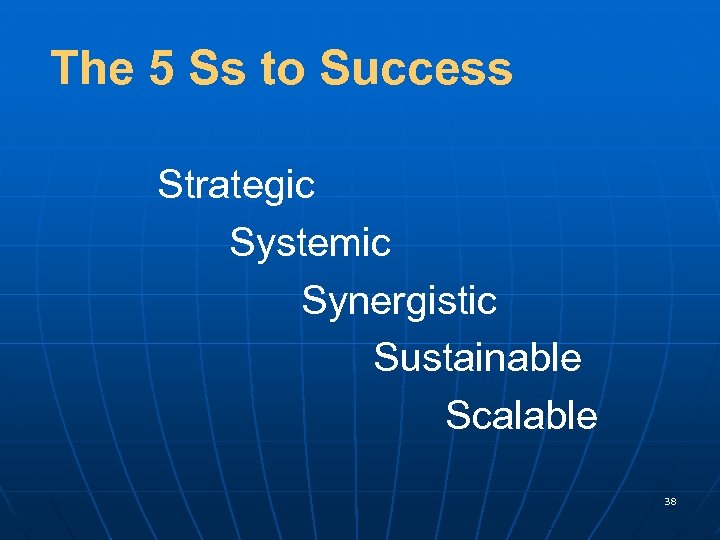 The 5 Ss to Success Strategic Systemic Synergistic Sustainable Scalable 38
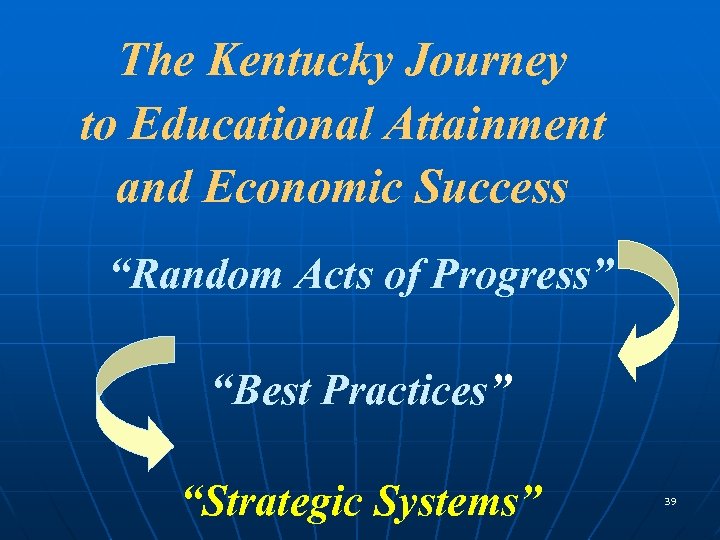 The Kentucky Journey to Educational Attainment and Economic Success “Random Acts of Progress” “Best Practices” “Strategic Systems” 39
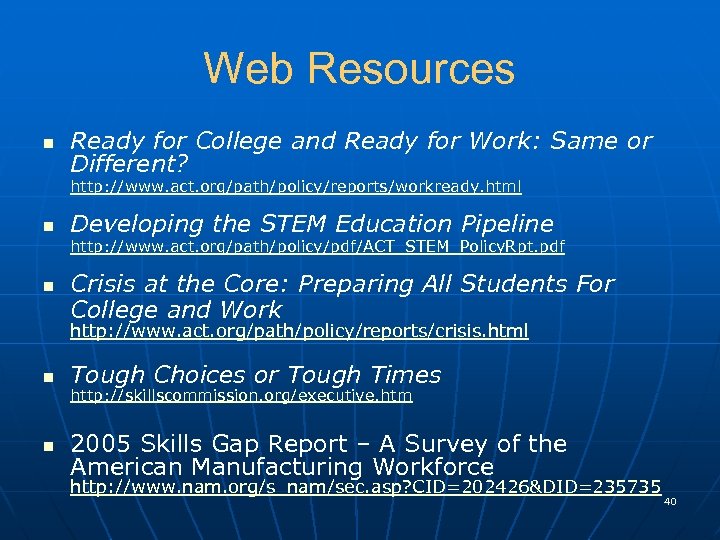 Web Resources n Ready for College and Ready for Work: Same or Different? http: //www. act. org/path/policy/reports/workready. html n Developing the STEM Education Pipeline http: //www. act. org/path/policy/pdf/ACT_STEM_Policy. Rpt. pdf n Crisis at the Core: Preparing All Students For College and Work http: //www. act. org/path/policy/reports/crisis. html n Tough Choices or Tough Times n 2005 Skills Gap Report – A Survey of the American Manufacturing Workforce http: //skillscommission. org/executive. htm http: //www. nam. org/s_nam/sec. asp? CID=202426&DID=235735 40
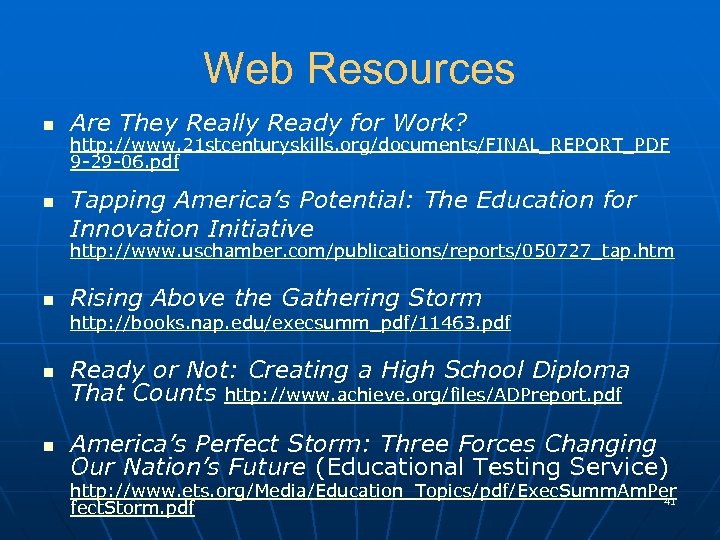 Web Resources n n Are They Really Ready for Work? http: //www. 21 stcenturyskills. org/documents/FINAL_REPORT_PDF 9 -29 -06. pdf Tapping America’s Potential: The Education for Innovation Initiative http: //www. uschamber. com/publications/reports/050727_tap. htm n Rising Above the Gathering Storm http: //books. nap. edu/execsumm_pdf/11463. pdf n Ready or Not: Creating a High School Diploma That Counts http: //www. achieve. org/files/ADPreport. pdf n America’s Perfect Storm: Three Forces Changing Our Nation’s Future (Educational Testing Service) http: //www. ets. org/Media/Education_Topics/pdf/Exec. Summ. Am. Per 41 fect. Storm. pdf
 Contact info Keith Bird Keith. bird@kctcs. edu 42