


 Скачать презентацию Career College Association Trends Policies and Issues Reauthorization
cbc6f09d37740de2e8c61f0758b17978.ppt
- Количество слайдов: 36
 Career College Association Trends, Policies and Issues Reauthorization – 2003 Nicholas J. Glakas National Council of Higher Education Loan Programs Sarasota, Florida January 9, 2003
 The Global Education Markplace A few facts. . .
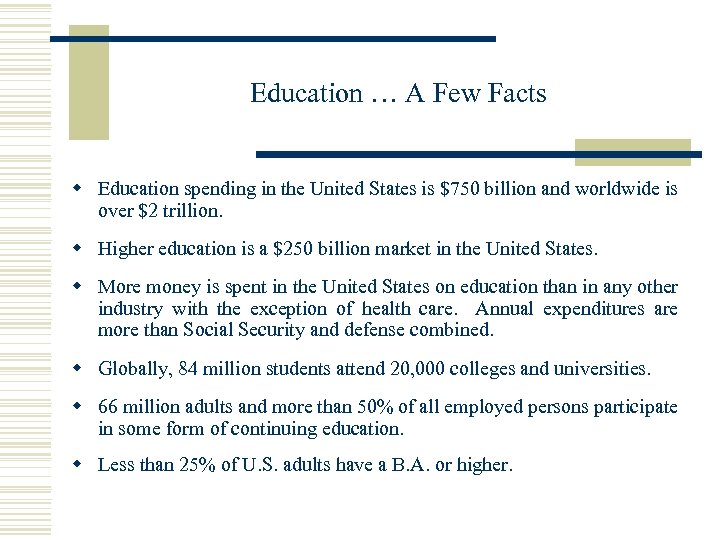 Education … A Few Facts w Education spending in the United States is $750 billion and worldwide is over $2 trillion. w Higher education is a $250 billion market in the United States. w More money is spent in the United States on education than in any other industry with the exception of health care. Annual expenditures are more than Social Security and defense combined. w Globally, 84 million students attend 20, 000 colleges and universities. w 66 million adults and more than 50% of all employed persons participate in some form of continuing education. w Less than 25% of U. S. adults have a B. A. or higher.
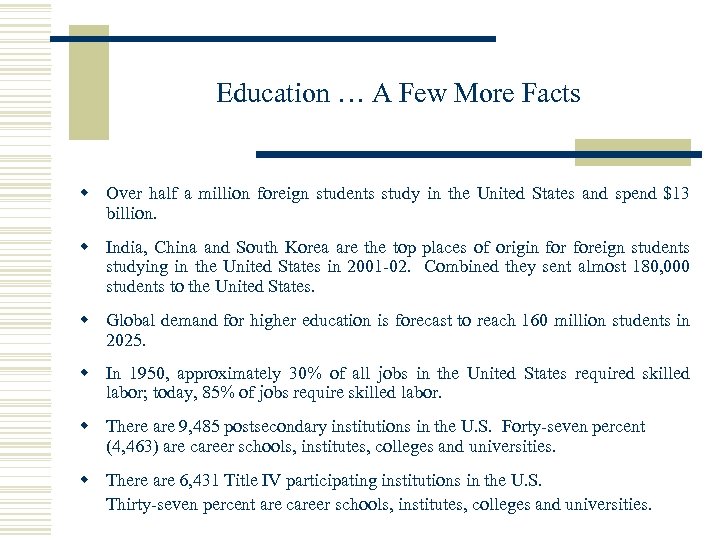 Education … A Few More Facts w Over half a million foreign students study in the United States and spend $13 billion. w India, China and South Korea are the top places of origin foreign students studying in the United States in 2001 -02. Combined they sent almost 180, 000 students to the United States. w Global demand for higher education is forecast to reach 160 million students in 2025. w In 1950, approximately 30% of all jobs in the United States required skilled labor; today, 85% of jobs require skilled labor. w There are 9, 485 postsecondary institutions in the U. S. Forty-seven percent (4, 463) are career schools, institutes, colleges and universities. w There are 6, 431 Title IV participating institutions in the U. S. Thirty-seven percent are career schools, institutes, colleges and universities.
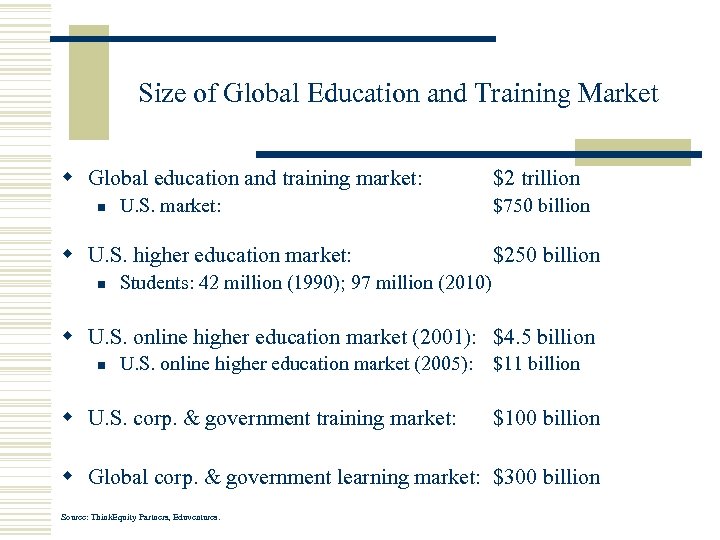 Size of Global Education and Training Market w Global education and training market: n U. S. market: w U. S. higher education market: n $2 trillion $750 billion $250 billion Students: 42 million (1990); 97 million (2010) w U. S. online higher education market (2001): $4. 5 billion n U. S. online higher education market (2005): $11 billion w U. S. corp. & government training market: $100 billion w Global corp. & government learning market: $300 billion Source: Think. Equity Partners, Eduventures.
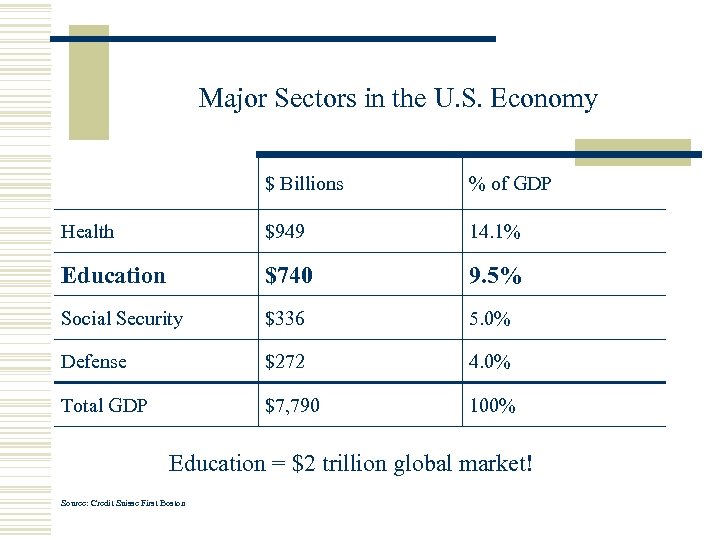 Major Sectors in the U. S. Economy $ Billions % of GDP Health $949 14. 1% Education $740 9. 5% Social Security $336 5. 0% Defense $272 4. 0% Total GDP $7, 790 100% Education = $2 trillion global market! Source: Credit Suisse First Boston
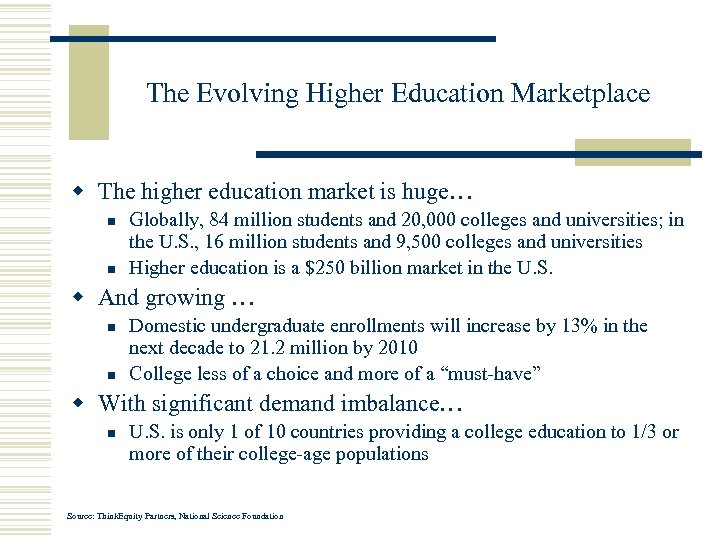 The Evolving Higher Education Marketplace w The higher education market is huge… n n Globally, 84 million students and 20, 000 colleges and universities; in the U. S. , 16 million students and 9, 500 colleges and universities Higher education is a $250 billion market in the U. S. w And growing … n n Domestic undergraduate enrollments will increase by 13% in the next decade to 21. 2 million by 2010 College less of a choice and more of a “must-have” w With significant demand imbalance… n U. S. is only 1 of 10 countries providing a college education to 1/3 or more of their college-age populations Source: Think. Equity Partners, National Science Foundation
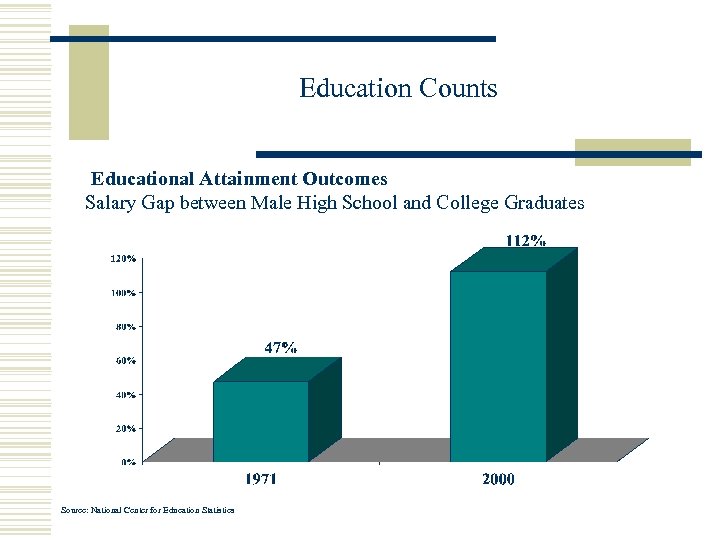 Education Counts Educational Attainment Outcomes Salary Gap between Male High School and College Graduates Source: National Center for Education Statistics
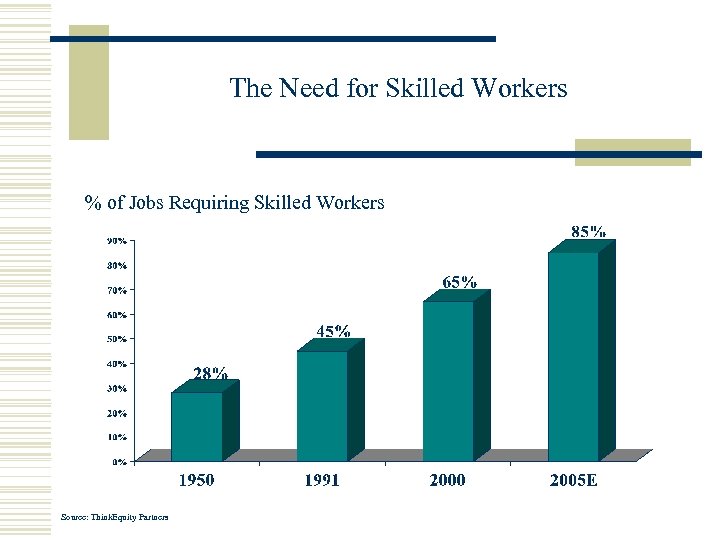 The Need for Skilled Workers % of Jobs Requiring Skilled Workers Source: Think. Equity Partners
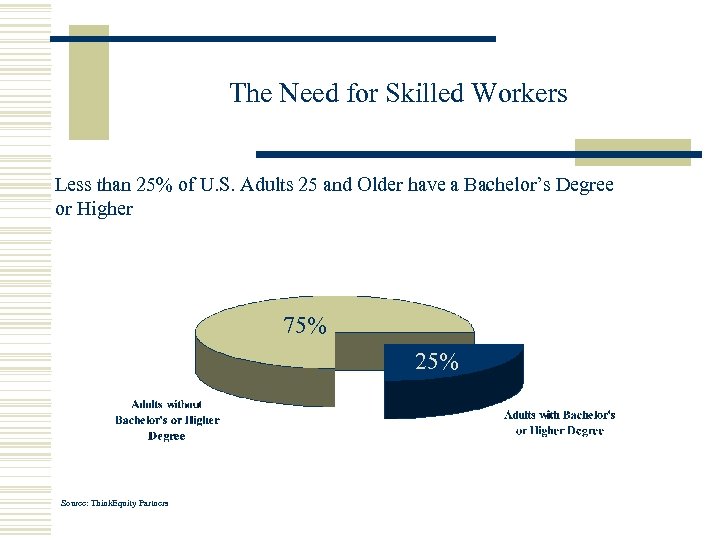 The Need for Skilled Workers Less than 25% of U. S. Adults 25 and Older have a Bachelor’s Degree or Higher 75% 25% Source: Think. Equity Partners
 Higher Education Landscape w 66 million adults and more than 50% of all employed persons participate in some form of continuing education w 56% of the workforce, or 66 million people, is without an advanced degree w Number of corporate “universities” skyrocketed from 400 in 1988 to over 2, 000 today, including 40% of Fortune 500 companies w More than 60% of corporate universities have alliances with institutions of higher education, increasing to 85% by 2003 Source: Think. Equity Partners
 Global Higher Education Landscape w Over 500, 000 foreign students, or 3. 5% of total postsecondary enrollees, study in the U. S. and spend $13 billion w America educates one-third of all foreign students w For every foreign student studying in the U. S. , there are three to five students who would consume U. S. education online, if they had the access or the resources n Potential of 1. 6 million international distance learning candidates w Global demand for higher education forecast to reach 160 million students in 2025 n Conservatively, 45 million users of online higher education Source: Think. Equity Partners
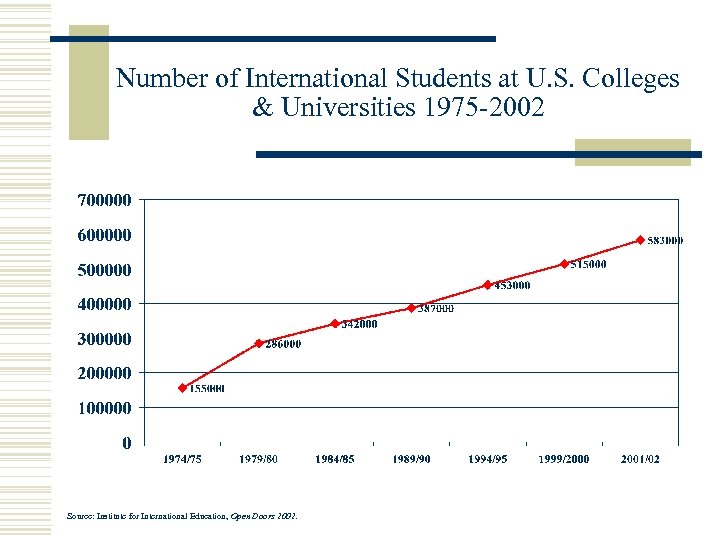 Number of International Students at U. S. Colleges & Universities 1975 -2002 Source: Institute for International Education, Open Doors 2002.
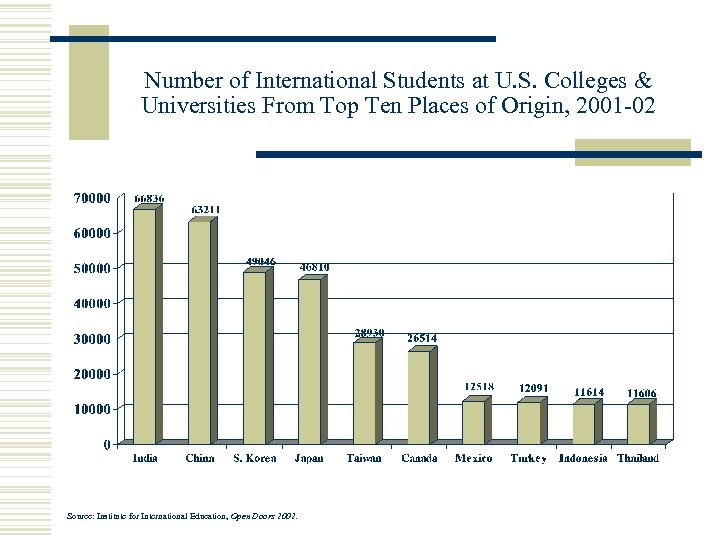 Number of International Students at U. S. Colleges & Universities From Top Ten Places of Origin, 2001 -02 Source: Institute for International Education, Open Doors 2002.
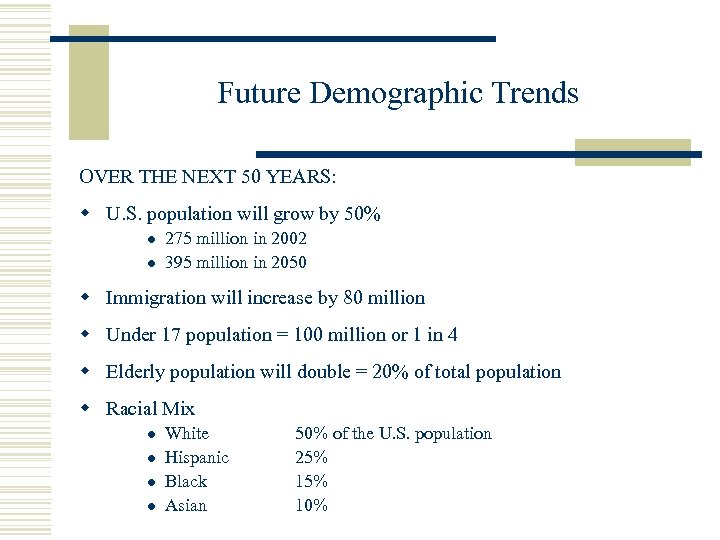 Future Demographic Trends OVER THE NEXT 50 YEARS: w U. S. population will grow by 50% l l 275 million in 2002 395 million in 2050 w Immigration will increase by 80 million w Under 17 population = 100 million or 1 in 4 w Elderly population will double = 20% of total population w Racial Mix l l White Hispanic Black Asian 50% of the U. S. population 25% 10%
 The For-Profit Sector w The Career College Association is a voluntary membership organization of private, postsecondary schools, institutes, colleges and universities that provide career-specific educational programs. CCA’s 1, 000 members educate and support more than a million students each year for employment in over 200 occupational fields. w CCA member institutions cover the full gamut of postsecondary education: from short-term certificate and diploma programs, to two- and four-year associate and baccalaureate degrees, to master’s and doctoral programs. w Most CCA member institutions participate in federal student financial assistance programs under Title IV of the Higher Education Act. w In addition, over the past four years CCA’s Foundation has provided more than 17, 000 scholarships to high school graduates attending CCA member schools, institutes, colleges and universities.
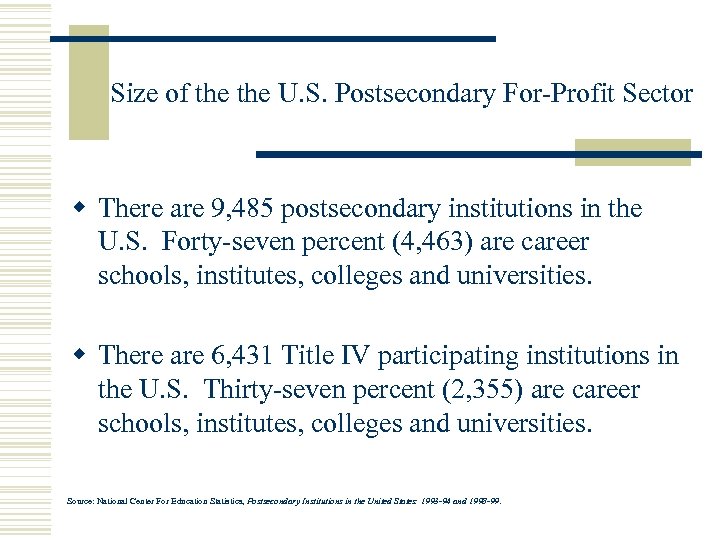 Size of the U. S. Postsecondary For-Profit Sector w There are 9, 485 postsecondary institutions in the U. S. Forty-seven percent (4, 463) are career schools, institutes, colleges and universities. w There are 6, 431 Title IV participating institutions in the U. S. Thirty-seven percent (2, 355) are career schools, institutes, colleges and universities. Source: National Center For Education Statistics, Postsecondary Institutions in the United States: 1993 -94 and 1998 -99.
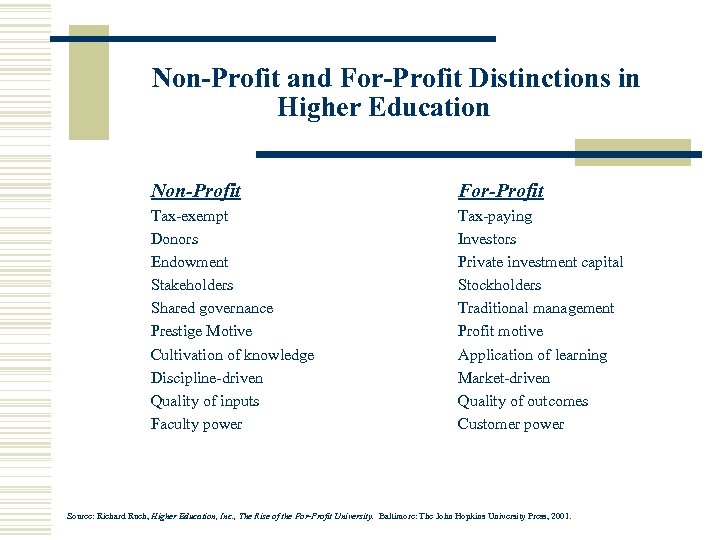 Non-Profit and For-Profit Distinctions in Higher Education Non-Profit Tax-exempt Donors Endowment Stakeholders Shared governance Prestige Motive Cultivation of knowledge Discipline-driven Quality of inputs Faculty power For-Profit Tax-paying Investors Private investment capital Stockholders Traditional management Profit motive Application of learning Market-driven Quality of outcomes Customer power Source: Richard Ruch, Higher Education, Inc. , The Rise of the For-Profit University. Baltimore: The John Hopkins University Press, 2001.
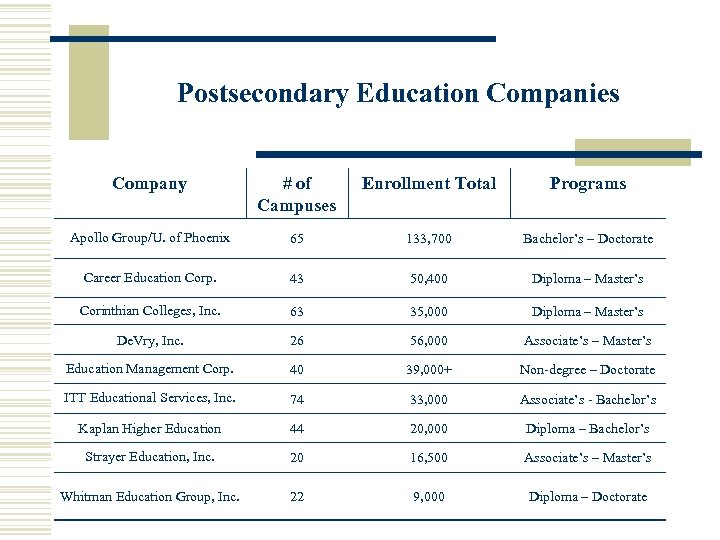 Postsecondary Education Companies Company # of Campuses Enrollment Total Programs Apollo Group/U. of Phoenix 65 133, 700 Bachelor’s – Doctorate Career Education Corp. 43 50, 400 Diploma – Master’s Corinthian Colleges, Inc. 63 35, 000 Diploma – Master’s De. Vry, Inc. 26 56, 000 Associate’s – Master’s Education Management Corp. 40 39, 000+ Non-degree – Doctorate ITT Educational Services, Inc. 74 33, 000 Associate’s - Bachelor’s Kaplan Higher Education 44 20, 000 Diploma – Bachelor’s Strayer Education, Inc. 20 16, 500 Associate’s – Master’s Whitman Education Group, Inc. 22 9, 000 Diploma – Doctorate
 The Reauthorization of the Higher Education Act CCA Reauthorization Preparations
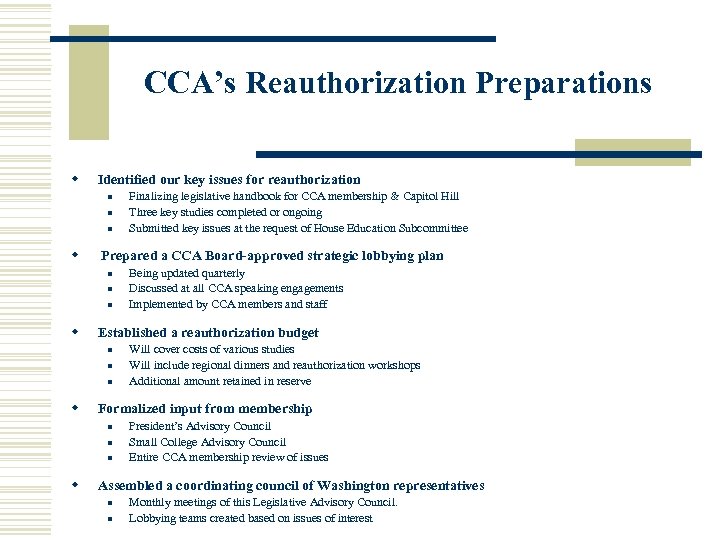 CCA’s Reauthorization Preparations w Identified our key issues for reauthorization n w Prepared a CCA Board-approved strategic lobbying plan n w n n Will cover costs of various studies Will include regional dinners and reauthorization workshops Additional amount retained in reserve Formalized input from membership n n n w Being updated quarterly Discussed at all CCA speaking engagements Implemented by CCA members and staff Established a reauthorization budget n w Finalizing legislative handbook for CCA membership & Capitol Hill Three key studies completed or ongoing Submitted key issues at the request of House Education Subcommittee President’s Advisory Council Small College Advisory Council Entire CCA membership review of issues Assembled a coordinating council of Washington representatives n n Monthly meetings of this Legislative Advisory Council. Lobbying teams created based on issues of interest
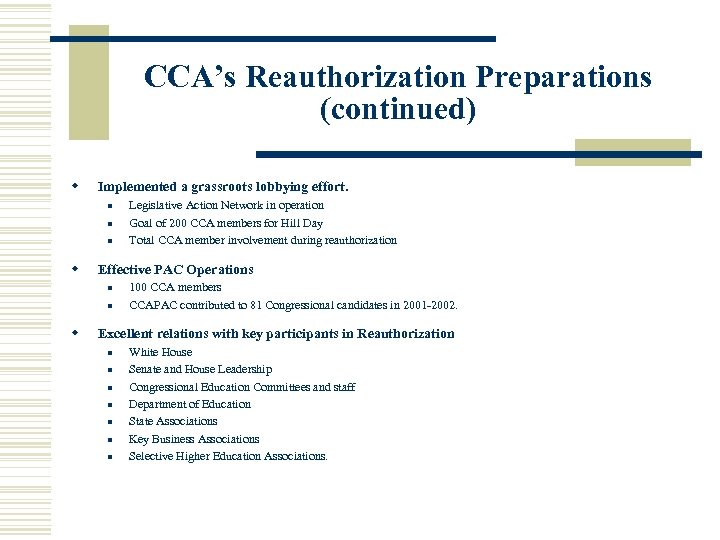 CCA’s Reauthorization Preparations (continued) w Implemented a grassroots lobbying effort. n n n w Effective PAC Operations n n w Legislative Action Network in operation Goal of 200 CCA members for Hill Day Total CCA member involvement during reauthorization 100 CCA members CCAPAC contributed to 81 Congressional candidates in 2001 -2002. Excellent relations with key participants in Reauthorization n n n White House Senate and House Leadership Congressional Education Committees and staff Department of Education State Associations Key Business Associations Selective Higher Education Associations.
 The Reauthorization of the Higher Education Act CCA Reauthorization Issues
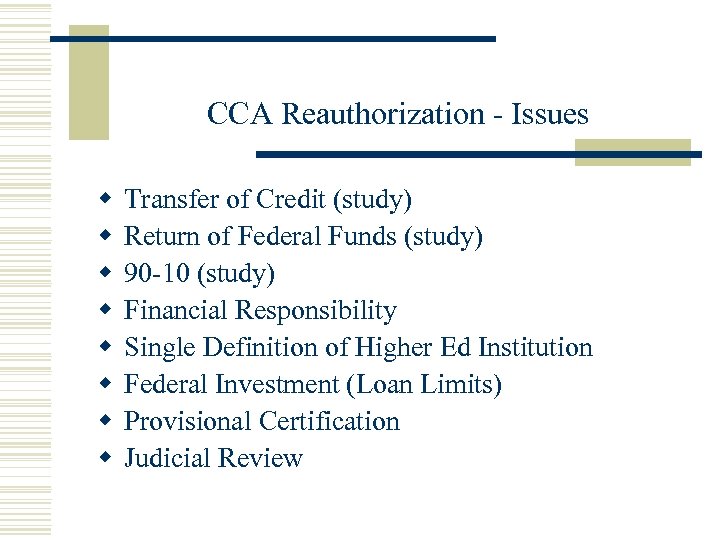 CCA Reauthorization - Issues w w w w Transfer of Credit (study) Return of Federal Funds (study) 90 -10 (study) Financial Responsibility Single Definition of Higher Ed Institution Federal Investment (Loan Limits) Provisional Certification Judicial Review
 Reauthorization – Issues (continued) w 50% Telecommunications Rule w Accountability Probably off the table: w 12 -Hour Rule w Incentive Compensation
 Transfer of Credit w Issue: CCA’s Foundation commissioned the Institute for Higher Education Policy to study the relationship between credit transfer of students who attend nationally accredited institutions to regionally accredited institutions. The study found a strong pattern of full acceptance of credit for virtually all institutions that are regionally accredited, but acceptance for only a small percentage of institutions accredited by national accrediting bodies. w CCA Proposal: Revise section 1094(a) to add a new required condition in the program participation agreement signed by institutions participating in the Title IV student aid programs as follows: (25) The institution will not exclude transfers of credit earned by students completing courses of programs from other eligible institutions of higher education on the basis of the agency or association that accredits such institutions, provided that the agency or association is recognized by the Secretary pursuant to Subpart 2 of Part H of this Act, and will base decisions on whether to accept such credits solely on whether the courses or programs are equivalent in content to those offered by the institution and the student has completed the course or program at the required level of proficiency. Revise section 1099 b(a) to add a new required recognition criterion for accrediting agencies: (9) such agency or association shall not adopt or apply standards, policies or practices that restrict transfers of credits between eligible institutions of higher education as defined by this Act that are accredited by an agency or association recognized by the
 Return of Title IV Funds w Issue: Return of Federal Funds has been one of the most controversial provisions of the 1998 reauthorization. CCA has commissioned a major study to determine the extent of harm to students and institutions. w CCA Proposal: Use the results of the study and its simulation model to develop specific proposals. Anticipated completion the end of January.
 90 -10 Rule w Issue: As part of the 1998 HEA Amendments, Congress modified the 85 -15 rule to allow no more than 90% of a proprietary institution’s revenue to be derived from Title IV. Subsequently, the Department of Education changed the definitions of eligible revenue to make compliance more difficult. w CCA Proposal: CCA has contracted with the American Economics Group for a comprehensive study of the effect of the 90 -10 rule on students and institutions. Upon completion of the 90 -10 study, CCA will determine the alternative proposals that have the greatest aggregate benefits for the largest number of institutions and students.
 Financial Responsibility w Issue: The higher education community and the Department of Education have gained five years of experience in applying the financial responsibility regulations adopted in November 1997. While the regulations have been an improvement over the requirements previously used to measure financial responsibility, there are still serious problems with the manner in which the Department judges the financial stability of institutions. w CCA Proposal: Only historic goodwill should be used in determining the ratios and calculating the composite score; additional goodwill booked as a consequence of an acquisition would not be deducted. After an acquisition, this additional goodwill would be recognized on a gradual basis over a five-year period. This treatment of goodwill would be conditioned on the acquirer being creditworthy at the time of the acquisition as measured by the strength factors for its primary reserve and equity ratios. w The language of the statute should clearly state that the Secretary will permit accounting treatments that are in accordance with GAAP.
 Single Definition of a Higher Education Institution w Issue: 1998 HEA Amendments moved toward enacting a single definition for the purpose of providing equal access to all Title IV programs. Separate definitions still remain in Section 101 of the Act. w CCA Proposal: Revise the Act to include proprietary institutions in Section 101 and delete Section 102.
 Federal Investment in Postsecondary Education w Issue: The federal grant and loan programs have not kept pace with inflation. Grants now account for less than one fourth of federal financial aid. w CCA Proposal: Increase funding to the Pell Grant program thereby increasing the maximum award levels, and explore other innovative proposals such as the concept of “front-loading” federal grant aid to provide increased assistance to students during their first two years of postsecondary education. w Increase the loan limits of the subsidized and unsubsidized federal student loans as much as feasible within the constraints of budget considerations, with special consideration given to students who are in year one and two where assistance is often needed the most.
 Provisional Certification w Issue: Provisional certification is a status that carries both limitations and risks that fully certified institutions do not face. The Department of Education takes the position that the Secretary may terminate the provisional certification of institutions as a response to allegations of regulatory violations. In such cases, the institutions do not have the due process protections that would be provided in a Limitation, Suspension & Termination action or an emergency action. w CCA Proposal: The law should be changed to create an exemption from the requirement that an institution be placed on provisional certification upon a change of ownership that results in a change in control when a change transfers ownership to a person or entity that has an established track record of regulatory compliance, which could be judged by whether the acquiring institution is itself fully certified and is permitted to use the advance payment method. w Additionally, the Department’s ability to make ad hoc policy should be replaced with a clear set of rules.
 Judicial Review w Issue: The Department of Education has used an obscure provision in the HEA to persuade some federal courts to deny educational institutions their day in court. w CCA Proposal: Amend Section 432(a)(2) of the HEA to allow court review.
 50% Telecommunications Rule w Issue: During the 1992 HEA Amendments, Congress enacted the 50% telecommunications rule. The rule stipulates that institutions are not eligible to participate in Title IV programs if they offer more than 50% of their courses via telecommunications or correspondence or if 50% or more of their regularly enrolled students are enrolled in telecommunications or correspondence courses. w CCA Proposal: CCA supports modification of the 50% rule to allow increased flexibility for students in meeting their educational goals.
 Accountability w Issue: The Administration has indicated that, just as performance measures were the centerpiece of the recent K-12 reauthorization, it will seek to import into the postsecondary education arena some measure of institutional effectiveness. CCA formed a Task Force to formulate recommendations for reasonable, workable accountability measures in higher education. w CCA Proposal: Create an “Institutional Report Card” based on a general framework with three constituent parts: • Input measures to assess the resources and capacity to deliver educational services; • Output measures to provide information on graduations/completions; and • Outcomes measures to demonstrate value added to students.
 Career College Association Nicholas J. Glakas Nick. G@career. org Phone: 202/336 -6754 www. career. org