 Скачать презентацию Cardio-respiratory II-4 Pharmacology Basics Cardio-respiratory drugs
03f1ba0b9aa3c5c7386eeeade35c4ccc.ppt
- Количество слайдов: 11



Cardio-respiratory II-4 Pharmacology Basics & Cardio-respiratory drugs
Basic principles • Pharmacology = study of drugs; actions, dosage, indication & adverse effects • Drug = substance, altering biological activity in a person • Agonists = activate receptor response • Antagonists = block a receptor response • ‘Half-life’ = rate of elimination of a drug by indicating the time for plasma level to drop to 50% • Drug metabolism; determined by patient’s age, size & drug’s route of excretion ESP slide 2
Drug Therapy Drug purpose - to prevent inflammation (Chromones) - treat inflammation (Corticosteroids) - treat bronchospasm (bronchodilators) - treat breathlessness (bronchodilators) - treat infection (Antibiotics) - help clear secretions (humidification, ↑ drinking) - inhibit coughing (nebulized local anaesthetics) - improve ventilation (respiratory stimulants) - relieve oedema (diuretics) ESP slide 3
Adverse effects • Hypersensitivity = allergic reaction; from mild to anaphylaxis (life-threatening systemic allergic, with respiratory obstruction & decreased BP) • Idiosyncratic effect = unusual resp. to drugs • Iatrongenic effect = neg. effect on body due to med. Error i. e. overdose • Teratogenic = harmful effects on Fetus • Interaction of drugs can lead to a synergism(++)/antagonism(--)effect or potentiation (1 st drug enhances 2 nd drug effect)
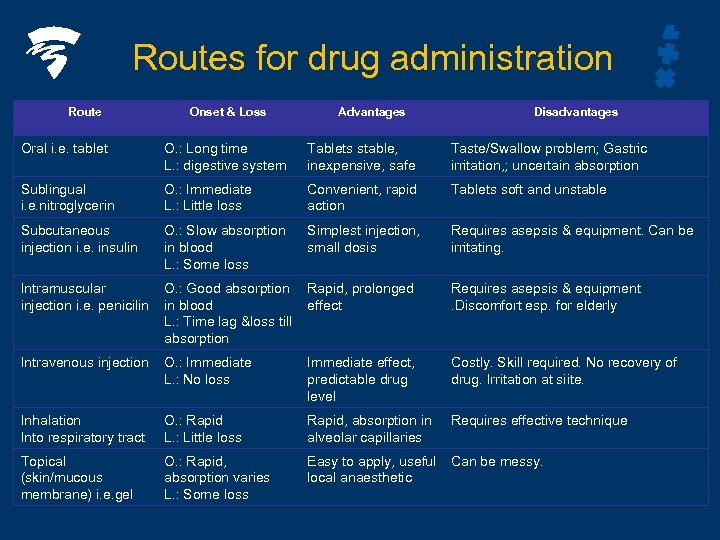
Routes for drug administration Route Onset & Loss Advantages Disadvantages Oral i. e. tablet O. : Long time L. : digestive system Tablets stable, inexpensive, safe Taste/Swallow problem; Gastric irritation, ; uncertain absorption Sublingual i. e. nitroglycerin O. : Immediate L. : Little loss Convenient, rapid action Tablets soft and unstable Subcutaneous injection i. e. insulin O. : Slow absorption in blood L. : Some loss Simplest injection, small dosis Requires asepsis & equipment. Can be irritating. Intramuscular injection i. e. penicilin O. : Good absorption in blood L. : Time lag &loss till absorption Rapid, prolonged effect Requires asepsis & equipment. Discomfort esp. for elderly Intravenous injection O. : Immediate L. : No loss Immediate effect, predictable drug level Costly. Skill required. No recovery of drug. Irritation at siite. Inhalation Into respiratory tract O. : Rapid L. : Little loss Rapid, absorption in alveolar capillaries Requires effective technique Topical (skin/mucous membrane) i. e. gel O. : Rapid, absorption varies L. : Some loss Easy to apply, useful local anaesthetic Can be messy.
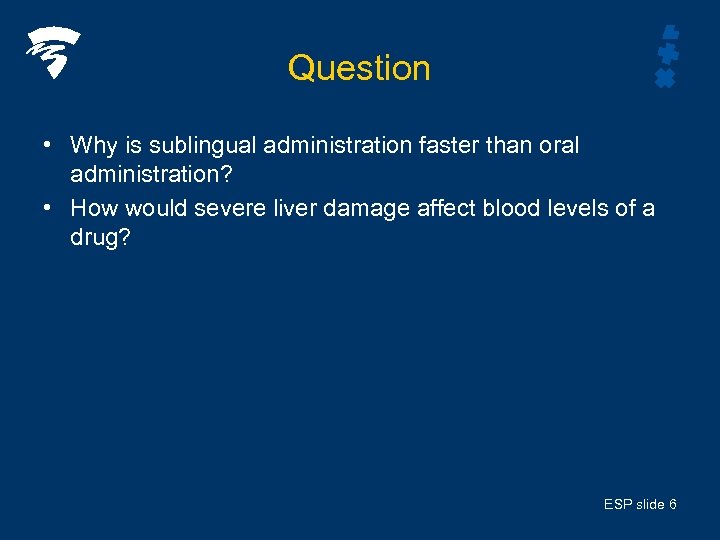
Question • Why is sublingual administration faster than oral administration? • How would severe liver damage affect blood levels of a drug? ESP slide 6
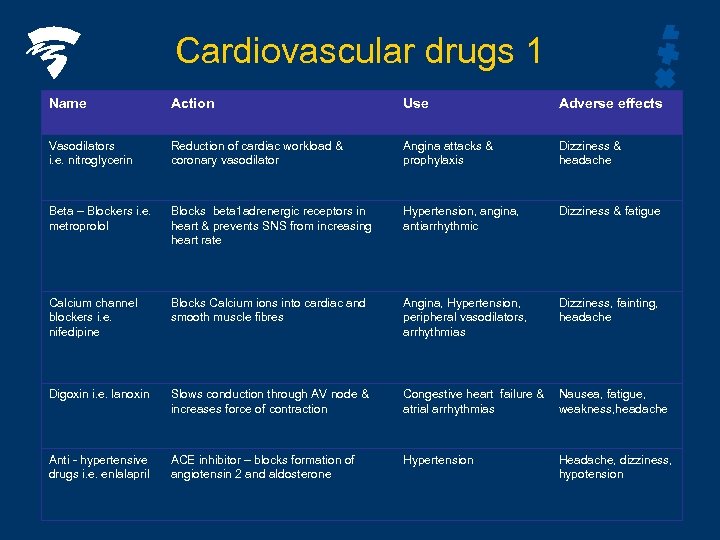
Cardiovascular drugs 1 Name Action Use Adverse effects Vasodilators i. e. nitroglycerin Reduction of cardiac workload & coronary vasodilator Angina attacks & prophylaxis Dizziness & headache Beta – Blockers i. e. metroprolol Blocks beta 1 adrenergic receptors in heart & prevents SNS from increasing heart rate Hypertension, angina, antiarrhythmic Dizziness & fatigue Calcium channel blockers i. e. nifedipine Blocks Calcium ions into cardiac and smooth muscle fibres Angina, Hypertension, peripheral vasodilators, arrhythmias Dizziness, fainting, headache Digoxin i. e. lanoxin Slows conduction through AV node & increases force of contraction Congestive heart failure & atrial arrhythmias Nausea, fatigue, weakness, headache Anti - hypertensive drugs i. e. enlalapril ACE inhibitor – blocks formation of angiotensin 2 and aldosterone Hypertension Headache, dizziness, hypotension
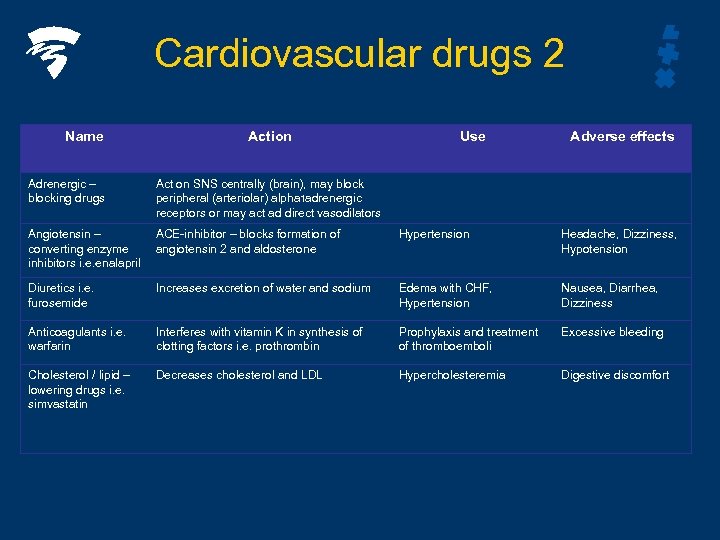
Cardiovascular drugs 2 Name Action Use Adverse effects Adrenergic – blocking drugs Act on SNS centrally (brain), may block peripheral (arteriolar) alpha 1 adrenergic receptors or may act ad direct vasodilators Angiotensin – converting enzyme inhibitors i. e. enalapril ACE-inhibitor – blocks formation of angiotensin 2 and aldosterone Hypertension Headache, Dizziness, Hypotension Diuretics i. e. furosemide Increases excretion of water and sodium Edema with CHF, Hypertension Nausea, Diarrhea, Dizziness Anticoagulants i. e. warfarin Interferes with vitamin K in synthesis of clotting factors i. e. prothrombin Prophylaxis and treatment of thromboemboli Excessive bleeding Cholesterol / lipid – lowering drugs i. e. simvastatin Decreases cholesterol and LDL Hypercholesteremia Digestive discomfort
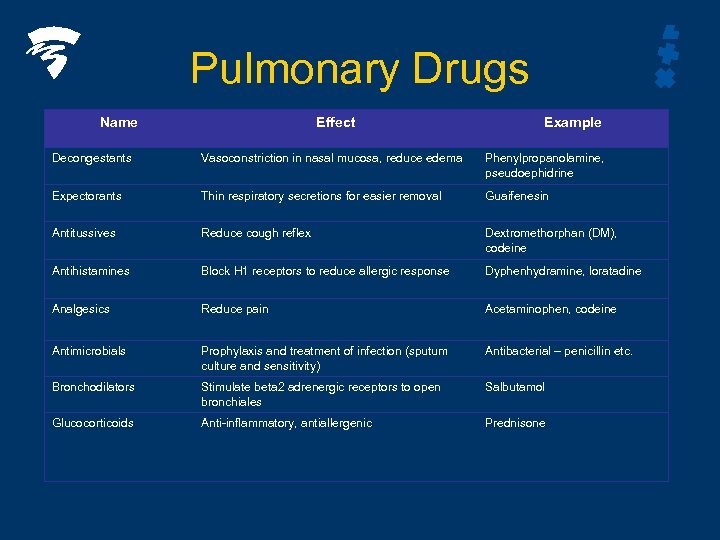
Pulmonary Drugs Name Effect Example Decongestants Vasoconstriction in nasal mucosa, reduce edema Phenylpropanolamine, pseudoephidrine Expectorants Thin respiratory secretions for easier removal Guaifenesin Antitussives Reduce cough reflex Dextromethorphan (DM), codeine Antihistamines Block H 1 receptors to reduce allergic response Dyphenhydramine, loratadine Analgesics Reduce pain Acetaminophen, codeine Antimicrobials Prophylaxis and treatment of infection (sputum culture and sensitivity) Antibacterial – penicillin etc. Bronchodilators Stimulate beta 2 adrenergic receptors to open bronchiales Salbutamol Glucocorticoids Anti-inflammatory, antiallergenic Prednisone
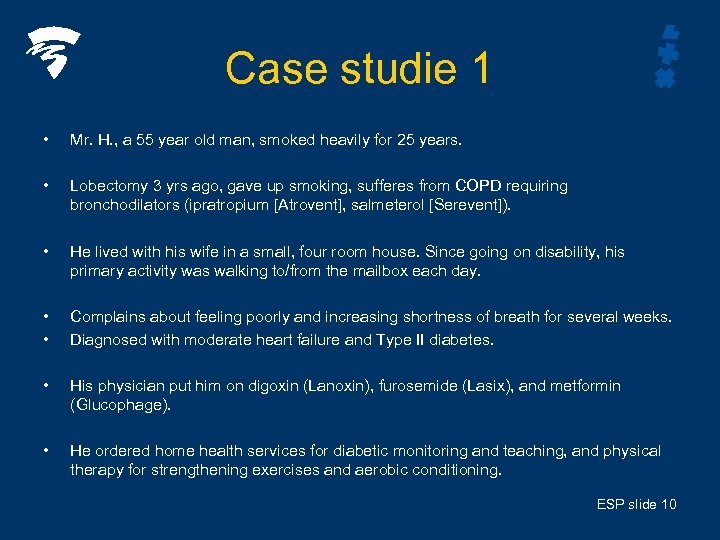
Case studie 1 • Mr. H. , a 55 year old man, smoked heavily for 25 years. • Lobectomy 3 yrs ago, gave up smoking, sufferes from COPD requiring bronchodilators (ipratropium [Atrovent], salmeterol [Serevent]). • He lived with his wife in a small, four room house. Since going on disability, his primary activity was walking to/from the mailbox each day. • • Complains about feeling poorly and increasing shortness of breath for several weeks. Diagnosed with moderate heart failure and Type II diabetes. • His physician put him on digoxin (Lanoxin), furosemide (Lasix), and metformin (Glucophage). • He ordered home health services for diabetic monitoring and teaching, and physical therapy for strengthening exercises and aerobic conditioning. ESP slide 10
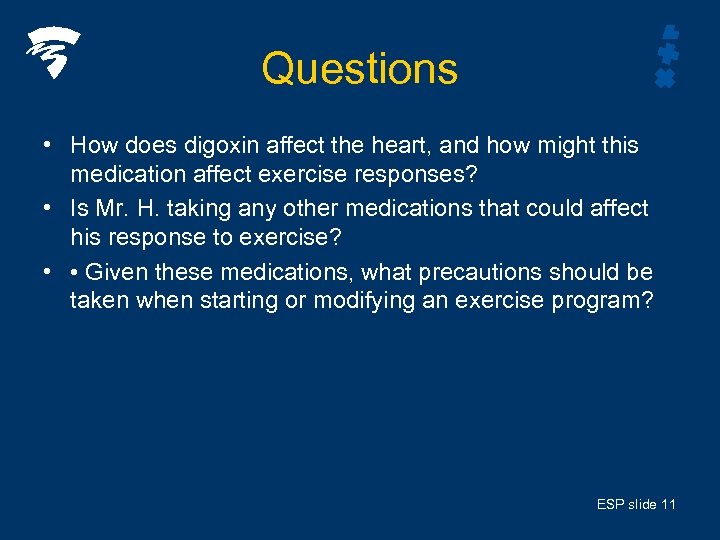
Questions • How does digoxin affect the heart, and how might this medication affect exercise responses? • Is Mr. H. taking any other medications that could affect his response to exercise? • • Given these medications, what precautions should be taken when starting or modifying an exercise program? ESP slide 11
Скачать презентацию Cardio-respiratory II-4 Pharmacology Basics Cardio-respiratory drugs
03f1ba0b9aa3c5c7386eeeade35c4ccc.ppt