


 Скачать презентацию Cardiac Assist Devices Wayne E Ellis Ph D
847d7e61f27e81d7c0fe4fc846849415.ppt
- Количество слайдов: 108
 Cardiac Assist Devices Wayne E. Ellis, Ph. D. , CRNA
 Types Pacemakers AICDs VADs 2
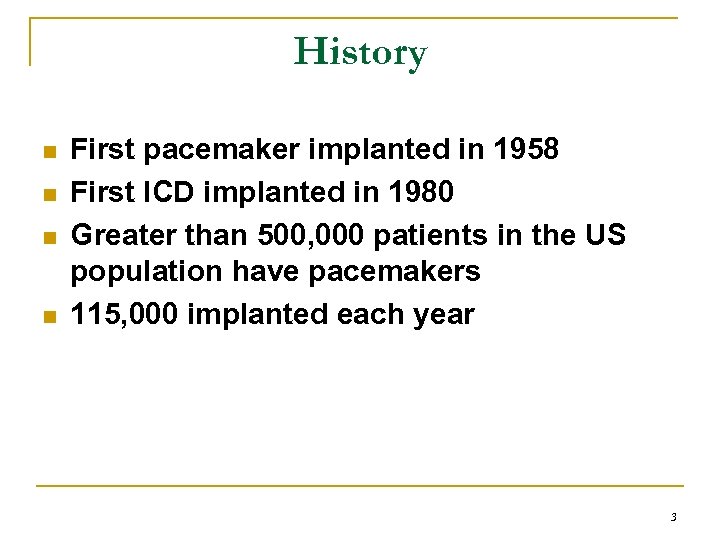 History n n First pacemaker implanted in 1958 First ICD implanted in 1980 Greater than 500, 000 patients in the US population have pacemakers 115, 000 implanted each year 3
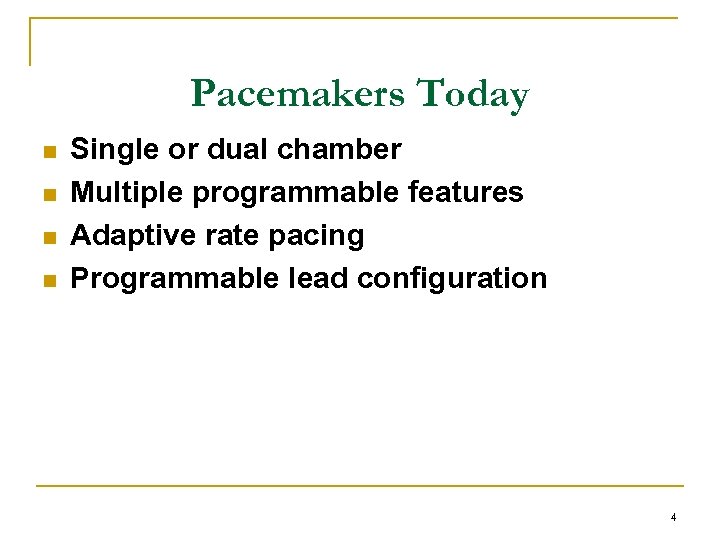 Pacemakers Today n n Single or dual chamber Multiple programmable features Adaptive rate pacing Programmable lead configuration 4
 Internal Cardiac Defibrillators (ICD) n n Transvenous leads Multiprogrammable Incorporate all capabilities of contemporary pacemakers Storage capacity 5
 Temporary Pacing Indications n Routes = Transvenous, transcutaneous, esophageal n Unstable bradydysrhythmias Atrioventricular heart block Unstable tachydysrhythmias n n n *Endpoint reached after resolution of the problem or permanent pacemaker implantation 6
 Permanent Pacing Indications n n n Chronic AVHB Chronic Bifascicular and Trifascicular Block AVHB after Acute MI Sinus Node Dysfunction Hypersensitive Carotid Sinus and Neurally Mediated Syndromes Miscellaneous Pacing Indications 7
 Chronic AVHB Especially if symptomatic Pacemaker most commonly indicated for: n Type 2 2º n q n Block occurs within or below the Bundle of His 3º Heart Block q No communication between atria and ventricles 8
 Chronic Bifascicular and Trifascicular Block n n n Differentiation between uni, bi, and trifascicular block Syncope common in patients with bifascicular block Intermittent 3º heart block common 9
 AVHB after Acute MI n n n Incidence of high grade AVHB higher Indications for pacemaker related to intraventricular conduction defects rather than symptoms Prognosis related to extent of heart damage 10
 Sinus Node Dysfunction n n Sinus bradycardia, sinus pause or arrest, or sinoatrial block, chronotropic incompetence Often associated with paroxysmal SVTs (bradycardia-tachycardia syndrome) May result from drug therapy Symptomatic? Often the primary indication for a pacemaker 11
 Hypersensitive Carotid Sinus Syndrome • Syncope or presyncope due to an exaggerated response to carotid sinus stimulation • Defined as asystole greater than 3 sec due to sinus arrest or AVHB, an abrupt reduction of BP, or both 12
 Neurally Mediated Syncope n n n 10 -40% of patients with syncope Triggering of a neural reflex Use of pacemakers is controversial since often bradycardia occurs after hypotension 13
 Miscellaneous n n n Hypertrophic Obstructive Cardiomyopathy Dilated cardiomyopathy Cardiac transplantation Termination and prevention of tachydysrhythmias Pacing in children and adolescents 14
 Indications for ICDs n n Cardiac arrest due to VT/VF not due to a transient or reversible cause Spontaneous sustained VT Syncope with hemodynamically significant sustained VT or VF NSVT with CAD, previous MI, LV dysfunction and inducible VF or VT not suppressed by a class 1 antidysrhythmic 15
 Device Selection n Temporary pacing (invasive vs. noninvasive) Permanent pacemaker ICD 16
 Pacemaker Characteristics • Adaptive-rate pacemakers • Single-pass lead Systems • Programmable lead configuration • Automatic Mode-Switching • Unipolar vs. Bipolar electrode configuration 17
 ICD selection n n Antibradycardia pacing Antitachycardia pacing Synchronized or nonsynchronized shocks for dysrhythmias Many of the other options incorporated into pacemakers 18
 Approaches to Insertion a. IV approach (endocardial lead) b. Subcostal approach (epicardial or myocardial lead) c. Noninvasive transcutaneous pacing Alternative to emergency transvenous pacing 19
 Mechanics Provide the rhythm heart cannot produce Either temporary or permanent Consists of external or internal power source and a lead to carry the current to the heart muscle Batteries provide the power source Pacing lead is a coiled wire spring encased in silicone to insulate it from body fluids 20
 Unipolar Pacemaker Lead has only one electrode that contacts the heart at its tip (+) pole The power source is the (-) pole Patient serves as the grounding source Patient’s body fluids provide the return pathway for the electrical signal Electromagnetic interference occurs more often in unipolar leads 21
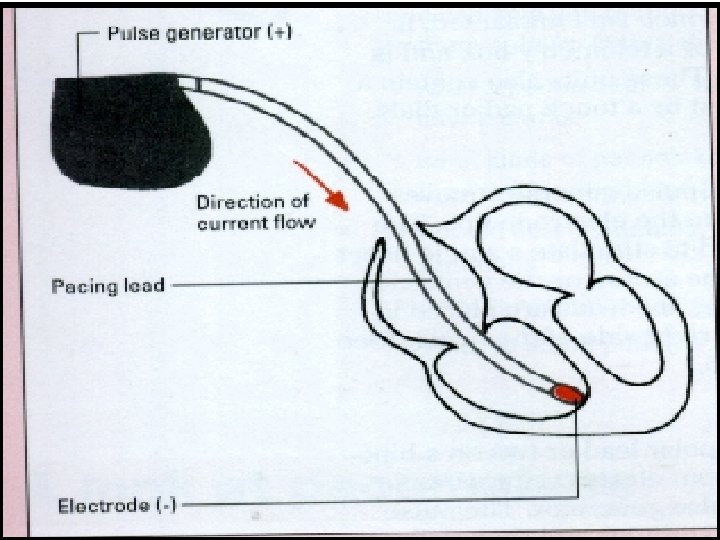 Unipolar Pacemaker 22
 Bipolar Pacemaker If bipolar, there are two wires to the heart or one wire with two electrodes at its tip Provides a built-in ground lead Circuit is completed within the heart Provides more contact with the endocardium; needs lower current to pace Less chance for cautery interference 23
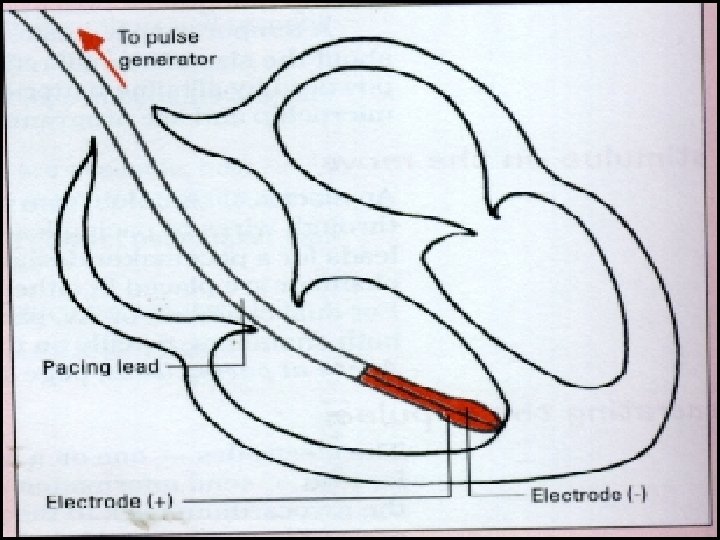 Bipolar Pacemaker 24
 Indications 1. Sick sinus syndrome (Tachy-brady syndrome) 2. Symptomatic bradycardia 3. Atrial fibrillation 4. Hypersensitive carotid sinus syndrome 5. Second-degree heart block/Mobitz II 25
 Indications 6. Complete heart block 7. Sinus arrest/block 8. Tachyarrhythmias Supraventricular, ventricular To overdrive the arrhythmia 26
 Atrial Fibrillation * A fibrillating atrium cannot be paced * Place a VVI * Patient has no atrial kick 27
 Types 1. Asynchronous/Fixed Rate 2. Synchronous/Demand 3. Single/Dual Chamber Sequential (A & V) 4. Programmable/nonprogrammable 28
 Asynchronous/Fixed Rate Does not synchronize with intrinsic HR Used safely in pts with no intrinsic ventricular activity If pt has vent. activity, it may compete with pt’s own conduction system VT may result (R-on-T phenomenon) EX: VOO, AOO, DOO 29
 Synchronous/Demand Contains two circuits * One forms impulses * One acts as a sensor When activated by an R wave, sensing circuit either triggers or inhibits the pacing circuit Called “Triggered” or “Inhibited” pacers Most frequently used pacer Eliminates competition; Energy sparing 30
 Examples of Demand Pacemakers DDI VVI/VVT AAI/AAT Disadvantage: Pacemaker may be fooled by interference and may not fire 31
 Dual Chamber: A-V Sequential Facilitates a normal sequence between atrial and ventricular contraction Provides atrial kick + ventricular pacing Atrial contraction assures more complete ventricular filling than the ventricular demand pacing unit Increase CO 25 -35% over ventricular pacing alone 32
 A-V Sequential Disadvantage: More difficult to place More expensive Contraindication: Atrial fibrillation, SVT Developed due to inadequacy of “pure atrial pacing” 33
 Single Chamber Atrial Ventricular 34
 “Pure Atrial Pacing” Used when SA node is diseased or damaged but AV conduction system remains intact Provides atrial kick Atrial kick can add 15 -30% to CO over a ventricular pacemaker Electrode in atrium: stimulus produces a P wave 35
 Problems with Atrial Pacing Electrode difficult to secure in atrium Tends to float Inability to achieve consistent atrial “demand” function 36
 Ventricular Pacemakers If electrode is placed in right ventricle, stimulus produces a left BBB pattern If electrode is placed in left ventricle, stimulus produces a right BBB pattern 37
 Programmability Capacity to noninvasively alter one of several aspects of the function of a pacer Desirable since pacer requirements for a person change over time Most common programmed areas Rate Output AV delay in dual chamber pacers R wave sensitivity Advantage: can overcome interference caused by electrocautery 38
 3 -Letter or 5 -Letter Code Devised to simplify the naming of pacemaker generators 39
 First letter Indicates the chamber being paced A: V: D: O: Atrium Ventricle Dual (Both A and V) None 40
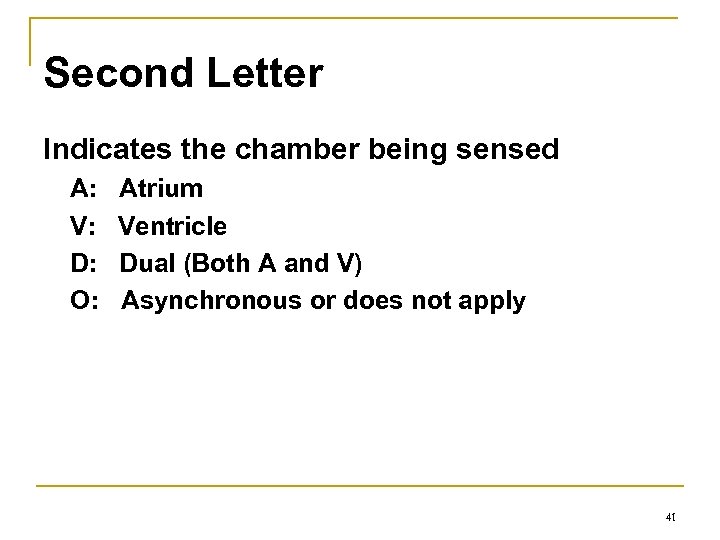 Second Letter Indicates the chamber being sensed A: V: D: O: Atrium Ventricle Dual (Both A and V) Asynchronous or does not apply 41
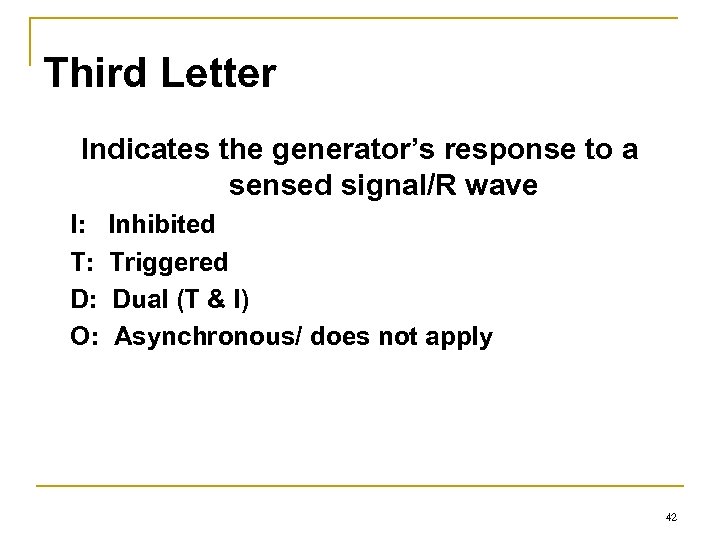 Third Letter Indicates the generator’s response to a sensed signal/R wave I: T: D: O: Inhibited Triggered Dual (T & I) Asynchronous/ does not apply 42
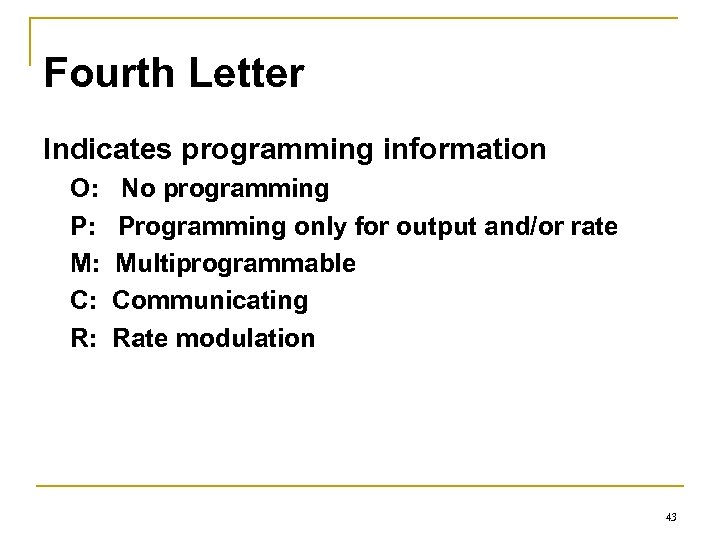 Fourth Letter Indicates programming information O: P: M: C: R: No programming Programming only for output and/or rate Multiprogrammable Communicating Rate modulation 43
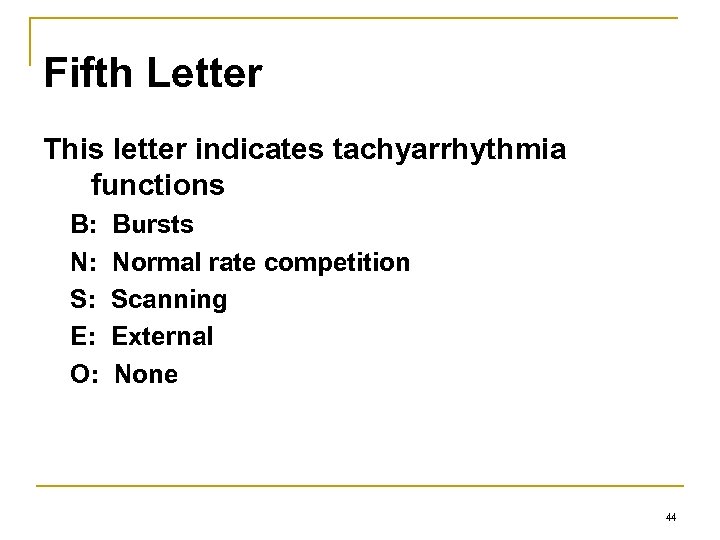 Fifth Letter This letter indicates tachyarrhythmia functions B: N: S: E: O: Bursts Normal rate competition Scanning External None 44
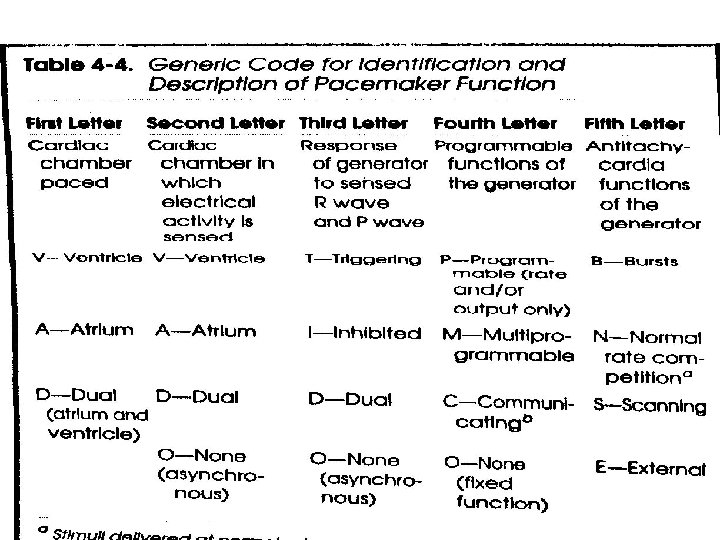 Table of Pacer Codes 45
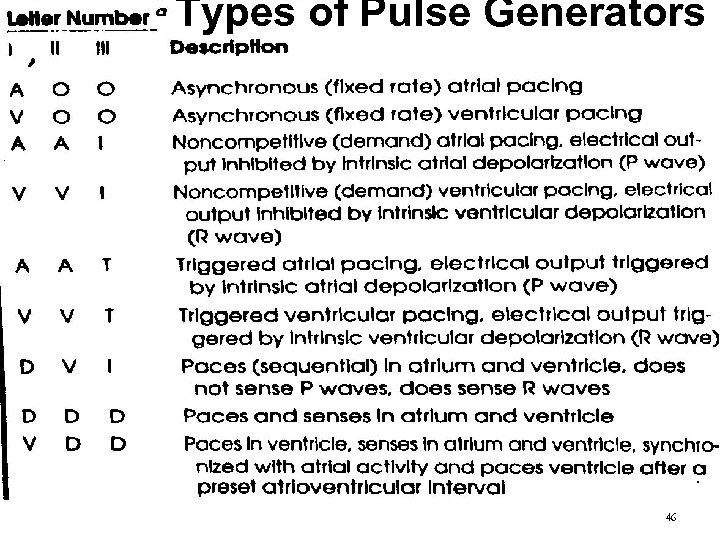 Types of Pulse Generators 46
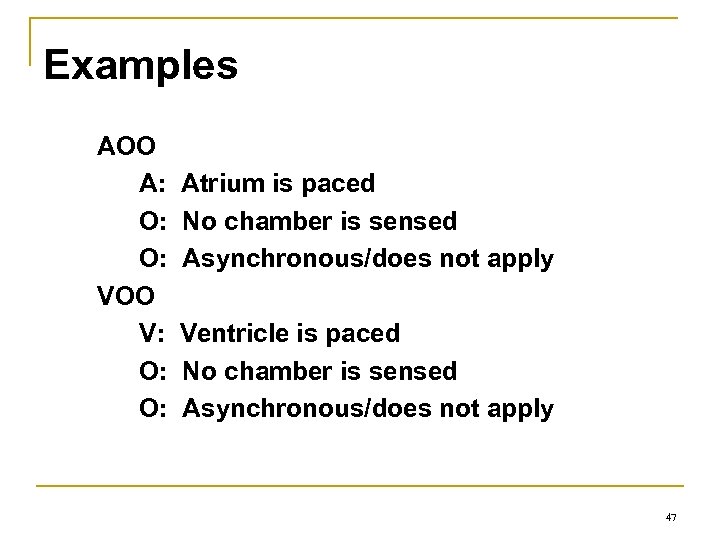 Examples AOO A: O: O: VOO V: O: O: Atrium is paced No chamber is sensed Asynchronous/does not apply Ventricle is paced No chamber is sensed Asynchronous/does not apply 47
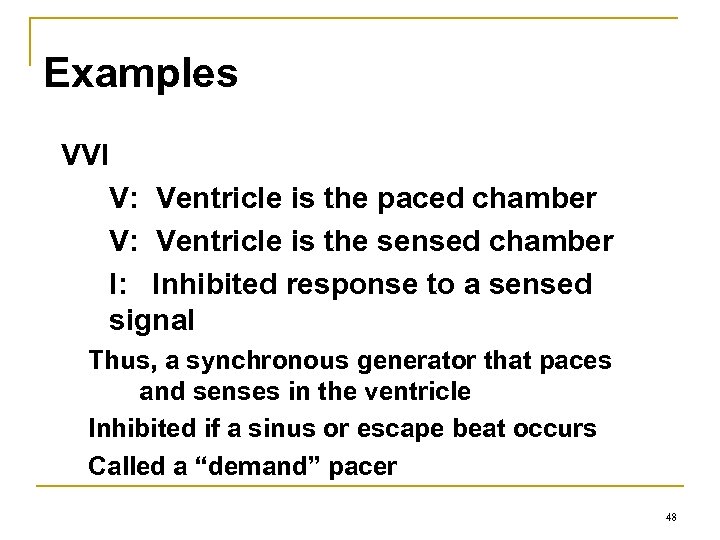 Examples VVI V: Ventricle is the paced chamber V: Ventricle is the sensed chamber I: Inhibited response to a sensed signal Thus, a synchronous generator that paces and senses in the ventricle Inhibited if a sinus or escape beat occurs Called a “demand” pacer 48
 Examples DVI D: Both atrium and ventricle are paced V: Ventricle is sensed I: Response is inhibited to a sensed ventricular signal For A-V sequential pacing in which atria and ventricles are paced. If a ventricular signal, generator won’t fire Overridden by intrinsic HR if faster 49
 Examples DDD Greatest flexibility in programming Best approximates normal cardiac response to exercise DOO Most apparent potential for serious ventricular arrhythmias VAT Ventricular paced, atrial sensed Should have an atrial refractory period programmed in to prevent risk of arrhythmias induced by PACs from ectopic or retrograde conduction AV interval is usually 150 -250 milliseconds 50
 Other Information Demand pacer can be momentarily converted to asynchronous mode by placing magnet externally over pulse generator in some pacers Dual chamber pacers preferable for almost all patients except those with chronic atrial fibrillation (need a working conduction system) Asynchronous pacer modes not generally used outside the OR OR has multiple potential sources of electrical interference which may prevent normal function of demand pacers 51
 Other Information VVI: Standard ventricular demand pacemaker DVI: AV pacemaker with two pacing electrodes Demand pacer may be overridden by intrinsic HR if more rapid Demand pacer can be momentarily converted to asynchronous mode by placing magnet externally over pulse generator 52
 Sensing Ability of device to detect intrinsic cardiac activity Undersensing: failure to sense Oversensing: too sensitive to activity 53
 Undersensing: Failure to sense Pacer fails to detect an intrinsic rhythm Paces unnecessarily Patient may feel “extra beats” If an unneeded pacer spike falls in the latter portion of T wave, dangerous tachyarrhythmias or V fib may occur (R on T) TX: Increase sensitivity of pacer 54
 Oversensing Pacer interprets noncardiac electrical signals as originating in the heart Detects extraneous signals such as those produced by electrical equipment or the activity of skeletal muscles (tensing, flexing of chest muscles, SUX) Inhibits itself from pacing as it would a true heart beat 55
 Oversensing On ECG: pauses longer than the normal pacing interval are present Often, electrical artifact is seen Deprived of pacing, the patient suffers CO, feels dizzy/light-headed Most often due to sensitivity being programmed too high TX: Reduce sensitivity 56
 Capture Depolarization of atria and/or ventricles in response to a pacing stimulus 57
 Noncapture/Failure to Capture Pacer’s electrical stimulus (pacing) fails to depolarize (capture) the heart There is no “failure to pace” Pacing is simply unsuccessful at stimulating a contraction ECG shows pacer spikes but no cardiac response CO occurs TX: threshold/output strength or duration 58
 Pacer Failure A. Early electrode displacement/breakage B. Failure > 6 months Premature battery depletion Faulty pulse generator 59
 Pacer Malfunctions per ECG Failure to capture Failure to sense Runaway pacemaker 60
 Pacer Malfunction SX 1. Vertigo/Syncope *Worsens with exercise 2. 3. 4. 5. 6. 7. 8. Unusual fatigue Low B/P/ peripheral pulses Cyanosis Jugular vein distention Oliguria Dyspnea/Orthopnea Altered mental status 61
 EKG Evaluation Capture: Should be 1: 1 (spike: EKG complex/pulse) *Not helpful if patient’s HR is > pacer rate if synchronous type 62
 EKG Evaluation Proper function of demand pacer Confirmed by seeing captured beats on EKG when pacer is converted to asynchronous mode Place external converter magnet over generator Do not use magnet unless recommended 63
 CAPTURE Output: amt of current (m. Amps) needed to get an impulse Sensitivity: (millivolts); the lower the setting, the more sensitive 64
 Anesthesia for Insertion MAC To provide comfort To control dysrhythmias To check for proper function/capture Have external pacer/Isuprel/Atropine ready Continuous ECG and peripheral pulse Pulse ox with plethysmography to see perfusion of each complex (EKG may become unreadable) 65
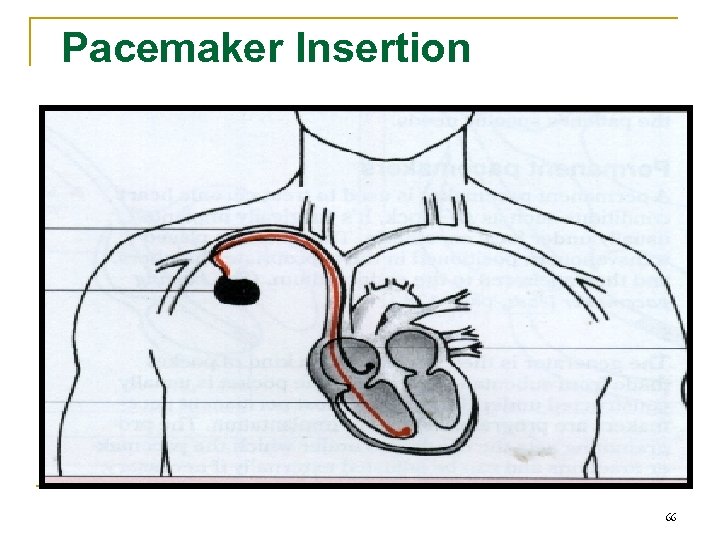 Pacemaker Insertion 66
 Interference Things which may modify pacer function: Sympathomimetic amines may increase myocardial irritability Quinidine/Procainamide toxicity may cause failure of cardiac capture K+, advanced ht disease, or fibrosis around electrode may cause failure of cardiac capture 67
 Anesthesia for Pt with Pacemaker a. Continuous ECG and peripheral pulse b. Pulse ox with plethysmography to see perfusion of each complex (EKG may become unreadable) c. Defibrillator/crash cart available d. External pacer available e. External converter magnet available 68
 Anesthesia for Pt with Pacemaker If using Succinylcholine, consider defasciculating dose of MR Fasciculations may inhibit firing due to the skeletal muscle contractions picked up by generator as intrinsic R waves Place ground pad far from generator but close to cautery tip Cover pad well with conductive gel Minimizes detection of cautery current by pulse generator If patient has a transvenous pacemaker, increased risk of V. fib from microshock levels of electrical current 69
 Anesthesia for Pt with Pacemaker Cautery may interfere with pacer: May inhibit triggering (pacer may sense electrical activity and not fire) May inadvertently reprogram May induce arrhythmias secondary to current May cause fixed-rate pacing 70
 Automatic Implantable Cardiac Defibrillators 71
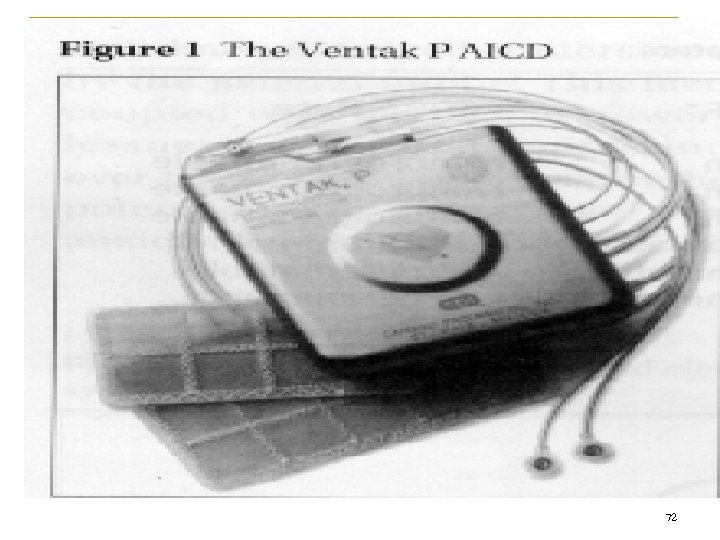 AICD 72
 Parts of AICD Pulse generator with batteries and capacitors Electrode or lead system Surgically placed in or on pericardium/myocardium Monitors HR and rhythm Delivers shock if VT or Vfib 73
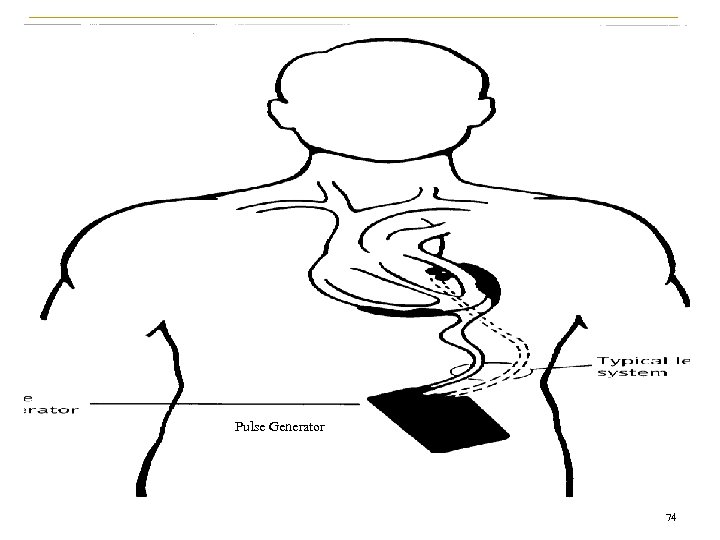 Placement of AICD Pulse Generator 74
 AICD Indications Risk for sudden cardiac death caused by tachyarrhythmias (VT, Vfib) Reduces death from 40% to 2% per year 75
 Defibrillator Codes First letter: Shock Chamber A: atrium V: ventricle D: dual O: none 76
 Defibrillator Codes Second letter: Antitachycardia Chamber A: atrium V: ventricle D: dual O: none Third letter: Tachycardia Detection E: EKG H: Hemodynamics 77
 Defibrillator Codes Fourth letter: Antibradycardia Pacing Chamber A: atrium V: ventricle D: dual O: none 78
 Settings Gives a shock at 0. 1 -30 joules Usually 25 joules Takes 5 -20 seconds to sense VT/VF Takes 5 -15 seconds more to charge 2. 5 -10 second delay before next shock is administered Total of 5 shocks, then pauses If patient is touched, may feel a buzz or tingle If CPR is needed, wear rubber gloves for insulation 79
 Tiered Therapy Ability of an implanted cardioverter defibrillator to deliver different types of therapies in an attempt to terminate ventricular tachyarrhythmias EX of therapies: Anticardiac pacing Cardioversion Defibrillation Antibradycardia pacing 80
 Anesthesia MAC vs General Usually general due to induction of VT/VF so AICD can be checked for performance Lead is placed in heart Generator is placed in hip area or in upper chest 81
 VADs Ventricular assist devices Implantable pumps used for circulatory support in pts with CHF Blood fills device through a cannulation site in V or A Diaphragm pumps blood into aorta or PA Set at predetermined rate (fixed) or automatic (rate changes in response to venous return) 82
 Electromagnetic Interference on Pacers and AICDs Electrocautery May inhibit or trigger output May revert it to asynchronous mode May reprogram inappropriately May induce Afib or Vfib May burn at lead-tissue interface 83
 Electromagnetic Interference on Pacers and AICDs Defibrillation May cause permanent damage to pulse generator May burn at lead-tissue interface Radiation Therapy May damage metal oxide silicon circuitry May reprogram inappropriately 84
 Electromagnetic Interference on Pacers and AICDs PET/CT (Contraindicated) May damage metal oxide silicon circuitry May reprogram inappropriately MRI (Contraindicated) May physically move pulse generator May reprogram inappropriately May give inappropriate shock to pt with AICD PNSs May cause inappropriate shock or inhibition Test at highest output setting 85
 Deactivating a Pacemaker Deactivate to prevent inappropriate firing or inhibition Can be deactivated by a special programmer/wand or by a magnet placed over generator for 30 seconds Put in asynchronous mode or place external pacer on patient 86
 If Pt has a Pacemaker/AICD Not all models from a certain company behave the same way with magnet placement ! For all generators, call manufacturer Most reliable method for determining magnet response ! ! 87
 Coding Patient If patient codes, do not wait for AICD to work Start CPR & defibrillate immediately Person giving CPR may feel slight buzz A 30 -joule shock is < 2 j on pt’s skin External defibrillation will not harm AICD Change paddle placement if unsuccessful attempt Try A-P paddle placement if A-Lat unsuccessful 88
 Pts with Pacemakers/AICDs/VADs Obtain information from patient regarding device Ask how often patient is shocked/day High or low K+ may render endothelial cells more or less refractory to pacing A properly capturing pacemaker should also be confirmed by watching the EKG and palpating the patient’s pulse 89
 Anesthetic Considerations Avoid Succinylcholine Keep PNS as far from generator as possible Have backup plan for device failure Have method other than EKG for assessing circulation Have magnet available in OR 90
 Electrocautery Use Place grounding pad as far from generator as possible Place grounding pad as near to surgical field as possible Use bipolar electrocautery if possible Have surgeon use short bursts of electrocautery (<1 sec, 5 -10 seconds apart) Maintain lowest possible current 91
 Electrocautery Use If cautery causes asystole, place magnet over control unit & change from inhibited to fixed mode Change back afterwards Be alert for R on T phenomenon 92
 Postoperative Considerations Avoid shivering Have device checked and reprogrammed if questions arise about its function 93
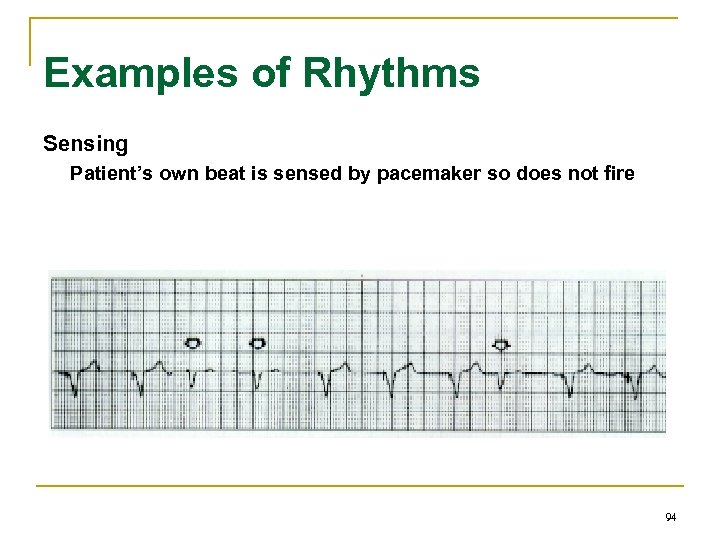 Examples of Rhythms Sensing Patient’s own beat is sensed by pacemaker so does not fire 94
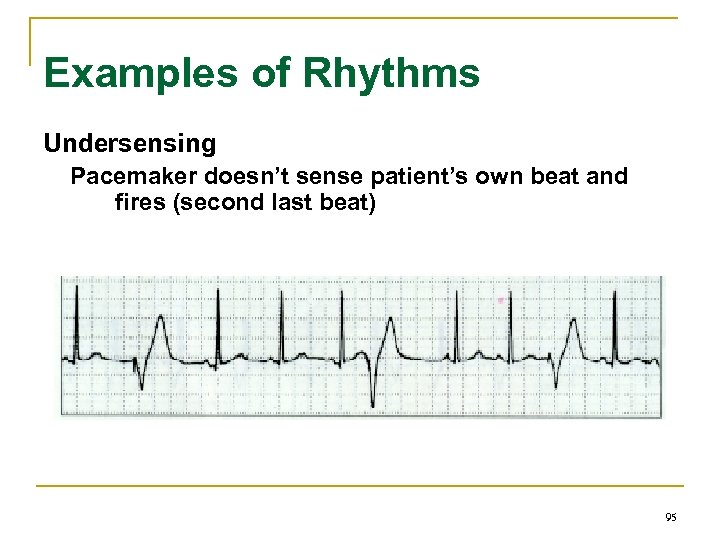 Examples of Rhythms Undersensing Pacemaker doesn’t sense patient’s own beat and fires (second last beat) 95
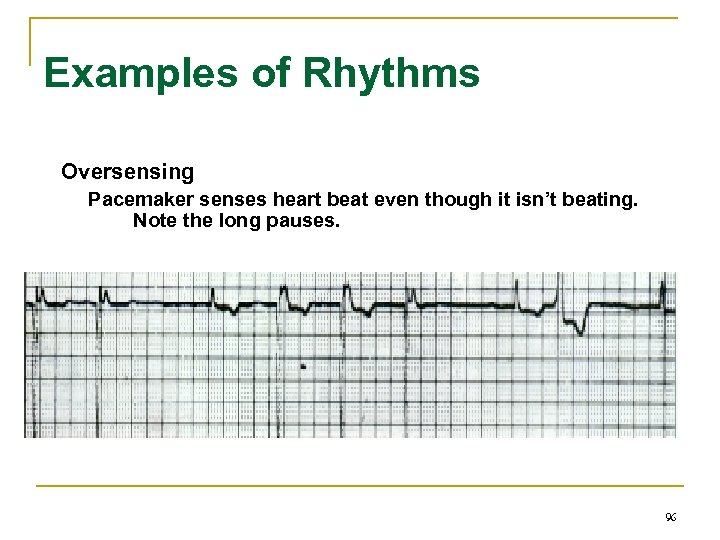 Examples of Rhythms Oversensing Pacemaker senses heart beat even though it isn’t beating. Note the long pauses. 96
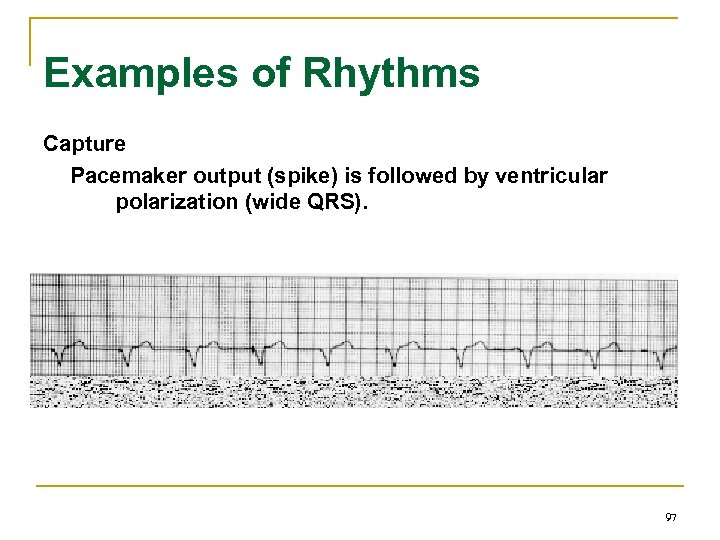 Examples of Rhythms Capture Pacemaker output (spike) is followed by ventricular polarization (wide QRS). 97
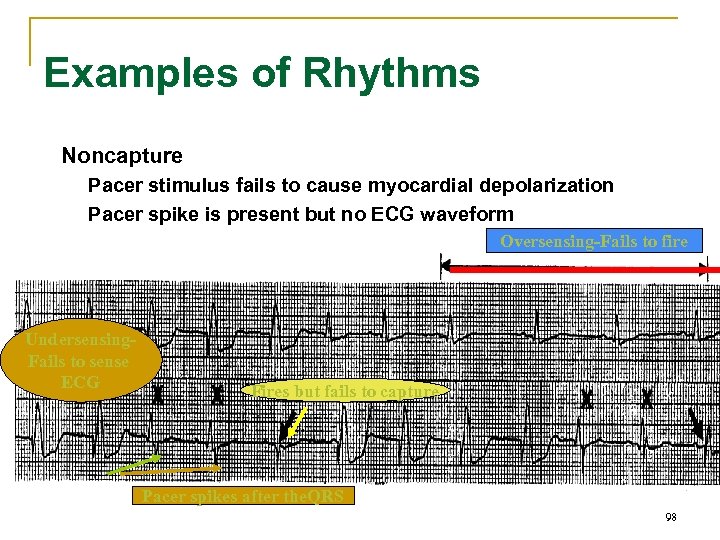 Examples of Rhythms Noncapture Pacer stimulus fails to cause myocardial depolarization Pacer spike is present but no ECG waveform Oversensing-Fails to fire Undersensing. Fails to sense ECG Fires but fails to capture Pacer spikes after the. QRS 98
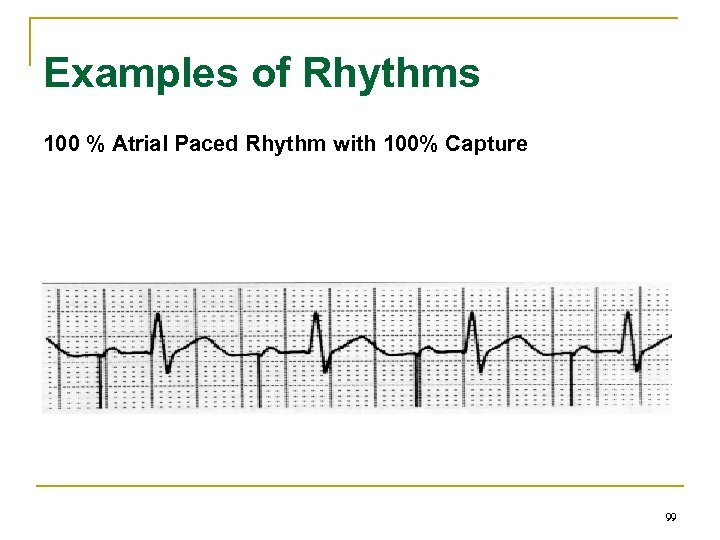 Examples of Rhythms 100 % Atrial Paced Rhythm with 100% Capture 99
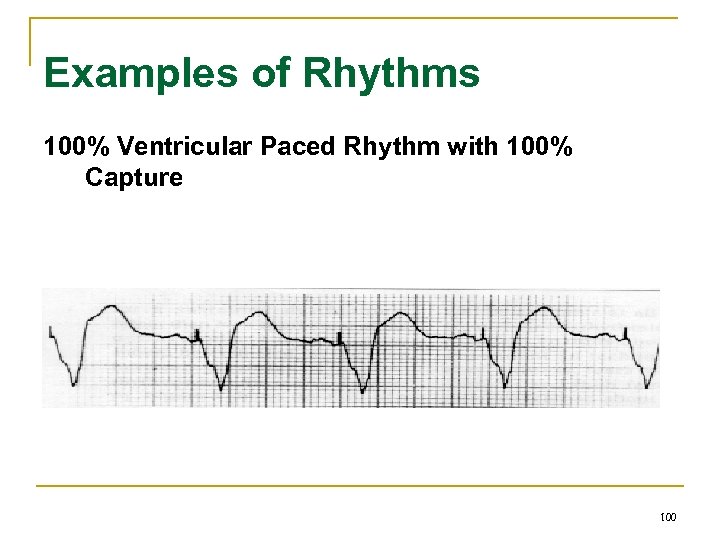 Examples of Rhythms 100% Ventricular Paced Rhythm with 100% Capture 100
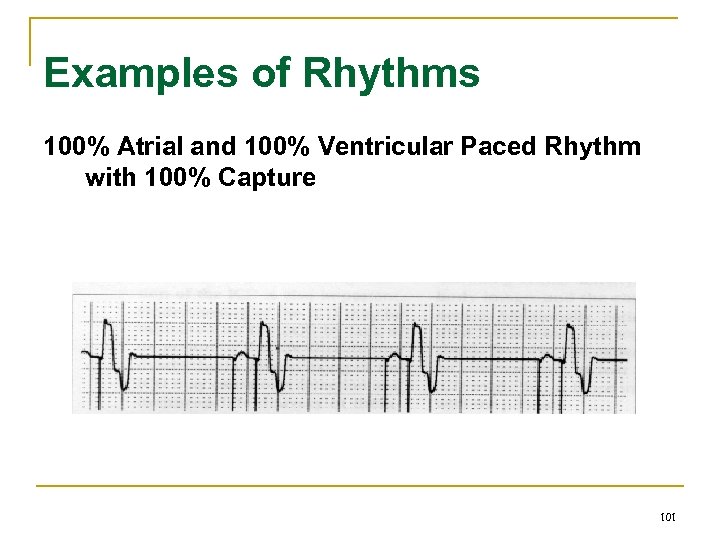 Examples of Rhythms 100% Atrial and 100% Ventricular Paced Rhythm with 100% Capture 101
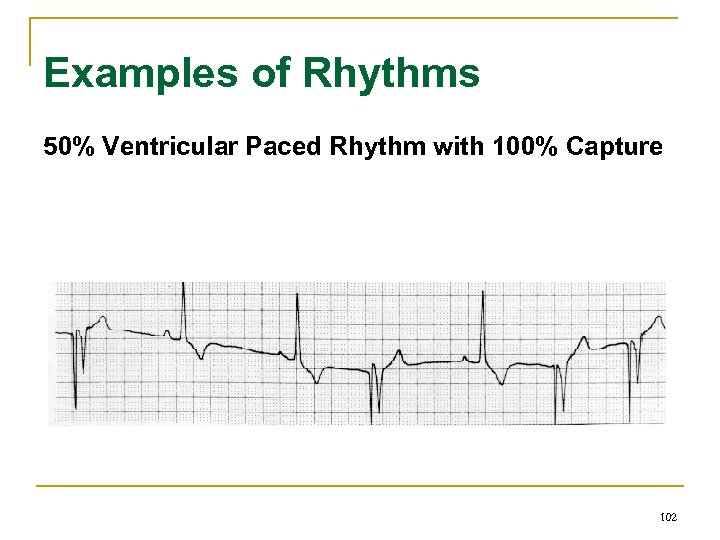 Examples of Rhythms 50% Ventricular Paced Rhythm with 100% Capture 102
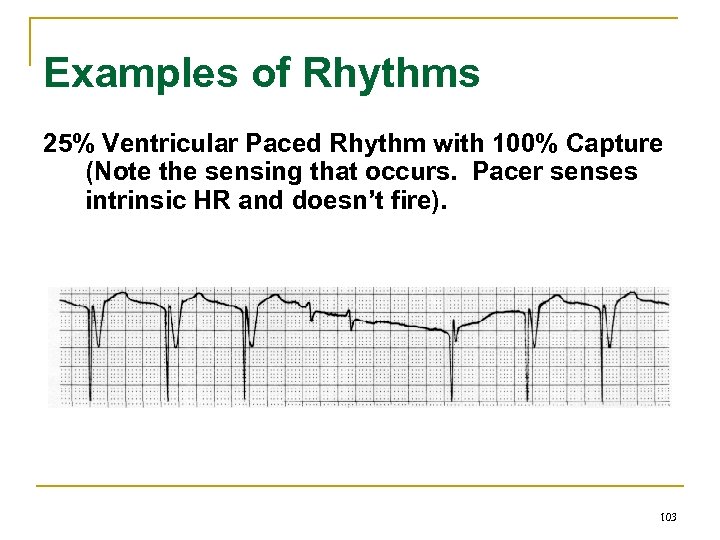 Examples of Rhythms 25% Ventricular Paced Rhythm with 100% Capture (Note the sensing that occurs. Pacer senses intrinsic HR and doesn’t fire). 103
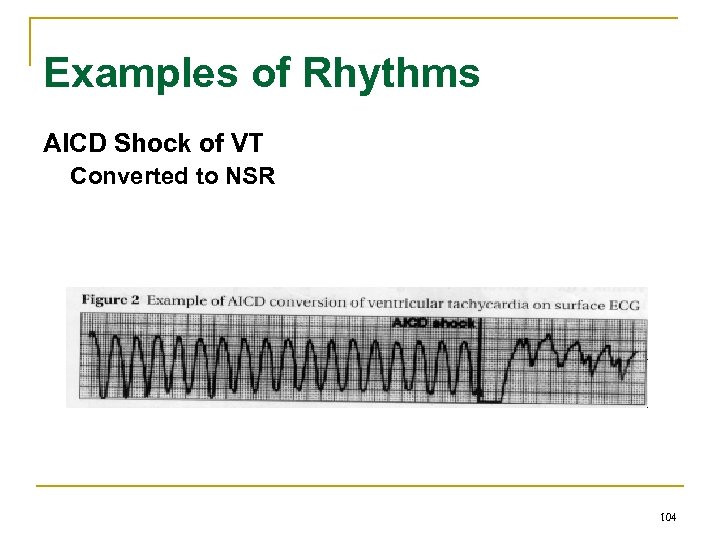 Examples of Rhythms AICD Shock of VT Converted to NSR 104
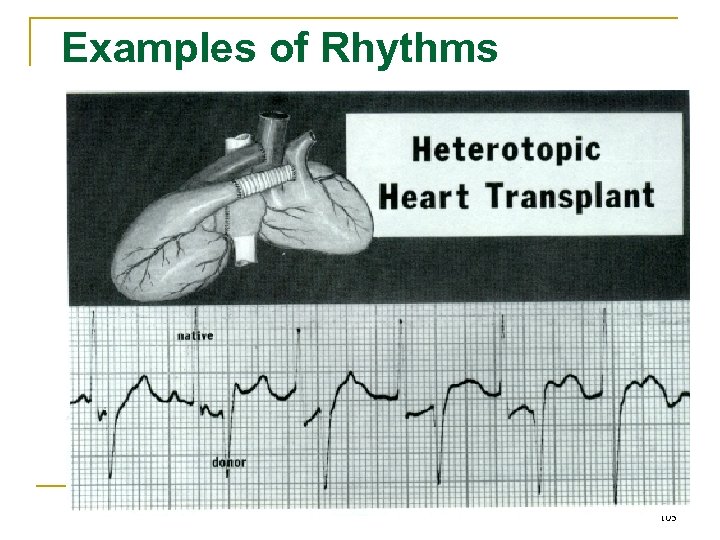 Examples of Rhythms 105
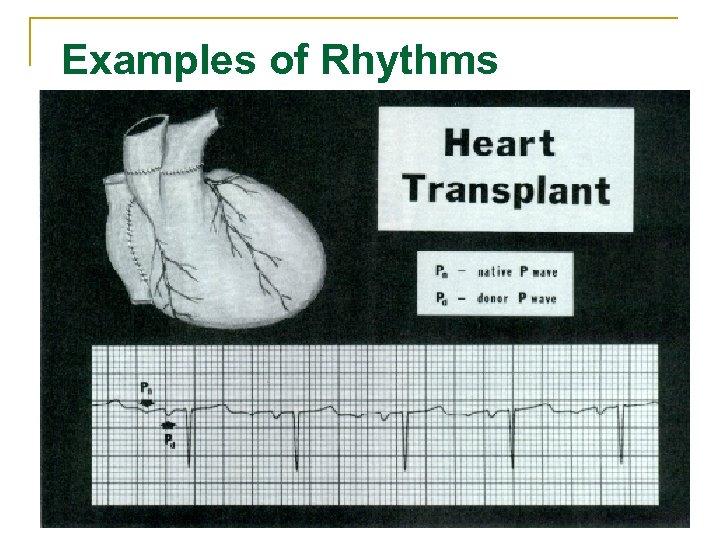 Examples of Rhythms 106
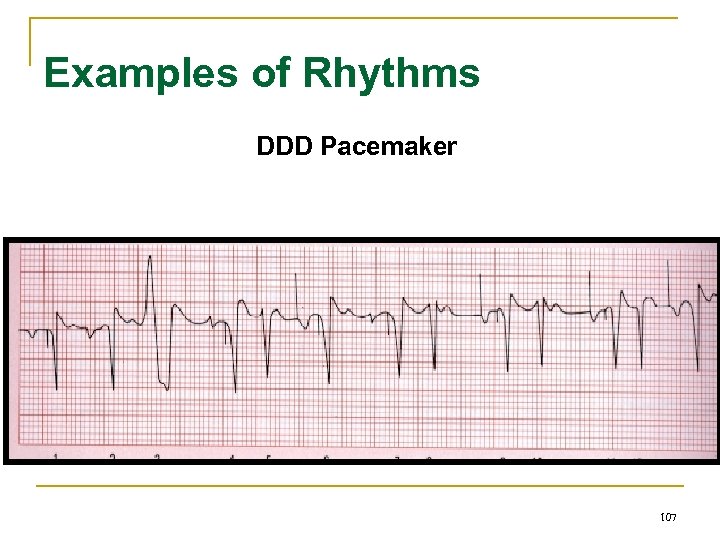 Examples of Rhythms DDD Pacemaker 107
 References Moser SA, Crawford D, Thomas A. AICDs. CC Nurse. 1993; 62 -73. Nagelhaut JJ, Zaglaniczny KL. Nurse Anesthesia. Philadelphia: Saunders. 1997. Ouellette, S. (2000). Anesthetic considerations in patients with cardiac assist devices. CNRA, 23(2), 9 -20. Roth, J. (1994). Programmable and dual chamber pacemakers: An update. Progress in anes thesiology, 8, chapter 17. WB Saunders. 108