Скачать презентацию CARDIAC ARRHYTHMIAS Sergey Yalonetsky MD Normal Sinus
CARDIAC ARRHYTHMIAS - 2015.ppt
- Количество слайдов: 143
 CARDIAC ARRHYTHMIAS Sergey Yalonetsky, MD

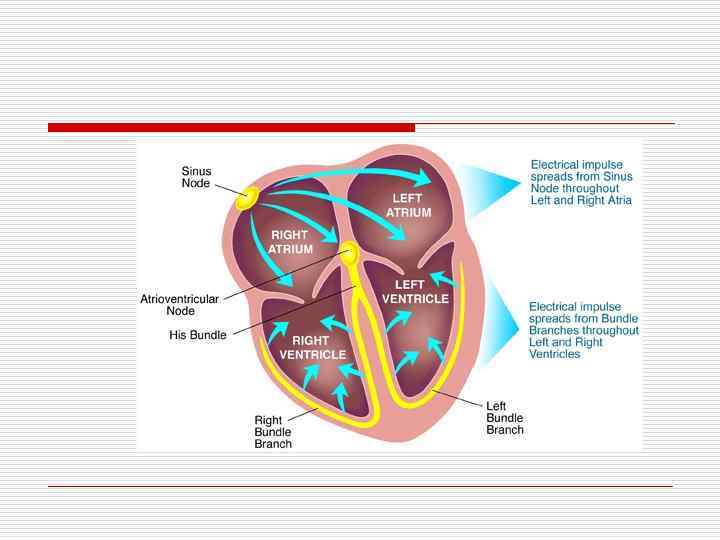
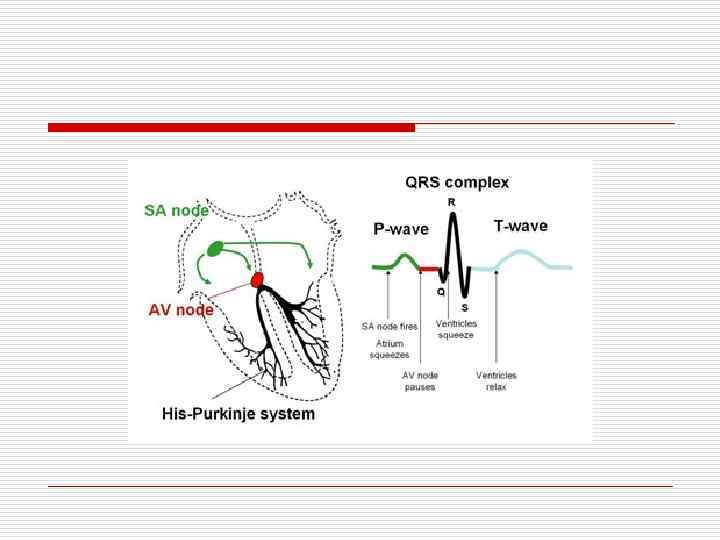
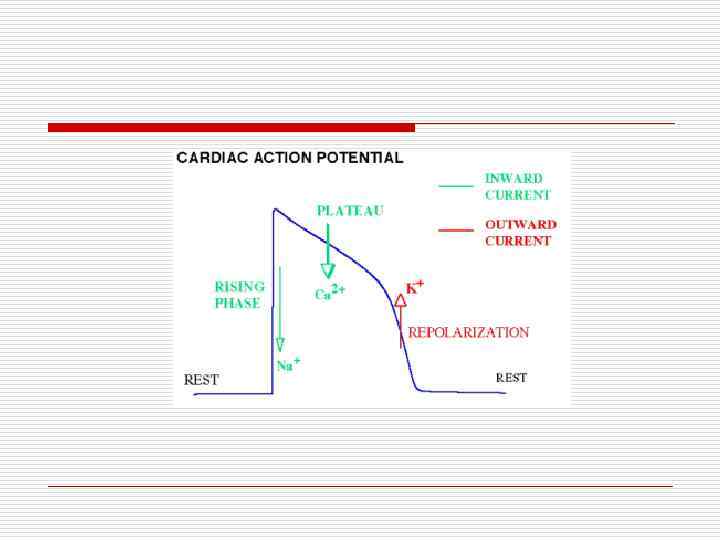
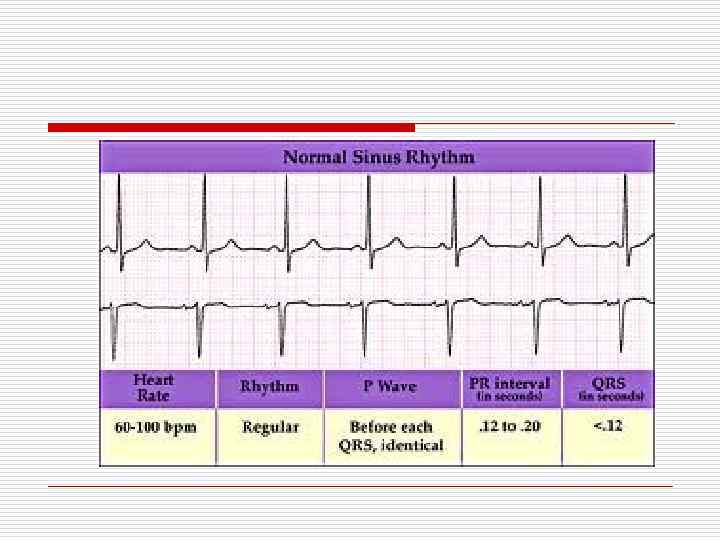
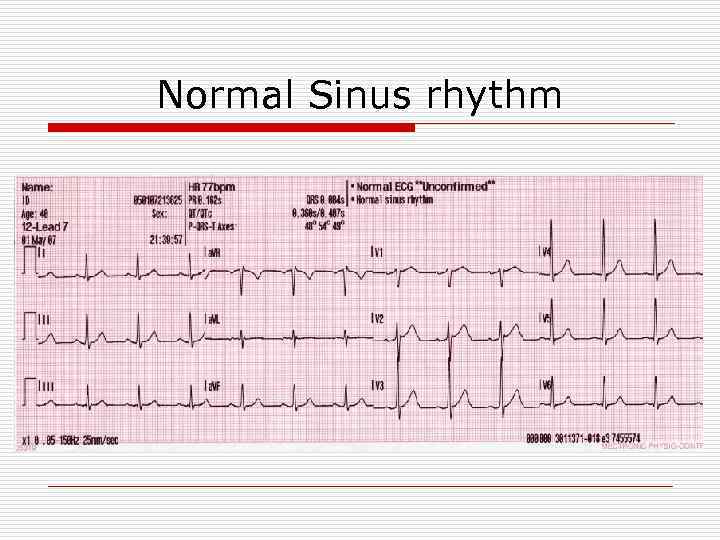 Normal Sinus rhythm
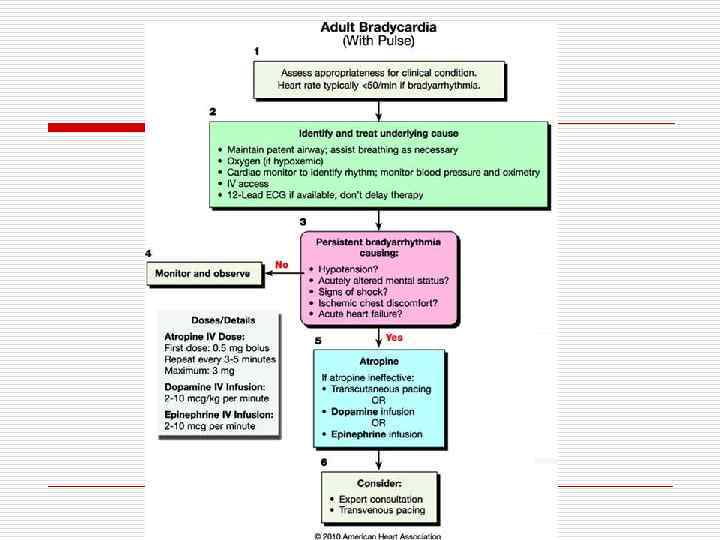
 Classification o Tachyarrhythmia: - Supraventricular - Ventricular o Bradiarrhythmia
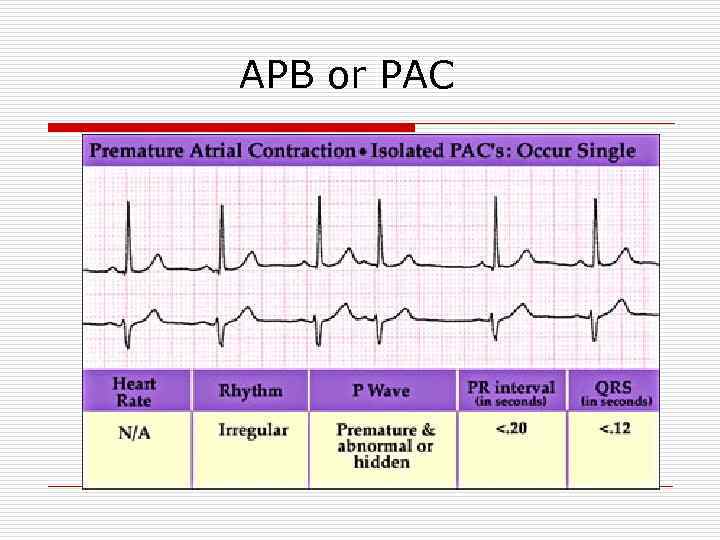 APB or PAC
 Atrial Fibrillation o The most common arrhythmia in clinical practice o Frequency increases with age
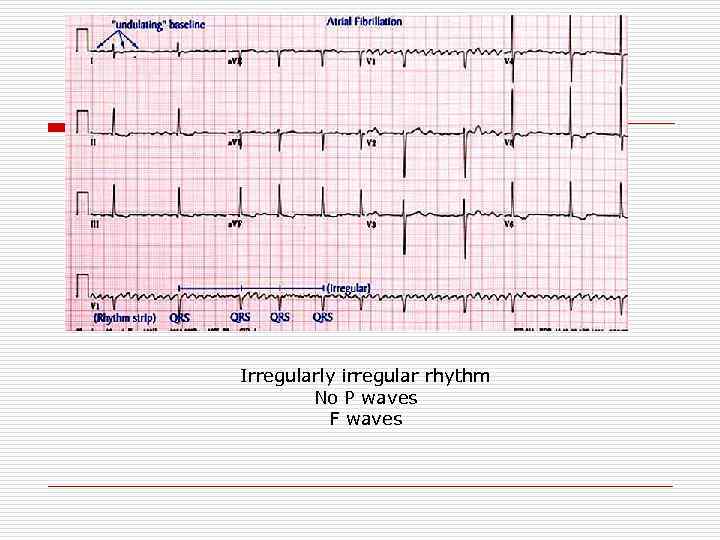 Irregularly irregular rhythm No P waves F waves
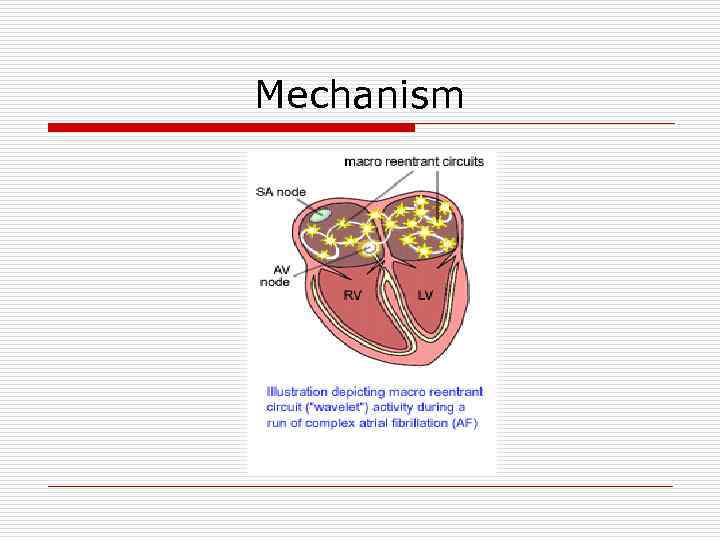 Mechanism
 Most common causes o o o o Valvular heart disease: (MS, MR) LV hypertrophy (HTN, other cause) Cardiomyopathy Thyrotoxicosis Alcohol (“holiday heart”) Atrial septal defect Lone AF (structurally normal heart)
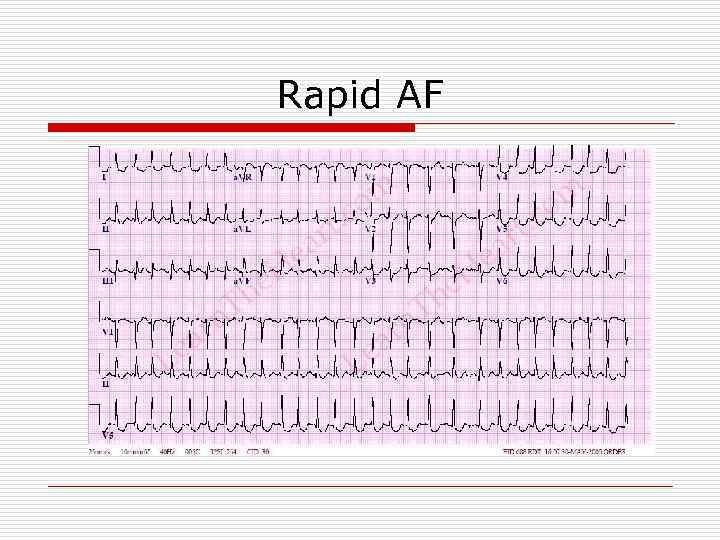 Rapid AF
 Consequences of Atrial Fibrillation Hemodynamic loss of synchronous atrial mechanical activity irregularity of ventricular response inappropriately rapid heart rate Myocardial – persistently rapid rate can lead to: atrial cardiomyopathy dilated ventricular cardiomyopathy Thromboembolism ischemic stroke and systemic arterial occlusion attributed to LA and LAA thrombus
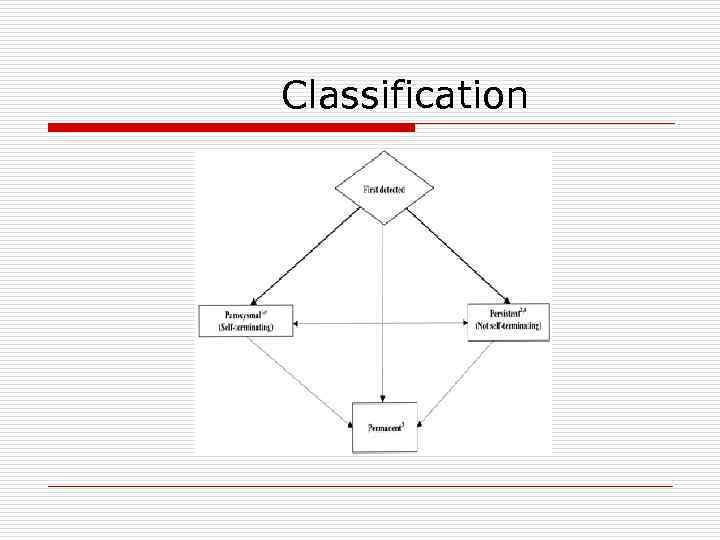 Classification
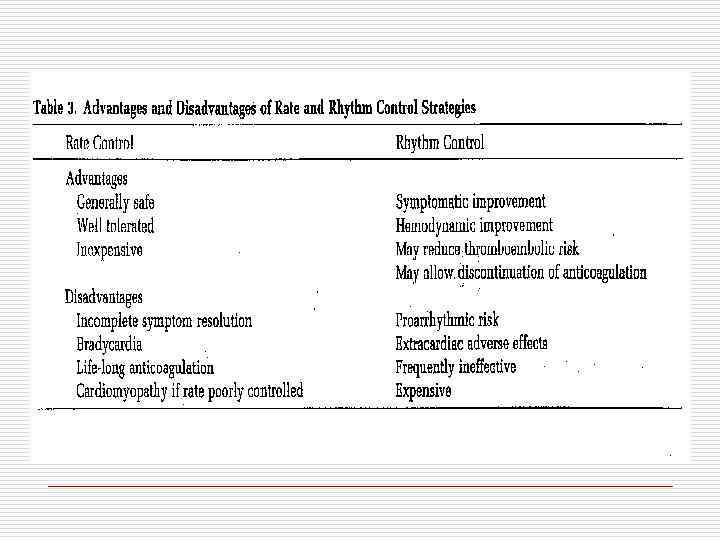
 Treatment options o 1. Rhythm control – restoration and maintenance of sinus rhythm o 2. Rate control Prevention of Thromboembolysm !
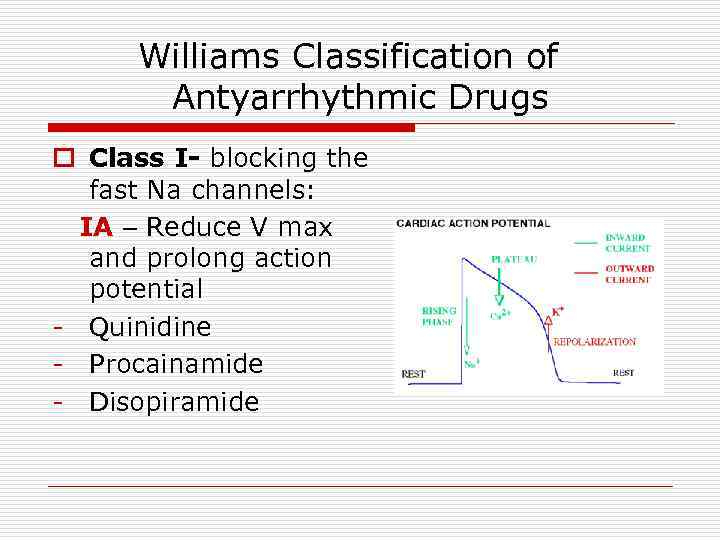 Williams Classification of Antyarrhythmic Drugs o Class I- blocking the fast Na channels: IA – Reduce V max and prolong action potential - Quinidine - Procainamide - Disopiramide
 IB : Do not reduce V max and shorten action potential duration - Lidocaine - Phenytoin - Mexiletine IC: Reduce V max - Flecainide - Propafenon
 o Class II – beta blockers o Class III – K channel blockers - Amiodaron - Sotalol - Bretylium o Class IV – Ca channel blockers
 Cardioversion Pharmacological o Propafenon o Amiodaron o Flecainide
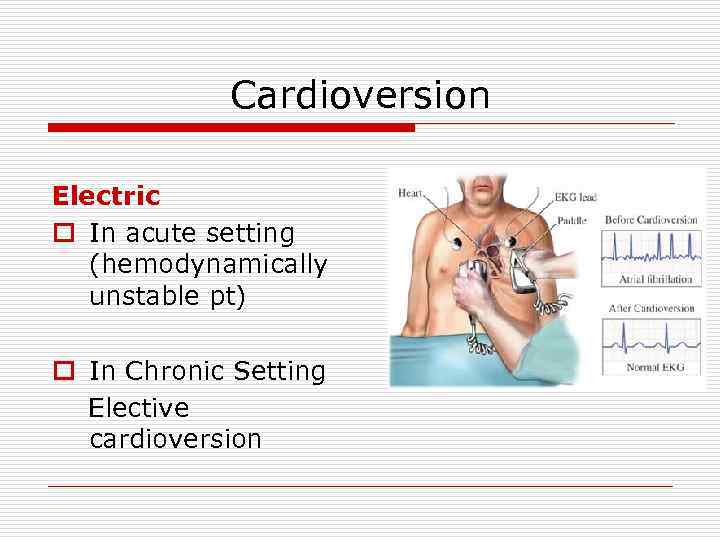 Cardioversion Electric o In acute setting (hemodynamically unstable pt) o In Chronic Setting Elective cardioversion
 Predictors of successful cardioverson o o Short AF duration Young age Normal atrial size No organic heart pathology
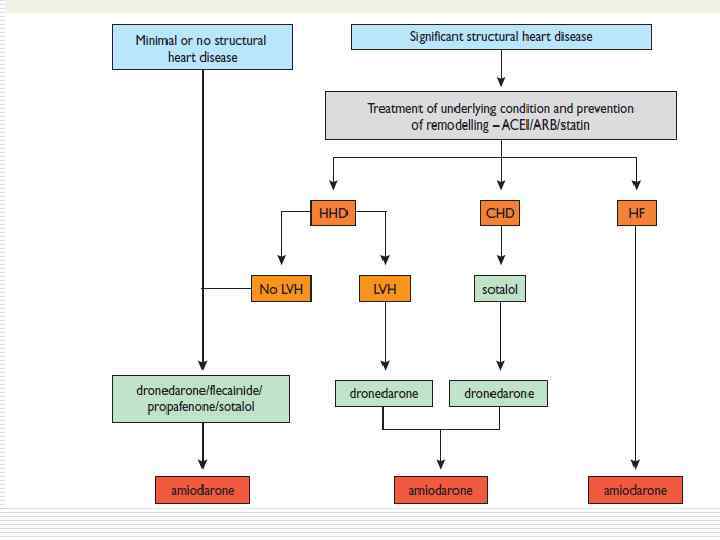
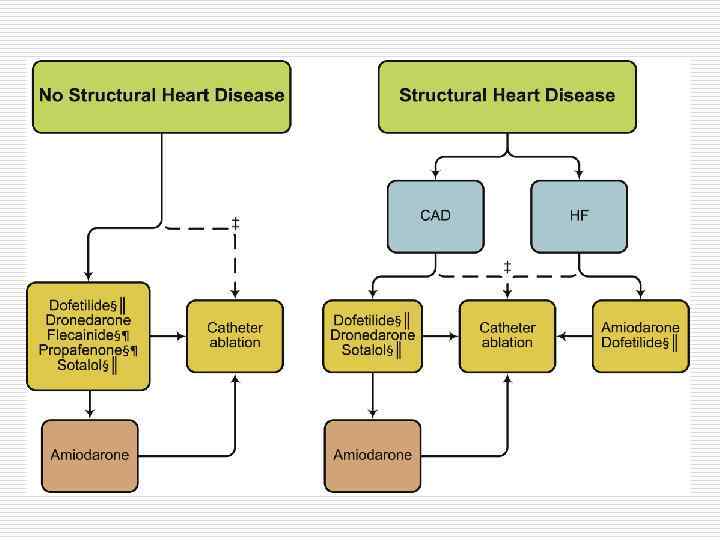
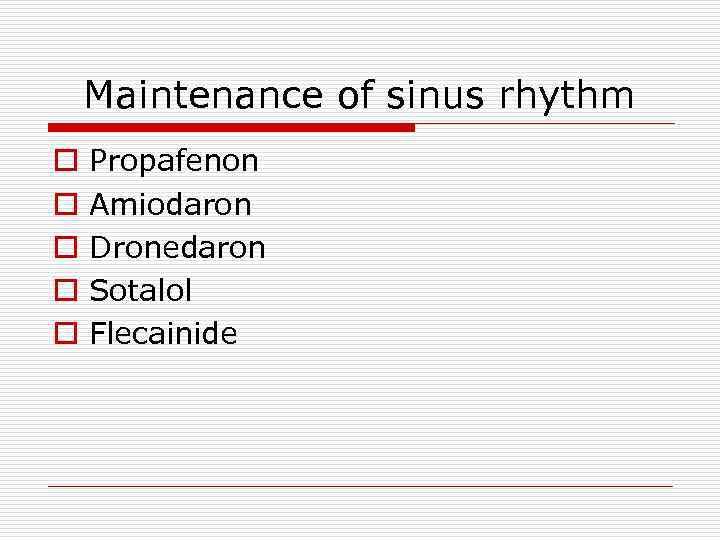 Maintenance of sinus rhythm o o o Propafenon Amiodaron Dronedaron Sotalol Flecainide
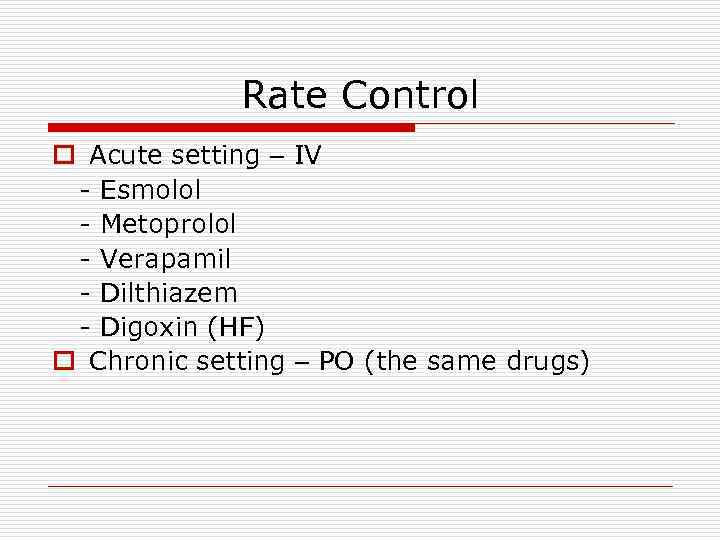 Rate Control o Acute setting – IV - Esmolol - Metoprolol - Verapamil - Dilthiazem - Digoxin (HF) o Chronic setting – PO (the same drugs)
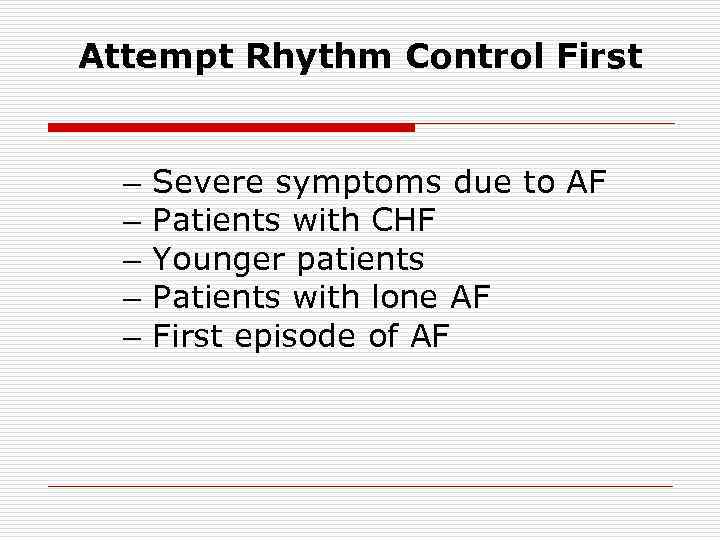 Attempt Rhythm Control First – – – Severe symptoms due to AF Patients with CHF Younger patients Patients with lone AF First episode of AF
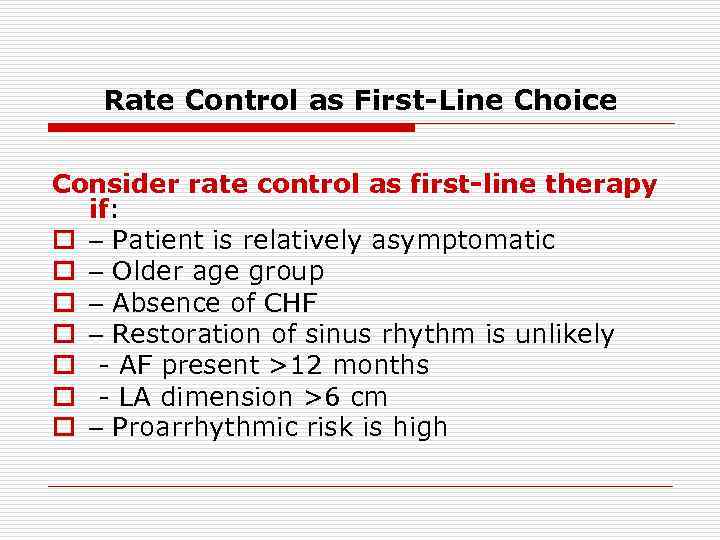 Rate Control as First-Line Choice Consider rate control as first-line therapy if: o – Patient is relatively asymptomatic o – Older age group o – Absence of CHF o – Restoration of sinus rhythm is unlikely o - AF present >12 months o - LA dimension >6 cm o – Proarrhythmic risk is high
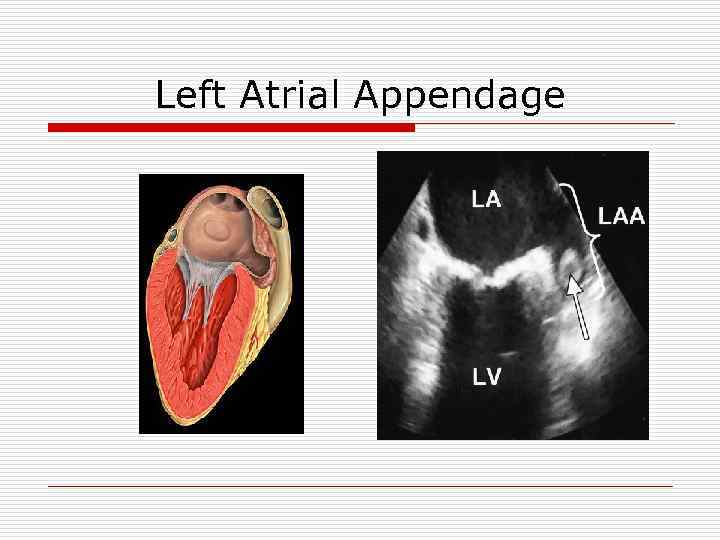 Left Atrial Appendage
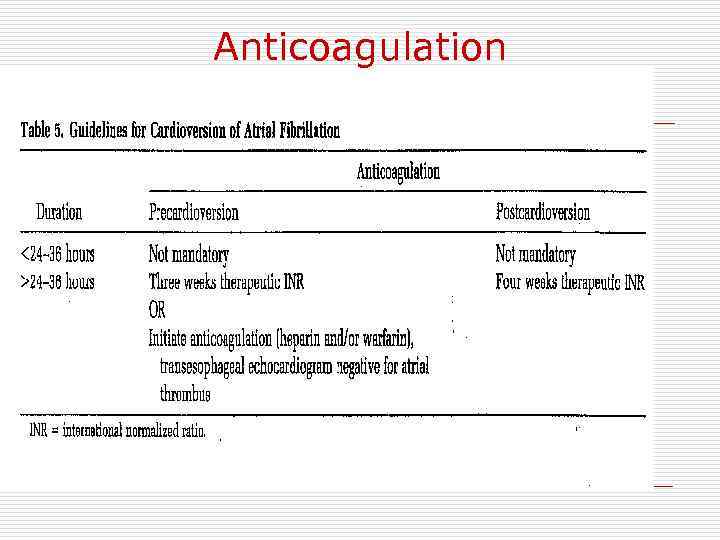 Anticoagulation
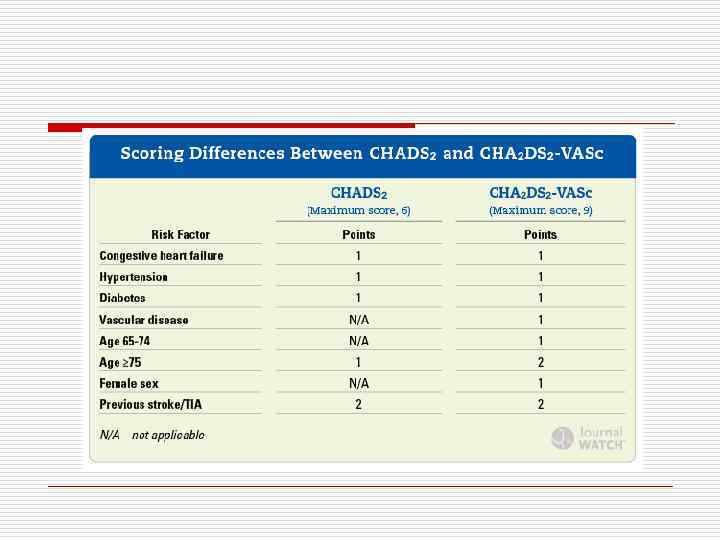
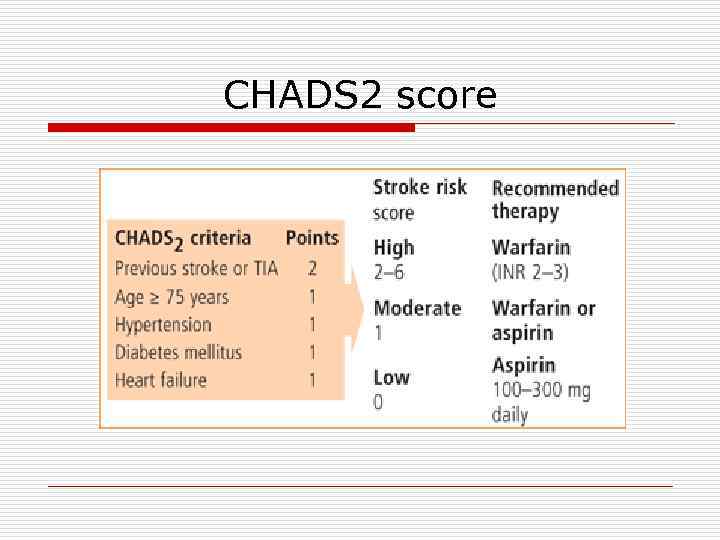 CHADS 2 score
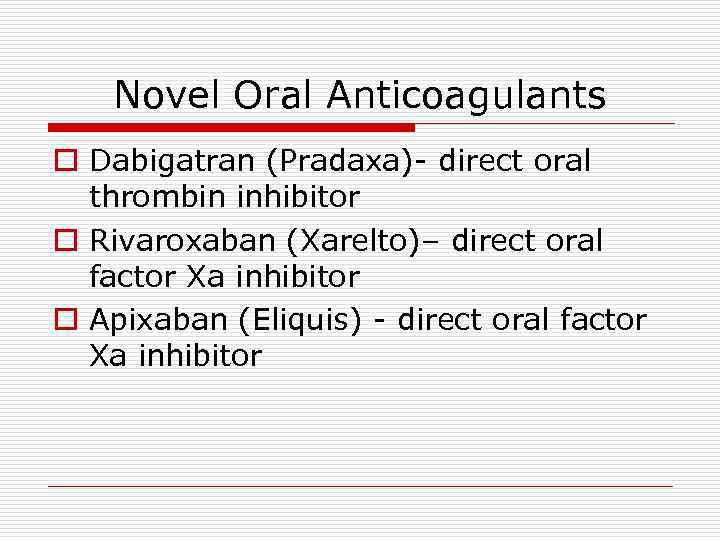 Novel Oral Anticoagulants o Dabigatran (Pradaxa)- direct oral thrombin inhibitor o Rivaroxaban (Xarelto)– direct oral factor Xa inhibitor o Apixaban (Eliquis) - direct oral factor Xa inhibitor
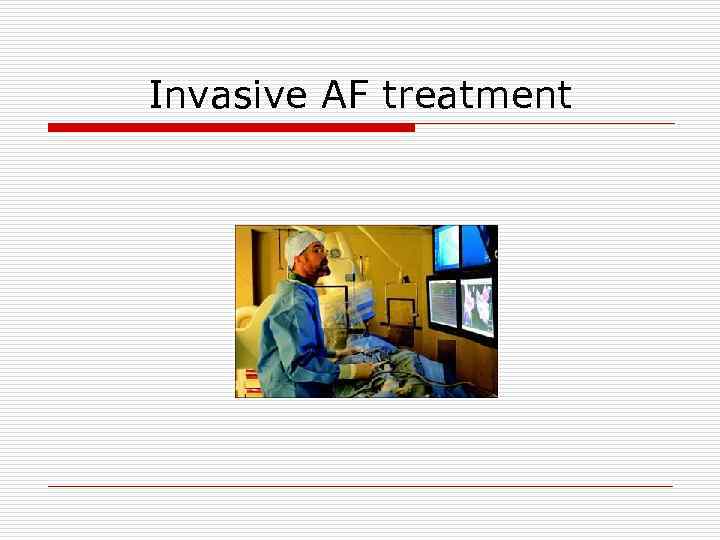 Invasive AF treatment
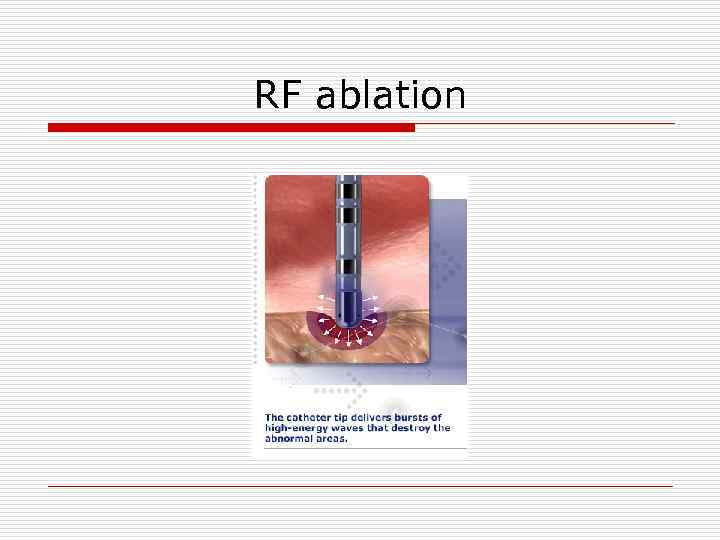 RF ablation
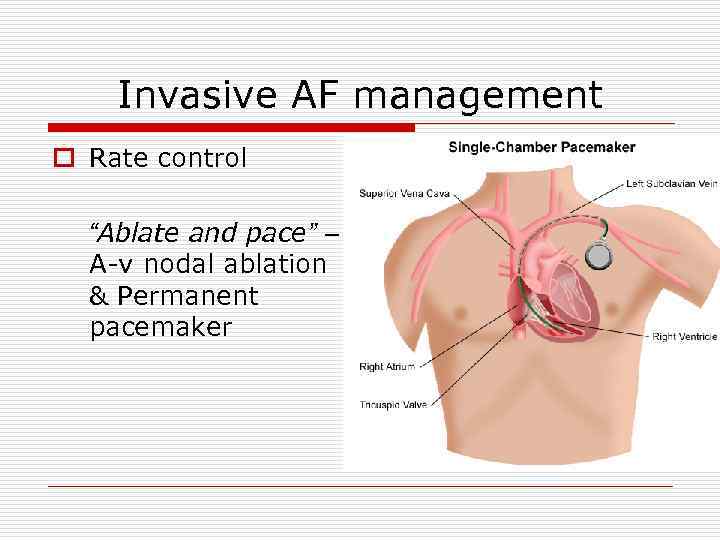 Invasive AF management o Rate control “Ablate and pace” – A-v nodal ablation & Permanent pacemaker
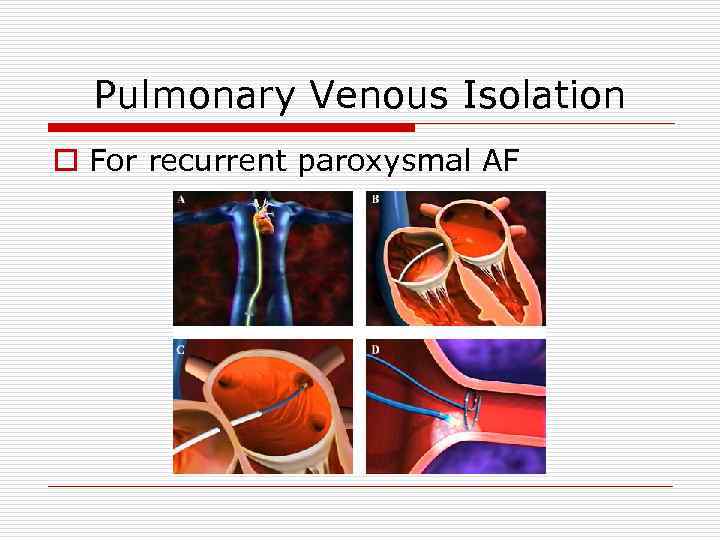 Pulmonary Venous Isolation o For recurrent paroxysmal AF
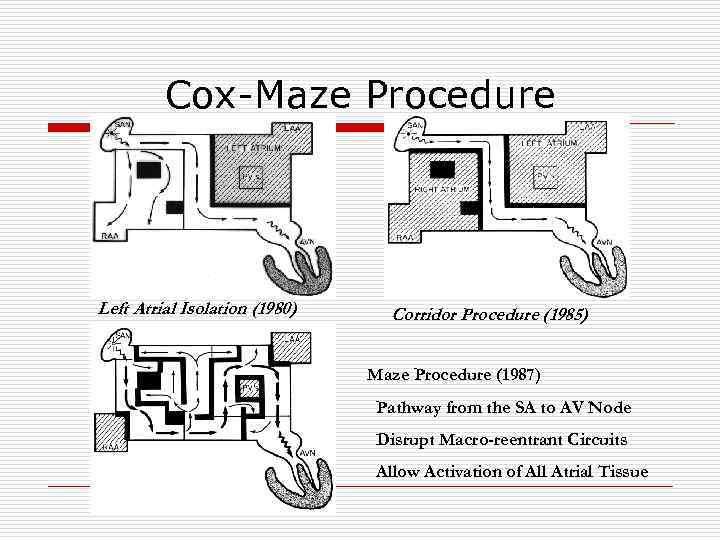 Cox-Maze Procedure Left Atrial Isolation (1980) Corridor Procedure (1985) Maze Procedure (1987) Pathway from the SA to AV Node Disrupt Macro-reentrant Circuits Allow Activation of All Atrial Tissue
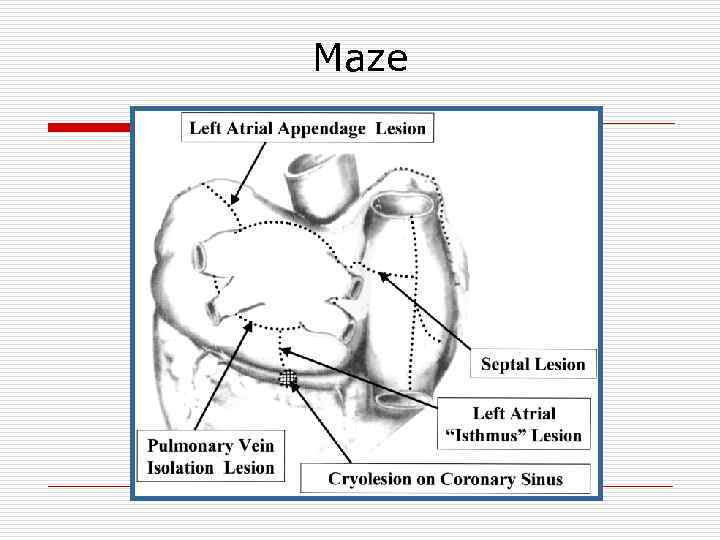 Maze
Maze
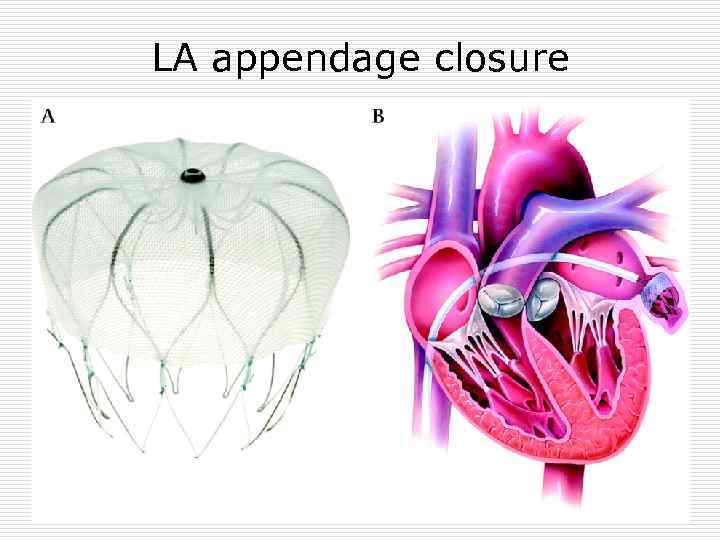 LA appendage closure
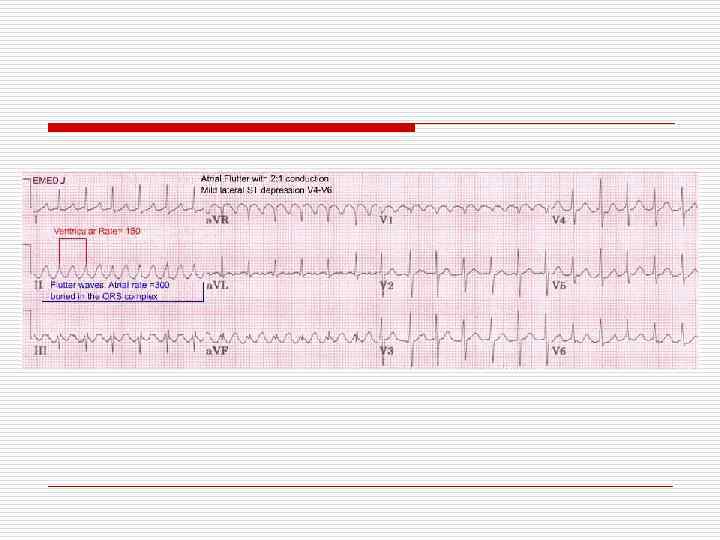
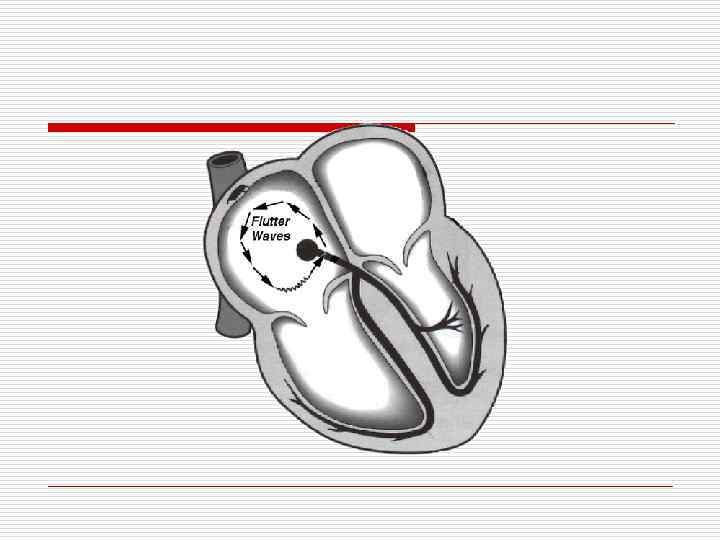
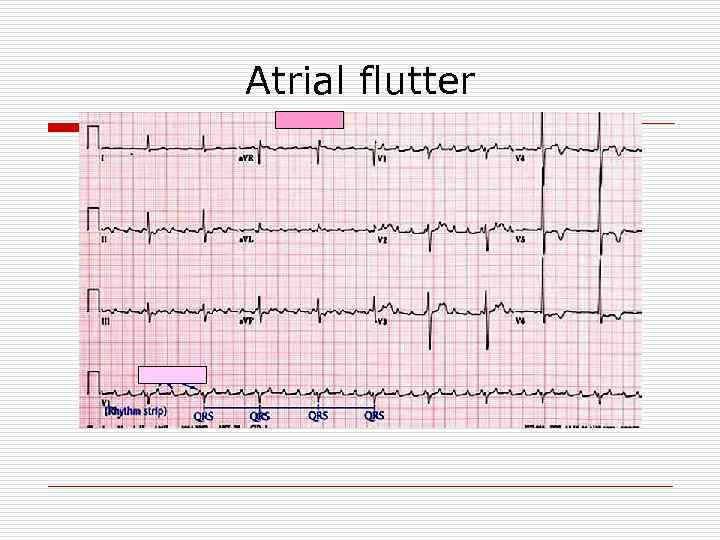 Atrial flutter
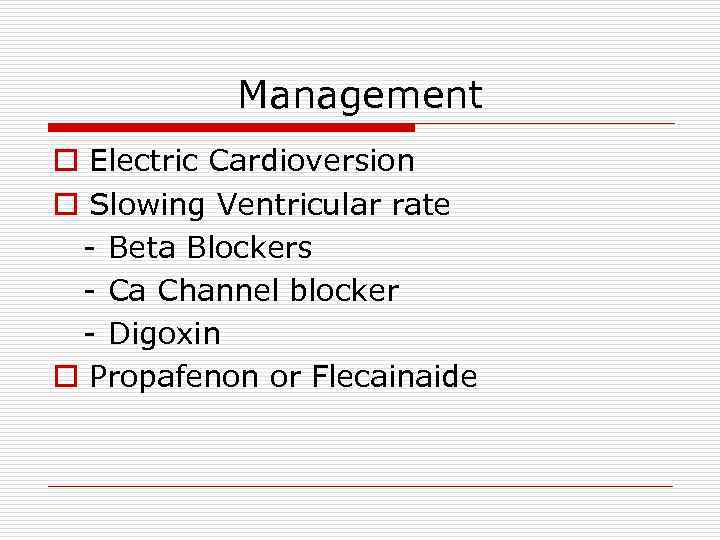 Management o Electric Cardioversion o Slowing Ventricular rate - Beta Blockers - Ca Channel blocker - Digoxin o Propafenon or Flecainaide
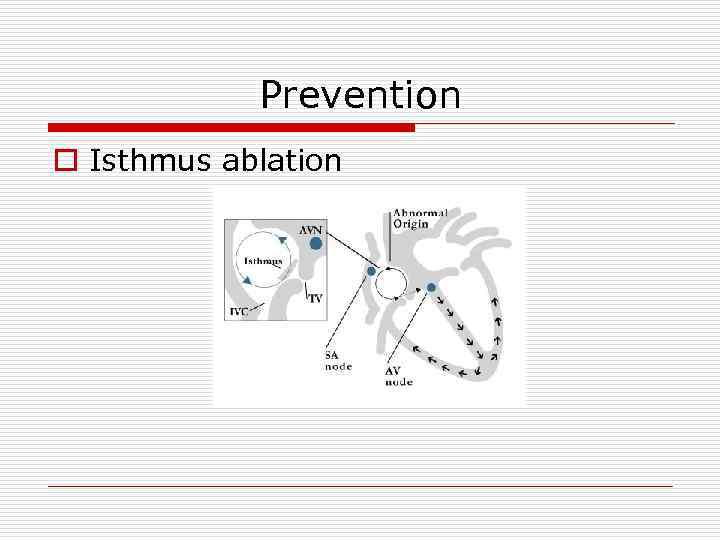 Prevention o Isthmus ablation
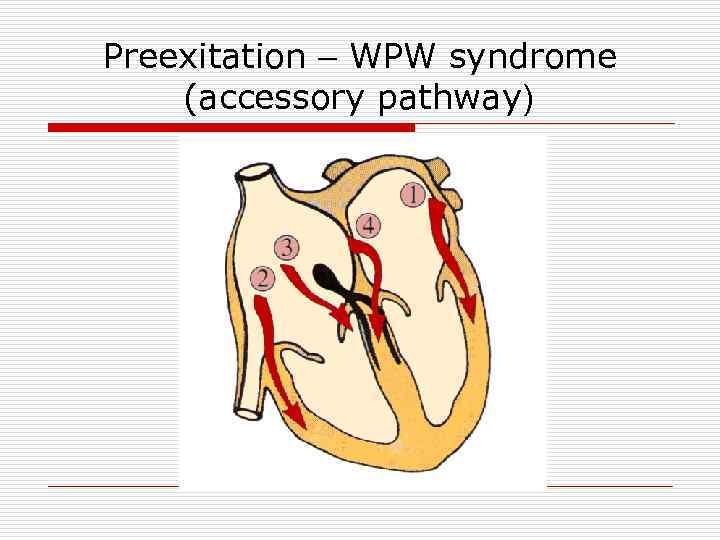 Preexitation – WPW syndrome (accessory pathway)
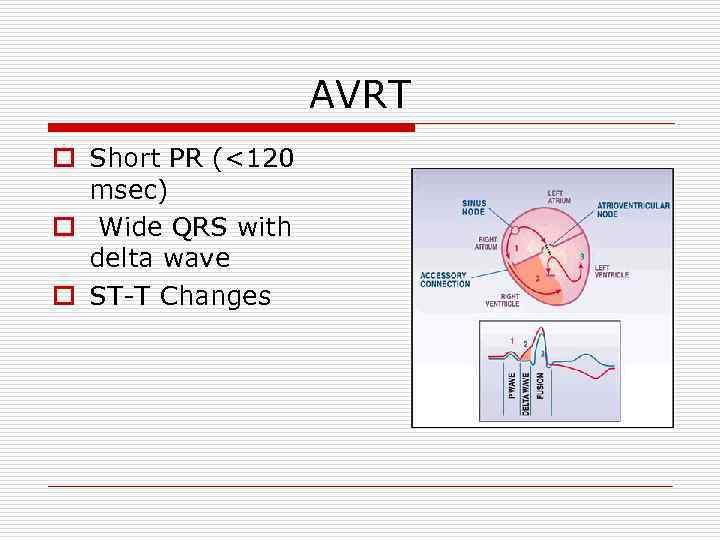 AVRT o Short PR (<120 msec) o Wide QRS with delta wave o ST-T Changes
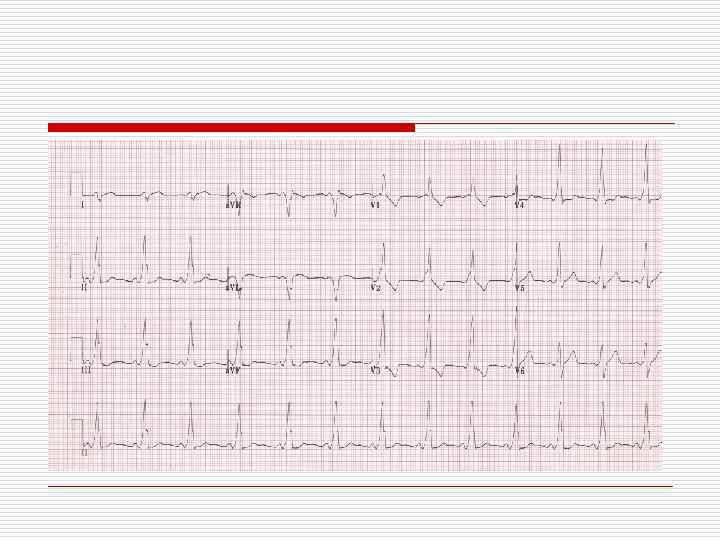
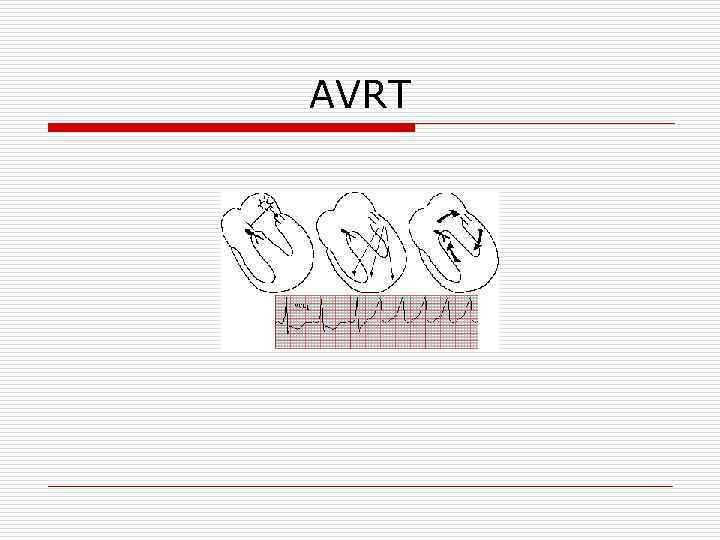 AVRT
AVRT
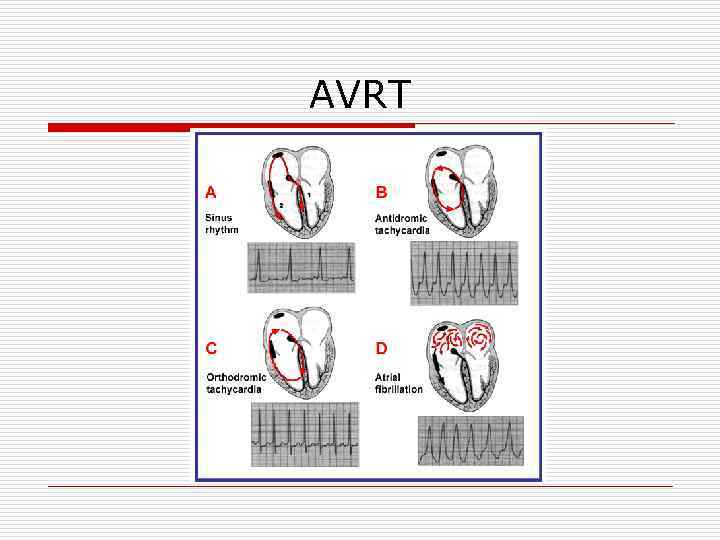 AVRT
AVRT
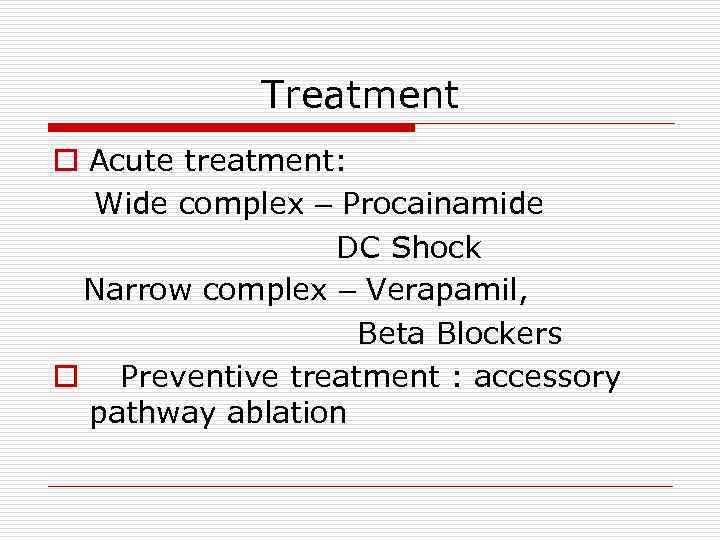 Treatment o Acute treatment: Wide complex – Procainamide DC Shock Narrow complex – Verapamil, Beta Blockers o Preventive treatment : accessory pathway ablation
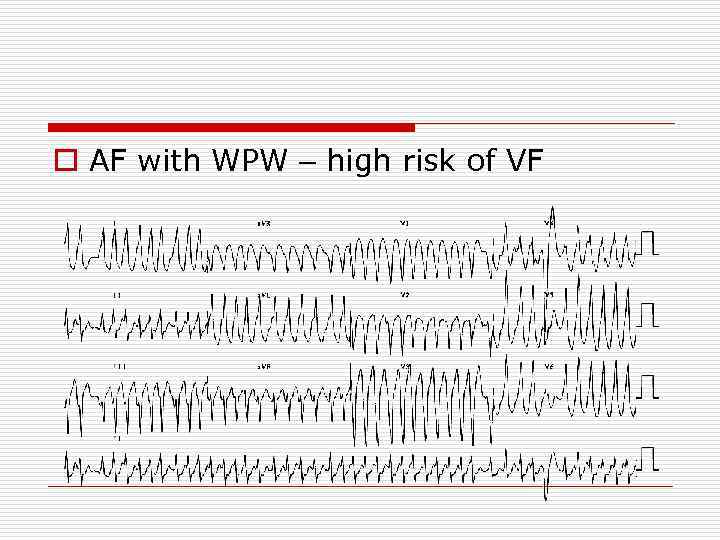 o AF with WPW – high risk of VF
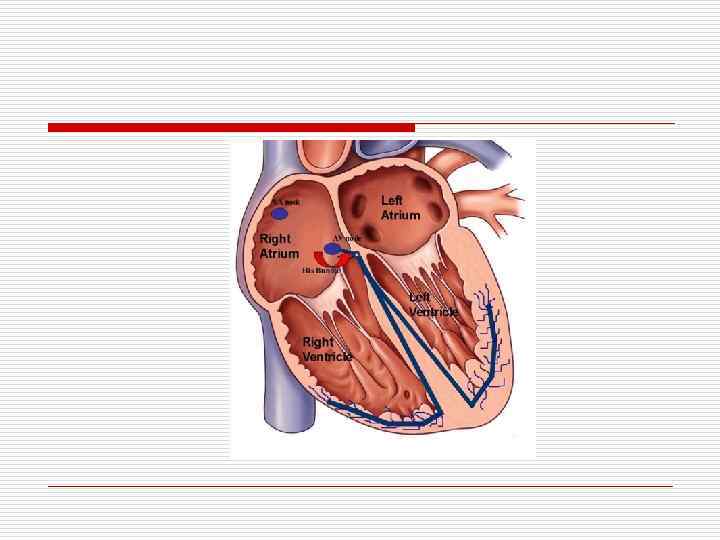
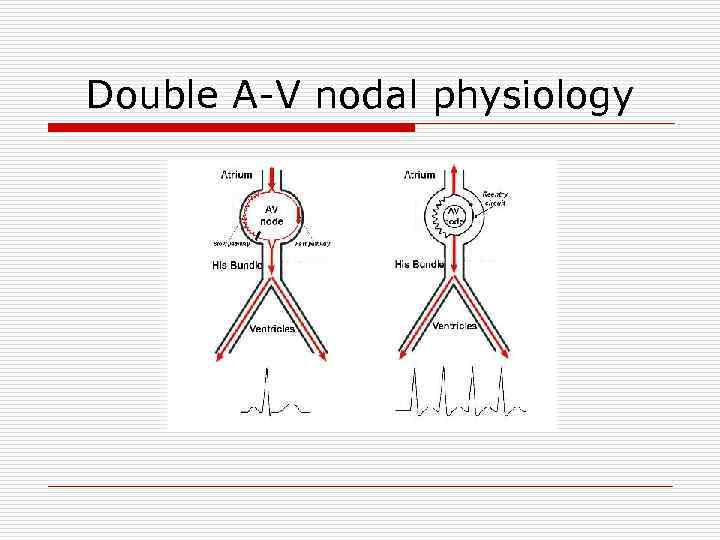 Double A-V nodal physiology
 AVNRT
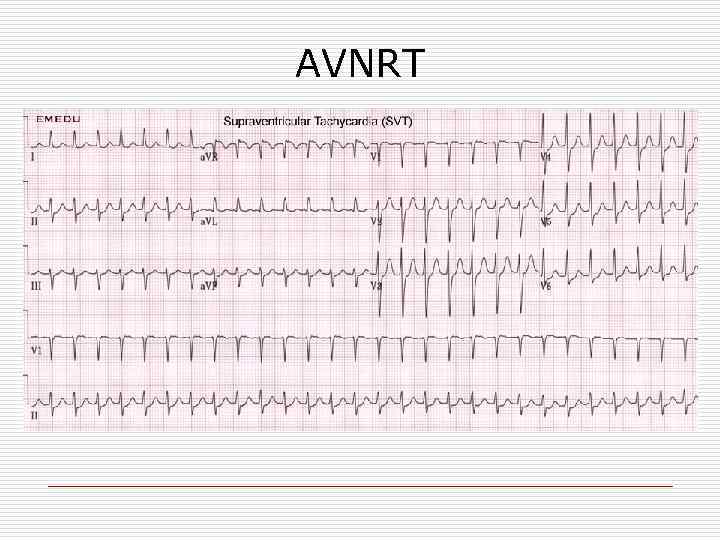
AVNRT
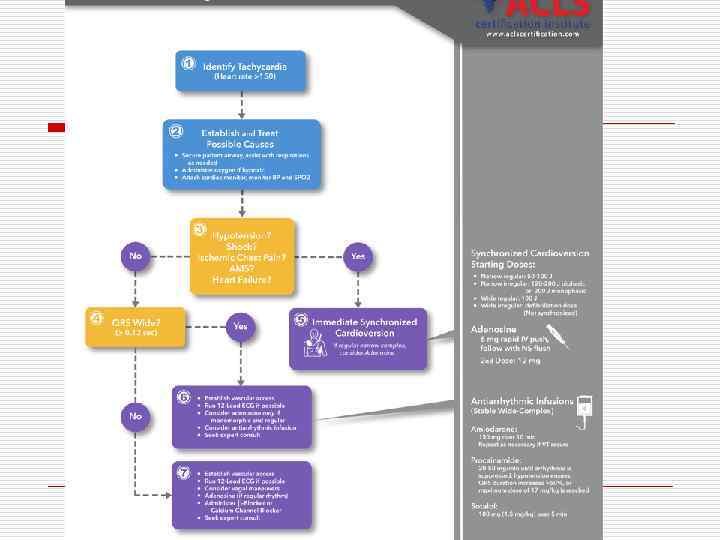
 Management of narrow complex SVT o If unstable – DC shock o If Stable : 1. Vagal maneuvers 2. Adenosin 3. Verapamil
 Preventive treatment o Drugs o EPS
 Ventricular Arrhythmias
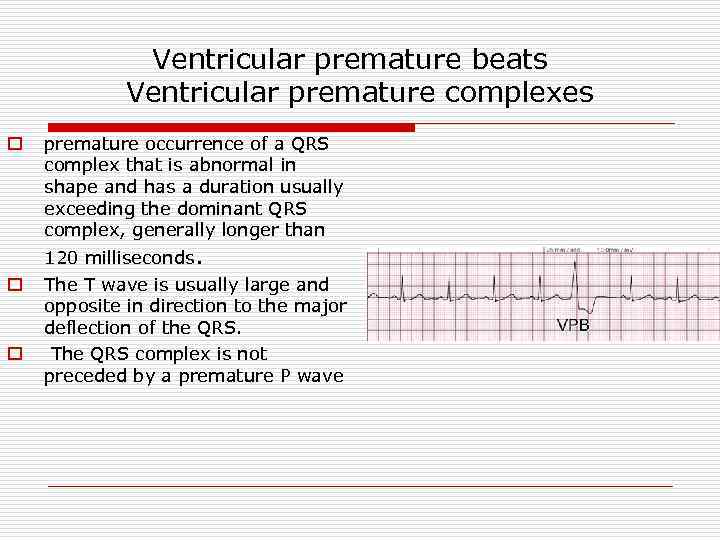 Ventricular premature beats Ventricular premature complexes o premature occurrence of a QRS complex that is abnormal in shape and has a duration usually exceeding the dominant QRS complex, generally longer than 120 milliseconds. o o The T wave is usually large and opposite in direction to the major deflection of the QRS. The QRS complex is not preceded by a premature P wave
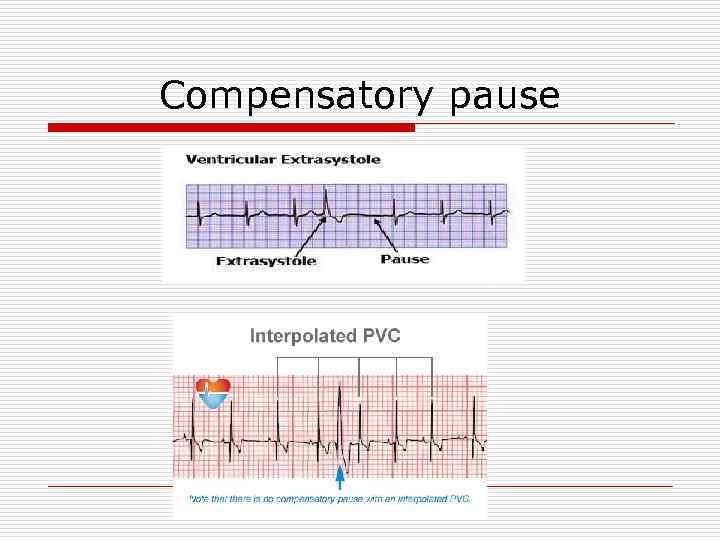 Compensatory pause
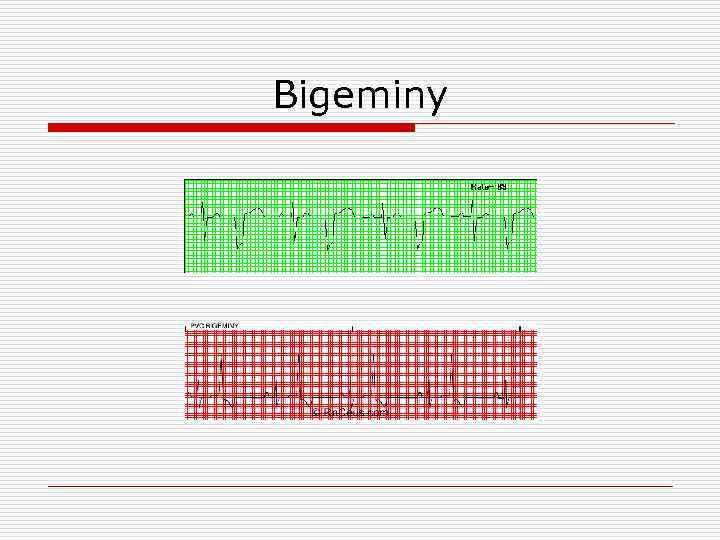 Bigeminy
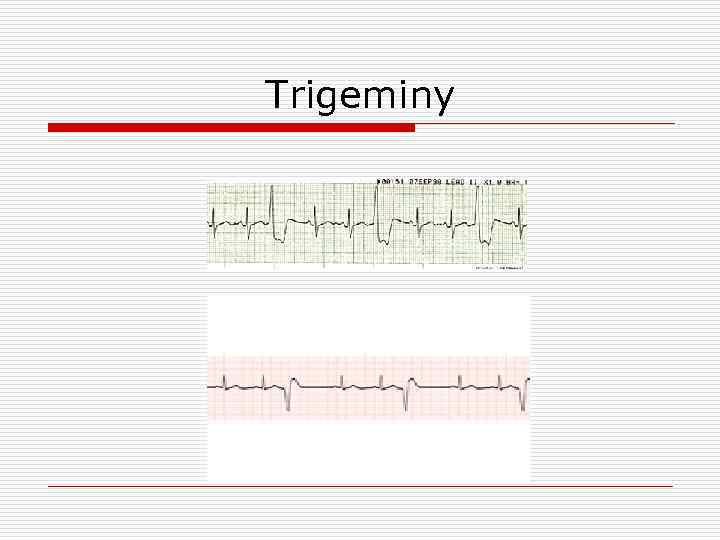 Trigeminy
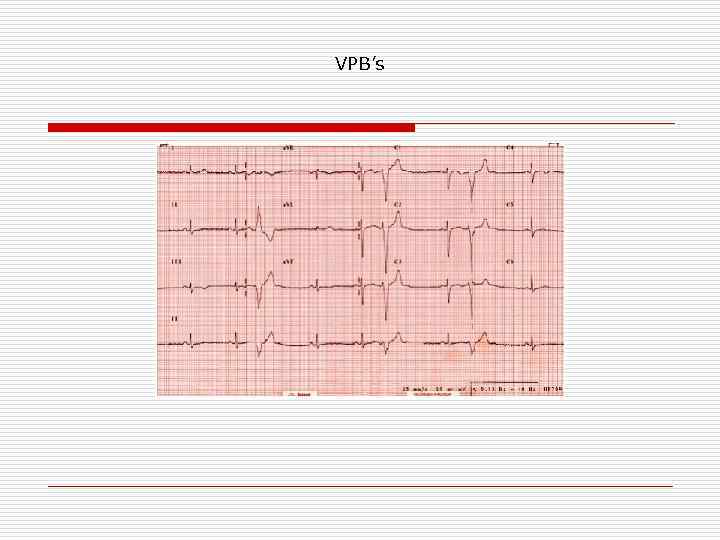 VPB’s
VPB’s
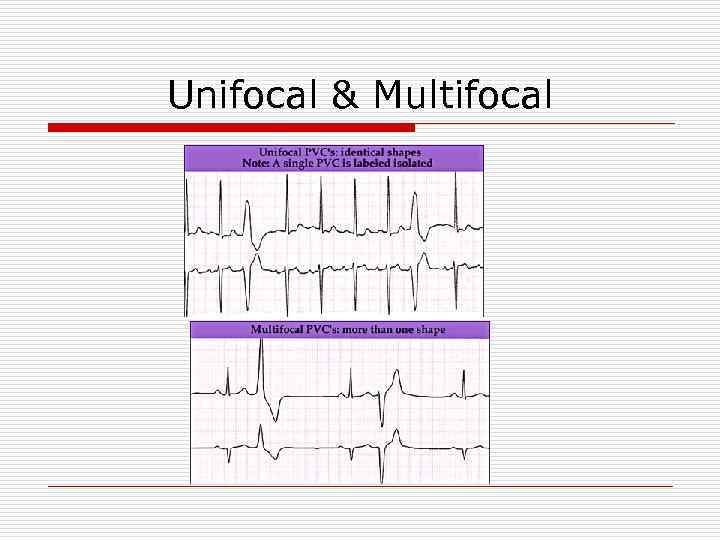 Unifocal & Multifocal
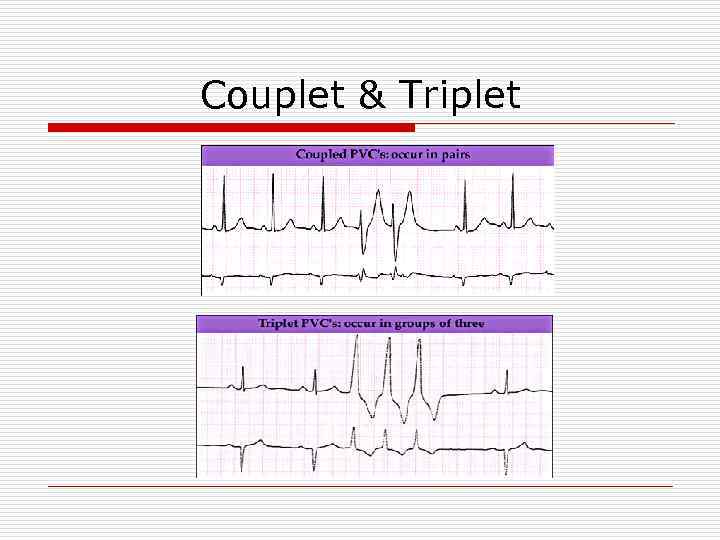 Couplet & Triplet
 Causes o o o LV false tendons, infection in ischemic or inflamed myocardium, hypoxia, Anesthesiaor surgery. Medications electrolyte imbalance, tension states, myocardial stretch, excessive use of tobacco, caffeine, or alcohol.
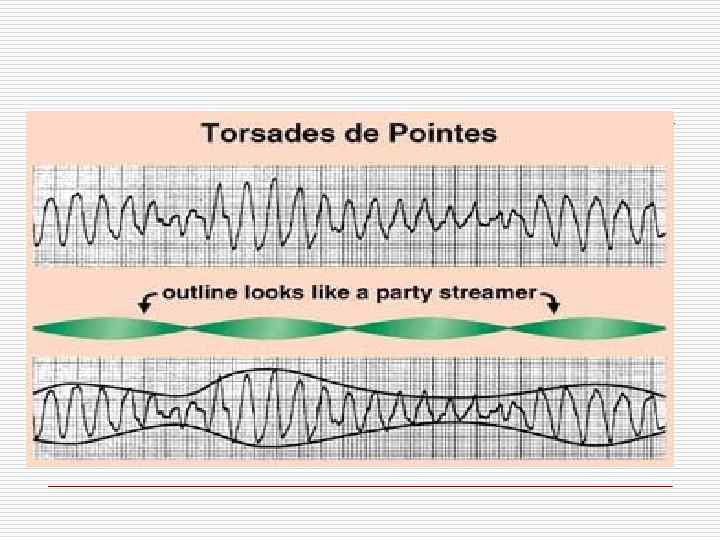
 Complex Ventricular Arrhythmia • Nonsustained ventricular tachycardia (VT) ♥ Monomorphic ♥ Polymorphic • Sustained VT ♥ Monomorphic ♥ Polymorphic • Torsades de pointes • Ventricular fibrillation
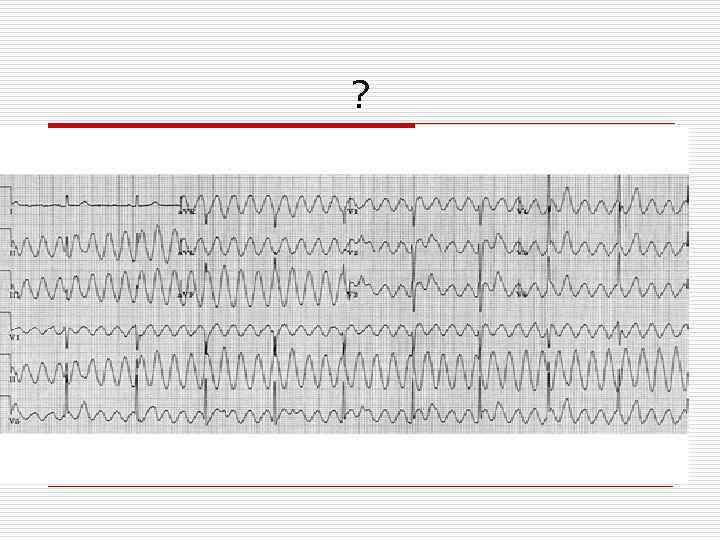
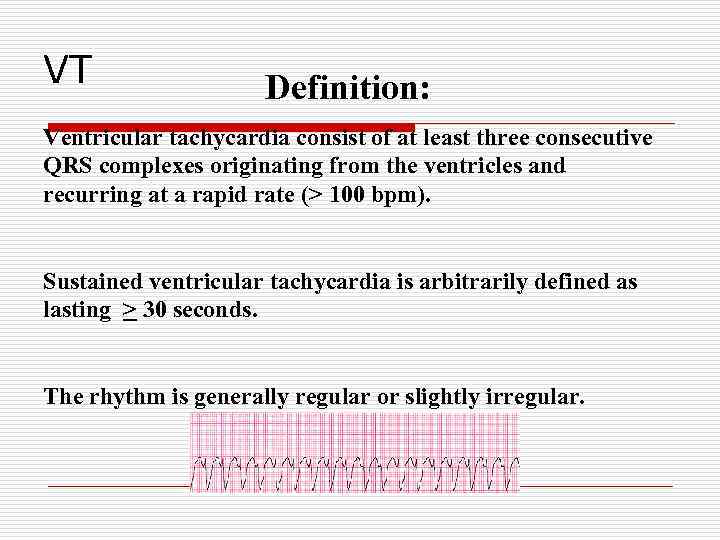 VT Definition: Ventricular tachycardia consist of at least three consecutive QRS complexes originating from the ventricles and recurring at a rapid rate (> 100 bpm). Sustained ventricular tachycardia is arbitrarily defined as lasting > 30 seconds. The rhythm is generally regular or slightly irregular.
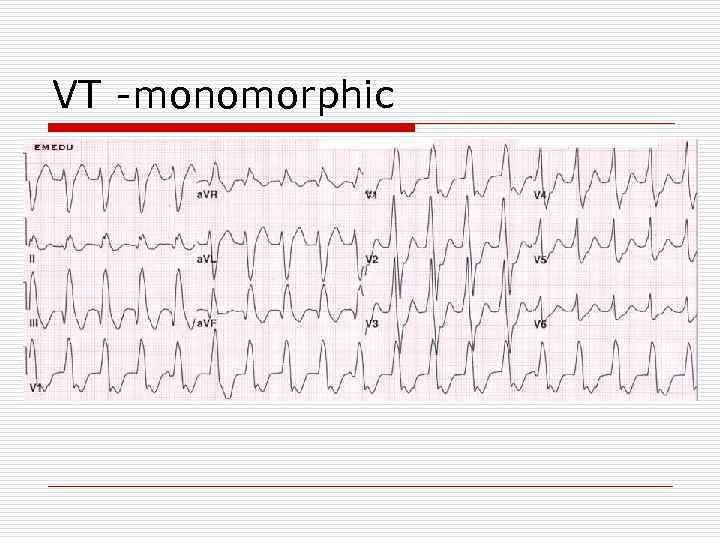 VT -monomorphic
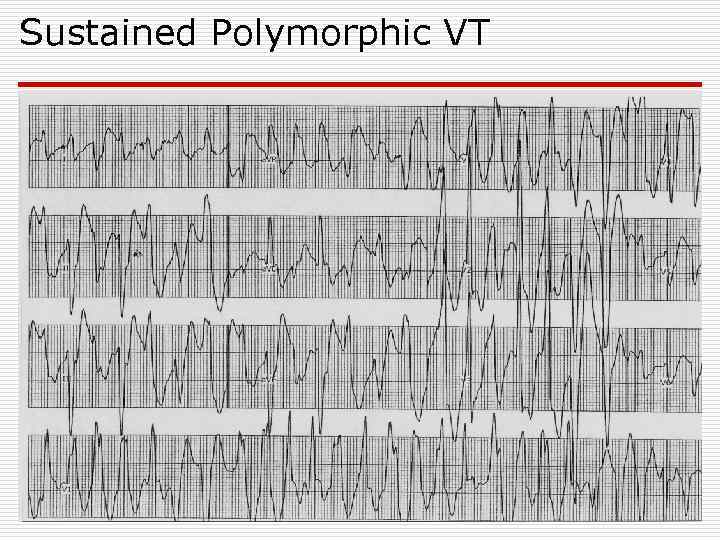 Sustained Polymorphic VT
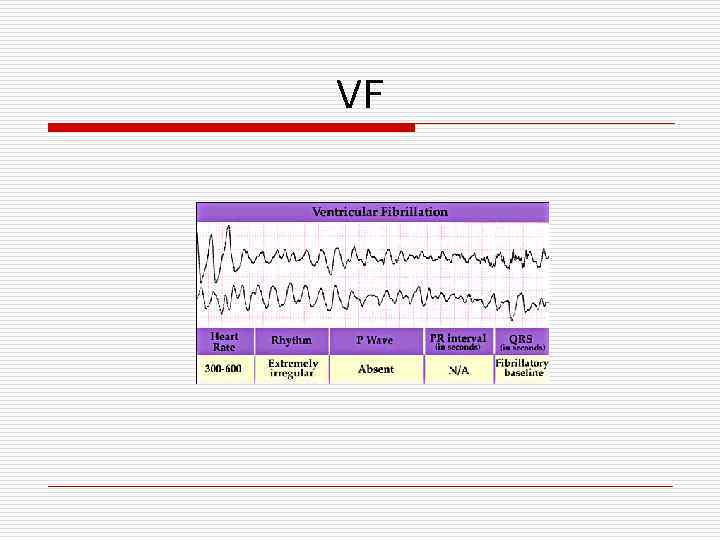 VF
VF
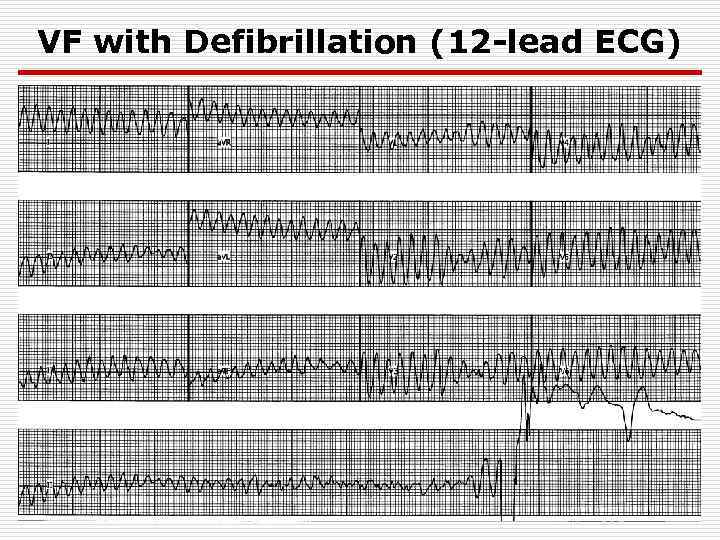 VF with Defibrillation (12 -lead ECG)
 Causes • Chronic coronary heart disease • Heart failure • Congenital heart disease • Neurological disorders • Structurally normal hearts • Sudden infant death syndrome • Cardiomyopathies ♥ Dilated cardiomyopathy ♥ Hypertrophic cardiomyopathy ♥ Arrhythmogenic right ventricular (RV) cardiomyopathy
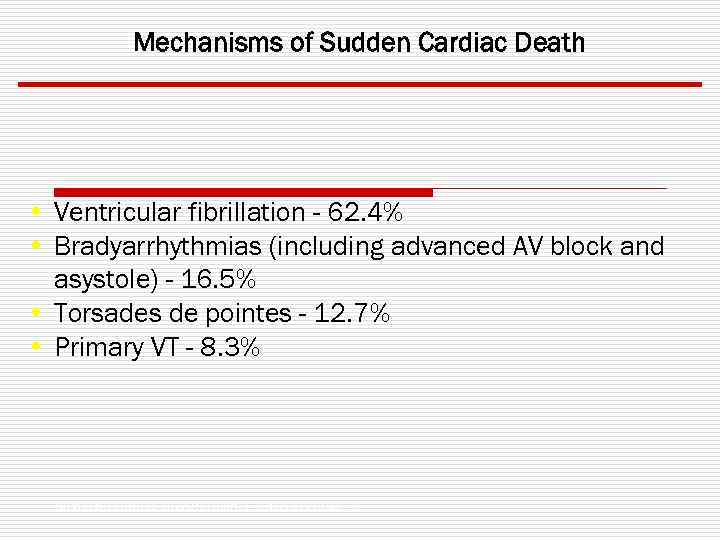 Mechanisms of Sudden Cardiac Death • Ventricular fibrillation - 62. 4% • Bradyarrhythmias (including advanced AV block and asystole) - 16. 5% • Torsades de pointes - 12. 7% • Primary VT - 8. 3% Bayes de Luna et al. Am Heart J 1989; 117: 151– 9.
 VA management o Acute o Chronic (secondary prevention)
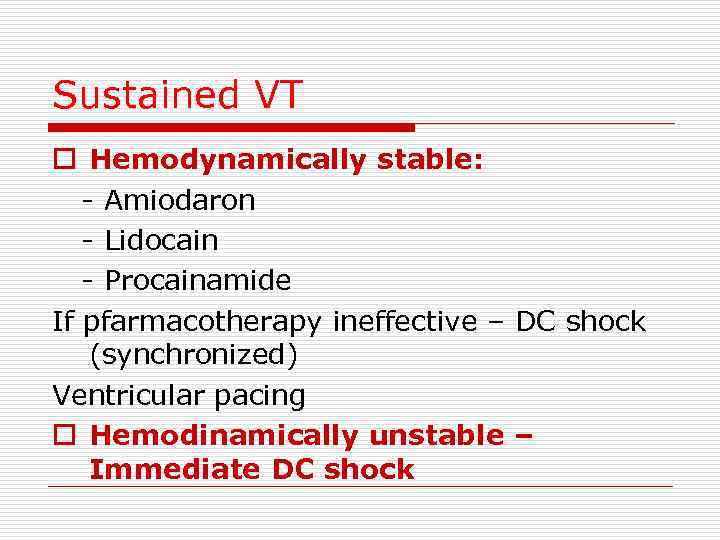 Sustained VT o Hemodynamically stable: - Amiodaron - Lidocain - Procainamide If pfarmacotherapy ineffective – DC shock (synchronized) Ventricular pacing o Hemodinamically unstable – Immediate DC shock
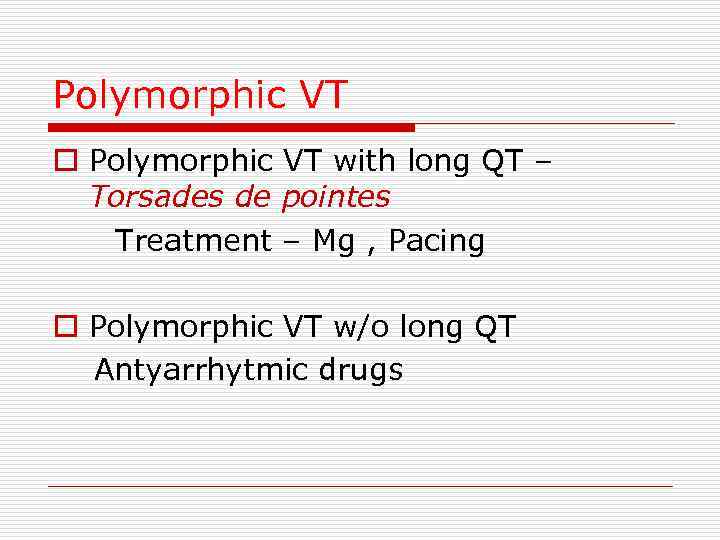 Polymorphic VT o Polymorphic VT with long QT – Torsades de pointes Treatment – Mg , Pacing o Polymorphic VT w/o long QT Antyarrhytmic drugs
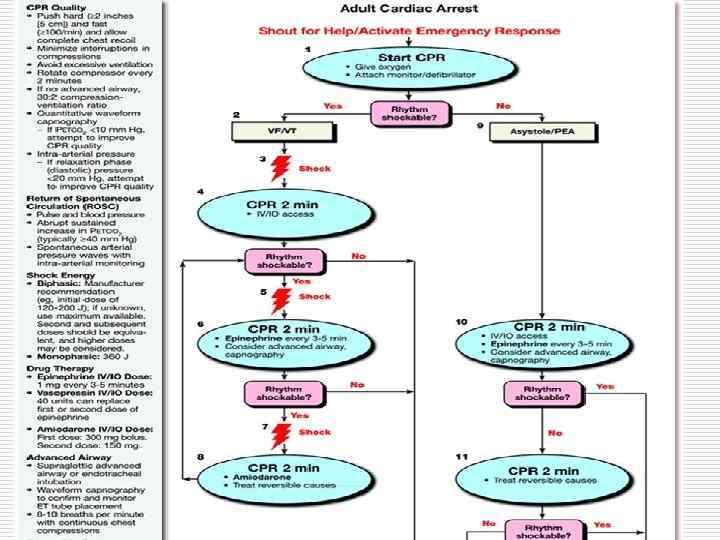
 Chronic Management (secondary prevention) Evaluation - Rest ECG - Exersise test - Ambulatory ECG - Imaging (LV function, CMP, Valves etc… o - EPS o o
 Treatment of the underlying disease o Revascularisation o Valve surgery o CHD repair
 Non-antiarrhythmic Drugs ♥ Electrolytes: Mg & K ♥ ACE inhibitors, ♥ Antithrombotic and antiplatelet agents ♥ Statins
 Antiarrhytmic drugs o Antiarrhythmic drugs (except for BB) should not be used as primary preventive therapy of VA and the prevention of SCD
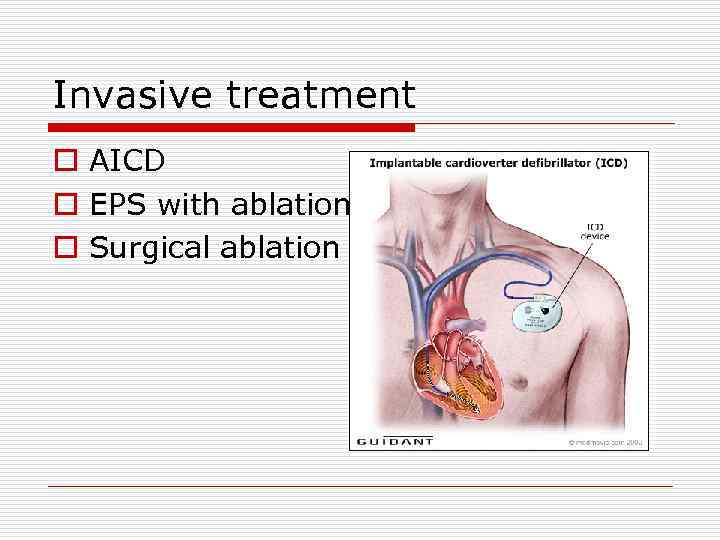 Invasive treatment o AICD o EPS with ablation o Surgical ablation
 AICD for primary prevention of SCD o 1. Post MI - LVEF < 30% - LVEF 30 -35%, NYHA II-III -LVEF 30 -40%, NSVT, positive EP o 2. Non ischemic CMP - LVEF <30%
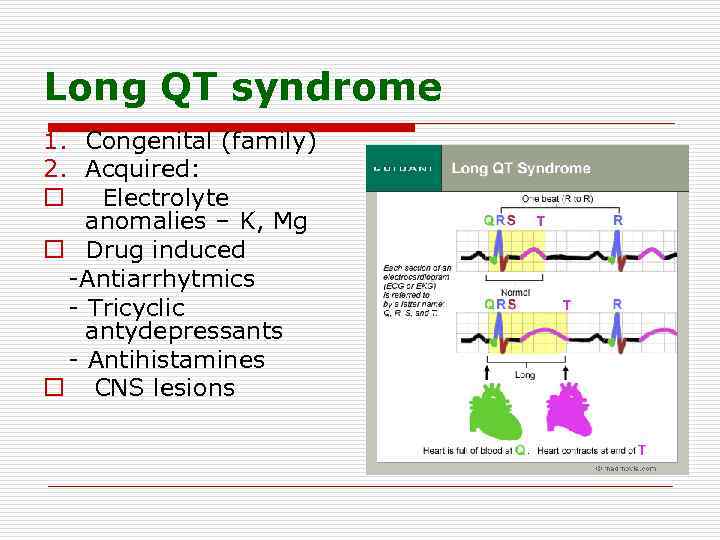 Long QT syndrome 1. Congenital (family) 2. Acquired: o Electrolyte anomalies – K, Mg o Drug induced -Antiarrhytmics - Tricyclic antydepressants - Antihistamines o CNS lesions
 Long QT syndrome treatment o Acute 1. Remove the precipitating factor 2. Mg IV 3. Pacing 4. Isoproterenol 5. IB antiarrhythmic
 Long QT syndrome treatment o Chronic – for congenital long QT 1. Beta blockers 2. AICD
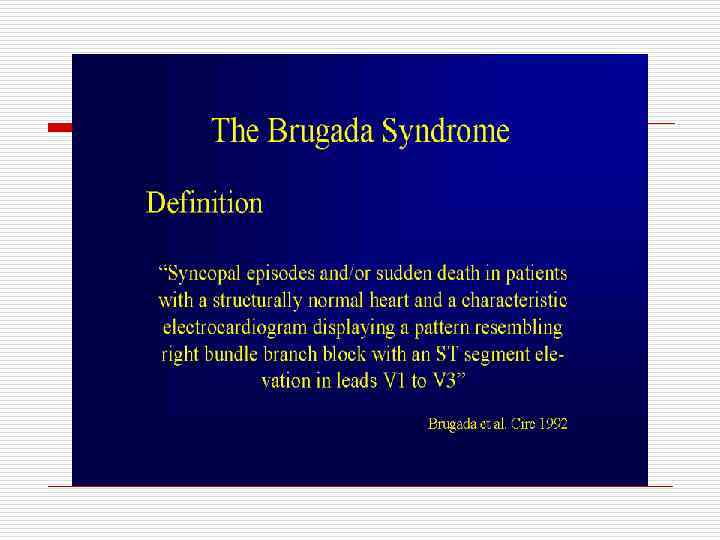
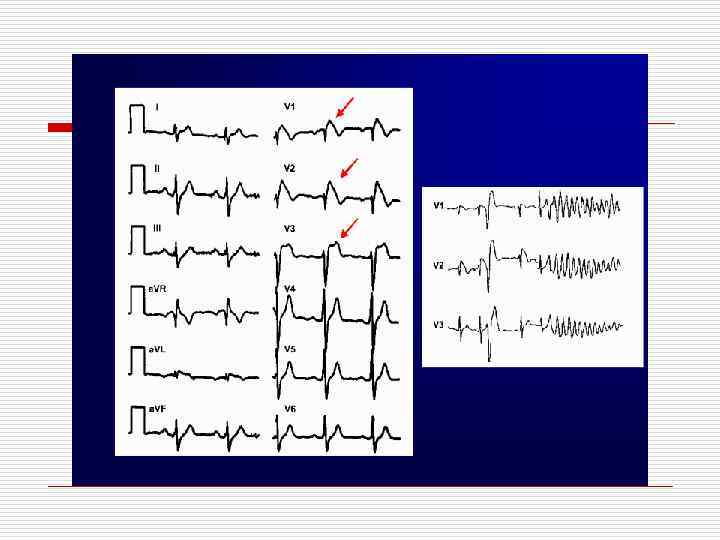
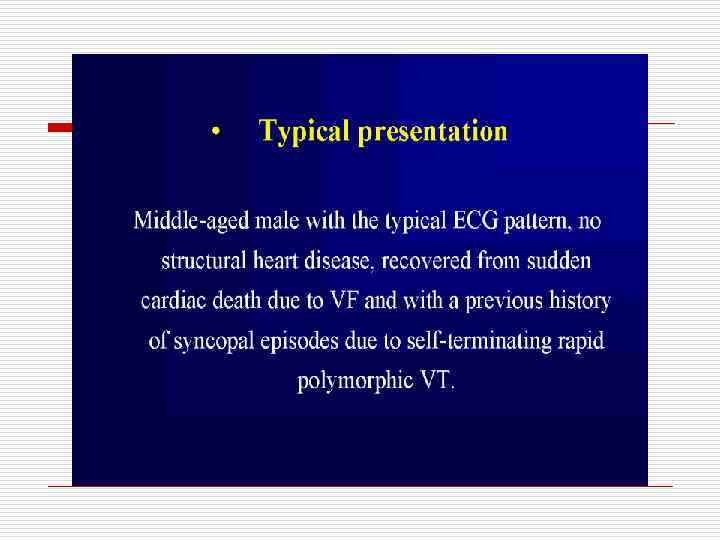
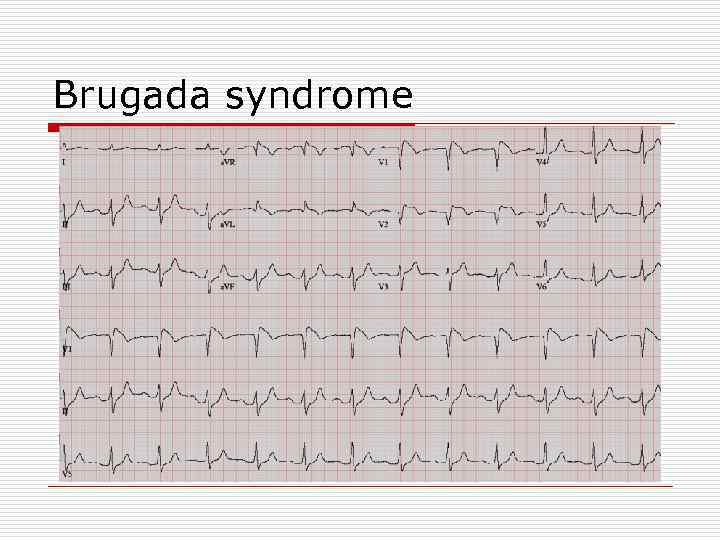 Brugada syndrome
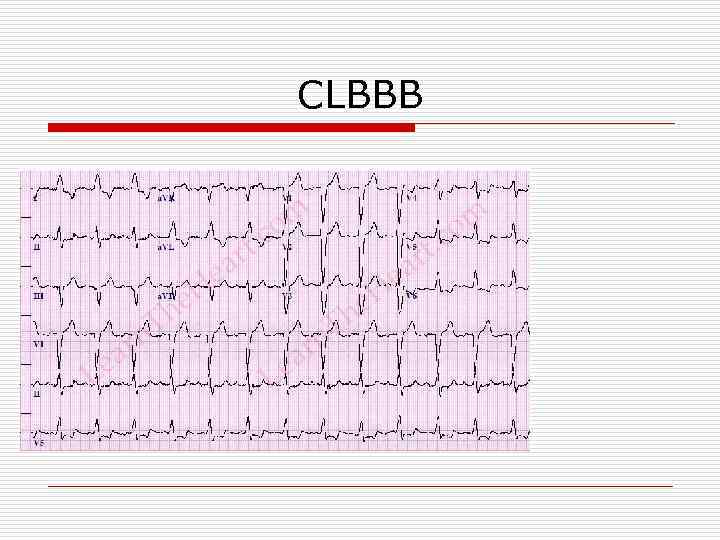 CLBBB
CLBBB
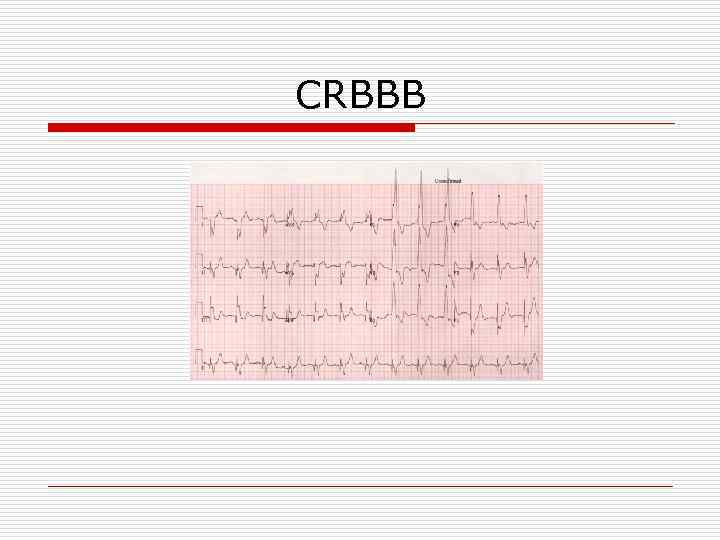 CRBBB
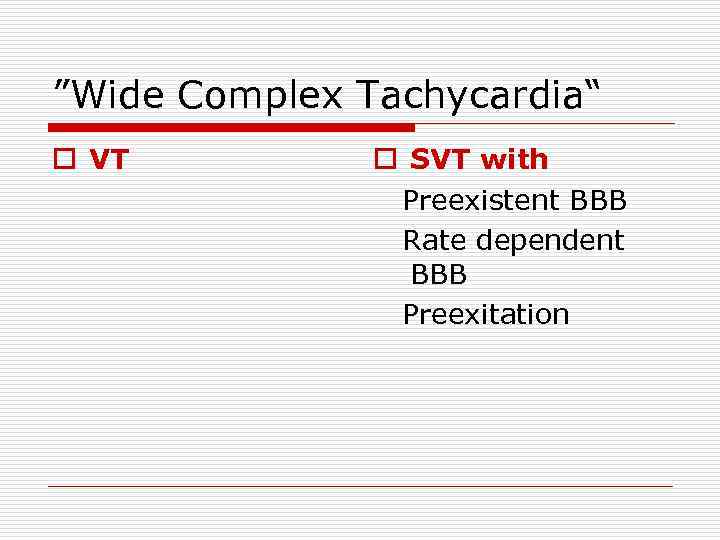
CRBBB
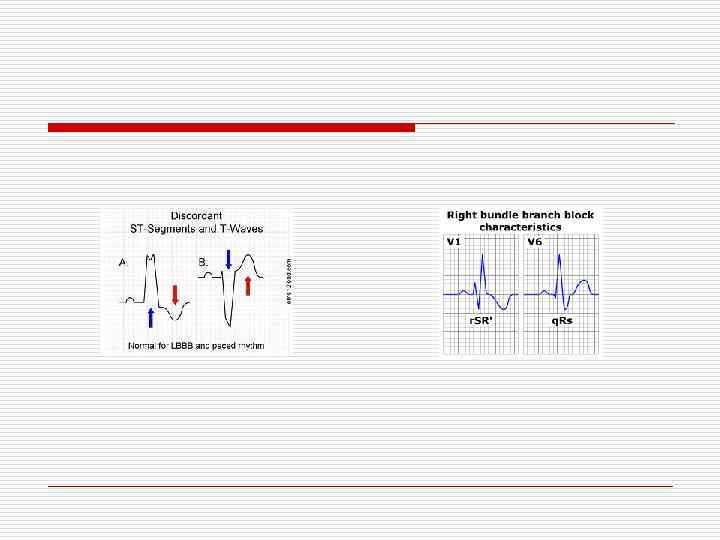
 ”Wide Complex Tachycardia“ o VT o SVT with Preexistent BBB Rate dependent BBB Preexitation
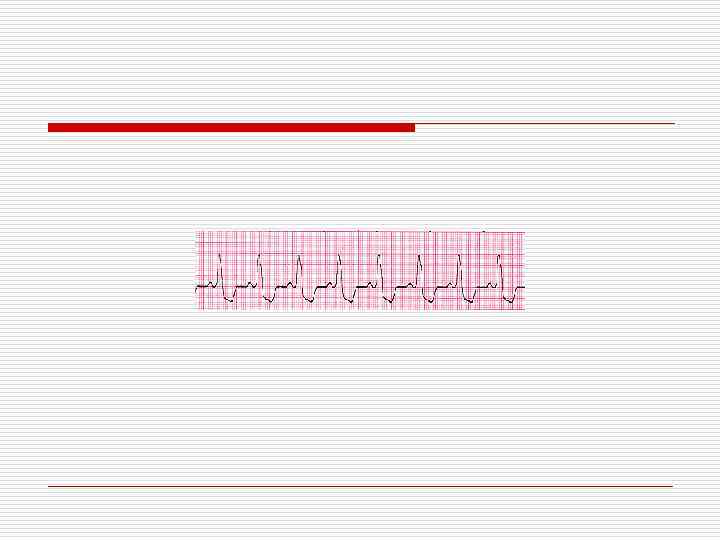
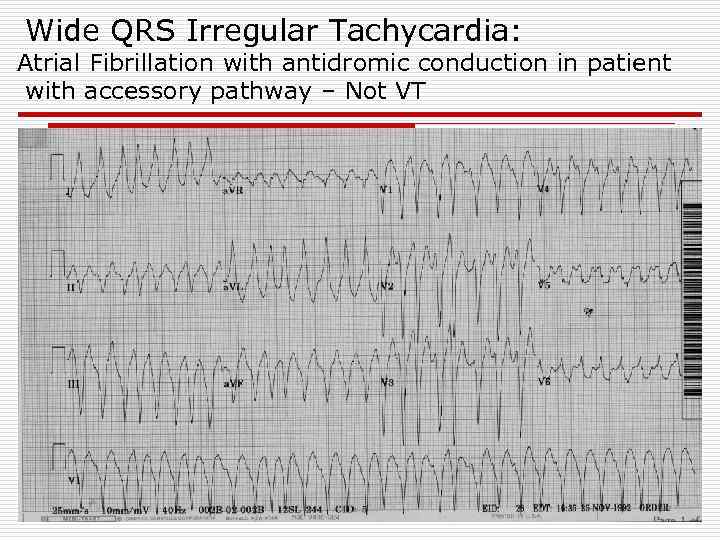 Wide QRS Irregular Tachycardia: Atrial Fibrillation with antidromic conduction in patient with accessory pathway – Not VT
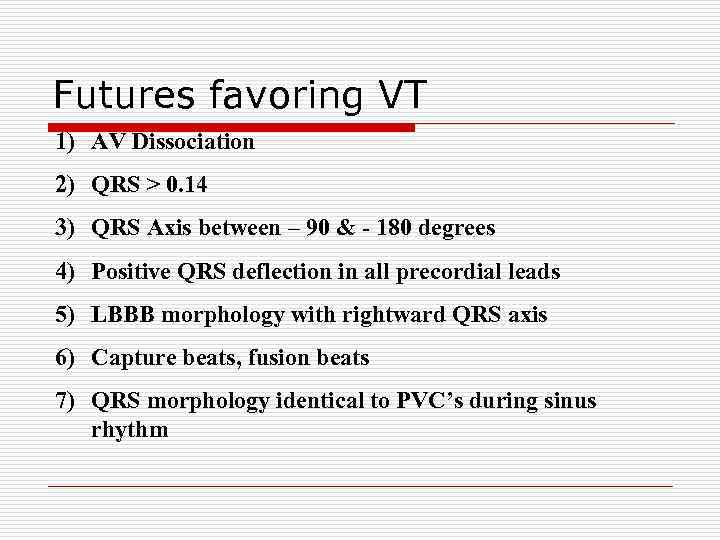 Futures favoring VT 1) AV Dissociation 2) QRS > 0. 14 3) QRS Axis between – 90 & - 180 degrees 4) Positive QRS deflection in all precordial leads 5) LBBB morphology with rightward QRS axis 6) Capture beats, fusion beats 7) QRS morphology identical to PVC’s during sinus rhythm
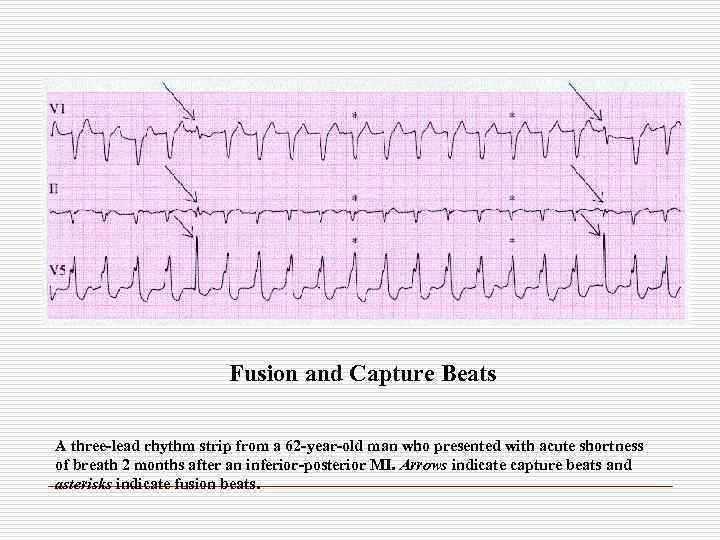 Fusion and Capture Beats A three-lead rhythm strip from a 62 -year-old man who presented with acute shortness of breath 2 months after an inferior-posterior MI. Arrows indicate capture beats and asterisks indicate fusion beats.
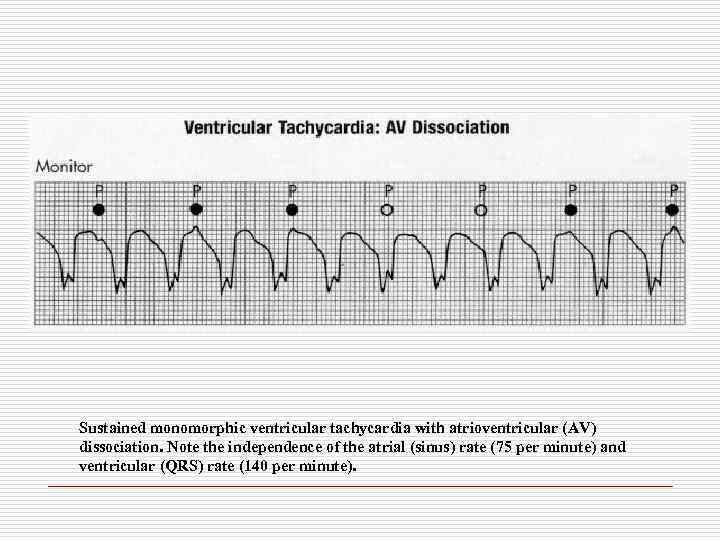 Sustained monomorphic ventricular tachycardia with atrioventricular (AV) dissociation. Note the independence of the atrial (sinus) rate (75 per minute) and ventricular (QRS) rate (140 per minute).
 ?
?
 Atrioventricular Conduction Disturbances and Bradyarrhythmias
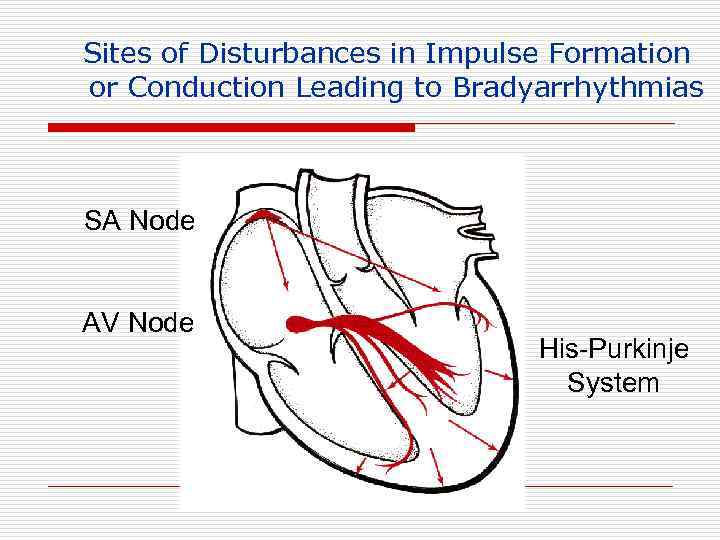 Sites of Disturbances in Impulse Formation or Conduction Leading to Bradyarrhythmias SA Node AV Node His-Purkinje System
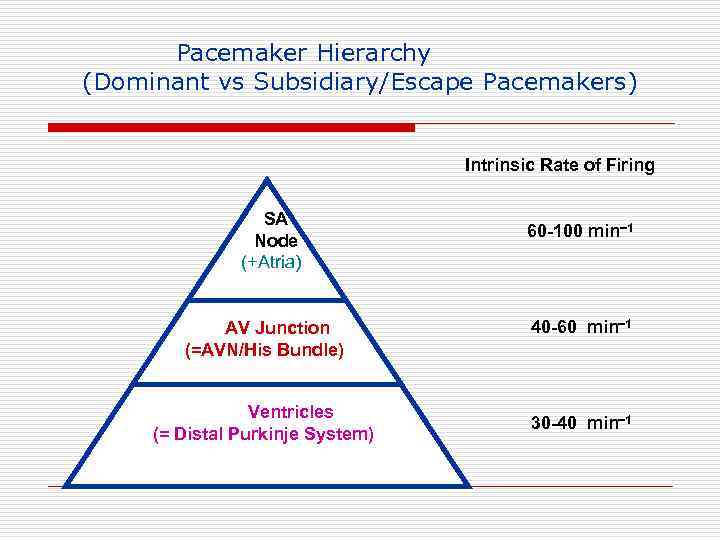 Pacemaker Hierarchy (Dominant vs Subsidiary/Escape Pacemakers) Intrinsic Rate of Firing SA Node (+Atria) AV Junction (=AVN/His Bundle) Ventricles (= Distal Purkinje System) 60 -100 min 1 40 -60 min 1 30 -40 min 1
 AV Block
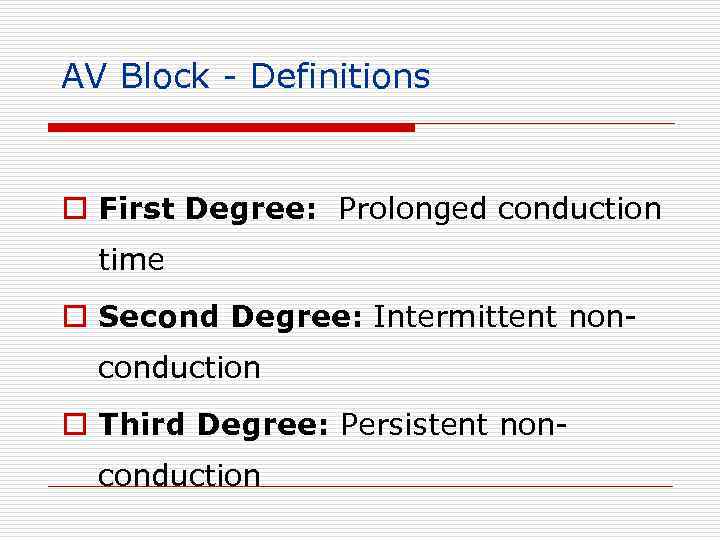 AV Block - Definitions o First Degree: Prolonged conduction time o Second Degree: Intermittent nonconduction o Third Degree: Persistent nonconduction
![II First Degree AV Block (PR >. 20 sec [1 big box]) P P](https://present5.com/presentation/8131944_451954334/image-111.jpg "II First Degree AV Block (PR >. 20 sec [1 big box]) P P") II First Degree AV Block (PR >. 20 sec [1 big box]) P P P . 36 Site of delay most commonly the AV node, but may be localized to the His-Purkinje system
II First Degree AV Block (PR >. 20 sec [1 big box]) P P P . 36 Site of delay most commonly the AV node, but may be localized to the His-Purkinje system
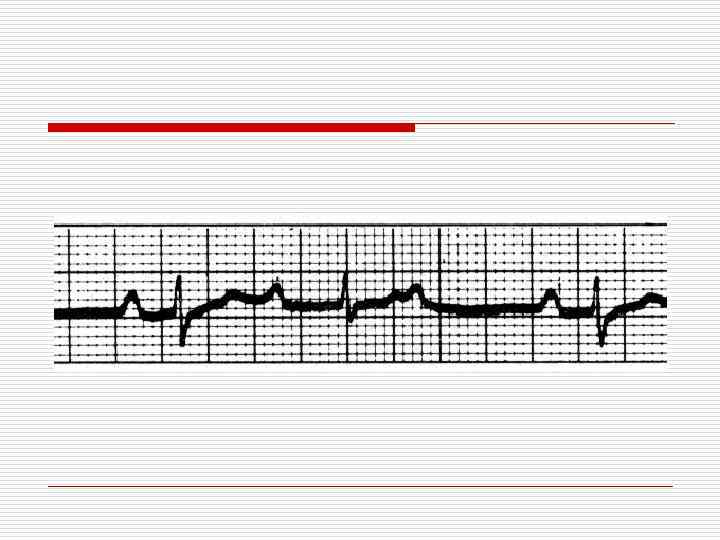
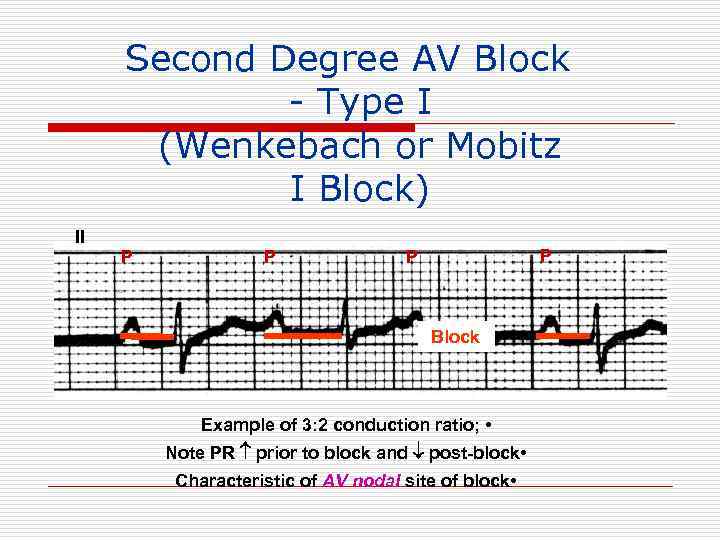 Second Degree AV Block - Type I (Wenkebach or Mobitz I Block) II P P Block Example of 3: 2 conduction ratio; • Note PR prior to block and post-block • Characteristic of AV nodal site of block •
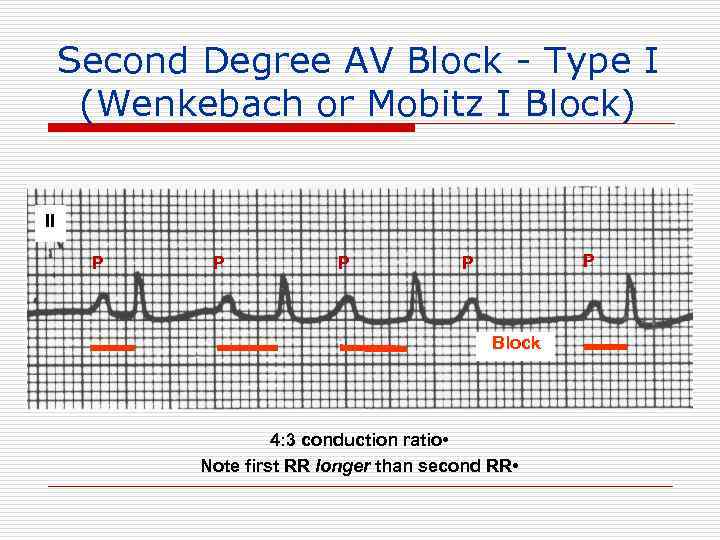 Second Degree AV Block - Type I (Wenkebach or Mobitz I Block) II P P P Block 4: 3 conduction ratio • Note first RR longer than second RR •
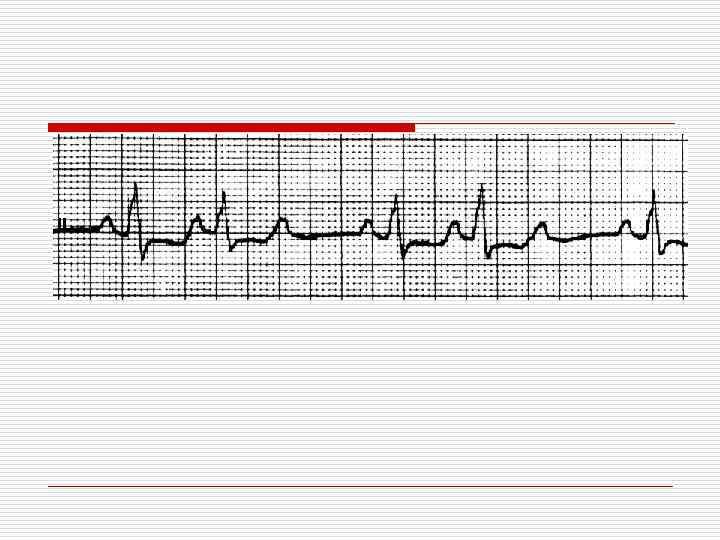 II
II
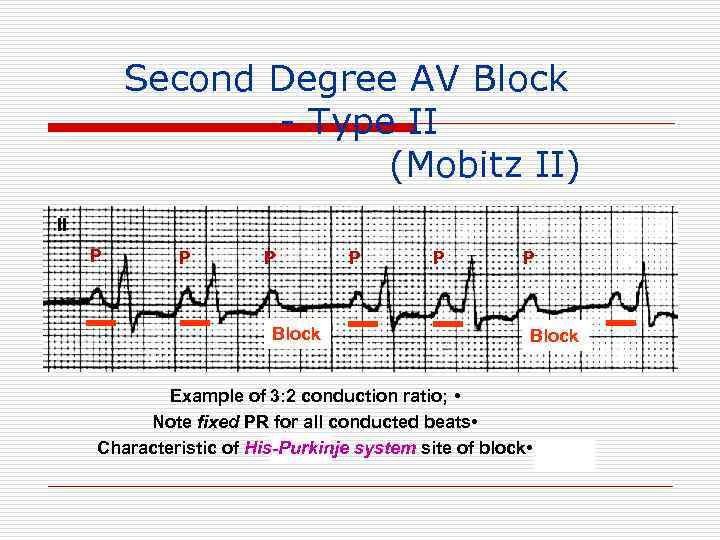 Second Degree AV Block - Type II (Mobitz II) II P P P Block Example of 3: 2 conduction ratio; • Note fixed PR for all conducted beats • Characteristic of His-Purkinje system site of block •
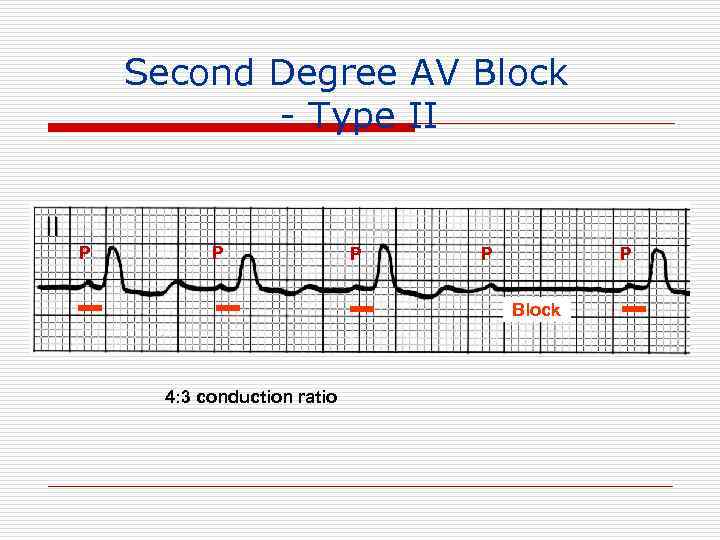 Second Degree AV Block - Type II P P P Block 4: 3 conduction ratio
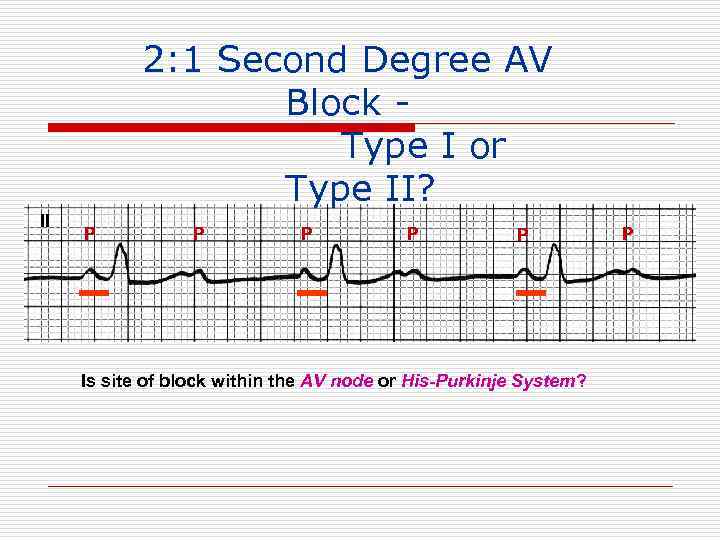 2: 1 Second Degree AV Block Type I or Type II? II P P P Is site of block within the AV node or His-Purkinje System? P
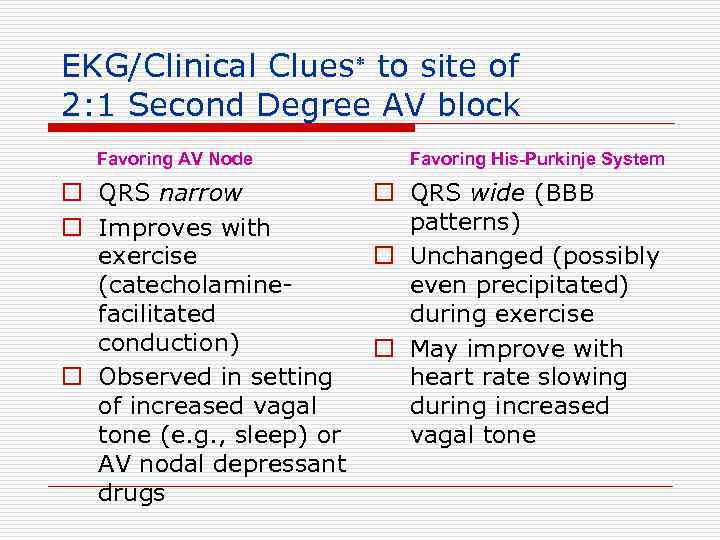 EKG/Clinical Clues to site of 2: 1 Second Degree AV block Favoring AV Node o QRS narrow o Improves with exercise (catecholaminefacilitated conduction) o Observed in setting of increased vagal tone (e. g. , sleep) or AV nodal depressant drugs Favoring His-Purkinje System o QRS wide (BBB patterns) o Unchanged (possibly even precipitated) during exercise o May improve with heart rate slowing during increased vagal tone
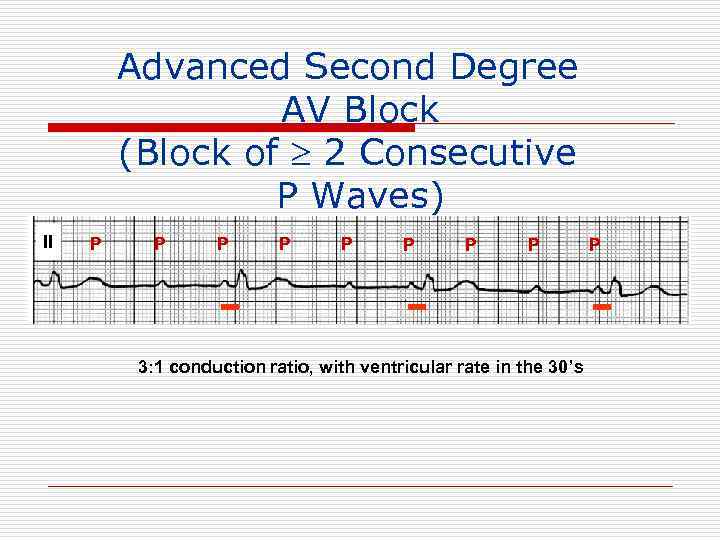 Advanced Second Degree AV Block (Block of 2 Consecutive P Waves) II P P P P 3: 1 conduction ratio, with ventricular rate in the 30’s P
 Site of AV Block vs. Escape Rhythm o AV Node: Junctional or ventricular o His-Purkinje System: Ventricular
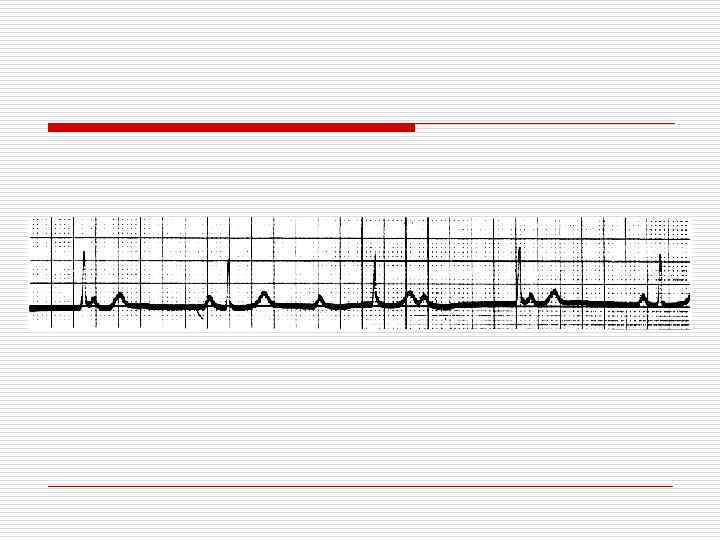
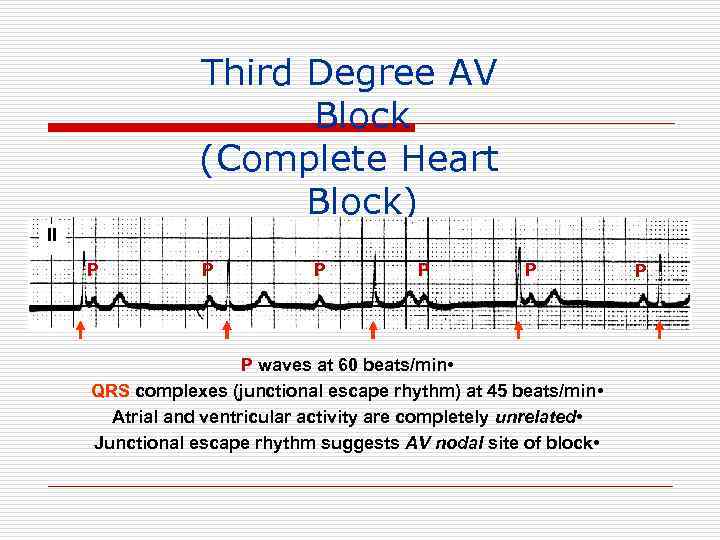 Third Degree AV Block (Complete Heart Block) II P P P waves at 60 beats/min • QRS complexes (junctional escape rhythm) at 45 beats/min • Atrial and ventricular activity are completely unrelated • Junctional escape rhythm suggests AV nodal site of block • P
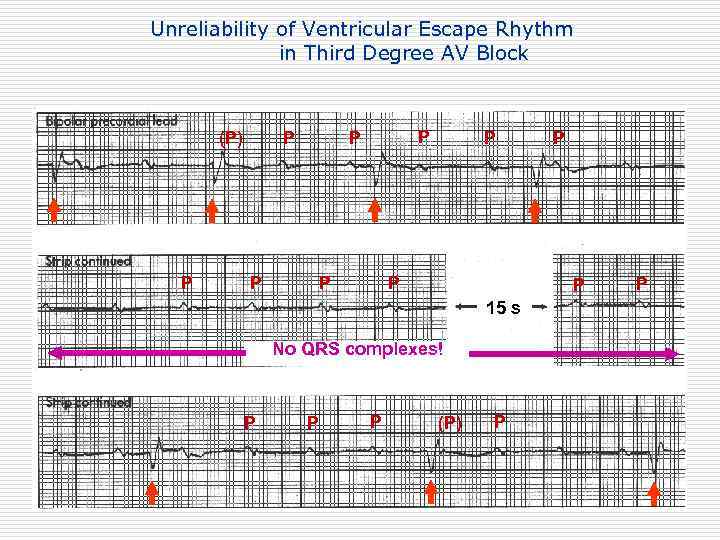 Unreliability of Ventricular Escape Rhythm in Third Degree AV Block (P) P P P P P 15 s No QRS complexes! P P (P) P P
 Causes of NON-Physiologic AV Block • Ischemic heart disease, cardiomyopathy and degenerative changes • Drugs that depress AV conduction – AV Node: digoxin, beta blockers, calcium channel blockers, amiodarone – His-Purkinje System: Antiarrhythmic drugs that depress the inward sodium current • Myocardial infection, infiltration (e. g. , tumor) • Trauma (e. g. , surgery; therapeutic ablation) • Congenital abnormalities
 Sinus Bradyarrhythmias
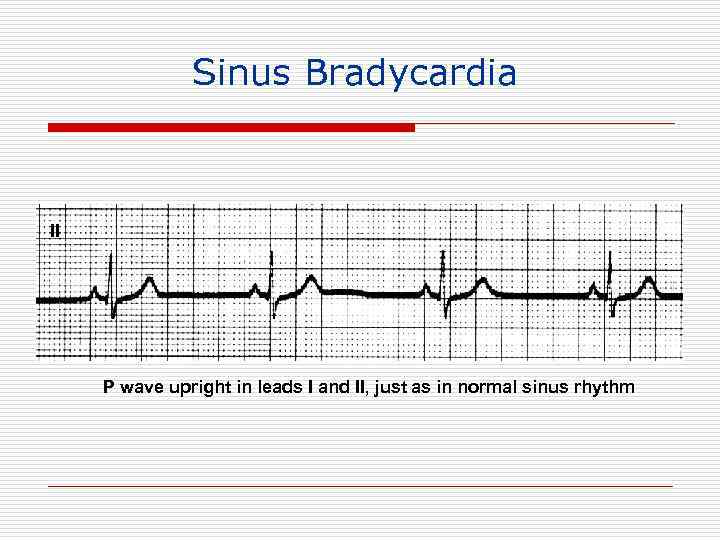 Sinus Bradycardia II P wave upright in leads I and II, just as in normal sinus rhythm
 Causes of Sinus Bradycardia o Increased vagal tone o Drugs: beta blockers, calcium channel blockers, amiodarone, digoxin (indirect effect) o Myocardial ischemia/infarction o Hypothyroidism o “Sick sinus syndrome” degenerative/fibrotic atrial process
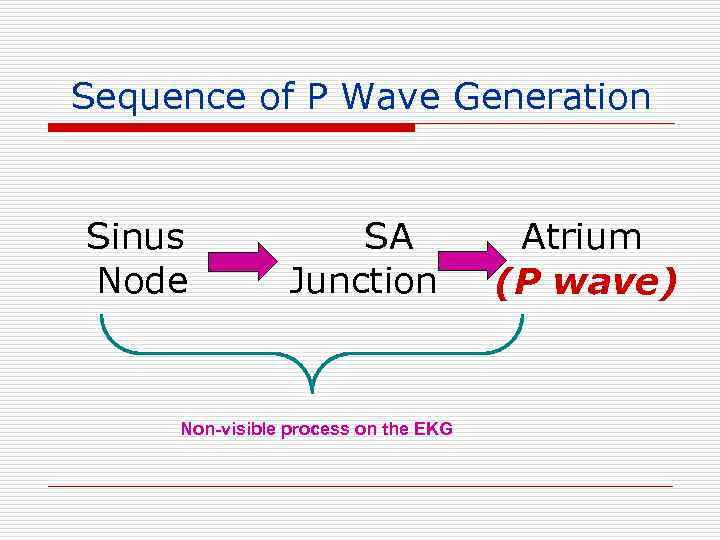 Sequence of P Wave Generation Sinus Node SA Junction Non-visible process on the EKG Atrium (P wave)
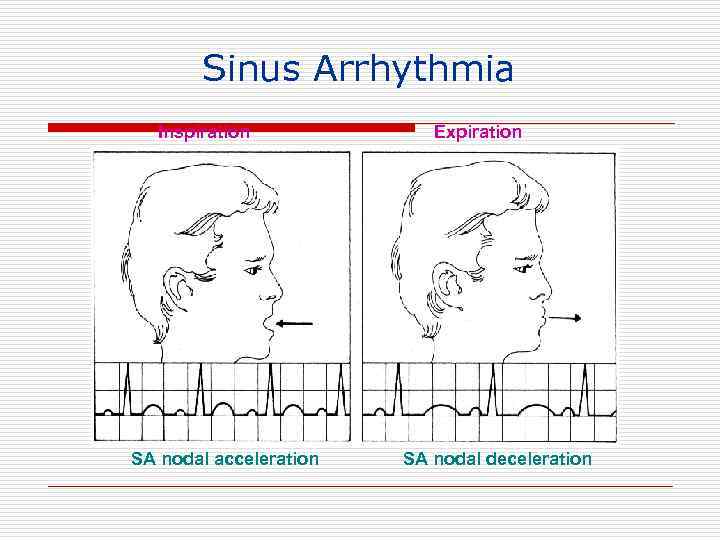 Sinus Arrhythmia Inspiration SA nodal acceleration Expiration SA nodal deceleration
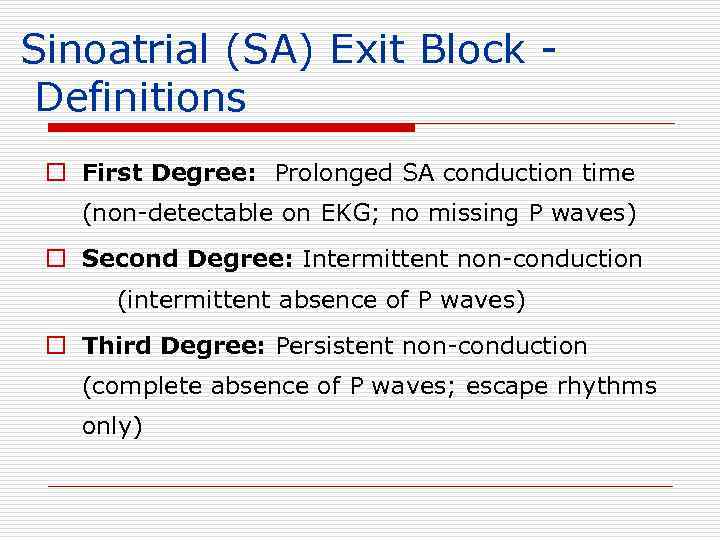 Sinoatrial (SA) Exit Block Definitions o First Degree: Prolonged SA conduction time (non-detectable on EKG; no missing P waves) o Second Degree: Intermittent non-conduction (intermittent absence of P waves) o Third Degree: Persistent non-conduction (complete absence of P waves; escape rhythms only)
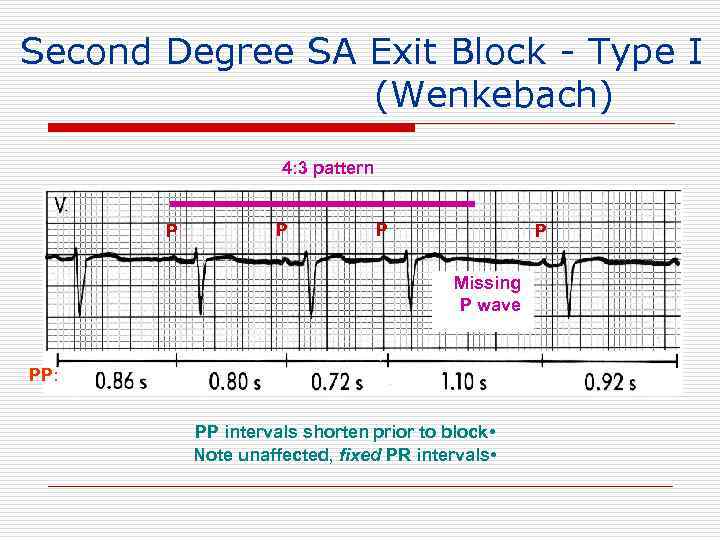 Second Degree SA Exit Block - Type I (Wenkebach) 4: 3 pattern P P Missing P wave PP: PP intervals shorten prior to block • Note unaffected, fixed PR intervals •
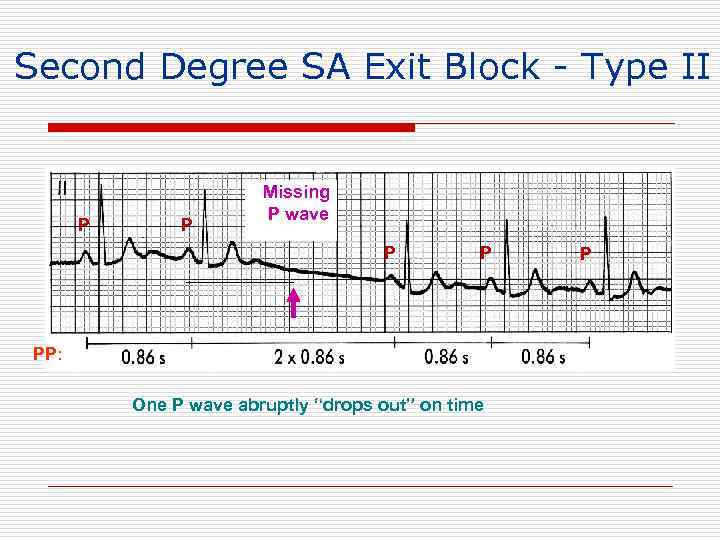 Second Degree SA Exit Block - Type II P P Missing P wave P P PP: One P wave abruptly “drops out” on time P
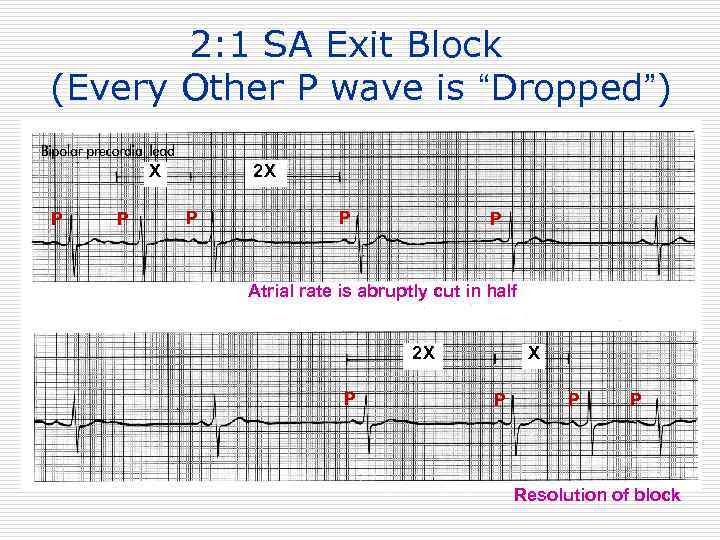 2: 1 SA Exit Block (Every Other P wave is “Dropped”) X P P 2 X P P P Atrial rate is abruptly cut in half 2 X P P P Resolution of block
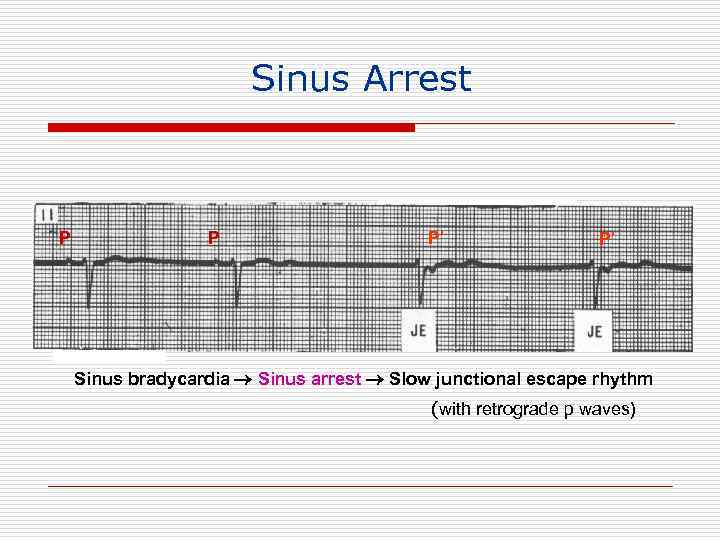 Sinus Arrest P P P’ P’ Sinus bradycardia Sinus arrest Slow junctional escape rhythm (with retrograde p waves)
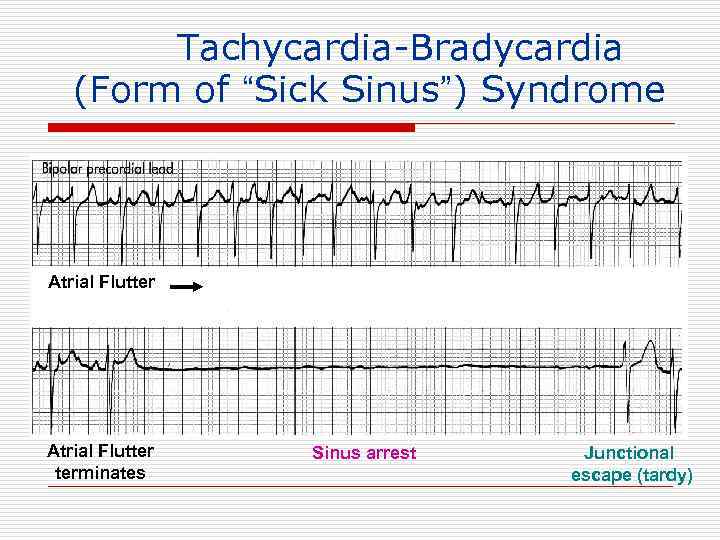 Tachycardia-Bradycardia (Form of “Sick Sinus”) Syndrome Atrial Flutter terminates Sinus arrest Junctional escape (tardy)
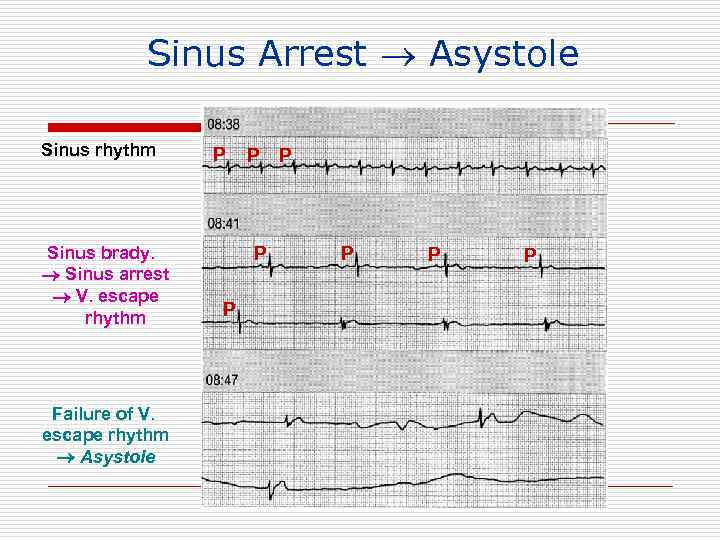 Sinus Arrest Asystole Sinus rhythm Sinus brady. Sinus arrest V. escape rhythm Failure of V. escape rhythm Asystole P P P P
 Causes of SA Exit Block and Sinus Pauses/Arrest o Increased vagal tone (very intense for sinus arrest) o Drugs: beta blockers, calcium channel blockers, amiodarone, digoxin (indirect effect) o Myocardial ischemia/infarction o Sick sinus syndrome o Sequela of open heart surgery
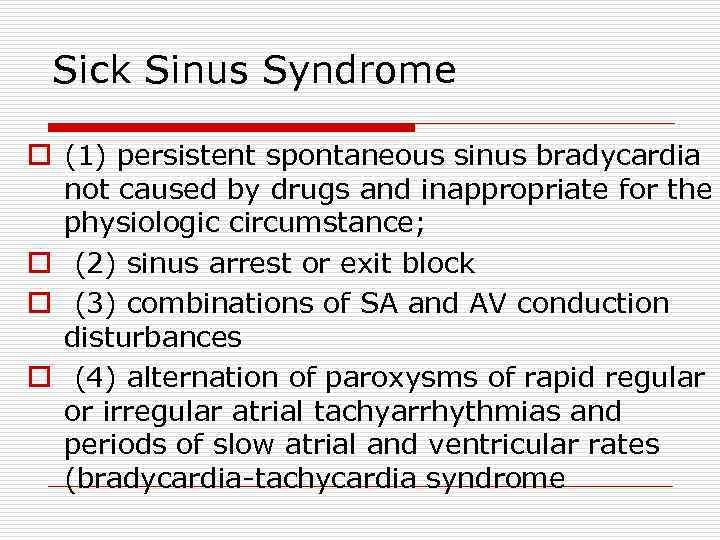 Sick Sinus Syndrome o (1) persistent spontaneous sinus bradycardia not caused by drugs and inappropriate for the physiologic circumstance; o (2) sinus arrest or exit block o (3) combinations of SA and AV conduction disturbances o (4) alternation of paroxysms of rapid regular or irregular atrial tachyarrhythmias and periods of slow atrial and ventricular rates (bradycardia-tachycardia syndrome