 Скачать презентацию Carbon Markets CDM project development 8 August
6a9cdf2428ebf0d7aeb947bade057900.ppt
- Количество слайдов: 8



Carbon Markets – CDM project development, 8. August 2011 Jørgen Fenhann PDD Development Small-scale CDM
PROJECT DESIGN DOCUMENT FORM (CDM‑SSC-PDD) VERSION 03 - IN EFFECT AS OF: 22 DECEMBER 2006 CONTENTS A. General description of the small scale project activity B. Application of a baseline and monitoring methodology C. Duration of the project activity / crediting period D. Environmental impacts E. Stakeholders’ comments Annexes Annex 1: Contact information on participants in the proposed small scale project activity Annex 2: Information regarding public funding Annex 3: Baseline information Annex 4: Monitoring Information
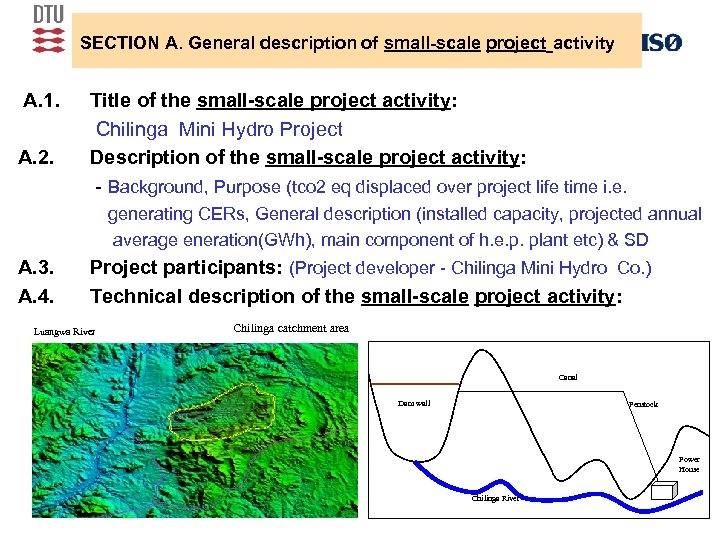
SECTION A. General description of small-scale project activity A. 1. A. 2. Title of the small-scale project activity: Chilinga Mini Hydro Project Description of the small-scale project activity: - Background, Purpose (tco 2 eq displaced over project life time i. e. generating CERs, General description (installed capacity, projected annual average eneration(GWh), main component of h. e. p. plant etc) & SD A. 3. A. 4. Project participants: (Project developer - Chilinga Mini Hydro Co. ) Technical description of the small-scale project activity: Luangwa River Chilinga catchment area Canal Dam wall Penstock Power House Chilinga River
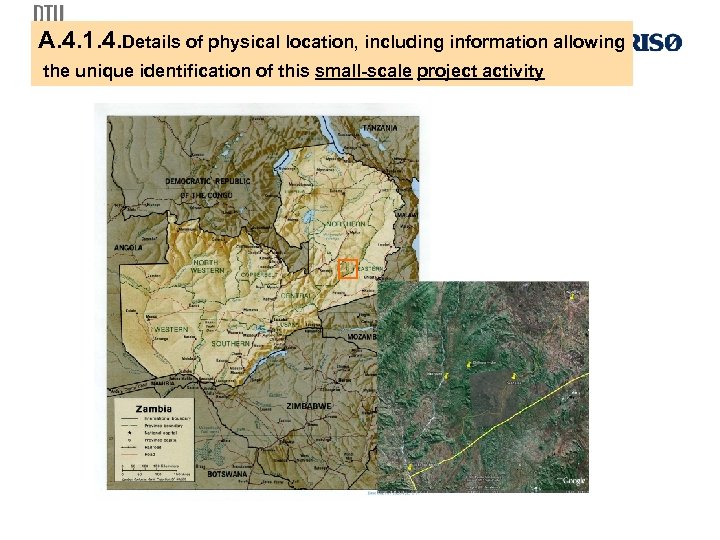
A. 4. 1. 4. Details of physical location, including information allowing the unique identification of this small-scale project activity
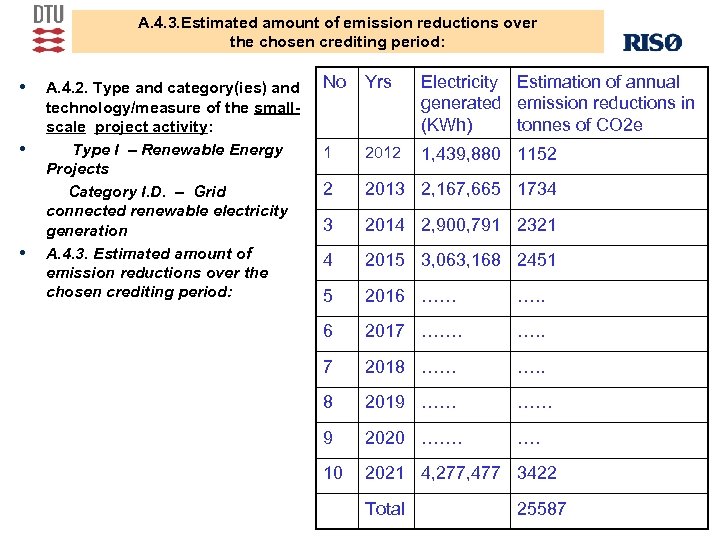
A. 4. 3. Estimated amount of emission reductions over the chosen crediting period: • • • A. 4. 2. Type and category(ies) and technology/measure of the smallscale project activity: Type I – Renewable Energy Projects Category I. D. – Grid connected renewable electricity generation A. 4. 3. Estimated amount of emission reductions over the chosen crediting period: No Yrs Electricity Estimation of annual generated emission reductions in (KWh) tonnes of CO 2 e 1 2012 1, 439, 880 1152 2 2013 2, 167, 665 1734 3 2014 2, 900, 791 2321 4 2015 3, 063, 168 2451 5 2016 …… …. . 6 2017 ……. …. . 7 2018 …… …. . 8 2019 …… …… 9 2020 ……. 10 2021 4, 277, 477 3422 Total 25587
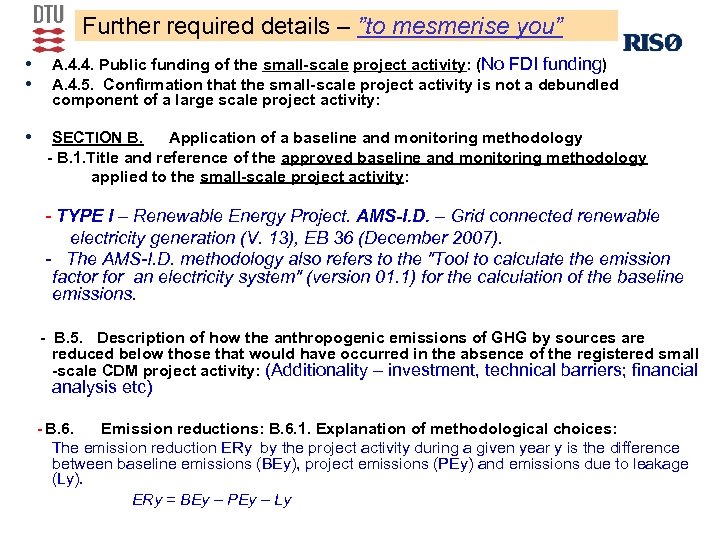
Further required details – ”to mesmerise you” • • • A. 4. 4. Public funding of the small-scale project activity: (No FDI funding) A. 4. 5. Confirmation that the small-scale project activity is not a debundled component of a large scale project activity: SECTION B. Application of a baseline and monitoring methodology - B. 1. Title and reference of the approved baseline and monitoring methodology applied to the small-scale project activity: - TYPE I – Renewable Energy Project. AMS-I. D. – Grid connected renewable electricity generation (V. 13), EB 36 (December 2007). - The AMS-I. D. methodology also refers to the "Tool to calculate the emission factor for an electricity system" (version 01. 1) for the calculation of the baseline emissions. - B. 5. Description of how the anthropogenic emissions of GHG by sources are reduced below those that would have occurred in the absence of the registered small -scale CDM project activity: (Additionality – investment, technical barriers; financial analysis etc) - B. 6. Emission reductions: B. 6. 1. Explanation of methodological choices: The emission reduction ERy by the project activity during a given year y is the difference between baseline emissions (BEy), project emissions (PEy) and emissions due to leakage (Ly). ERy = BEy – PEy – Ly
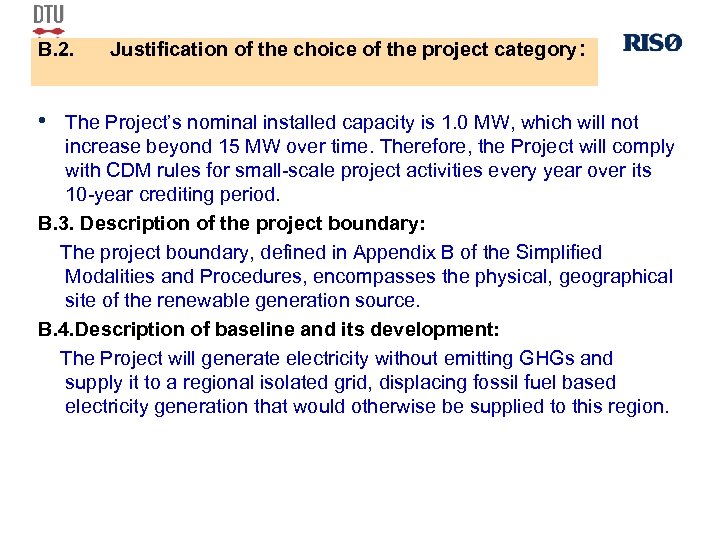
B. 2. Justification of the choice of the project category: • The Project’s nominal installed capacity is 1. 0 MW, which will not increase beyond 15 MW over time. Therefore, the Project will comply with CDM rules for small-scale project activities every year over its 10 -year crediting period. B. 3. Description of the project boundary: The project boundary, defined in Appendix B of the Simplified Modalities and Procedures, encompasses the physical, geographical site of the renewable generation source. B. 4. Description of baseline and its development: The Project will generate electricity without emitting GHGs and supply it to a regional isolated grid, displacing fossil fuel based electricity generation that would otherwise be supplied to this region.
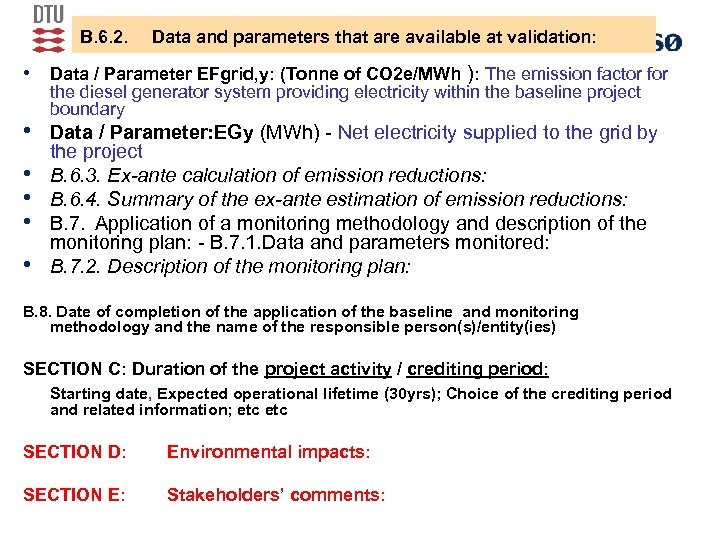
B. 6. 2. Data and parameters that are available at validation: • Data / Parameter EFgrid, y: (Tonne of CO 2 e/MWh ): The emission factor for the diesel generator system providing electricity within the baseline project boundary • Data / Parameter: EGy (MWh) - Net electricity supplied to the grid by • • the project B. 6. 3. Ex-ante calculation of emission reductions: B. 6. 4. Summary of the ex-ante estimation of emission reductions: B. 7. Application of a monitoring methodology and description of the monitoring plan: - B. 7. 1. Data and parameters monitored: B. 7. 2. Description of the monitoring plan: B. 8. Date of completion of the application of the baseline and monitoring methodology and the name of the responsible person(s)/entity(ies) SECTION C: Duration of the project activity / crediting period: Starting date, Expected operational lifetime (30 yrs); Choice of the crediting period and related information; etc SECTION D: Environmental impacts: SECTION E: Stakeholders’ comments:
Скачать презентацию Carbon Markets CDM project development 8 August
6a9cdf2428ebf0d7aeb947bade057900.ppt