 Скачать презентацию Carbon Funds in the Emerging Carbon Market and
eb2ca1bdb7a548f86e04b02f752c2f30.ppt
- Количество слайдов: 22



Carbon Funds in the Emerging Carbon Market and the Role of the Prototype Carbon Fund Carbon Finance Conference February 15 th-16 th, 2001, London www. Prototypecarbonfund. org
PCF Status and Focus Deal flow far exceeds funding - several carbon contracts now under negotiation >50 deals with $300 m+ carbon purchases under review Targeting signed ERPAs of $35 -40 mm in Argentina, Chile, Cost Rica, Morocco, Uganda, Poland, Honduras, India by end-Summer, 2001 Reserve ERPAs of $17 -22 mm in Hungary, Bulgaria, Jamaica, Guyana, Guatemala, Brazil conditional letters of intent to purchase to 6 others by end Feb, 2001 Constraints: Government Awareness and Resolve, Quality of Asset after baseline review
PCF Portfolio and Focus • predominance of wind, waste management, small-hydro and bagasse/biomass cogeneration • strategic focus on building market infrastructure for aggregation and intermediation of small projects • leaving space for PV, transport, fuel-switching, LULUCF (EITs) and Energy Efficiency
Typology of Funds/Plays • Pure Carbon Funds (PCF, National Funds) • Private Equity Funds Ø Ø • • Aimed at JI/CDM Projects New Energy, RE, EE Funds with Carbon Credits Forestry Funds with Carbon Credits Energy or Forestry Funds that Could Add Carbon Credits Mutual Funds with % in Private Equity NGO Funds Sustainability, Social, Ethical Mutual funds Corporate “Funds” Earmarked for Carbon Credit Investment
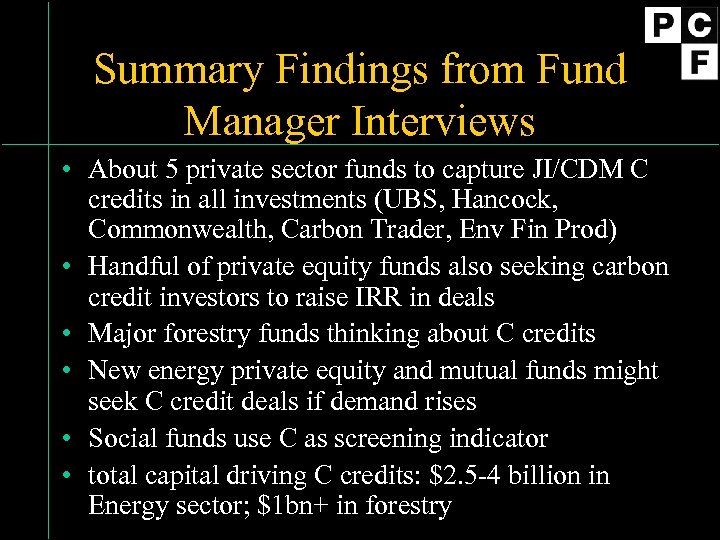
Summary Findings from Fund Manager Interviews • About 5 private sector funds to capture JI/CDM C credits in all investments (UBS, Hancock, Commonwealth, Carbon Trader, Env Fin Prod) • Handful of private equity funds also seeking carbon credit investors to raise IRR in deals • Major forestry funds thinking about C credits • New energy private equity and mutual funds might seek C credit deals if demand rises • Social funds use C as screening indicator • total capital driving C credits: $2. 5 -4 billion in Energy sector; $1 bn+ in forestry
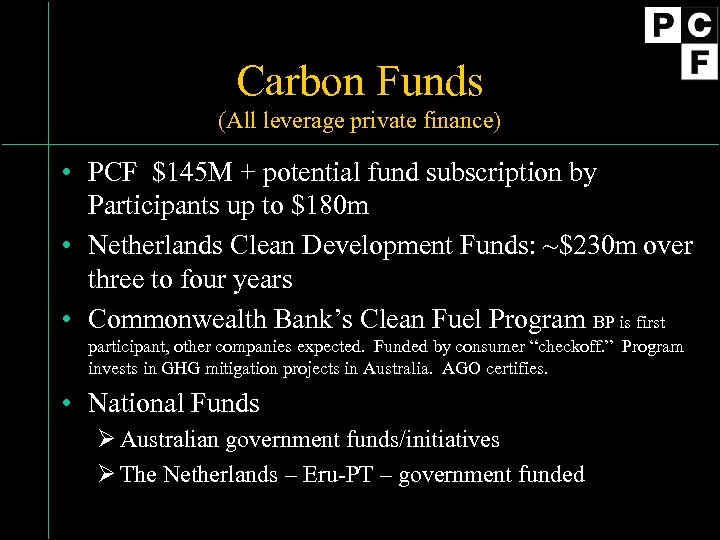
Carbon Funds (All leverage private finance) • PCF $145 M + potential fund subscription by Participants up to $180 m • Netherlands Clean Development Funds: ~$230 m over three to four years • Commonwealth Bank’s Clean Fuel Program BP is first participant, other companies expected. Funded by consumer “checkoff. ” Program invests in GHG mitigation projects in Australia. AGO certifies. • National Funds Ø Australian government funds/initiatives Ø The Netherlands – Eru-PT – government funded
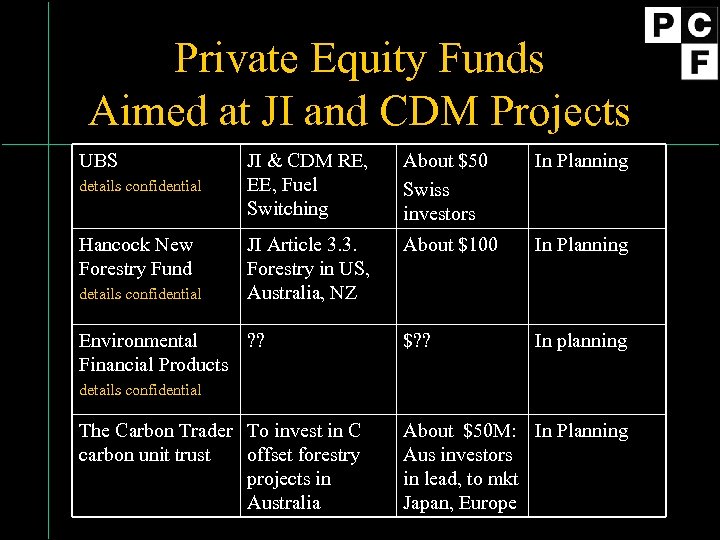
Private Equity Funds Aimed at JI and CDM Projects UBS details confidential Hancock New Forestry Fund details confidential JI & CDM RE, EE, Fuel Switching About $50 Swiss investors In Planning JI Article 3. 3. Forestry in US, Australia, NZ About $100 In Planning $? ? In planning Environmental ? ? Financial Products details confidential The Carbon Trader To invest in C carbon unit trust offset forestry projects in Australia About $50 M: In Planning Aus investors in lead, to mkt Japan, Europe
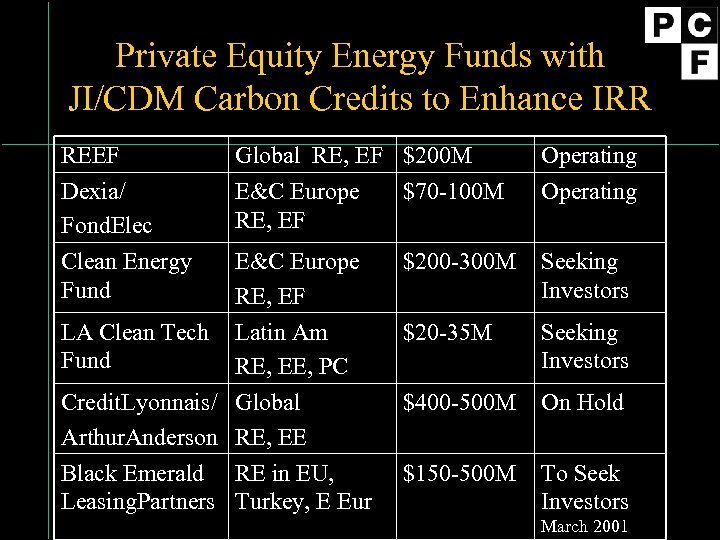
Private Equity Energy Funds with JI/CDM Carbon Credits to Enhance IRR REEF Dexia/ Fond. Elec Clean Energy Fund Global RE, EF $200 M E&C Europe $70 -100 M RE, EF E&C Europe RE, EF LA Clean Tech Latin Am Fund RE, EE, PC Credit. Lyonnais/ Global Arthur. Anderson RE, EE Black Emerald RE in EU, Leasing. Partners Turkey, E Eur Operating $200 -300 M Seeking Investors $20 -35 M Seeking Investors $400 -500 M On Hold $150 -500 M To Seek Investors March 2001
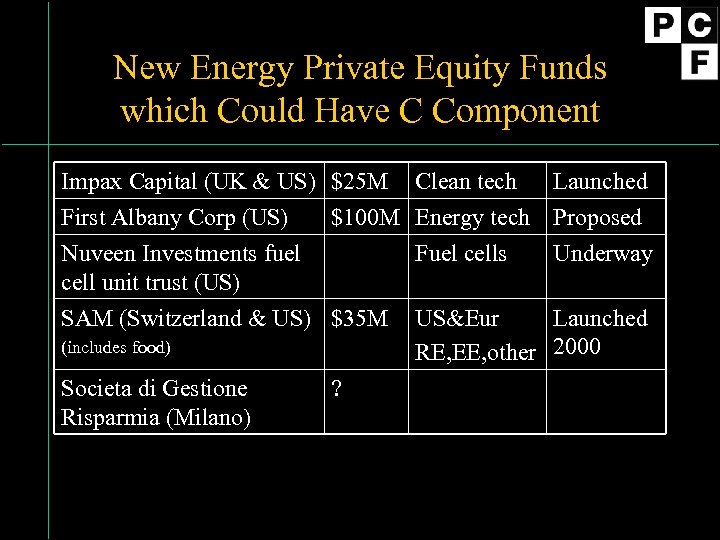
New Energy Private Equity Funds which Could Have C Component Impax Capital (UK & US) $25 M First Albany Corp (US) Launched $100 M Energy tech Proposed Nuveen Investments fuel cell unit trust (US) SAM (Switzerland & US) $35 M (includes food) Societa di Gestione Risparmia (Milano) Clean tech ? Fuel cells Underway US&Eur Launched RE, EE, other 2000
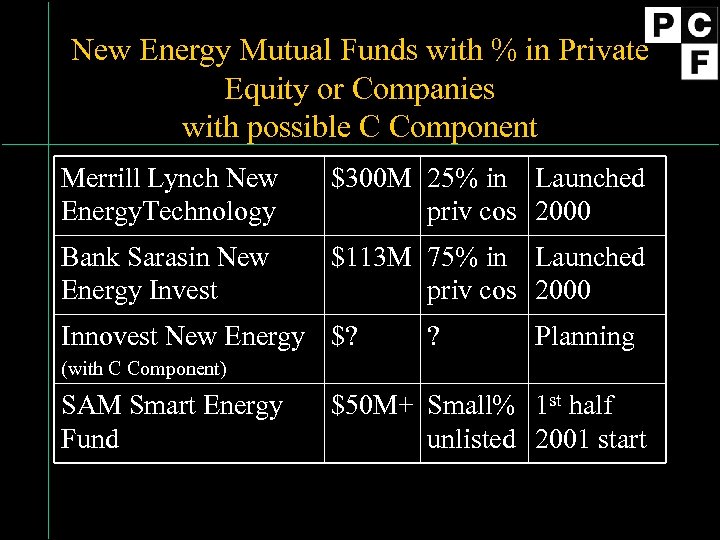
New Energy Mutual Funds with % in Private Equity or Companies with possible C Component Merrill Lynch New Energy. Technology $300 M 25% in Launched priv cos 2000 Bank Sarasin New Energy Invest $113 M 75% in Launched priv cos 2000 Innovest New Energy $? ? Planning (with C Component) SAM Smart Energy Fund $50 M+ Small% 1 st half unlisted 2001 start
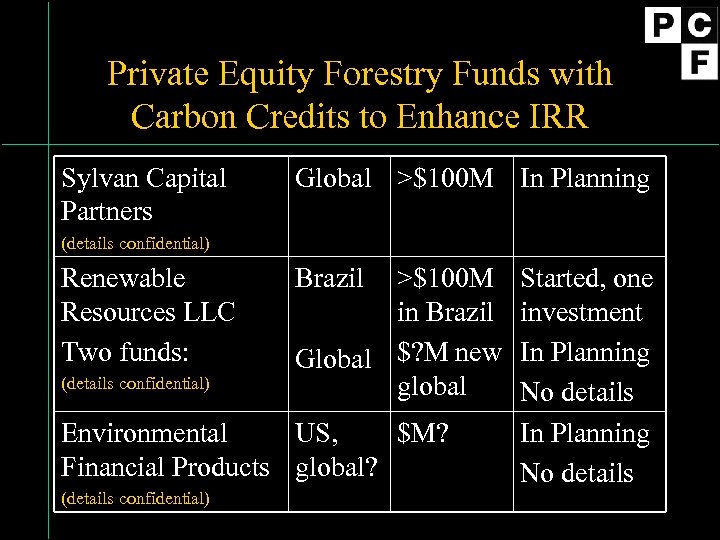
Private Equity Forestry Funds with Carbon Credits to Enhance IRR Sylvan Capital Partners Global >$100 M In Planning (details confidential) Renewable Resources LLC Two funds: (details confidential) Brazil >$100 M in Brazil Global $? M new global Environmental US, $M? Financial Products global? (details confidential) Started, one investment In Planning No details
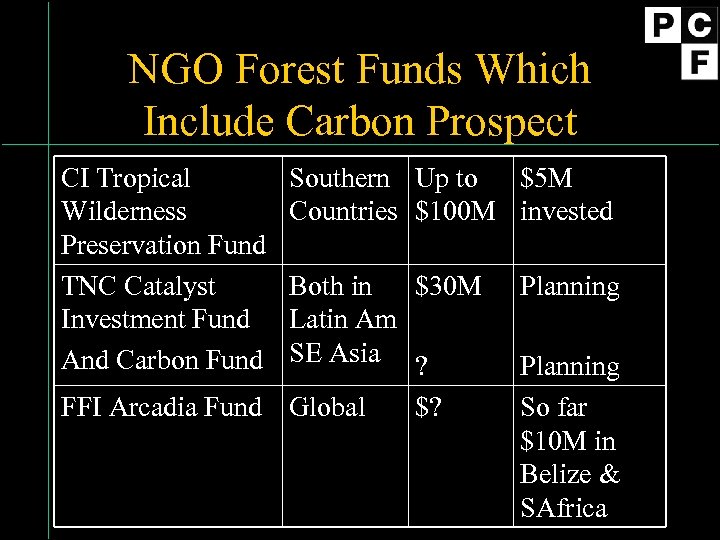
NGO Forest Funds Which Include Carbon Prospect CI Tropical Wilderness Preservation Fund TNC Catalyst Investment Fund And Carbon Fund Southern Up to $5 M Countries $100 M invested Both in $30 M Latin Am SE Asia ? FFI Arcadia Fund Global $? Planning So far $10 M in Belize & SAfrica
Types of Fund Investments in Projects with Carbon Credits • PCF invests cash for C credits. Price of C and amount of credits negotiated with equity holders. • UBS, Hancock, Carbon Trader to invest cash for equity and negotiate for C credits with other equity holders in projects. Investors get return plus C credit, or combination. • REEF, Fond. Elec, LA Clean Tech will invest cash for equity and negotiate for some/all of C credit with other equity shareholders. Fund may sell C credit to enhance fund returns.
Types of Fund Investments in Projects with Carbon Credits (Continued) • Black Emerald to provide equipment lease in return for cash return, depreciation and tax loss benefits, and C credit. May have to negotiate C credit with equity owners of project. • Commonwealth Bank’s Program: Participants pledge revenues (BP’s penny checkoff on premium petrol). Program invests in projects in return for C credit. Credits owned by consumers and “retired. ” • NGO funds use donor money to buy land or bid on concessions. C credit may be sold and the proceeds reinvested.
Investor Carbon Market Sentiment • Most fence sitting – waiting for national and international regulations • Early movers in deals and funds: – have high carbon exposure and regulatory risk, – are seeking strategic positioning – are seeking to influence policy – are at an early stage – wish to capture upside speculative C benefit • Mainstream investment, “big” money still skeptical
Other Players and Angles • Investment banks: waiting for market development • Social/ethical/sustainability funds: use carbon as a screening criteria • Some companies have internal “funds” for carbon credit investments (e. g. , Fortum, Sucor Energy) • Agribusiness companies (Syngenta, Monsanto) • Swiss consortium funding R&D in Africa
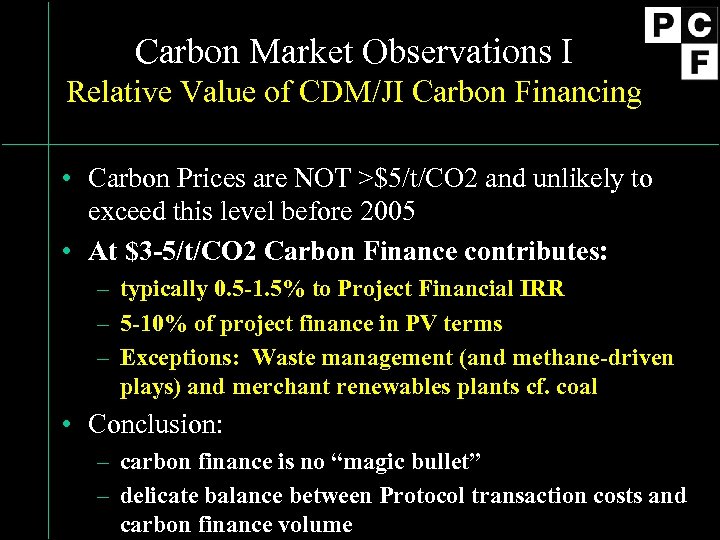
Carbon Market Observations I Relative Value of CDM/JI Carbon Financing • Carbon Prices are NOT >$5/t/CO 2 and unlikely to exceed this level before 2005 • At $3 -5/t/CO 2 Carbon Finance contributes: – typically 0. 5 -1. 5% to Project Financial IRR – 5 -10% of project finance in PV terms – Exceptions: Waste management (and methane-driven plays) and merchant renewables plants cf. coal • Conclusion: – carbon finance is no “magic bullet” – delicate balance between Protocol transaction costs and carbon finance volume
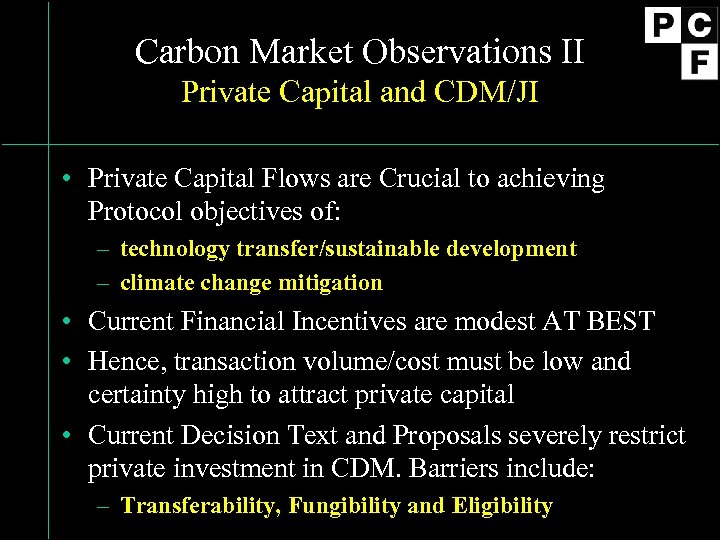
Carbon Market Observations II Private Capital and CDM/JI • Private Capital Flows are Crucial to achieving Protocol objectives of: – technology transfer/sustainable development – climate change mitigation • Current Financial Incentives are modest AT BEST • Hence, transaction volume/cost must be low and certainty high to attract private capital • Current Decision Text and Proposals severely restrict private investment in CDM. Barriers include: – Transferability, Fungibility and Eligibility
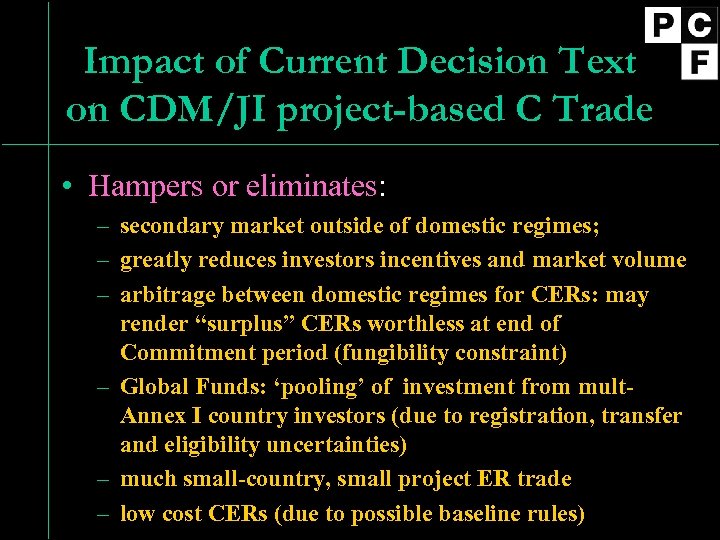
Impact of Current Decision Text on CDM/JI project-based C Trade • Hampers or eliminates: – secondary market outside of domestic regimes; – greatly reduces investors incentives and market volume – arbitrage between domestic regimes for CERs: may render “surplus” CERs worthless at end of Commitment period (fungibility constraint) – Global Funds: ‘pooling’ of investment from mult. Annex I country investors (due to registration, transfer and eligibility uncertainties) – much small-country, small project ER trade – low cost CERs (due to possible baseline rules)
Annexed material
Features of the PCF • Portfolio or fund structure – Minimize Project Risks – Reduce Transactional Costs – Enhance the Learning Experience • Governments: $10 m; Companies: $5 m • Total: US$145 million to be used in 25 -30 projects • PCF Products: – Competitively priced, high quality emissions reductions • target price outcome: $4 -5/t-CO 2 (= $20/t-C) • target cost of generating ERs: $3/t-CO 2 (= $10/t-C) – High value knowledge asset to help create competitive advantage for corporate investors and efficient market regulation for Parties
PCF Subscribers ($145 million) Governments: (6) Netherlands, Finland, Sweden, Norway, Canada, Japan (through Japan Bank for International Cooperation) Private Sector: (17) RWE - Germany, Gaz de France, Tokyo Electric Power, Deutsche Bank, Chubu Electric, Chugoku Electric, Kyushu Electric, Shikoku Electric, Tohoku Electric, Mitsui, Mitsubishi, Electrabel, Norsk. Hydro- Norway, Statoil -Norway, BPAmoco, Fortum, Rabo. Bank, NL
Скачать презентацию Carbon Funds in the Emerging Carbon Market and
eb2ca1bdb7a548f86e04b02f752c2f30.ppt