 Скачать презентацию Carbon Dioxide The Ultimate Carbon Source By Brenton
10d8a3f3941b09fd7f05257bbccb719d.ppt
- Количество слайдов: 17



Carbon Dioxide: The Ultimate Carbon Source By: Brenton L. De. Boef And Stanley M. Barnett Chemistry and Chemical Engineering Dept. University of Rhode Island
Carbon Dioxide and Global Warming A Problem? Or A Solution?
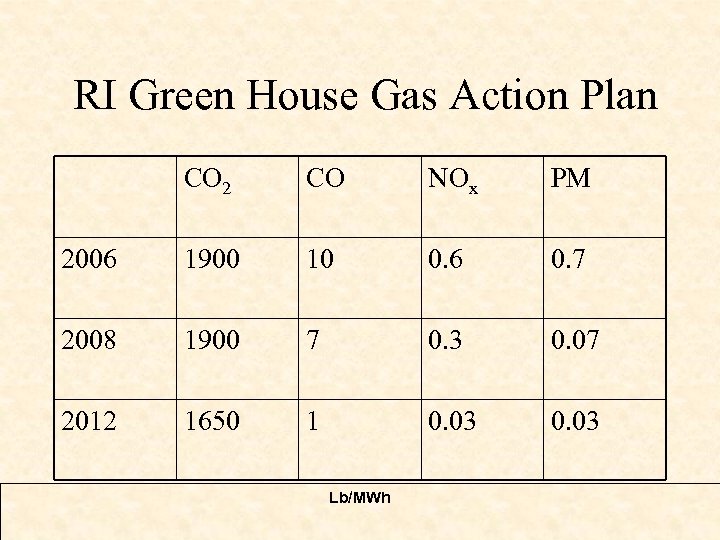
RI Green House Gas Action Plan CO 2 CO NOx PM 2006 1900 10 0. 6 0. 7 2008 1900 7 0. 3 0. 07 2012 1650 1 0. 03 Lb/MWh
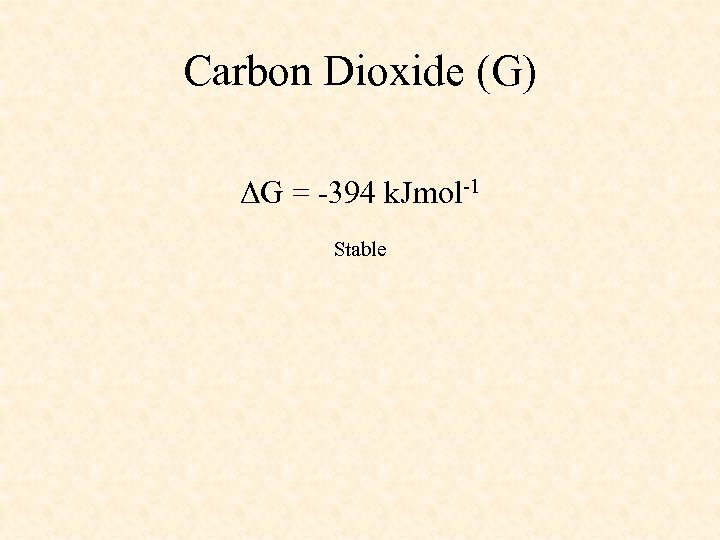
Carbon Dioxide (G) ΔG = -394 k. Jmol-1 Stable
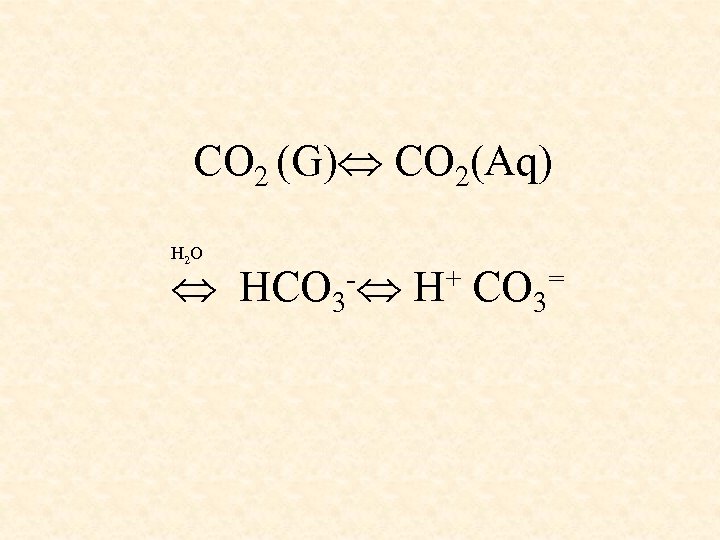
CO 2 (G) CO 2(Aq) H 2 O HCO 3 - H+ CO 3=
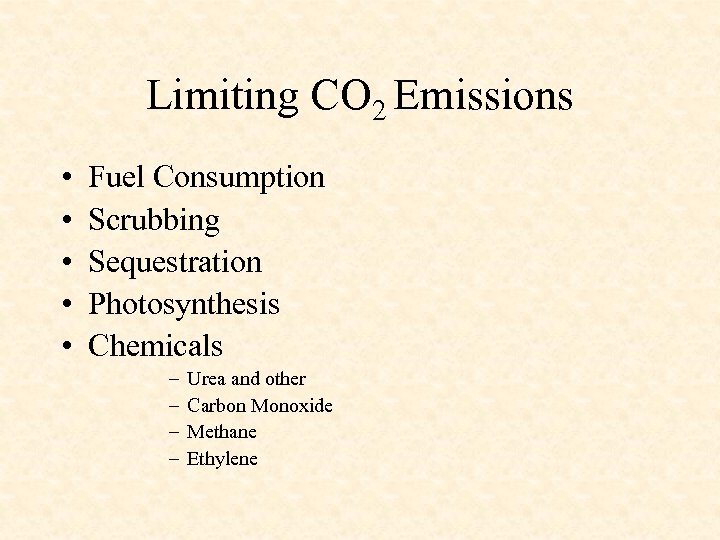
Limiting CO 2 Emissions • • • Fuel Consumption Scrubbing Sequestration Photosynthesis Chemicals – – Urea and other Carbon Monoxide Methane Ethylene
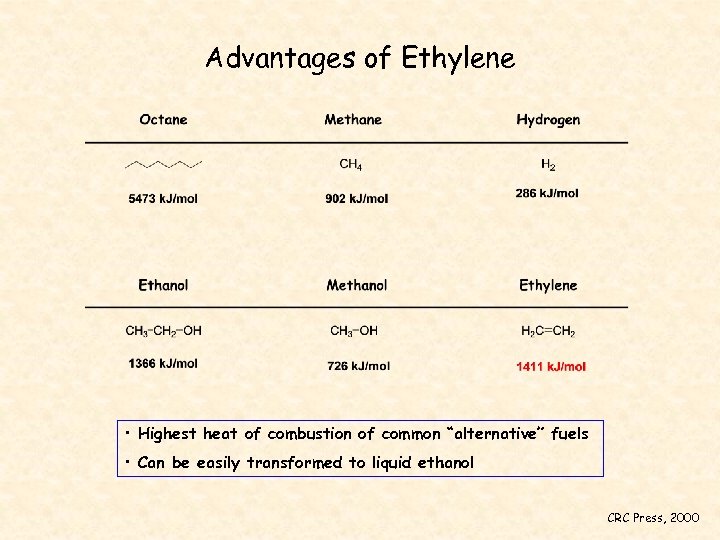
Advantages of Ethylene • Highest heat of combustion of common “alternative” fuels • Can be easily transformed to liquid ethanol CRC Press, 2000
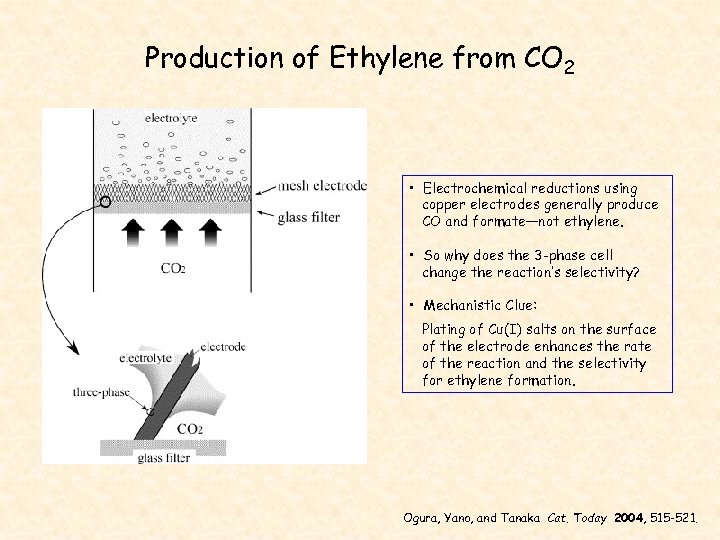
Production of Ethylene from CO 2 • Electrochemical reductions using copper electrodes generally produce CO and formate—not ethylene. • So why does the 3 -phase cell change the reaction’s selectivity? • Mechanistic Clue: Plating of Cu(I) salts on the surface of the electrode enhances the rate of the reaction and the selectivity for ethylene formation. Ogura, Yano, and Tanaka Cat. Today 2004, 515 -521.
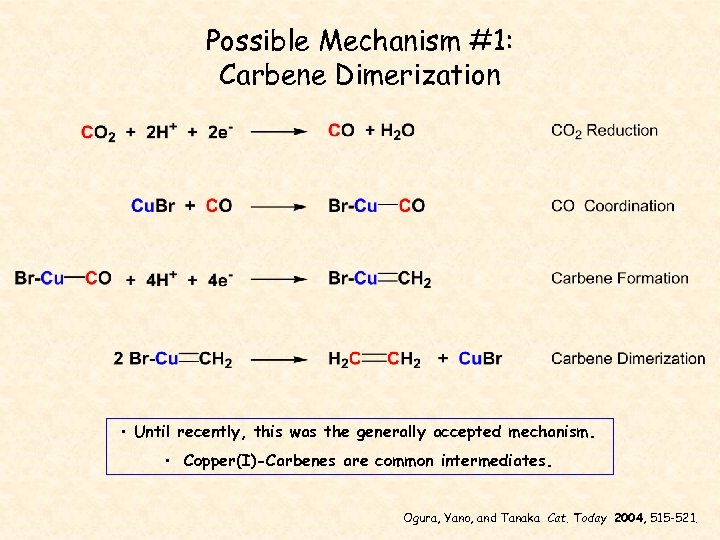
Possible Mechanism #1: Carbene Dimerization • Until recently, this was the generally accepted mechanism. • Copper(I)-Carbenes are common intermediates. Ogura, Yano, and Tanaka Cat. Today 2004, 515 -521.
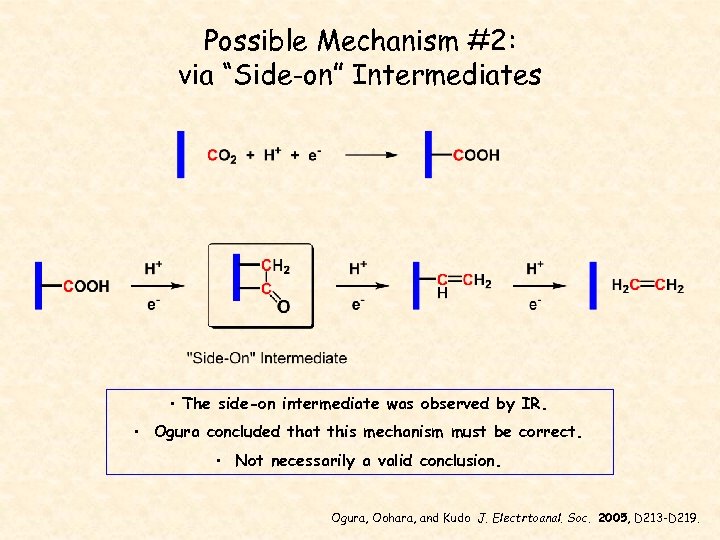
Possible Mechanism #2: via “Side-on” Intermediates • The side-on intermediate was observed by IR. • Ogura concluded that this mechanism must be correct. • Not necessarily a valid conclusion. Ogura, Oohara, and Kudo J. Electrtoanal. Soc. 2005, D 213 -D 219.
Our Hypothesis • Regardless of the mechanism, two Cu atoms must be involved in the formation of each molecule of ethylene. • Can we construct discrete small-molecule catalysts that facilitate the bimolecular mechanism and reduce the required overpotential? • Two possible solutions to this challenge: 1. Homogeneous Monometallic Catalysts 2. Bimetallic Catalysts (either homogeneous or heterogeneous)
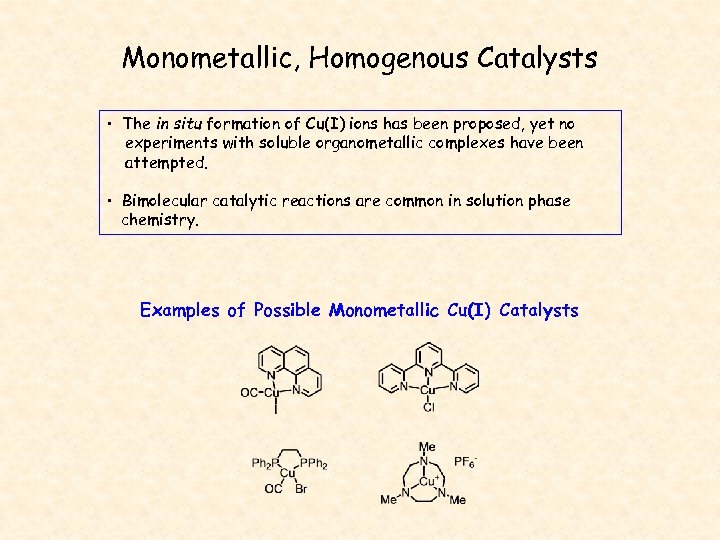
Monometallic, Homogenous Catalysts • The in situ formation of Cu(I) ions has been proposed, yet no experiments with soluble organometallic complexes have been attempted. • Bimolecular catalytic reactions are common in solution phase chemistry. Examples of Possible Monometallic Cu(I) Catalysts
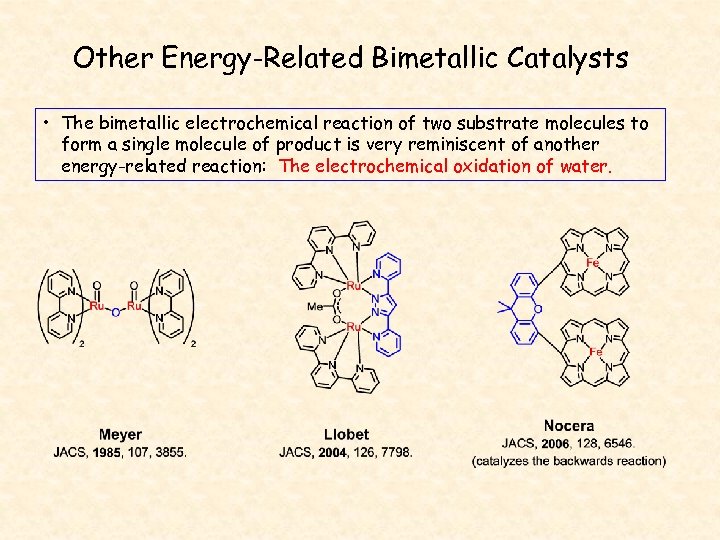
Other Energy-Related Bimetallic Catalysts • The bimetallic electrochemical reaction of two substrate molecules to form a single molecule of product is very reminiscent of another energy-related reaction: The electrochemical oxidation of water.
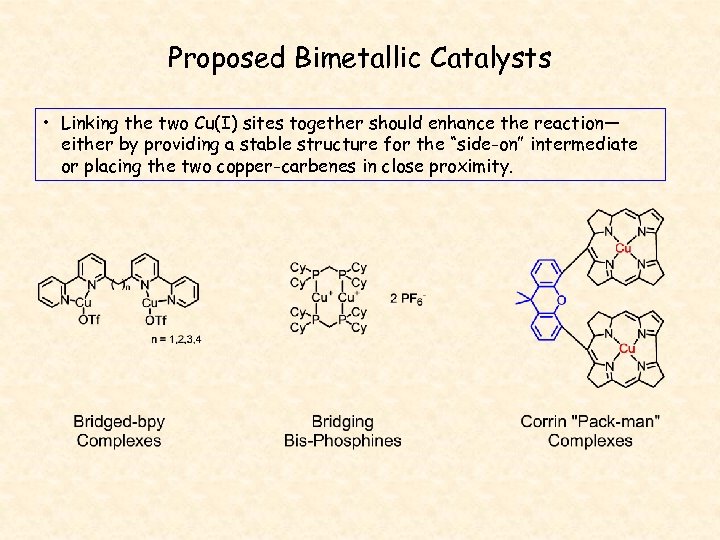
Proposed Bimetallic Catalysts • Linking the two Cu(I) sites together should enhance the reaction— either by providing a stable structure for the “side-on” intermediate or placing the two copper-carbenes in close proximity.
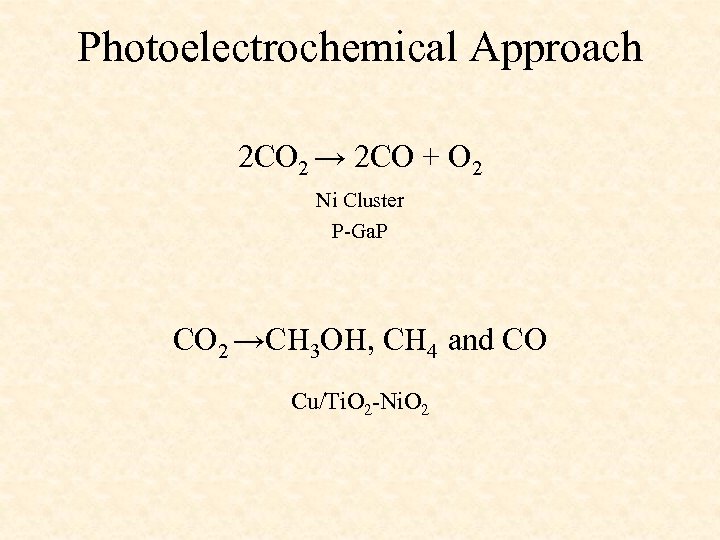
Photoelectrochemical Approach 2 CO 2 → 2 CO + O 2 Ni Cluster P-Ga. P CO 2 →CH 3 OH, CH 4 and CO Cu/Ti. O 2 -Ni. O 2
Conclusions • Incentives • Catalyst: Cu • Choice of Processes • Literature Discrepancies • Mechanism • Non-aqueous electrolyte – Source of H • Economics

Thank You For Listening Questions?
Скачать презентацию Carbon Dioxide The Ultimate Carbon Source By Brenton
10d8a3f3941b09fd7f05257bbccb719d.ppt