


 Скачать презентацию CARAT Access Control and Quality of service in
b77668e21849c8d72f83037833017185.ppt
- Количество слайдов: 7
 CARAT Access Control and Quality of service in ATM Networks Sylvain Gombault Maryline Laurent Gwenn Gueguen Olivier Paul ENST de Bretagne CELAR France Telecom - RD
 CARAT - Goals • Filtering at the ATM and TCP/IP levels. • High Speed. – 622 Mb/s on cells. • Qo. S preservation. – Delay on the ATM cells filtering can be precomputed. • Easy to manage.
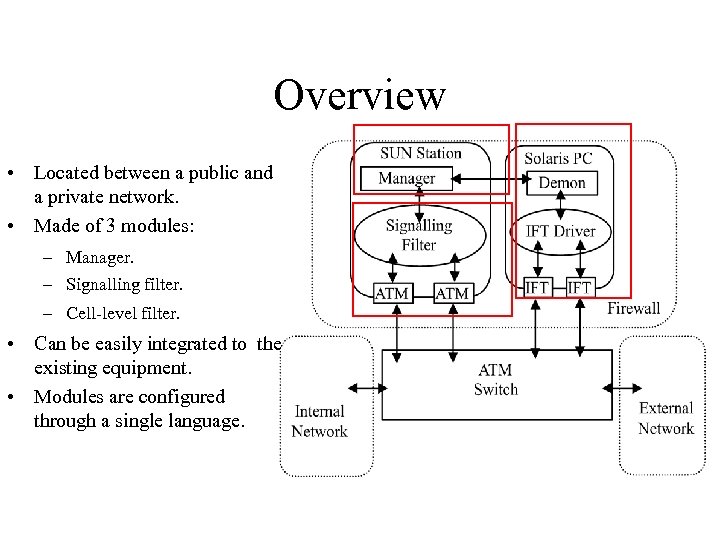 Overview • Located between a public and a private network. • Made of 3 modules: – Manager. – Signalling filter. – Cell-level filter. • Can be easily integrated to the existing equipment. • Modules are configured through a single language.
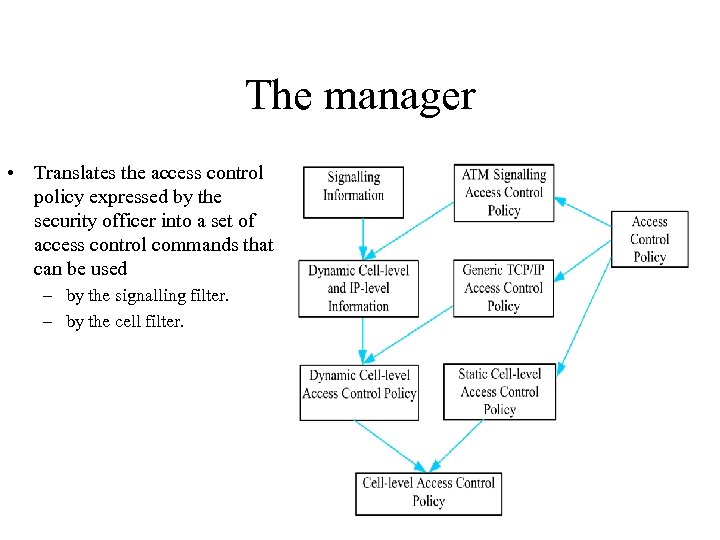 The manager • Translates the access control policy expressed by the security officer into a set of access control commands that can be used – by the signalling filter. – by the cell filter.
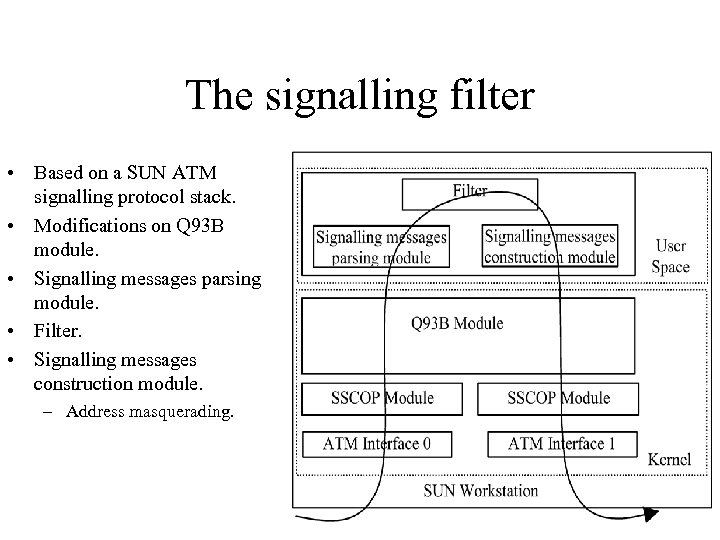 The signalling filter • Based on a SUN ATM signalling protocol stack. • Modifications on Q 93 B module. • Signalling messages parsing module. • Filter. • Signalling messages construction module. – Address masquerading.
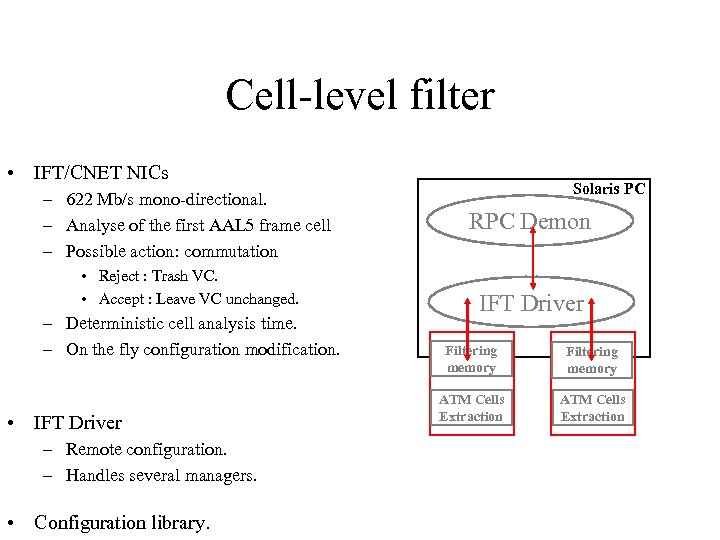 Cell-level filter • IFT/CNET NICs – 622 Mb/s mono-directional. – Analyse of the first AAL 5 frame cell – Possible action: commutation • Reject : Trash VC. • Accept : Leave VC unchanged. – Deterministic cell analysis time. – On the fly configuration modification. • IFT Driver – Remote configuration. – Handles several managers. • Configuration library. Solaris PC RPC Demon IFT Driver Filtering memory ATM Cells Extraction
 Conclusions • Good performance (throughput, delay) – Patented Cell Analysis scheme. – Dynamic Configuration Adaptation. • Test results complete ISP TCP/IP level ACP (400 rules): – 70% memory was used (1. 4 M/ 2 M). – 1. 7 s maximum delay. • ATM & TCP/IP Access Control Capabilities. – Native ATM Applications Control. • “Plug-in” controller. – Easy Adaptation to the Existing Equipment. – New functions can be easily integrated. • Easy to manage