 Скачать презентацию CAPWAP Architecture draft-mani-ietf-capwap-arch-00 Mahalingam Mani Avaya Bob O Hara
420976b7673b28d7e5ec28fb61c95098.ppt
- Количество слайдов: 14



CAPWAP Architecture draft-mani-ietf-capwap-arch-00 Mahalingam Mani Avaya Bob O’Hara Airespace Lily Yang Intel
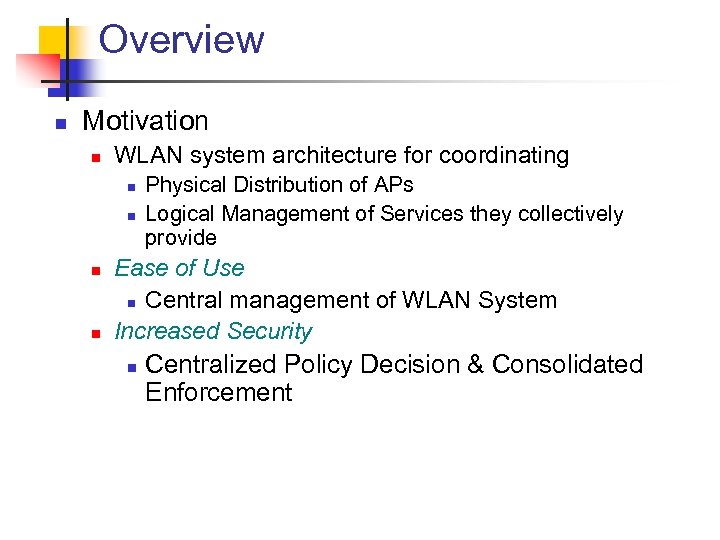
Overview n Motivation n WLAN system architecture for coordinating n n Physical Distribution of APs Logical Management of Services they collectively provide Ease of Use n Central management of WLAN System Increased Security n Centralized Policy Decision & Consolidated Enforcement
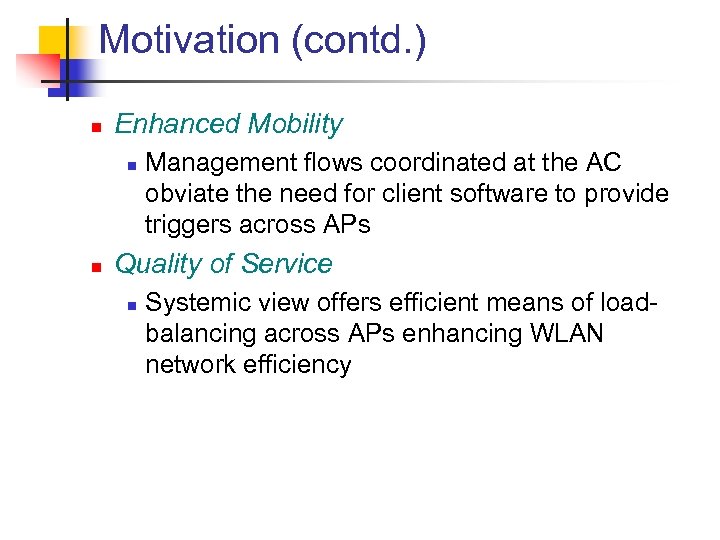
Motivation (contd. ) n Enhanced Mobility n n Management flows coordinated at the AC obviate the need for client software to provide triggers across APs Quality of Service n Systemic view offers efficient means of loadbalancing across APs enhancing WLAN network efficiency
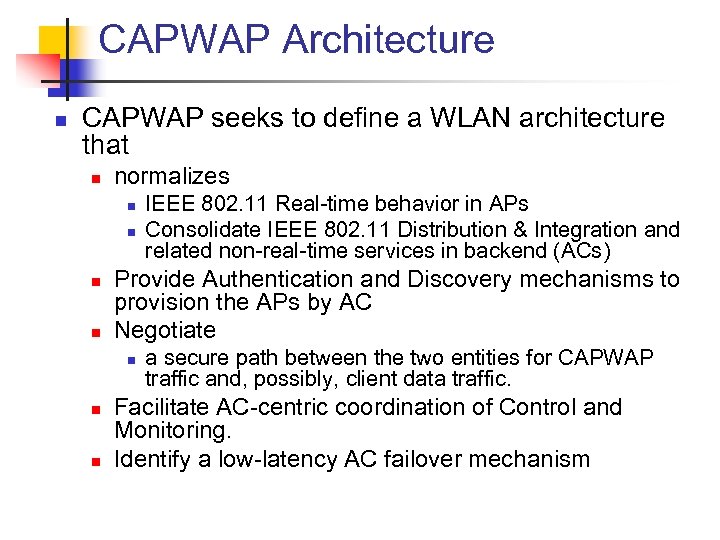
CAPWAP Architecture n CAPWAP seeks to define a WLAN architecture that n normalizes n n Provide Authentication and Discovery mechanisms to provision the APs by AC Negotiate n n n IEEE 802. 11 Real-time behavior in APs Consolidate IEEE 802. 11 Distribution & Integration and related non-real-time services in backend (ACs) a secure path between the two entities for CAPWAP traffic and, possibly, client data traffic. Facilitate AC-centric coordination of Control and Monitoring. Identify a low-latency AC failover mechanism
WLAN architecture Variants n ARCH 0: Classical AP n n Each AP is an independent entity in a Distribution System (DS) ARCH 1: Split-AP n Real-time AP MAC functions retained in AP (close to physical medium) n n Frame Security, Beaconing, Synchronization, Power Management, RRM, RADAR detection, … Non-real-time functions (and correlation of above) are consolidated at the AC n (De)Authentication, Association/Disassociation, Distribution, Integration, Dynamic Channel Selection, …
WLAN architecture Variants (contd) n ARCH 2: Split-MAC n Some or most IEEE 802. 11 MAC real-time services are moved to AC as well n n Frame Security, Qo. S, Channel assignment, … ARCH 3: Single-AP Switch (Bridge) n ‘extreme-ARCH 3’: AC itself is the ‘unified AP’ with APs behaving as smart-antennas: zero-roaming across antennas n any of the antennas may transmit or receive with a client
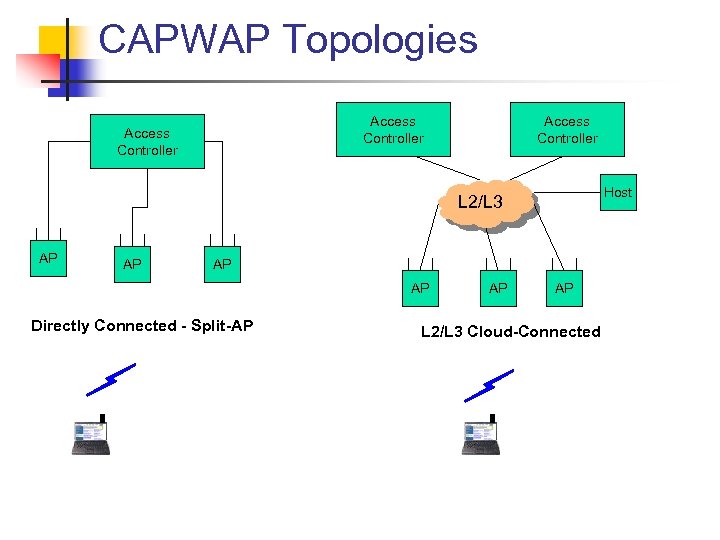
CAPWAP Topologies Access Controller Host L 2/L 3 AP AP Directly Connected - Split-AP AP AP L 2/L 3 Cloud-Connected
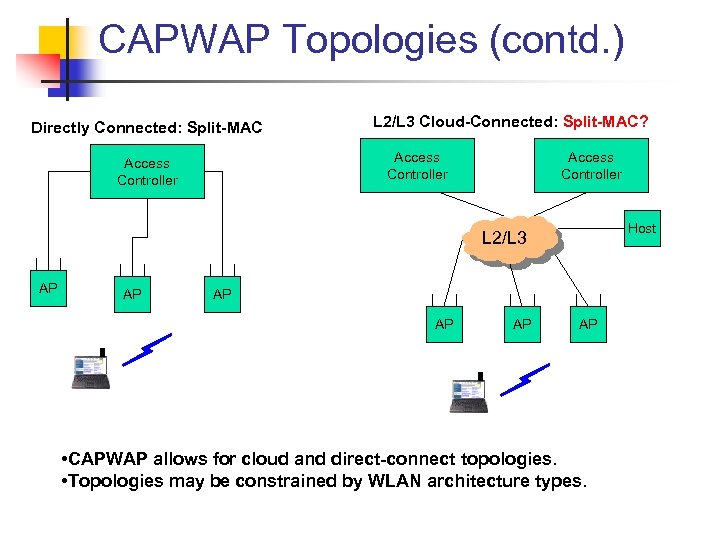
CAPWAP Topologies (contd. ) Directly Connected: Split-MAC L 2/L 3 Cloud-Connected: Split-MAC? Access Controller Host L 2/L 3 AP AP AP • CAPWAP allows for cloud and direct-connect topologies. • Topologies may be constrained by WLAN architecture types.
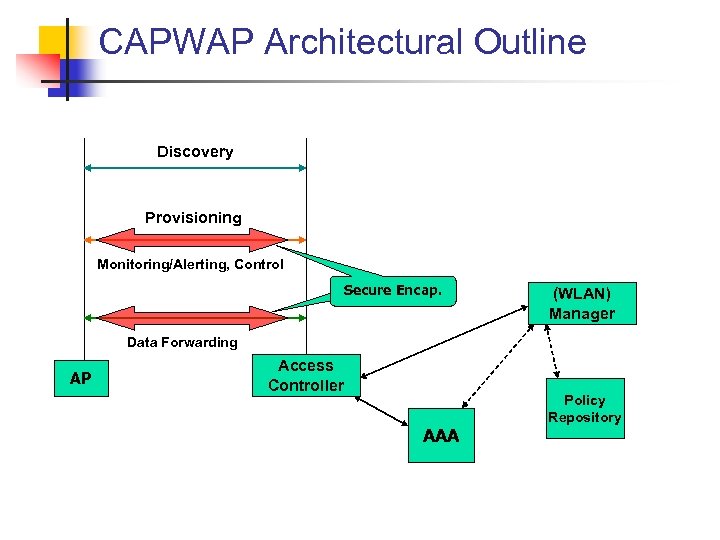
CAPWAP Architectural Outline Discovery Provisioning Monitoring/Alerting, Control Secure Encap. (WLAN) Manager Data Forwarding AP Access Controller AAA Policy Repository
Authentication & Discovery n Authentication n n AP and AC need to mutually authenticate prior to engaging in discovery and configuration exchanges. Presume a PSK/certificate-based enrolment of APs n n a lightweight authentication algorithm is required (to let APs of varied lightness) Key Exchange n n Keys generated from the cryptographic authentication exchange may be used to protect subsequent exchanges and derive traffic-related keys. Depending on requirements and architecture n n independent SA’s may be established to secure data and management traffic ARCH 2 -like systems may use 802. 11 i for data security.
Authentication & Discovery (contd. ) n Discovery phase, prior to authentication, may involve identifying the right AC to associate with among a set of available ACs. n n n In some architectures such as in ARCH 2 this discovery may be trivial. Mixed mode environments may select and associate with available ACs by exchanging architectural types (ARCH 0 -3). Discovery also involves the announcement of each entity’s capabilities to its associated entity (AP<->AC). n n Such discovery may consider use of existing or extensions of existing protocols, e. g. , LLDP (IEEE 802. 1 ab) or upcoming 802. 1 af (authenticated discovery). Suitable IETF protocols may also be candidates. s
Encapsulation/Tunneling n Non-real-time service functions deferred to AC n Management/Control traffic to be encapsulated/ tunneled over Ethernet LAN between AP & AC. n n They may be MAC layer frames that are L 3 -encapsulated Existing secure encapsulation protocols that may use the lightweight key derivation are candidates for consideration.
Provisioning, Control & Monitoring n CAPWAP architecture allows for n n ACs to deliver secure boot/runtime configuration to APs ACs to help retrieve MAC/PHY layer status from APs n n n aggregating dynamic views of APs in a ESS or several ESSs set up APs to send low-level alerts from APs to AC (as triggers) forward management/control frames to AC for non-real-time functions AC may control / authorize AP-AP forwarding in a AP cloud …
Alternatives n Distributed Control n n n Scalability is a concern under high-mobility when updates may be of the O(N 2) Timing constraints may dictate limitations. IAPP n n A Distributed Control Primitive Known security issues Best Current Practices Spec. - not a standard Above shortcomings of distributed control/ context transfers.
Скачать презентацию CAPWAP Architecture draft-mani-ietf-capwap-arch-00 Mahalingam Mani Avaya Bob O Hara
420976b7673b28d7e5ec28fb61c95098.ppt