 Скачать презентацию Capturing Opportunities in Distressed Deals Columbia University Real
3f1907a57603d5dd5f46f55922943acd.ppt
- Количество слайдов: 56



Capturing Opportunities in Distressed Deals Columbia University Real Estate Development Workout and Restructuring Stephen J. Pearlman September 2014 July 23, 2009 Confidential
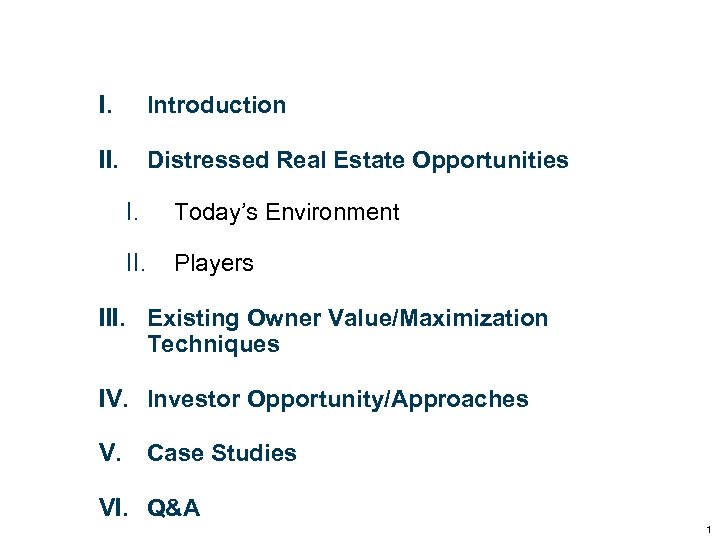
Presentation Overview I. Introduction II. Distressed Real Estate Opportunities I. Today’s Environment II. Players III. Existing Owner Value/Maximization Techniques IV. Investor Opportunity/Approaches V. Case Studies VI. Q&A 1
Introduction
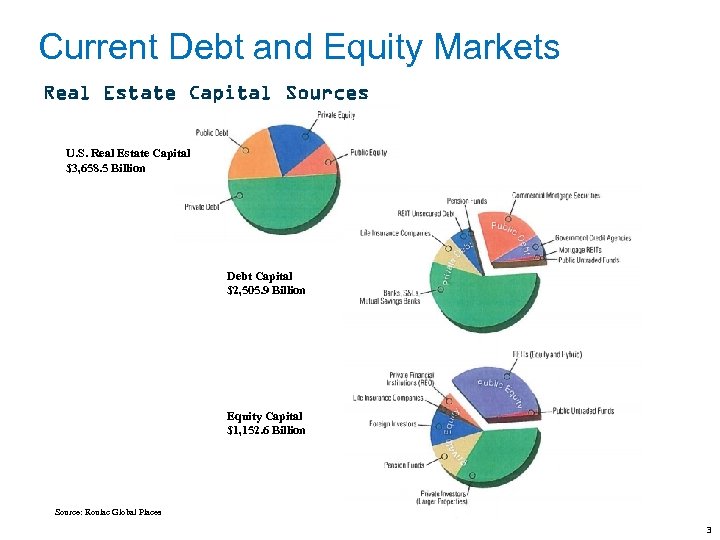
Current Debt and Equity Markets Real Estate Capital Sources U. S. Real Estate Capital $3, 658. 5 Billion Debt Capital $2, 505. 9 Billion Equity Capital $1, 152. 6 Billion Source: Roulac Global Places 3
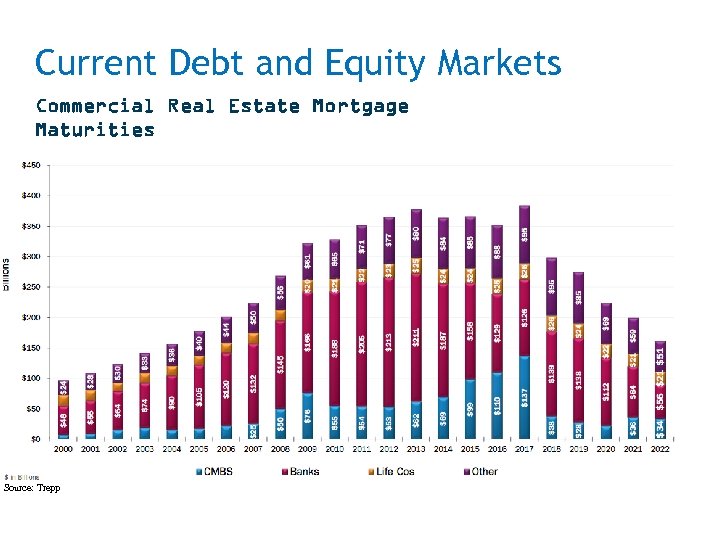
Current Debt and Equity Markets Commercial Real Estate Mortgage Maturities Source: Trepp 4
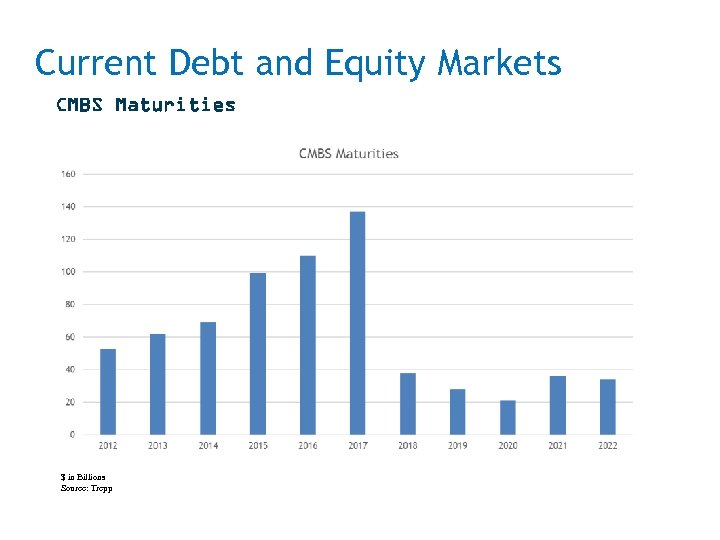
Current. Maturities Equity Markets CMBS Debt and CMBS Maturities $ in Billions Source: Trepp 5
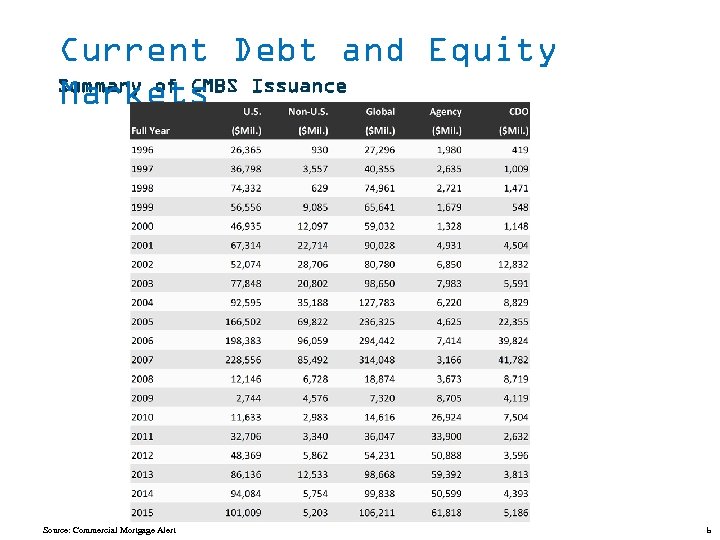
Current Debt and Equity Summary of CMBS Issuance Markets Source: Commercial Mortgage Alert 6
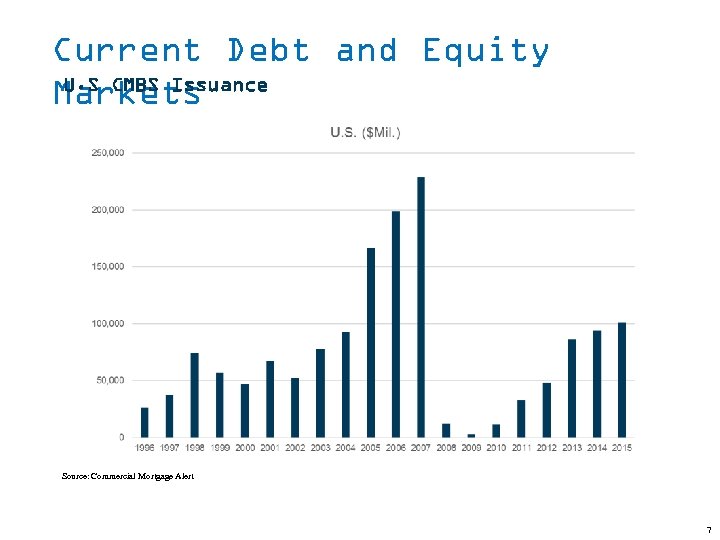
Current Debt and Equity U. S CMBS Issuance Markets Source: Commercial Mortgage Alert 7
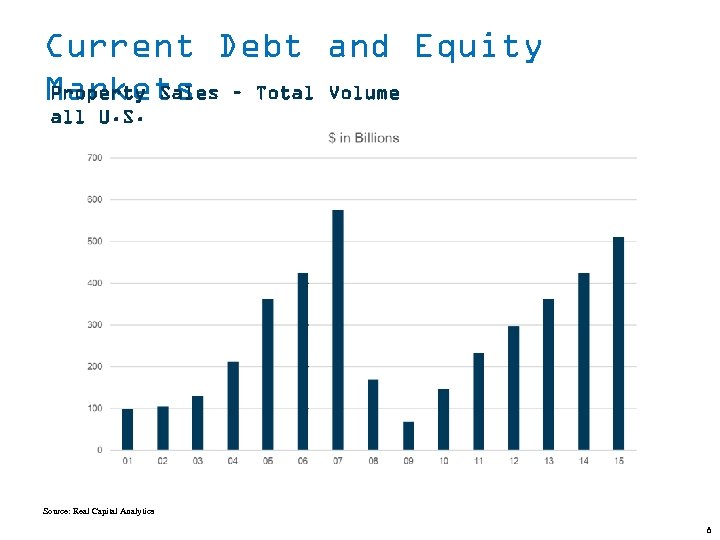
Current Debt and Equity Property Sales Markets – Total Volume all U. S. Source: Real Capital Analytics 8
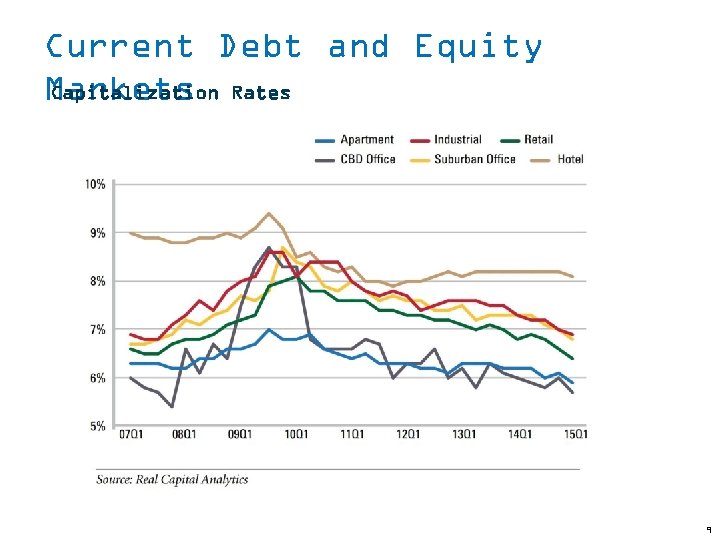
Current Debt and Equity Capitalization Markets Rates 9
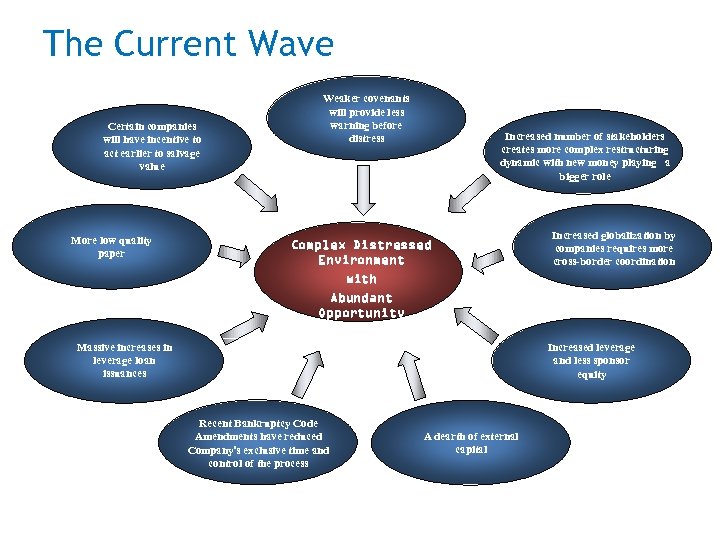
The Current Wave Certain companies will have incentive to act earlier to salvage value More low quality paper Weaker covenants will provide less warning before distress Increased number of stakeholders creates more complex restructuring dynamic with new money playing a bigger role Increased globalization by companies requires more cross-border coordination Complex Distressed Environment with Abundant Opportunity Massive increases in leverage loan issuances Increased leverage and less sponsor equity Recent Bankruptcy Code Amendments have reduced Company’s exclusive time and control of the process A dearth of external capital 10
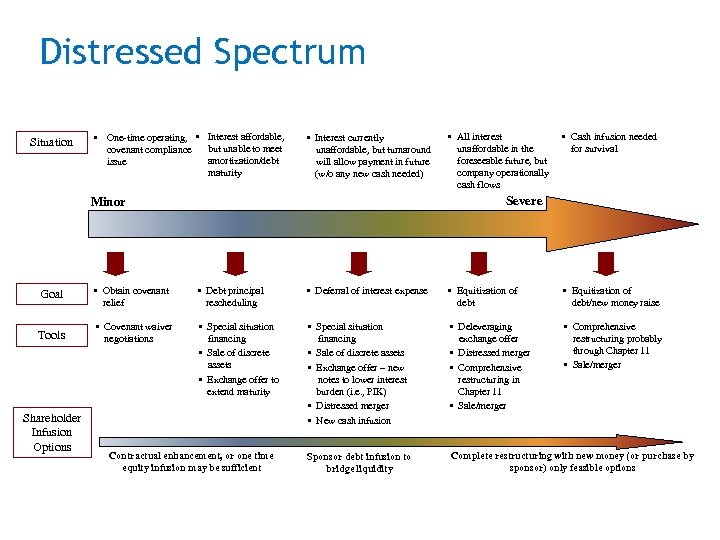
Distressed Spectrum Situation • One-time operating, • Interest affordable, but unable to meet covenant compliance amortization/debt issue maturity • Interest currently unaffordable, but turnaround will allow payment in future (w/o any new cash needed) • All interest unaffordable in the foreseeable future, but company operationally cash flows • Cash infusion needed for survival Severe Minor Goal • Obtain covenant relief • Debt principal rescheduling • Deferral of interest expense • Equitization of debt/new money raise Tools • Covenant waiver negotiations • Special situation financing • Sale of discrete assets • Exchange offer to extend maturity • Special situation financing • Sale of discrete assets • Exchange offer – new notes to lower interest burden (i. e. , PIK) • Distressed merger • New cash infusion • Deleveraging exchange offer • Distressed merger • Comprehensive restructuring in Chapter 11 • Sale/merger • Comprehensive restructuring probably through Chapter 11 • Sale/merger Sponsor debt infusion to bridge liquidity Complete restructuring with new money (or purchase by sponsor) only feasible options Shareholder Infusion Options Contractual enhancement, or one time equity infusion may be sufficient 11
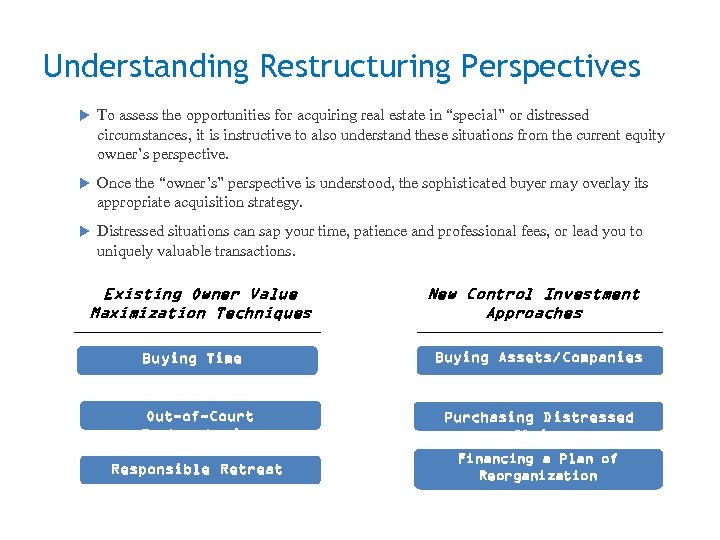
Understanding Restructuring Perspectives Understanding Restructuring To assess the opportunities acquiring real estate in distressed Perspectives for to also understand these“special” orfrom the current equity circumstances, it is instructive situations owner’s perspective. Once the “owner’s” perspective is understood, the sophisticated buyer may overlay its appropriate acquisition strategy. Distressed situations can sap your time, patience and professional fees, or lead you to uniquely valuable transactions. Existing Owner Value Maximization Techniques Buying Time New Control Investment Approaches Buying Assets/Companies Out-of-Court Restructuring Purchasing Distressed Claims Responsible Retreat Financing a Plan of Reorganization 12
Restructuring Concepts Throughout this presentation, reference will be made to “in-court” vs. “out-of-court” restructurings. In-Court Restructuring – Refers to reorganizations that occur under Chapter 11 of the bankruptcy code. After filing for bankruptcy, a debtor and its various constituents can negotiate a Plan of Reorganization (POR) that dictates the treatments and recoveries of each creditor class and is solicited and explained through a disclosure statement. Voting Requirements – Section 1126 of the bankruptcy code outlines requirements for acceptance of a POR. “Impaired” classes will be solicited to vote on the POR. For a fully consensual plan, 2/3 in dollar value or share amount of those who vote in each creditor or equity class must accept, and over 1/2 of creditors voting in each class must accept. “Hold-outs” in an accepting class are generally bound, subject to the “best interest of creditors” test (demonstrating that their treatment is no worse than what they would receive in a liquidation). Cram Down – Section 1129(b) permits the court to confirm a POR in the face of non- acceptance by an impaired class (a “cram down”). To cram down any class, the POR must not “discriminate unfairly” (the classes of creditors and/or interests have not been inappropriately gerrymandered) and must be “fair and equitable. ” Absolute Priority – In order to be fair and equitable, a POR must follow the doctrine of “absolute priority, ” which requires senior classes to be fully paid (but not overpaid) or consent by a class vote to a lesser treatment before junior classes receive any distribution. New Value Plan – POR which utilizes a new investment from existing shareholder(s) or other investor to justify their new ownership stake in the reorganized company by creating a transaction value for the restructuring based on a new investment, often wiping out the existing equity interests of these investors. In effect the old owners or other investor are buying back in, while often impairing creditors’ interests as well, therefore steering around the “absolute priority rule” noted above. 13
Restructuring Concepts (continued) – Generally refers to transactions that are in fact Out-of-Court Restructuring negotiated outside of bankruptcy. However, for a variety of reasons, notably to bind holdouts (i. e. , non-participating creditors), these transactions are often implemented through a short in-court bankruptcy process. Implementation can come in the form of: Out-of-Court Exchange Offer – Usually registered with the SEC or exempt from registration under 3(a)(9) or 4(2) of the Securities Act of 1933 – “hold outs” can generally not be bound to financial terms, and no bankruptcy is filed. “Pre-Packaged” Bankruptcies – Out-of-court negotiation and solicitation of creditor votes. Subsequent bankruptcy filing concurrent with filing POR. The in-court bankruptcy process can be as short as 30 days until emergence and all “hold-outs” are bound. “Pre-Arranged” Bankruptcies – Negotiated out-of-court, followed by bankruptcy filing and prompt filing of POR and disclosure statement. Solicitation of votes occurs in bankruptcy, adding another 60 days to the process, for total in-court timeline for a successful deal of at least 90 days, with all “hold-outs” bound. 14
Restructuring Concepts (continued) This presentation will also reference other commonly used bankruptcy and restructuring concepts: 363 Asset Sales – Section 363 of the bankruptcy code governs all Chapter 11 asset sales outside of a POR. 363 sales are made by a motion on a relatively short basis (i. e. , as little as 20 days). In contrast, a sale pursuant to a POR involves a prolonged notice period and two-step approval process, first of a disclosure statement and then the solicitation of POR votes. Aside from speed, the primary benefit of a 363 sale is that it allows for sale of the debtors ’ assets “free and clear” of “any interest” in that property which includes not only all liens and recorded encumbrances but a host of potential business liabilities (as established by a large doctrine of case law). 363 sales often include the selection of a lead bidder, or “stalking horse, ” that establishes a bidding floor and purchase structure. Single Shareholder vs. Multiple (or Public) Shareholders For simplicity, this presentation explains the equity owner’s perspective for one material sponsor or sole shareholder, which is obviously not always the case. Multiple or public shareholders create another layer of complexity, and implicate a variety of conflict of interest issues where an existing sponsor is contemplating a new investment, for example. Rights offerings are a key tool to address many of the issues which arise in these situations. “Hold-out” Dynamic – If debt holders provide concessions or reduce their claim in an out-of-court exchange which de-levers a Company, any non-participating (“hold-out”) bondholder reaps the benefits of the de-leveraging, but need not provide concessions or reduce its claim. This is a variation on the “free rider” effect; all the gain, none of the pain. Debtor – The terms “Debtor” and “Debtor in Possession” are often used interchangeably to refer to a company that is operating in Chapter 11. 15

Distressed Real Estate Opportunities
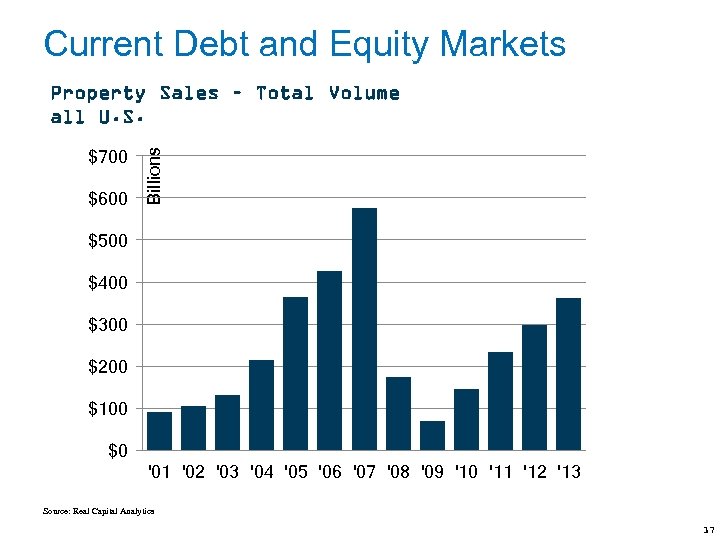
Current Debt and Equity Markets $700 $600 Billions Property Sales – Total Volume all U. S. $500 $400 $300 $200 $100 $0 '01 '02 '03 '04 '05 '06 '07 '08 '09 '10 '11 '12 '13 Source: Real Capital Analytics 17
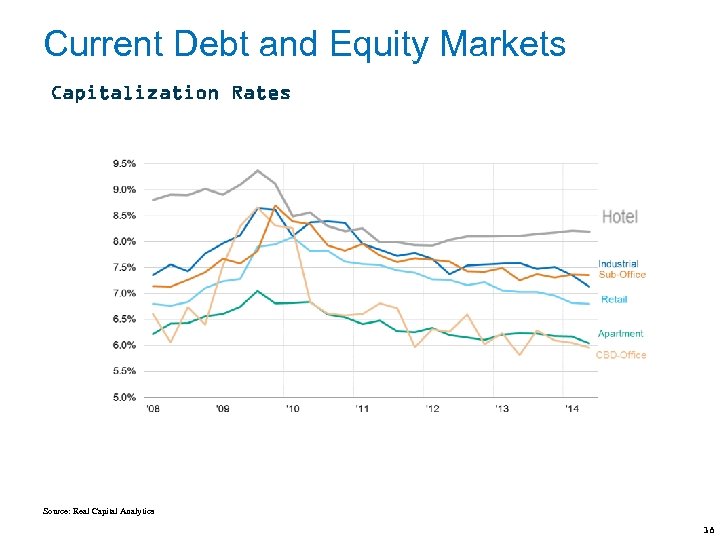
Current Debt and Equity Markets Capitalization Rates Source: Real Capital Analytics 18
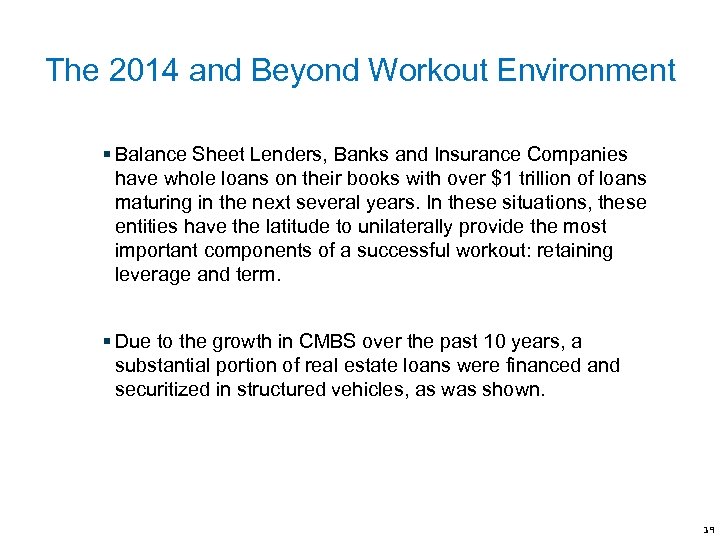
The 2014 and Beyond Workout Environment § Balance Sheet Lenders, Banks and Insurance Companies have whole loans on their books with over $1 trillion of loans maturing in the next several years. In these situations, these entities have the latitude to unilaterally provide the most important components of a successful workout: retaining leverage and term. § Due to the growth in CMBS over the past 10 years, a substantial portion of real estate loans were financed and securitized in structured vehicles, as was shown. 19
The 2014 and Beyond Workout Environment § Many of these loans have the following complicating factors: − Multiple tranches − Multiple participants within each tranche − Pooling and Servicing Agreement restrictions (REMIC Rules) § Further complicated by: − Control provisions that shift balance of power − Unclear property valuations in this market 20
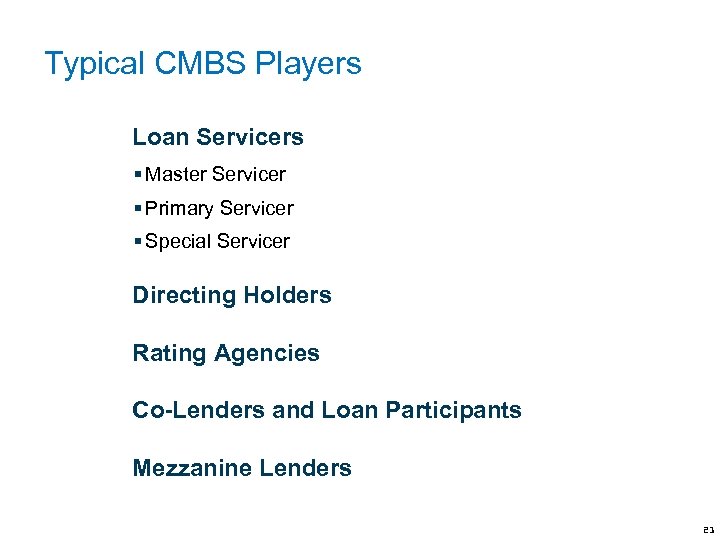
Typical CMBS Players Loan Servicers § Master Servicer § Primary Servicer § Special Servicer Directing Holders Rating Agencies Co-Lenders and Loan Participants Mezzanine Lenders 21
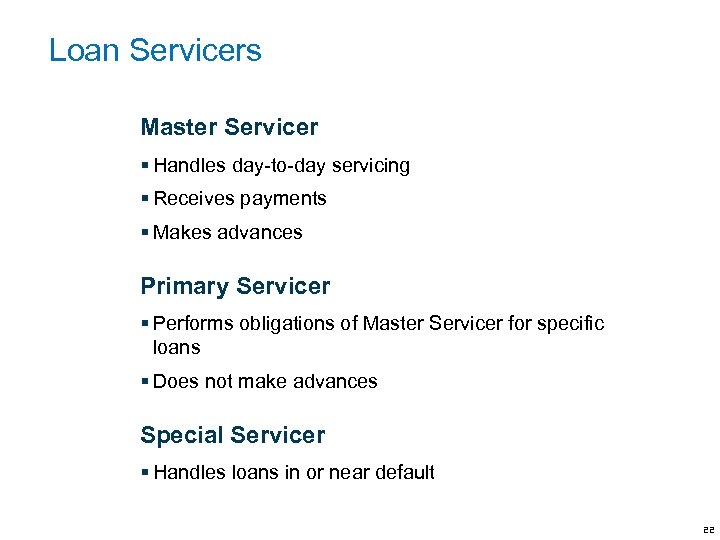
Loan Servicers Master Servicer § Handles day-to-day servicing § Receives payments § Makes advances Primary Servicer § Performs obligations of Master Servicer for specific loans § Does not make advances Special Servicer § Handles loans in or near default 22
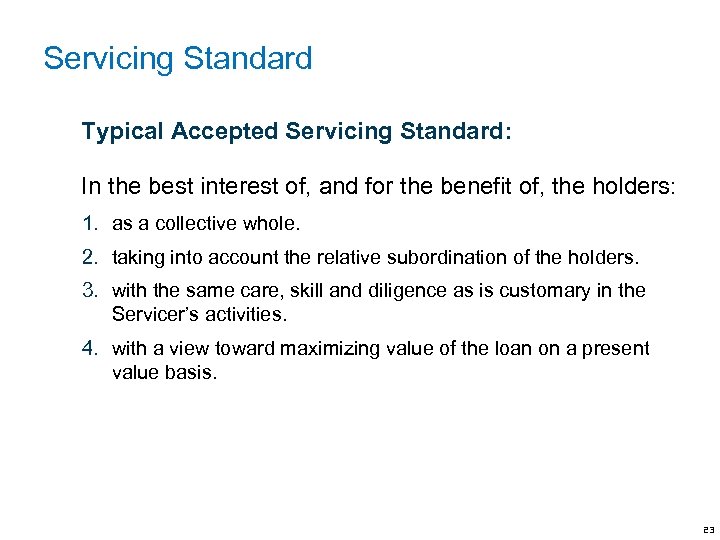
Servicing Standard Typical Accepted Servicing Standard: In the best interest of, and for the benefit of, the holders: 1. as a collective whole. 2. taking into account the relative subordination of the holders. 3. with the same care, skill and diligence as is customary in the Servicer’s activities. 4. with a view toward maximizing value of the loan on a present value basis. 23
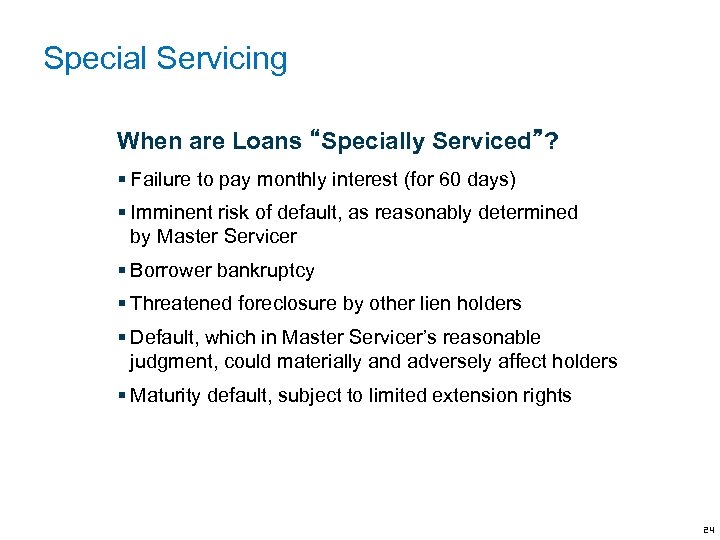
Special Servicing When are Loans “Specially Serviced”? § Failure to pay monthly interest (for 60 days) § Imminent risk of default, as reasonably determined by Master Servicer § Borrower bankruptcy § Threatened foreclosure by other lien holders § Default, which in Master Servicer’s reasonable judgment, could materially and adversely affect holders § Maturity default, subject to limited extension rights 24
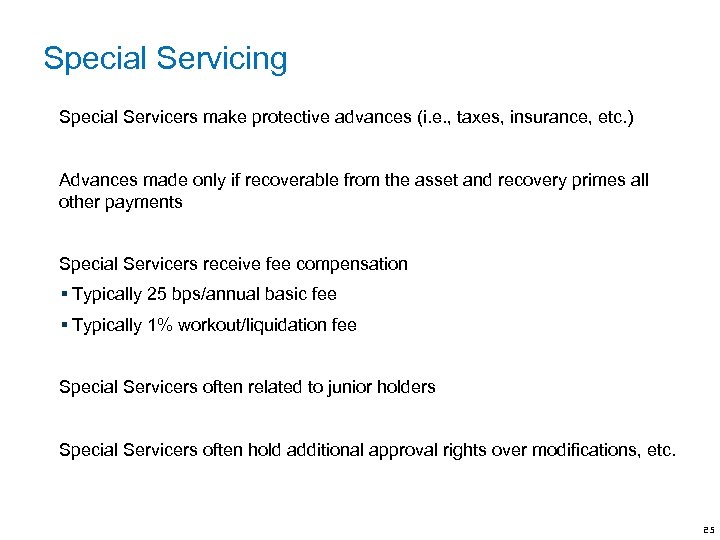
Special Servicing (continued) Special Servicing Special Servicers make protective advances (i. e. , taxes, insurance, etc. ) Advances made only if recoverable from the asset and recovery primes all other payments Special Servicers receive fee compensation § Typically 25 bps/annual basic fee § Typically 1% workout/liquidation fee Special Servicers often related to junior holders Special Servicers often hold additional approval rights over modifications, etc. 25
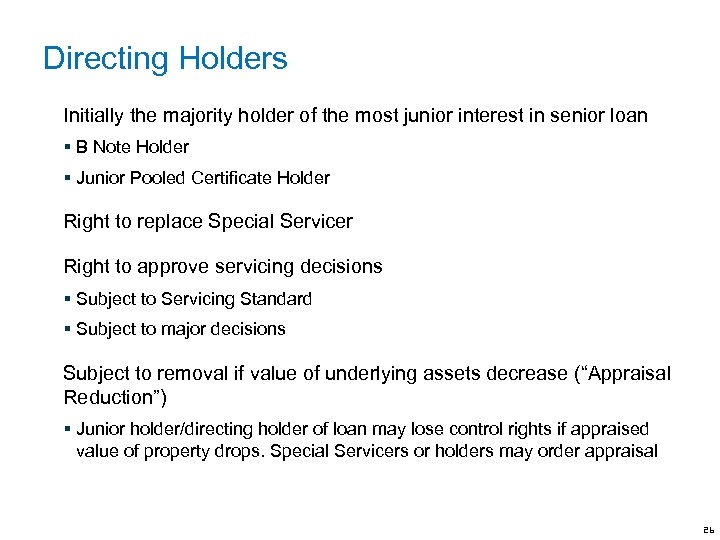
Directing Holders Initially the majority holder of the most junior interest in senior loan § B Note Holder § Junior Pooled Certificate Holder Right to replace Special Servicer Right to approve servicing decisions § Subject to Servicing Standard § Subject to major decisions Subject to removal if value of underlying assets decrease (“Appraisal Reduction”) § Junior holder/directing holder of loan may lose control rights if appraised value of property drops. Special Servicers or holders may order appraisal 26
Existing Owner Value Maximization Techniques
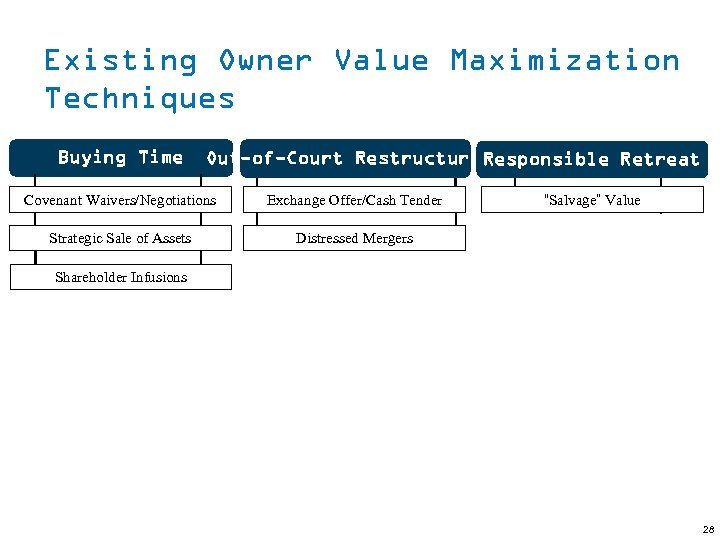
Existing Owner Value Maximization Techniques Buying Time Out-of-Court Restructuring Responsible Retreat Covenant Waivers/Negotiations Exchange Offer/Cash Tender Strategic Sale of Assets “Salvage” Value Distressed Mergers Shareholder Infusions 28
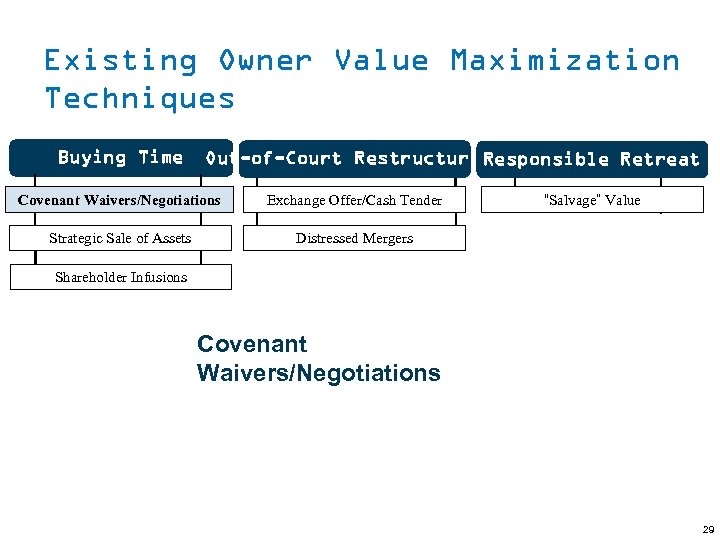
Existing Owner Value Maximization Techniques (continued) Existing Owner Value Maximization Techniques Buying Time Out-of-Court Restructuring Responsible Retreat Covenant Waivers/Negotiations Exchange Offer/Cash Tender Strategic Sale of Assets “Salvage” Value Distressed Mergers Shareholder Infusions Covenant Waivers/Negotiations 29
Forbearance Agreements § Lender agrees to forbear from exercising remedies for a fixed period of time § Terminates earlier if: − Borrower bankruptcy − A default occurs under the Forbearance Agreement − If an intervening loan default occurs § Borrower waives defenses, offsets, counterclaims to date 30
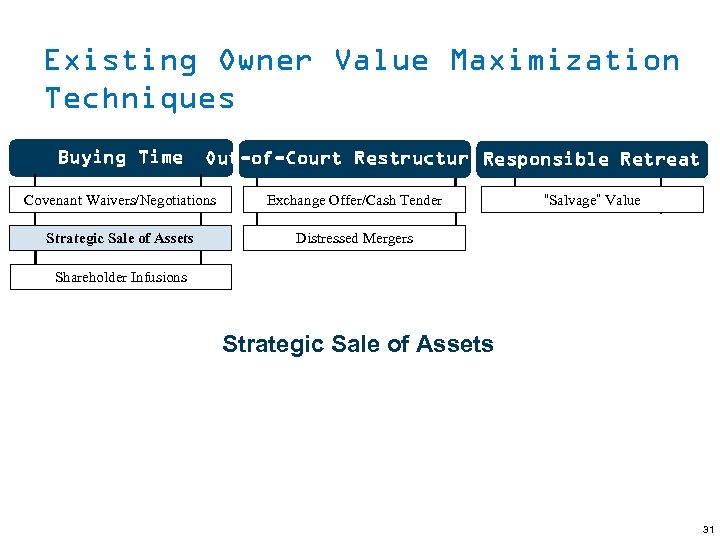
Existing Owner Value Maximization Techniques Buying Time Out-of-Court Restructuring Responsible Retreat Covenant Waivers/Negotiations Exchange Offer/Cash Tender Strategic Sale of Assets “Salvage” Value Distressed Mergers Shareholder Infusions Strategic Sale of Assets 31
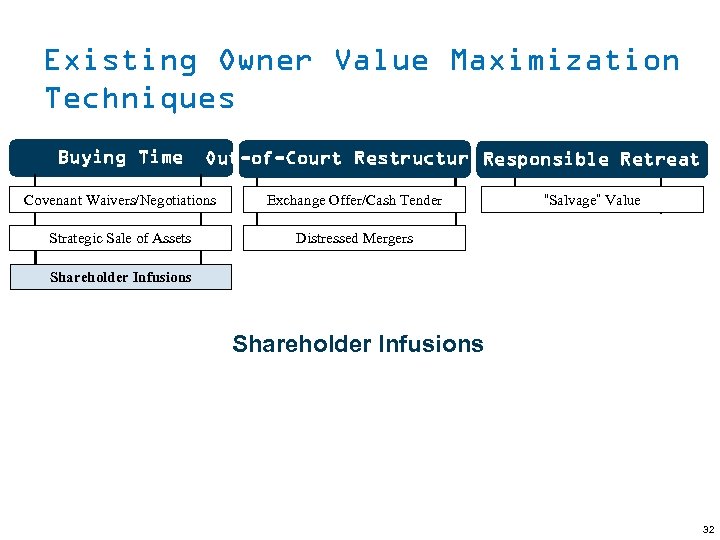
Existing Owner Value Maximization Techniques (continued) Existing Owner Value Maximization Techniques Buying Time Out-of-Court Restructuring Responsible Retreat Covenant Waivers/Negotiations Exchange Offer/Cash Tender Strategic Sale of Assets “Salvage” Value Distressed Mergers Shareholder Infusions 32
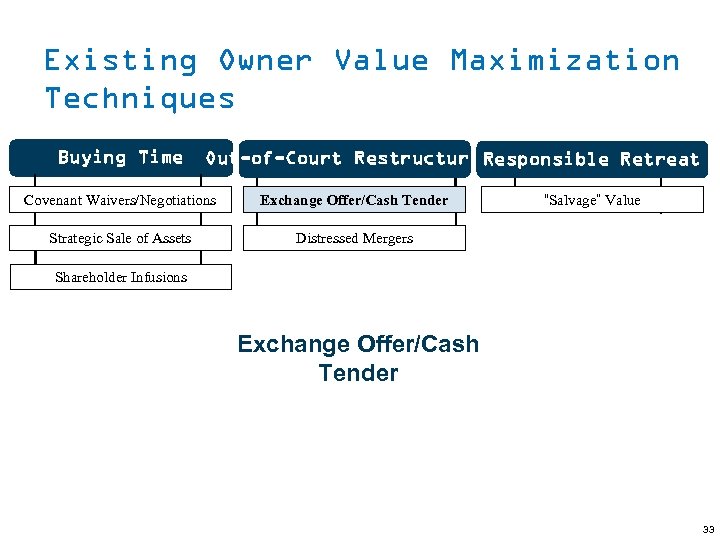
Existing Owner Value Maximization Techniques (continued) Existing Owner Value Maximization Techniques Buying Time Out-of-Court Restructuring Responsible Retreat Covenant Waivers/Negotiations Exchange Offer/Cash Tender Strategic Sale of Assets “Salvage” Value Distressed Mergers Shareholder Infusions Exchange Offer/Cash Tender 33
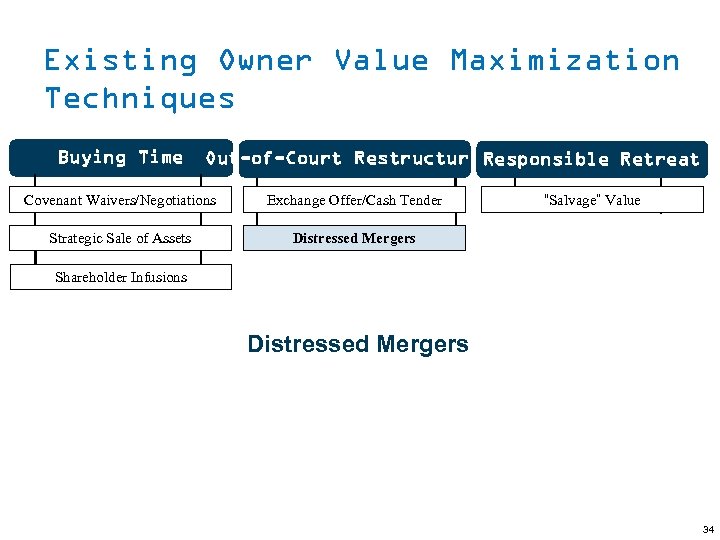
Existing Owner Value Maximization Techniques (continued) Existing Owner Value Maximization Techniques Buying Time Out-of-Court Restructuring Responsible Retreat Covenant Waivers/Negotiations Exchange Offer/Cash Tender Strategic Sale of Assets “Salvage” Value Distressed Mergers Shareholder Infusions Distressed Mergers 34
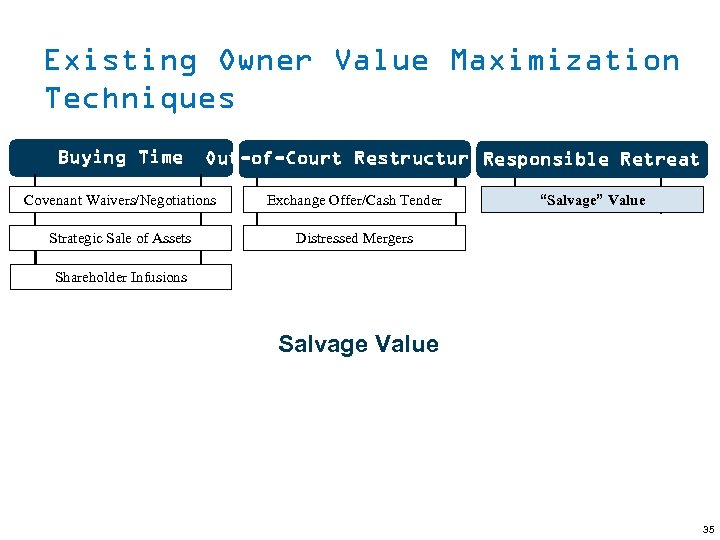
Existing Owner Value Maximization Techniques Buying Time Out-of-Court Restructuring Responsible Retreat Covenant Waivers/Negotiations Exchange Offer/Cash Tender Strategic Sale of Assets “Salvage” Value Distressed Mergers Shareholder Infusions Salvage Value 35
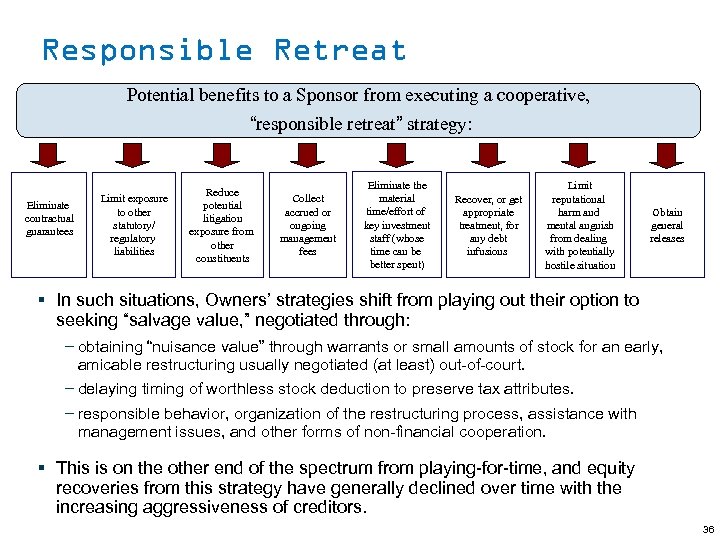
Responsible Retreat Potential benefits to a Sponsor from executing a cooperative, “responsible retreat” strategy: Eliminate contractual guarantees Limit exposure to other statutory/ regulatory liabilities Reduce potential litigation exposure from other constituents Collect accrued or ongoing management fees Eliminate the material time/effort of key investment staff (whose time can be better spent) Recover, or get appropriate treatment, for any debt infusions Limit reputational harm and mental anguish from dealing with potentially hostile situation Obtain general releases § In such situations, Owners’ strategies shift from playing out their option to seeking “salvage value, ” negotiated through: − obtaining “nuisance value” through warrants or small amounts of stock for an early, amicable restructuring usually negotiated (at least) out-of-court. − delaying timing of worthless stock deduction to preserve tax attributes. − responsible behavior, organization of the restructuring process, assistance with management issues, and other forms of non-financial cooperation. § This is on the other end of the spectrum from playing-for-time, and equity recoveries from this strategy have generally declined over time with the increasing aggressiveness of creditors. 36

Investor Opportunity/Approaches s
New Control Investment Approaches § Creative deal makers can obtain significant advantages in distressed situations: − Acquire valuable assets at “special situation” prices − “First mover” buyers can sometimes be the “only game in town” out-of-court or gain advantages and special protections in a Chapter 11 process − Not everybody can do it – less competition for deals at all value levels given difficulty, time, and expertise required. § Valuable assets and the old “good company, bad capital structure” will become available in the current restructuring wave. − A key element of the process is making the cost/benefit judgment of where, when, and even whether to get involved. − Establishing a reputation for honesty, sophistication and speed will maximize your access to opportunities, and materially increase your chances for success in competitive, time-sensitive situations. − However “honesty” can’t be taught; “sophistication” comes with experience and good advisors; and speed requires focus, energy, guts and a decision-maker involved and ready to pull the trigger. BE POSITIONED TO PROACTIVELY CAPTURE OPPORTUNITIES 38
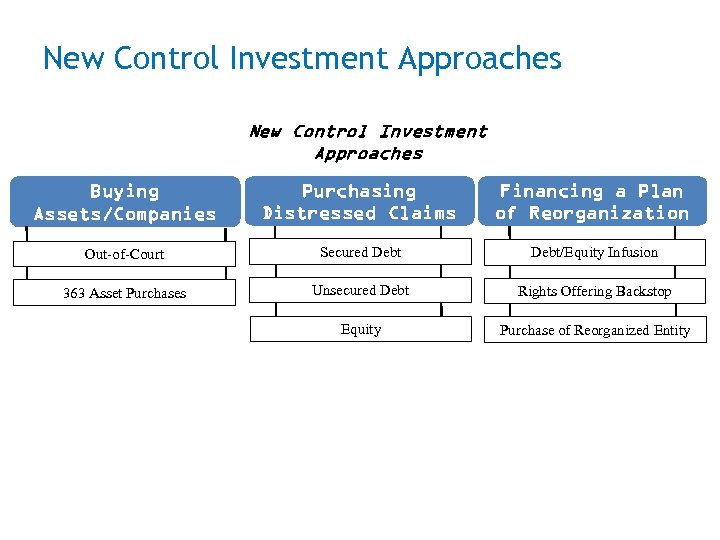
New Control Investment Approaches New Control Investment (continued) Approaches Buying Assets/Companies Purchasing Distressed Claims Financing a Plan of Reorganization Out-of-Court Secured Debt/Equity Infusion 363 Asset Purchases Unsecured Debt Rights Offering Backstop Equity Purchase of Reorganized Entity 39
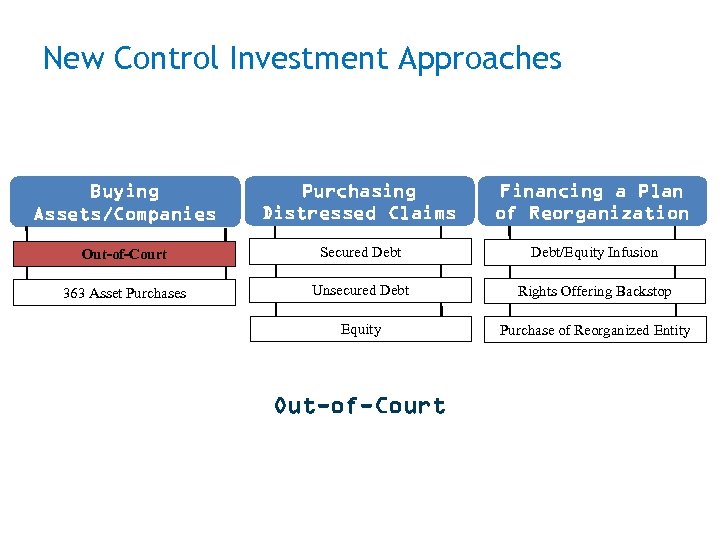
New Control Investment Approaches (continued) Buying Assets/Companies Purchasing Distressed Claims Financing a Plan of Reorganization Out-of-Court Secured Debt/Equity Infusion 363 Asset Purchases Unsecured Debt Rights Offering Backstop Equity Purchase of Reorganized Entity Out-of-Court 40
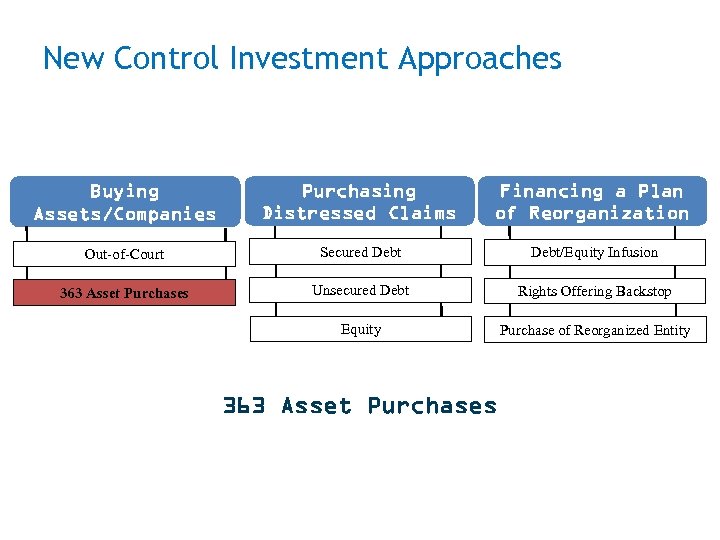
New Control Investment Approaches (continued) Buying Assets/Companies Purchasing Distressed Claims Financing a Plan of Reorganization Out-of-Court Secured Debt/Equity Infusion 363 Asset Purchases Unsecured Debt Rights Offering Backstop Equity Purchase of Reorganized Entity 363 Asset Purchases 41
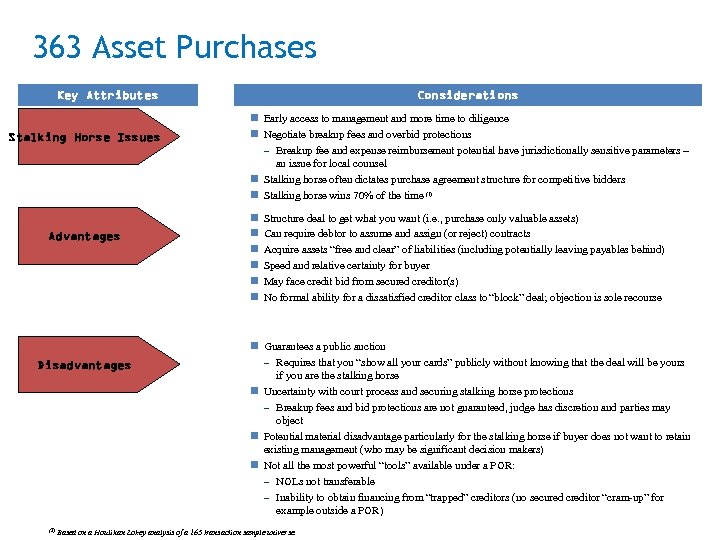
363 Asset Purchases Key Attributes Stalking Horse Issues Advantages Disadvantages (1) Considerations n Early access to management and more time to diligence n Negotiate breakup fees and overbid protections − Breakup fee and expense reimbursement potential have jurisdictionally sensitive parameters – an issue for local counsel n Stalking horse often dictates purchase agreement structure for competitive bidders n Stalking horse wins 70% of the time (1) n n n Structure deal to get what you want (i. e. , purchase only valuable assets) Can require debtor to assume and assign (or reject) contracts Acquire assets “free and clear” of liabilities (including potentially leaving payables behind) Speed and relative certainty for buyer May face credit bid from secured creditor(s) No formal ability for a dissatisfied creditor class to “block” deal; objection is sole recourse n Guarantees a public auction − Requires that you “show all your cards” publicly without knowing that the deal will be yours if you are the stalking horse n Uncertainty with court process and securing stalking horse protections − Breakup fees and bid protections are not guaranteed, judge has discretion and parties may object n Potential material disadvantage particularly for the stalking horse if buyer does not want to retain existing management (who may be significant decision makers) n Not all the most powerful “tools” available under a POR: − NOLs not transferable 42 − Inability to obtain financing from “trapped” creditors (no secured creditor “cram-up” for example outside a POR) Based on a Houlihan Lokey analysis of a 165 transaction sample universe.
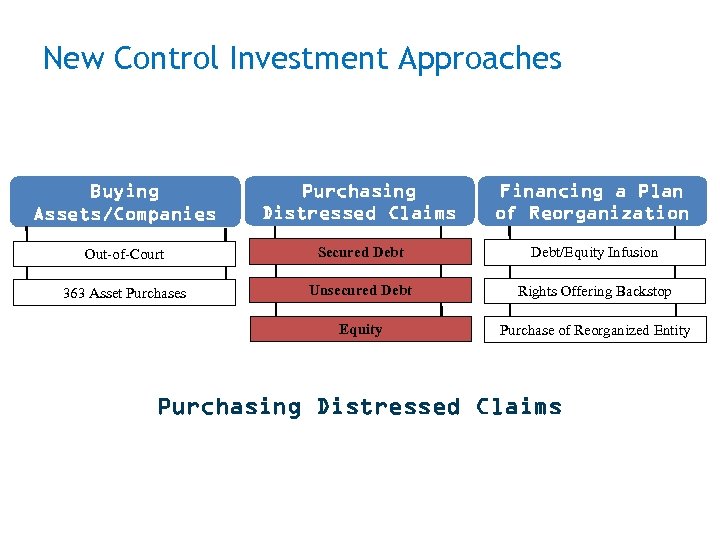
New Control Investment Approaches (continued) Buying Assets/Companies Purchasing Distressed Claims Financing a Plan of Reorganization Out-of-Court Secured Debt/Equity Infusion 363 Asset Purchases Unsecured Debt Rights Offering Backstop Equity Purchase of Reorganized Entity Purchasing Distressed Claims 43
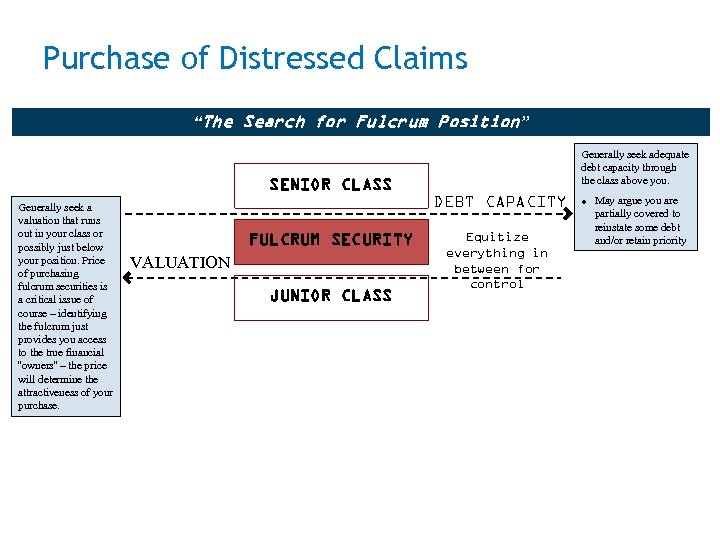
Purchase of Distressed Claims “The Search for Fulcrum Position” SENIOR CLASS Generally seek a valuation that runs out in your class or possibly just below your position. Price of purchasing fulcrum securities is a critical issue of course – identifying the fulcrum just provides you access to the true financial “owners” – the price will determine the attractiveness of your purchase. FULCRUM SECURITY VALUATION JUNIOR CLASS Generally seek adequate debt capacity through the class above you. DEBT CAPACITY Equitize everything in between for control 44 u May argue you are partially covered to reinstate some debt and/or retain priority
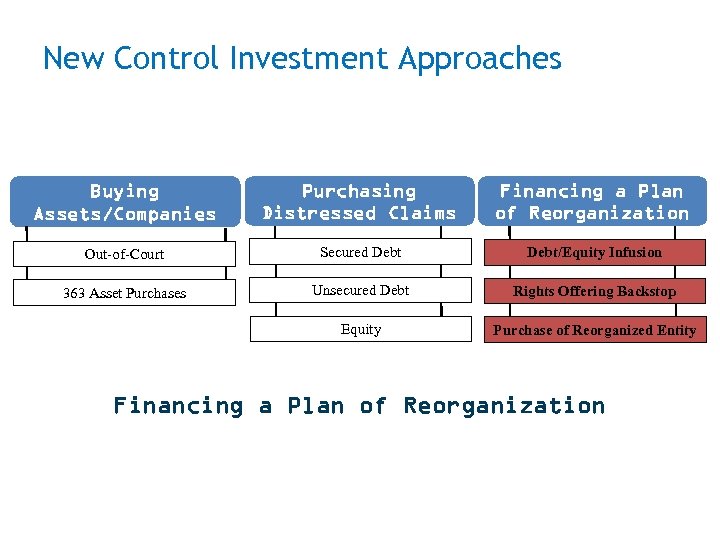
New Control Investment Approaches (continued) Buying Assets/Companies Purchasing Distressed Claims Financing a Plan of Reorganization Out-of-Court Secured Debt/Equity Infusion 363 Asset Purchases Unsecured Debt Rights Offering Backstop Equity Purchase of Reorganized Entity Financing a Plan of Reorganization 45
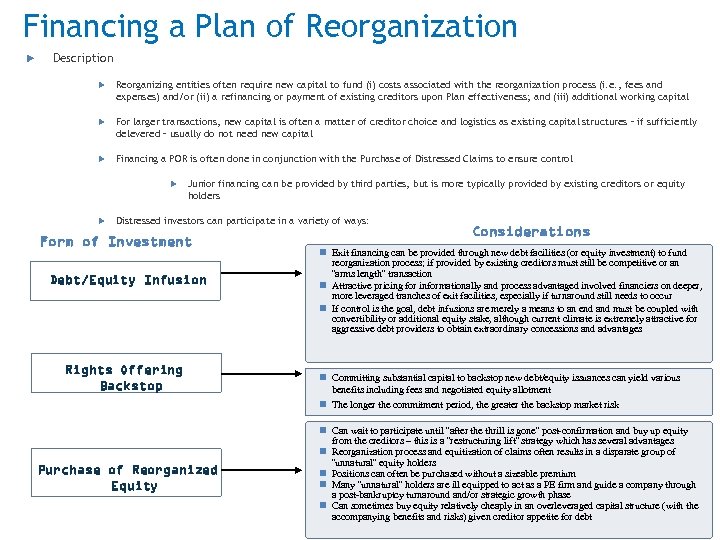
Financing a Plan of Reorganization Description Financing a Plan of Reorganization Reorganizing entities often require new capital to fund (i) costs associated with the reorganization process (i. e. , fees and expenses) and/or (ii) a refinancing or payment of existing creditors upon Plan effectiveness; and (iii) additional working capital For larger transactions, new capital is often a matter of creditor choice and logistics as existing capital structures – if sufficiently delevered – usually do not need new capital Financing a POR is often done in conjunction with the Purchase of Distressed Claims to ensure control Junior financing can be provided by third parties, but is more typically provided by existing creditors or equity holders Distressed investors can participate in a variety of ways: Form of Investment Debt/Equity Infusion Rights Offering Backstop Purchase of Reorganized Equity Considerations n Exit financing can be provided through new debt facilities (or equity investment) to fund reorganization process; if provided by existing creditors must still be competitive or an “arms length” transaction n Attractive pricing for informationally and process advantaged involved financiers on deeper, more leveraged tranches of exit facilities, especially if turnaround still needs to occur n If control is the goal, debt infusions are merely a means to an end and must be coupled with convertibility or additional equity stake, although current climate is extremely attractive for aggressive debt providers to obtain extraordinary concessions and advantages n Committing substantial capital to backstop new debt/equity issuances can yield various benefits including fees and negotiated equity allotment n The longer the commitment period, the greater the backstop market risk n Can wait to participate until “after the thrill is gone” post-confirmation and buy up equity from the creditors – this is a “restructuring lift” strategy which has several advantages n Reorganization process and equitization of claims often results in a disparate group of “unnatural” equity holders n Positions can often be purchased without a sizeable premium n Many “unnatural” holders are ill equipped to act as a PE firm and guide a company through a post-bankruptcy turnaround and/or strategic growth phase n Can sometimes buy equity relatively cheaply in an overleveraged capital structure (with the accompanying benefits and risks) given creditor appetite for debt 46

Case Studies
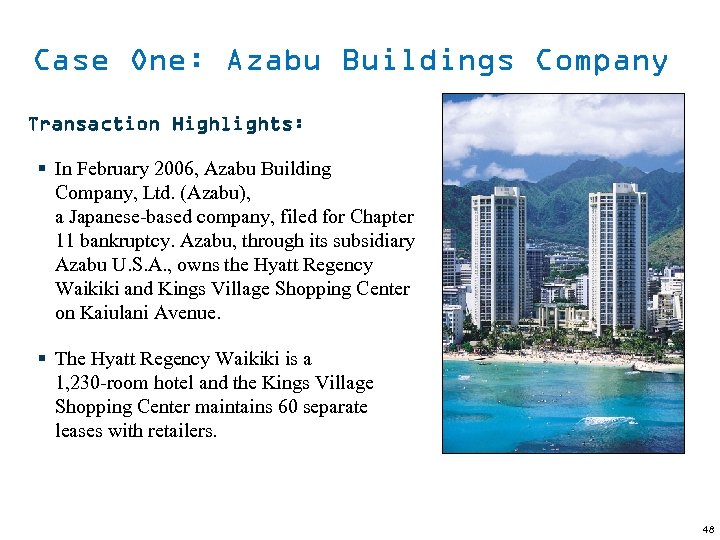
Case One: Azabu Buildings Company Transaction Highlights: § In February 2006, Azabu Building Company, Ltd. (Azabu), a Japanese-based company, filed for Chapter 11 bankruptcy. Azabu, through its subsidiary Azabu U. S. A. , owns the Hyatt Regency Waikiki and Kings Village Shopping Center on Kaiulani Avenue. § The Hyatt Regency Waikiki is a 1, 230 -room hotel and the Kings Village Shopping Center maintains 60 separate leases with retailers. 48
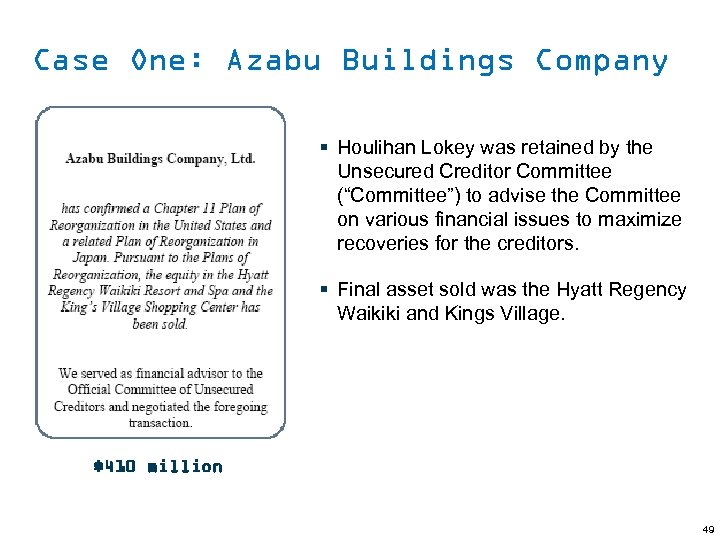
Case One: Azabu Buildings Company (continued) Case One: Azabu Buildings Company § Houlihan Lokey was retained by the Unsecured Creditor Committee (“Committee”) to advise the Committee on various financial issues to maximize recoveries for the creditors. § Final asset sold was the Hyatt Regency Waikiki and Kings Village. $410 million 49
Case Two: Project Motor City Living Project Overview: § The Company was a 36 -year old real estate development company headquartered in Michigan with operations nationally. The Company was experiencing problems caused by the dislocation in the capital markets and the homebuilding industry. The outstanding debt had personal guarantees which exacerbated the Company’s capital needs. § The Company needed financing for 13 residential development projects, most of which were already in active development, in the form of a joint venture equity and/or a mezzanine debt facility in the amount of approximately $90 million. 50
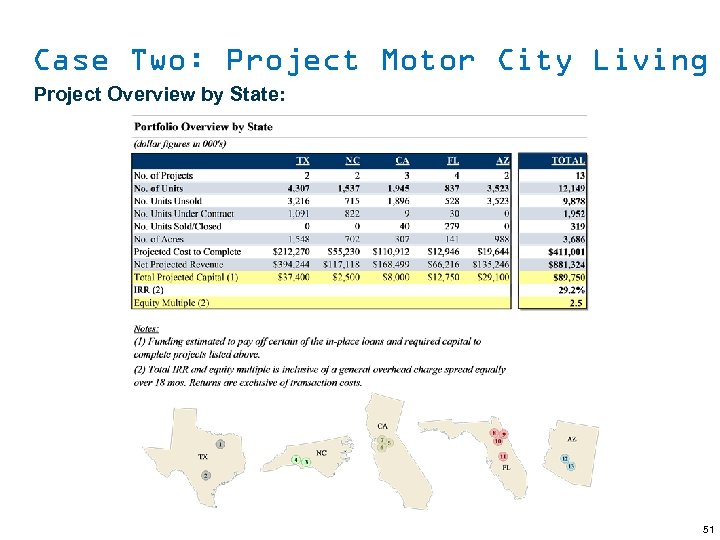
Case Two: Project Motor City Living Project Overview by State: 51
Case Two: Project Motor City Living (continued) Case Two: Project Motor City Living Key Investment Considerations: § Accomplished, nationally recognized full-service development sponsorship § Compelling risk adjusted return opportunity § Relatively low cost, in-place senior and mezzanine loans § Limited entitlement risk § Advanced development phase resulting in short-term cash flow § Diverse economic and growth-oriented market distribution 52
Case Two: Project Motor City Living (continued) Case Two: Project Motor City Living Investment Summary: § The financing would be utilized to pay down in-place senior debt and/or mezzanine loans, several of which had matured and were in arrears, and to fund completion costs on the projects that were currently in varying stages of development with many partly completed or nearing completion. § The new capital partner would arrange a joint venture relationship with the Company to utilize its already established management infrastructure and access to both lender and real estate industry relationships to capitalize on the historically attractive acquisition opportunities presenting themselves during the current dislocation and distress in the real estate and credit market environments. 53
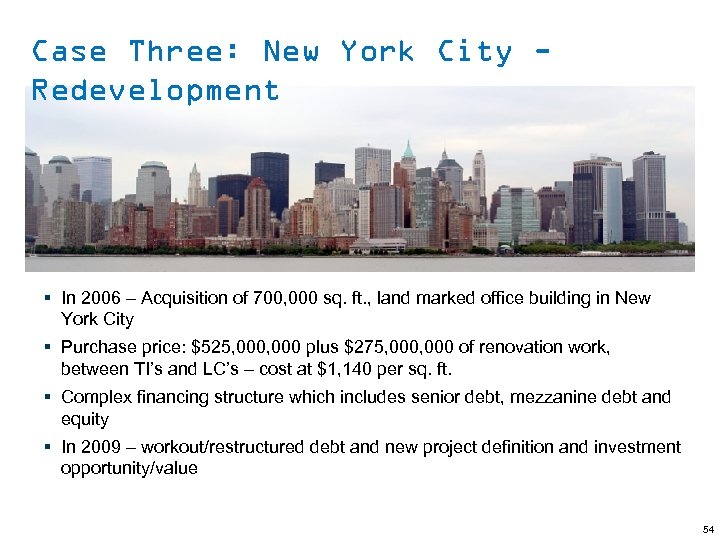
Case Three: New York City - Redevelopment Case Three: New York City Redevelopment § In 2006 – Acquisition of 700, 000 sq. ft. , land marked office building in New York City § Purchase price: $525, 000 plus $275, 000 of renovation work, between TI’s and LC’s – cost at $1, 140 per sq. ft. § Complex financing structure which includes senior debt, mezzanine debt and equity § In 2009 – workout/restructured debt and new project definition and investment opportunity/value 54
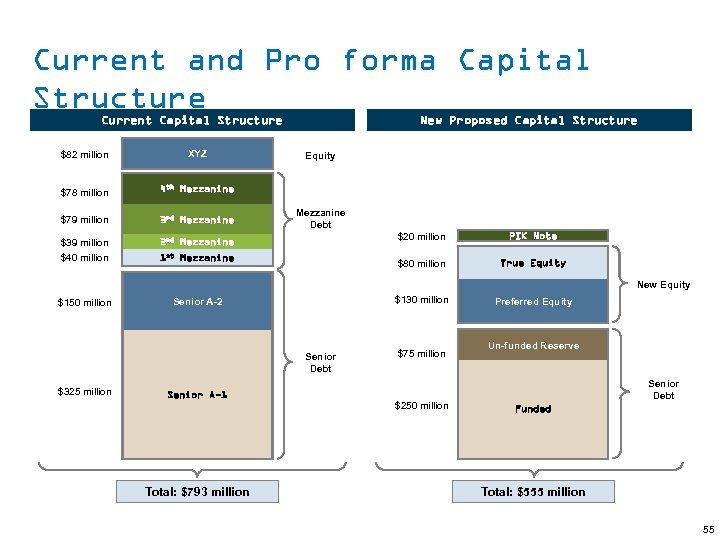
Current and Pro forma Capital Structure Current Capital Structure $82 million XYZ $78 million 4 th Mezzanine $79 million 3 rd Mezzanine $39 million $40 million New Proposed Capital Structure 2 nd Mezzanine Equity Mezzanine Debt $20 million $80 million 1 st Mezzanine PIK Note True Equity New Equity $150 million $130 million Senior A-2 Senior Debt $325 million Senior A-1 Total: $793 million $75 million $250 million Preferred Equity Un-funded Reserve Senior Debt Funded Total: $555 million 55
Скачать презентацию Capturing Opportunities in Distressed Deals Columbia University Real
3f1907a57603d5dd5f46f55922943acd.ppt