


 Скачать презентацию Capturing assessing transferring and applying knowledge of good
f97e6c125f8499a332477ac3b8a2f39c.ppt
- Количество слайдов: 57
 Capturing, assessing, transferring and applying knowledge of good practice in crime prevention: the 5 Is framework Paul Ekblom p. ekblom@csm. arts. ac. uk www. designagainstcrime. com/web/crimeframeworks
 Presentation at Irish Youth Justice Service first biennial conference ‘Best Practice for Youth Justice, Best Practice for all’ Ballyconnell, March 2008 With thanks to the youth work teams whose practice experience illustrates the frameworks shown here
 What’s coming up • Importance of Good Practice knowledge • What’s wrong with the way we collect it – implications for selection, replication and innovation in Good Practice • Specifying fit-for-purpose framework for Good Practice knowledge and suggesting its performance criteria • Introducing the knowledge suite that attempts to meet the specification – definitions, framework for causes and interventions (CCO), and for process of prevention (5 Is) • Illustration with mini examples from Irish visit
 Who should be interested in Good Practice? People/organisations concerned with • Practice (obviously) But also those responsible for action at higher levels: • • • Delivery Policy Public understanding and debate Governance Research and evaluation • They will view Good Practice from different angles • At all levels, Good (and Bad) Practice examples can illustrate principles, challenge assumptions, test theory, extend frontiers of thinking
 Why collect Good Practice information? • To improve performance, and widen the scope of crime prevention to cover new problems and solutions • By sharing technical knowledge of how to do it well • By helping other practitioners avoid past mistakes • By motivating practitioners who improve performance & extend scope • By developing wider culture & climate of quality of preventive action among practitioners, policymakers and others
 What’s wrong with Practice and why? • Many evaluations of crime prevention have shown performance to be limited – implementation failure rife • Pervasive problem across English-speaking world • From Problem-Oriented Policing to Communities That Care • Mainstreaming of ‘success story’ demonstration projects rarely fails to disappoint • Explanations include • • • Deficient project management skills Limited analytic capacity of practitioners Short-term funding Over-centralised management Unsupportive organisational context Mission drift • But have neglected inadequate knowledge of practice
 What kinds of knowledge to collect? • • Know crime – definitions Know-about crime problems Know-what works to reduce crime Know-who to involve Know-when to act Know-where to distribute resources Know-why – symbolism, values, politics, ethics – eg fairness of access to youth centres • Know-how to put into practice • Each of these is relevant to each level of action – from practice to governance
 What’s wrong with Good Practice knowledge? • Limitations of knowledge, how it is captured through impact & process evaluation and how it is managed • Common underlying themes: • Much knowledge remains tacit and unarticulated, hence • Not tested • Not efficiently transferred between individual practitioners, between teams or between programmes • Knowledge of good and bad practice is lost and frequently reinvented (both reinventing the wheel… and the flat tyre) • Failure to handle complexity of choice, delivery and action that crime prevention requires • Addressing both requires attention to Know-What Works and Know-How in particular
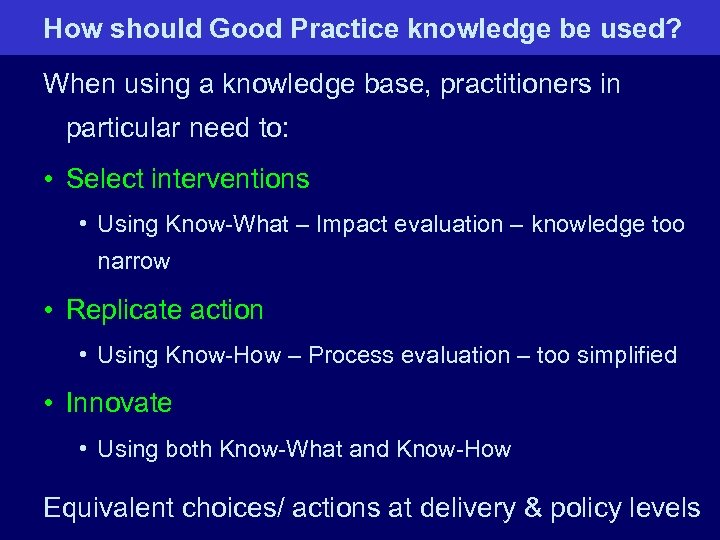 How should Good Practice knowledge be used? When using a knowledge base, practitioners in particular need to: • Select interventions • Using Know-What – Impact evaluation – knowledge too narrow • Replicate action • Using Know-How – Process evaluation – too simplified • Innovate • Using both Know-What and Know-How Equivalent choices/ actions at delivery & policy levels
 Selection of preventive action from a Good Practice Knowledge Base – Do Good Practice descriptions contain the right information to help choose?
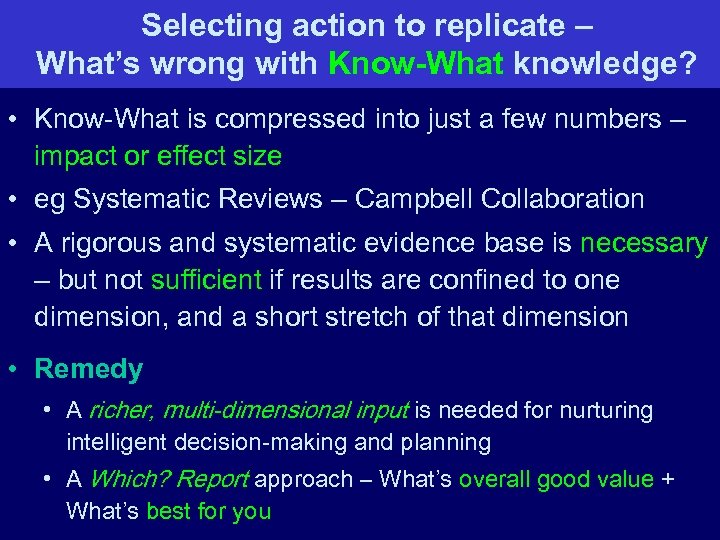 Selecting action to replicate – What’s wrong with Know-What knowledge? • Know-What is compressed into just a few numbers – impact or effect size • eg Systematic Reviews – Campbell Collaboration • A rigorous and systematic evidence base is necessary – but not sufficient if results are confined to one dimension, and a short stretch of that dimension • Remedy • A richer, multi-dimensional input is needed for nurturing intelligent decision-making and planning • A Which? Report approach – What’s overall good value + What’s best for you
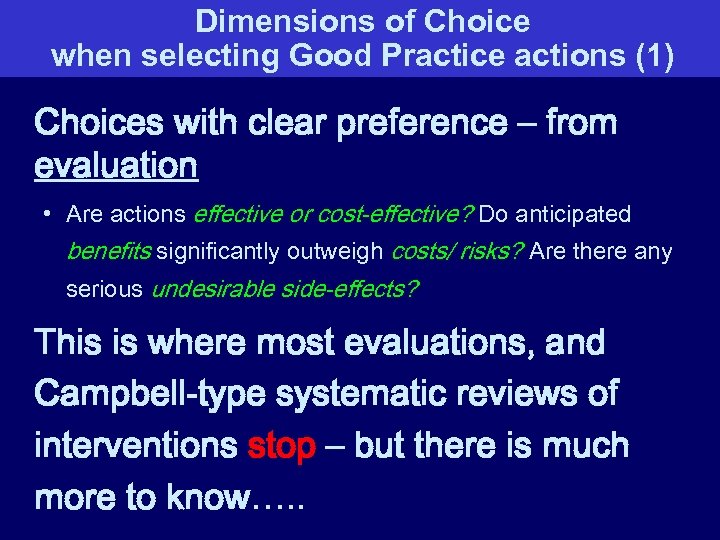 Dimensions of Choice when selecting Good Practice actions (1) Choices with clear preference – from evaluation • Are actions effective or cost-effective? Do anticipated benefits significantly outweigh costs/ risks? Are there any serious undesirable side-effects? This is where most evaluations, and Campbell-type systematic reviews of interventions stop – but there is much more to know…. .
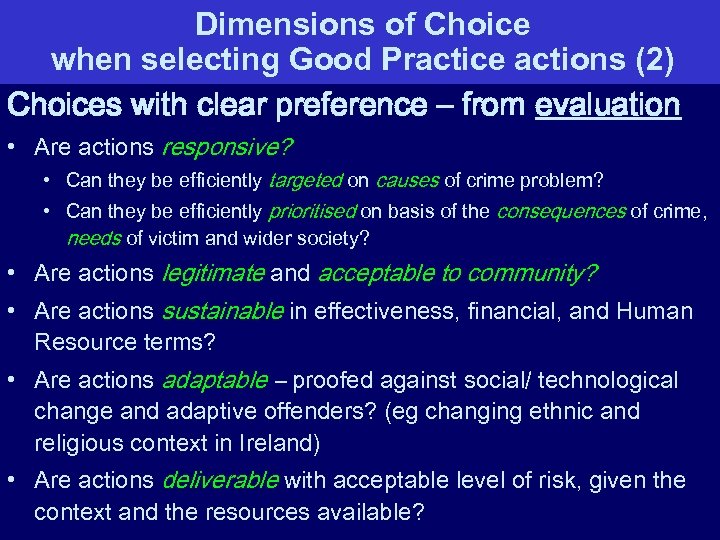 Dimensions of Choice when selecting Good Practice actions (2) Choices with clear preference – from evaluation • Are actions responsive? • Can they be efficiently targeted on causes of crime problem? • Can they be efficiently prioritised on basis of the consequences of crime, needs of victim and wider society? • Are actions legitimate and acceptable to community? • Are actions sustainable in effectiveness, financial, and Human Resource terms? • Are actions adaptable – proofed against social/ technological change and adaptive offenders? (eg changing ethnic and religious context in Ireland) • Are actions deliverable with acceptable level of risk, given the context and the resources available?
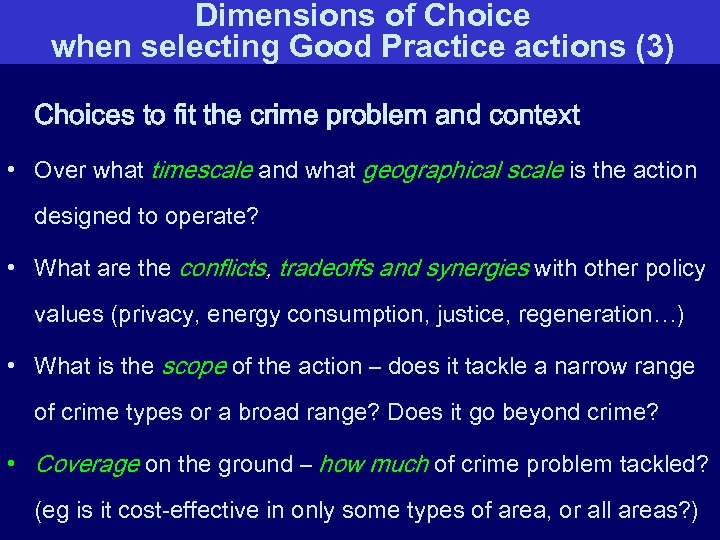 Dimensions of Choice when selecting Good Practice actions (3) Choices to fit the crime problem and context • Over what timescale and what geographical scale is the action designed to operate? • What are the conflicts, tradeoffs and synergies with other policy values (privacy, energy consumption, justice, regeneration…) • What is the scope of the action – does it tackle a narrow range of crime types or a broad range? Does it go beyond crime? • Coverage on the ground – how much of crime problem tackled? (eg is it cost-effective in only some types of area, or all areas? )
 Replication and Innovation of preventive action from a Good Practice Knowledge Base – Do Good Practice descriptions contain the right information to help replicate & innovate?
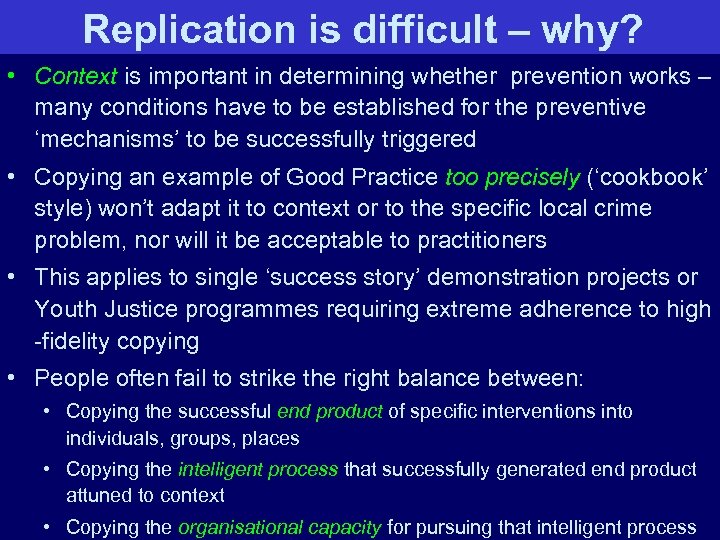 Replication is difficult – why? • Context is important in determining whether prevention works – many conditions have to be established for the preventive ‘mechanisms’ to be successfully triggered • Copying an example of Good Practice too precisely (‘cookbook’ style) won’t adapt it to context or to the specific local crime problem, nor will it be acceptable to practitioners • This applies to single ‘success story’ demonstration projects or Youth Justice programmes requiring extreme adherence to high -fidelity copying • People often fail to strike the right balance between: • Copying the successful end product of specific interventions into individuals, groups, places • Copying the intelligent process that successfully generated end product attuned to context • Copying the organisational capacity for pursuing that intelligent process
 The problem with practitioners… • Much knowledge of practice is tacit – as said – typical approach to knowledge transfer is to supply contact details of originating practitioner • Dependence on particular able and/or charismatic practitioners is risky – they move on, die with their boots on and reinforce tacit nature of knowledge… and human cloning not yet possible • More generally, practitioners operate at two extremes – either • Given anarchic total freedom of manoeuvre, with implications for quality and mission drift, or • Seen as technicians not consultants, slavishly copying – many hate it • Limited career structure and organisational reward means investment in education and developing expertise is patchy
 Replication and Innovation • Every replication faces a different context – therefore it inevitably involves some degree of innovation • Coverage of Know-What and Know-How is limited: • New problems • New configurations of causes or RPFs • Changing nature of crime – new tools, weapons, even fashions; new themes and balances within justice …so innovation has to make up the deficit
 How to innovate? • Draw on generic principles/theory – ‘generative grammar’ of crime prevention • Recombine elements of action – break down Good Practices into sub-units (eg how to mobilise people in a project targeted on burglary) and put them together in new combinations (eg use same method in a car crime project) – Does GP description enable this? • Pursue an ‘iterative process’ of design and testing • … > generate > trial > get feedback > adjust > … • Continuous monitoring/ development/improvement
 Does the Good Practice description contain the right information in the right detail to help replicate it innovatively and intelligently in different contexts? Quick-read glossy summaries are necessary but : • Descriptions of practical methods are brief • Information on generic principles or mechanisms underlying the action, which do transfer between contexts, is often unclear • eg ‘our project is about working with young people’ – both imprecise and confuses outreach with actual intervention to be done once the young people engaged • Process information is absent or limited • It is difficult to ‘reconstruct’ the unfolding stages of action • There is no information about the choices and tradeoffs that had to be faced at different stages – in different contexts practitioners may want to make different choices
 A Good Practice knowledge base designed to be fit for purpose – Specifying the right format
 A knowledge base designed to be fit for purpose? • Info in Good Practice knowledge base must be far more than a heap of case studies: • Retrievable/ searchable – precise, clear, consistent – can you find what you want? • Communicable – nationally and internationally – can you understand it? Are terms clearly-defined and unambiguous? • Of good quality – accurate and reliable – can you trust it? • Organised to guide planning and action – reflects structure of action & process of doing prevention – can you act on it? • Organised to support training – can you learn from it? • Clear about what type of action it describes – eg practice or delivery – can you be sure of the level you are working at? • Of appropriate complexity and detail – you cannot describe essentially complex actions with over-simple terms – does it match complexity of your reality on the ground?
 Fit for purpose? The 5 Is framework… and more
 Elements of New Framework seeking to meet specification • Defining Crime Prevention, Community Safety, Partnership • Clarifying Focus, Units, Levels of action • Conjunction of Criminal Opportunity – framework to map both situational & offender-oriented approaches covering • Know-About crime – immediate causes of criminal events • Know-What works to prevent it – interventions in causes • 5 Is – Process of doing prevention • Know-How • A language and a map for describing all the detailed tasks of the preventive process and thereby capturing, organising and sharing good practice knowledge • Began with focus on crime problems, but through Irish experience is evolving to handle offender-oriented action
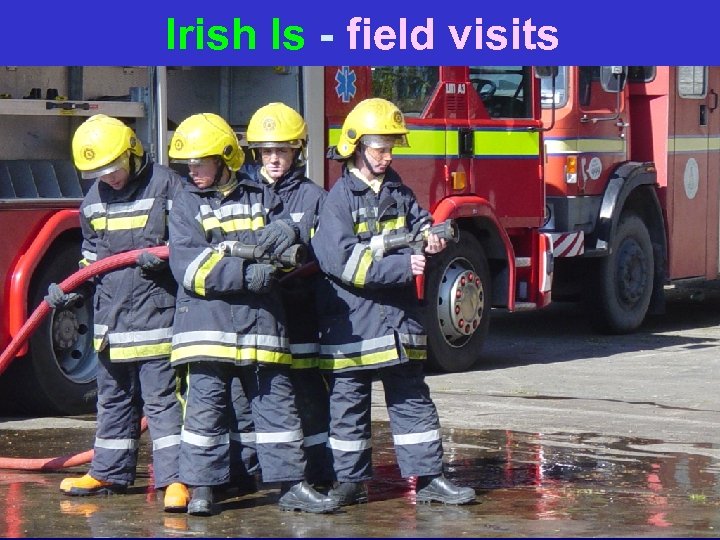 Irish Is - field visits
 Irish Is - field visits • Will illustrate aspects of knowledge with ref to around 10 youth projects in Dublin & Limerick visited over 2 days in January • Each involved • A stimulating discussion with staff & partners eg Gardai • Discovery of many items of knowledge at all levels – tacit and explicit • Many new categories of knowledge (still being digested) • Some challenges to the structure of the framework (even a possible 6 th I) • Previous experiences have been with intensive visits to single project – eg Moonshine – 3 hours, 13 Intervention methods – present case means more mini -illustrations rather than single case study; more categories than detailed content
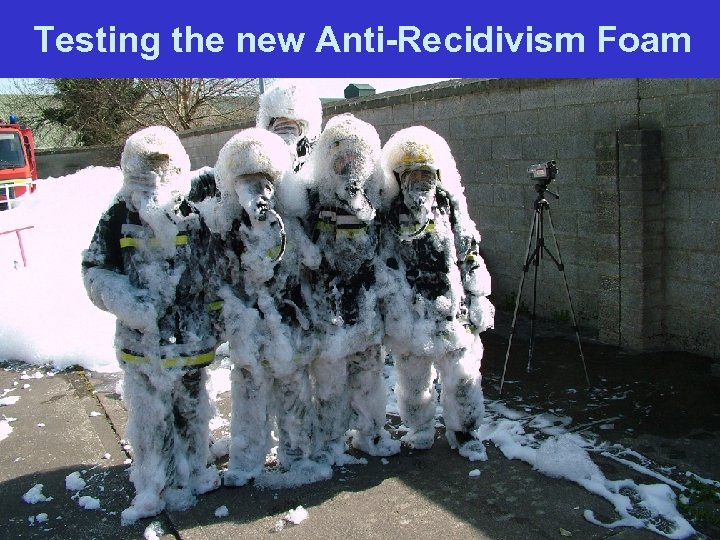 Testing the new Anti-Recidivism Foam
 Defining Crime Prevention • Crime prevention is narrow – intervening in the causes of criminal events to reduce their risk, whether the probability of their occurrence or their harmful consequences
 Defining Community Safety • A broader concept, an aspect of the quality of life • A state of existence in which people, individually & collectively: • Are sufficiently free from / reassured about a range of real & perceived hazards/ harms including crime & related misbehaviour • Are able to cope with those which they nevertheless experience, or • Are otherwise sufficiently protected from their consequences through mitigation……. • To allow them to pursue the necessities of their social and economic lives • To exercise their skills and • To create and enjoy wealth in the widest sense
 Clarifying the focus of action • Crime prevention action can focus on: • Causes or Risk and Protective Factors (RPFs) • Immediate or remote causes/ RPFs • Situational or offender causes/ RPFs • Crime problems or actual/potential offenders as cases • And take a narrow or broad scope • Criminal events, civil conflicts or wider community safety (individual and collective reduction and mitigation of harm relating to quality of life) • Crime/safety per se or as part of concern with wider issues eg inclusion, cohesion, education, renewal
 Clarifying the units of action Crime prevention action has a rich structure: • Organisation of activity • Programme • Project • Problem • Case – short term or developmental • Transferable action elements - eg insurance for activities • Nature of Intervention in causes or RPFs: • Causal mechanisms – how each intervention method works in detail, in context, usually with reference to theoretical processes – eg social learning theory) • Generic principles – eg trusting relationships with role model • Practical methods – eg sailing trips • Packages of methods – eg suite of centre-based and outdoor activities
 Clarifying the ecological level of action • Crime prevention can target problems, or act through causes/RPFs, which operate at various levels: • Individual • Family • Peer group • Institutions eg schools • Community/Area • Networks, markets • Wider social structure • Good practitioners adept at using different levels: mix of 1: 1 and group work with young people • Good practitioners adept at switching levels: if problems arose with young people at individual/peer group levels at youth centre, switched to family visit/intervention involving local ‘family monitors’
 Clarifying the institutional setting of action • Crime prevention can act: • In enforcement/ justice v welfare, education, health, ‘civil’ crime prevention • Within single agency v partnership – attempting to balance division v separation of labour for tasks of care, control, conflict avoidance/resolution, collaboration • Localised v centralised organisation • Different settings will apply different perspectives – may conflict, but some youth centres were adept at not only balancing/mitigating effect of divergent perspectives, but actively exploiting the crossover between justice and welfare as resource to influence young people and their families
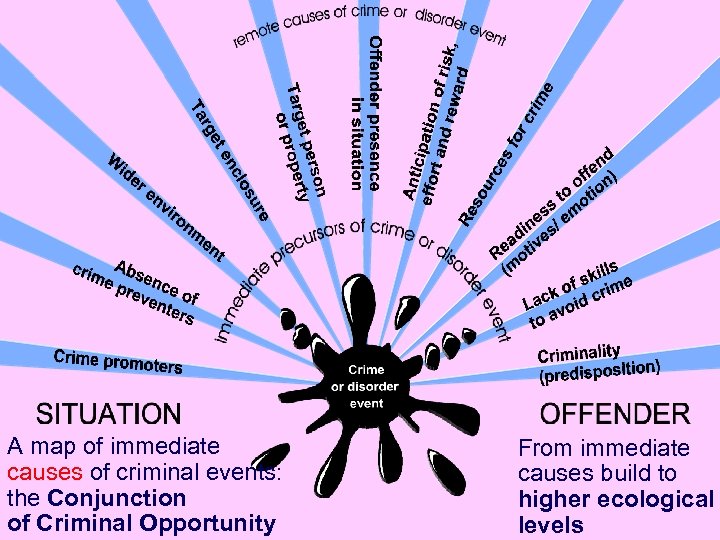 A map of immediate causes of criminal events: the Conjunction of Criminal Opportunity From immediate causes build to higher ecological levels
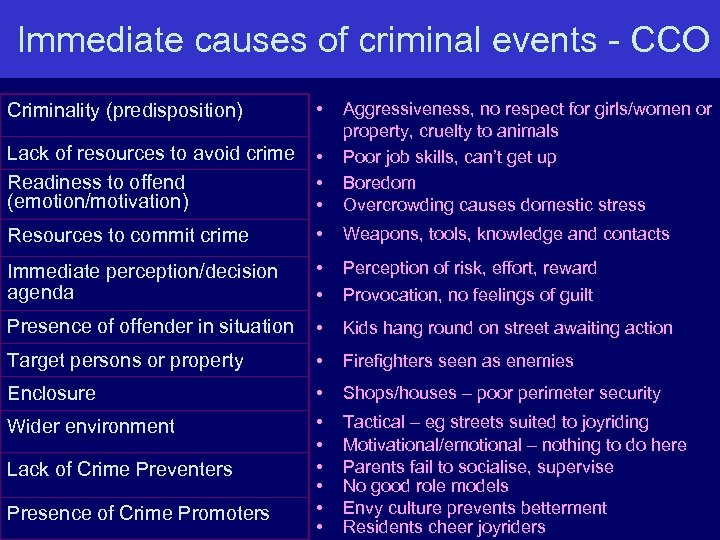 Immediate causes of criminal events - CCO Criminality (predisposition) • Lack of resources to avoid crime Readiness to offend (emotion/motivation) • • • Aggressiveness, no respect for girls/women or property, cruelty to animals Poor job skills, can’t get up Boredom Overcrowding causes domestic stress Resources to commit crime • Weapons, tools, knowledge and contacts Immediate perception/decision agenda • • Perception of risk, effort, reward Presence of offender in situation • Kids hang round on street awaiting action Target persons or property • Firefighters seen as enemies Enclosure • Shops/houses – poor perimeter security Wider environment • • • Tactical – eg streets suited to joyriding Motivational/emotional – nothing to do here Parents fail to socialise, supervise No good role models Envy culture prevents betterment Residents cheer joyriders Lack of Crime Preventers Presence of Crime Promoters Provocation, no feelings of guilt
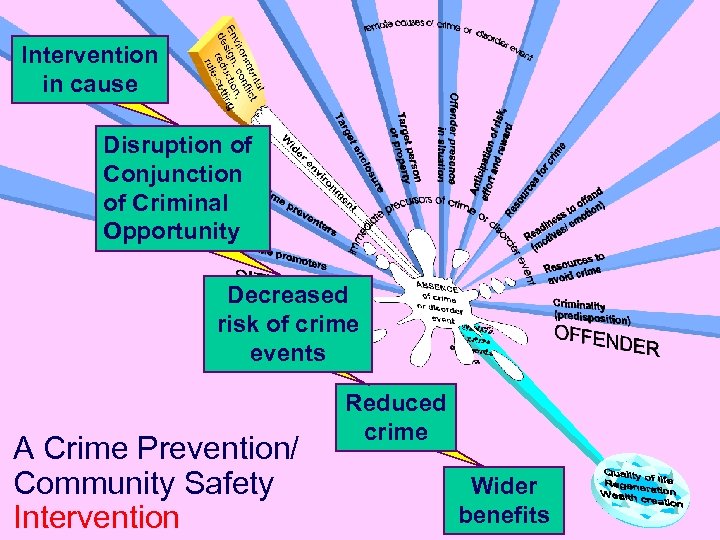 Intervention in cause Disruption of Conjunction of Criminal Opportunity Decreased risk of crime events A Crime Prevention/ Community Safety Intervention Reduced crime Wider benefits
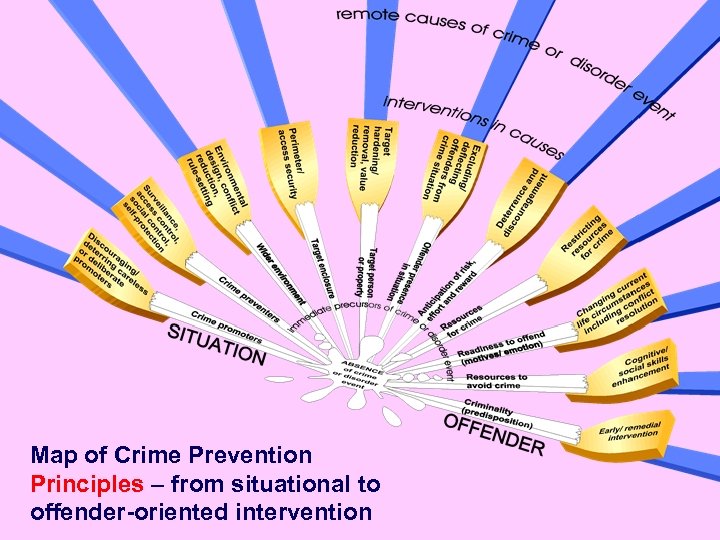 Map of Crime Prevention Principles – from situational to offender-oriented intervention
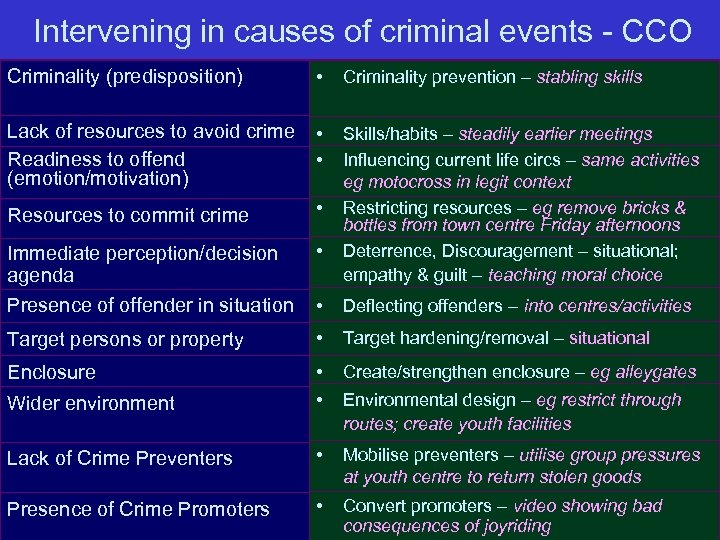 Intervening in causes of criminal events - CCO Criminality (predisposition) Criminality prevention – stabling girls/women • Aggressiveness, no respect for skills or property, cruelty to animals Immediate perception/decision agenda • Poor job skills, can’t get up meetings Skills/habits – steadily earlier • Boredom current life circs – same activities Influencing eg motocross in legit domestic stress • Overcrowding causescontext • Weapons, tools, knowledge and contacts • Restricting resources – eg remove bricks & bottles from town centre Friday afternoons • Perception of Discouragement – situational; of Deterrence, risk, effort, reward; feelings empathy & guilt, provocation – teaching moral choice Presence of offender in situation • Kids hang round on street awaiting action Deflecting offenders – into centres/activities Target persons or property • Empty houses easily vandalised/burnt Target hardening/removal – situational Enclosure Create/strengthen enclosure – eg alleygates • Shops/houses – poor perimeter security Wider environment Environmental design – eg to joyriding • Tactical – eg streets suitedrestrict through routes; create youth facilities • Motivational/emotional – nothing to do here Lack of Crime Preventers Mobilise preventers – utilise group • Parents fail to socialise, supervisepressures at youth centre to return stolen goods • No good role models Presence of Crime Promoters • Envy culture preventsvideo showing bad Convert promoters – betterment consequences joyriders • Residents cheerof joyriding Lack of resources to avoid crime Readiness to offend (emotion/motivation) Resources to commit crime
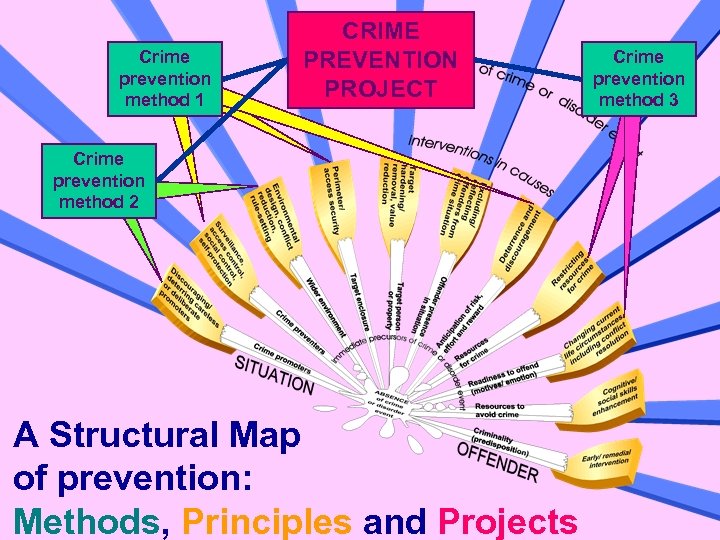 Crime prevention method 1 CRIME PREVENTION PROJECT Crime prevention method 2 A Structural Map of prevention: Methods, Principles and Projects Crime prevention method 3
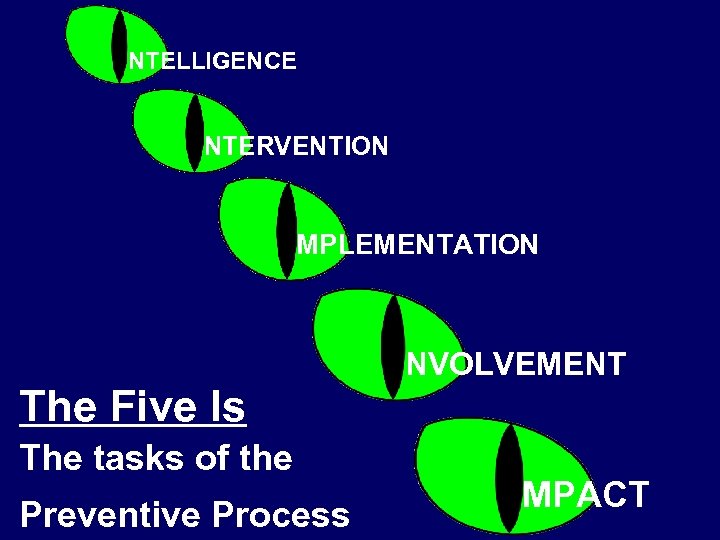 NTELLIGENCE NTERVENTION MPLEMENTATION The Five Is The tasks of the Preventive Process NVOLVEMENT MPACT
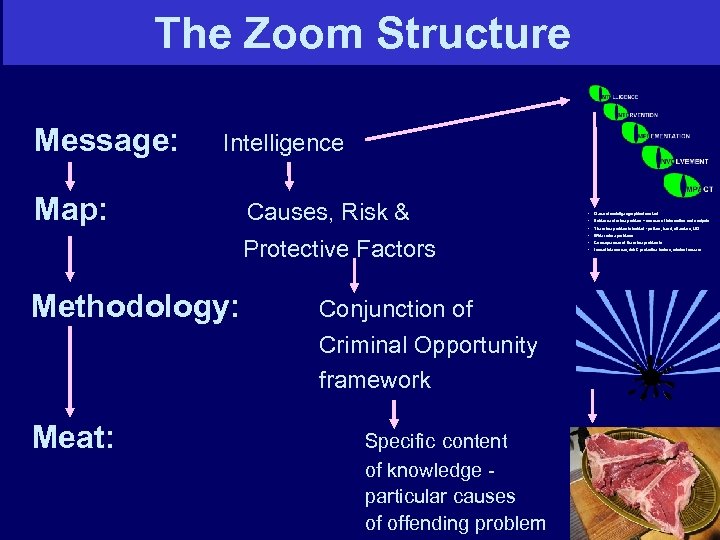 The Zoom Structure Message: Intelligence Map: Causes, Risk & Conjunction of Criminal Opportunity framework Meat: • Evidence of crime problem – sources of information and analysis • The crime problem/s tackled - pattern, trend, offenders, MO Protective Factors Methodology: • General social/geographical context Specific content of knowledge particular causes of offending problem • Wider crime problems • Consequences of the crime problem/s • Immediate causes, risk & protective factors, criminal careers
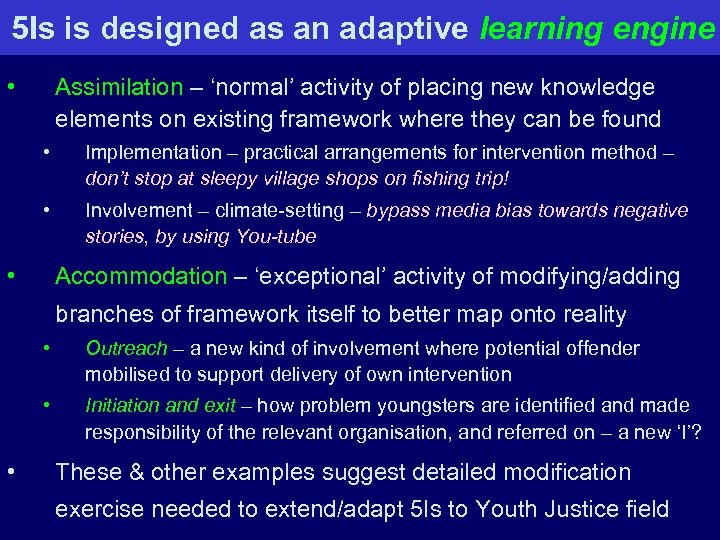 5 Is is designed as an adaptive learning engine • Assimilation – ‘normal’ activity of placing new knowledge elements on existing framework where they can be found • Implementation – practical arrangements for intervention method – don’t stop at sleepy village shops on fishing trip! • Involvement – climate-setting – bypass media bias towards negative stories, by using You-tube • Accommodation – ‘exceptional’ activity of modifying/adding branches of framework itself to better map onto reality • • • Outreach – a new kind of involvement where potential offender mobilised to support delivery of own intervention Initiation and exit – how problem youngsters are identified and made responsibility of the relevant organisation, and referred on – a new ‘I’? These & other examples suggest detailed modification exercise needed to extend/adapt 5 Is to Youth Justice field
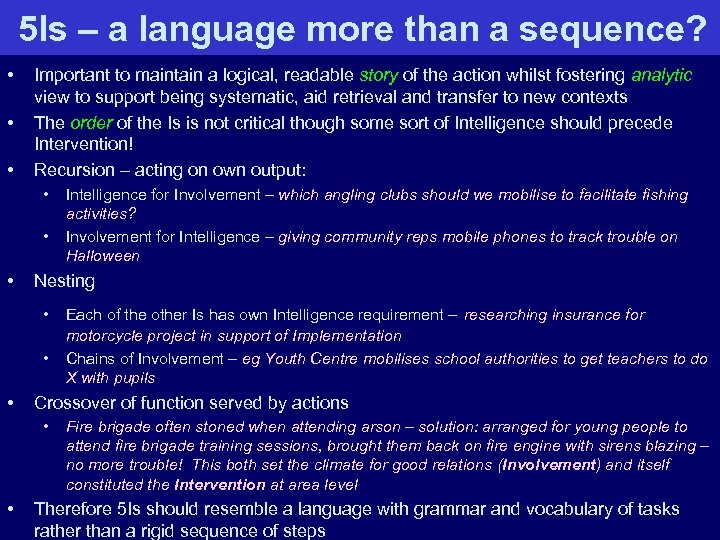 5 Is – a language more than a sequence? • • • Important to maintain a logical, readable story of the action whilst fostering analytic view to support being systematic, aid retrieval and transfer to new contexts The order of the Is is not critical though some sort of Intelligence should precede Intervention! Recursion – acting on own output: • • • Nesting • • • Each of the other Is has own Intelligence requirement – researching insurance for motorcycle project in support of Implementation Chains of Involvement – eg Youth Centre mobilises school authorities to get teachers to do X with pupils Crossover of function served by actions • • Intelligence for Involvement – which angling clubs should we mobilise to facilitate fishing activities? Involvement for Intelligence – giving community reps mobile phones to track trouble on Halloween Fire brigade often stoned when attending arson – solution: arranged for young people to attend fire brigade training sessions, brought them back on fire engine with sirens blazing – no more trouble! This both set the climate for good relations (Involvement) and itself constituted the Intervention at area level Therefore 5 Is should resemble a language with grammar and vocabulary of tasks rather than a rigid sequence of steps
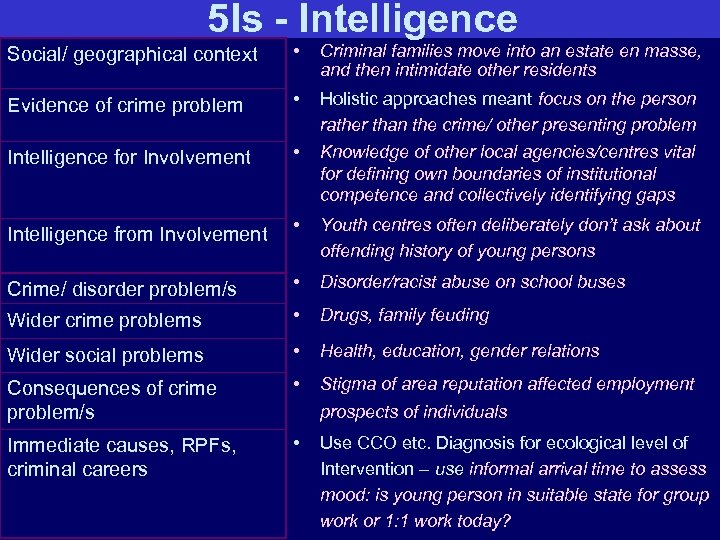 5 Is - Intelligence Social/ geographical context • Criminal families move into an estate en masse, and then intimidate other residents Evidence of crime problem • Intelligence for Involvement • Holistic approaches meant focus on the person rather than the crime/ other presenting problem Knowledge of other local agencies/centres vital for defining own boundaries of institutional competence and collectively identifying gaps Intelligence from Involvement • Youth centres often deliberately don’t ask about offending history of young persons Crime/ disorder problem/s • Disorder/racist abuse on school buses Wider crime problems • Drugs, family feuding Wider social problems • Health, education, gender relations Consequences of crime problem/s • Stigma of area reputation affected employment Immediate causes, RPFs, criminal careers • prospects of individuals Use CCO etc. Diagnosis for ecological level of Intervention – use informal arrival time to assess mood: is young person in suitable state for group work or 1: 1 work today?
 5 Is - Intervention · Intervention is the precision view on how the action works – linking: · Causal mechanisms or RPFs of crime · Causal mechanisms of intervention · This view connects with Theories of Change/ Realistic evaluation approaches · Start with describing practical methods eg Fishing-trip activities · But one method may work via many mechanisms · So move on to conjecture analytic principles - eg from CCO · Predisposition – teaching calmness, care of animals · Resources to avoid offending – learn planning/budgeting of trip (doubles as Implementation); teamwork; make/sell flies (learn to earn) · Readiness to offend – alleviate boredom · Decision to offend – risk losing the right to go on more trips, motivation by trophies · Offender presence – Removal of potential offenders from crime situation · Crime preventers – relationships with positive role models
 5 Is - Involvement • Many crime prevention Interventions are not directly Implemented by professionals such as Garda, probation, youth service, but by others in community; even direct implementation may require professional partnerships to span divisions of labour & bring together complementary perspectives/ resources • Involvement comprises: • Partnership – Interagency or with residents, organisations • Mobilisation – Organisations, companies, departments, volunteers • Climate-setting – Background relations – public trust, interagency trust, mutual expectations • Outreach – Getting young people as potential offenders to participate voluntarily in own treatment
 5 Is – Involvement – Partnership • Partnership as strategic background to individual operational actions • • • Each project had connections with wider ‘justice family’ of agencies eg on local probation project management ctee. Discussions between agencies on what activities to be done on whose premises Partnership in operations • • With parents of young person at youth centre - parent meetings if problem arises – for every negative issue, ensure they discuss 3 positives first. ‘Nurture programme’ in Dublin – developed this concept of the ‘compliment sandwich’ Agreement with local Garda that no yp was to be picked up whilst on youth centre activity or at the centre itself - a means of preserving trust between centre and yps.
 5 Is – Involvement – Mobilisation · Getting other organisations/people to Implement Interventions · Clarify crime prevention roles/ tasks – expert supervisor for motorcycle project, volunteer youth centre staff, community rep · Locate appropriate preventive agents – trawl organisations eg angling societies such as Dublin Angling Initiative, and local angling enthusiast · Alert them that they may be causing crime and/or could help prevent it · Inform them – challenge joyriding audience behaviour by showing video of consequences to stop them acting as crime promoters · Motivate them – get children off parents’ hands… in extreme circumstances pressure parents to send yp to youth centre by arranging conditional stay of eviction order · Empower them – increase capacity – training staff/volunteers · Direct them - objectives, standards – Health & Safety/ Child safety rules
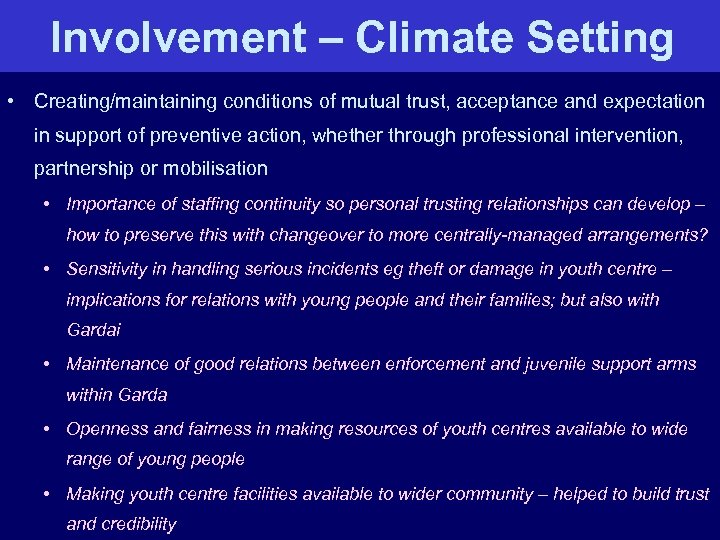 Involvement – Climate Setting • Creating/maintaining conditions of mutual trust, acceptance and expectation in support of preventive action, whether through professional intervention, partnership or mobilisation • Importance of staffing continuity so personal trusting relationships can develop – how to preserve this with changeover to more centrally-managed arrangements? • Sensitivity in handling serious incidents eg theft or damage in youth centre – implications for relations with young people and their families; but also with Gardai • Maintenance of good relations between enforcement and juvenile support arms within Garda • Openness and fairness in making resources of youth centres available to wide range of young people • Making youth centre facilities available to wider community – helped to build trust and credibility
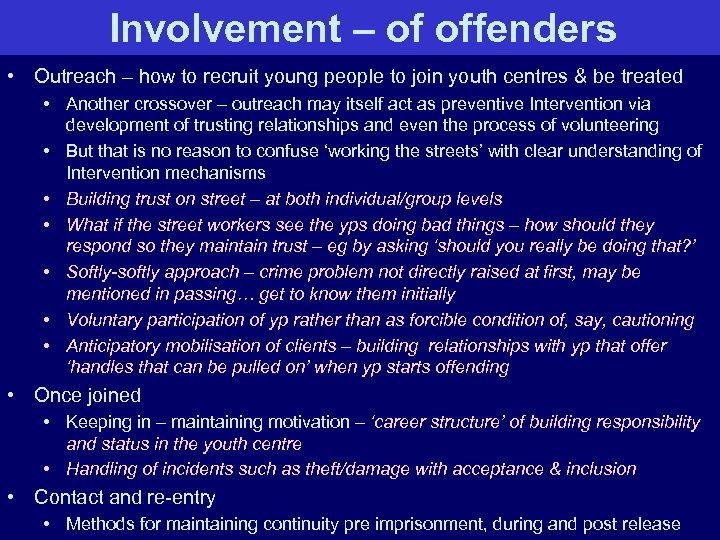 Involvement – of offenders • Outreach – how to recruit young people to join youth centres & be treated • Another crossover – outreach may itself act as preventive Intervention via development of trusting relationships and even the process of volunteering • But that is no reason to confuse ‘working the streets’ with clear understanding of Intervention mechanisms • Building trust on street – at both individual/group levels • What if the street workers see the yps doing bad things – how should they respond so they maintain trust – eg by asking ‘should you really be doing that? ’ • Softly-softly approach – crime problem not directly raised at first, may be mentioned in passing… get to know them initially • Voluntary participation of yp rather than as forcible condition of, say, cautioning • Anticipatory mobilisation of clients – building relationships with yp that offer ‘handles that can be pulled on’ when yp starts offending • Once joined • Keeping in – maintaining motivation – ‘career structure’ of building responsibility and status in the youth centre • Handling of incidents such as theft/damage with acceptance & inclusion • Contact and re-entry • Methods for maintaining continuity pre imprisonment, during and post release
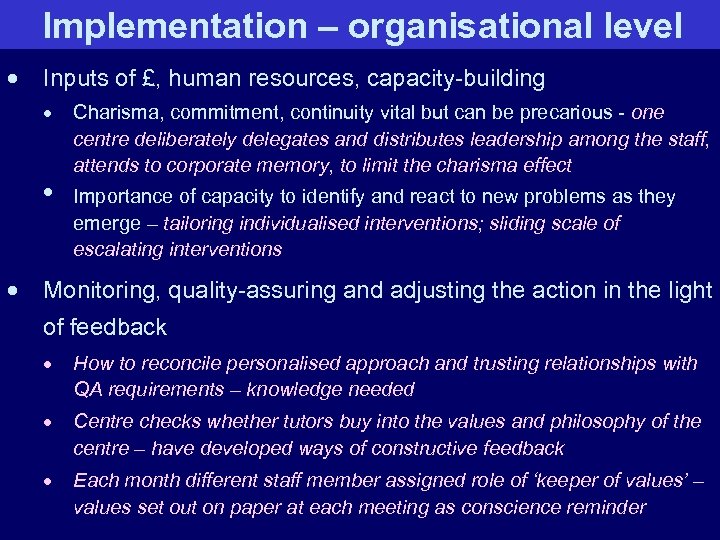 Implementation – organisational level · Inputs of £, human resources, capacity-building · • · Charisma, commitment, continuity vital but can be precarious - one centre deliberately delegates and distributes leadership among the staff, attends to corporate memory, to limit the charisma effect Importance of capacity to identify and react to new problems as they emerge – tailoring individualised interventions; sliding scale of escalating interventions Monitoring, quality-assuring and adjusting the action in the light of feedback · How to reconcile personalised approach and trusting relationships with QA requirements – knowledge needed · Centre checks whether tutors buy into the values and philosophy of the centre – have developed ways of constructive feedback · Each month different staff member assigned role of ‘keeper of values’ – values set out on paper at each meeting as conscience reminder
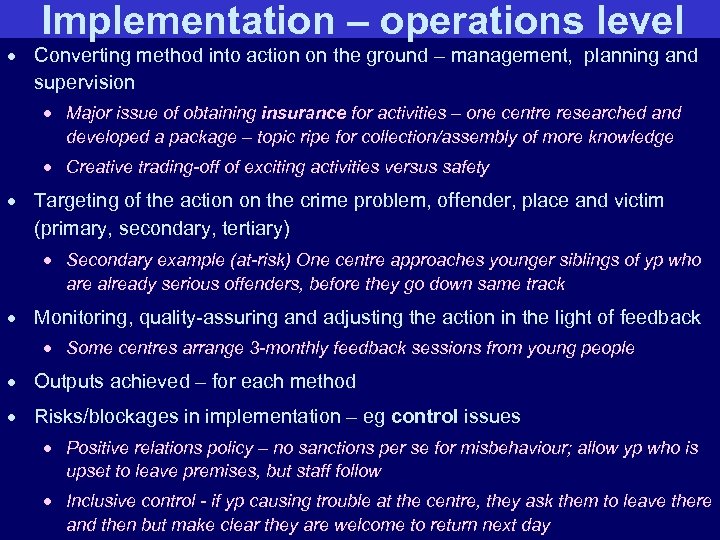 Implementation – operations level · Converting method into action on the ground – management, planning and supervision · Major issue of obtaining insurance for activities – one centre researched and developed a package – topic ripe for collection/assembly of more knowledge · Creative trading-off of exciting activities versus safety · Targeting of the action on the crime problem, offender, place and victim (primary, secondary, tertiary) · Secondary example (at-risk) One centre approaches younger siblings of yp who are already serious offenders, before they go down same track · Monitoring, quality-assuring and adjusting the action in the light of feedback · Some centres arrange 3 -monthly feedback sessions from young people · Outputs achieved – for each method · Risks/blockages in implementation – eg control issues · Positive relations policy – no sanctions per se for misbehaviour; allow yp who is upset to leave premises, but staff follow · Inclusive control - if yp causing trouble at the centre, they ask them to leave there and then but make clear they are welcome to return next day
 Impact - evaluation • Intermediate outcomes – eg young people maintain attendance at centre; successfully complete a qualification • Ultimate outcomes – back to multidimensional evaluative and selection criteria suggested before • Reduced involvement in crime • Wider harm reduction and positive benefit – got job, girlfriends, further education; area benefits too in terms of eg better service from firefighters • Good idea to develop a comprehensive list of likely harms and benefits from intervention for use across projects rather than each having to reinvent locally • Sustainability of implementation – continuity of staffing and approach; volunteer fatigue • Sustainability of impact – how long do benefits last? Fire and forget, or keep fixing problems? • Replicability – scope for application in different contexts • Of organisation • Of methods of handling young people as individual and group cases
 Knowledge collection issues • Much more information recorded than presented; impression of vast amount of practice knowledge out there waiting to be collected, scrutinised, refined and assembled, and shared • How to do this? Many ways but some suggestions: • Thematic focus groups of experienced practitioners meet to discuss and evaluate a quite specific topic (with ramifications for wider issues) – eg insurance for activity programmes, control of yp in youth centres • After Action Reviews (US Army; UK NHS) – where something goes well, or badly, local meeting to review good and bad aspects. Done in some centres – but needs extending to make conclusions available to other practitioners • In both cases an external facilitator important: • To hold the ring • To articulate generalisations in structured form that slot into knowledge framework (or modify it) and link to theory • To identify what is newsworthy in the mass of detail
 The question of complexity • Simplicity preferred, but… • Crime prevention/ community safety are complex • Einstein – As simple as possible but no simpler • Ashby’s Law of Requisite Variety – to understand complexity in reality, you have to have sufficient complexity in your model. • So: It’s futile dumbing down to communicate with practitioners, if what you communicate can’t deliver successful prevention. Or provide adequate foundation for research. • Any complexity must be appropriate and deliberate • Language must be sophisticated but communicable • 5 Is tackles this by Zoom Structure… and will use more communications design techniques for V. 2 • Interactive graphical version a possibility • 5 Is is best learned as primary schema for prevention
 Finally. . . Philosophy • High investment in training, guidance and other infrastructure and capacity building leads to High return in successful performance of crime prevention/ community safety/ Problem-Oriented Policing • Major factor behind this is richness of information captured in evaluations • And systematic collection and organisation of knowledge for sharing, for policy, delivery and practice
 Where to find information on 5 Is, CCO and more www. designagainstcrime. com Click on crimeframeworks Please send comments, suggest improvements or participate in development! p. ekblom@csm. arts. ac. uk