Скачать презентацию Capturing and Applying Existing Knowledge to Semantic Applications
3c208de6bdfb6b53153c28c5735f5a0b.ppt
- Количество слайдов: 52
 Capturing and Applying Existing Knowledge to Semantic Applications or Ontology-driven Information Systems in Action Invited Talk “Sharing the Knowledge” International CIDOC CRM Symposium Washington DC, March 26 - 27, 2003 Amit Sheth Semagix, Inc. and LSDIS Lab, University of Georgia
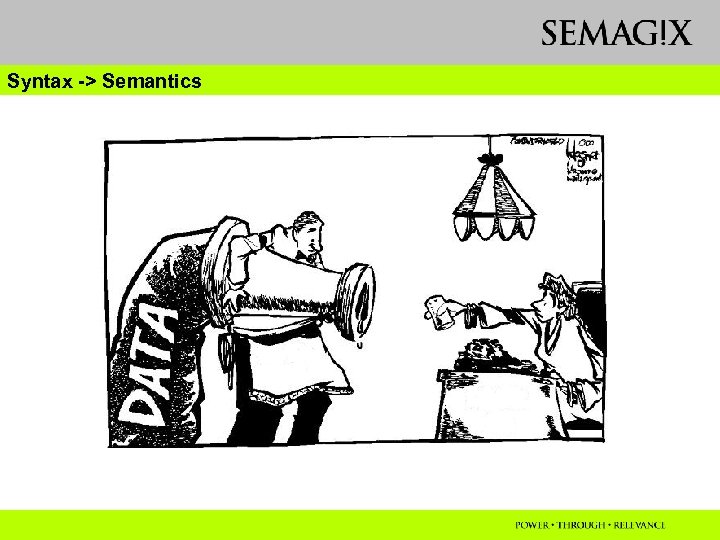 Syntax -> Semantics
 Ontology-driven Information Systems are becoming reality Software and practical tools to support key capabilities and requirements for such a system are now available: u Ontology creation and maintenance u Knowledge-based (and other techniques) supporting Automatic Classification u Ontology-driven Semantic Metadata Extraction/Annotation and u Semantic normalization u Utilizing semantic metadata and ontology u Semantic querying/browsing/analysis u Information and application integration Achieved in the context of successful technology transfer from academic research (LSDIS lab, UGA’s SCORE technology) into commercial product (Semagix’s Freedom)
 Ontology at the heart of the Semantic Web; Relationships at the heart of Semantics Ontology provides underpinning for semantic techniques in information systems. u A model/representation of the real world (relevant concepts, entities, attributes, relationships, domain vocabulary and factual knowledge, all connected via a semantic network). Basic of agreement, applying knowledge u Enabler for improved information systems functionalities and the Semantic Web: u Relevant information by (semantic) Search, Browsing u Actionable information by (semantic) information correlation and analysis u Interoperability and Integration u Relationships – what makes ontologies richer (more semantic) than taxonomies … see “Relationships at the Heart of Semantic Web: Modeling, Discovering, Validating and Exploiting Complex Semantic Relationship
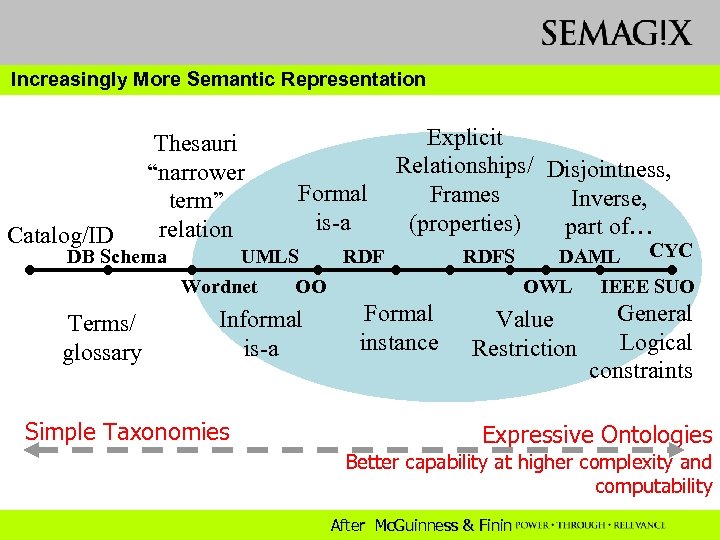 Increasingly More Semantic Representation Catalog/ID Thesauri “narrower term” relation DB Schema UMLS Wordnet Terms/ glossary Formal is-a RDFS OO Informal is-a Simple Taxonomies Explicit Relationships/ Disjointness, Frames Inverse, (properties) part of… DAML CYC OWL Formal instance IEEE SUO Value Restriction General Logical constraints Expressive Ontologies Better capability at higher complexity and computability After Mc. Guinness & Finin
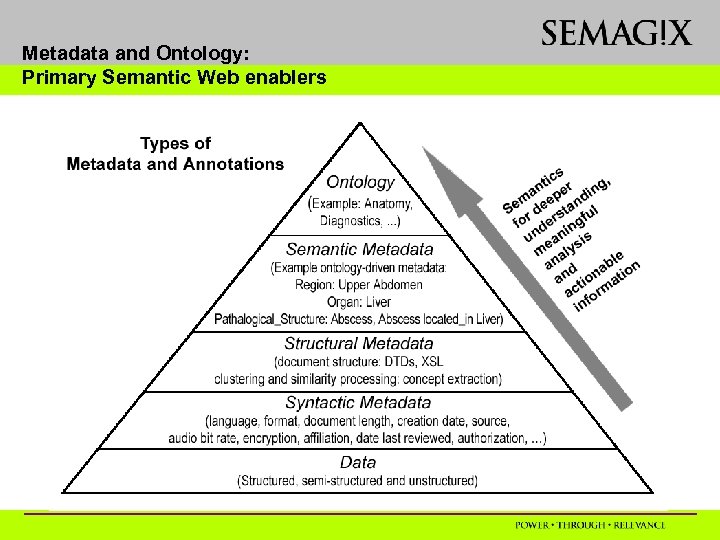 Metadata and Ontology: Primary Semantic Web enablers
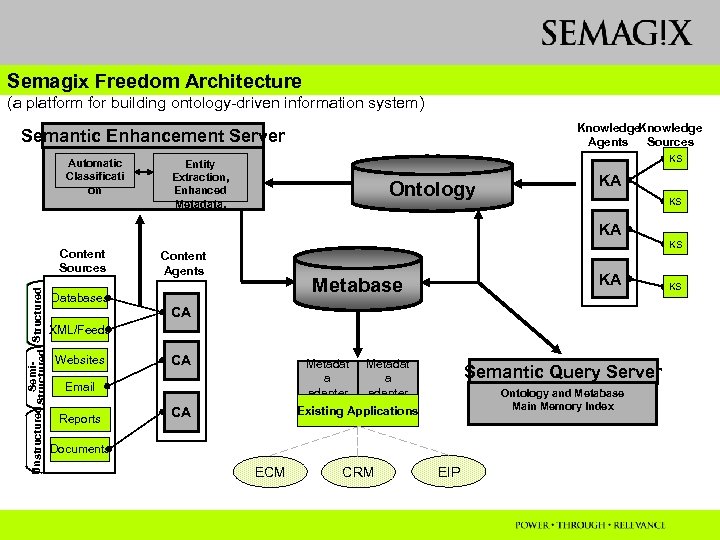 Semagix Freedom Architecture (a platform for building ontology-driven information system) Knowledge Agents Sources Semantic Enhancement Server Automatic Classificati on KS Entity Extraction, Enhanced Metadata, Ontology KA KS KA Semi. Unstructured Structured Content Sources Databases KS Content Agents KA Metabase CA XML/Feeds Websites CA Metadat a adapter Email Reports Metadat a adapter Semantic Query Server Ontology and Metabase Main Memory Index Existing Applications CA Documents ECM CRM EIP KS
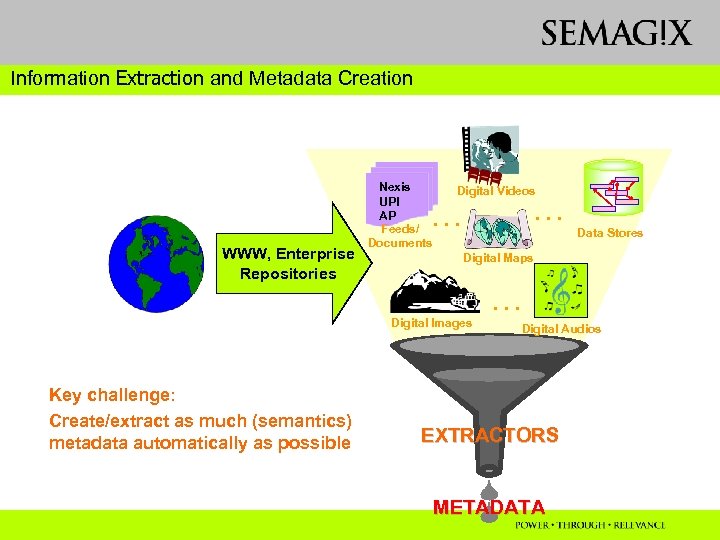 Information Extraction and Metadata Creation WWW, Enterprise Repositories Nexis UPI AP Feeds/ Documents Digital Videos . . . Data Stores Digital Maps . . . Digital Images Key challenge: Create/extract as much (semantics) metadata automatically as possible Digital Audios EXTRACTORS METADATA
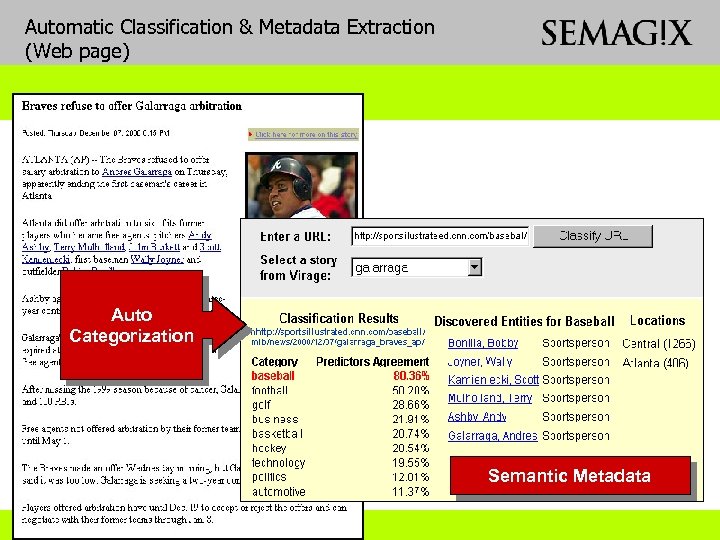 Automatic Classification & Metadata Extraction (Web page) Video with Editorialized Text on the Web Auto Categorization Semantic Metadata
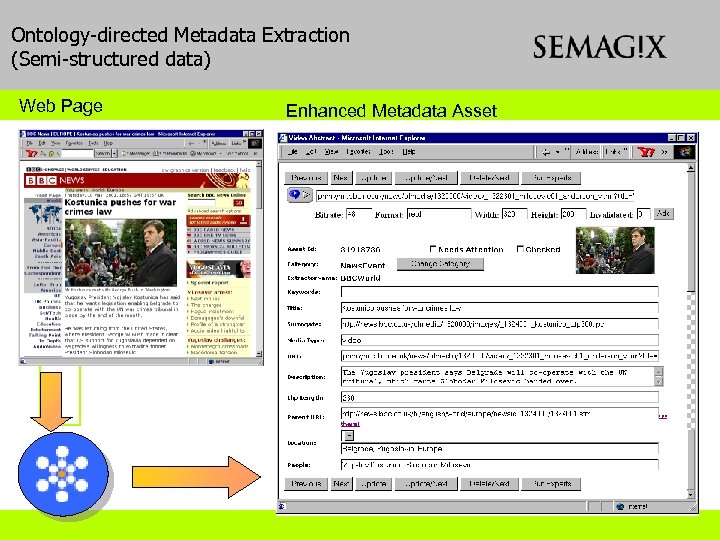 Ontology-directed Metadata Extraction (Semi-structured data) Web Page Enhanced Metadata Asset Extraction Agent
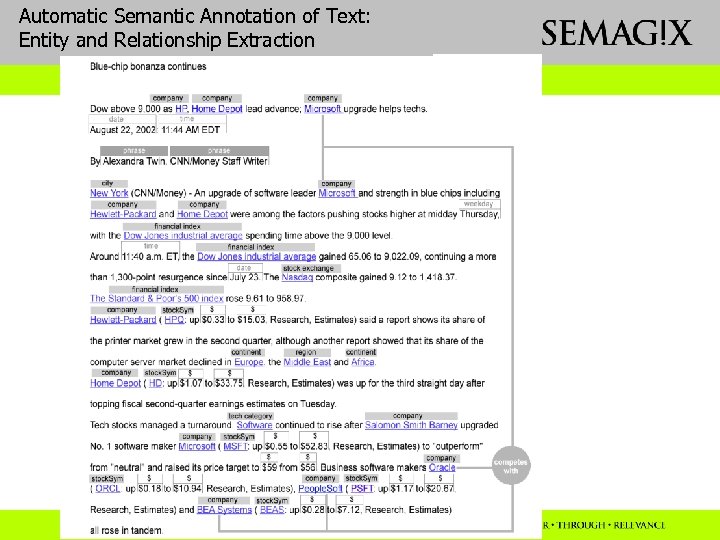 Automatic Semantic Annotation of Text: Entity and Relationship Extraction
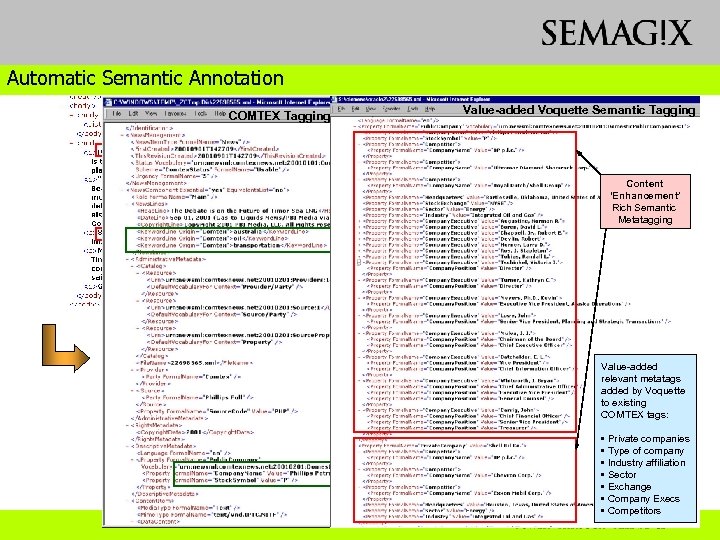 Automatic Semantic Annotation COMTEX Tagging Value-added Voquette Semantic Tagging Content ‘Enhancement’ Rich Semantic Metatagging Limited tagging (mostly syntactic) Value-added relevant metatags added by Voquette to existing COMTEX tags: • Private companies • Type of company • Industry affiliation • Sector • Exchange • Company Execs • Competitors
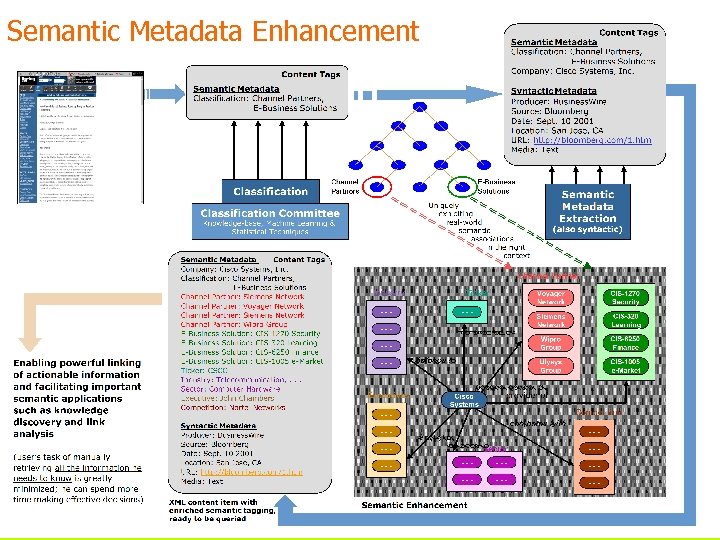 Semantic Metadata Enhancement
 The CIDOC CRM can be an excellent starting point for building the Semantic Web and ontology-driven information system for exchange, interoperability, integration of data/information and knowledge in the area of scientific and cultural heritage.
 Types of Ontologies (or things close to ontology) u Upper ontologies: modeling of time, space, process, etc u Broad-based or general purpose ontology/nomenclatures: Cyc, CIRCA ontology (Applied Semantics), Word. Net u Domain-specific or Industry specific ontologies u News: politics, sports, business, entertainment u Financial Market u Terrorism u (GO (a nomenclature), UMLS inspired ontology, …) u Application Specific and Task specific ontologies u Anti-money laundering u Equity Research
 Practical Questions (for developing typical industry and application ontologies) u Is there a typical ontology? u Three broad approaches: social process/manual: many years, committees u automatic taxonomy generation (statistical clustering/NLP): limitation/problems on quality, dependence on corpus, naming u Descriptional component (schema) designed by domain experts; Assertional component (extension) by automated processes u How do you develop ontology (methodology)? u People (expertise), time, money u Ontology maintenance u
 Practical Ontology Development Observation by Semagix u Ontologies Semagix has designed: u Few classes to many tens (few hundreds) of classes and relationships (types); very small number of designers/knowledge experts; descriptional component (schema) designed with GUI u Hundreds of thousands to several millions entities and relationships (instances/assertions) u Tens of knowledge sources; populated by knowledge extractors u Primary scientific challenges faced: entity ambiguity resolution and data cleanup u Total effort: few person weeks
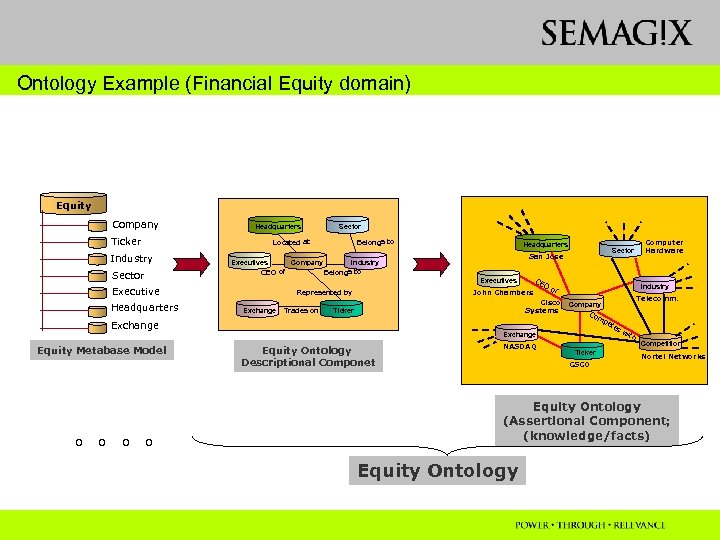 Ontology Example (Financial Equity domain) Equity Company Ticker Headquarters Sector Belongs to Located at Industry Sector Headquarters Exchange Trades on John Chambers Equity Metabase Model o o O Computer Hardware Industry of Cisco Systems Ticker Company Co mp Telecomm. ete Exchange o CE Executives Represented by Sector San Jose Executives Company Industry CEO of Belongs to Executive o Headquarters Exchange Equity Ontology Descriptional Componet NASDAQ Ticker CSCO sw ith Competition Nortel Networks Equity Ontology (Assertional Component; (knowledge/facts) Equity Ontology
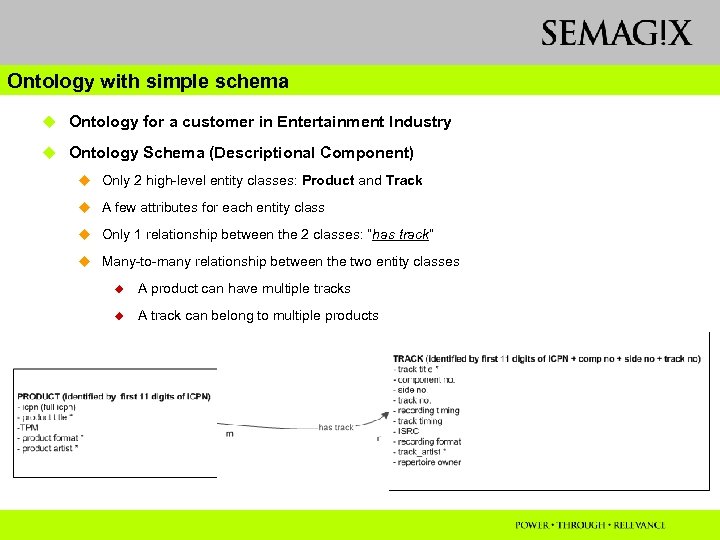 Ontology with simple schema u Ontology for a customer in Entertainment Industry u Ontology Schema (Descriptional Component) u Only 2 high-level entity classes: Product and Track u A few attributes for each entity class u Only 1 relationship between the 2 classes: “has track” u Many-to-many relationship between the two entity classes u A product can have multiple tracks u A track can belong to multiple products
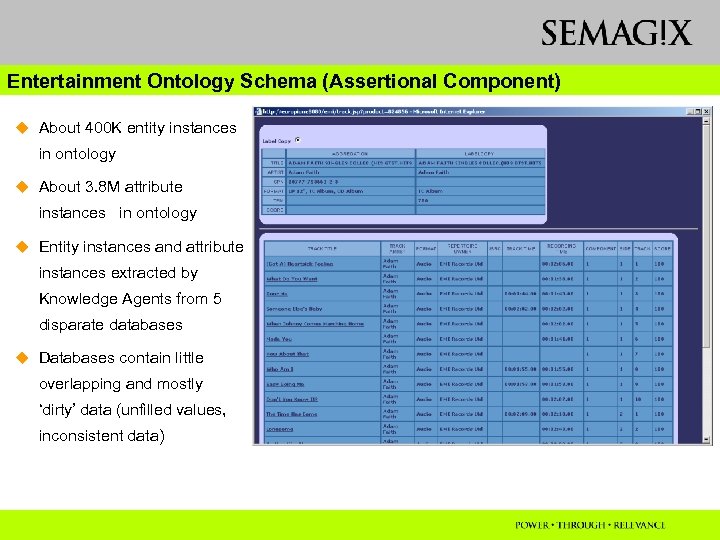 Entertainment Ontology Schema (Assertional Component) u About 400 K entity instances in ontology u About 3. 8 M attribute instances in ontology u Entity instances and attribute instances extracted by Knowledge Agents from 5 disparate databases u Databases contain little overlapping and mostly ‘dirty’ data (unfilled values, inconsistent data)
 Technical Challenges Faced u Extremely ‘dirty’ data u Inconsistent field values u Unfilled field values u Field values appearing to mean the same, but are different u Non-normalized Data u Same field value referred to, in several different ways u Upper case vs. Lower case text analysis u Modelling the ontology so that appropriate level (not too much, not too less) of information is modelled u Optimizing the storage of the huge data u How to load it into Freedom (currently distributed across 3 servers) u Scoring and pre-processing parameters changed frequently by customer, necessitating constant update of algorithm u Efficiency measures
 Effort Involved u Ontology Schema Build-Out (descriptional component) Essentially an iterative approach to refining the ontology schema based on periodic customer feedback u Very little technical effort (hours), but due to iterative decision making process with the multi-national customer, overall finalization of ontology took 3 -4 weeks to complete Ontology Population (assertional component/knowledge base) u 5 Knowledge Agents, one for each database u Automated ontology population using Knowledge Agents took no longer than a day for all the Agents
 Example of Ontology with complex schema u Ontology for Anti-money Laundering (AML) application in Financial Industry u Ontology Schema (Descriptional Component) u About 40 entity classes u About 100 attribute types u About 50 relationship types between entity classes
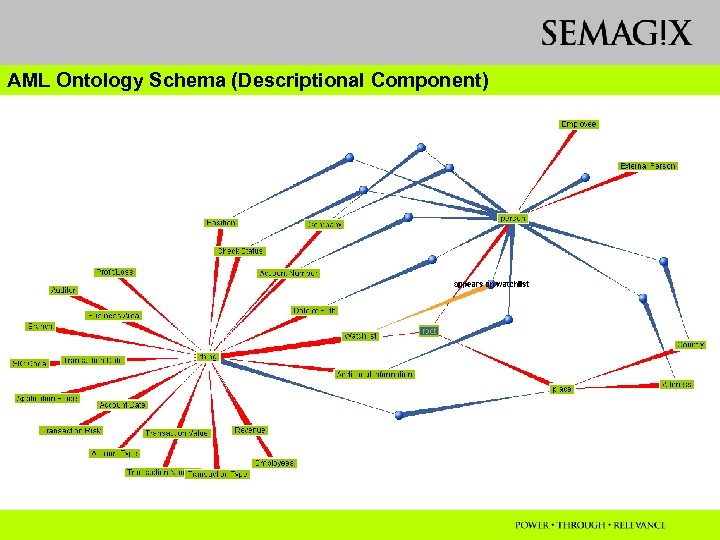 AML Ontology Schema (Descriptional Component)
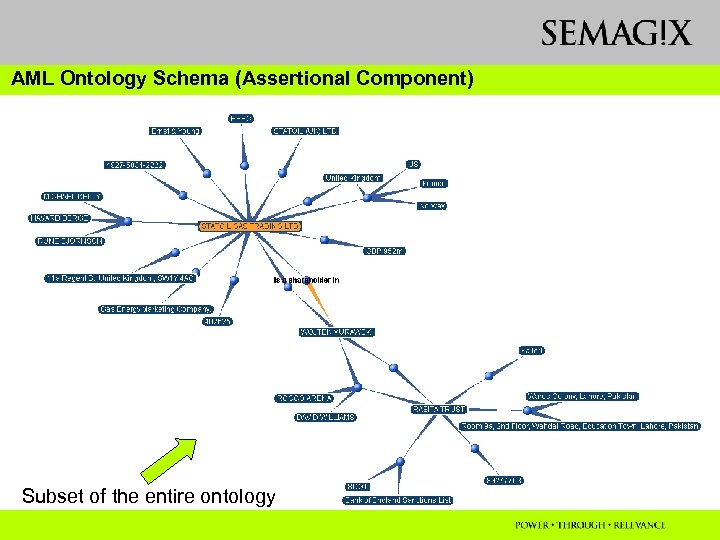 AML Ontology Schema (Assertional Component) Subset of the entire ontology
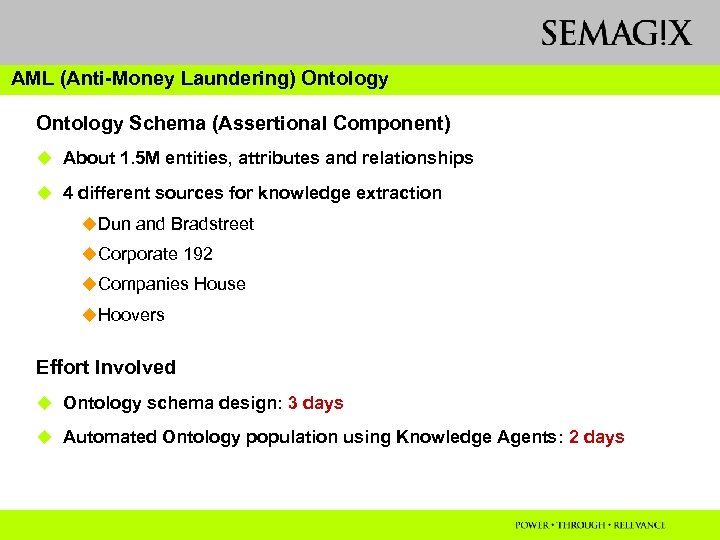 AML (Anti-Money Laundering) Ontology Schema (Assertional Component) u About 1. 5 M entities, attributes and relationships u 4 different sources for knowledge extraction u. Dun and Bradstreet u. Corporate 192 u. Companies House u. Hoovers Effort Involved u Ontology schema design: 3 days u Automated Ontology population using Knowledge Agents: 2 days
 Technical Challenges Faced u Complex ambiguity resolution at entity extraction time u Modelling the ontology so that appropriate level (not too much, not too less) of information is modelled u Knowledge extraction from sources that needed extended cookie/HTTPS handling u Programming ontology modelling through API u Chalking out a balanced risk algorithm based on numerous parameters involved
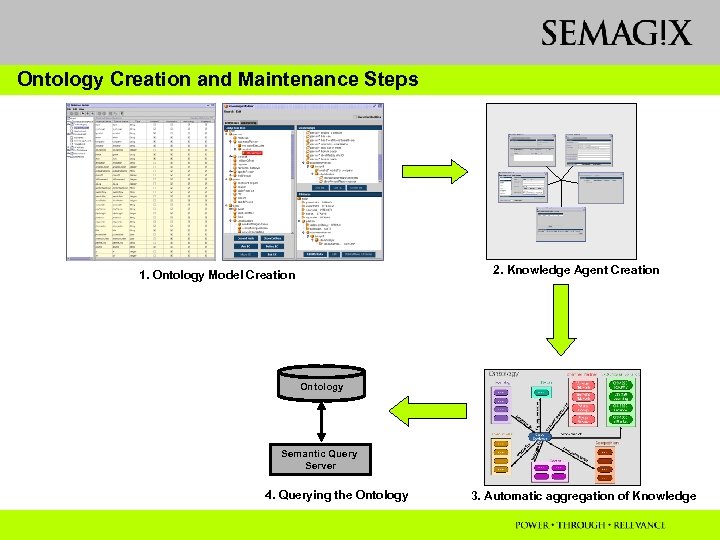 Ontology Creation and Maintenance Steps 2. Knowledge Agent Creation 1. Ontology Model Creation Ontology Semantic Query Server 4. Querying the Ontology 3. Automatic aggregation of Knowledge
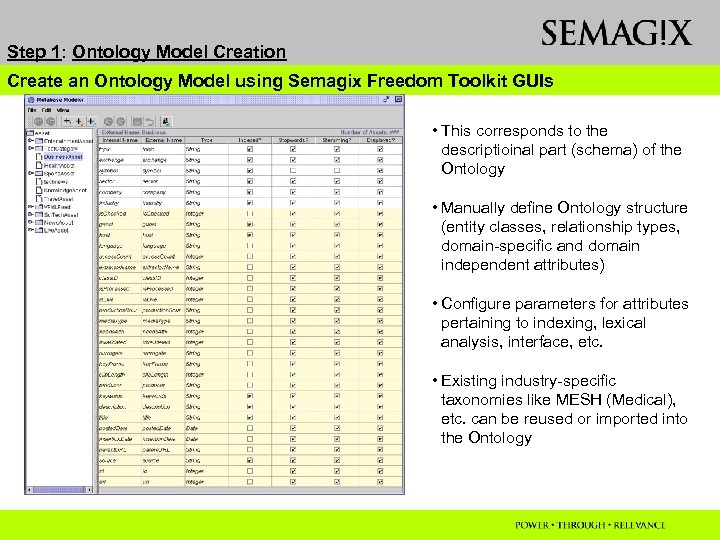 Step 1: Ontology Model Creation Create an Ontology Model using Semagix Freedom Toolkit GUIs • This corresponds to the descriptioinal part (schema) of the Ontology • Manually define Ontology structure (entity classes, relationship types, domain-specific and domain independent attributes) • Configure parameters for attributes pertaining to indexing, lexical analysis, interface, etc. • Existing industry-specific taxonomies like MESH (Medical), etc. can be reused or imported into the Ontology
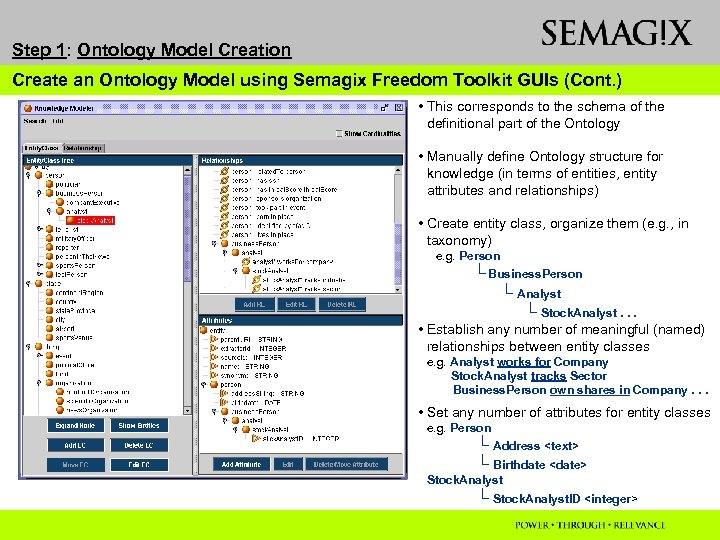 Step 1: Ontology Model Creation Create an Ontology Model using Semagix Freedom Toolkit GUIs (Cont. ) • This corresponds to the schema of the definitional part of the Ontology • Manually define Ontology structure for knowledge (in terms of entities, entity attributes and relationships) • Create entity class, organize them (e. g. , in taxonomy) e. g. Person └ Business. Person └ Analyst └ Stock. Analyst. . . • Establish any number of meaningful (named) relationships between entity classes e. g. Analyst works for Company Stock. Analyst tracks Sector Business. Person own shares in Company. . . • Set any number of attributes for entity classes e. g. Person └ Address
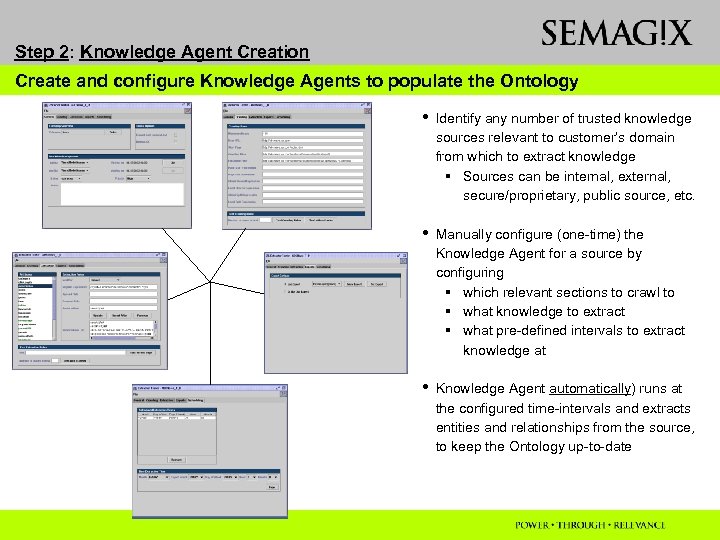 Step 2: Knowledge Agent Creation Create and configure Knowledge Agents to populate the Ontology • Identify any number of trusted knowledge sources relevant to customer’s domain from which to extract knowledge § Sources can be internal, external, secure/proprietary, public source, etc. • Manually configure (one-time) the Knowledge Agent for a source by configuring § which relevant sections to crawl to § what knowledge to extract § what pre-defined intervals to extract knowledge at • Knowledge Agent automatically) runs at the configured time-intervals and extracts entities and relationships from the source, to keep the Ontology up-to-date
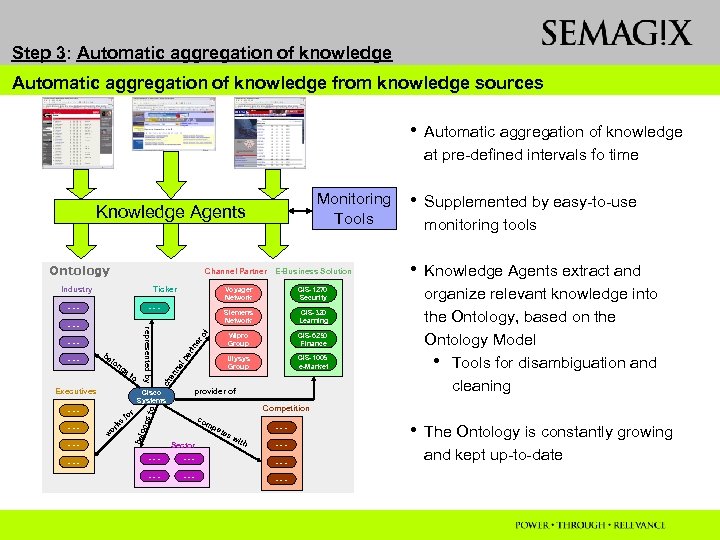 Step 3: Automatic aggregation of knowledge from knowledge sources • Automatic aggregation of knowledge at pre-defined intervals fo time Monitoring Tools Knowledge Agents Ontology Channel Partner E-Business Solution Industry Ticker s to Executives --- of provider of Competition co mp ong ks or w bel --- r fo CIS-1005 e-Market er Cisco Systems ----- Ulysys Group pa rtn ng CIS-6250 Finance ne l be lo s to --- organize relevant knowledge into the Ontology, based on the Ontology Model • Tools for disambiguation and cleaning CIS-320 Learning Wipro Group • Knowledge Agents extract and an --- represented by --- monitoring tools CIS-1270 Security Siemens Network --- ch --- Voyager Network • Supplemented by easy-to-use Sector ete --- sw ith --- --- • The Ontology is constantly growing and kept up-to-date
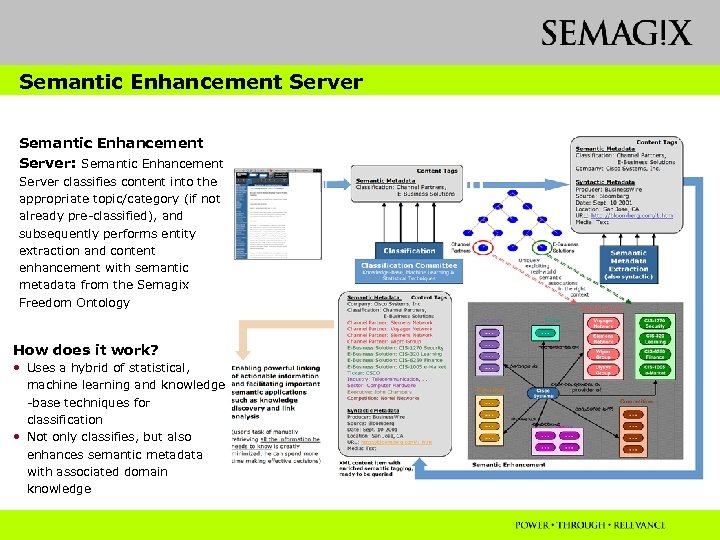 Semantic Enhancement Server: Semantic Enhancement Server classifies content into the appropriate topic/category (if not already pre-classified), and subsequently performs entity extraction and content enhancement with semantic metadata from the Semagix Freedom Ontology How does it work? • Uses a hybrid of statistical, machine learning and knowledge -base techniques for classification • Not only classifies, but also enhances semantic metadata with associated domain knowledge
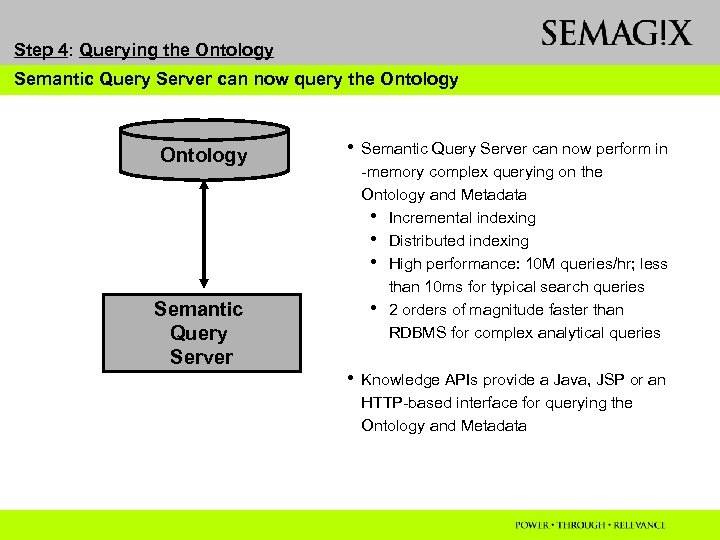 Step 4: Querying the Ontology Semantic Query Server can now query the Ontology Semantic Query Server • Semantic Query Server can now perform in -memory complex querying on the Ontology and Metadata • Incremental indexing • Distributed indexing • High performance: 10 M queries/hr; less than 10 ms for typical search queries • 2 orders of magnitude faster than RDBMS for complex analytical queries • Knowledge APIs provide a Java, JSP or an HTTP-based interface for querying the Ontology and Metadata
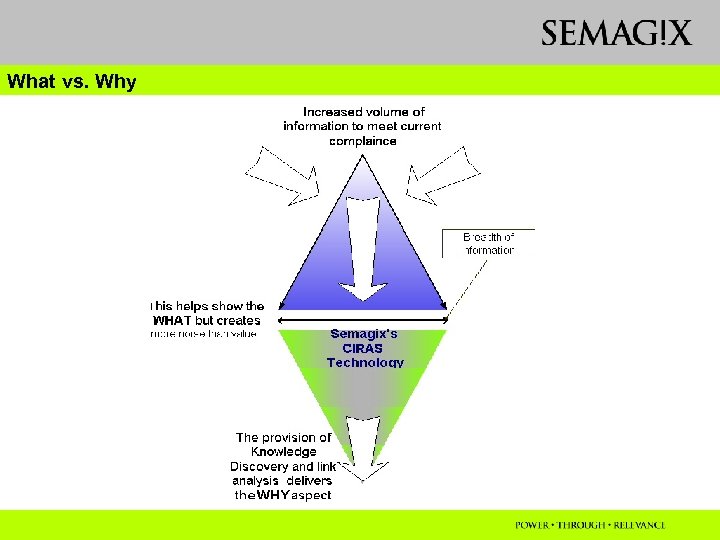
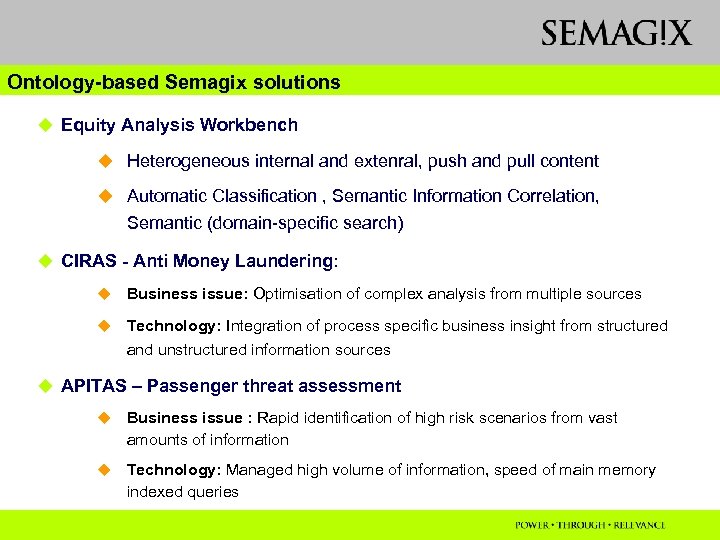 Ontology-based Semagix solutions u Equity Analysis Workbench u Heterogeneous internal and extenral, push and pull content u Automatic Classification , Semantic Information Correlation, Semantic (domain-specific search) u CIRAS - Anti Money Laundering: u Business issue: Optimisation of complex analysis from multiple sources u Technology: Integration of process specific business insight from structured and unstructured information sources u APITAS – Passenger threat assessment u Business issue : Rapid identification of high risk scenarios from vast amounts of information u Technology: Managed high volume of information, speed of main memory indexed queries
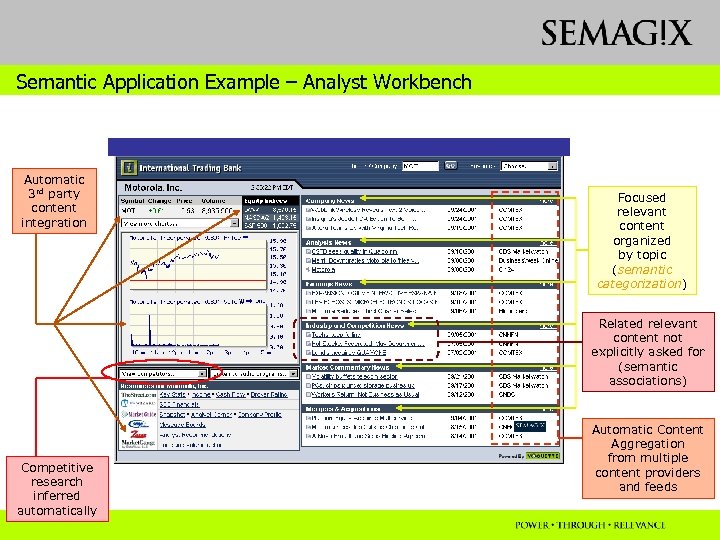 Semantic Application Example – Analyst Workbench Automatic 3 rd party content integration Focused relevant content organized by topic (semantic categorization) Related relevant content not explicitly asked for (semantic associations) Competitive research inferred automatically Automatic Content Aggregation from multiple content providers and feeds
 CIRAS - Anti Money Laundering (Know Your Customer – KYC)
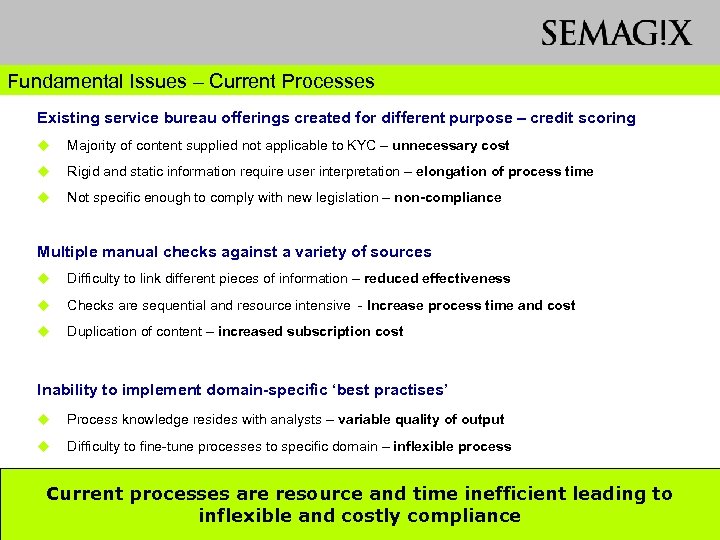 Fundamental Issues – Current Processes Existing service bureau offerings created for different purpose – credit scoring u Majority of content supplied not applicable to KYC – unnecessary cost u Rigid and static information require user interpretation – elongation of process time u Not specific enough to comply with new legislation – non-compliance Multiple manual checks against a variety of sources u Difficulty to link different pieces of information – reduced effectiveness u Checks are sequential and resource intensive - Increase process time and cost u Duplication of content – increased subscription cost Inability to implement domain-specific ‘best practises’ u Process knowledge resides with analysts – variable quality of output u Difficulty to fine-tune processes to specific domain – inflexible process Current processes are resource and time inefficient leading to inflexible and costly compliance
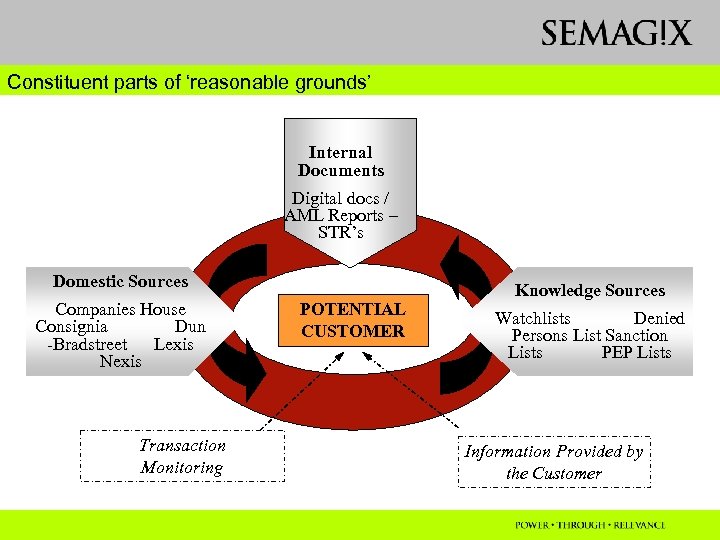 Constituent parts of ‘reasonable grounds’ Internal Documents Digital docs / AML Reports – STR’s Domestic Sources Companies House Consignia Dun -Bradstreet Lexis Nexis Transaction Monitoring POTENTIAL CUSTOMER Knowledge Sources Watchlists Denied Persons List Sanction Lists PEP Lists Information Provided by the Customer
 What vs. Why
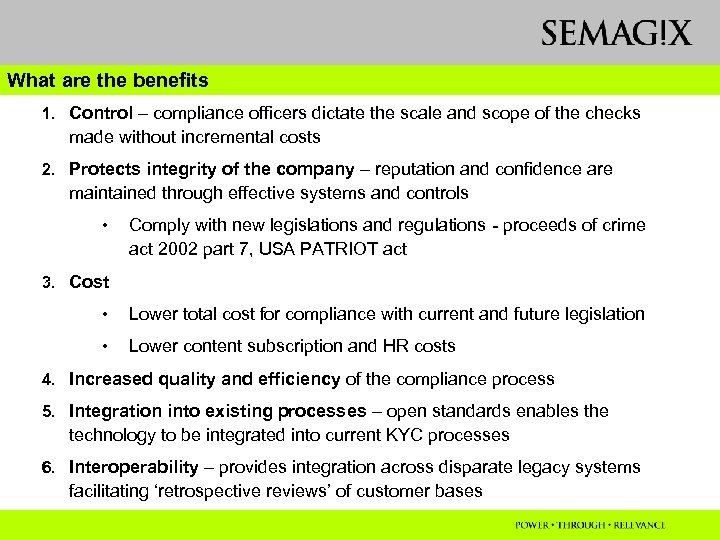 What are the benefits 1. Control – compliance officers dictate the scale and scope of the checks made without incremental costs 2. Protects integrity of the company – reputation and confidence are maintained through effective systems and controls • Comply with new legislations and regulations - proceeds of crime act 2002 part 7, USA PATRIOT act 3. Cost • Lower total cost for compliance with current and future legislation • Lower content subscription and HR costs 4. Increased quality and efficiency of the compliance process 5. Integration into existing processes – open standards enables the technology to be integrated into current KYC processes 6. Interoperability – provides integration across disparate legacy systems facilitating ‘retrospective reviews’ of customer bases
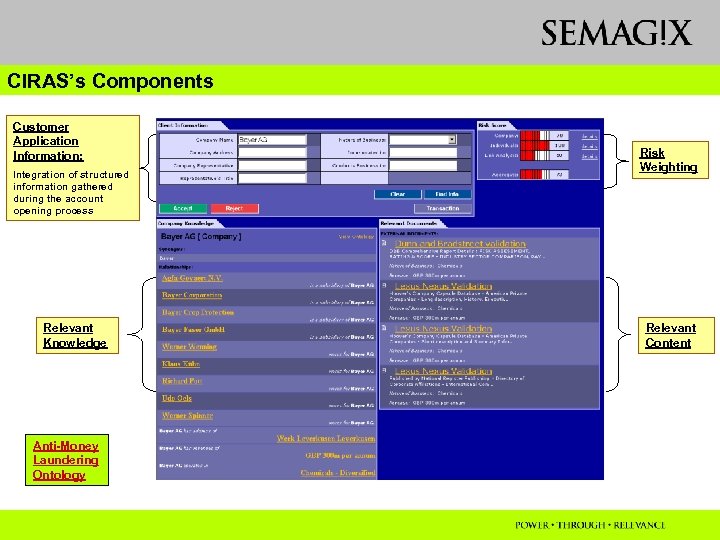 CIRAS’s Components Customer Application Information: Integration of structured information gathered during the account opening process Relevant Knowledge Anti-Money Laundering Ontology Risk Weighting Relevant Content
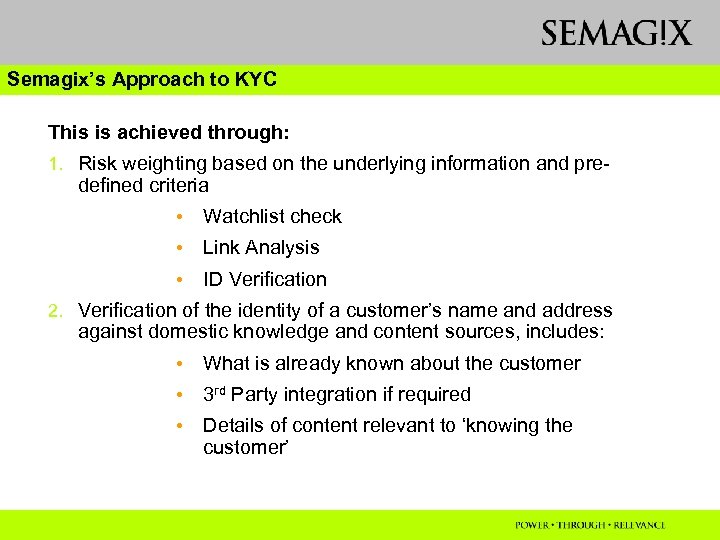 Semagix’s Approach to KYC This is achieved through: 1. Risk weighting based on the underlying information and pre- defined criteria • Watchlist check • Link Analysis • ID Verification 2. Verification of the identity of a customer’s name and address against domestic knowledge and content sources, includes: • What is already known about the customer • 3 rd Party integration if required • Details of content relevant to ‘knowing the customer’
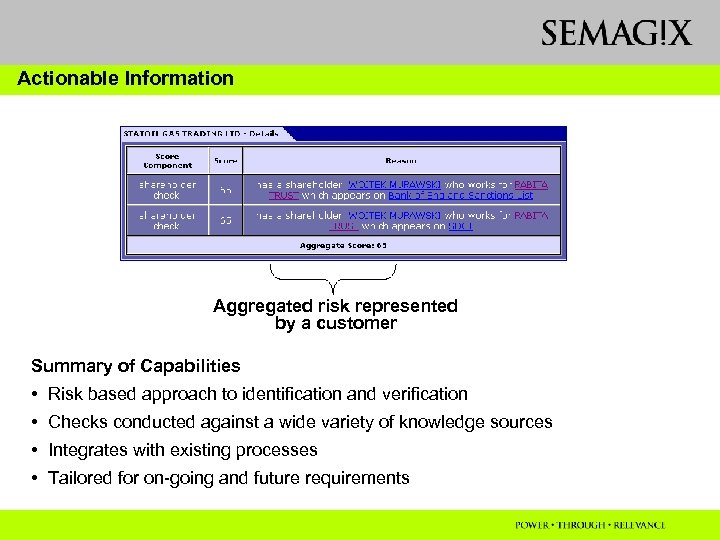 Actionable Information Aggregated risk represented by a customer Summary of Capabilities • Risk based approach to identification and verification • Checks conducted against a wide variety of knowledge sources • Integrates with existing processes • Tailored for on-going and future requirements
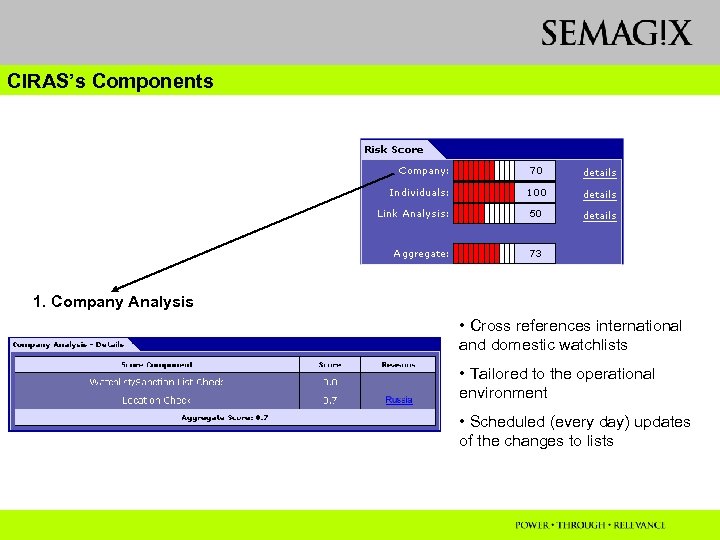 CIRAS’s Components 1. Company Analysis • Cross references international and domestic watchlists • Tailored to the operational environment • Scheduled (every day) updates of the changes to lists
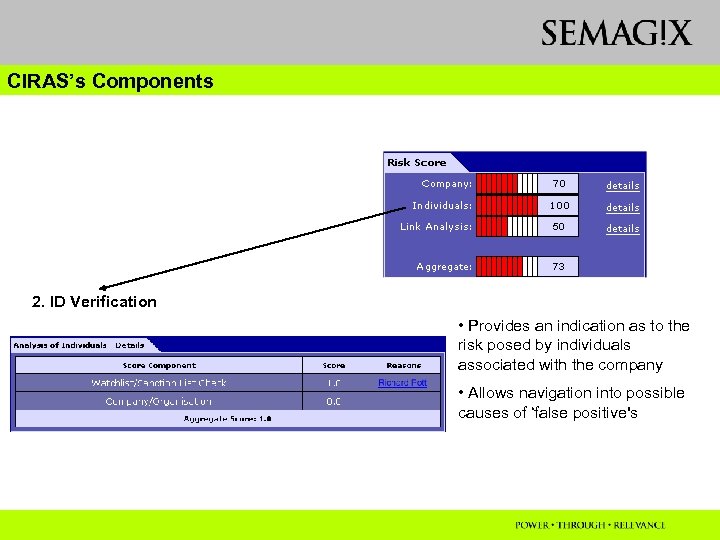 CIRAS’s Components 2. ID Verification • Provides an indication as to the risk posed by individuals associated with the company • Allows navigation into possible causes of ‘false positive's
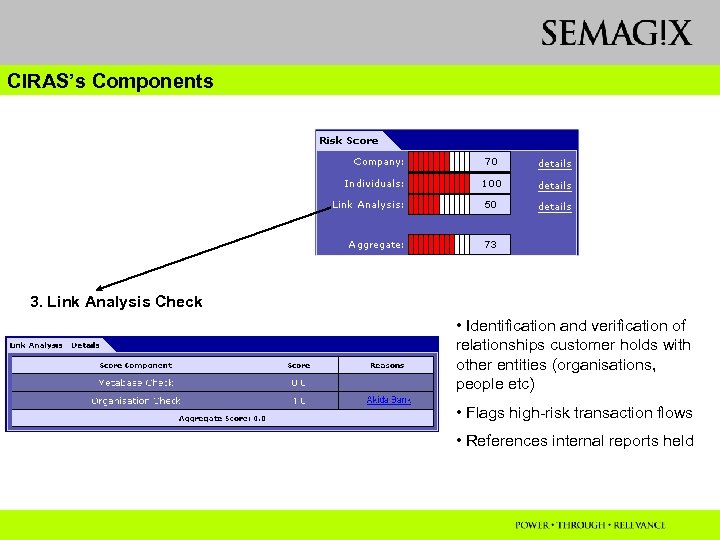 CIRAS’s Components 3. Link Analysis Check • Identification and verification of relationships customer holds with other entities (organisations, people etc) • Flags high-risk transaction flows • References internal reports held
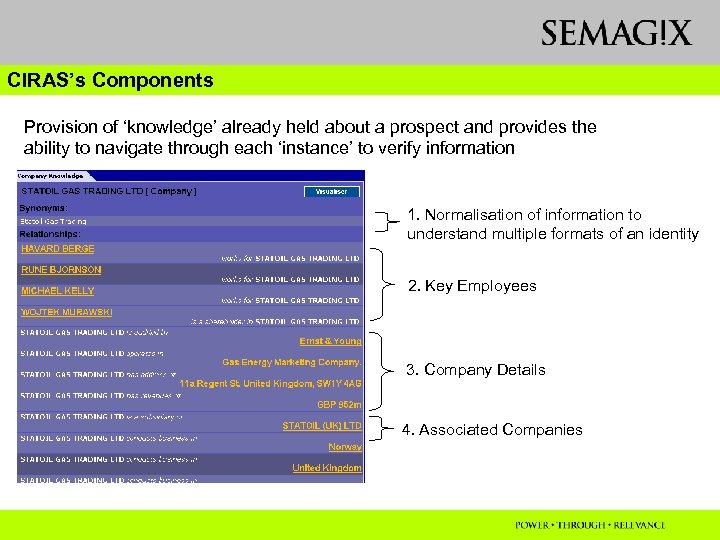 CIRAS’s Components Provision of ‘knowledge’ already held about a prospect and provides the ability to navigate through each ‘instance’ to verify information 1. Normalisation of information to understand multiple formats of an identity 2. Key Employees 3. Company Details 4. Associated Companies
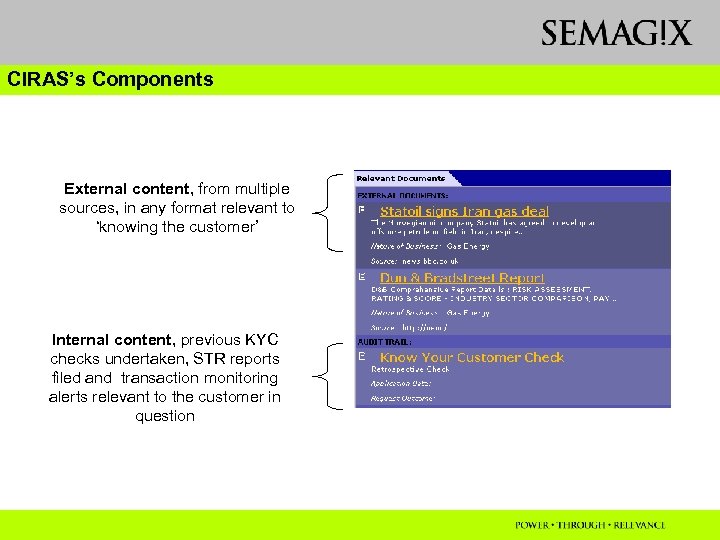 CIRAS’s Components External content, from multiple sources, in any format relevant to ‘knowing the customer’ Internal content, previous KYC checks undertaken, STR reports filed and transaction monitoring alerts relevant to the customer in question
 Current applications of the technology u CIRAS - Anti Money Laundering u Passenger Threat Assessment System External demo page
 About Semagix, through a patented semantic approach to Enterprise Information Integration (EII), allows enterprises to integrate and extract insights from their structured and unstructured information assets in order to conceive and develop smarter business processes and applications