 Скачать презентацию Captive Breeding and Reintroduction 4 Once the limiting
4bc8abc6818c76777f21783a9799cf42.ppt
- Количество слайдов: 54



Captive Breeding and Reintroduction 4 Once the limiting factors have been addressed it might be time for intensive management – last resort – expensive – difficult to make succeed • Beck et al. 1994 -- 11% successful • Griffith et al. 1989 -- 19% successful – requires large, long-term effort in captivity and the wild
Typical Questions About Captive Propagation 4 Is it necessary? 4 Is it successful and worth it? 4 How do you do it? – Technical questions about breeding, rearing, and release
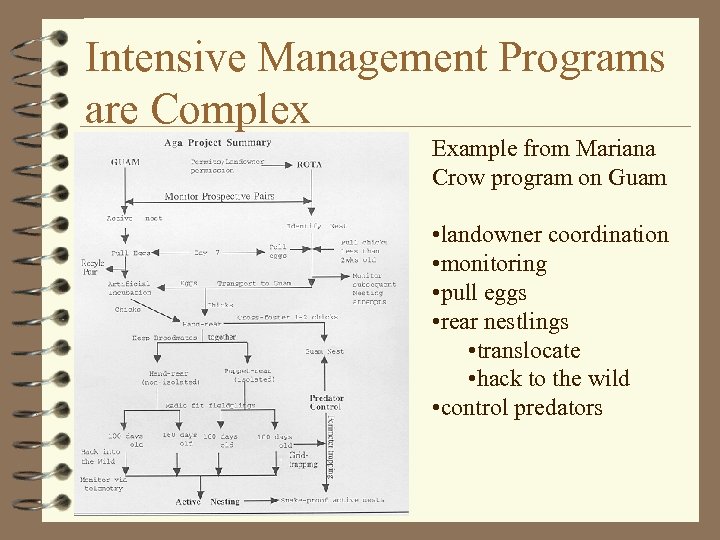
Intensive Management Programs are Complex Example from Mariana Crow program on Guam • landowner coordination • monitoring • pull eggs • rear nestlings • translocate • hack to the wild • control predators
Why Captive Breed? 4 Produce stock for reintroduction (Wilson and Stanley Price 1994) 4 Preserve genetic variability 4 Produce stock for research 4 Produce animals for public education 4 Provide insurance against extinction – alala pva
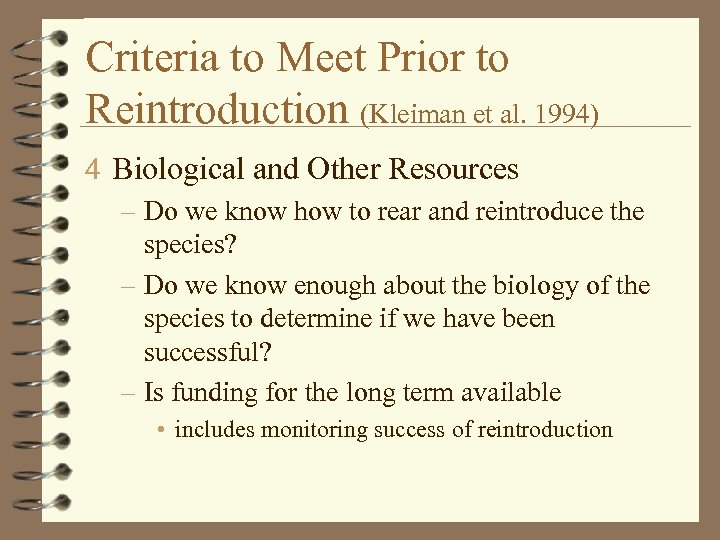
Criteria to Meet Prior to Reintroduction (Kleiman et al. 1994) 4 Biological and Other Resources – Do we know how to rear and reintroduce the species? – Do we know enough about the biology of the species to determine if we have been successful? – Is funding for the long term available • includes monitoring success of reintroduction
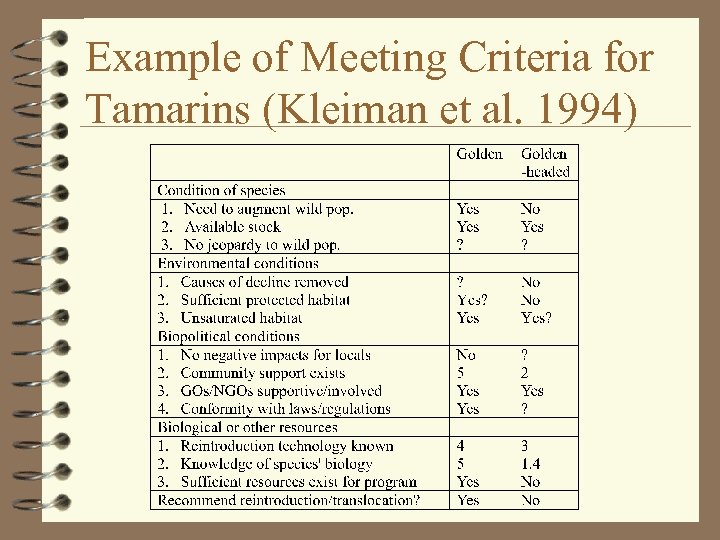
Example of Meeting Criteria for Tamarins (Kleiman et al. 1994)
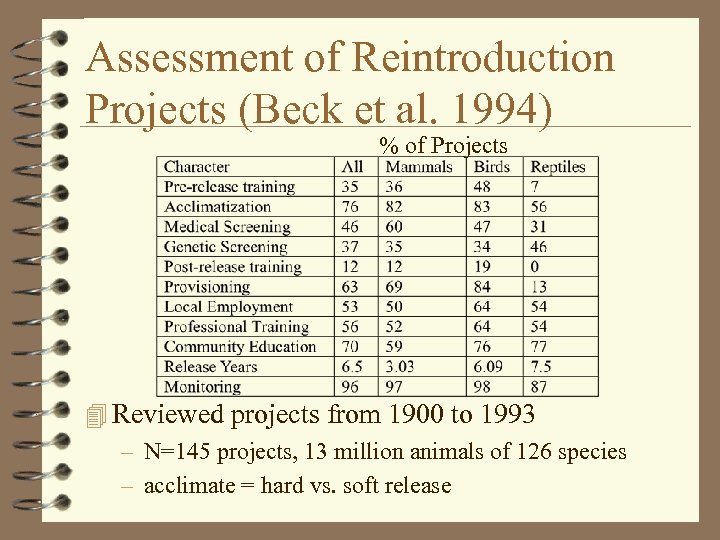
Assessment of Reintroduction Projects (Beck et al. 1994) % of Projects 4 Reviewed projects from 1900 to 1993 – N=145 projects, 13 million animals of 126 species – acclimate = hard vs. soft release
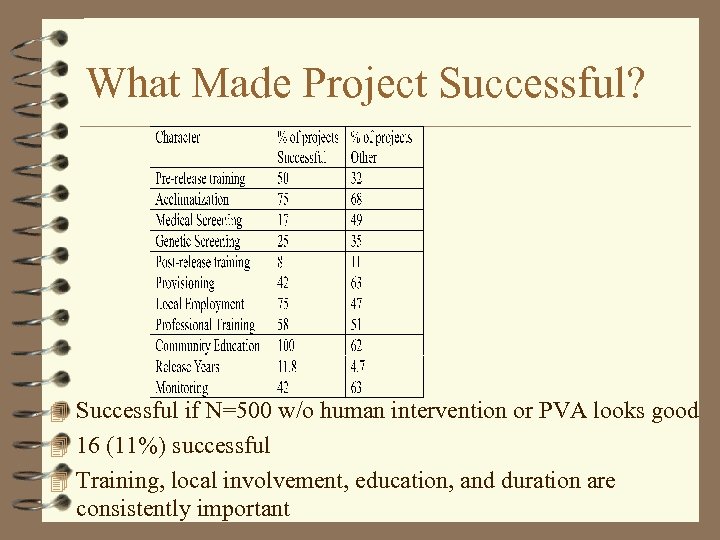
What Made Project Successful? 4 Successful if N=500 w/o human intervention or PVA looks good 4 16 (11%) successful 4 Training, local involvement, education, and duration are consistently important
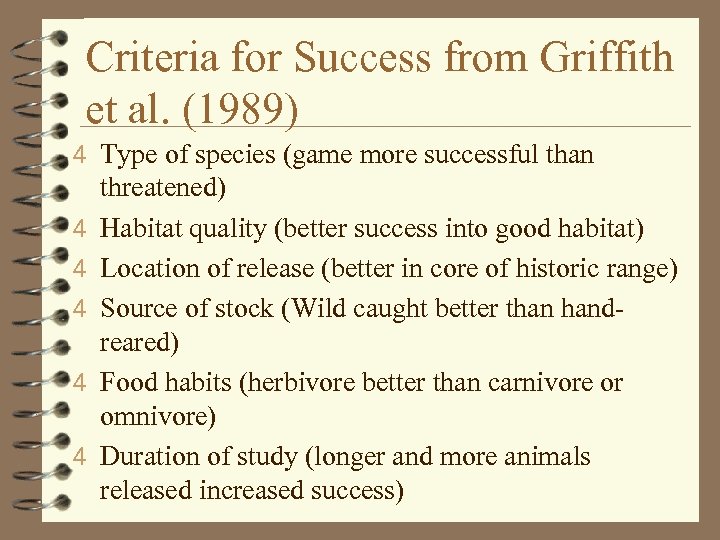
Criteria for Success from Griffith et al. (1989) 4 Type of species (game more successful than 4 4 4 threatened) Habitat quality (better success into good habitat) Location of release (better in core of historic range) Source of stock (Wild caught better than handreared) Food habits (herbivore better than carnivore or omnivore) Duration of study (longer and more animals released increased success)
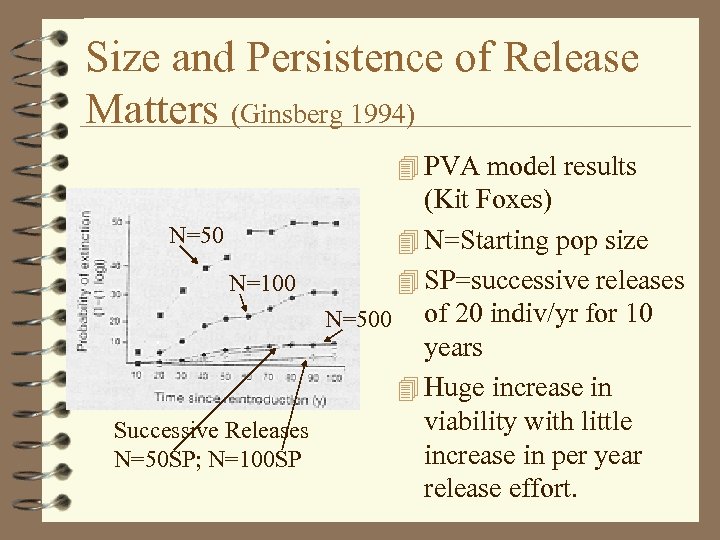
Size and Persistence of Release Matters (Ginsberg 1994) 4 PVA model results (Kit Foxes) N=50 4 N=Starting pop size 4 SP=successive releases N=100 N=500 of 20 indiv/yr for 10 years 4 Huge increase in viability with little Successive Releases increase in per year N=50 SP; N=100 SP release effort.
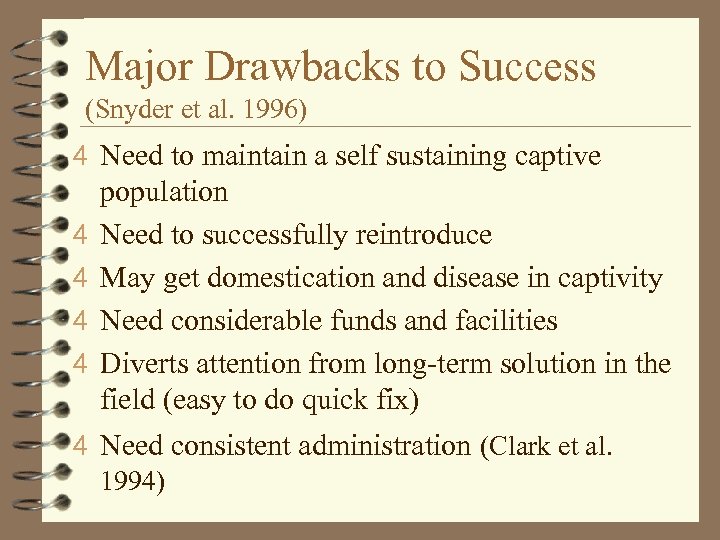
Major Drawbacks to Success (Snyder et al. 1996) 4 Need to maintain a self sustaining captive 4 4 population Need to successfully reintroduce May get domestication and disease in captivity Need considerable funds and facilities Diverts attention from long-term solution in the field (easy to do quick fix) 4 Need consistent administration (Clark et al. 1994)
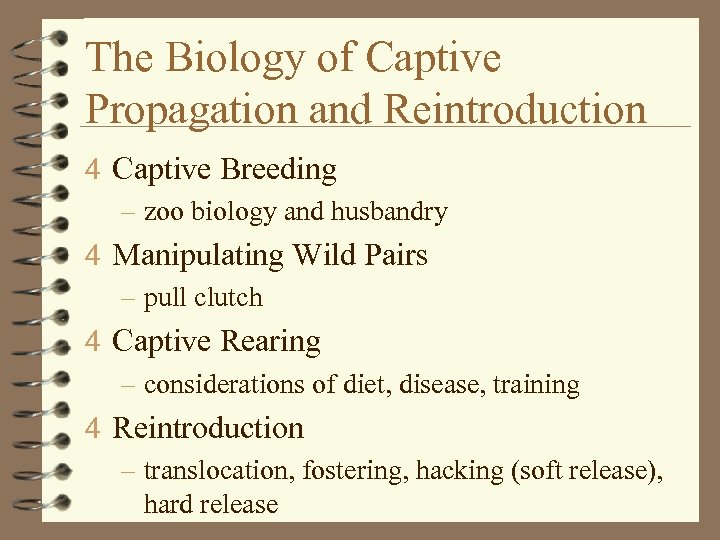
The Biology of Captive Propagation and Reintroduction 4 Captive Breeding – zoo biology and husbandry 4 Manipulating Wild Pairs – pull clutch 4 Captive Rearing – considerations of diet, disease, training 4 Reintroduction – translocation, fostering, hacking (soft release), hard release
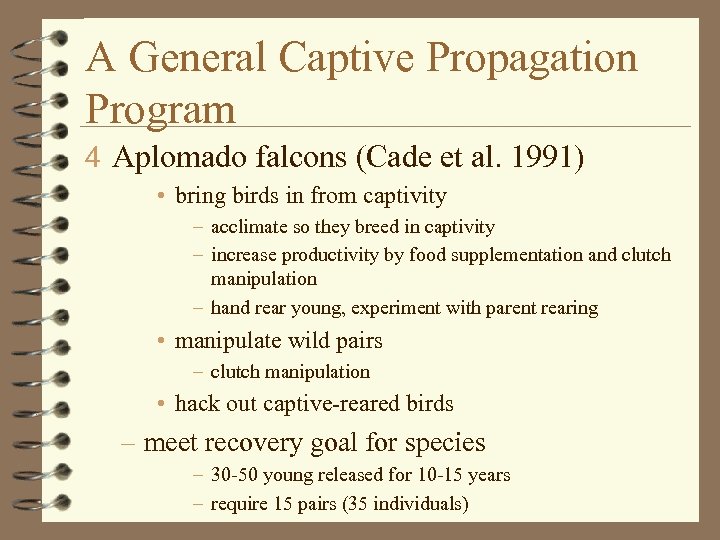
A General Captive Propagation Program 4 Aplomado falcons (Cade et al. 1991) • bring birds in from captivity – acclimate so they breed in captivity – increase productivity by food supplementation and clutch manipulation – hand rear young, experiment with parent rearing • manipulate wild pairs – clutch manipulation • hack out captive-reared birds – meet recovery goal for species – 30 -50 young released for 10 -15 years – require 15 pairs (35 individuals)
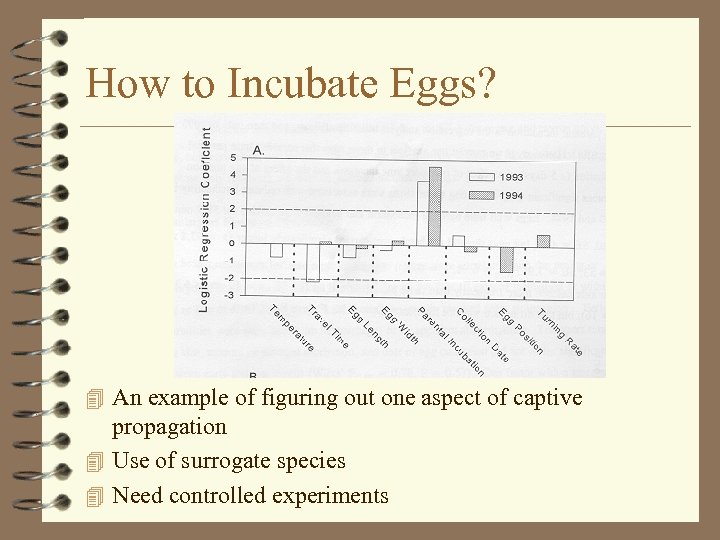
How to Incubate Eggs? 4 An example of figuring out one aspect of captive propagation 4 Use of surrogate species 4 Need controlled experiments
Effects of Manipulating Wild Pairs 4 Bald Eagles (Wood and Collopy 1993) – 78% renested within 1 month – subsequent reproduction within the year may be reduced • this was modeled with RAMAS age model and was estimated not to affect viability of “donor” population 4 Corvids (Marzluff et al. 1994) – 69% renested – reduced clutch size on renesting and slightly lower number of fledglings – occupancy and productivity at manipulated sites was same as controls next year
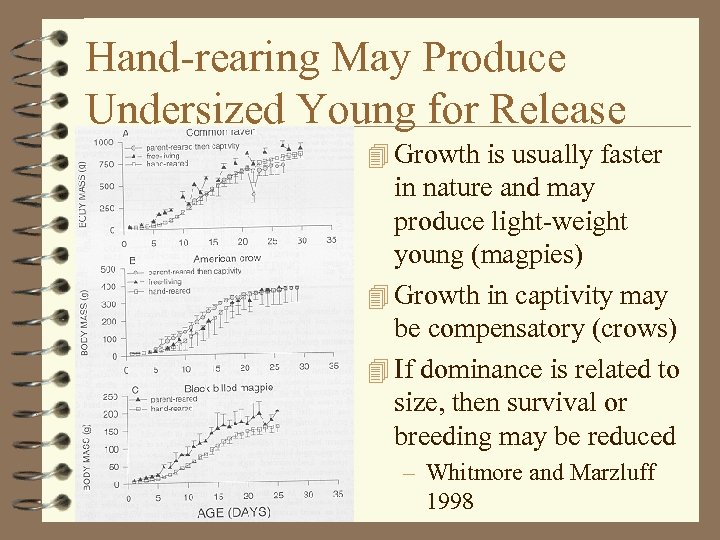
Hand-rearing May Produce Undersized Young for Release 4 Growth is usually faster in nature and may produce light-weight young (magpies) 4 Growth in captivity may be compensatory (crows) 4 If dominance is related to size, then survival or breeding may be reduced – Whitmore and Marzluff 1998
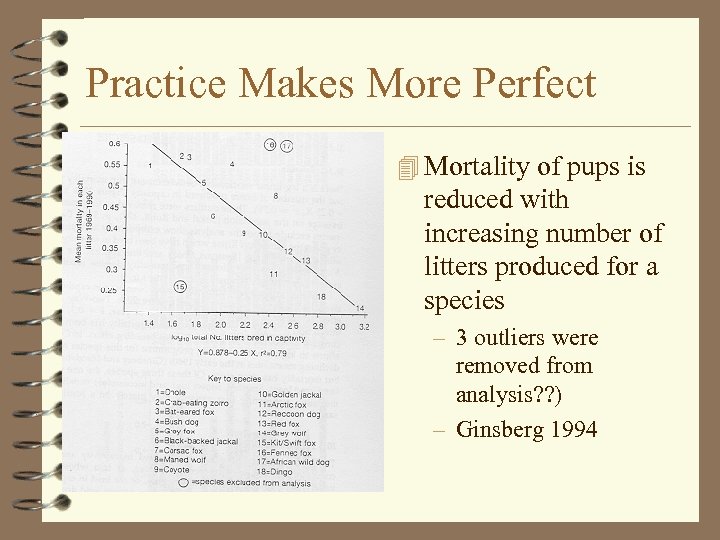
Practice Makes More Perfect 4 Mortality of pups is reduced with increasing number of litters produced for a species – 3 outliers were removed from analysis? ? ) – Ginsberg 1994
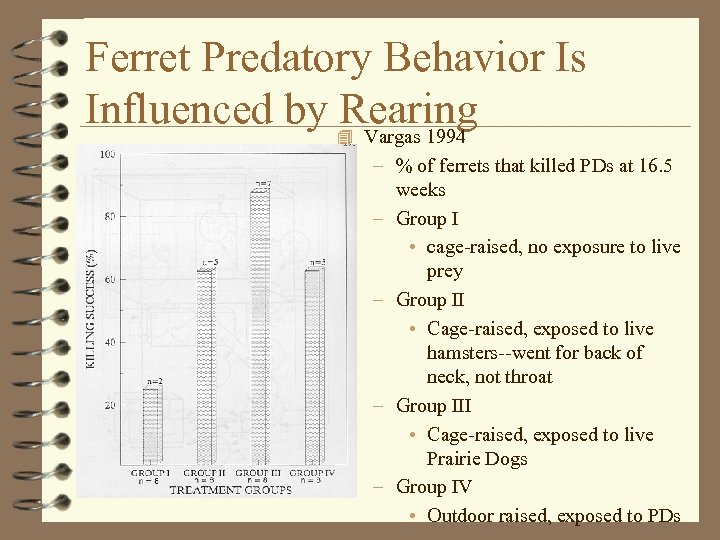
Ferret Predatory Behavior Is Influenced by 4 Vargas 1994 Rearing – % of ferrets that killed PDs at 16. 5 weeks – Group I • cage-raised, no exposure to live prey – Group II • Cage-raised, exposed to live hamsters--went for back of neck, not throat – Group III • Cage-raised, exposed to live Prairie Dogs – Group IV • Outdoor raised, exposed to PDs
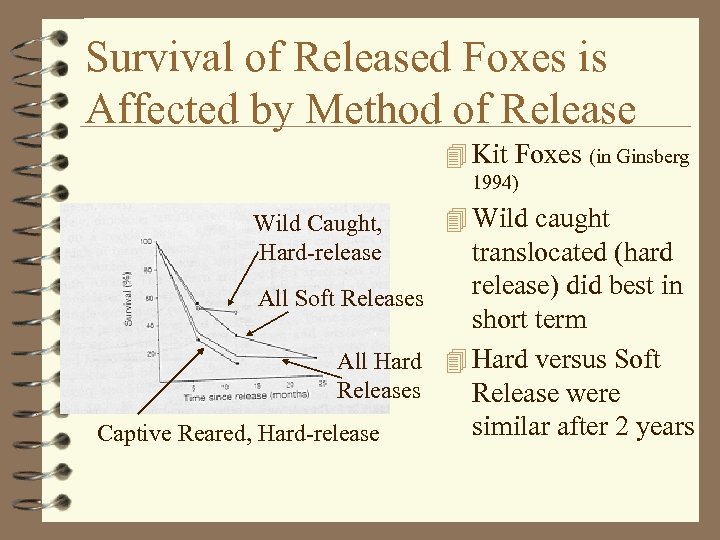
Survival of Released Foxes is Affected by Method of Release 4 Kit Foxes (in Ginsberg 1994) Wild Caught, Hard-release 4 Wild caught translocated (hard release) did best in All Soft Releases short term All Hard 4 Hard versus Soft Releases Release were similar after 2 years Captive Reared, Hard-release
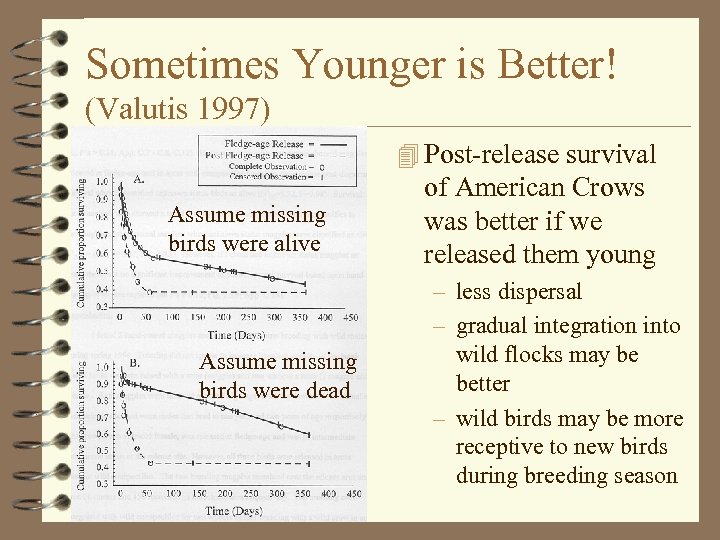
Sometimes Younger is Better! (Valutis 1997) 4 Post-release survival Assume missing birds were alive Assume missing birds were dead of American Crows was better if we released them young – less dispersal – gradual integration into wild flocks may be better – wild birds may be more receptive to new birds during breeding season
Recent Thoughts About Reintroduction 4 Red and Mexican Wolves – Politics and Biology – Guard Donkeys? 4 Grizzlies 4 Lynx 4 Whooping Cranes – Western and Eastern Efforts
Red Wolves 4 1970’s few wolves left in Texas and Louisiana 4 All that could be found (N = 17) were captured by late 1970’s and brought in for captive breeding (Point Defiance Zoo initially then 20+ zoos) 4 Bred wolves in captivity successfully (300 + were produced at 30+ facilities) 4 Began reintroduction in 1987
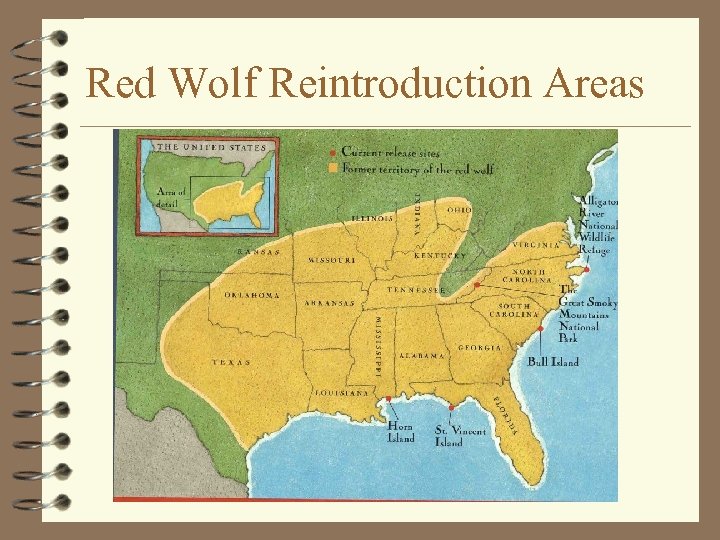
Red Wolf Reintroduction Areas
Red Wolf Reintroduction Stats 4 First releases at Alligator River National Wildlife Refuge (1992: 30 animals roam free) 4 1988 -90 marooned species on 3 islands – 10 on Bulls Island (2 survived through 1990) • Ended 2005 – 9 on Horn Island (5 survived through 1990) • None currently – 4 on St. Vincent National Wildlife Refuge (all surviving) • Minimal efforts now, but captives at visitor facility – Goal was to produce wild-reared young wolves for reintroduction 4 2006: 100 in wild (20 packs, 1. 7 mil. Acres in NC), 184 in captivity
Reintroduction Strategies 4 Pre-release training – minimum human contact – varied feeding regime (boom bust) – weaned from dog food to all meat – exposed to live prey 4 10(j) status – hunting and trapping of game allowed in release area to get sportsmen behind the program – can kill if threatening humans, but not livestock or pets
Reintroduction Success 4 ARNWR---1987 -90 --released 29 captive born wolves (19 adults, 10 pups) were released on 13 occasions – 6 pups born in the wild – mid Oct. 1990 --->19 free-ranging – 17 animals recaptured on 29 occasions • 1 animal had to be returned to zoo – 15 died • 5 vehicle; 2 killed by other wolves; 2 infections; 1 choked on a coon kidney; 1 drowned in leghold; 4 drowned crossing river – This is now the center of the reintroduction efforts and an increasing wild population is distributed in 20 packs across 5 NC counties
Why No Losses to Human Hatred? 4 Pre-release public education campaign – briefed enviros, congress, governor, local officials and local landowners – briefed navy and airforce which train next to refuge – focused on hunters and trappers at public meetings prior to release 4 10(j) status 4 Post-release press – 22 mags, 24 newspapers, 5 national news broadcasts, 4 documentaries 4 New landowner agreements
Humans Benefited From Release 4 Post-release press increased tourism 4 Portrayed the region as unaffected by increase in human population where natural resources are still thriving – helped attract recreation
Other Spinoffs 4 Additional land for conservation – Conservation Fund bought 47, 000 ha next to ARNWR – 33 private citizens donated 10, 000 ha to the project 4 Civic groups got involved – Rotary Club gave conservation internships
Not So Good in Smokies 4 1990 reintroductions began in Great Smoky Mountains National Park – 500, 000 acre park (NC and Tenn) – 1. 5 mill acres of national forest adjoining with inholdings – 37 wolves released • many strayed from park and were recaptured – like beef--$7, 900 paid for 24 cows killed – liked people (taking handouts from tourists) – 6 killed by cars, poison, shooting – 33 pups born • 4 survived through 1998
Lack of Food Important 4 Movements out of park were apparently in response to lack of big game 4 Parvovirus also got some pups 4 4 remaining animals (2 adults and 2 pups) were removed
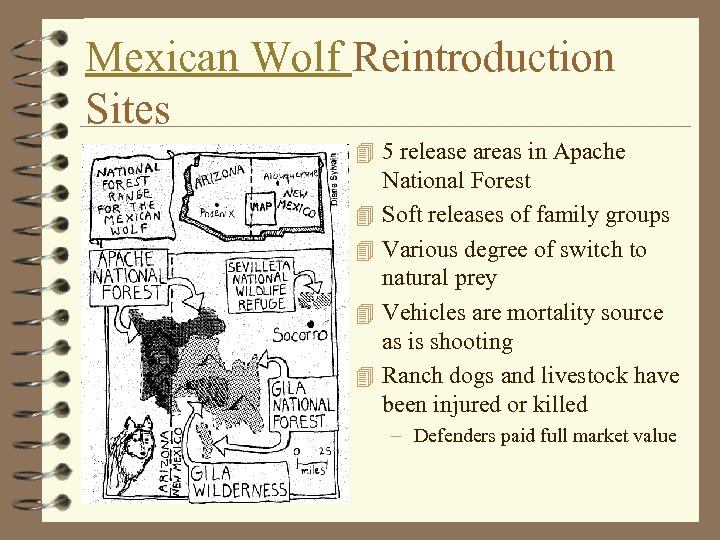
Mexican Wolf Reintroduction Sites 4 5 release areas in Apache 4 4 National Forest Soft releases of family groups Various degree of switch to natural prey Vehicles are mortality source as is shooting Ranch dogs and livestock have been injured or killed – Defenders paid full market value
Mexican Wolves 4 Captive propagation for release 4 First releases March 29 -30 1998 (New Mexico and Arizona) on NWR and USFS lands – Recent info from Arizona Game and Fish 4 Public not happy – – New Mexico cattle growers have sued Mortalities from autos and shooting 5 of first 11 released were shot 2005 Recovery Planning on hold, reintroductions continue
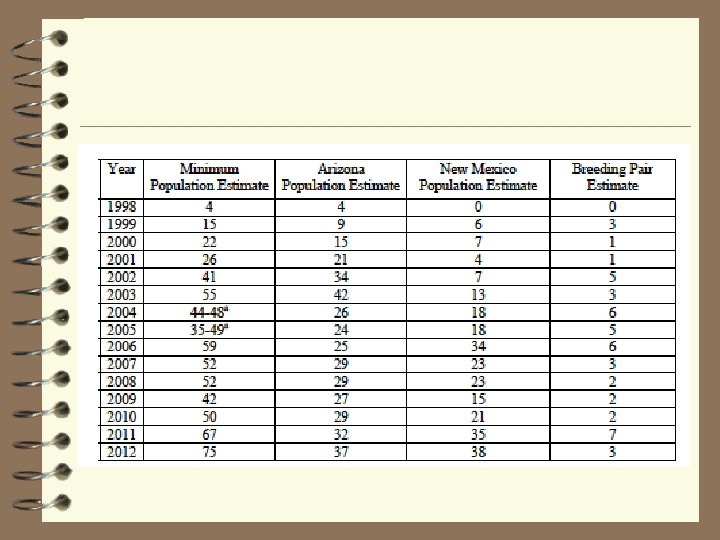
Perseverance is the Key 4 Babbitt was committed – “release … is to send a message that this is public land…. . Americans support this effort…I’ve got my instructions from the American people” 4 As of 2013 – 83 wolves with 5 breeding pairs in AZ and NM – ~300 in captivity (including wolf haven)

Flexible Releases 4 Lightweight pens – take into backcountry – electrify soft mesh – soft releases will continue to be used • little room for error
Reducing Wolf Encounters with Lifestock (M. Jimenez (Ph. D work) 4 Trials with Montana’s Ninemile Pack – Cracker shells • very short term deterrence – Country Music • music played at night by a crippled cow--kept wolves away – Flags • flags on fences keep wolves out – Guard Donkeys • burros with cattle--increase aggressiveness of the prey – worked with coyotes
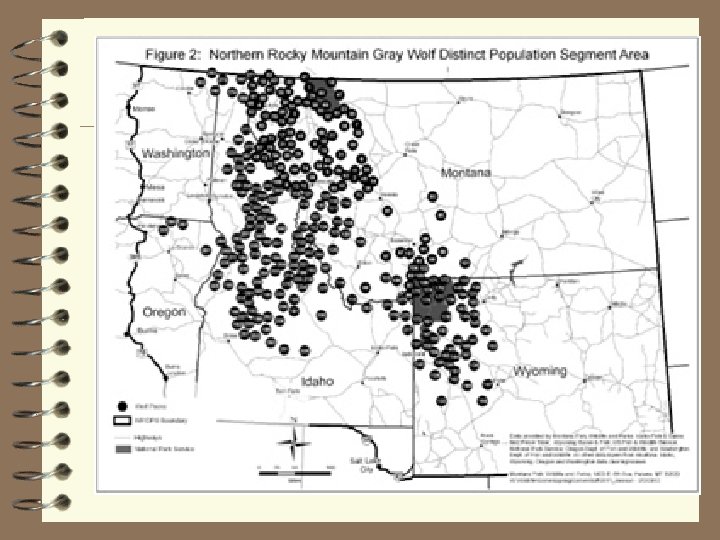
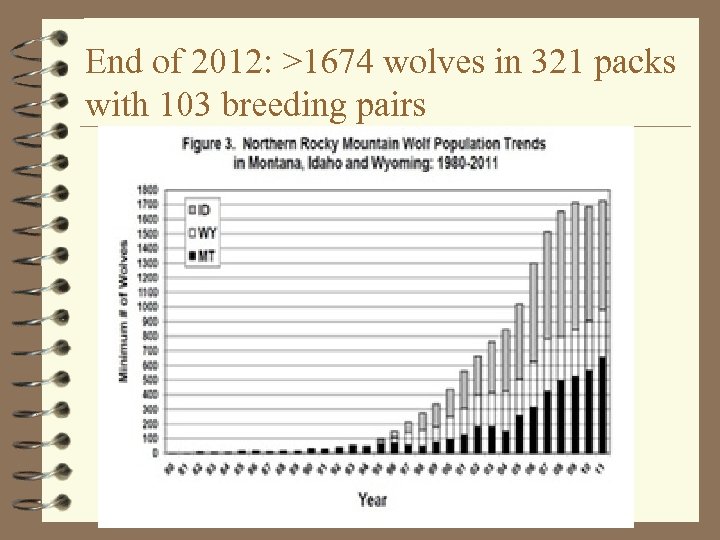
End of 2012: >1674 wolves in 321 packs with 103 breeding pairs
Grizzly Tales 4 Yellowstone Griz (Kaiser 1999) – USFWS delisted, court vacated, appeal partially supported, as of 2011 reinstated as “threatened” pending evaluation of impact of white-barked pine decline 4 Conflict over assessing the rate of population growth – Pease and Mattson 1999 --1% per year increase – NPS 5% per year increase 4 1800 ---100, 000 bears; 1975 --<1000; 2004 ---580; range-wide in 2013 there are 1400 -1700 bears
Grizzly Reintroduction? 4 USFWS proposes reintroduction into Northern Rockies – would use 10(j) status 4 Good support in Montana, not so in Idaho – “Bringing back bears is nothing but a polite form of genocide” L. Barrett, Idaho State Rep. – “I’m less scared of grizzlies than I am of the Endangered Species Act” D. Burtenshaw, Idaho State Senate
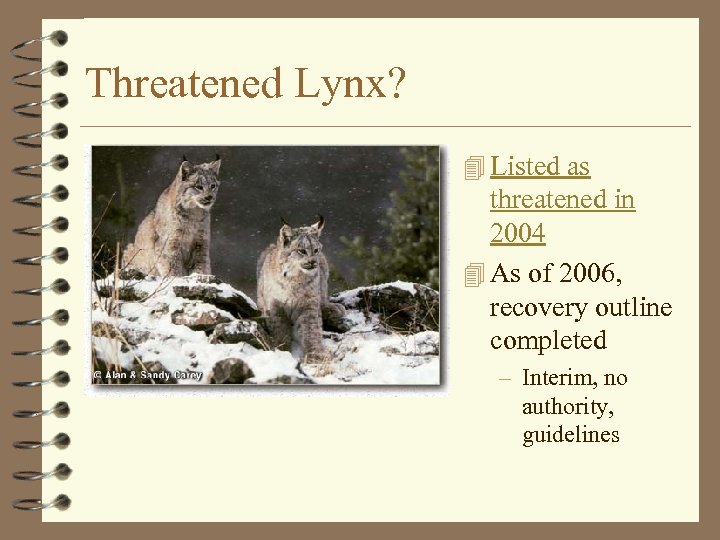
Threatened Lynx? 4 Listed as threatened in 2004 4 As of 2006, recovery outline completed – Interim, no authority, guidelines
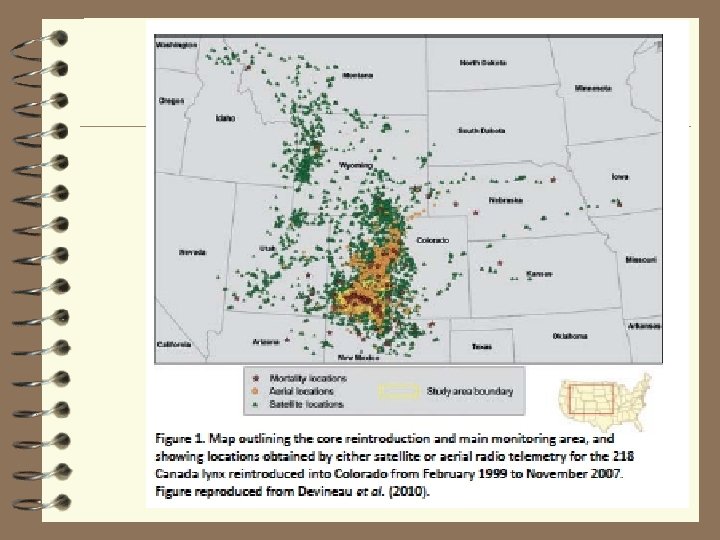
Lynx Reintroduction Stats 4 Reintroduction occurring in Colorado – winter 1999 --11 Lynx brought to San Juans from Canada – hard release – plan for 110 to be released over next 2 years – cost = $1. 4 million (for first 3 years) 4 Initial Poor Success was questioned – 2 of first 5 died of starvation 4 Later reintroductions went well • 2010 deemed a success after >200 animals released
Whooping Cranes 4 Early efforts in western US – – – 1975 --early 1990 s whoopers cross fostered under Sandhill Cranes Migrated and survived ok, but no breeding 1992 --cross fostered whooper bred with a female sandhill 1993 --cross fostered group down to 8 from high of 30 in 1980 Guide-bird program initiated • incubate and hatch in captivity • house chicks with cross fostered whoopers held in cages on breeding grounds • bond with whoopers to learn migration route • imprint on whoopers to learn sexual preference – 2005 efforts in west essentially halted
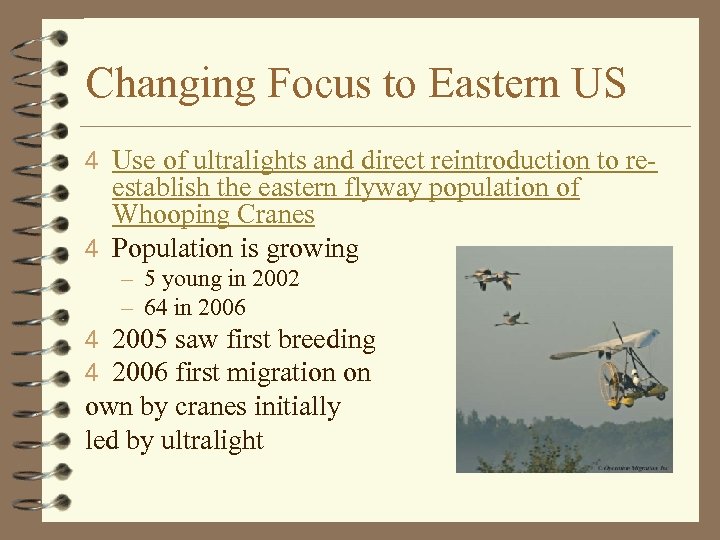
Changing Focus to Eastern US 4 Use of ultralights and direct reintroduction to re- establish the eastern flyway population of Whooping Cranes 4 Population is growing – 5 young in 2002 – 64 in 2006 4 2005 saw first breeding 4 2006 first migration on own by cranes initially led by ultralight
References 4 Phillips, M. K. 1990 a. The red wolf: recovery of an 4 4 endangered species. Endangered Species Update 8: 79 -81. Phillips, M. K. 1990 b. Measures of the value and success of a reintroduction project: red wolf reintroduction in Alligator River National Wildlife Refuge. Endangered Species Update 8: 24 -26. Kaiser, J. 1999. Study sounds alarm on Yellowstone Grizzlies. Science 284: 568. Davis, T. 1997. Agencies dunk endangered songbird. High Country News Sept. 15, 1997 Drewien, R. C. 1993. Guide bird program holds promise for whoopers. Habitat.
More References 4 Borenstein, S. 1999. The bald eagle to be taken off endangered list. Seattle Times. June 17, 1999. 4 Weller, R. 1999. Lynx reintroduced to Colorado. Seattle Times February 4, 1999. 4 London, J. 1996. Red Wolf Country. Penguin Books, New York. 4 Miller, E. 1997. Salmon says no bears, no way. High Country News. October 27, 1997
References 4 Vargas, A. 1994. Ontogeny of the endangered black-footed ferret 4 4 (Mustela nigripes) and effects of rearing conditions on predatory behavior and post-release survival. Ph. D. Diss. U. Wyoming Ginsberg, JR. 1994. Captive breeding, reintroduction and the conservation of canids. PP. 365 -383. In. Olney et al. (eds. ). Creative Conservation. Chapman and Hall, London. Valutis, LL. 1997. Reintroduction of captive-reared birds. MSc. BSU. Boise, ID. Wild, MA. Et al. 1994. Comparing growth rates of dam- and handraised Bighorn sheep, pronghorn, and elk neonates. J W M 58: 340 -347. Whitmore, KD and JM Marzluff. 1998. Hand-rearing corvids for reintroduction: importance of feeding regime, nestling growth, and dominance. JWM 62: 1460 -1479.
More References 4 Wilson, AC and MR Stanley Price. 1994. Reintroduction as a reason 4 4 4 for captive breeding. PP 243 -264. In. Olney et al. (eds. ). Creative Conservation. Chapman and Hall, London. Kleiman, DG et al. 1994. Criteria for reintroductions. PP 287 -303. In. Olney et al. (eds. ). Creative Conservation. Chapman and Hall, London. Beck, B. B. , et al. 1994. Reintroduction of captive-born animals. PP 265 -286. In. Olney et al. (eds. ). Creative Conservation. Chapman and Hall, London. Griffith, B. Et al. 1989. Translocation as a species conservation tool: status and strategy. Science 245: 477 -480. Cade, TJ et al. 1991. Efforts to restore the northern aplomado falcon by captive breeding and reintroduction. Dodo 27: 71 -81. Williams, GR. 1977. Marooning--a technique for saving threatened species from extinction. International Zoo Yearbook 17: 102 -106.
Yet More References 4 Jones, CG. Et al. 1991. A summary of the conservation management of 4 4 the mauritius kestrel Falco punctatus 1973 -1991. Dodo 27: 81 -99. Rachlow, JL. And J. Berger. 1997. Conservation implications of patterns of horn regeneration in dehorned white rhinos. Conservation Biology 11: 84 -91. Berger, J. 1996. Animal behaviour and plundered mammals: Is the study of mating systems a scientific luxury or a conservation necessity? Oikos 77: 207 -216. Wood, PB. And MW Collopy. 1993. Effects of egg removal on bald eagle productivity in northern Florida. JWM 57: 1 -9. Marzluff, JM et al. 1994. Captive propagation and reintroduction of social birds. Annual Report. Sustainable Ecosystems Institute, Meridian, ID.
References 4 4 4 4 Haig, SM and JC Avise. 1996. Avian conservation genetics. PP 160 -189 In. JC Avise and JL Hamrick (ed. ) Conservation genetics. Chapman & Hall. New York. Lynch, M. 1996. A quantitative-genetic perspective on conservation issues. PP 471 -501 In. JC Avise and JL Hamrick (ed. ) Conservation genetics. Chapman & Hall. New York. Britten, HB. Meta-analyses of the association between multilocus heterozygosity and fitness. Evolution 50: 2158 -2164. Fleischer, RC. 1998. Genetics and avian conservation. PP 29 -47 In. JM Marzluff and R Sallabanks (eds. ) Avian Conservation. Island Press. Covelo, CA. Mitton, JB. 1994. Molecular approaches to population biology. Ann. Rev. Ecol. Syst. 25: 45 -69 Lynch, M. R. Burger, D. Butcher, and W. Gabriel. 1993. The mutational meltdown in asexual populations. J. Heredity 84: 339 -344. Westemeier, R. L. , Brawn, J. D. , Simpson, S. A. , Esker, T. L. , Jansen, R. W. , Walk, J. W. , Kershner, E. L. , Bouzat, J. L. , and K. N. Paige. 1998. Tracking the long-term decline and recovery of an isolated population. Science 282: 1695 -1698.
More References 4 Ardern, S. L. and D. M. Lambert. 1997. Is the black robin in genetic 4 4 4 peril? Molecular Ecology 6: 21 -28 Caro, T. M. and M. K. Laurenson. 1994. Ecological and genetic factors in conservation: a cautionary tale. Science 263: 485 -486. Jimenez, J. A. , K. A. Hughes, G. Alaks, L. Graham, and R. C. Lacy. 1994. An experimental study of inbreeding depression in a natural habitat. Science 266: 271 -273. O’Brien, S. J. , Roelke, M. E. , Marker, L. , Newman, A. , Winkler, C. A. , Meltzer, D. , Colly, L. , Evermann, J. F. , Bush, M. , and D. E. Wildt. 1985. Genetic basis for species vulnerability in the Cheetah. Science 227: 14281434. Roy, M. S. , E. Geffen, D. Smith, and R. K. Wayne. 1996. Molecular genetics of pre-1940 red wolves. Conservation Biology 10: 1413 -1424. Vrijenhoek, R. C. , M. E. Douglas, and G. K. Meffe. 1985. Conservation genetics of endangered fish populations in Arizona. Science 229: 400 -402.
Still More Refs 4 4 4 4 Hale, ML, Lurz, PWW, Shirley, MDF, Rushton, S. , Fuller, RM, and K. Wolff. 2001. Impact of landscape management on the genetic structure of red squirrel populations. Science 293: 2246 -2248. Caro, T. 2000. Controversy over behavior and genetics in Cheetah conservation. In. LM Gosling and WJ Sutherland, eds. Behavior and Conservation. Keller, LF and DM Waller. 2002. Inbreeding effects in wild populations. Trends in Ecology and Evolution 17: 230 -241. Lande, R. 1999. Extinction risks from anthropogenic, ecological, and genetic factors. Pp 1 -22. In Genetics and the Extinction of Species (Landweber, LF and AP Dobson, eds. ). Princeton University Press Nicholl, M. A. C. Jones, C. G. , and K. Norris. 2003. Declining survival rates in a reintroduced population of the Mauritius kestrel: evidence for non-linear density dependence and environmental stochasticity. J. Anim. Ecol. 72: 917 -926. Nichols, R. A. , Bruford, M. W. , and J. J. Groombridge. 2001. Sustaining genetic variation in a small population: evidence from the Mauritius kestrel. Molecular Ecology 10: 593 -602. Mandel, J. T. , Donlan, C. J. , and J. Armstrong. 2010. A derivative approach to endangered species conservation. Frontiers in Ecology and the Environment. 8: 44 -49.
Скачать презентацию Captive Breeding and Reintroduction 4 Once the limiting
4bc8abc6818c76777f21783a9799cf42.ppt