


 Скачать презентацию Capítulo 4 De tiendas Español 3 El
6708dcf2e860676a48e78b96c7a7056a.ppt
- Количество слайдов: 42
 Capítulo 4: De tiendas Español 3
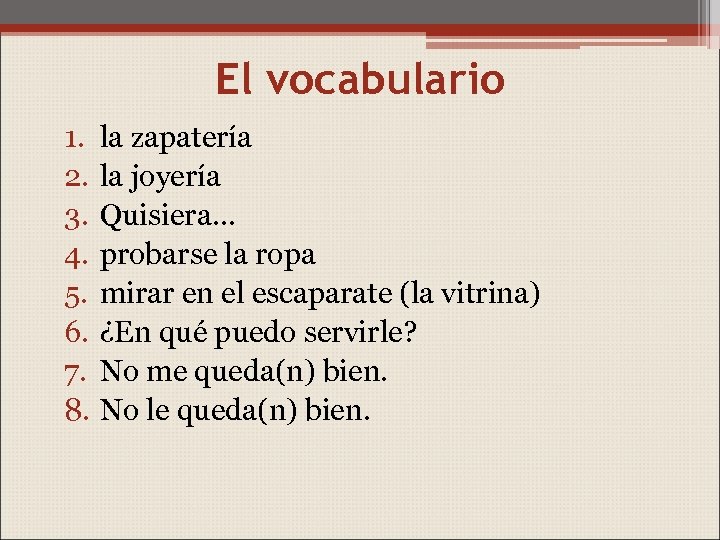 El vocabulario 1. 2. 3. 4. 5. 6. 7. 8. la zapatería la joyería Quisiera… probarse la ropa mirar en el escaparate (la vitrina) ¿En qué puedo servirle? No me queda(n) bien. No le queda(n) bien.
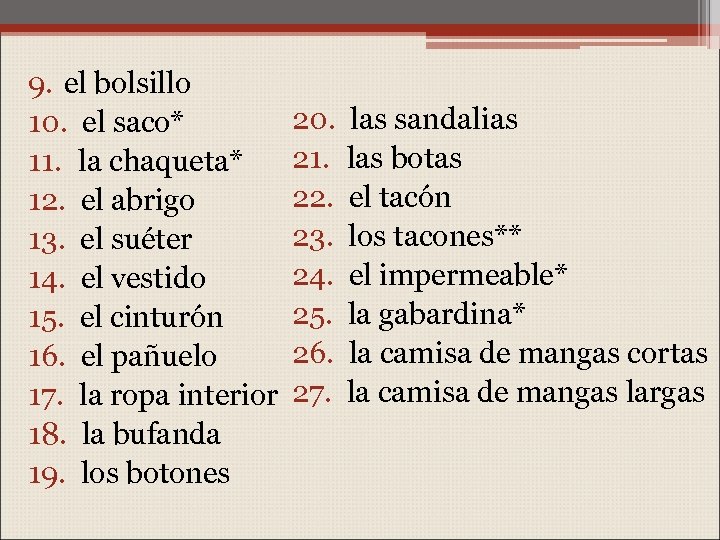 9. el bolsillo 10. el saco* 11. la chaqueta* 12. el abrigo 13. el suéter 14. el vestido 15. el cinturón 16. el pañuelo 17. la ropa interior 18. la bufanda 19. los botones 20. 21. 22. 23. 24. 25. 26. 27. las sandalias las botas el tacón los tacones** el impermeable* la gabardina* la camisa de mangas cortas la camisa de mangas largas
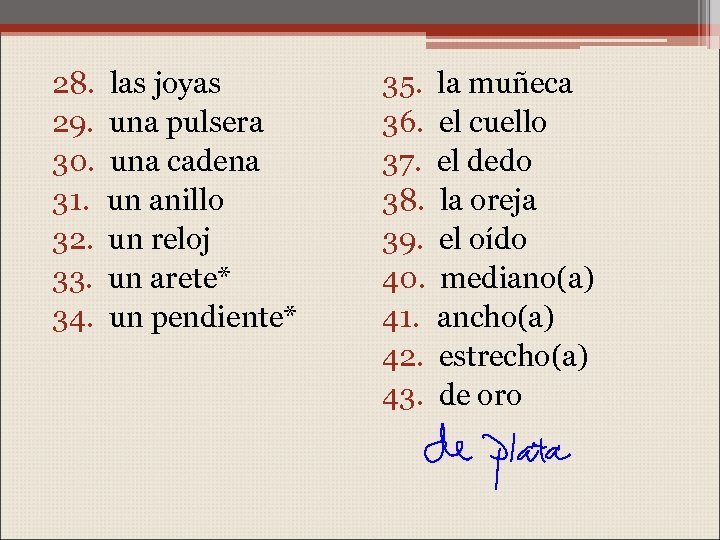 28. 29. 30. 31. 32. 33. 34. las joyas una pulsera una cadena un anillo un reloj un arete* un pendiente* 35. 36. 37. 38. 39. 40. 41. 42. 43. la muñeca el cuello el dedo la oreja el oído mediano(a) ancho(a) estrecho(a) de oro
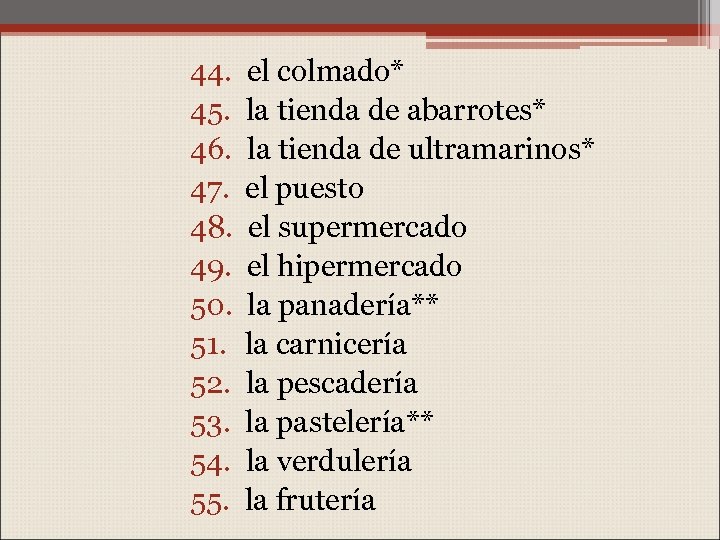 44. 45. 46. 47. 48. 49. 50. 51. 52. 53. 54. 55. el colmado* la tienda de abarrotes* la tienda de ultramarinos* el puesto el supermercado el hipermercado la panadería** la carnicería la pescadería la pastelería** la verdulería la frutería
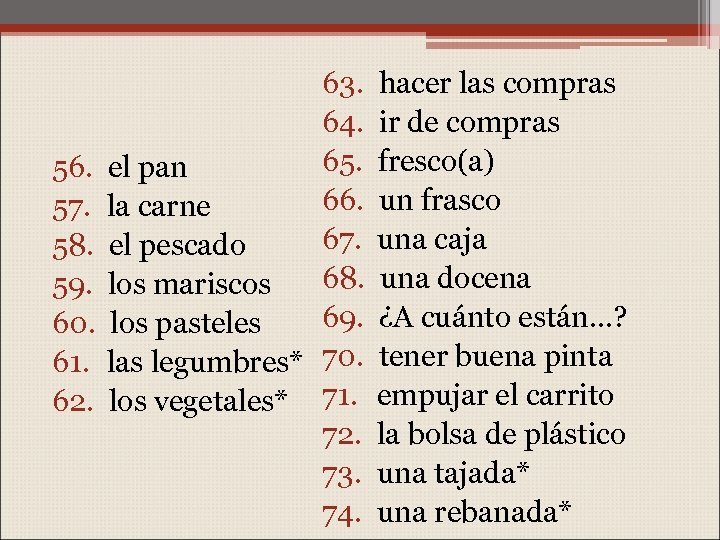 56. 57. 58. 59. 60. 61. 62. 63. 64. 65. el pan 66. la carne 67. el pescado 68. los mariscos 69. los pasteles las legumbres* 70. los vegetales* 71. 72. 73. 74. hacer las compras ir de compras fresco(a) un frasco una caja una docena ¿A cuánto están…? tener buena pinta empujar el carrito la bolsa de plástico una tajada* una rebanada*
 Práctica con el vocabulario 1. 2. 3. 4. 5. 6. 7. 8. 9. tres tipos de zapatos dos cosas que lleva en el invierno dos partes de una camisa el opuesto de cortas un sinónimo de saco lo que lleva en la lluvia una cosa que soporta los pantalones usa cuando está enfermo la ropa que lleva adentro
 Más práctica con las palabras 1. 2. 3. 4. 5. 6. 7. el opuesto de ancho donde lleva un anillo no grande ni pequeño una joya que lleva en el cuello la material de joyas caras donde pone unos aretes dos joyas que lleva en la muñeca
 Práctica con el vocabulario 1. Alicia necesitaba pan para un sándwich. Ø ¿Adónde fue ella? 2. Quería comprar un biftec también. 3. Nececitaba una docena de manzanas. 4. Quería las almejas y la langosta. 5. ¡Necesitaba una berenjena! 6. Pero, no quería ir a las tiendas diferentes… 7. Finalmente, quería sandalias nuevas y un collar.
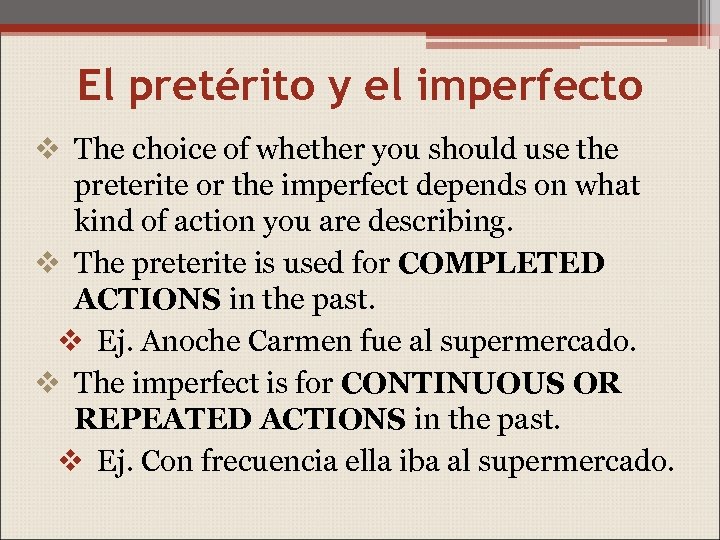 El pretérito y el imperfecto v The choice of whether you should use the preterite or the imperfect depends on what kind of action you are describing. v The preterite is used for COMPLETED ACTIONS in the past. v Ej. Anoche Carmen fue al supermercado. v The imperfect is for CONTINUOUS OR REPEATED ACTIONS in the past. v Ej. Con frecuencia ella iba al supermercado.
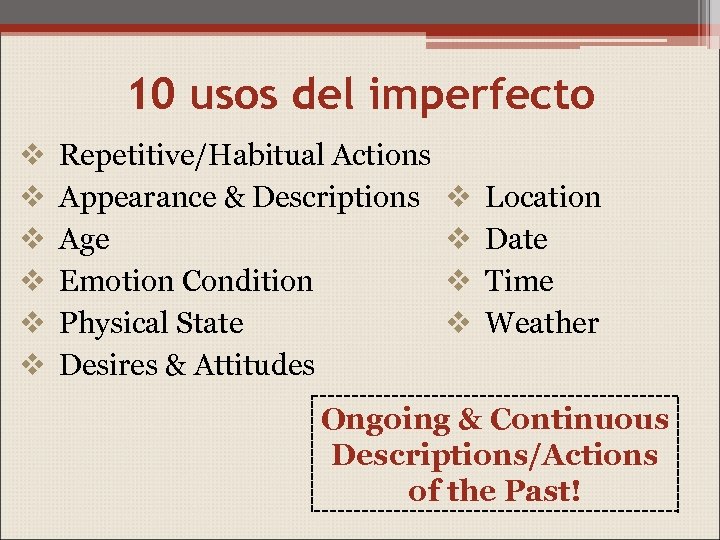 10 usos del imperfecto v v v Repetitive/Habitual Actions Appearance & Descriptions Age Emotion Condition Physical State Desires & Attitudes v v Location Date Time Weather Ongoing & Continuous Descriptions/Actions of the Past!
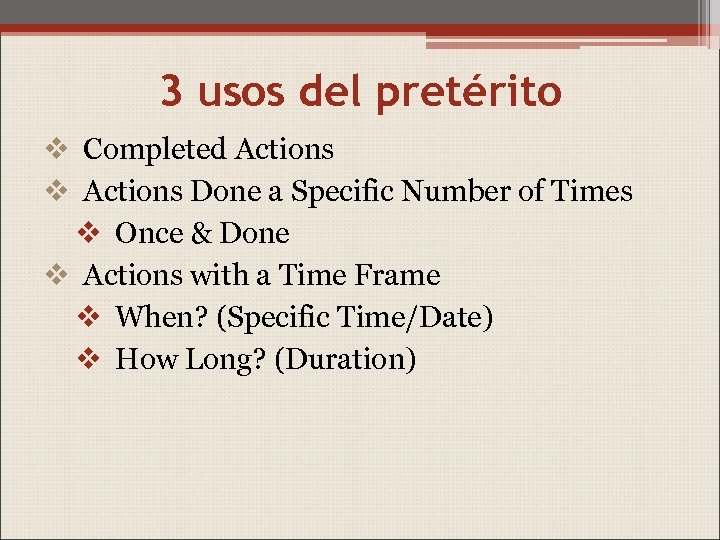 3 usos del pretérito v Completed Actions v Actions Done a Specific Number of Times v Once & Done v Actions with a Time Frame v When? (Specific Time/Date) v How Long? (Duration)
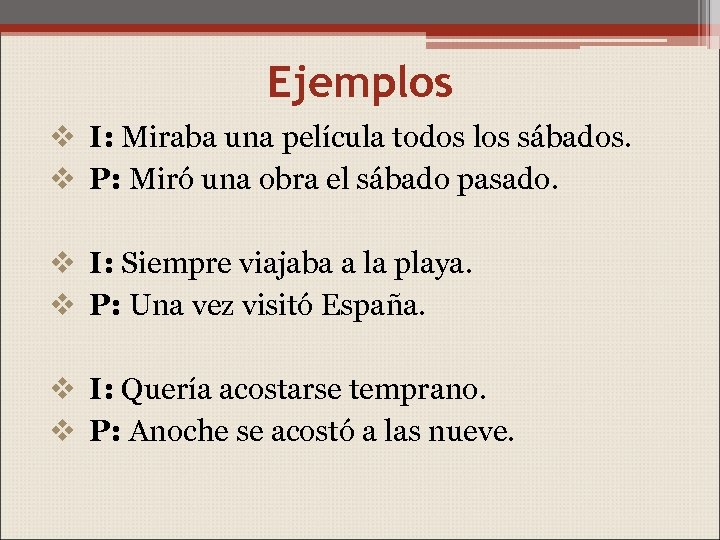 Ejemplos v I: Miraba una película todos los sábados. v P: Miró una obra el sábado pasado. v I: Siempre viajaba a la playa. v P: Una vez visitó España. v I: Quería acostarse temprano. v P: Anoche se acostó a las nueve.
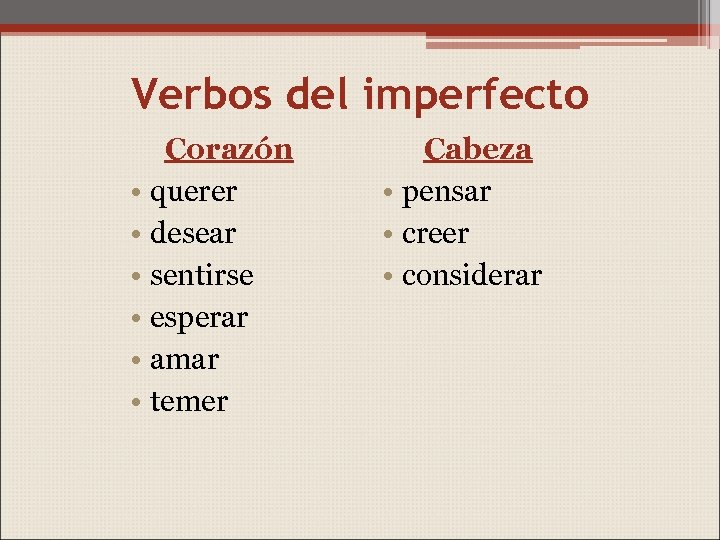 Verbos del imperfecto Corazón • querer • desear • sentirse • esperar • amar • temer Cabeza • pensar • creer • considerar
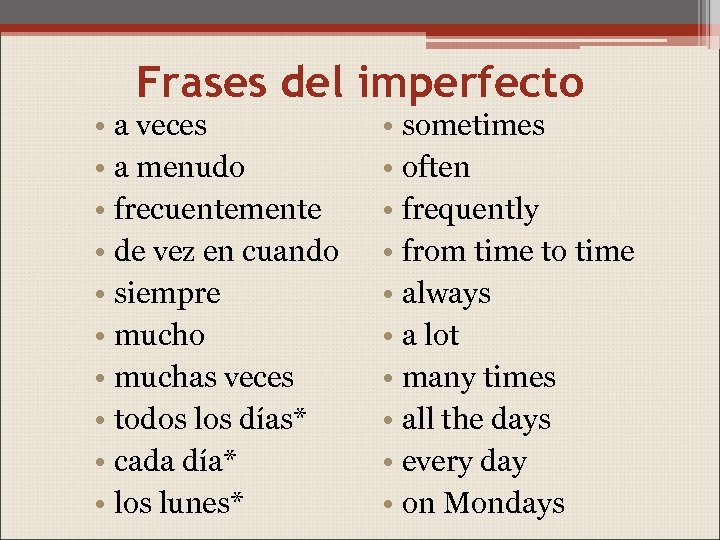 Frases del imperfecto • a veces • a menudo • frecuentemente • de vez en cuando • siempre • mucho • muchas veces • todos los días* • cada día* • los lunes* • sometimes • often • frequently • from time to time • always • a lot • many times • all the days • every day • on Mondays
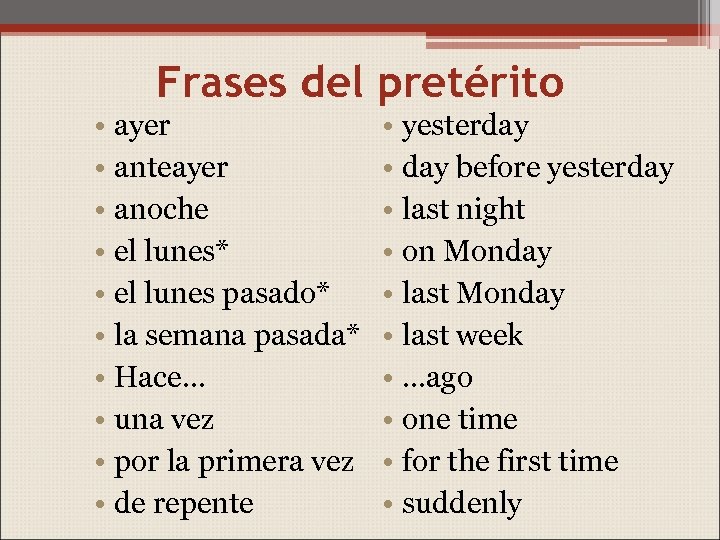 Frases del pretérito • ayer • anteayer • anoche • el lunes* • el lunes pasado* • la semana pasada* • Hace… • una vez • por la primera vez • de repente • yesterday • day before yesterday • last night • on Monday • last week • …ago • one time • for the first time • suddenly
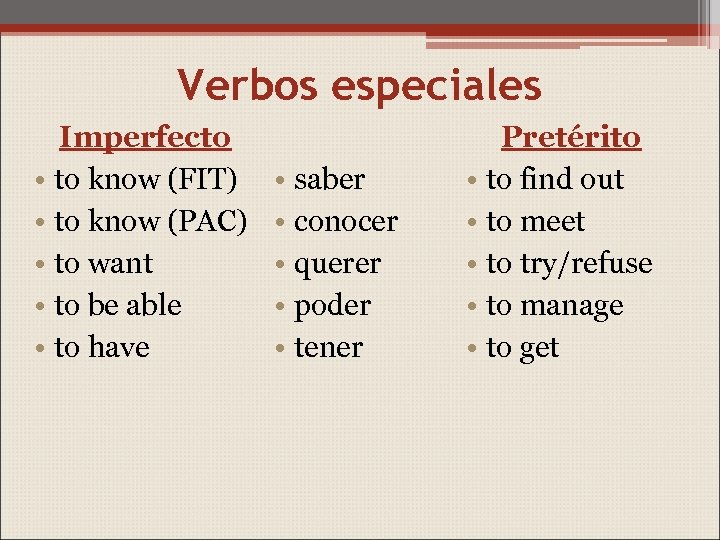 Verbos especiales Imperfecto • to know (FIT) • to know (PAC) • to want • to be able • to have • saber • conocer • querer • poder • tener Pretérito • to find out • to meet • to try/refuse • to manage • to get
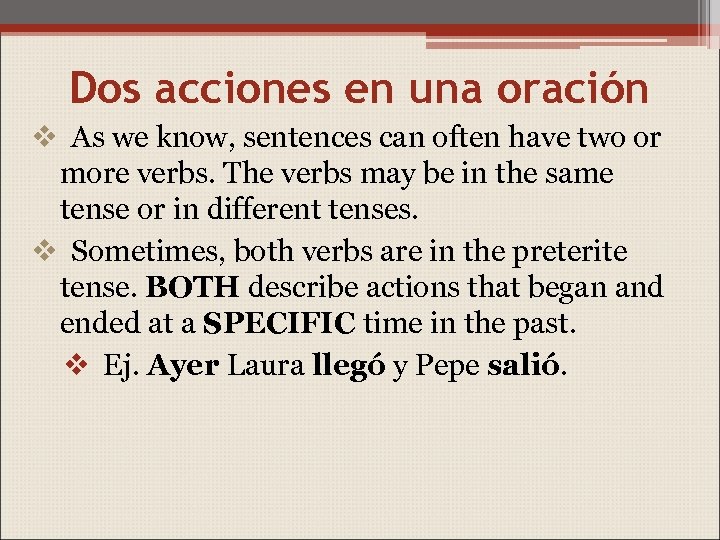 Dos acciones en una oración v As we know, sentences can often have two or more verbs. The verbs may be in the same tense or in different tenses. v Sometimes, both verbs are in the preterite tense. BOTH describe actions that began and ended at a SPECIFIC time in the past. v Ej. Ayer Laura llegó y Pepe salió.
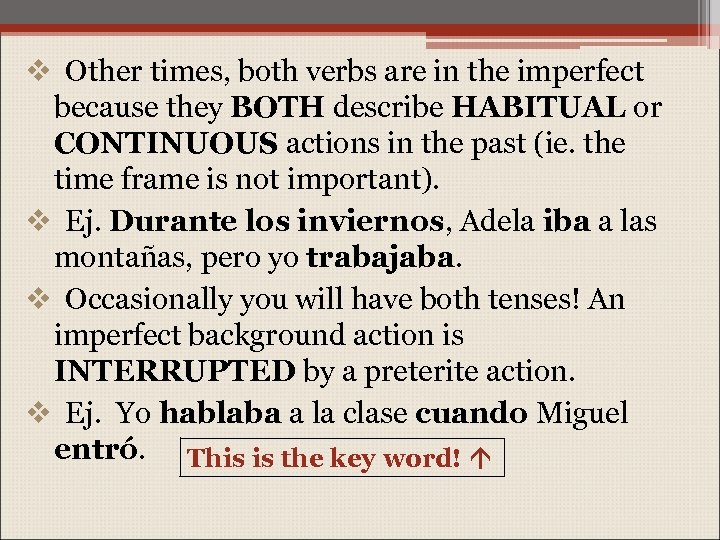 v Other times, both verbs are in the imperfect because they BOTH describe HABITUAL or CONTINUOUS actions in the past (ie. the time frame is not important). v Ej. Durante los inviernos, Adela iba a las montañas, pero yo trabajaba. v Occasionally you will have both tenses! An imperfect background action is INTERRUPTED by a preterite action. v Ej. Yo hablaba a la clase cuando Miguel entró. This is the key word!
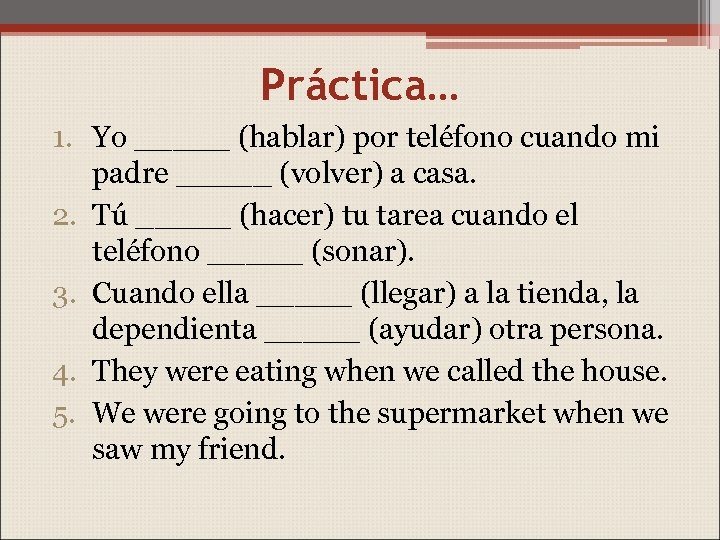 Práctica… 1. Yo _____ (hablar) por teléfono cuando mi padre _____ (volver) a casa. 2. Tú _____ (hacer) tu tarea cuando el teléfono _____ (sonar). 3. Cuando ella _____ (llegar) a la tienda, la dependienta _____ (ayudar) otra persona. 4. They were eating when we called the house. 5. We were going to the supermarket when we saw my friend.
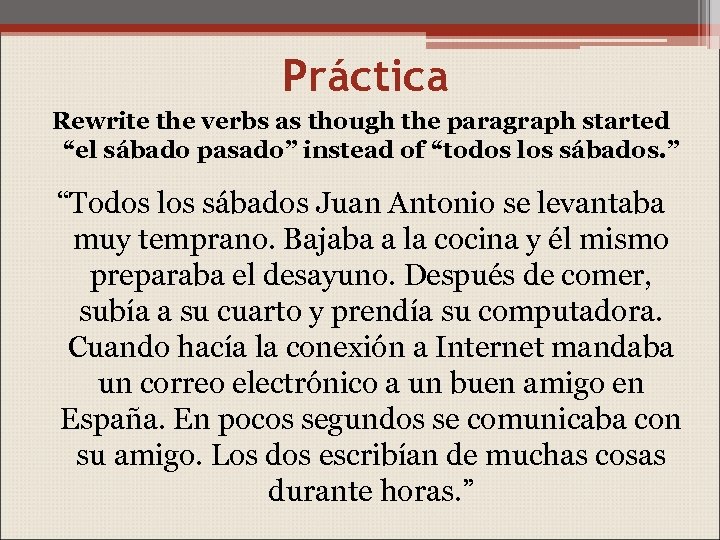 Práctica Rewrite the verbs as though the paragraph started “el sábado pasado” instead of “todos los sábados. ” “Todos los sábados Juan Antonio se levantaba muy temprano. Bajaba a la cocina y él mismo preparaba el desayuno. Después de comer, subía a su cuarto y prendía su computadora. Cuando hacía la conexión a Internet mandaba un correo electrónico a un buen amigo en España. En pocos segundos se comunicaba con su amigo. Los dos escribían de muchas cosas durante horas. ”
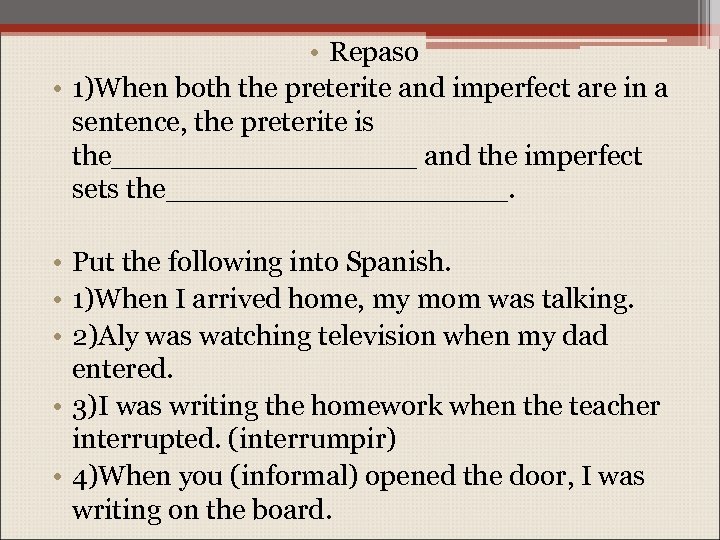 • Repaso • 1)When both the preterite and imperfect are in a sentence, the preterite is the_________ and the imperfect sets the__________. • Put the following into Spanish. • 1)When I arrived home, my mom was talking. • 2)Aly was watching television when my dad entered. • 3)I was writing the homework when the teacher interrupted. (interrumpir) • 4)When you (informal) opened the door, I was writing on the board.
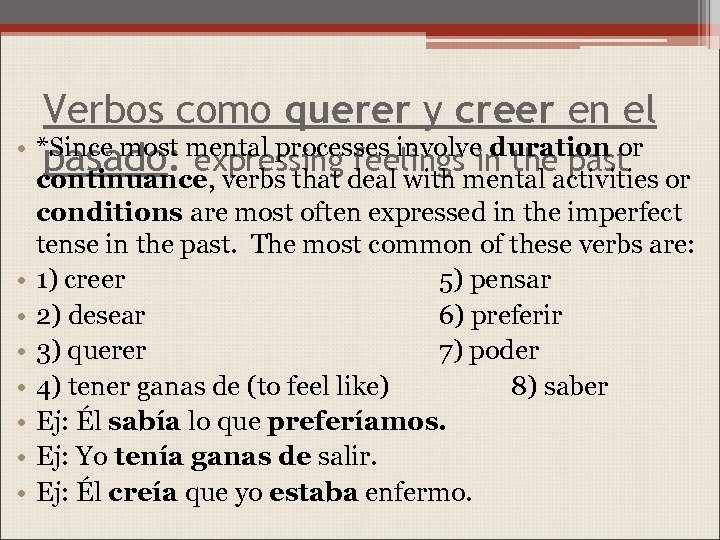 Verbos como querer y creer en el • *Since most mental processes involve duration or pasado: expressing deal with mental activities or feelings in the past continuance, verbs that • • conditions are most often expressed in the imperfect tense in the past. The most common of these verbs are: 1) creer 5) pensar 2) desear 6) preferir 3) querer 7) poder 4) tener ganas de (to feel like) 8) saber Ej: Él sabía lo que preferíamos. Ej: Yo tenía ganas de salir. Ej: Él creía que yo estaba enfermo.
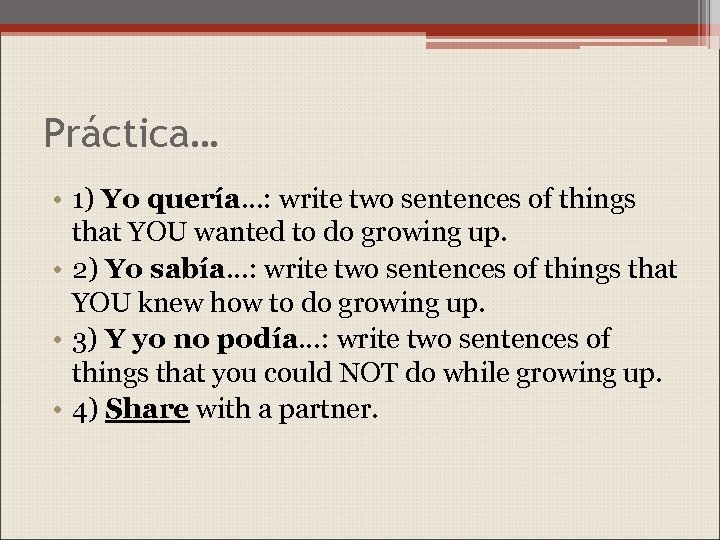 Práctica… • 1) Yo quería…: write two sentences of things that YOU wanted to do growing up. • 2) Yo sabía…: write two sentences of things that YOU knew how to do growing up. • 3) Y yo no podía…: write two sentences of things that you could NOT do while growing up. • 4) Share with a partner.
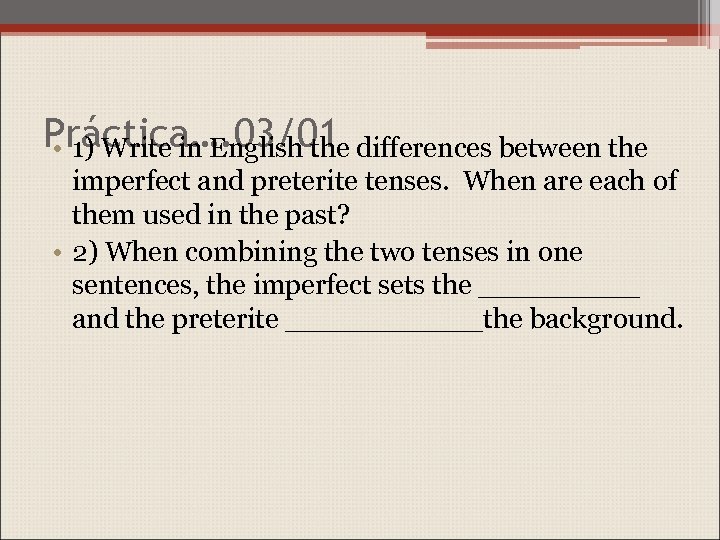 Práctica…. 03/01 differences between the • 1) Write in English the imperfect and preterite tenses. When are each of them used in the past? • 2) When combining the two tenses in one sentences, the imperfect sets the _____ and the preterite ______the background.
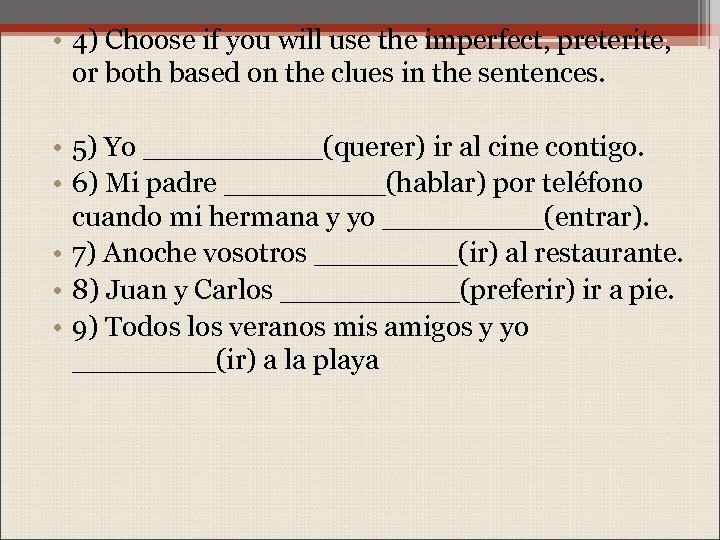 • 4) Choose if you will use the imperfect, preterite, or both based on the clues in the sentences. • 5) Yo _____(querer) ir al cine contigo. • 6) Mi padre _____(hablar) por teléfono cuando mi hermana y yo _____(entrar). • 7) Anoche vosotros ____(ir) al restaurante. • 8) Juan y Carlos _____(preferir) ir a pie. • 9) Todos los veranos mis amigos y yo ____(ir) a la playa
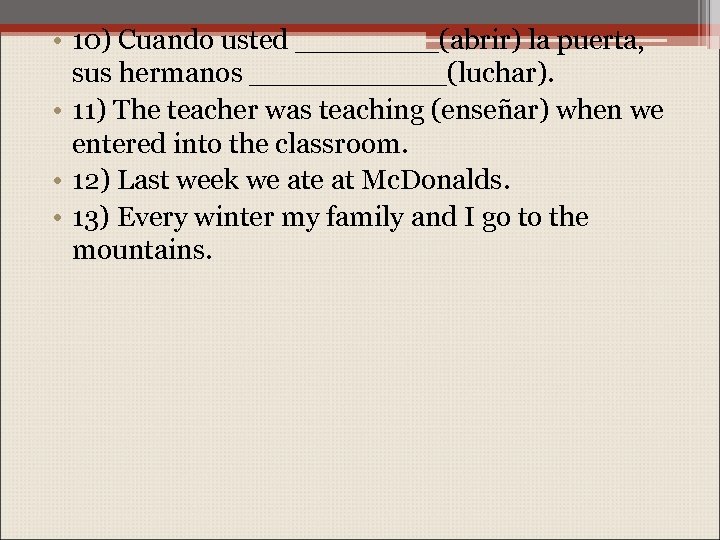 • 10) Cuando usted ____(abrir) la puerta, sus hermanos ______(luchar). • 11) The teacher was teaching (enseñar) when we entered into the classroom. • 12) Last week we at Mc. Donalds. • 13) Every winter my family and I go to the mountains.
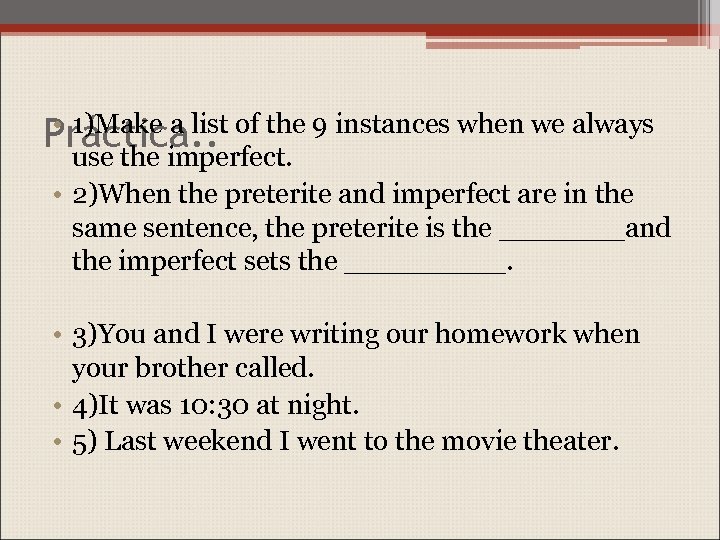 • 1)Make a list Práctica. . of the 9 instances when we always use the imperfect. • 2)When the preterite and imperfect are in the same sentence, the preterite is the _______and the imperfect sets the _____. • 3)You and I were writing our homework when your brother called. • 4)It was 10: 30 at night. • 5) Last weekend I went to the movie theater.
 • 1)Make a list of at least 5 clue phrases that we use with the preterite. • 2)Make a list of at least 5 clue phrases that we use with the imperfect • • 1)It was cold. 2)It was 1: 10 in the afternoon. 3)Last night we watched Spongebob. 4)Suddenly (de pronto), the door opened.
 • La Whenpasiva about se: talkingbeing done 1) voz we talk con something in general without terms saying who does it, we use the passive voice in English. • Ej: Fish is sold at the fish market. • 2) In Spanish, the pronoun se is used to express this idea. • Ej: Se vende pescado en la pescadería. • Ej: Se venden papas en la verdulería.
 • 3) You will often see the se construction used to express ideas such as: • Spanish is spoken here. • • > Aquí se habla Español.
 Práctica • Answer the following sentences in complete sentences. • • • 1) ¿ Qué idioma se habla en Quebec? 2) ¿ Qué idioma se habla en México? 3) ¿ Cómo se dice “ happy” en español? 4) ¿ Dónde se vende fruta? 5) ¿ Se venden bolígrafos en la papelería?
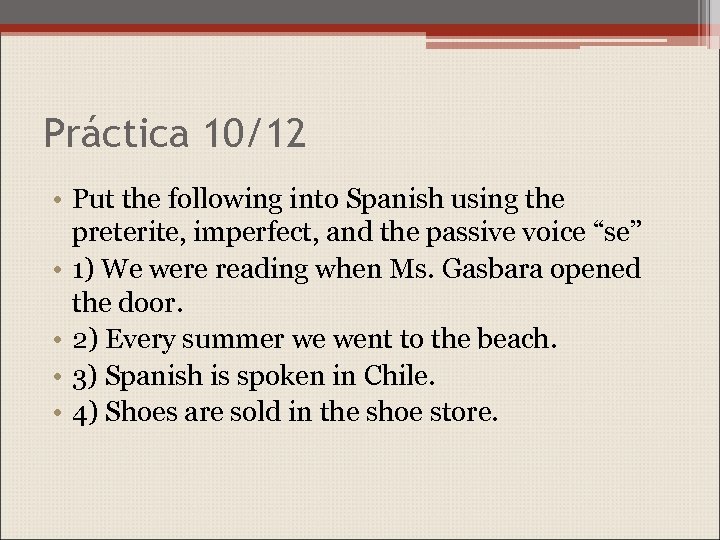 Práctica 10/12 • Put the following into Spanish using the preterite, imperfect, and the passive voice “se” • 1) We were reading when Ms. Gasbara opened the door. • 2) Every summer we went to the beach. • 3) Spanish is spoken in Chile. • 4) Shoes are sold in the shoe store.
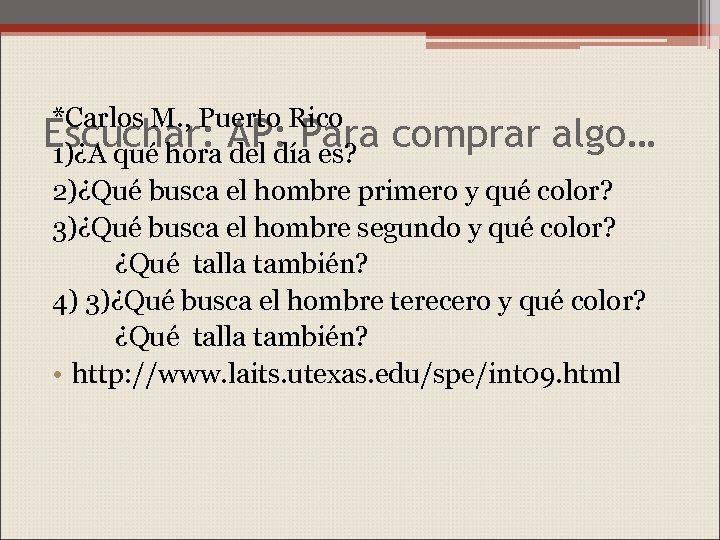 *Carlos M. , Puerto Rico Escuchar: AP: Para comprar algo… 1)¿A qué hora del día es? 2)¿Qué busca el hombre primero y qué color? 3)¿Qué busca el hombre segundo y qué color? ¿Qué talla también? 4) 3)¿Qué busca el hombre terecero y qué color? ¿Qué talla también? • http: //www. laits. utexas. edu/spe/int 09. html
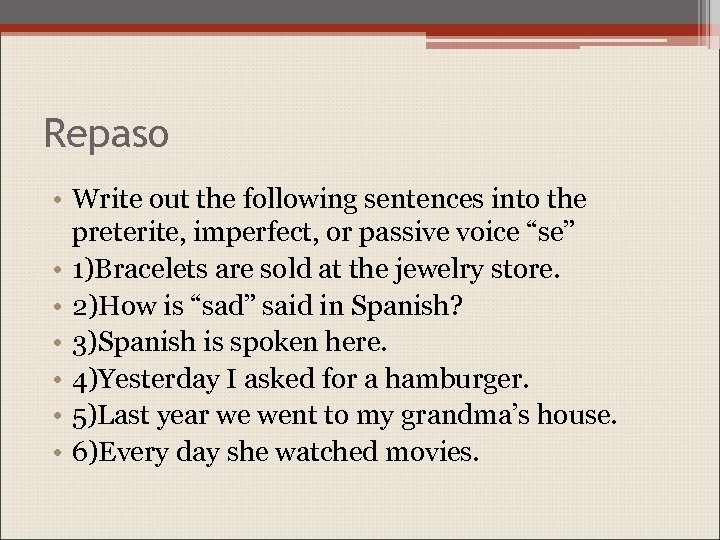 Repaso • Write out the following sentences into the preterite, imperfect, or passive voice “se” • 1)Bracelets are sold at the jewelry store. • 2)How is “sad” said in Spanish? • 3)Spanish is spoken here. • 4)Yesterday I asked for a hamburger. • 5)Last year we went to my grandma’s house. • 6)Every day she watched movies.
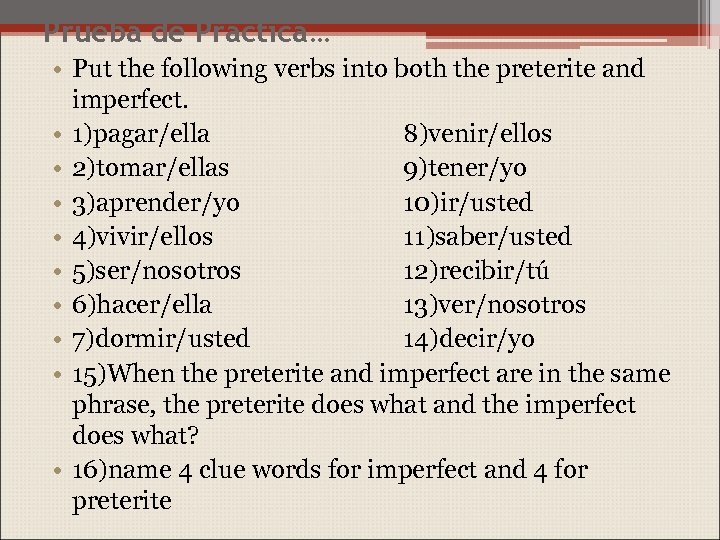 Prueba de Práctica… • Put the following verbs into both the preterite and imperfect. • 1)pagar/ella 8)venir/ellos • 2)tomar/ellas 9)tener/yo • 3)aprender/yo 10)ir/usted • 4)vivir/ellos 11)saber/usted • 5)ser/nosotros 12)recibir/tú • 6)hacer/ella 13)ver/nosotros • 7)dormir/usted 14)decir/yo • 15)When the preterite and imperfect are in the same phrase, the preterite does what and the imperfect does what? • 16)name 4 clue words for imperfect and 4 for preterite
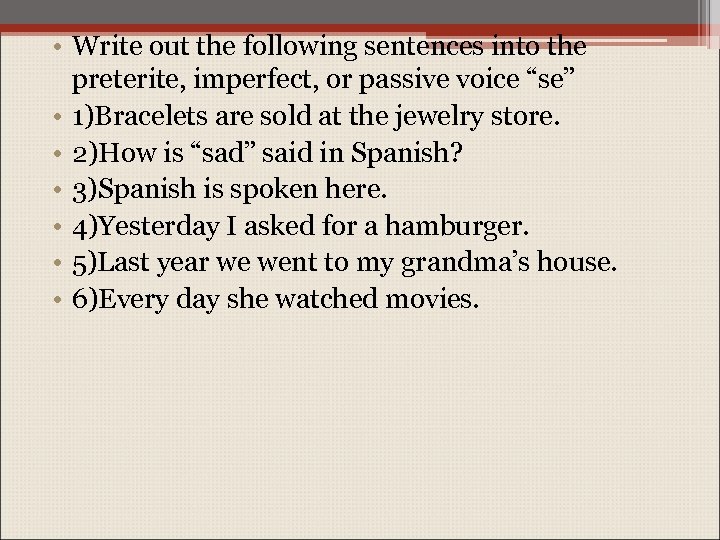 • Write out the following sentences into the preterite, imperfect, or passive voice “se” • 1)Bracelets are sold at the jewelry store. • 2)How is “sad” said in Spanish? • 3)Spanish is spoken here. • 4)Yesterday I asked for a hamburger. • 5)Last year we went to my grandma’s house. • 6)Every day she watched movies.
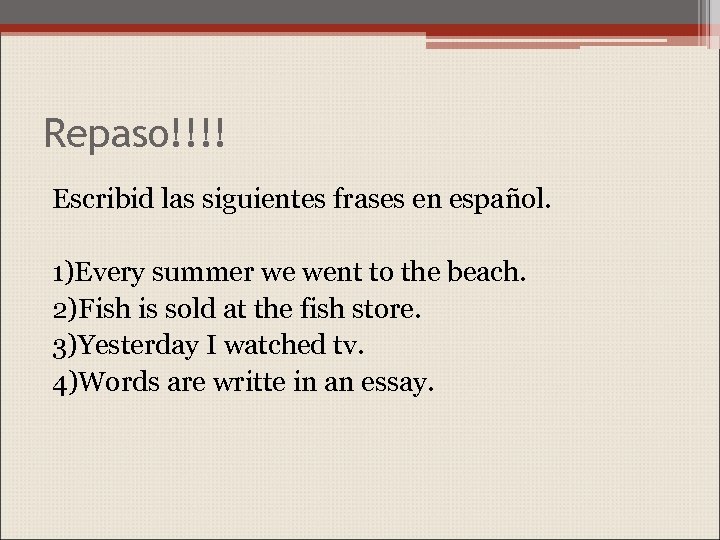 Repaso!!!! Escribid las siguientes frases en español. 1)Every summer we went to the beach. 2)Fish is sold at the fish store. 3)Yesterday I watched tv. 4)Words are writte in an essay.