


 Скачать презентацию Capital Structure and Cost of Capital Capital
Chapter 10 (B).ppt
- Количество слайдов: 31
 Capital Structure and Cost of Capital
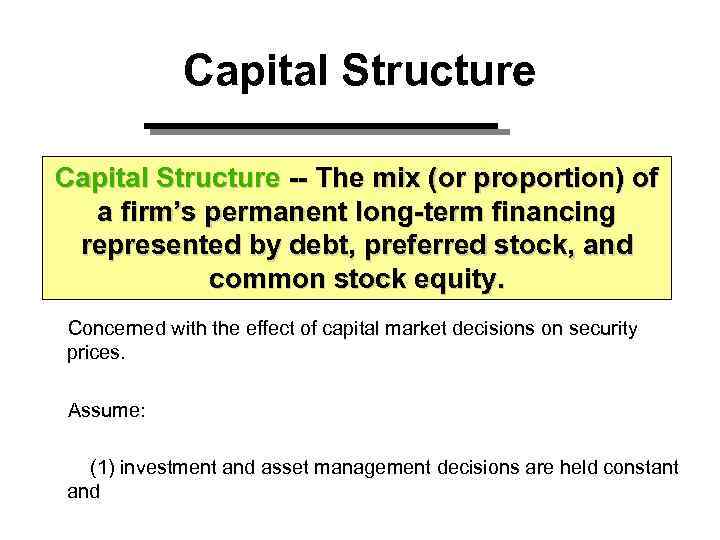 Capital Structure -- The mix (or proportion) of a firm’s permanent long-term financing represented by debt, preferred stock, and common stock equity. Concerned with the effect of capital market decisions on security prices. Assume: (1) investment and asset management decisions are held constant and
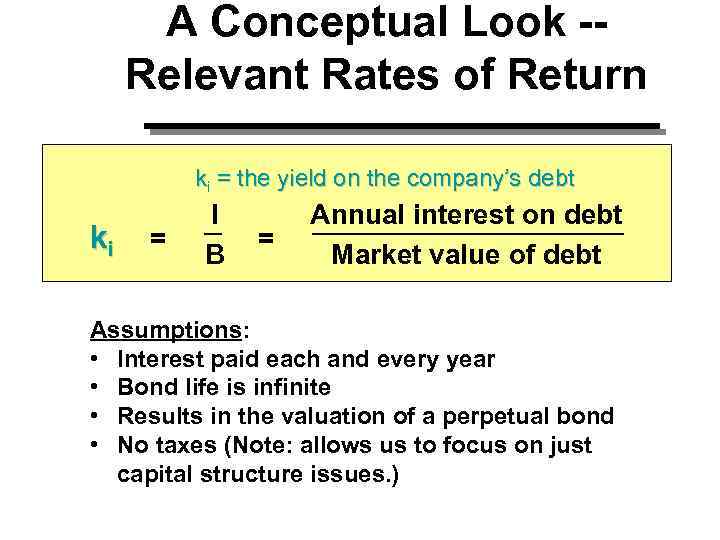 A Conceptual Look -Relevant Rates of Return ki = the yield on the company’s debt ki = I B = Annual interest on debt Market value of debt Assumptions: • Interest paid each and every year • Bond life is infinite • Results in the valuation of a perpetual bond • No taxes (Note: allows us to focus on just capital structure issues. )
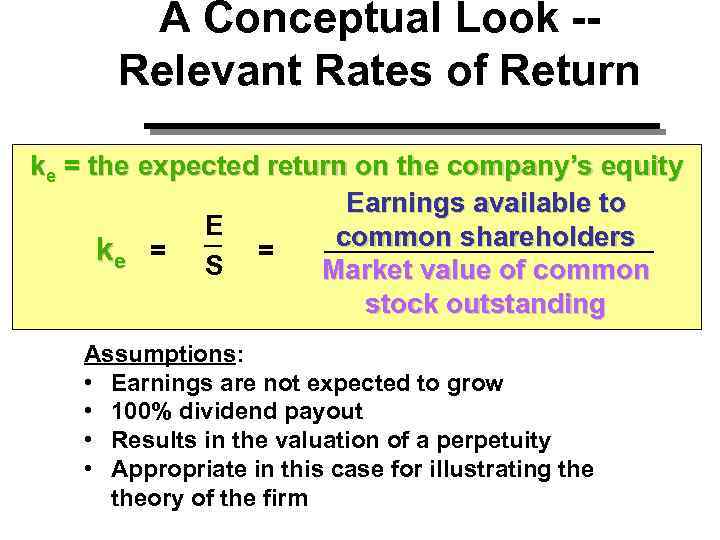 A Conceptual Look -Relevant Rates of Return ke = the expected return on the company’s equity Earnings available to E E common shareholders = = ke S Market value of common S stock outstanding Assumptions: • Earnings are not expected to grow • 100% dividend payout • Results in the valuation of a perpetuity • Appropriate in this case for illustrating theory of the firm
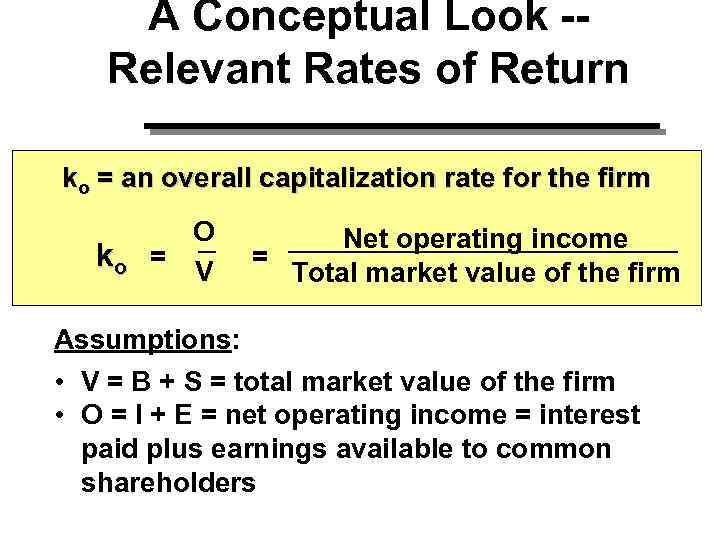 A Conceptual Look -Relevant Rates of Return ko = an overall capitalization rate for the firm ko O O = V V Net operating income = Total market value of the firm Assumptions: • V = B + S = total market value of the firm • O = I + E = net operating income = interest paid plus earnings available to common shareholders
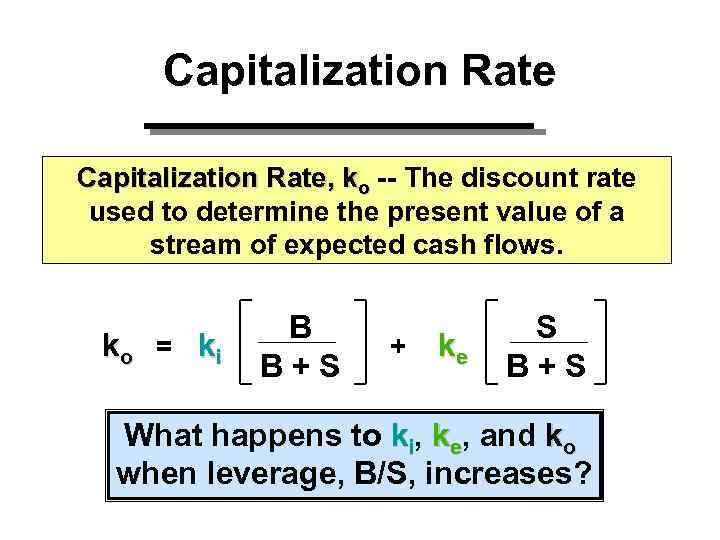 Capitalization Rate, ko -- The discount rate used to determine the present value of a stream of expected cash flows. ko = ki B B+S + ke S B+S What happens to ki, ke, and ko when leverage, B/S, increases?
 Optimal Capital Structure • The objective of management is to maximise shareholder wealth. • Is it possible to increase shareholder wealth by changing the gearing ratio/level?
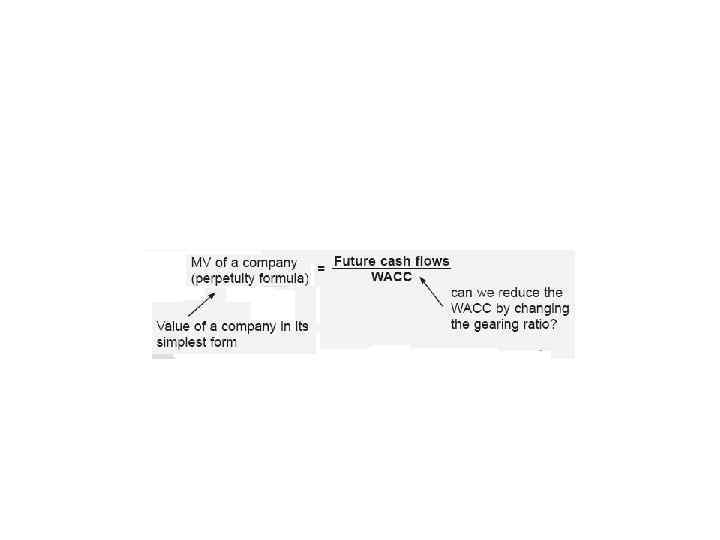
 • If you can reduce the WACC, this results in a higher MV/net present value (NPV) of the company and therefore an increase in shareholder wealth as they own the company:
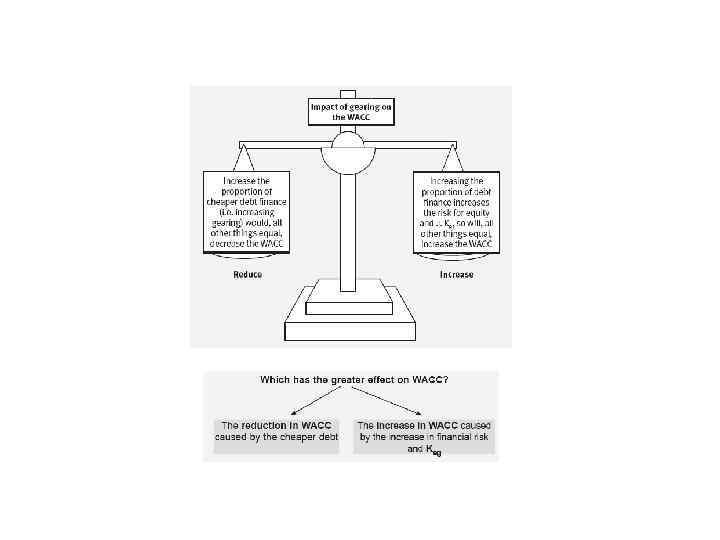
 • The WACC is a weighted average of the various sources of finance used by the company. – Debt is cheaper than equity: – lower risk – tax relief on interest • so you might expect that increasing the proportion of debt finance would reduce WACC. but: – increasing levels of debt make equity more risky: – fixed commitment paid before equity – finance risk • so increasing gearing increases the cost of equity and that would increase the WACC.
 Summary of NOI Approach • Critical assumption is ko remains constant. • An increase in cheaper debt funds is exactly offset by an increase in the required rate of return on equity. • As long as ki is constant, ke is a linear function of the debt-to-equity ratio. • Thus, there is no one optimal capital structure
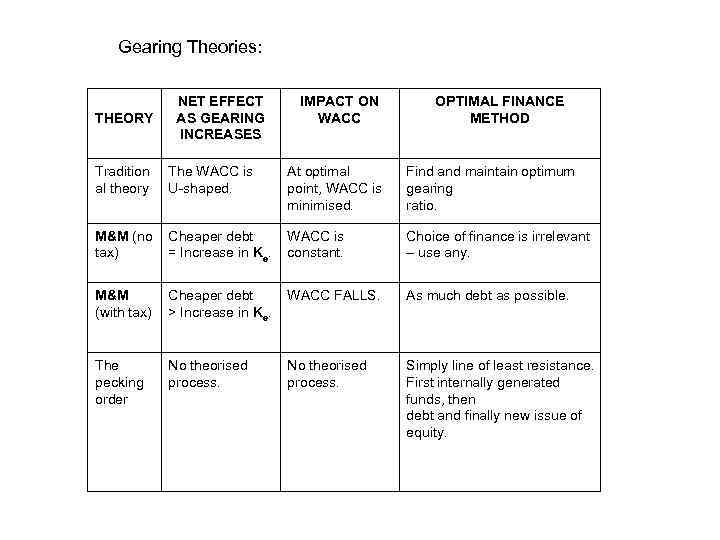 Gearing Theories: THEORY NET EFFECT AS GEARING INCREASES IMPACT ON WACC OPTIMAL FINANCE METHOD Tradition al theory The WACC is U-shaped. At optimal point, WACC is minimised. Find and maintain optimum gearing ratio. M&M (no tax) Cheaper debt = Increase in Ke. WACC is constant. Choice of finance is irrelevant – use any. M&M (with tax) Cheaper debt > Increase in Ke. WACC FALLS. As much debt as possible. The pecking order No theorised process. Simply line of least resistance. First internally generated funds, then debt and finally new issue of equity.
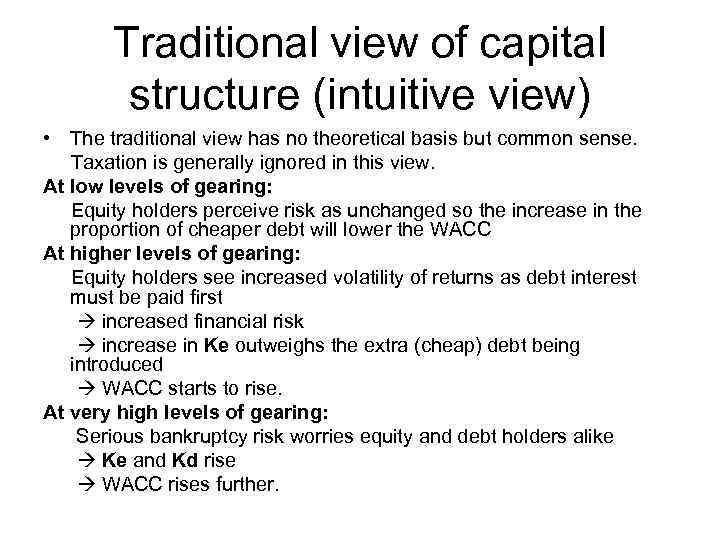 Traditional view of capital structure (intuitive view) • The traditional view has no theoretical basis but common sense. Taxation is generally ignored in this view. At low levels of gearing: Equity holders perceive risk as unchanged so the increase in the proportion of cheaper debt will lower the WACC At higher levels of gearing: Equity holders see increased volatility of returns as debt interest must be paid first increased financial risk increase in Ke outweighs the extra (cheap) debt being introduced WACC starts to rise. At very high levels of gearing: Serious bankruptcy risk worries equity and debt holders alike Ke and Kd rise WACC rises further.
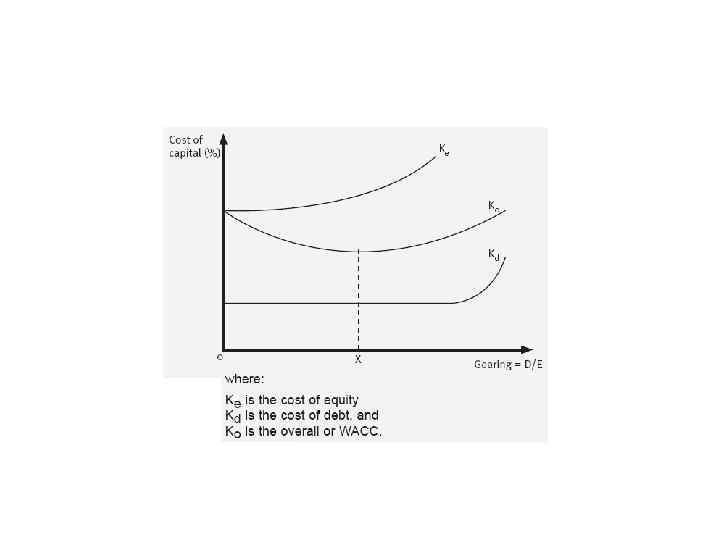
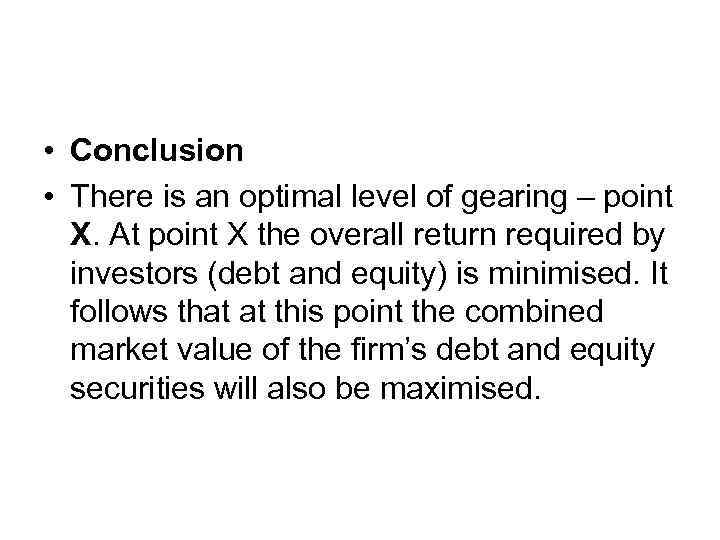 • Conclusion • There is an optimal level of gearing – point X. At point X the overall return required by investors (debt and equity) is minimised. It follows that at this point the combined market value of the firm’s debt and equity securities will also be maximised.
 Modigliani and Miller (M&M) – No tax • Assumptions – The theory developed by M&M in 1958 was based on the premise of a perfect capital market in which: – there are no transaction costs – no individual dominates the market – there is full information efficiency – all investors can borrow and lend at the riskfree rate – all investors are rational and risk averse • and crucially there are no taxes.
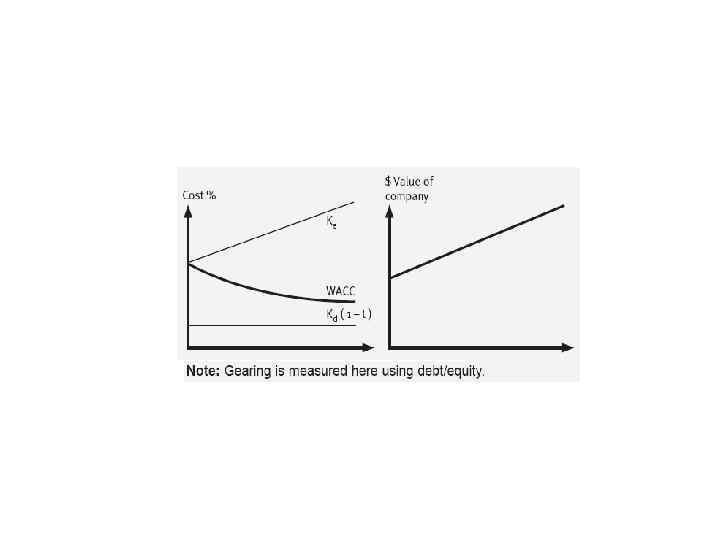
 • M&M argued that: – as investors are rational, the required return of equity is directly proportional to the increase in gearing. – There is thus a linear relationship between Ke and gearing (measured as D/E) – the increase in Ke exactly offsets the benefit of the cheaper debt finance and therefore the WACC remains unchanged. • Conclusion – The WACC and therefore the value of the firm are unaffected by changes in gearing levels and gearing is irrelevant.
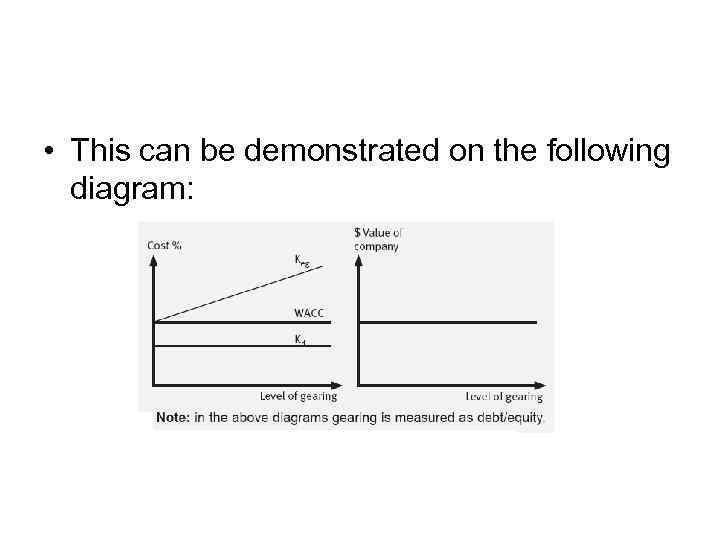 • This can be demonstrated on the following diagram:
 Modigliani and Miller (M&M) – with tax M&M modified their model to reflect the fact that the corporate tax system gives tax relief on interest payments. • The starting point for theory is, as before, that: – as investors are rational, the required return of equity is directly linked to the increase in gearing – as gearing increases, Ke increases in direct proportion. • However this is adjusted to reflect the fact that: – debt interest is tax deductible so the overall cost of debt to the company is lower than in M&M – no tax – lower debt costs less volatility in returns for the same level of gearing lower increases in Ke • the increase in Ke does not offset the benefit of the cheaper debt finance and therefore the WACC falls as gearing increases.
 The problems of high gearing • • • Bankruptcy risk Agency costs Tax exhaustion Borrowing/debt capacity Difference risk tolerance levels between shareholders and directors • Restrictions in the articles of association • The cost of borrowing increases as gearing increases
 Pecking-order theory In this approach, there is no search for an optimal capital structure through a theorised process. Instead it is argued that firms will raise new funds as follows: – internally-generated funds – debt – new issue of equity.
 • Internally-generated funds – i. e. retained earnings – Already have the funds. – Do not have to spend any time persuading outside investors of the merits of the project. – No issue costs. • Debt – The degree of questioning and publicity associated with debt is usually significantly less than that associated with a share issue. – Moderate issue costs. • New issue of equity – Perception by stock markets that it is a possible sign of problems. Extensive questioning and publicity associated with a share issue. – Expensive issue costs.
 BUSINESS VALUATION
 Valuing shares – the DVM
 • Strengths and weaknesses of the DVM – The model is theoretically sound and good for valuing a non-controlling interest but: – there may be problems estimating a future growth rate – it assumes that growth will be constant in the future, this is not true of most companies – the model is highly sensitive to changes in its assumptions – for controlling interests it offers few advantages over the earnings methods below.
 Asset-based valuations • Problems with asset-based valuations The fundamental weakness: – investors do not normally buy a company for its balance sheet assets, but for the earnings/cash flows that all of its assets can produce in the future – we should value is what is being purchased, i. e. the future income/cash flows. Subsidiary weakness: – The asset approach also ignores non-balance sheet intangible ‘assets’, e. g. : – highly-skilled workforce – strong management team – competitive positioning of the company’s products.
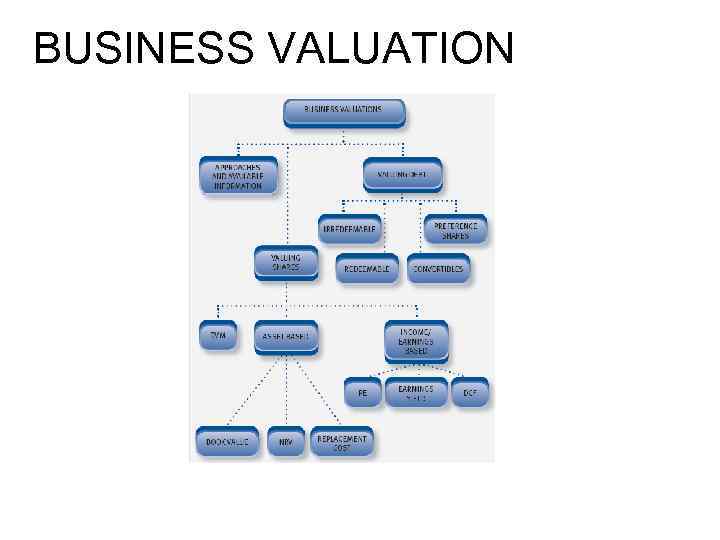
 When asset-based valuations are useful (1) Asset stripping (2) To set a minimum price in a takeover bid (3) To value property investment companies
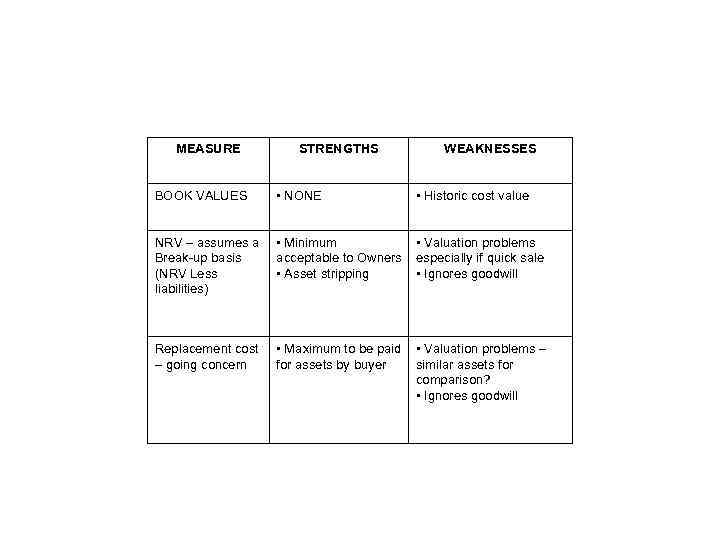 MEASURE STRENGTHS WEAKNESSES BOOK VALUES • NONE • Historic cost value NRV – assumes a Break-up basis (NRV Less liabilities) • Minimum acceptable to Owners • Asset stripping • Valuation problems especially if quick sale • Ignores goodwill Replacement cost – going concern • Maximum to be paid for assets by buyer • Valuation problems – similar assets for comparison? • Ignores goodwill
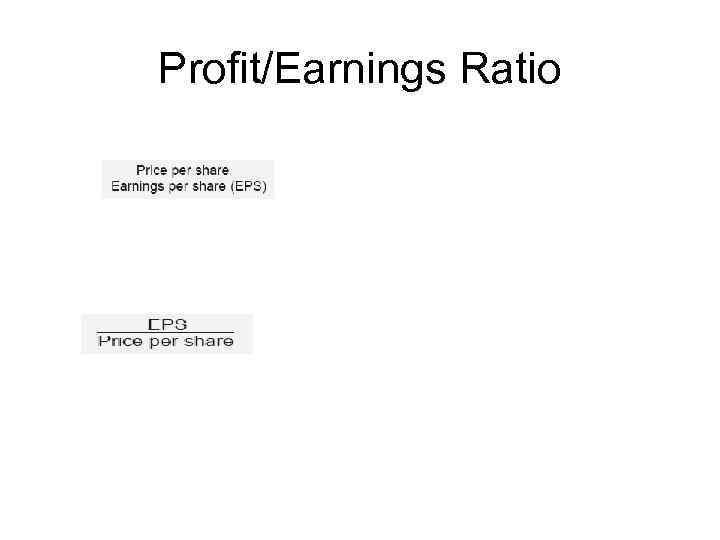 Profit/Earnings Ratio