


 Скачать презентацию CAPITAL FUND REGULATION TRAINING 24 CFR Part 905
6afe5941fbcb89726cb4dd6e261147e5.ppt
- Количество слайдов: 62
 CAPITAL FUND REGULATION TRAINING 24 CFR Part 905 1
 WHAT ARE WE TRYING TO ACCOMPLISH? A better understanding of program requirements for PHAs and residents to more effectively use Capital Funds; More efficient and consistent management of Capital Fund Program by Headquarters and HUD Field Offices; Directing more funds toward modernization given our limited fiscal environment Incorporating of the Department’s Energy Efficiency strategic goals; 2
 BACKGROUND Ø Final regulation combines and streamlines former legacy programs into the Capital Fund Program Ø Existing regulations for modernization (Part 968) and development and mixed finance will be eliminated (Part 941) Ø Final Rule in 24 CFR incorporates Capital Fund Financing Program Regulation (published in the Federal Register as a final 10/21/10) (Reserved as Part 500) 3
 HOW WILL THE RULE BENEFIT PHAS AND RESIDENTS? Ø New- Decouples Capital Fund forms from the larger PHA Plan Submission § Allows PHAs to submit Capital Fund requirements with the ACC Amendment § Eliminates requirements to submit a preliminary budget and a final budget to HUD for Review (1 budget submission) § Enables PHAs to only hold 1 public hearing 4
 HOW WILL THE RULE BENEFIT PHAS AND RESIDENTS? Ø New - Implements Demolition Disposition Transitional Funding (DDTF), which can be used more flexibly, to replace Replacement Housing Factor Grants (RHF) § Allows PHAs to use the funding for any eligible Capital Fund activities, including modernization § Eliminates separate RHF grants with separate use and reporting requirements § By reducing eligibility from 10 years to 5 years, it increases funding levels for PHAs generally § Provides a smooth RHF transition period that allows PHAs to continue receiving their RHF incremental funding for units removed 5 prior to the effective date stated in the rule
 HOW WILL THE RULE BENEFIT PHAS AND RESIDENTS? Ø New - Targets more funds to maintain the physical inventory § by reducing Management Improvements from 20% to 10% § Phases down the Management Improvement cost limits over a 5 year period § Clarifies eligible and ineligible uses for Management Improvements § Reduction of replacement funding timeframe from 10 years to 5 years makes more modernization funding available to PHAs without unit reductions § DDTF, which replaces RHF, allows PHAs to use their replacement funding to maintain physical inventory 6
 HOW WILL THE RULE BENEFIT PHAS AND RESIDENTS? Ø New - Streamlines Mixed Finance Requirements § Requires submission of evidentiary documents for mixed finance projects at HUD’s discretion § Eliminates the requirement for a separate waiver to use Identity of Interest approvals as part of the development process no longer require separate waivers 7
 HOW WILL THE RULE BENEFIT PHAS AND RESIDENTS? Ø New -Provides a TDC limit exception for energy conservation and efficiency § Allows PHAs to request a total development cost exception for integrated utility management, capital planning, and other capital and management activities that promote energy conservation and efficiency Ø New - Implements Energy Star requirements § Puts into regulation that Energy Star appliances are eligible Capital Fund costs Ø New - Standardizes the Energy Code § Implements the 2009 International Energy Conservation Code (IECC), or ASHRAE standard 90. 1 -2010 for multifamily high-rises (four stories or higher, which is consistent with the standard used in over 40 states throughout the US 8
 PART 100 GENERAL REQUIREMENTS AND PURPOSE Purpose § Provides financial assistance to PHAs and RMCs to make improvements and to develop Public Housing Applicability § Applies to all PHAs that have public housing units under ACC HUD approvals § All approvals required in this part, must be in writing Compliance § Execution of the CF ACC Amendment and disbursement of CF grants are the PHA’s certification that it will comply with 905 and the Public Housing Requirements Non-Compliance with Public Housing Requirements § HUD can institute sanctions as described in Part 800 § PHA can appeal 9
 § 905. 108 DEFINITIONS Ø New -Capital Fund Program Fee is a fee that a PHA may charge a Capital Fund grant to cover costs associated with oversight and management of the Capital Fund Program by the PHA’s Central Office Cost Center (COCC). Ø Fungibility allows PHAs to substitute work items, without prior HUD approval, between any of the years within the PHA’s latest approved 5 -Year Action Plan. Ø Obligation is a binding agreement for work or financing that will result in outlays, immediately or in the future. All obligations must be incorporated in the 5 -year Action Plan, approved by HUD and by the PHA’s Board. This includes funds obligated by the PHA for work to be performed by contract labor or by force account labor. Capital Funds that are to be transferred to operations (BLI 1406) are obligated once the funds have been budgeted and drawn down. 10
 § 905. 108 DEFINITIONS Ø New - Public Housing Requirements consist of the 1937 Act, HUD regulations, the Consolidated Annual Contributions Contract (including amendments), HUD notices, applicable federal statutes, applicable executive orders, and applicable regulatory requirements. Ø New (903. 3) - Qualified PHAs are PHAs that administer 550 or fewer units (the sum of public housing units and vouchers under Section 8(o)), that are not designated as a troubled PHA under section 6(j)(2), and that do not have a failing score under the Section 8 Management Assessment Program (SEMAP) during the prior 12 months. PHAs that meet this definition are not required to file the PHA Annual Plan called for in section 5 A(b)(1) of the 1937 Act. 11
 § 905. 108 MAJOR CHANGES NEW AND REVISED DEFINITIONS INCLUDE THE FOLLOWING: Ø Capital Fund Program Fee Ø Declaration of Restrictive Covenants Ø Fungibility Ø Mixed-Finance Modernization Ø Natural Disaster Ø Obligation Ø Public Housing Requirements 12
 § 905. 200 ELIGIBLE ACTIVITIES INTRODUCTION Ø Eligible Activities include Modernization, Development or Financing Activities that are: § Specified in an approved CFP 5 -Year Action Plan § Approved by HUD for emergency and natural disaster assistance 13
 § 905. 202 INELIGIBLE ACTIVITIES AND COSTS Ø Costs not associated with a PH project or development Ø PH operating assistance, except as provided in § 905. 314(l) Ø Direct Provisions of social services thru either force account or contract labor Ø Cost funded by another source- duplication 14
 MANAGEMENT IMPROVEMENTS Ø Non-Capital Activities needed to upgrade or improve the operation or maintenance of the PHA’s projects § Promote Energy Conservation § Sustain Physical Improvements § Correct Management Deficiencies Ø PHAs must demonstrate a linkage between the management improvement and an identified management deficiency Ø Fundable only through the initial implementation period of the physical improvements 15
 ELIGIBLE ACTIVITIES AND COSTS MANAGEMENT IMPROVEMENTS Training of PHA personnel in operations and procedures Improvement of Resident and Project Security (e. g. Security Equipment) Economic Self Sufficiency for Residents (e. g. Resident Job Training, Business Development Activities) Resident Management Costs not covered by the Operating Fund (e. g. Costs that promote more effective resident participation in Capital Fund Activities, Cost of Formation of RMC) 16
 INELIGIBLE ACTIVITIES AND COSTS MANAGEMENT IMPROVEMENTS Ø Costs for security guards or ongoing services § salaries and benefits Ø General remedial education Ø Job counseling, job development and placement § supportive services during training and the hiring of a resident coordinator 17
 § 905. 204 EMERGENCY AND NATURAL DISASTERS Ø What is an emergency? § An unforeseen or unpreventable event or occurrence that poses an immediate threat to the health and safety of the residents that must be corrected within one year of funding Ø What is a disaster? § For Capital Fund Purposes, Non-Presidentially declared disasters are eligible § Sect. 9 K of the 1937 Act repealed –Public Housing Disaster Relief Act of 2008 18
 § 905. 204 EMERGENCY AND NATURAL DISASTERS Ø The Emergency/Disaster Reserve – ($18, 953, 880 in FY 13) (reduced approx. 5% for sequester) § Congressionally Mandated set aside of Annual CFP appropriation § Funds approvable disaster and emergency applications in the order they are received § Funded from the FY Appropriation in which the Disaster/Emergency occurred § The grant award amount will be reduced by the amount of any insurance funds received § PHAs may be required to use unobligated Capital Funds before being granted funding § Safety and Security grants funded from Reserve ($3 m in FY 13) 19
 § 905. 204 EMERGENCY AND DISASTER APPLICATION PROCESS Ø Submitted to Field Office who reviews and forwards to HQ with recommendation (Memo from FO director to Director OCI) Ø Due to the urgency of the need, PHAs may submit an abbreviated preliminary application to fund disasters 20
 § 905. 200 MAJOR CHANGES ELIGIBLE & INELIGIBLE Ø Clarification of eligibility of energy audit or updated energy audits Ø Eligible: § Use of Energy Star appliances where cost effective § Capital Fund Program Fee for asset management PHAs Ø Ineligible: § Direct provision of social services through either force account or contract labor § Costs for security guard salaries or ongoing services 21
 § 905. 204 MAJOR CHANGES EMERGENCIES AND NATURAL DISASTERS Ø Repeal of 9 k – HUD cannot fund Presidentially declared disasters § PHAs should seek funding from FEMA for Presidentially declared disasters § PHAs can continue to request funding from the reserve for non-Presidentially declared disasters 22
 § 905. 300 NEW CAPITAL FUND SUBMISSION REQUIREMENTS Ø Submission requirements apply to Qualified and Non-Qualified PHAs Ø All PHAs must complete a comprehensive PNA Ø Capital Fund Submissions with ACC Amendment Annually Ø Capital Fund submissions requirements are decoupled from PHA Plan (24 CFR Part 903) 23
 DECOUPLING FROM THE PHA PLAN Ø Capital Fund Submission is not submitted with the PHA Plan § Separate Requirements than 903 § Applicable to both Qualified and Non-Qualified PHAs Ø PHAs submit Capital Fund Requirements when they submit the Capital Fund ACC Amendment each FY Ø PHAs will no longer have to submit a preliminary budget and a final budget since it will be submitted after the PHA gets it’s annual award Ø PHAs may combine the Public Hearing/ RAB Consultation for Capital Fund with the hearing required for the PHA Plan 24
 CFP 5 YEAR ACTION PLAN SUBMISSION REQUIREMENTS Ø Capital Fund Budget for each of the 5 Years Ø Required Certifications: § PIC Annual Reporting, Civil Rights, Lobbying Form, Certification of Compliance w/Public Hearing Ø Annual Public Hearing & RAB Consultation Ø Submission of Public & RAB Comments Ø Performance & Evaluation Report 25
 § 905. 312 NEW PROVISIONS IN DESIGN AND CONSTRUCTION Ø All development projects shall be designed and constructed in compliance with: § A national building code (i. e. International Code Council) and the 2009 International Energy Conservation Code (IECC), or ASHRAE standard 90. 12010 for multifamily high-rises Ø All modernization projects shall be designed and constructed in compliance with: § Cost-effective energy conservation measures identified in the PHA’s most recently updated energy audit. Ø PHAs must purchase appliances that are Energy Star or Federal Energy Management Program designed products § Exceptions given if purchase of these appliances is not cost effective 26
 § 905. 314 TDC LIMIT EXCEPTIONS Ø Public Housing funds may not be used to pay for Housing Construction Cost (HCC) and Community Renewal Costs in excess of the TDC limit, except: § PHAs may request a TDC exception for integrated utility management, capital planning, and other capital and management activities that promote energy conservation and efficiency. § HUD will review such requests to ensure that they would be cost-effective, i. e. , up-front expenditures would be justified by future cost savings. 27
 § 905. 314 COST AND OTHER LIMITATIONS ADMINISTRATIVE COSTS Ø Limited to 10 percent of the annual Capital Fund grant, in accordance with the CFP 5 Year Action Plan. Ø For PHAs under asset management, the Capital Fund Program Fee and administrative costs limits are the same. A PHA may charge a management fee of up to 10 percent of the annual CFP formula grant(s) amount Ø For development work with Capital Fund and RHF grants, the administrative cost limit is 3 percent of the total project budget or up to 6 percent with HUD approval. 28
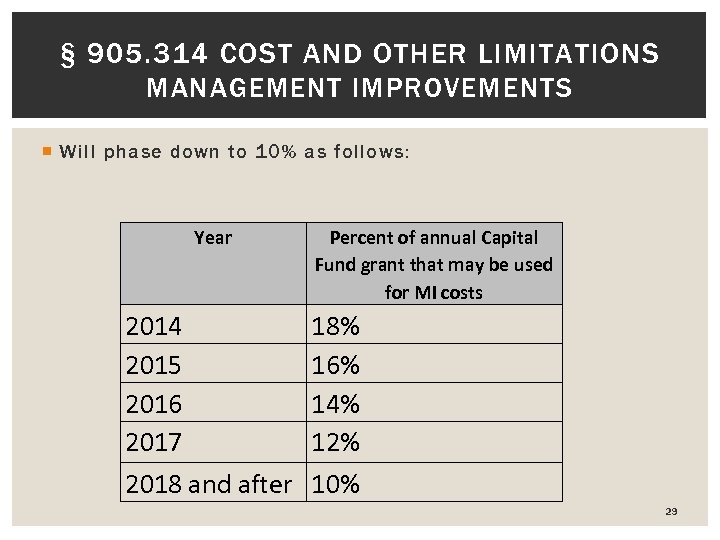 § 905. 314 COST AND OTHER LIMITATIONS MANAGEMENT IMPROVEMENTS Will phase down to 10% as follows: Year 2014 2015 2016 2017 2018 and after Percent of annual Capital Fund grant that may be used for MI costs 18% 16% 14% 12% 10% 29
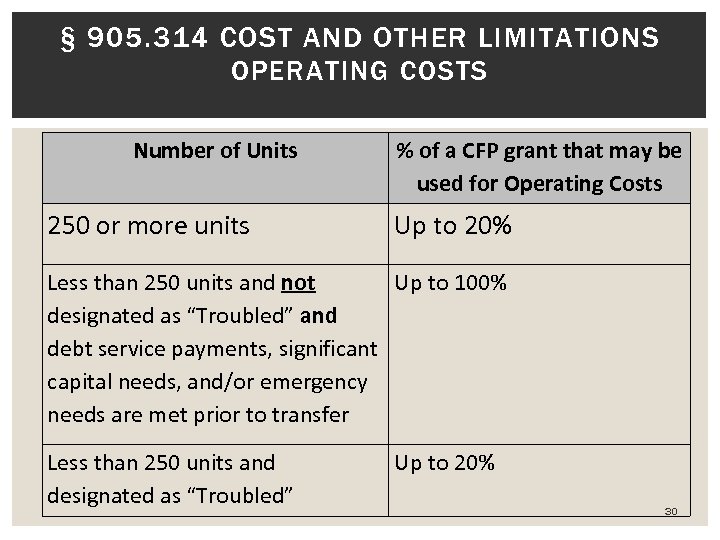 § 905. 314 COST AND OTHER LIMITATIONS OPERATING COSTS Number of Units 250 or more units % of a CFP grant that may be used for Operating Costs Up to 20% Less than 250 units and not Up to 100% designated as “Troubled” and debt service payments, significant capital needs, and/or emergency needs are met prior to transfer Less than 250 units and designated as “Troubled” Up to 20% 30
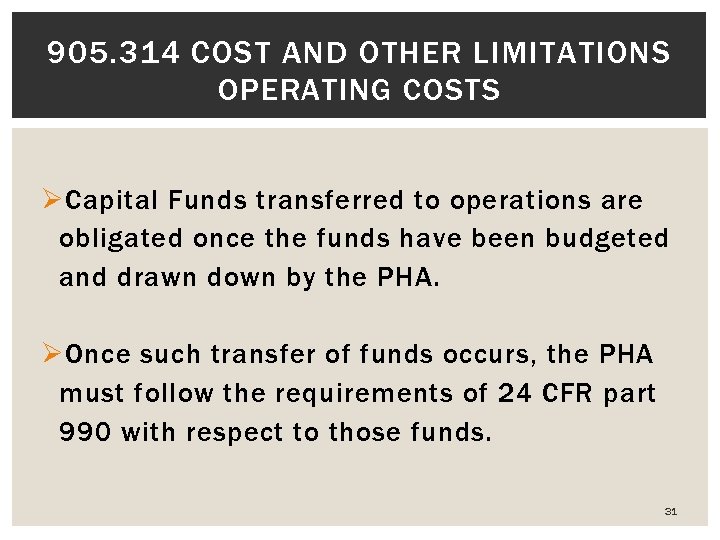 905. 314 COST AND OTHER LIMITATIONS OPERATING COSTS Ø Capital Funds transferred to operations are obligated once the funds have been budgeted and drawn down by the PHA. Ø Once such transfer of funds occurs, the PHA must follow the requirements of 24 CFR part 990 with respect to those funds. 31
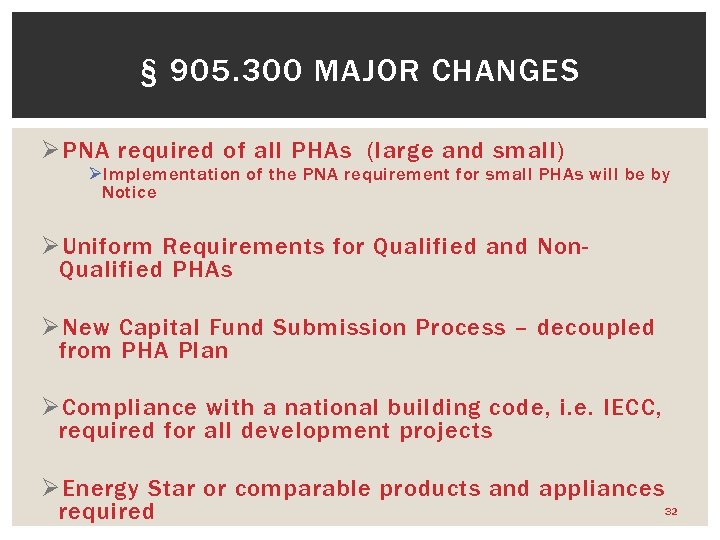 § 905. 300 MAJOR CHANGES Ø PNA required of all PHAs (large and small) Ø Implementation of the PNA requirement for small PHAs will be by Notice Ø Uniform Requirements for Qualified and Non. Qualified PHAs Ø New Capital Fund Submission Process – decoupled from PHA Plan Ø Compliance with a national building code, i. e. IECC, required for all development projects Ø Energy Star or comparable products and appliances 32 required
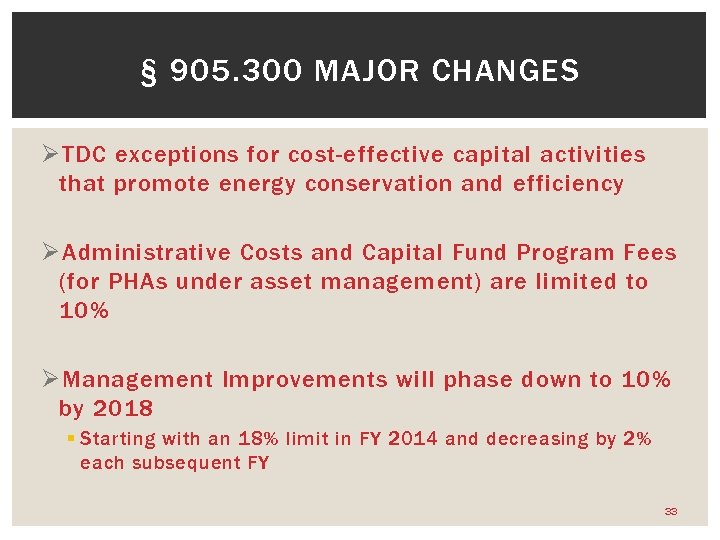 § 905. 300 MAJOR CHANGES Ø TDC exceptions for cost-effective capital activities that promote energy conservation and efficiency Ø Administrative Costs and Capital Fund Program Fees (for PHAs under asset management) are limited to 10% Ø Management Improvements will phase down to 10% by 2018 § Starting with an 18% limit in FY 2014 and decreasing by 2% each subsequent FY 33
 § 905. 400 CAPITAL FUND FORMULA RECONFIGURATION OF UNITS Ø Reconfiguration (conversion of units) causes the PHA’s formula share to be calculated based on the count of existing units after the reconfiguration § The purpose of this provision is to clarify HUD’s policy as it has consistently been implemented § It was never the intent of the formula calculation to fund the modernization needs or administrative costs of units that no longer exist as a result of conversion 34
 § 905. 400 CAPITAL FUND FORMULA REPLACEMENT HOUSING FACTOR (RHF) Ø Provides up to 10 years of funding for units removed from a PHA’s inventory due to demolition or disposition prior to September 30, 2013 § 2 five year increments of funding 35
 NEW - § 905. 400 CAPITAL FUND FORMULA DEMOLITION AND DISPOSITION TRANSITIONAL FUNDING (DDTF) Ø Provides 5 years of funding for units removed from a PHA’s inventory due to demolition or disposition on or after October 1, 2013 Ø PHAs that remove units due to demo/dispo are automatically eligible unless they reject the funding in writing. § If the PHA has received funding for units that will replace the lost units through another program, e. g. , Choice Neighborhoods or HOPE VI, it is not eligible for DDTF. 36
 § 905. 400 CAPITAL FUND FORMULA DDTF Ø The funding will be included in the PHA’s annual Capital Fund Formula Grant § not given as a separate grant § PHAs will be unable to accumulate grants Ø The PHA may use the funding for any eligible activities under the Capital Fund Program (905. 200) § Accumulation is no longer necessary as a result of the expansion of eligible activities Ø The funding must be obligated and expended in accordance with the requirements of the Capital Fund formula grant in which the funding has been included. § 24 months to obligate 90 percent § 48 months to expend 100 percent 37
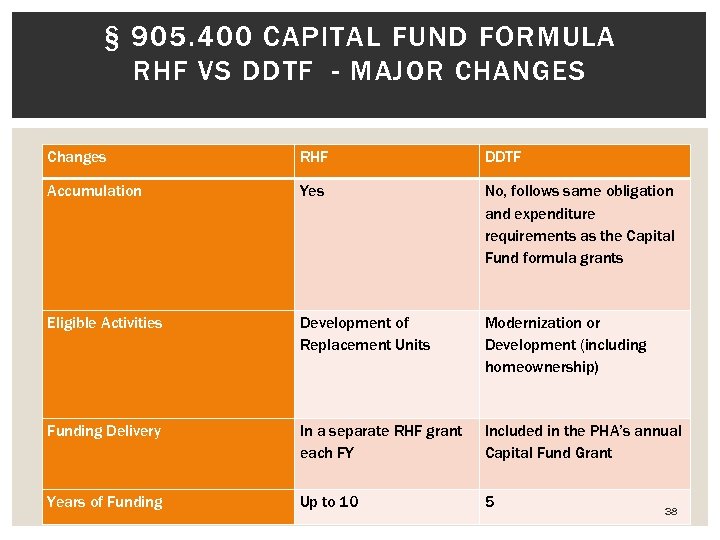 § 905. 400 CAPITAL FUND FORMULA RHF VS DDTF - MAJOR CHANGES Changes RHF DDTF Accumulation Yes No, follows same obligation and expenditure requirements as the Capital Fund formula grants Eligible Activities Development of Replacement Units Modernization or Development (including homeownership) Funding Delivery In a separate RHF grant each FY Included in the PHA’s annual Capital Fund Grant Years of Funding Up to 10 5 38
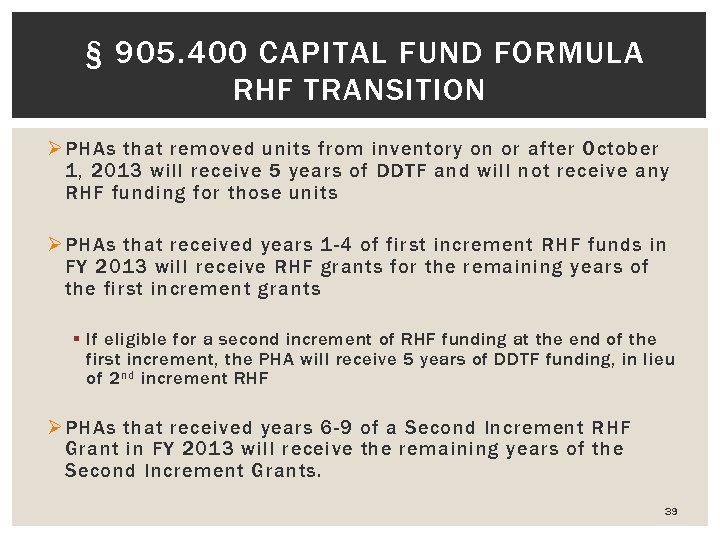 § 905. 400 CAPITAL FUND FORMULA RHF TRANSITION Ø PHAs that removed units from inventory on or after October 1, 2013 will receive 5 years of DDTF and will not receive any RHF funding for those units Ø PHAs that received years 1 -4 of first increment RHF funds in FY 2013 will receive RHF grants for the remaining years of the first increment grants § If eligible for a second increment of RHF funding at the end of the first increment, the PHA will receive 5 years of DDTF funding, in lieu of 2 nd increment RHF Ø PHAs that received years 6 -9 of a Second Increment RHF Grant in FY 2013 will receive the remaining years of the Second Increment Grants. 39
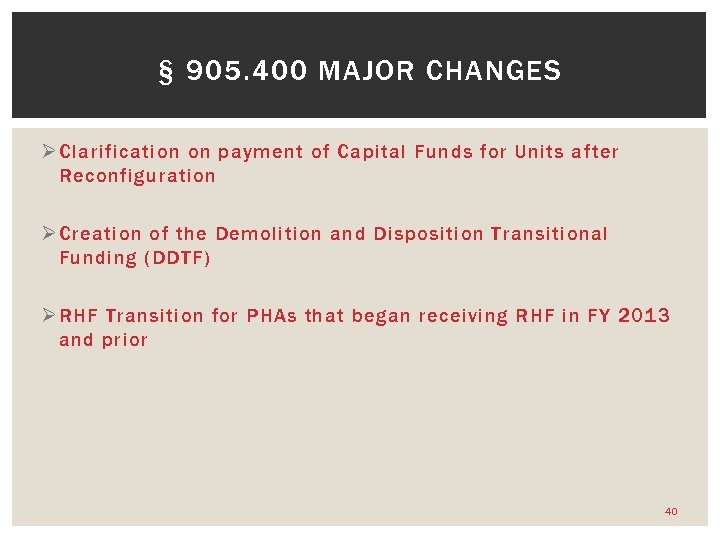 § 905. 400 MAJOR CHANGES Ø Clarification on payment of Capital Funds for Units after Reconfiguration Ø Creation of the Demolition and Disposition Transitional Funding (DDTF) Ø RHF Transition for PHAs that began receiving RHF in FY 2013 and prior 40
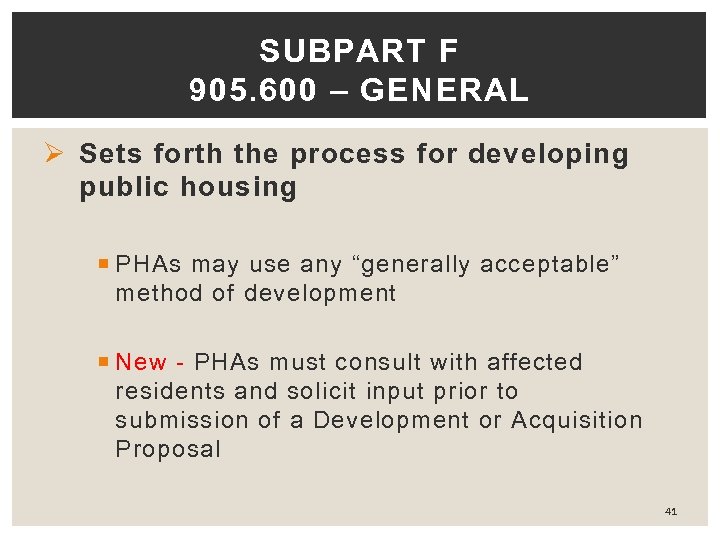 SUBPART F 905. 600 – GENERAL Ø Sets forth the process for developing public housing PHAs may use any “generally acceptable” method of development New - PHAs must consult with affected residents and solicit input prior to submission of a Development or Acquisition Proposal 41
 905. 602 PROGRAM REQUIREMENTS. Ø Sets forth specific Program Requirements § PHAs cannot develop more public housing than existed in October 1999 (Faircloth Limit) § “Develop” means new construction and acquisition 42
 905. 602 PROGRAM REQUIREMENTS CONTINUED Ø Each site must comply with Site & Neighborhood Standards Ø The cost of new construction cannot exceed the cost of acquisition/rehab Ø PHAs must comply with environmental regulations at 24 CFR part 58 or part 50 43
 905. 604 MIXED-FINANCE Ø Sets forth the requirements specific to mixed-finance § Definition of mixed-finance development: § Development of public housing units which will be owned in whole or part by an entity other than a PHA § Units which will be owned by a PHA are not mixed-finance 44
 905. 604 MIXED-FINANCE CONTINUED Ø HQ processes mixed-finance projects; Field Offices process traditional development Ø New- Projects doing only modernization can keep existing DOFAs automatically Ø New-Identify of Interest now approved as part of development process Ø Projects must meet the “pro rata” test 45
 905. 604 MIXED-FINANCE CONTINUED Ø New – Provides regulations pursuant to section 35(h) of the Act § Process for HUD approval to deviate from public housing requirements if reduction in operating subsidy impacts project feasibility § PHAs must prepare an Alternative Management Plans for HUD approval 46
 905. 606 – DEVELOPMENT PROPOSAL Ø Prior to developing public housing, PHAs must submit a Development Proposal § Specific elements of a Development Proposals are identified § Elements are the same for both conventional &mixed-finance § New – Legal documents required to be submitted for mixed-finance reduced 47
 905. 608 – ACQUISITION PROPOSAL Ø Prior to acquiring land, PHAs must submit an Acquisition Proposal § Refers to purchase of vacant land for future public housing development § A Development Proposal still required prior to development 48
 905. 610 TECHNICAL PROCESSING Ø Sets forth conditions for HUD approval of Proposals § Subsidy layering analysis required for mixedfinance § HUD has Safe Harbor Standards for fees for mixed-finance § Material changes to Proposals must be approved by HUD 49
 905. 612 – DISBURSEMENT OF FUNDS Ø Funding of predevelopment expenses § New - 5% of total public housing funds may be spent for predevelopment costs without HUD approval, except for mixed-finance § no predevelopment funds spent without HUD approval for mixed-finance 50
 § 905. 600 MAJOR CHANGES Ø A definition of mixed-finance development is provided Ø Identify of Interest issues now approved as part of the development process Ø Submission of evidentiary documents for mixed-finance projects has been streamlined Ø Clarification that development of units under Faircloth includes acquisition Ø Regulations related to deviation under 35(h) are provided Ø PHAs can now spend up to 5% of the Public Housing Funds committed to a project to pay for pre-development costs without HUD approval 51
 § 905. 802 HUD REVIEW OF PHA PERFORMANCE Ø carried out its activities under this part in a timely manner and in accordance with its CFP 5 Year Action Plan Ø accurately reported its obligation and expenditures in a timely manner Ø accurately reported required building and unit data for the calculation of the formula 52
 § 905. 804 SANCTIONS Ø Sanctions associated with failure to obligate or expend in a timely manner are specified at § 905. 306 Ø Other possible noncompliance sanctions may include, but are not limited to: § Issue a corrective action order. § Require reimbursement from non-HUD sources. § Limit, withhold, reduce, or terminate Capital Fund or Operating Fund assistance. Ø HUD shall notify the PHA of its finding and proposed action § PHA has a limited time to appeal 53
 § 905. 800 MAJOR CHANGES Ø Clarifies minimum performance review standards for PHAs Ø Lists possible noncompliance sanctions 54
 QUESTION When will the Public Housing Capital Fund Program Final Rule be effective? Are all the provisions effective on that date? 55
 ANSWER Generally speaking the Public Housing Capital Fund Program Final Rule will be effective on November 25, 2013. Some provisions are effective immediately such as: identify of interest TDC waivers for energy efficiency Alternative Management Plans The final rule contains provisions that are clarifications of existing policy or procedure which continue to be in effect: ineligibility of salaries and benefits for security guard limit on development - new construction and rehabilitation (Faircloth Amendment) 56
 QUESTION How does the rule change the submission of Capital Fund forms and information? Do the changes affect Qualified and non-Qualified PHAs? 57
 ANSWER First non-qualified PHAs no longer have to submit Capital Fund forms and information with the PHA Plan. When the FY 2014 formula awards are made: All PHAs are required to use the new provisions on Capital Fund submission in FY 2014 DDTF will be included in FY 2014 formula; RHF Transition begins in FY 2014 and PHAs will be limited to 18% for Management Improvements in 2014 58
 QUESTION Based on the clarification in 905. 202 of the final rule, how will FY 2013 PHA budgets that included salaries for security guards be handled? 59
 ANSWER Salaries for security guards and the direct provision of social services remain ineligible expenses. The Annual Statement for FY 2013 (budget) should be reviewed, revised to remove ineligible expenses, if necessary, and resubmitted to the Field Office. § The revised budget should be spread in LOCCS. § Large PHAs can transfer up to 20% to BLI 1406 Operations. The PHA can use these funds to fund security guards and/or direct social services. 60
 QUESTIONS Please send questions to CFRule@hud. gov 61
 62
62