 Скачать презентацию Cape Town s Energy Efficiency Forum for Commercial Buildings
7ac5352172116cbc367f9214c1b0e4ea.ppt
- Количество слайдов: 13



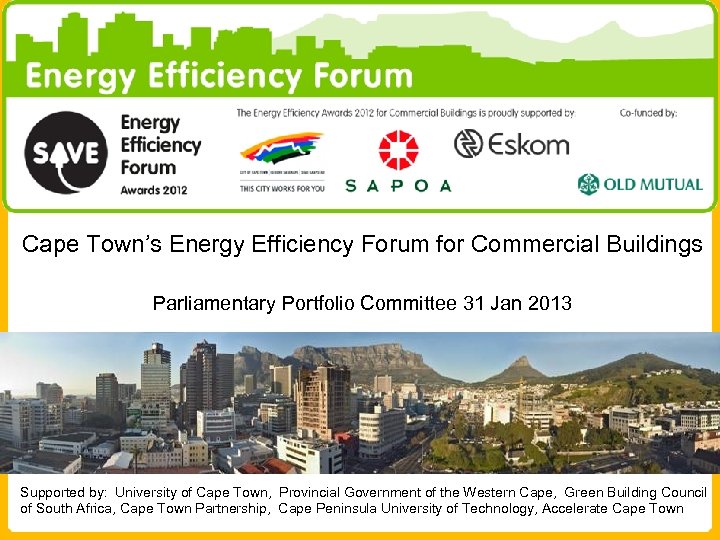
Cape Town’s Energy Efficiency Forum for Commercial Buildings Parliamentary Portfolio Committee 31 Jan 2013 Supported by: University of Cape Town, Provincial Government of the Western Cape, Green Building Council of South Africa, Cape Town Partnership, Cape Peninsula University of Technology, Accelerate Cape Town
Supported by: • University of Cape Town, • Provincial Government of the Western Cape, • Green Building Council of South Africa, • Cape Town Partnership, • Cape Peninsula University of Technology, • Accelerate Cape Town
How does it work? • Public Private Partnership • Membership built on networking/databases of partner orgs • Three meetings per year at Old Mutual Pinelands Centre ü Two information meetings for building owners and managers ü One market place at which suppliers can showcase their wares • EE Forum Awards – once per year – newly introduced, strict criteria with professional evaluation by UCT ERC M&V
Overview from previous events Ø Attendance – between 160 and 220 participants at each event Ø Outreach based on networking system through partners Database of 800 – all the partners and supporters provide their databases as contacts and send out invitations; registration is automatic on the website as is notice of attendance. Ø About 40% new attendees each time. Ø 95 % feel that they are provided with valuable/useful information Ø 92 % are motivated to make improvements in their building/s or company through what they learn at the Forum.
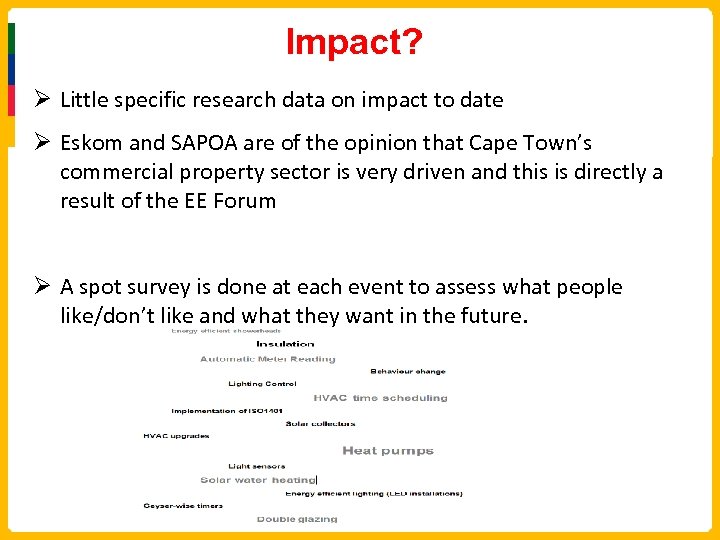
Impact? Ø Little specific research data on impact to date Ø Eskom and SAPOA are of the opinion that Cape Town’s commercial property sector is very driven and this is directly a result of the EE Forum Ø A spot survey is done at each event to assess what people like/don’t like and what they want in the future.
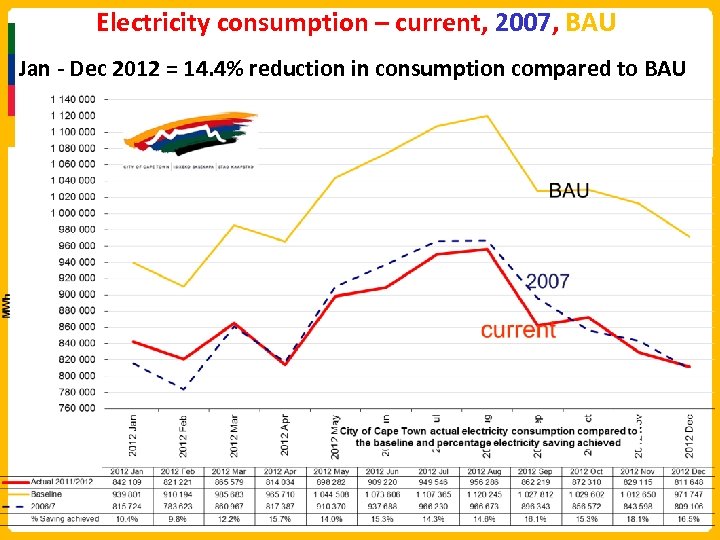
Electricity consumption – current, 2007, BAU Jan - Dec 2012 = 14. 4% reduction in consumption compared to BAU
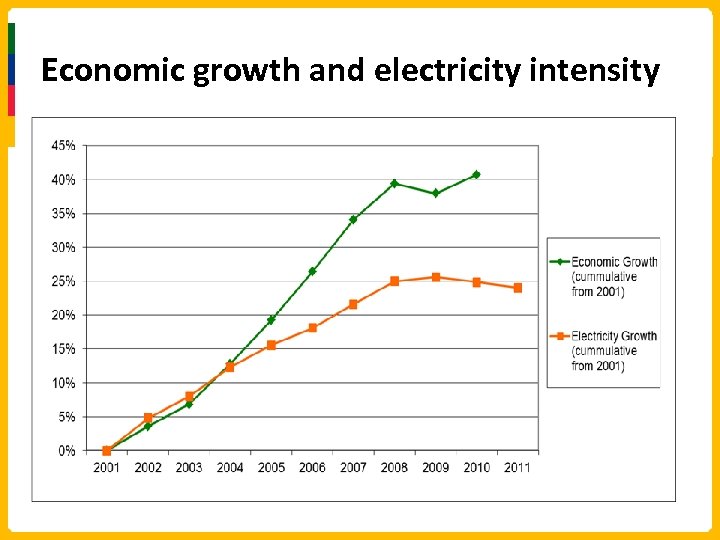
Economic growth and electricity intensity
Themes and topics Ø Case studies presented by companies – always create a LOT of interest, opportunity to brag! Ø Useful info: tariffs, NBRegs XA, GBCSA star tools, Eskom EE financial offerings, National Industrial EE Prog etc. Ø Awareness raising: green leasing, insurance in a changing climate, benchmarking Ø New technology inputs Ø EE Forum Awards!
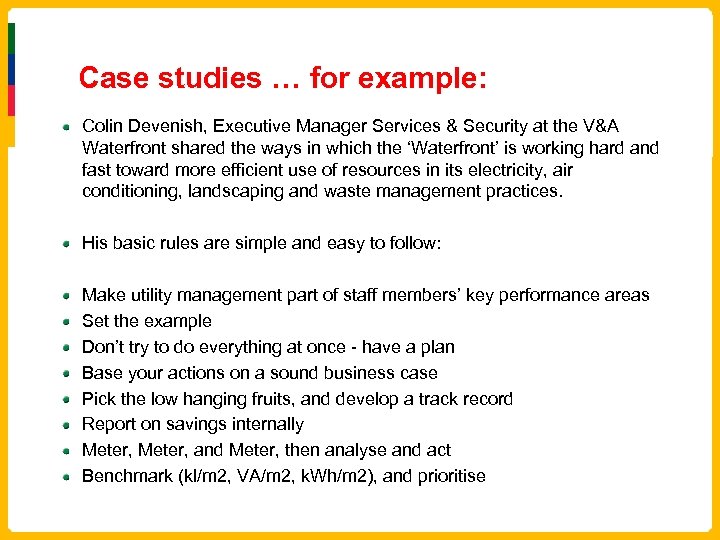
Case studies … for example: Colin Devenish, Executive Manager Services & Security at the V&A Waterfront shared the ways in which the ‘Waterfront’ is working hard and fast toward more efficient use of resources in its electricity, air conditioning, landscaping and waste management practices. His basic rules are simple and easy to follow: Make utility management part of staff members’ key performance areas Set the example Don’t try to do everything at once - have a plan Base your actions on a sound business case Pick the low hanging fruits, and develop a track record Report on savings internally Meter, and Meter, then analyse and act Benchmark (kl/m 2, VA/m 2, k. Wh/m 2), and prioritise
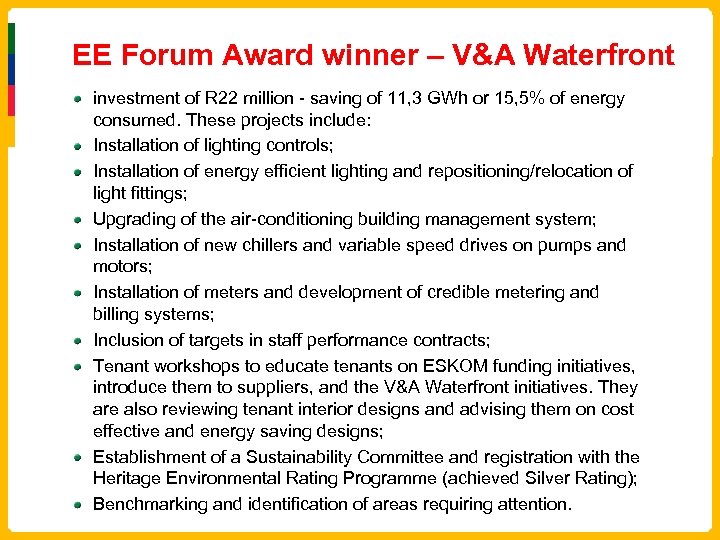
EE Forum Award winner – V&A Waterfront investment of R 22 million - saving of 11, 3 GWh or 15, 5% of energy consumed. These projects include: Installation of lighting controls; Installation of energy efficient lighting and repositioning/relocation of light fittings; Upgrading of the air-conditioning building management system; Installation of new chillers and variable speed drives on pumps and motors; Installation of meters and development of credible metering and billing systems; Inclusion of targets in staff performance contracts; Tenant workshops to educate tenants on ESKOM funding initiatives, introduce them to suppliers, and the V&A Waterfront initiatives. They are also reviewing tenant interior designs and advising them on cost effective and energy saving designs; Establishment of a Sustainability Committee and registration with the Heritage Environmental Rating Programme (achieved Silver Rating); Benchmarking and identification of areas requiring attention.
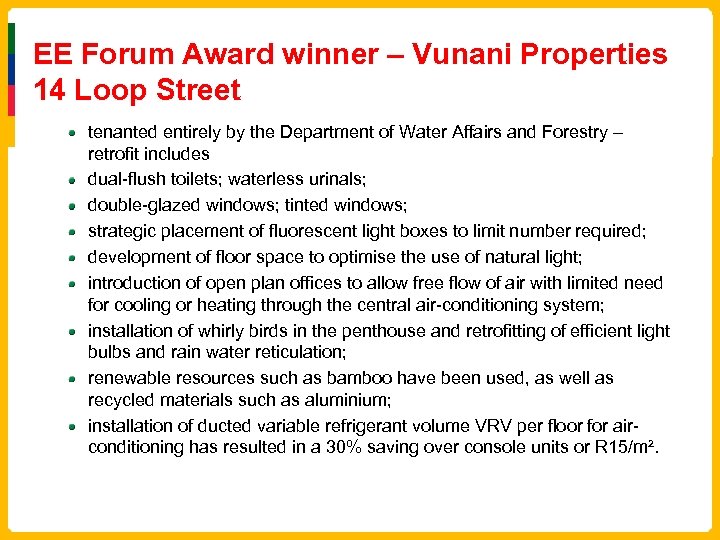
EE Forum Award winner – Vunani Properties 14 Loop Street tenanted entirely by the Department of Water Affairs and Forestry – retrofit includes dual-flush toilets; waterless urinals; double-glazed windows; tinted windows; strategic placement of fluorescent light boxes to limit number required; development of floor space to optimise the use of natural light; introduction of open plan offices to allow free flow of air with limited need for cooling or heating through the central air-conditioning system; installation of whirly birds in the penthouse and retrofitting of efficient light bulbs and rain water reticulation; renewable resources such as bamboo have been used, as well as recycled materials such as aluminium; installation of ducted variable refrigerant volume VRV per floor for airconditioning has resulted in a 30% saving over console units or R 15/m².
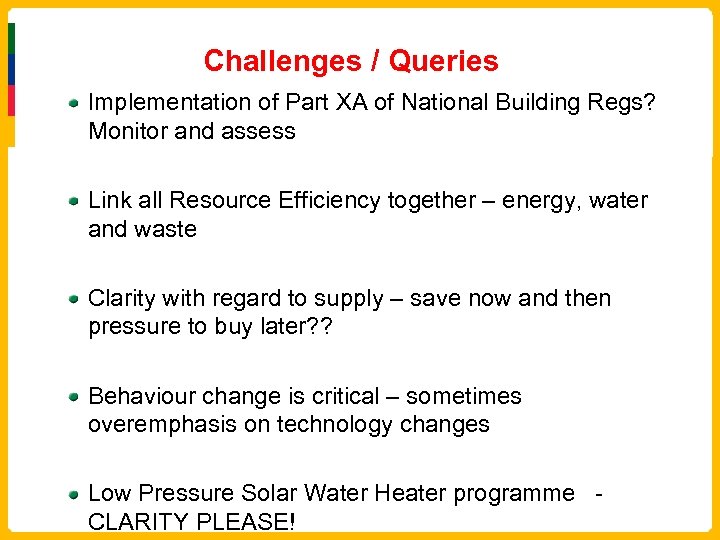
Challenges / Queries Implementation of Part XA of National Building Regs? Monitor and assess Link all Resource Efficiency together – energy, water and waste Clarity with regard to supply – save now and then pressure to buy later? ? Behaviour change is critical – sometimes overemphasis on technology changes Low Pressure Solar Water Heater programme - CLARITY PLEASE!
 Скачать презентацию Cape Town s Energy Efficiency Forum for Commercial Buildings
7ac5352172116cbc367f9214c1b0e4ea.ppt