 Скачать презентацию Capacity Limit Problem in 3 G Networks By
15e14477098f1eb5d1d962c34ba5c9d0.ppt
- Количество слайдов: 13



Capacity Limit Problem in 3 G Networks By Fahd Ahmad Saeed
Problem • 3 G network will not be able to withstand the bandwidth intensive services being planned to be offered by mobile operators, even with only a small number of subscribers utilizing the service within a service area. • 3 G wireless technology was never built to deliver the streaming media services • The bandwidth consumed for a certain media will increase exponentially as users requesting the certain media increases within a cell. As more subscribers start using these services, more base stations are needed to boost the shared bandwidth. • Currently mobile operators have to depend on additional overlay networks to broadcast high bandwidth media
Background • 3 G networks – W-CDMA • UMTS • FOMA – – • • cdma 2000 1 x EVDO, 3 x TD-SCDMA UMA EDGE Supports data rates from 384 kbps to 2 Mbps Packet switched data services Use Licensed spectrum, no spare spectrum No proven mathematical formula on how to handle capacity problems • Network divided into cells • Each cell shares bandwidth
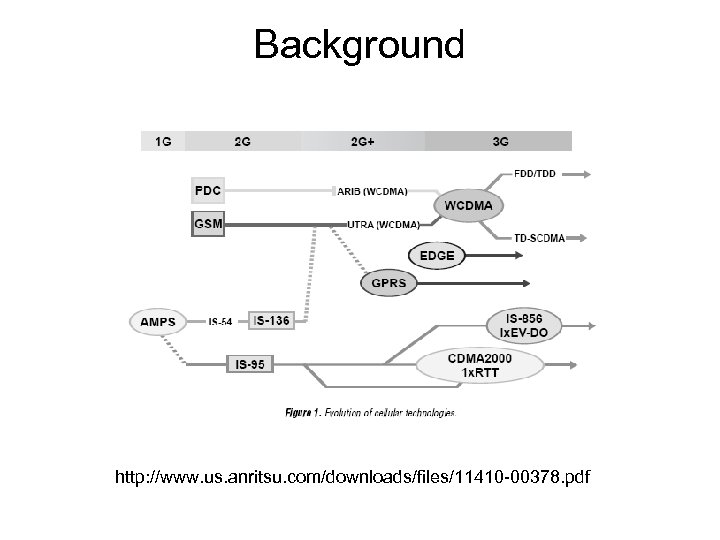
Background http: //www. us. anritsu. com/downloads/files/11410 -00378. pdf
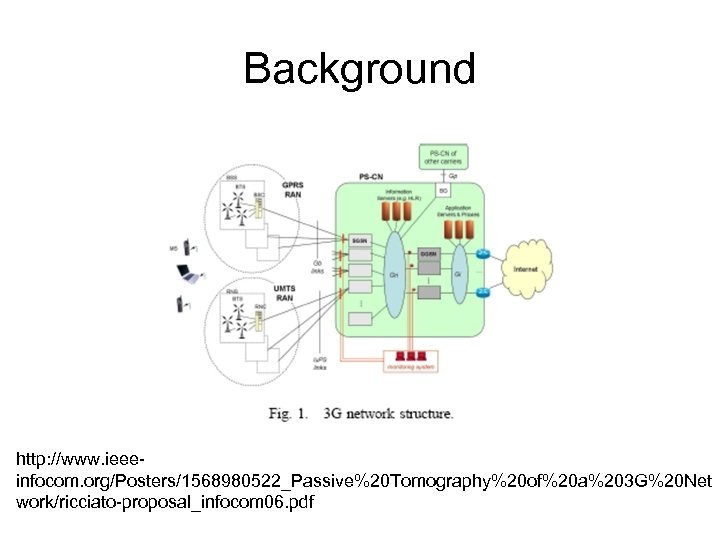
Background http: //www. ieeeinfocom. org/Posters/1568980522_Passive%20 Tomography%20 of%20 a%203 G%20 Net work/ricciato-proposal_infocom 06. pdf
Possible Solutions • 3 GPP/3 GPP 2 is working on modifying 3 G, called MBMS (Multimedia Broadcast and Multicast Standard), will be available in networks in 2007. – Doesn’t require additional spectrum or licensing. coverage will be identical to conventional 3 G networks. – Capacity needs to be set aside that could be used to sell end to end voice and data. Limited number of channels, due to capacity limitation. • Building dedicated broadcast networks to additional channels, such as DVB-H, DMB and Media. Flo. – Will require mobile operators to upgrade equipment and consumers to buy new handsets. • Add more cells to the network to decrease cells covered area to support more bandwidth. Expensive. • Using Smart Antennas: directs radio signal to intended target, rather than broadcasting it to everyone. Utilizes spatial separation.
Proposed Solution • Use a combination of Wi. Fi, 3 G with strategically placing Smart Antennas in dense cell usage areas. • Seamless handshaking between Wi. Fi and 3 G. • Pricing: Volume of Data transmitted through Wi. Fi is tracked within the handheld device and transmitted to the operator with a certain delay – End of session?
Research • After extensive research on the problem, it was found that the proposed solution has already been looked at and the technology developed by Nortel and has been successfully tested in Japan. http: //informationweek. com/story/show. Article. jhtml? article. ID=164901785 • Lucent Technologies also successfully tested the handoff between 3 G networks and Wi. Fi seamlessly. http: //www. mobile. commerce. net/story. php? story_id=2195 • IEEE 802. 21 standard will try to make it possible to roam from any 802 - based network to another, and will also let them roam to 3 G cellular network. • Nokia demonstrated its seamless handoff of voice and data services between Wi. Fi and 3 G networks at the CTIA Wireless 2006. http: //www. pdastreet. com/articles/2006/4/2006 -4 -14 -Nokia-Demos-Cellular. html
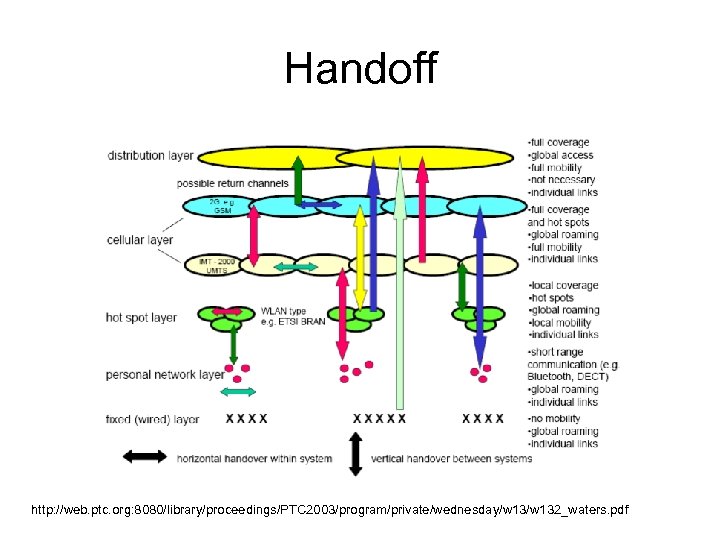
Handoff http: //web. ptc. org: 8080/library/proceedings/PTC 2003/program/private/wednesday/w 132_waters. pdf
3 G vs. Wi. Fi • Combination of the two technologies prevents the capacity bottleneck associated with 3 G network. If a 3 G cell is being overloaded, the call or data connection can be handed off to a Wi. Fi Access Point. • Wi. Fi is less expensive to deploy then 3 G networks and can be deployed for thousands of dollars vs. millions. • Since Wi. Fi has a short range, but more bandwidth compared to 3 G, each technology will compliment each other.
Problems with the Proposed Solution • Pricing model between Wi. Fi and mobile operators (3 G). How is the consumer going to get billed. • Security within unsecured Wi. Fi networks. • Seamless handoff will not occur between secured Wi. Fi networks and 3 G networks, if the network key (WPA, WEP) is not preprogrammed. • Maintaining Qos between networks.
Conclusion • The proposed solution attractive, if the pricing and security problems are resolved between handoffs between networks. • A fair pricing model is needed to address roaming between networks. • A secure public key encryption scheme supported between Wi. Fi and 3 G networks is needed to allow seamless roaming between the two networks. • Some good article about integrated support between heterogeneous networks are http: //middleware 05. objectweb. org/WSProceedings. MPAC 05/a 15 -bellavista. pdf http: //web. ptc. org: 8080/library/proceedings/PTC 2003/program/private/wednesday/w 132_wat ers. pdf
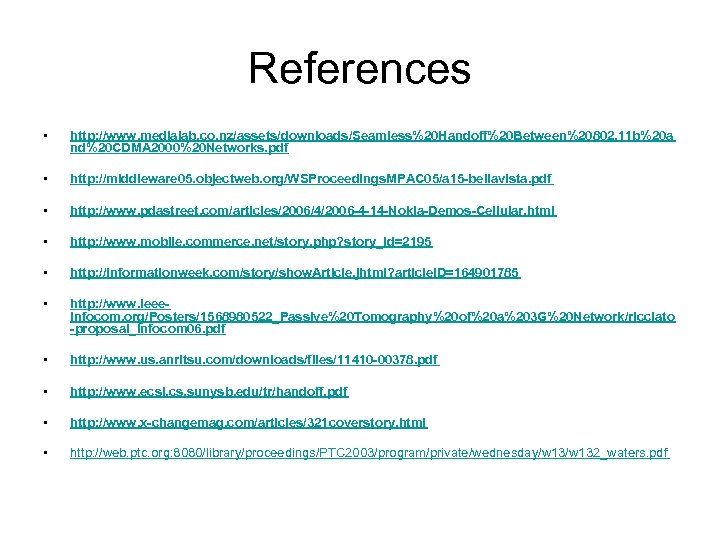
References • http: //www. medialab. co. nz/assets/downloads/Seamless%20 Handoff%20 Between%20802. 11 b%20 a nd%20 CDMA 2000%20 Networks. pdf • http: //middleware 05. objectweb. org/WSProceedings. MPAC 05/a 15 -bellavista. pdf • http: //www. pdastreet. com/articles/2006/4/2006 -4 -14 -Nokia-Demos-Cellular. html • http: //www. mobile. commerce. net/story. php? story_id=2195 • http: //informationweek. com/story/show. Article. jhtml? article. ID=164901785 • http: //www. ieeeinfocom. org/Posters/1568980522_Passive%20 Tomography%20 of%20 a%203 G%20 Network/ricciato -proposal_infocom 06. pdf • http: //www. us. anritsu. com/downloads/files/11410 -00378. pdf • http: //www. ecsl. cs. sunysb. edu/tr/handoff. pdf • http: //www. x-changemag. com/articles/321 coverstory. html • http: //web. ptc. org: 8080/library/proceedings/PTC 2003/program/private/wednesday/w 132_waters. pdf
Скачать презентацию Capacity Limit Problem in 3 G Networks By
15e14477098f1eb5d1d962c34ba5c9d0.ppt