


 Скачать презентацию CANARIE The Critical Role Universities will play in
c293d650bef0760a3f63e8a84b8e5943.ppt
- Количество слайдов: 17
 CANARIE “The Critical Role Universities will play in the Future Evolution of the Internet” http: //www. canarie. ca http: //www. canet 3. net Bill. St. Arnaud@canarie. ca
 CANARIE Inc · · · · Canada’s Advanced Internet Development Organization Canadian equivalent to Internet 2 and NGI Private-sector led, not-for-profit consortium Consortium formed 1993 Federal funding of $300 m (1993 -99) Total project costs estimated over $600 M Currently over 140 members; 21 Board members
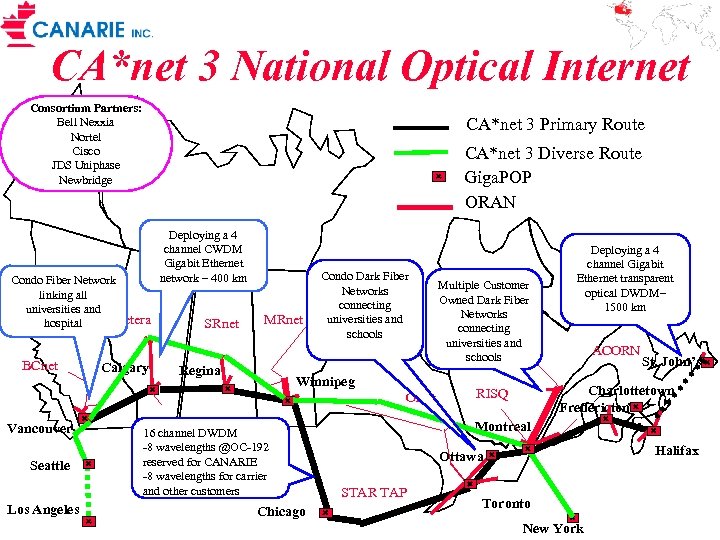 CA*net 3 National Optical Internet Consortium Partners: Bell Nexxia Nortel Cisco JDS Uniphase Newbridge CA*net 3 Primary Route CA*net 3 Diverse Route Giga. POP ORAN Condo Fiber Network linking all universities and Netera hospital BCnet Calgary Deploying a 4 channel CWDM Gigabit Ethernet network – 400 km SRnet MRnet Regina Condo Dark Fiber Networks connecting universities and schools Winnipeg ONet Vancouver Seattle Los Angeles 16 channel DWDM -8 wavelengths @OC-192 reserved for CANARIE -8 wavelengths for carrier and other customers Chicago Multiple Customer Owned Dark Fiber Networks connecting universities and schools Deploying a 4 channel Gigabit Ethernet transparent optical DWDM– 1500 km ACORN St. John’s Charlottetown Fredericton RISQ Montreal Halifax Ottawa STAR TAP Toronto New York
 The Internet Revolution · The Internet revolution has barely begun… · In mid 1990 s the prevailing wisdom was that commercial sector would drive design of Internet infrastructure · As a result in North America R&E networks were commercialized or decommissioned · e. g NSFnet & CA*net · New R&E networks would focus on applications or specialized services such as Qo. S · But new developments in customer owned dark fiber, long distance LAN and wireless are putting the universities back in the driver’s seat in the ongoing evolution of the Internet
 Customer Empowered Networks · Individual institutions – the customers – own and control their own strands of fiber · Fiber are configured in point to point private networks; or · Connect to local ISP or carrier hotel or Giga. POP · Low cost LAN architectures and optics are used to light the fiber for distances to several hundred kilometers · Control and management of the optics and wavelengths is under the domain of the customer at the edge, as opposed to the traditional carrier in the center · These new concepts in customer empowered networking are starting in the same place as the Internet started – the university and research community. · Extending the Internet model of autonomous peering networks to the telecom world
 New Critical Role for Universities · This time it is not only about Internet networks for universities and research centers, but for schools and most importantly for the community as a whole · Communities and schools are looking to the universities for leadership · They are the only neutral 3 rd party in the community with the skills and knowledge to lead this revolution · University community has a greater role and a greater responsibility with this second Internet revolution
 Examples of University Leadership · Universities in Quebec are building their own 3500 km “condominium” fiber network in partnership with several school board and many communities · In Ottawa is deploying a 85 km- 144 strand “condominium” network connecting 26 institutions – cost $1 m US · Universities are the anchor tenants and lead for the project · Blacksburg Electronic Village dark fiber network was lead Uo. Virginia · University community in Chicago area and Indiana are instrumental in municipal developments there · University in California – CENIC is the lead for the California DCP project to connect up all California schools with high bandwidth
 Market Drivers · First - low cost · Up to 1000% reduction over current telecom prices. 6 -12 month payback · Second - LAN invades the WAN – no complex SONET or ATM required in network · Third - Enables new applications and services not possible with traditional telecom service providers · Relocation of servers and extending LAN to central site · Out sourcing LAN and web servers to a 3 rd party because no performance impact · IP telephony in the wide area (Spokane) · HDTV video · Fourth – Allows access to new competitive low cost telecom and IT companies at carrier neutral meet me points - Giga. POPs · Much easier to out source servers, e-commerce etc to a 3 rd party at a carrier neutral collocation facility
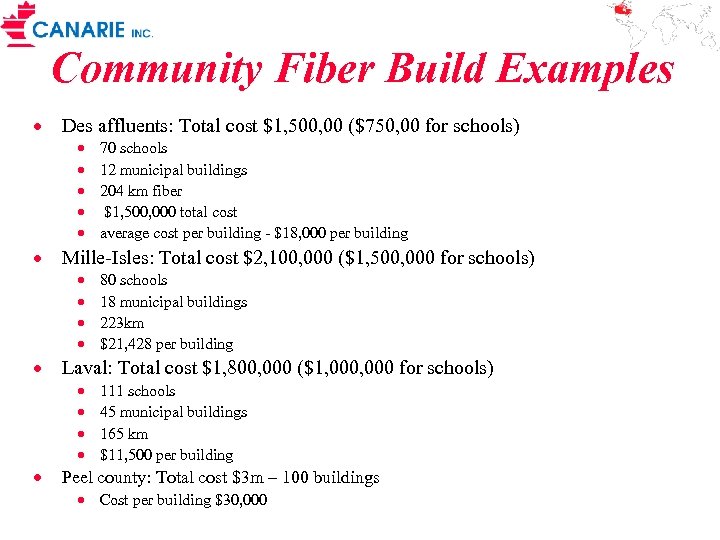 Community Fiber Build Examples · Des affluents: Total cost $1, 500, 00 ($750, 00 for schools) · · · 70 schools 12 municipal buildings 204 km fiber $1, 500, 000 total cost average cost per building - $18, 000 per building · Mille-Isles: Total cost $2, 100, 000 ($1, 500, 000 for schools) · · 80 schools 18 municipal buildings 223 km $21, 428 per building · Laval: Total cost $1, 800, 000 ($1, 000 for schools) · · · 111 schools 45 municipal buildings 165 km $11, 500 per building Peel county: Total cost $3 m – 100 buildings · Cost per building $30, 000
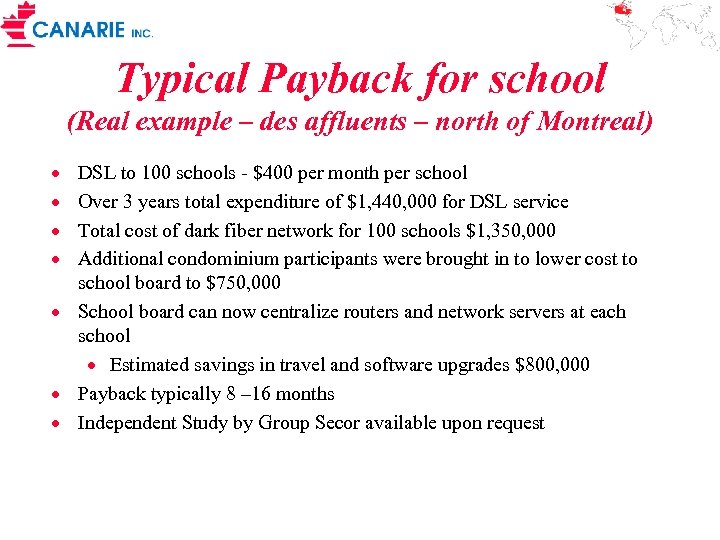 Typical Payback for school (Real example – des affluents – north of Montreal) · · DSL to 100 schools - $400 per month per school Over 3 years total expenditure of $1, 440, 000 for DSL service Total cost of dark fiber network for 100 schools $1, 350, 000 Additional condominium participants were brought in to lower cost to school board to $750, 000 · School board can now centralize routers and network servers at each school · Estimated savings in travel and software upgrades $800, 000 · Payback typically 8 – 16 months · Independent Study by Group Secor available upon request
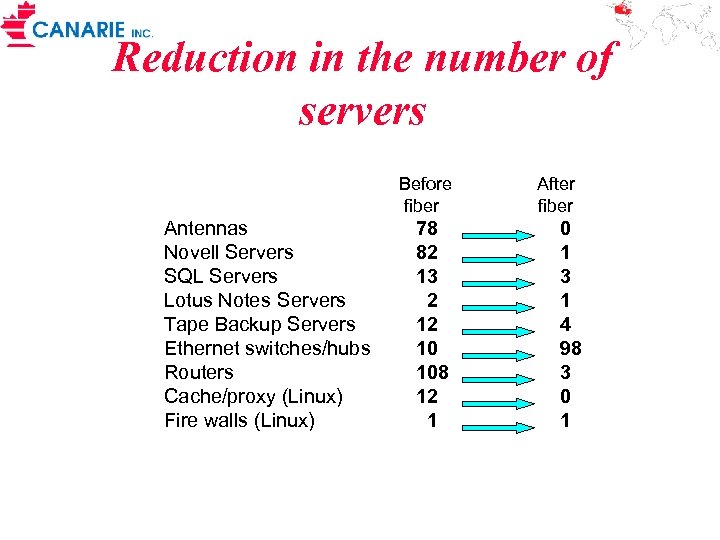 Reduction in the number of servers Before fiber Antennas Novell Servers SQL Servers Lotus Notes Servers Tape Backup Servers Ethernet switches/hubs Routers Cache/proxy (Linux) Fire walls (Linux) 78 82 13 2 12 10 108 12 1 After fiber 0 1 3 1 4 98 3 0 1
 The biggest challenge of all… To foster and accelerate broadband Internet to the home
 The basic assumptions · The good, the bad and the ugly. . · Monopolies are bad · Duopolies are ugly · Facilities based competition is good · The private sector, in an open competitive market, is far more effective at responding to consumer’s needs and introducing new services at lower prices than any kind of government regulation · Facilities based competition is alive and well in downtown core · How do we accelerate facilities based competition into residential market · As well how can we assure scalable high speed Internet services to the home that eventually will support Gigabit speeds or higher?
 Critical role for universities · Community dark fiber networks increases facilities based competition, levels the playing field and provides greater choice to the consumer · Universities can play critical role in organizing municipal condominium fiber builds in their community and serve as the “anchor tenant” · Universities can also encourage building carrier neutral collocation facilities · In downtown cores will likely be done by private sector · In suburbs will probably have to be public facility like school board office, university, etc · Universities are also seen as critical anchor tenants for carrier hotels e. g. Halifax, BC @home
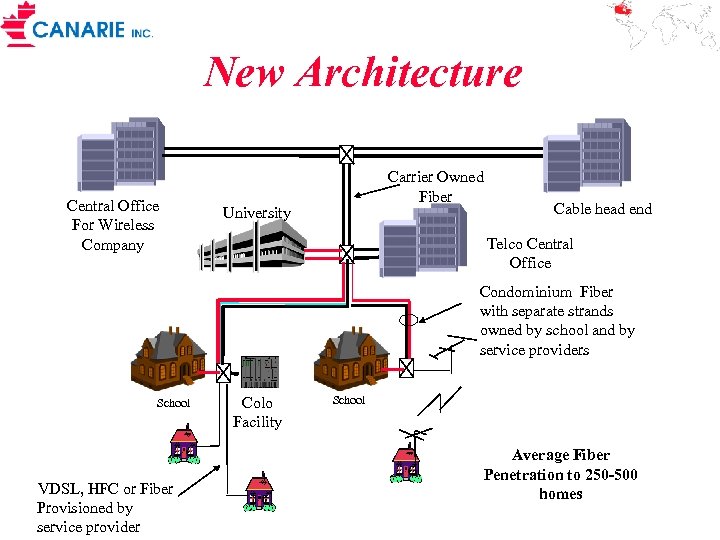 New Architecture Central Office For Wireless Company Carrier Owned Fiber University Cable head end Telco Central Office Condominium Fiber with separate strands owned by school and by service providers School VDSL, HFC or Fiber Provisioned by service provider Colo Facility School Average Fiber Penetration to 250 -500 homes
 Benefits to Industry · For cablecos and telcos it help them accelerate the deployment of high speed internet services into the community · Currently deployment of DSL and cable modem deployment is hampered by high cost of deploying fiber into the neighbourhoods · Cable companies need fiber to every 250 homes for cable modem service, but currently only have fiber on average to every 5000 homes · Telephone companies need to get fiber to every 250 homes to support VDSL or FSAN technologies · Wireless companies need to get fiber to every 250 homes for new high bandwidth wireless services and mobile Internet · It will provide opportunities for small innovative service providers to offer service to public institutions as well as homes · For e-commerce and web hosting companies it will generate new business in out sourcing and web hosting
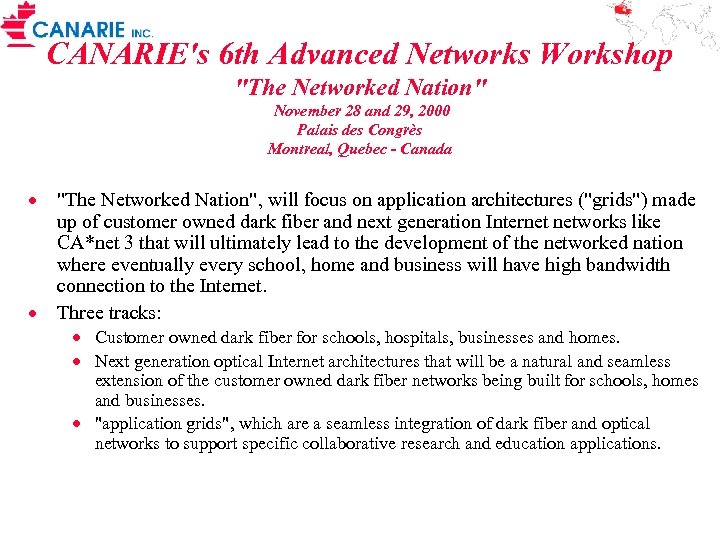 CANARIE's 6 th Advanced Networks Workshop "The Networked Nation" November 28 and 29, 2000 Palais des Congrès Montreal, Quebec - Canada · "The Networked Nation", will focus on application architectures ("grids") made up of customer owned dark fiber and next generation Internet networks like CA*net 3 that will ultimately lead to the development of the networked nation where eventually every school, home and business will have high bandwidth connection to the Internet. · Three tracks: · Customer owned dark fiber for schools, hospitals, businesses and homes. · Next generation optical Internet architectures that will be a natural and seamless extension of the customer owned dark fiber networks being built for schools, homes and businesses. · "application grids", which are a seamless integration of dark fiber and optical networks to support specific collaborative research and education applications.