 Скачать презентацию CANARIE Building Condominium Fiber Networks For High Speed
c763a1dc9ef3d1a3f44061e90d057d97.ppt
- Количество слайдов: 34



CANARIE “Building Condominium Fiber Networks For High Speed Internet Access” http: //www. canarie. ca http: //www. canet 3. net Bill. St. Arnaud@canarie. ca Tel: +1. 613. 785. 0426
Outline · Overview and introductions · Canada’s community fiber programs – Bill St Arnaud · Stockholm’s Stokab – Anders Comstedt · Sweden’s ICT programs - Anne-Marie Eklund-Lowinder
Tutorial Objectives · To provide real world case studies on community and municipal fiber networks · To provide information sources and pointers to organizations that will provide assistance and/or funding
Issues facing municipalities · Many carriers want to deploy fiber networks · Each carrier will deploy many conduits and or fiber and yet only use a small percentage · Municipalities need to coordinate fiber builds so as to minimize tearing up of road and/or obstruction of traffic · Once a fiber build is done many municipalities insist on a 5 year freeze on any future digging up of road · Gives unfair market advantage to carriers who got in under the wire or have existing infrastructure · In fact this is strategic part of many carrier’s business plan · Carriers want to go for low hanging fruit in downtown cores · Little interest in serving low profit residential neighbourhoods · Outside of the downtown core unlikely to have many competitive fiber builds
Historical Reference Points · There is a clear trend in all formerly monopoly services to move to unbundled competitive services · Roads and highway systems vs railways: infrastructure was largely “public”, but the services (e. g. trucking) were private and competitive · Electrical distribution systems: regulated monopolies (unbundling is on horizon) · Gas distribution systems: regulated monopolies (unbundling is well underway) · Legacy telecommunications systems: moving to unbundled fiber and facilities based competition
Government intervention? · As much as possible governments should have minimum intrusion into the marketplace. · However, sometimes government intrusion in the marketplace will produce significantly greater benefits to the economy and society otherwise "to do nothing would be to do harm“ · E. g. bridges displace competitive ferry service operations · Free trade disrupted business plans of many private sector companies · Opening up of long distance disrupted business plans of incumbent telcos · Private sector competition in a genuine competitive open market is generally viewed as a good thing. · Monopolies are bad · Duopolies are ugly · Therefore should governments intrude into the marketplace to actively promote facilities based competition? · There is no question such a disruption will impact existing business models and investment plans. · But will the overall benefit be significantly better for the municipality?
What is condominium fiber? · A number of organizations such as schools, hospitals, businesses and universities get together to fund and build a fiber network · Carrier partners are also invited to be part of condominium project · Several next generation carriers and fiber brokers are now arranging condominium fiber builds · IMS, Quebec. Tel, Videotron, Cogeco, Dixon Cable, GT Telecom, etc · Fiber is installed, owned and maintained by 3 rd party professional fiber contractors – usually the same contractors used by the carriers for their fiber builds · Each institution gets its own set of fibers, at cost, on a 20 year IRU (Indefeasible Right of Use) · One time up front cost, plus annual maintenance and right of way cost approx 5% of the capital cost · Institution lights up their own strands with whatever technology they want – Gigabit Ethernet, ATM, PBX, etc · New long range laser will reach 120 km · Ideal solution for point to point links for large fixed institutions · Payback is usually less than 18 months
Market Drivers · First - low cost · Up to 1000% reduction over current telecom prices. 6 -12 month payback · Second - LAN invades the WAN – no complex SONET or ATM required in network · Network Restoral & Protection can be done by customer using a variety of techniques such as wireless backup, or relocating servers to a multi-homed site, etc · Third - Enables new applications and services not possible with traditional telecom service providers · · Relocation of servers and extending LAN to central site Out sourcing LAN and web servers to a 3 rd party because no performance impact IP telephony in the wide area (Spokane) HDTV video · Fourth – Allows access to new competitive low cost telecom and IT companies at carrier neutral meet me points · Much easier to out source servers, e-commerce etc to a 3 rd party at a carrier neutral collocation facility
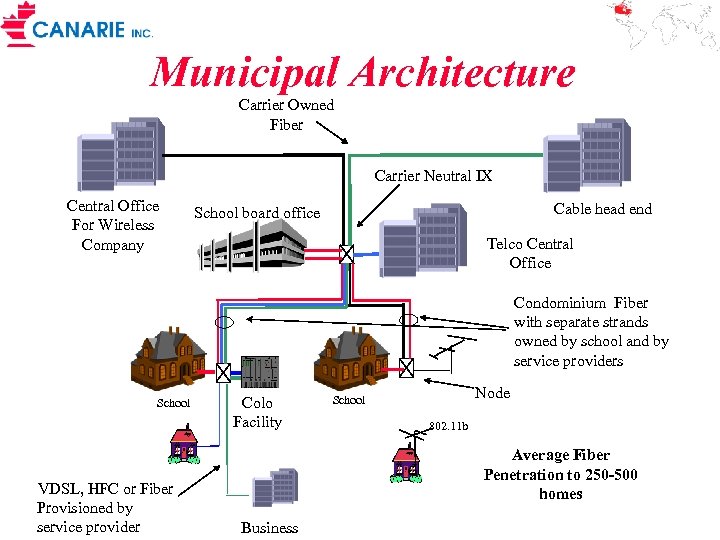
Municipal Architecture Carrier Owned Fiber Carrier Neutral IX Central Office For Wireless Company Cable head end School board office Telco Central Office Condominium Fiber with separate strands owned by school and by service providers School VDSL, HFC or Fiber Provisioned by service provider Colo Facility Node School 802. 11 b Average Fiber Penetration to 250 -500 homes Business
Advantages · Municipality saves significantly on current telecom costs · Chicago sees immediate 20% reduction · Other cities seen 50%- 75% · Makes the municipality “ 21 st century” ready · Attracts new businesses in multimedia, services, etc · Reduces cost for deploying fiber into neighbourhoods for carriers · Lowers barriers of entry for new carriers and creates competitive open environment
Benefits to Industry · For cablecos and telcos it help them accelerate the deployment of high speed internet services into the community · Currently deployment of DSL and cable modem deployment is hampered by high cost of deploying fiber into the neighbourhoods · Cable companies need fiber to every 250 homes for cable modem service, but currently only have fiber on average to every 5000 homes · Telephone companies need to get fiber to every 250 homes to support VDSL or FSAN technologies · Wireless companies need to get fiber to every 250 homes for new high bandwidth wireless services and mobile Internet · It will provide opportunities for small innovative service providers to offer service to public institutions as well as homes · For e-commerce and web hosting companies it will generate new business in out sourcing and web hosting
RFP models 1. 2. 3. 4. In normal RFP for telecom services municipality encourages responses from condominium fiber suppliers Municipality issues RFP to private sector for a municipal wide condominium fiber network where contractor commits to selling strands of fiber at an agreed upon price before and after the build. In turn the municipality will direct all municipal telcom business to the winner bidder and provide access to all municipal owned ducts – Chicago Civic. Net model Municipality issues RFP to private sector for a municipal condominium fiber network, but municipality owns all strands of fiber and sells them to end users or competitive carriers as required – Alberta Super. Net model Municipality uses MAA to force fiber installers to build condominium fiber networks
Negotiating issues · · · Offering commodity Internet bandwidth business as a carrot. Trading municipal right-of-way for condominium fiber Leverage the tax benefits for fiber builder of selling dark fiber vs leasing. Capitalize the telecom budget by moving monthly telecom budget into capital Deal with fiber builders rather than carriers. · Most fiber builders are construction companies who make their money on the construction contract. · Offer upfront financing deals. · Some fiber builders are willing to do deals where community may pay 50%- 95% of the fiber build costs. The fiber builder does an overbuild and as the additional strands are sold to businesses or other carriers, a percentage of the profits are returned to the school. · Negotiate umbrella agreements for a large number of public sector institutions across a region. · The institutions contract directly with the carrier or fiber builder, but the terms and conditions are set in contract negotiations with the umbrella organization that represents the collective interests of the institutions.
Alberta SUPERnet • Province wide network of condominium fiber to 420 communities in Alberta • Guaranteed cost of bandwidth to all public sector institutions • $500/mo for 10 Mbps, $700/mo for 100 Mbps • Network a mix of fibre builds and existing supplier infrastructure (swap/buy/lease) • Condominium approach: All suppliers can • Buy (or swap) a share of the fibre (during build or after) • Lease bandwidth at competitive rates • GOA has perpetual right to use (IRU) • Ownership will be held at arms length • GOA/stakeholder rates are costs to run divided over users • Because of fibre capacity, bandwidth can be made available to businesses at urban competitive rate • Total cost $193 m • Bell Intrigna prime contractor
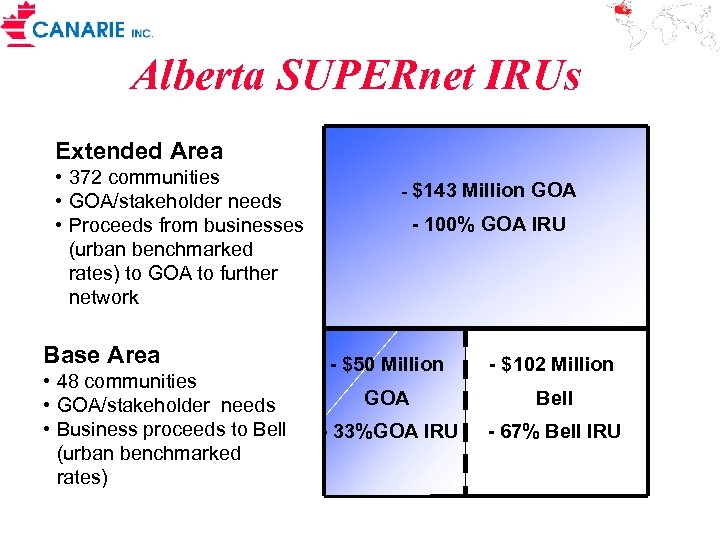
Alberta SUPERnet IRUs Extended Area • 372 communities • GOA/stakeholder needs • Proceeds from businesses (urban benchmarked rates) to GOA to further network Base Area • 48 communities • GOA/stakeholder needs • Business proceeds to Bell (urban benchmarked rates) - $143 Million GOA - 100% GOA IRU - $50 Million - $102 Million GOA Bell - 33%GOA IRU - 67% Bell IRU
Alberta SUPERnet Impact RURAL COMMUNITIES Current (Typical) Future (Everywhere) Residences • 56 Kbps dial Internet ($85/Month) Residences • High speed DSL residential Internet at urban rates ($40/month) • No high speed Internet Businesses • Some T 1 Facilities ($2000/Month average - rates distance sensitive) • Some high speed business service on special setup arrangement Businesses • High speed business services available at competitive urban rates (eg $820/month - T 1) • Higher speeds at comparable rates
National Broadband Task Force · Mandate: To map out a strategy and advise the Government on best approaches to make high-speed broadband Internet services available to businesses and residents in all Canadian communities by the year 2004. · To ensure Canada’s competitiveness in a global economy · To address the Digital Divide · To create opportunities for all Canadians · 35 members including carriers, educators, librarians, communities, equipment manufacturers, etc · Chair – David Johnston · www. broadband. ic. gc. ca
Chicago Civic. Net • Civic. Net - A City-Wide Condominium Fiber Project • connecting up 1600 public sector institutions • Oriented to Development of Backbone Infrastructure • With Gateways to Tributary Systems • More Fiber in More Places Faster • Ubiquitous, Pervasive: 1, 600 Locations • E-Z High-Performance Low-Cost Internet Connectivity • Foundation = Existing City Fiber Builds
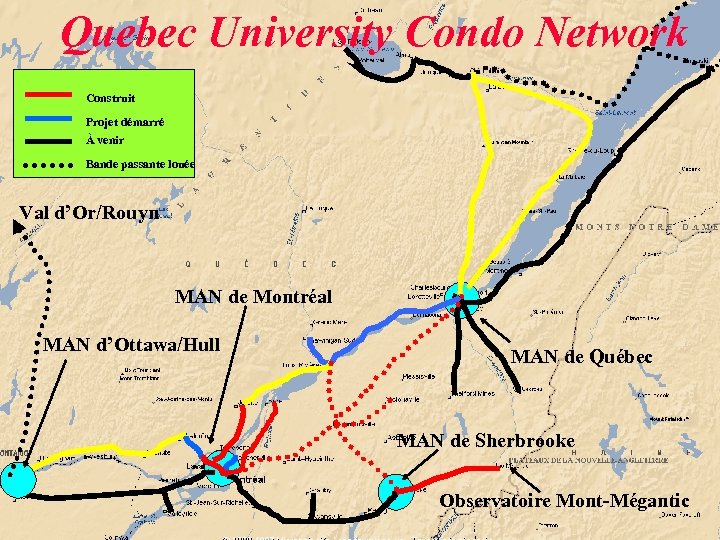
Quebec University Condo Network Construit Projet démarré À venir Bande passante louée Val d’Or/Rouyn MAN de Montréal MAN d’Ottawa/Hull MAN de Québec MAN de Sherbrooke Observatoire Mont-Mégantic
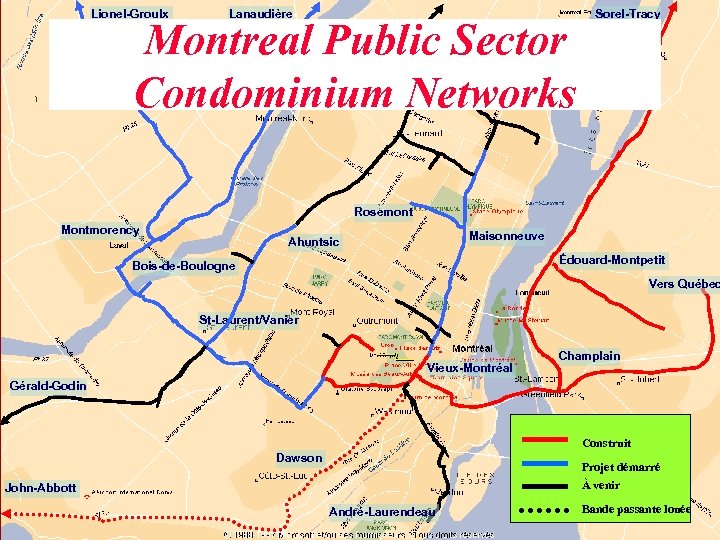
Lionel-Groulx Lanaudière Montreal Public Sector Condominium Networks Sorel-Tracy Marie-Victorin Rosemont Montmorency Maisonneuve Ahuntsic Édouard-Montpetit Bois-de-Boulogne Vers Québec St-Laurent/Vanier Vieux-Montréal Champlain Gérald-Godin Construit Dawson Projet démarré À venir John-Abbott André-Laurendeau Bande passante louée
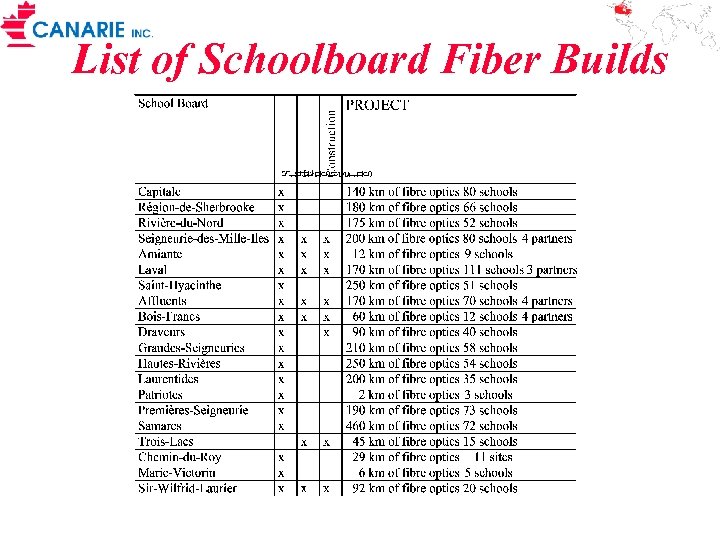
List of Schoolboard Fiber Builds
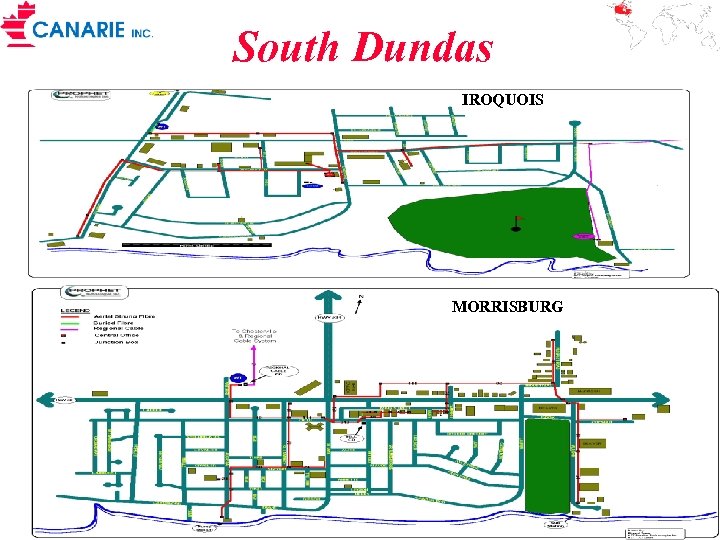
South Dundas IROQUOIS MORRISBURG
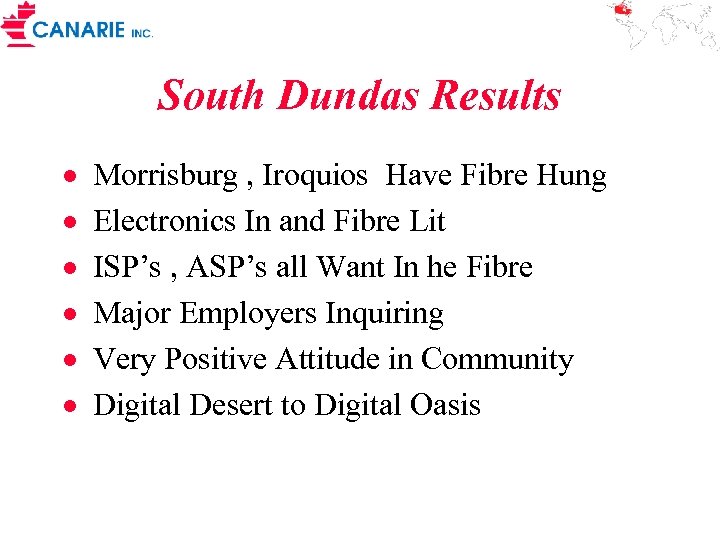
South Dundas Results · · · Morrisburg , Iroquios Have Fibre Hung Electronics In and Fibre Lit ISP’s , ASP’s all Want In he Fibre Major Employers Inquiring Very Positive Attitude in Community Digital Desert to Digital Oasis
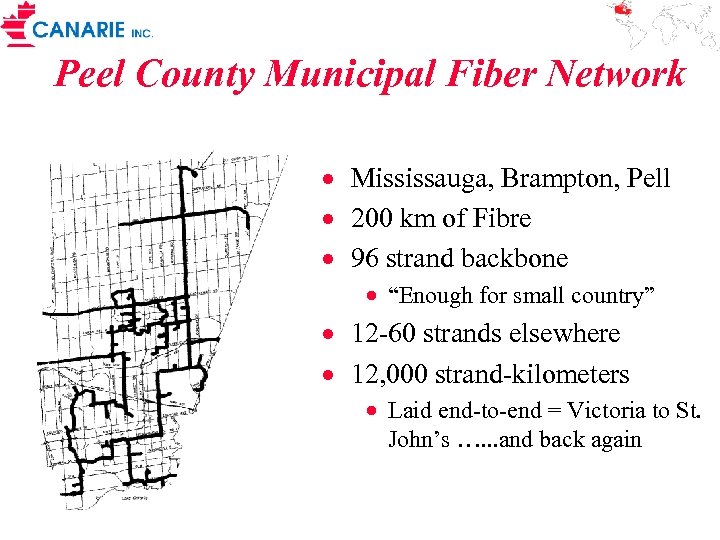
Peel County Municipal Fiber Network · Mississauga, Brampton, Pell · 200 km of Fibre · 96 strand backbone · “Enough for small country” · 12 -60 strands elsewhere · 12, 000 strand-kilometers · Laid end-to-end = Victoria to St. John’s …. . . and back again
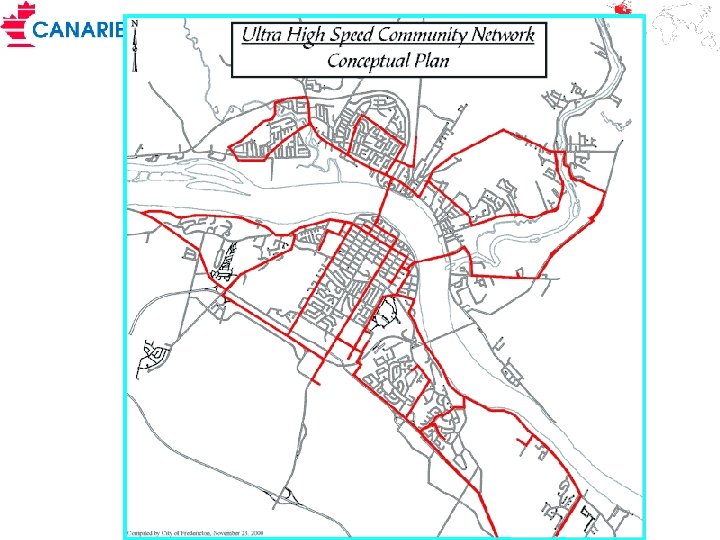
Fredericton Fiber Build · Started as Economic Development tool · MUSH, Govt. , Research - ISP, carriers invited to participate · Build partners emerged quickly, $50, 000 “donated” by three firms · Contracting now for 8 km phase 1, $110, 000, complete Sept 2001 · 48 fiber min.
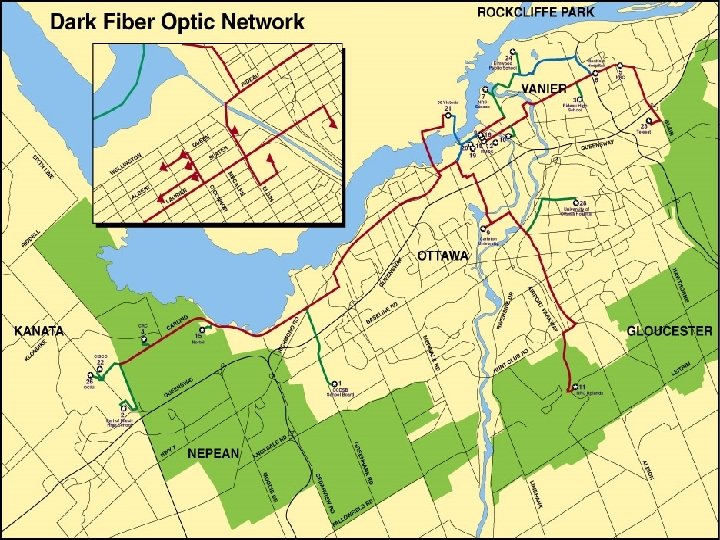
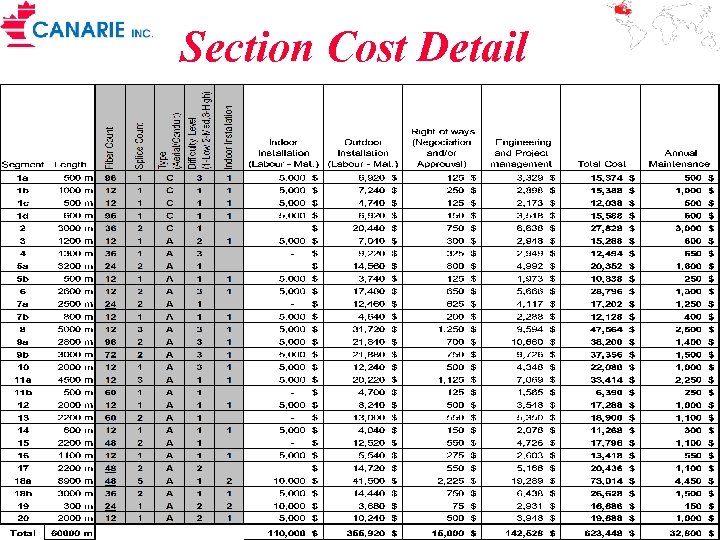
Ottawa Fiber Condominium · Consortium consists of 16 members from various sectors including businesses, hospitals, schools, universities, research institutes · 26 sites · Point-to-point topology · 144 fibre pairs · Route diversity requirement for one member · 85 km run · $11 k - $50 K per site · Total project cost $CDN 1. 25 million · Cost per strand less than $. 50 per strand per meter · 80% aerial · Due to overwhelming response to first build – planning for second build under way
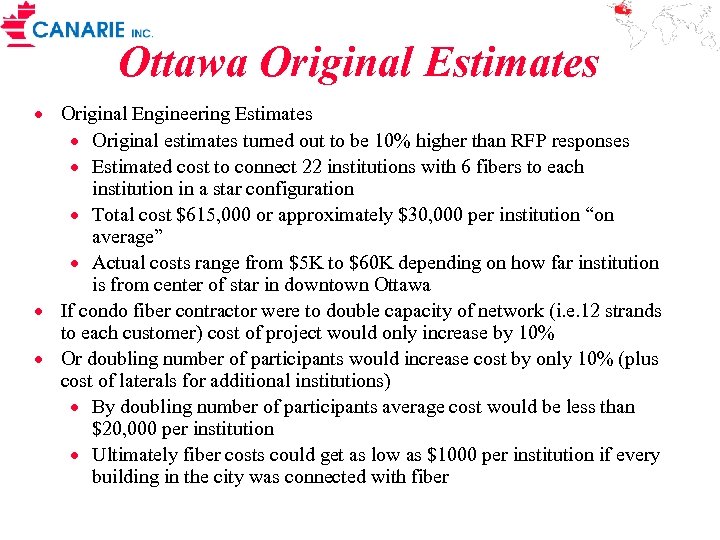
Ottawa Original Estimates · Original Engineering Estimates · Original estimates turned out to be 10% higher than RFP responses · Estimated cost to connect 22 institutions with 6 fibers to each institution in a star configuration · Total cost $615, 000 or approximately $30, 000 per institution “on average” · Actual costs range from $5 K to $60 K depending on how far institution is from center of star in downtown Ottawa · If condo fiber contractor were to double capacity of network (i. e. 12 strands to each customer) cost of project would only increase by 10% · Or doubling number of participants would increase cost by only 10% (plus cost of laterals for additional institutions) · By doubling number of participants average cost would be less than $20, 000 per institution · Ultimately fiber costs could get as low as $1000 per institution if every building in the city was connected with fiber
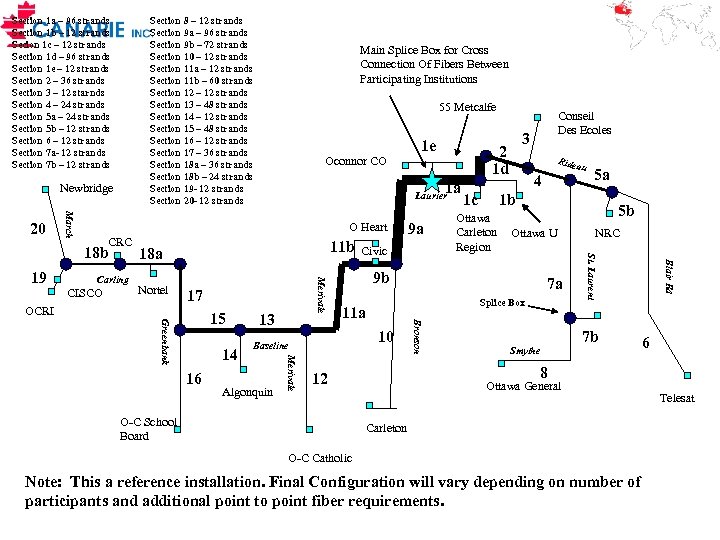
Section 1 a – 96 strands Section 1 b – 12 strands Secion 1 c – 12 strands Section 1 d – 96 strands Section 1 e – 12 strands Section 2 – 36 strands Section 3 – 12 starnds Section 4 – 24 strands Section 5 a – 24 strands Section 5 b – 12 strands Section 6 – 12 strands Section 7 a- 12 strands Section 7 b – 12 strands Section 8 – 12 strands Section 9 a – 96 strands Section 9 b – 72 strands Section 10 – 12 strands Section 11 a – 12 strands Section 11 b – 60 strands Section 12 – 12 strands Section 13 – 48 strands Section 14 – 12 strands Section 15 – 48 strands Section 16 – 12 strands Section 17 – 36 strands Section 18 a – 36 strands Section 18 b – 24 strands Section 19 - 12 strands Section 20 - 12 strands Newbridge March 20 55 Metcalfe Oconnor CO CRC Nortel OCRI 17 16 10 Ottawa Carleton Region 5 b Ottawa U 7 a Smythe NRC 7 b 6 8 12 O-C School Board 5 a 1 b Splice Box 11 a Baseline Algonquin 4 9 b Bronson 14 13 Merivale Greenbank 15 Civic u Blair Rd 18 a Ridea St. Laurent CISCO 11 b 9 a 1 c Conseil Des Ecoles 3 2 1 d 1 a Merivale Carling 1 e Laurier O Heart 18 b 19 Main Splice Box for Cross Connection Of Fibers Between Participating Institutions Ottawa General Carleton O-C Catholic Note: This a reference installation. Final Configuration will vary depending on number of participants and additional point to point fiber requirements. Telesat
Section Cost Detail
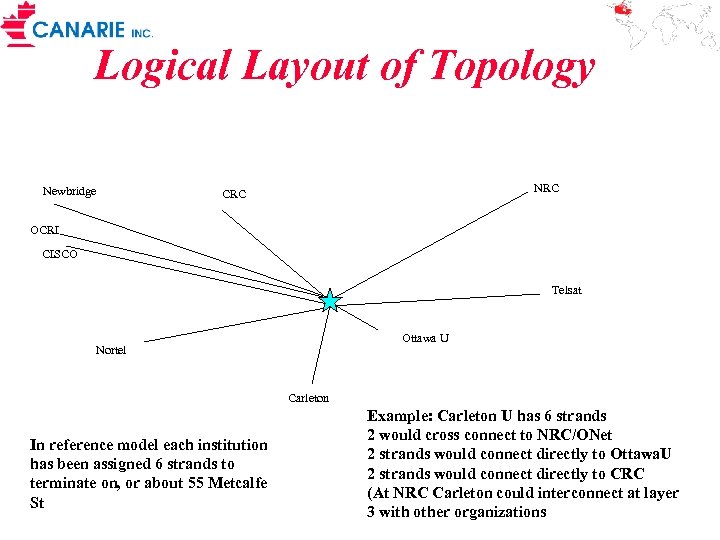
Logical Layout of Topology Newbridge NRC CRC OCRI CISCO Telsat Ottawa U Nortel Carleton In reference model each institution has been assigned 6 strands to terminate on, or about 55 Metcalfe St Example: Carleton U has 6 strands 2 would cross connect to NRC/ONet 2 strands would connect directly to Ottawa. U 2 strands would connect directly to CRC (At NRC Carleton could interconnect at layer 3 with other organizations
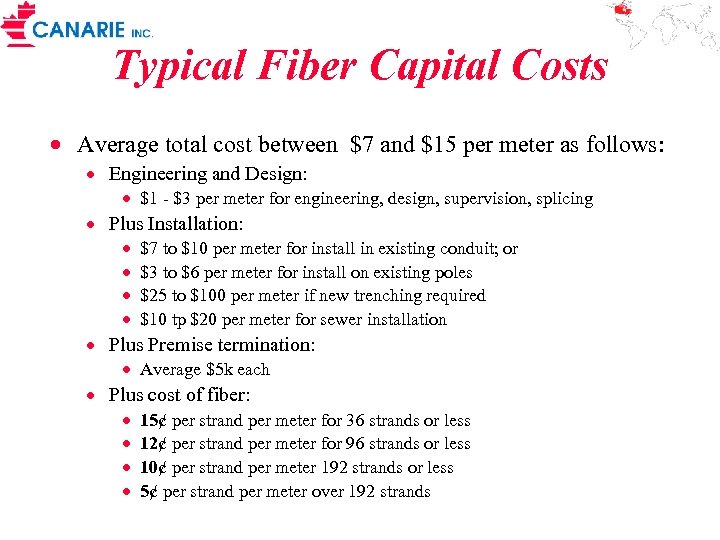
Typical Fiber Capital Costs · Average total cost between $7 and $15 per meter as follows: · Engineering and Design: · $1 - $3 per meter for engineering, design, supervision, splicing · Plus Installation: · · $7 to $10 per meter for install in existing conduit; or $3 to $6 per meter for install on existing poles $25 to $100 per meter if new trenching required $10 tp $20 per meter for sewer installation · Plus Premise termination: · Average $5 k each · Plus cost of fiber: · · 15¢ per strand per meter for 36 strands or less 12¢ per strand per meter for 96 strands or less 10¢ per strand per meter 192 strands or less 5¢ per strand per meter over 192 strands
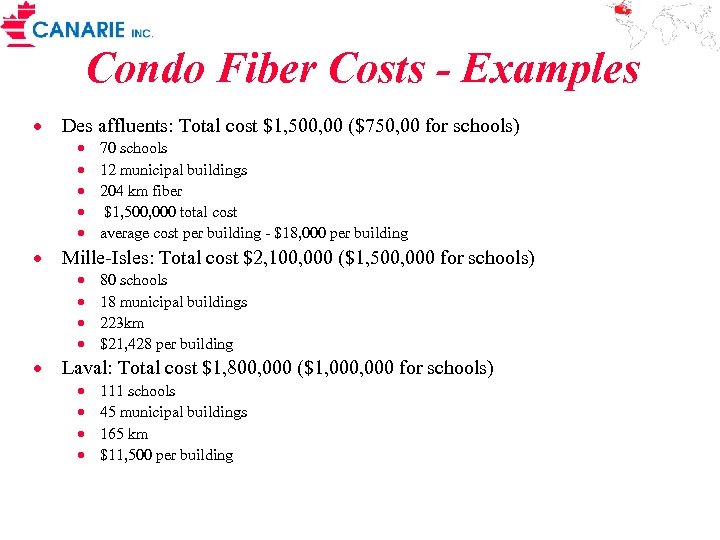
Condo Fiber Costs - Examples · Des affluents: Total cost $1, 500, 00 ($750, 00 for schools) · · · 70 schools 12 municipal buildings 204 km fiber $1, 500, 000 total cost average cost per building - $18, 000 per building · Mille-Isles: Total cost $2, 100, 000 ($1, 500, 000 for schools) · · 80 schools 18 municipal buildings 223 km $21, 428 per building · Laval: Total cost $1, 800, 000 ($1, 000 for schools) · · 111 schools 45 municipal buildings 165 km $11, 500 per building
Скачать презентацию CANARIE Building Condominium Fiber Networks For High Speed
c763a1dc9ef3d1a3f44061e90d057d97.ppt